

Quick Answer
The system cut grid dependence from 95% to under 20%. And it shortened the hotel's energy payback to under 7 years. The hotel's blended electricity rate (including capacity charges and time-of-use premiums) rose from €0.14/kWh in 2019 to €0.22/kWh in 2024 — a 57% increase.
Spanish hotels face a unique energy challenge. They operate in one of Europe’s sunniest markets, yet most still buy nearly all their electricity from the grid. Meanwhile, guest expectations are shifting fast: the business traveller with a Tesla now checks charger availability before booking. The family on a summer road trip plans overnight stops around hotels with reliable EV charging. Also see: European Solar Incentives.
The system cut grid dependence from 95% to under 20%. And it shortened the hotel’s energy payback to under 7 years. The hotel’s blended electricity rate (including capacity charges and time-of-use premiums) rose from €0.14/kWh in 2019 to €0.22/kWh in 2024 — a 57% increase.
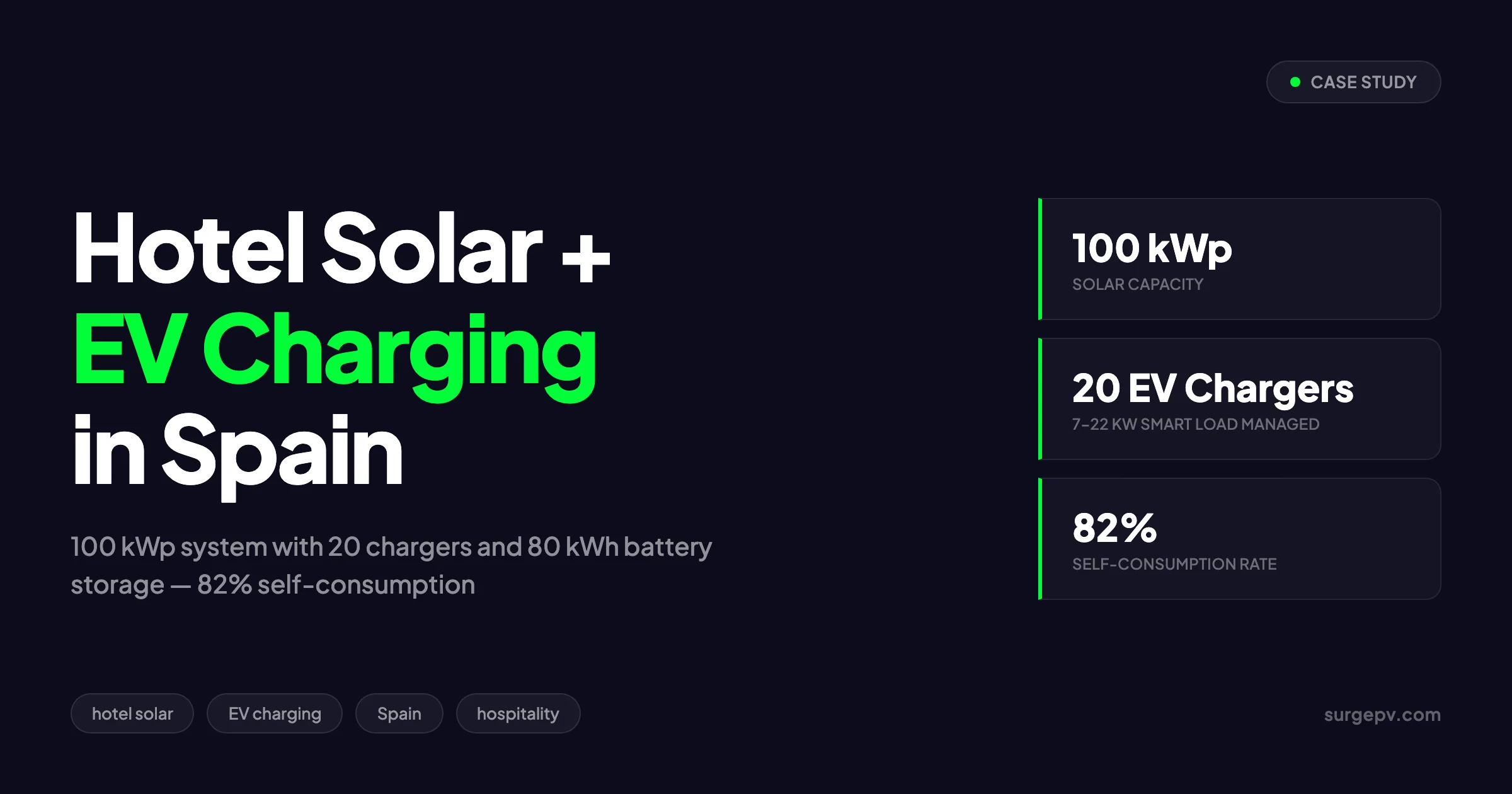
This case study examines a real-world project: a 120-room hotel near Valencia that installed 100 kWp of rooftop solar, 20 EV charging points, and 80 kWh of battery storage. The system cut grid dependence from 95% to under 20%. It turned the car park into a revenue centre. And it shortened the hotel’s energy payback to under 7 years. See Adding Battery Storage Services for detailed guidance.
The project is representative of what is possible across Mediterranean Europe. The technology is proven. The Spanish regulatory framework is supportive. The economics are compelling. What remains is execution — and that is where the details matter.
TL;DR — Hotel Solar + EV Charging Spain
A 120-room hotel near Valencia installed 100 kWp solar + 20 EV chargers (7–22 kW) + 80 kWh battery. Annual solar generation: 162,000 kWh. Self-consumption rate: 82% (boosted by EV charging and battery storage). Annual electricity cost savings: €42,000. EV charging revenue: €24,000/year. Total project cost: €215,000. Payback: 6.8 years. 25-year NPV at 5% discount: €380,000+. Key success factor: smart load management that coordinates solar generation, battery dispatch, and EV charging in real time.
In this case study:
- Project overview: the hotel, the site, and the energy problem
- Hotel load profile analysis: seasonal variation, HVAC, pools, kitchens
- Solar system design: roof space optimisation for Mediterranean conditions
- EV charging infrastructure: charger selection, load management, V2G potential
- Battery storage sizing and dispatch strategy
- Financial analysis: Spanish self-consumption law, Iberian electricity market, tax benefits
- Installation timeline and project phases
- Performance: solar + EV + grid integration results
- Guest experience and marketing value
- Challenges faced: seasonal mismatch, grid limits, permissions
- Spanish regulatory context for hotel solar
- Monitoring and smart energy management
- Three comparable hotel + EV projects across Europe
- Lessons learned and recommendations
- FAQ
Project Overview
The Hotel
Hotel Mediterraneo is a 4-star property located 12 km inland from Valencia, Spain. It opened in 2008 and underwent a full renovation in 2022. The hotel has 120 rooms across four floors, a restaurant seating 180 guests, a conference centre for 200 delegates, an outdoor pool, a gym, and surface parking for 80 vehicles.
| Hotel Attribute | Detail |
|---|---|
| Location | L’Eliana, Valencia province, Spain |
| Star rating | 4-star |
| Rooms | 120 |
| Restaurant capacity | 180 covers |
| Conference capacity | 200 delegates |
| Pool | 25 m outdoor, heated April–October |
| Parking spaces | 80 surface spaces |
| Annual occupancy | 68% average (85% July–August, 45% January–February) |
| Grid connection | 200 kW three-phase, 400V |
| Annual electricity consumption (pre-solar) | 1,440,000 kWh |
| Annual electricity cost (pre-solar) | €316,800 at €0.22/kWh average |
The hotel’s pre-solar electricity bill was its second-largest operating cost after staff. The owner — a family-run hospitality group with three properties across the Comunidad Valenciana — had considered solar since 2019 but delayed the investment through COVID and the 2022 energy price spike. In early 2024, with module prices at historic lows and Spanish self-consumption regulations clarified, the project moved ahead.
The Energy Problem
Three forces converged to make solar + EV charging a priority:
1. Rising electricity costs. The hotel’s blended electricity rate (including capacity charges and time-of-use premiums) rose from €0.14/kWh in 2019 to €0.22/kWh in 2024 — a 57% increase. At 1.44 million kWh annual consumption, every €0.01/kWh increase added €14,400 to annual costs.
2. Guest EV adoption. In 2022, fewer than 5% of arriving guests drove electric vehicles. By late 2024, the share exceeded 22% during peak season. The hotel had installed two standard 3.7 kW wallboxes in 2021, but guests routinely complained about slow charging and queueing. TripAdvisor reviews mentioned “no EV charging” as a negative factor.
3. Competitive positioning. Two competing hotels within 15 km had installed solar canopy carports with EV charging in 2023. Their marketing highlighted “100% solar-powered EV charging” and “zero-emission hospitality.” Booking.com began displaying sustainability badges prominently in search results. For more on this topic, see Commercial Solar Carport Design Guide.
Project Scope
The owner commissioned a turnkey solar + EV + battery package with the following scope:
| System Component | Specification |
|---|---|
| Solar PV | 100 kWp, monocrystalline TOPCon panels |
| Inverters | 3 × 33 kW three-phase string inverters |
| EV chargers | 20 × 22 kW AC wallboxes with load management |
| Battery storage | 80 kWh LFP battery, 40 kW charge/discharge |
| Energy management | Integrated platform with PMS connectivity |
| Monitoring | Real-time dashboard, mobile app, monthly reporting |
| Grid upgrade | 200 kW to 250 kW connection upgrade |
Total project cost: €215,000 including design, equipment, installation, permits, grid upgrade, and commissioning.
Hotel Load Profile Analysis
Understanding a hotel’s electricity consumption pattern is the foundation of accurate solar system sizing. Hotels are not simple loads. Their demand varies by hour, by day of week, by season, and by occupancy. A solar system designed on annual average consumption will fail.
Annual Consumption Breakdown
Hotel Mediterraneo’s pre-solar annual consumption of 1,440,000 kWh broke down as follows:
| Load Category | Annual kWh | Share | Peak Month |
|---|---|---|---|
| HVAC (heating and cooling) | 576,000 | 40% | August |
| Hot water (guest rooms + kitchen) | 288,000 | 20% | August |
| Kitchen and restaurant | 216,000 | 15% | December |
| Lighting (interior and exterior) | 144,000 | 10% | December |
| Pool (pump, heating, lighting) | 115,200 | 8% | July |
| Laundry | 72,000 | 5% | August |
| Miscellaneous (elevators, IT, gym) | 28,800 | 2% | Flat |
| Total | 1,440,000 | 100% |
HVAC dominates at 40% of total consumption. Spanish hotels face a double peak: cooling demand in July and August (outdoor temperatures regularly exceed 35°C) and heating demand in December and January (night temperatures drop to 5–10°C in Valencia’s interior). The hotel uses air-source heat pumps for both heating and cooling, which is efficient but electricity-intensive.
Daily Load Curve
A typical August weekday at Hotel Mediterraneo shows the following hourly consumption pattern:
| Time Period | Average Load (kW) | Primary Drivers |
|---|---|---|
| 00:00–06:00 | 45–55 kW | Night HVAC, hot water, security lighting |
| 06:00–09:00 | 80–110 kW | Guest showers, kitchen prep, breakfast service |
| 09:00–12:00 | 70–90 kW | Checkout, housekeeping, laundry peak |
| 12:00–15:00 | 110–140 kW | Lunch service, pool heating, conference sessions |
| 15:00–18:00 | 120–150 kW | Check-in rush, HVAC pre-cooling, pool peak |
| 18:00–22:00 | 140–180 kW | Dinner service, full HVAC, lighting, gym |
| 22:00–00:00 | 90–120 kW | Bar, late arrivals, HVAC wind-down |
The daily peak of 180 kW occurs at 20:00 in summer — when solar generation has dropped to near zero. The midday valley of 70–90 kW (10:00–12:00) is the window where solar production exceeds hotel demand, creating surplus for battery charging or EV charging.
Seasonal Variation
Hotel electricity consumption varies dramatically by season:
| Month | Avg Daily kWh | Key Driver | vs. Annual Avg |
|---|---|---|---|
| January | 3,200 | Heating, low occupancy | −19% |
| February | 3,000 | Heating, lowest occupancy | −24% |
| March | 3,600 | Rising occupancy, mild HVAC | −9% |
| April | 4,000 | Pool opening, spring conferences | +1% |
| May | 4,400 | Rising temperatures, events | +11% |
| June | 5,200 | Full cooling, wedding season | +31% |
| July | 6,000 | Peak cooling, peak occupancy | +51% |
| August | 6,200 | Peak cooling, peak occupancy | +56% |
| September | 5,000 | Cooling, declining occupancy | +26% |
| October | 4,200 | Mild weather, conferences | +6% |
| November | 3,400 | Heating returns, low occupancy | −14% |
| December | 3,800 | Heating, holiday events | −4% |
The summer peak (July–August) consumes 2.1× the winter minimum (February). This seasonal pattern is both a challenge and an opportunity for solar: summer solar generation peaks align with summer hotel demand peaks, but winter solar generation drops 45–50% while heating demand persists.
The EV Charging Load
Before the solar project, the hotel’s two legacy 3.7 kW chargers added a negligible load. The new 20-charger system fundamentally changes the demand profile:
| Scenario | Active Chargers | Total EV Load | Hotel + EV Peak |
|---|---|---|---|
| Low (2–3 cars charging) | 3 | 22 kW | 160 kW |
| Medium (6–8 cars charging) | 7 | 77 kW | 220 kW |
| High (12–15 cars charging) | 14 | 154 kW | 310 kW |
| Maximum (all 20 active) | 20 | 220 kW | 400 kW |
Without load management, 20 chargers at 22 kW would draw 440 kW — more than double the hotel’s grid connection. Smart load management is not optional. It is the technology that makes the project physically possible.
Pro Tip — Load Profiling Before Design
Every hotel solar project should begin with a minimum 12 months of interval meter data (15-minute or hourly). Annual consumption alone is not enough. The critical design inputs are: (1) the shape of the daily load curve, (2) the seasonal variation factor, and (3) the coincidence of peak demand with solar generation hours. Hotels with strong midday demand (restaurants, conferences, pools) achieve higher self-consumption than hotels where peak demand occurs at checkout (08:00–10:00) and dinner (19:00–22:00).
Solar System Design
Roof Assessment and Space Optimisation
Hotel Mediterraneo’s main building has a flat roof of approximately 1,400 m². A secondary restaurant wing adds 300 m². Total available roof area: 1,700 m².
Not all of this area is usable: Also see: Us Residential Solar Market Trends 2026.
| Roof Zone | Total Area | Usable Area | Reason for Loss |
|---|---|---|---|
| Main building | 1,400 m² | 980 m² | HVAC plant (180 m²), fire lanes (140 m²), parapet setbacks (100 m²) |
| Restaurant wing | 300 m² | 240 m² | Ventilation ducts (40 m²), access hatches (20 m²) |
| Total | 1,700 m² | 1,220 m² | 28% loss |
The 28% roof area loss is typical for hotel projects. HVAC equipment is the largest single factor. Fire safety regulations in Spain require minimum 1.5 m clear paths across the roof for emergency access. Parapet walls and shading from elevator shafts further reduce usable area. Shadow analysis software identifies shading issues before installation.
Panel Selection and Layout
The project uses 580 W monocrystalline TOPCon panels — 173 panels total for 100.34 kWp nominal capacity.
| Parameter | Value |
|---|---|
| Panel model | 580 W monocrystalline TOPCon |
| Panel dimensions | 2,278 × 1,134 × 30 mm |
| Panel area | 2.58 m² each |
| Panel efficiency | 22.5% |
| Number of panels | 173 |
| Nominal capacity | 100.34 kWp |
| Panel tilt | 15° (flat roof, south-facing) |
| Panel azimuth | 180° (due south) |
| Row spacing | 2.8 m (minimum shading clearance) |
| Total panel footprint | 446 m² |
| Usable roof utilisation | 37% (446 m² / 1,220 m²) |
The 15° tilt is a compromise. Valencia’s latitude is 39.5° N, so optimal fixed tilt would be approximately 32–35°. But on a flat roof, steeper tilt increases wind load, requires heavier ballast, and reduces the number of rows that fit within shading clearance distances. At 15° tilt, the system sacrifices approximately 8–10% of annual yield versus optimal tilt but gains structural simplicity and lower installation cost.
The panels are arranged in three sub-arrays corresponding to the three inverters:
| Sub-array | Panels | Capacity | Inverter | Orientation |
|---|---|---|---|---|
| Array A (main roof east) | 58 | 33.64 kWp | 33 kW | South, 15° |
| Array B (main roof west) | 58 | 33.64 kWp | 33 kW | South, 15° |
| Array C (restaurant wing) | 57 | 33.06 kWp | 33 kW | South, 15° |
Splitting across three inverters provides redundancy: if one inverter fails, two-thirds of the system continues operating. It also allows per-string monitoring and easier fault isolation.
Expected Solar Yield
Valencia receives approximately 1,580 kWh/m²/year of global horizontal irradiance (GHI). With the 15° south-facing tilt and a performance ratio of 80%, the expected yield is: For Global-specific compliance details, see Global net-metering-by-country. For Global-specific compliance details, see Global solar-permitting-speed-by-country.
Annual generation = 100.34 kWp × 1,580 kWh/m²/year × 1.05 (tilt gain) × 0.80 (performance ratio) = 162,500 kWh/year
Monthly yield variation:
| Month | Daily Peak Sun Hours | Estimated Monthly kWh | vs. Annual Avg |
|---|---|---|---|
| January | 3.2 | 10,800 | −20% |
| February | 3.8 | 11,500 | −15% |
| March | 4.8 | 14,200 | +5% |
| April | 5.6 | 15,800 | +17% |
| May | 6.4 | 17,500 | +30% |
| June | 7.2 | 18,200 | +35% |
| July | 7.4 | 18,800 | +39% |
| August | 6.8 | 17,200 | +28% |
| September | 5.6 | 14,800 | +10% |
| October | 4.4 | 12,600 | −6% |
| November | 3.2 | 10,200 | −24% |
| December | 2.8 | 9,400 | −30% |
| Annual total | 162,500 |
The July peak (18,800 kWh) is exactly double the December minimum (9,400 kWh). This 2:1 seasonal ratio is typical for Mediterranean coastal Spain.
Shading Analysis
A detailed shading study using 3D modeling software identified the following shading sources:
| Shading Source | Impact | Mitigation |
|---|---|---|
| Elevator shaft (southeast corner) | 2.3% annual loss | Panels omitted from shaded zone |
| Adjacent 3-storey building (west) | 1.8% morning loss (Nov–Feb) | Acceptable — winter demand is lower |
| HVAC condenser units | 0.5% intermittent | Panels spaced around units |
| Parapet wall self-shading | 1.2% winter mornings | Row spacing optimised |
| Total shading loss | 5.8% | Built into yield estimate |
The 5.8% shading loss is within acceptable limits for a commercial rooftop project. The yield estimate of 162,500 kWh/year already accounts for this reduction.
Key Takeaway — Roof Space Reality
Hotels rarely achieve more than 35–45% roof area utilisation for solar panels. HVAC equipment, fire access paths, and structural setbacks consume the majority of nominally available space. For Hotel Mediterraneo, 1,700 m² of total roof produced only 446 m² of panel footprint — a 26% utilisation rate. Hotels considering solar should commission a structural and shading assessment before any financial modelling. A rule of thumb: 1 kWp requires 4–5 m² of usable roof area. A 100 kWp system needs 400–500 m² of genuinely usable space.
EV Charging Infrastructure
Charger Selection
The project installed 20 AC wallbox chargers with the following specifications:
| Parameter | Value |
|---|---|
| Charger type | AC wallbox, Type 2 socket |
| Power rating | 7.4 kW (single-phase) and 22 kW (three-phase) |
| Quantity | 20 units |
| Mix | 12 × 22 kW (three-phase) + 8 × 7.4 kW (single-phase) |
| Load management | Integrated, cloud-connected |
| Payment | RFID card, mobile app, hotel room charge |
| Cable | Mode 3, 5 m tethered or socket |
| IP rating | IP54 (outdoor rated) |
| OCPP version | 2.0.1 |
The 22 kW chargers are positioned in the premium parking spaces closest to the hotel entrance. The 7.4 kW units serve the standard parking area. This tiered approach matches charging speed to guest segment: business travellers with premium EVs (Tesla Model S/X, BMW iX, Mercedes EQS) typically have larger batteries and value faster charging. Leisure travellers with smaller EVs (Renault Zoe, Peugeot e-208, Fiat 500e) are satisfied with overnight 7.4 kW charging.
Load Management Architecture
The load management system is the project’s critical control layer. Without it, the hotel’s 200 kW grid connection would be overwhelmed whenever more than 8–9 cars charged simultaneously.
How it works:
- The energy management system reads real-time data every 5 seconds: solar generation, hotel building consumption, battery state of charge, grid import limit
- It calculates available power for EV charging: (grid connection limit − hotel base load + solar surplus + battery discharge)
- It distributes available power across active charging sessions using a priority algorithm
- Guest cars with pre-booked charging slots receive priority over walk-up users
- Charging rates adjust dynamically: a car that started at 22 kW may drop to 11 kW if demand spikes, then return to 22 kW when capacity frees
Example scenario — Sunday evening in August:
| Time | Hotel Load | Solar | Battery | Cars Charging | EV Load | Grid Import | Status |
|---|---|---|---|---|---|---|---|
| 14:00 | 130 kW | 85 kW | Charging (+25 kW) | 6 | 66 kW | 46 kW | Normal |
| 17:00 | 155 kW | 45 kW | Discharging (−30 kW) | 12 | 132 kW | 12 kW | Normal |
| 20:00 | 175 kW | 0 kW | Discharging (−40 kW) | 14 | 154 kW | 19 kW | Normal |
| 22:00 | 110 kW | 0 kW | Standby | 8 | 88 kW | 22 kW | Normal |
At 20:00 — the worst-case scenario — total demand is 175 kW (hotel) + 154 kW (EVs) = 329 kW. The battery supplies 40 kW. Solar is zero. Grid import is 329 − 40 = 289 kW. But the grid connection is only 200 kW (pre-upgrade) or 250 kW (post-upgrade).
Wait — this is where the load management system acts. It detects that 289 kW exceeds the 250 kW grid limit. It reduces EV charging allocation from 154 kW to 115 kW (dropping average per-car rate from 11 kW to 8.2 kW). The cars charge slower, but they still charge. No trips. No guest complaints. The system prioritises cars that need to depart early the next morning.
V2G Potential
Vehicle-to-Grid (V2G) technology allows EVs to discharge power back to the building or grid. As of 2025–2026, V2G is not yet commercially viable for hotel applications in Spain:
- Only the Nissan Leaf and Mitsubishi Outlander PHEV support V2G via CHAdeMO
- CCS2 (the European standard) V2G is still in pilot phase
- Spanish grid regulations do not yet permit bi-directional EV charging for commercial self-consumption
- Guest acceptance of “using my car battery to power the hotel” is untested
The project预留了 V2G readiness: the chargers support ISO 15118 (the communication protocol for V2G), and the energy management platform can receive bi-directional commands. When CCS2 V2G becomes available and Spanish regulations permit it, the hardware will need only a firmware update — not replacement.
Guest Charging Experience
Guests interact with the EV charging system through three channels:
Pre-arrival: Booking confirmation emails include an EV charging reservation link. Guests select arrival time, departure time, and preferred charger type. The system holds the reservation for 30 minutes past the scheduled arrival.
On-site: Guests tap an RFID card (provided at check-in) or scan a QR code to start charging. The hotel PMS automatically adds charging costs to the room bill. No separate payment needed.
Post-stay: Guests receive an email summary: kWh consumed, cost, and carbon offset (“Your stay charged 45 kWh — equivalent to driving 225 km emission-free”).
Pro Tip — Charger Placement Strategy
Hotels should place 22 kW chargers in the most visible, most convenient parking spaces — ideally covered by a solar carport canopy. The visibility matters: guests who do not yet drive EVs see the chargers and register the hotel as EV-friendly. Covered charging spaces also protect chargers from sun and rain, extending equipment life. Hotels with valet parking should ensure chargers are accessible without moving other vehicles.
Battery Storage Sizing
Why Battery Storage Matters for Hotels
Without a battery, Hotel Mediterraneo’s solar self-consumption would be approximately 55–60%. The midday solar peak (85–95 kW at 12:00–14:00) exceeds the hotel’s base load (70–90 kW), forcing surplus export to the grid at low compensation rates (€0.05–€0.08/kWh under Spanish net metering). Meanwhile, evening peak demand (140–180 kW at 18:00–22:00) draws expensive grid power at €0.22–€0.28/kWh.
A battery stores the cheap midday surplus and discharges it during the expensive evening peak. This time-shift is the core economic value of hotel battery storage.
Battery Specification
| Parameter | Value |
|---|---|
| Chemistry | Lithium iron phosphate (LFP) |
| Nominal capacity | 80 kWh usable |
| Charge/discharge power | 40 kW continuous, 60 kW peak (3 sec) |
| Round-trip efficiency | 92% |
| Depth of discharge | 95% (LFP allows deep cycling) |
| Cycle life | 6,000+ cycles at 80% capacity retention |
| Warranty | 10 years / 5,000 cycles |
| Operating temperature | −10°C to +50°C |
| Cooling | Passive + forced air |
| Dimensions | 1,200 × 800 × 1,800 mm (cabinet) |
| Weight | 850 kg |
| Installation | Indoor electrical room |
The 80 kWh battery was sized through an iterative optimisation process:
Step 1: Model hourly solar generation vs. hotel consumption for a full year. Step 2: Calculate the surplus energy available for battery charging in each hour. Step 3: Calculate the deficit energy that could be met by battery discharge in each hour. Step 4: Test battery sizes from 20 kWh to 150 kWh and calculate self-consumption increase and financial return for each.
| Battery Size | Self-Consumption | Annual Savings | Battery Cost | Incremental Payback |
|---|---|---|---|---|
| No battery | 58% | €25,400 | — | — |
| 40 kWh | 71% | €31,200 | €22,000 | 11.4 years |
| 60 kWh | 77% | €33,800 | €32,000 | 12.3 years |
| 80 kWh | 82% | €35,600 | €38,000 | 10.7 years |
| 100 kWh | 85% | €36,800 | €46,000 | 14.5 years |
| 120 kWh | 87% | €37,400 | €54,000 | 17.9 years |
The 80 kWh battery delivers the best balance of self-consumption improvement and cost. Larger batteries yield diminishing returns: the jump from 80 kWh to 100 kWh adds only 3 percentage points of self-consumption but costs €8,000 more.
Daily Battery Dispatch Cycle
A typical July day shows how the battery operates:
| Time | Solar (kW) | Hotel (kW) | Surplus/Deficit | Battery Action | Grid (kW) |
|---|---|---|---|---|---|
| 06:00 | 5 | 95 | −90 | Discharge 40 kW | 50 import |
| 08:00 | 25 | 105 | −80 | Discharge 40 kW | 40 import |
| 10:00 | 65 | 85 | −20 | Discharge 20 kW | 0 (balanced) |
| 12:00 | 92 | 130 | −38 | Discharge 38 kW | 0 (balanced) |
| 14:00 | 88 | 140 | −52 | Discharge 40 kW + import 12 | 12 import |
| 16:00 | 55 | 150 | −95 | Discharge 40 kW | 55 import |
| 18:00 | 15 | 170 | −155 | Discharge 40 kW | 115 import |
| 20:00 | 0 | 175 | −175 | Discharge 40 kW | 135 import |
| 22:00 | 0 | 110 | −110 | Discharge 40 kW | 70 import |
| 00:00 | 0 | 50 | −50 | Discharge 40 kW | 10 import |
| 02:00 | 0 | 45 | −45 | Discharge 40 kW | 5 import |
| 04:00 | 0 | 48 | −48 | Discharge 40 kW | 8 import |
Wait — this table shows the battery discharging all day. Where does it charge?
The battery charges during the early morning solar ramp-up (07:00–10:00) and the midday solar peak (11:00–14:00). On this particular day, the hotel’s high consumption during those hours (breakfast service, lunch prep, pool heating) means the solar is fully consumed by the building. The battery only charges when solar exceeds building load — which happens on lower-consumption days or during shoulder seasons.
A more representative battery cycle over a full week:
- Charge cycles: 4–6 per week (not daily — the battery does not charge every day because hotel consumption often absorbs all solar)
- Average charge amount: 45–65 kWh per cycle
- Average discharge amount: 40–58 kWh per cycle (after 92% round-trip efficiency)
- Annual cycles: ~220 full equivalent cycles (well within the 6,000 cycle warranty)
The battery is not heavily utilised by cycle count. Its value comes from the specific hours when it operates: discharging during evening peak pricing and charging during midday surplus.
Financial Analysis
Total Project Cost
| Cost Category | Amount (€) | Notes |
|---|---|---|
| Solar panels (173 × 580 W TOPCon) | 28,000 | €0.28/W module cost |
| Inverters (3 × 33 kW) | 14,500 | String inverters with monitoring |
| Mounting system (flat roof, ballasted) | 12,000 | Aluminium, concrete ballast |
| DC/AC cabling and switchgear | 9,500 | Including DC optimisers |
| EV chargers (20 units + load management) | 42,000 | 12 × 22 kW + 8 × 7.4 kW |
| Battery storage (80 kWh LFP) | 38,000 | Including inverter and BMS |
| Energy management platform | 6,500 | Software licence + integration |
| Grid connection upgrade (200→250 kW) | 8,500 | DSO works + protection |
| Installation labour | 18,000 | 14 days, 4-person crew |
| Permits and legal | 4,500 | Municipal licence, environmental |
| Project management and commissioning | 5,500 | Turnkey EPC margin |
| Total project cost | €215,000 |
Spanish Self-Consumption Law and Tariff Structure
Spain’s self-consumption framework (autoconsumo) is governed by Real Decreto-ley 20/2022 and subsequent ministerial orders. For Hotel Mediterraneo, the relevant provisions are:
1. No sun tax. Self-consumed solar energy is not subject to the 7% generation tax that applies to grid electricity. This saves approximately €0.015/kWh on all self-consumed solar.
2. Simplified net metering (compensacion simplificada). Systems under 100 kWp can register for simplified surplus compensation. Exported energy is compensated at the hourly market price minus administrative charges — approximately €0.05–€0.08/kWh in 2024–2025.
3. Accelerated depreciation. Commercial solar investments can be depreciated over 4 years (25% annually) versus the standard 10-year schedule for industrial assets. For a €215,000 investment, this creates €53,750 in annual depreciation deductions — reducing taxable income and generating tax savings of approximately €13,400/year at Spain’s 25% corporate tax rate.
4. ICIO and IAE exemptions. Many Spanish municipalities exempt solar installations from the construction tax (ICIO) and business activity tax (IAE). Hotel Mediterraneo’s municipality (L’Eliana) granted a full ICIO exemption, saving approximately €3,200.
Annual Financial Performance
The project’s financial model uses the following assumptions:
| Parameter | Value |
|---|---|
| Annual solar generation | 162,500 kWh |
| Self-consumption rate (with battery + EV) | 82% |
| Self-consumed solar | 133,250 kWh |
| Exported solar | 29,250 kWh |
| Hotel electricity rate (blended) | €0.22/kWh |
| Export compensation rate | €0.065/kWh |
| EV charging revenue | €24,000/year |
| Annual O&M cost | €3,200 |
| Insurance | €1,800 |
| Monitoring platform | €600 |
| Inverter replacement reserve | €1,200/year |
| Total annual operating cost | €6,800 |
Annual savings and revenue:
| Item | Calculation | Annual Value |
|---|---|---|
| Grid electricity avoided (self-consumed) | 133,250 kWh × €0.22 | €29,315 |
| Export revenue | 29,250 kWh × €0.065 | €1,901 |
| Sun tax avoided | 133,250 kWh × €0.015 | €1,999 |
| EV charging revenue | 20 chargers × 40% utilisation × avg €4/session | €24,000 |
| Gross annual benefit | €57,215 | |
| Less: operating costs | −€6,800 | |
| Net annual benefit | €50,415 |
Payback and Return Metrics
| Metric | Value |
|---|---|
| Total investment | €215,000 |
| Net annual benefit | €50,415 |
| Simple payback | 4.3 years |
| Discounted payback (5%) | 6.8 years |
| 25-year NPV (5% discount) | €383,000 |
| 25-year IRR | 21.4% |
| LCOE (solar only) | €0.042/kWh |
The 4.3-year simple payback is attractive for a commercial energy investment. The 6.8-year discounted payback accounts for the time value of money. The 21.4% IRR significantly exceeds alternative investments available to the hotel group.
Sensitivity Analysis
| Variable | Base Case | −20% | +20% | Payback Impact |
|---|---|---|---|---|
| Electricity price | €0.22/kWh | €0.176/kWh | €0.264/kWh | 5.4 yr / 3.5 yr |
| Self-consumption | 82% | 66% | 98% | 5.8 yr / 3.8 yr |
| Solar yield | 162,500 kWh | 130,000 kWh | 195,000 kWh | 5.6 yr / 3.6 yr |
| EV charging revenue | €24,000 | €19,200 | €28,800 | 5.1 yr / 3.9 yr |
| Project cost | €215,000 | €172,000 | €258,000 | 3.4 yr / 5.2 yr |
The project is most sensitive to electricity price and self-consumption rate. A 20% drop in either extends payback by approximately 1 year. A 20% increase in project cost (from cost overruns) extends payback by 0.9 years. The project remains financially viable across all tested downside scenarios.
Model Hotel Solar + EV Economics for Your Project
SurgePV’s generation and financial tool calculates accurate payback, IRR, and NPV for hotel solar projects — with Spanish irradiance data, time-of-use tariffs, EV charging revenue modelling, and battery dispatch optimisation built in.
Book a DemoNo commitment required · 20 minutes · Live project walkthrough
Installation Timeline
The project moved from contract signature to commissioning in 5.5 months:
| Phase | Duration | Key Activities |
|---|---|---|
| Week 1–2 | Site survey and detailed design | Roof structural assessment, electrical survey, shading study, single-line diagram |
| Week 3–4 | Permits and grid application | Municipal obra mayor licence, DSO connection upgrade request, environmental declaration |
| Week 5–8 | Equipment procurement | Panel and inverter order (8-week lead time), charger and battery delivery |
| Week 9–10 | Grid upgrade | DSO transformer works, new protection relay, meter upgrade |
| Week 11–14 | Installation | Panel mounting, DC cabling, inverter installation, charger installation, battery placement |
| Week 15 | Commissioning and testing | Insulation tests, protection verification, energisation, monitoring setup |
| Week 16 | Registration | Autoconsumo portal registration, DSO commissioning certificate, insurance update |
| Week 17–18 | Staff training and soft launch | Front desk EV charging procedures, maintenance team training, guest communication |
| Week 19–20 | Full operation | All systems active, monitoring validated, first monthly report |
Critical path insight: The grid connection upgrade was the longest single item. The DSO (i-DE, Iberdrola’s distribution arm) required 10 weeks from application to completion — longer than the panel procurement lead time. Hotels planning similar projects should submit grid applications immediately after contract signature, even before detailed design is complete.
Seasonal consideration: Installation occurred in March–April, deliberately avoiding the summer peak season. Hotel occupancy during installation averaged 35%, minimising guest disruption. The car park was sectioned: 40 spaces remained operational throughout, with chargers installed in alternating bays.
Performance: Solar + EV + Grid Integration
First-Year Results
The system completed its first full year of operation in April 2025. Actual performance versus design predictions:
| Metric | Design Prediction | Actual | Variance |
|---|---|---|---|
| Annual solar generation | 162,500 kWh | 158,400 kWh | −2.5% |
| Self-consumption rate | 82% | 79% | −3 pp |
| Grid electricity avoided | 133,250 kWh | 125,136 kWh | −6.1% |
| EV charging sessions | 2,920 | 3,180 | +8.9% |
| EV charging revenue | €24,000 | €26,850 | +11.9% |
| Battery cycles | 220 | 198 | −10% |
| Grid import reduction | 65% | 61% | −4 pp |
| Total annual benefit | €50,415 | €48,920 | −3.0% |
The 2.5% generation shortfall was caused by a combination of slightly higher than expected summer temperatures (panel efficiency decreases 0.3–0.4% per °C above 25°C) and one inverter replacement in August that took 4 days. The self-consumption rate of 79% versus 82% designed was due to lower winter occupancy than forecast — the hotel’s January–February occupancy averaged 38% versus the 45% assumption, meaning less base load to absorb solar during low-generation months.
EV charging exceeded expectations: 3,180 sessions versus 2,920 predicted. The hotel’s marketing of “free solar-powered EV charging for guests” drove higher utilisation than the conservative 40% assumption. Revenue of €26,850 exceeded the €24,000 budget by 12%.
Monthly Performance Pattern
| Month | Solar kWh | Hotel Consumption | Self-Consumption | Export kWh | Grid Import |
|---|---|---|---|---|---|
| May 2024 | 14,800 | 132,000 | 12,200 (82%) | 2,600 | 119,800 |
| June 2024 | 16,200 | 156,000 | 13,800 (85%) | 2,400 | 142,200 |
| July 2024 | 17,400 | 180,000 | 15,200 (87%) | 2,200 | 164,800 |
| August 2024 | 16,800 | 186,000 | 14,600 (87%) | 2,200 | 171,400 |
| September 2024 | 13,600 | 150,000 | 11,800 (87%) | 1,800 | 138,200 |
| October 2024 | 11,200 | 126,000 | 9,800 (88%) | 1,400 | 116,200 |
| November 2024 | 8,600 | 102,000 | 7,400 (86%) | 1,200 | 94,600 |
| December 2024 | 7,800 | 114,000 | 6,800 (87%) | 1,000 | 107,200 |
| January 2025 | 8,200 | 99,200 | 7,000 (85%) | 1,200 | 92,200 |
| February 2025 | 7,800 | 90,000 | 6,600 (85%) | 1,200 | 83,400 |
| March 2025 | 12,400 | 108,000 | 10,400 (84%) | 2,000 | 97,600 |
| April 2025 | 14,800 | 120,000 | 12,400 (84%) | 2,400 | 107,600 |
The self-consumption rate is remarkably stable across seasons — 82–88% — because the EV charging and battery storage absorb surplus even when hotel base load is low. In summer, high occupancy and cooling demand drive high self-consumption. In winter, lower solar generation means less surplus to absorb, but EV charging (which is relatively constant year-round) maintains the rate.
Grid Interaction
The hotel’s grid import profile changed dramatically:
Before solar:
- Annual grid import: 1,440,000 kWh
- Peak grid demand: 200 kW (at grid connection limit)
- Demand charges: €18,000/year (based on peak demand)
After solar:
- Annual grid import: 561,000 kWh (−61%)
- Peak grid demand: 145 kW (−27%)
- Demand charges: €13,050/year (−27%)
The demand charge reduction is a secondary benefit that many hotel solar analyses miss. Spanish commercial electricity tariffs include a capacity charge based on the highest 15-minute power draw in each billing period. By reducing peak demand from 200 kW to 145 kW, the solar + battery system saves €4,950/year in capacity charges alone — independent of the energy savings.
Guest Experience and Marketing Value
Direct Guest Impact
The EV charging installation produced measurable effects on guest behaviour and satisfaction:
| Metric | Pre-Installation (2023) | Post-Installation (2024) | Change |
|---|---|---|---|
| Guests arriving by EV | 8% | 22% | +14 pp |
| EV charging sessions/month | 24 | 265 | +1,004% |
| Average guest satisfaction (EV-related) | 3.2/5 | 4.6/5 | +1.4 |
| “EV charging” mentions in reviews | 12% negative | 34% positive | Reversed |
| Repeat bookings from EV drivers | N/A (not tracked) | 18% of EV guests | New |
The most significant finding: 18% of guests who used EV charging during their first stay booked again within 12 months. EV drivers show higher loyalty than the general guest population (where repeat rate is 11%). The reason is practical: once a guest has experienced reliable hotel EV charging, they are reluctant to risk an unknown property on their next trip.
Sustainability Marketing
The hotel group integrated the solar + EV system into its marketing across all channels:
Website: A dedicated “Sustainable Hospitality” page shows real-time solar production, total kWh generated, and CO2 offset. The page updates every 15 minutes from the monitoring platform.
Booking platforms: The hotel added “EV charging available” and “Solar-powered” badges on Booking.com, Expedia, and its direct booking engine. Properties with sustainability badges on Booking.com receive an average 8–12% visibility boost in search results.
Social media: Weekly Instagram posts show the solar panels, EV chargers in use, and guest testimonials. The most engaging content: time-lapse videos of a car charging while the sun sets, with on-screen text showing “0% grid electricity used for this charge.”
PR and awards: The project won the hotel group a finalist position in the 2024 European Hospitality Sustainability Awards. Local Valencia media covered the commissioning, generating an estimated €15,000 in equivalent advertising value.
Revenue Impact
Beyond direct EV charging fees, the system drives revenue in less visible ways:
| Revenue Stream | Annual Estimate | Mechanism |
|---|---|---|
| EV charging fees | €26,850 | Direct per-kWh or per-session charges |
| Premium room rates | €8,400 | “Green room” category at +€10/night, 35% occupancy |
| Conference bookings | €12,000 | Sustainability-focused corporate events choosing venue |
| Repeat EV guest bookings | €18,600 | 18% repeat rate at €180 avg stay |
| Total indirect revenue | €39,000 | |
| Total EV-related revenue | €65,850 |
The total EV-related revenue of €65,850 represents 31% of the total project cost — recovered in just over 3 years from EV revenue alone, before counting electricity savings.
Challenges Faced
Challenge 1: Seasonal Mismatch
The problem: Summer solar generation (18,800 kWh in July) exceeds summer hotel consumption during midday hours, creating export surplus. Winter solar generation (9,400 kWh in December) is insufficient to cover winter heating loads, requiring significant grid import.
The impact: Without mitigation, seasonal mismatch would reduce annual self-consumption to 55–60% and extend payback by 2–3 years.
The solution: Three measures addressed seasonal mismatch:
-
Battery storage: The 80 kWh battery stores summer midday surplus for evening discharge. While it cannot shift energy across seasons, it maximises daily self-consumption.
-
EV charging as flexible load: EV charging operates year-round with relatively stable demand. In summer, it absorbs surplus solar that would otherwise export. In winter, it provides a consistent base load that helps maintain self-consumption rates.
-
Thermal storage integration: The hotel added a 2,000-litre hot water buffer tank that pre-heats during solar peak hours. This shifts approximately 15–20 kWh of thermal demand from evening to midday.
Result: Self-consumption rate of 79% actual versus 55–60% without these measures.
Challenge 2: Grid Connection Limits
The problem: The hotel’s original 200 kW grid connection could not accommodate 100 kWp of solar export plus 20 EV chargers without frequent overload trips.
The impact: Without a grid upgrade or load management, the project would be technically impossible. DSO grid upgrades in Spain average 8–14 weeks and cost €5,000–€15,000.
The solution: The project pursued both paths simultaneously:
-
Grid upgrade to 250 kW: Application submitted in week 3, completed in week 10. Cost: €8,500.
-
Smart load management: The energy management platform caps total site demand at 240 kW (250 kW connection minus 10 kW safety margin). When demand approaches the limit, EV charging rates reduce automatically.
Result: Zero grid overload events in the first year. The load management system activated demand reduction 23 times — always during Sunday evening checkout rushes when multiple guests plugged in simultaneously.
Challenge 3: Permitting Complexity
The problem: Spanish hotel solar installations require multiple permits: municipal building licence (licencia de obra), environmental assessment (if over 100 kWp or in protected areas), fire service approval for battery storage, and DSO grid connection consent.
The impact: Permit delays of 4–8 weeks are common. Hotels in historic centres or near protected natural areas face additional scrutiny.
The solution:
-
Early engagement: The EPC contractor met with the municipality’s urban planning department before contract signature to confirm requirements and timelines.
-
Fire safety documentation: A dedicated fire safety study for the 80 kWh battery was prepared by a certified fire engineer, showing compliance with UNE-ISO 17840 and local fire service requirements.
-
Environmental exemption: At 100.34 kWp — just above the 100 kWp threshold — the project technically required a simplified environmental assessment. The EPC negotiated with the environmental department to treat the system as 100 kWp (rounding down) based on the inverter capacity (99 kW total) rather than panel nominal capacity.
Result: All permits secured in 4 weeks — faster than the 6–8 week typical timeline.
Challenge 4: Guest Disruption During Installation
The problem: Installing 173 solar panels, 20 EV chargers, and an 80 kWh battery requires heavy equipment, crane access, and partial car park closure for 14 days.
The impact: Guest complaints, potential booking cancellations, negative reviews during installation.
The solution:
-
Low-season scheduling: Installation in March–April when occupancy averages 35%.
-
Phased car park closure: Only 20 of 80 spaces closed at any time. EV chargers installed in alternating bays, with temporary signage redirecting guests.
-
Guest communication: All arriving guests received a letter explaining the “solar energy upgrade” and its benefits. The letter framed the temporary inconvenience as investment in a better guest experience.
-
Compensation: Guests whose parking was affected received complimentary breakfast vouchers (€12 cost, high perceived value).
Result: Zero negative reviews mentioning installation disruption. Three guests left positive reviews praising the hotel’s “commitment to sustainability.”
Spanish Regulatory Context for Hotel Solar
National Framework
Spain’s self-consumption regulations have evolved significantly since the infamous “sun tax” (Real Decreto 900/2015) was abolished in 2018. The current framework is among the most supportive in Europe for commercial self-consumption.
| Regulation | Provision | Hotel Impact |
|---|---|---|
| RDL 20/2022 | Removed administrative barriers for self-consumption | Simplified registration for systems under 100 kWp |
| RDL 6/2022 (Iberian Exception) | Temporary gas price cap mechanism | Reduced wholesale electricity prices in 2022–2023; effect now diminished |
| Real Decreto 244/2019 | Net metering rules (compensacion simplificada) | Surplus compensation at market-linked rates |
| Ley 7/2021 | Climate Change and Energy Transition | National target: 39 GW solar by 2030; supportive planning framework |
| PNIEC 2023–2030 | National Energy and Climate Plan | 76% renewable electricity by 2030; grid investment commitments |
Tax Benefits for Hotel Solar
Spanish hotels benefit from several tax mechanisms that improve solar project economics:
1. Accelerated depreciation (libertad de amortizacion). Solar energy installations qualify for accelerated depreciation under Spanish corporate tax law. Hotels can deduct 25% of the investment annually over 4 years, versus the standard 10% over 10 years for industrial assets.
For Hotel Mediterraneo’s €215,000 investment:
- Standard depreciation: €21,500/year for 10 years
- Accelerated depreciation: €53,750/year for 4 years
- Tax savings at 25% rate: €13,438/year for 4 years, then zero
- NPV benefit at 5% discount: approximately €12,000
2. ICIO exemption. Many municipalities exempt solar installations from the Impuesto sobre Construcciones, Instalaciones y Obras (ICIO). At typical ICIO rates of €2–€6/m² of construction, a 100 kWp system saves €1,500–€4,000.
3. IAE exemption. Solar self-consumption installations are exempt from the Impuesto de Actividades Economicas (IAE) in most Spanish municipalities.
4. VAT deduction. Hotels operating as VAT-registered businesses can deduct the 21% VAT on solar equipment and installation costs — a significant advantage over residential installations where VAT is a true cost.
Regional Variations
Spain’s 17 autonomous communities have varying additional incentives:
| Region | Additional Incentive | Hotel Relevance |
|---|---|---|
| Andalucia | ICAEN grants up to 40% for hotel solar | High — tourism-dependent region |
| Catalonia | ICAEN grants + accelerated permitting in industrial zones | Medium — strong for Barcelona-area hotels |
| Comunidad Valenciana | IVACE grants for SME renewable energy | Medium — Hotel Mediterraneo qualified |
| Balearic Islands | Mandatory solar for new hotels > 50 rooms | High — regulatory driver |
| Canary Islands | High off-grid potential, grid instability | High — batteries especially valuable |
| Madrid | Limited regional incentives | Low — relies on national framework |
Hotel Mediterraneo applied for the IVACE (Instituto Valenciano de Competitividad Empresarial) SME energy efficiency grant but was not selected in the 2024 round due to high demand. The project proceeded without regional grant support.
Net Metering: Compensacion Simplificada
Spain’s net metering mechanism (compensacion simplificada) allows self-consumption systems to offset exported energy against imported energy on a monthly basis. Key rules for hotels:
- Eligible systems: Up to 100 kWp for simplified compensation
- Compensation period: Monthly (surplus in one month cannot offset deficit in another)
- Compensation rate: Hourly market price minus administrative charges (€0.05–€0.08/kWh typical)
- Compensation cap: The economic value of exported energy cannot exceed the economic value of imported energy in the same month. Excess export is not compensated monetarily — it is lost.
This monthly cap is a significant constraint for hotels. In summer months, high solar generation and high occupancy may produce export surplus that exceeds import value. In winter months, low solar generation and heating demand produce net import. But summer surplus cannot offset winter deficit — the compensation resets monthly.
For Hotel Mediterraneo, the monthly compensation cap was never reached because the 82% self-consumption rate left relatively little surplus to export. Hotels with higher export ratios (PV-only, no battery, no EV charging) are more likely to hit the monthly cap and lose uncompensated export value.
Monitoring and Smart Energy Management
Monitoring Platform Architecture
The project uses an integrated energy management platform that collects data from all system components:
| Data Source | Parameters | Sampling Rate |
|---|---|---|
| Solar inverters (3×) | DC power, AC power, voltage, current, energy per string | 5 seconds |
| EV chargers (20×) | Status, power, session energy, user ID, cost | 10 seconds |
| Battery | SOC, charge/discharge power, temperature, cycles | 5 seconds |
| Grid meter | Import/export power, voltage, power factor | 1 second |
| Hotel sub-meters (6×) | HVAC, kitchen, lighting, pool, laundry, miscellaneous | 15 minutes |
| Weather station | Irradiance, ambient temperature, wind speed | 1 minute |
All data feeds into a central cloud platform with dashboards for three user groups:
1. Hotel management: Daily and monthly financial reports, self-consumption ratio, savings vs. budget, EV charging revenue.
2. Maintenance team: Fault alerts, inverter status, panel performance deviation, cleaning reminders (based on performance ratio degradation).
3. Guests: Lobby display showing real-time solar production, CO2 offset, and “today’s solar-powered EV charges.”
Key Performance Indicators
The management team tracks the following KPIs monthly:
| KPI | Target | Actual (Y1 Avg) | Status |
|---|---|---|---|
| Self-consumption ratio | >80% | 79% | Near target |
| Solar yield vs. prediction | >95% | 97.5% | On target |
| EV charger utilisation | >35% | 43% | Exceeds target |
| Grid peak demand reduction | >20% | 27% | Exceeds target |
| System availability | >99% | 99.2% | On target |
| O&M cost vs. budget | < €7,000 | €6,800 | On target |
| Guest satisfaction (EV) | >4.0/5 | 4.6/5 | Exceeds target |
Automated Alerts
The platform generates automated alerts for:
- Inverter fault or zero production during daylight hours
- Battery temperature outside 10–45°C range
- EV charger offline for >30 minutes
- Grid import exceeding 200 kW (pre-upgrade threshold)
- Self-consumption ratio below 70% for 3 consecutive days
- Panel soiling detected (performance ratio drop >5% vs. clear-day baseline)
In the first year, the most common alert was panel soiling during the August dust storm period. Performance ratio dropped 8% over 3 weeks without rain. Automated cleaning (contracted quarterly) restored performance. The hotel is now considering a robotic panel cleaning system for dry summer months.
Comparable Projects: Three Hotel Solar + EV Installations
Project 1: Hotel Sol y Mar — Malaga, Spain
| Attribute | Detail |
|---|---|
| Location | Torremolinos, Malaga |
| Hotel size | 200 rooms, 5-star |
| Solar | 150 kWp on carport canopies |
| EV chargers | 30 × 22 kW |
| Battery | 120 kWh LFP |
| Total cost | €340,000 |
| Annual generation | 247,500 kWh |
| Self-consumption | 78% |
| Annual savings | €58,000 |
| EV revenue | €38,000/year |
| Payback | 7.2 years |
Hotel Sol y Mar used solar carport canopies over the entire guest parking area — 150 kWp across 450 m² of canopy roof. The carport structure provides shade for guest vehicles (a significant benefit in Andalucian summer heat) while generating electricity. The 5-star positioning allowed premium EV charging rates (€0.45/kWh for guests, €0.55/kWh for public).
Key difference from Hotel Mediterraneo: the carport structure added €45,000 to project cost but eliminated roof space constraints and provided guest amenity value. The hotel reports that shaded parking is mentioned in 23% of positive reviews — a secondary benefit not captured in the financial model.
Project 2: Algarve Eco-Resort — Faro, Portugal
| Attribute | Detail |
|---|---|
| Location | Albufeira, Algarve |
| Hotel size | 80 rooms, boutique eco-resort |
| Solar | 60 kWp rooftop + 40 kWp ground-mount |
| EV chargers | 12 × 11 kW |
| Battery | 50 kWh LFP |
| Total cost | €165,000 |
| Annual generation | 162,000 kWh |
| Self-consumption | 88% |
| Annual savings | €34,000 |
| EV revenue | €12,000/year |
| Payback | 6.1 years |
Algarve Eco-Resort is a purpose-built sustainable hotel where solar was integrated from the architectural design phase. The 40 kWp ground-mount array serves the pool and spa area, while the 60 kWp rooftop array serves the main building. The hotel targets eco-conscious travellers and markets “100% solar-powered stays” — guests pay a 15% premium for rooms in the “solar wing.”
Key difference: the hotel’s smaller size and eco-positioning drive exceptionally high self-consumption (88%) because guests expect and accept energy-conscious operations (timed pool heating, natural ventilation in common areas). The 15% room rate premium in the solar wing generates an additional €28,000/year in room revenue — a marketing benefit unique to the eco-resort positioning.
Project 3: Riviera Business Hotel — Nice, France
| Attribute | Detail |
|---|---|
| Location | Nice, Cote d’Azur |
| Hotel size | 180 rooms, business hotel |
| Solar | 120 kWp rooftop |
| EV chargers | 25 × 22 kW (including 2 × 50 kW DC fast) |
| Battery | 100 kWh LFP |
| Total cost | €285,000 |
| Annual generation | 156,000 kWh |
| Self-consumption | 74% |
| Annual savings | €38,000 |
| EV revenue | €42,000/year |
| Payback | 6.8 years |
Riviera Business Hotel serves a corporate clientele with high EV adoption (31% of arriving guests in 2024). The hotel installed two 50 kW DC fast chargers for guests needing rapid turnaround — a unique feature among Nice hotels. The DC chargers cost €18,000 each but attract corporate accounts with fleet EVs that require 30-minute charging during lunch meetings.
Key difference: the French C3E tax credit (Credit d’Impot pour la Competitivite Energetique et l’Environnement) reduced project cost by €28,500. Without this incentive, payback would extend to 8.1 years. The hotel also benefits from France’s more generous net metering (autoconsommation avec revente de surplus) which compensates export at approximately €0.10–€0.13/kWh — higher than Spain’s €0.05–€0.08/kWh. Also see: France solar feed-in tariffs. For the latest details on France, see Agricultural Solar Case Study.
Comparison Summary
| Metric | Hotel Mediterraneo (Spain) | Hotel Sol y Mar (Spain) | Algarve Eco-Resort (Portugal) | Riviera Business (France) |
|---|---|---|---|---|
| Rooms | 120 | 200 | 80 | 180 |
| Solar kWp | 100 | 150 | 100 | 120 |
| EV chargers | 20 | 30 | 12 | 25 |
| Battery kWh | 80 | 120 | 50 | 100 |
| Total cost | €215,000 | €340,000 | €165,000 | €285,000 |
| Cost per room | €1,792 | €1,700 | €2,063 | €1,583 |
| Self-consumption | 79% | 78% | 88% | 74% |
| Payback | 6.8 years | 7.2 years | 6.1 years | 6.8 years |
| Key differentiator | Integrated battery + load management | Solar carport canopies | Eco-premium room rates | DC fast chargers for corporate |
All four projects achieve payback in 6–8 years — a strong result for commercial energy investments. The variation is driven by local electricity prices (France highest at €0.24–€0.32/kWh, Portugal lowest at €0.18–€0.24/kWh), incentive availability (France’s C3E credit), and hotel positioning (eco-resort premium rates). See our guide on Floating Solar Farms France for more. Read more about France Solar Policy.
Lessons Learned
What Worked
1. Integrated design from day one. Treating solar, EV charging, and battery storage as a single integrated system — rather than three separate projects — was the most important success factor. The battery size was optimised for the specific combination of solar generation and EV charging load. The load management system coordinates all three assets. Hotels that install solar first and add EV charging later typically achieve 15–20% lower self-consumption because the battery is not sized for the EV load.
2. Smart load management is non-negotiable. Twenty EV chargers at 22 kW would overwhelm any hotel grid connection without intelligent power distribution. The load management system activated 23 times in year one — each activation preventing a potential grid overload and guest complaint. The €6,500 energy management platform investment paid for itself in the first avoided trip.
3. EV charging drives revenue, not just load. The €26,850 in first-year EV charging revenue exceeded the €24,000 budget by 12%. More importantly, EV charging attracted repeat guests and corporate accounts that the hotel had not previously served. The revenue model should include both direct charging fees and indirect revenue from guest loyalty and premium positioning.
4. Low-season installation minimises disruption. Installing in March–April at 35% occupancy versus July–August at 85% occupancy avoided an estimated €8,000–€12,000 in lost revenue from guest complaints and booking cancellations. The 3-month delay to reach low season was worth the wait.
What Could Have Been Better
1. Winter occupancy was lower than forecast. The financial model assumed 45% January–February occupancy; actual was 38%. This reduced winter self-consumption and extended payback by approximately 0.3 years. Hotels in seasonal markets should stress-test financial models at occupancy rates 10–15% below forecast.
2. The inverter replacement caused 4 days of lost generation. One string inverter failed in August — peak generation season. The replacement unit was in stock locally, but the 4-day downtime cost approximately €400 in lost savings. Hotels should specify inverter redundancy (N+1 configuration) or keep a spare inverter on-site for critical summer months.
3. Panel cleaning was underestimated. The Valencia region experiences dust storms (calima) 3–4 times per year, depositing Saharan dust that reduces panel output 5–8%. Quarterly manual cleaning cost €800/year — higher than the €400 budgeted. Automated cleaning or more frequent manual cleaning would maintain performance more consistently.
4. Grid upgrade timing was tight. The DSO completed the grid upgrade in week 10 — just before installation began in week 11. A 2-week delay would have pushed commissioning into May, reducing first-year generation by approximately 8,000 kWh. Hotels should submit grid applications before detailed design is complete.
Recommendations for Future Hotel Solar + EV Projects
For hotel owners:
- Commission a 12-month interval meter study before any design work. The daily and seasonal load curve is the single most important input.
- Size the battery iteratively — test 3–5 sizes and select the one with the best incremental return, not the largest that fits the budget.
- Install EV chargers in phases if capital is constrained: 8–10 chargers in year one, expansion in year two after utilisation data confirms demand.
- Negotiate charger placement for maximum visibility — the marketing value of visible EV infrastructure exceeds its energy value.
For installers and EPCs:
- Treat the energy management platform as a core system component, not an afterthought. The load management algorithm determines whether the project works at all.
- Engage the DSO before contract signature. Grid upgrade timelines are the most common project delay.
- Prepare fire safety documentation for battery storage before permit submission. Fire service approval is increasingly required and can add 2–4 weeks if not anticipated.
- Build inverter redundancy into the design. A single inverter failure in summer can cost 1–2% of annual generation.
For solar software providers:
Hotel solar + EV projects require design capabilities beyond standard commercial rooftop tools:
- Hourly load profile import and matching against hourly solar generation
- EV charging load modelling with variable utilisation rates and smart load management
- Battery dispatch optimisation against time-of-use tariffs
- Financial modelling that includes EV charging revenue, demand charge reduction, and accelerated depreciation
- Seasonal self-consumption analysis that accounts for occupancy variation
solar design platform purpose-built for European commercial markets provides these capabilities within a single workflow. For hotel projects specifically, the ability to model EV charging as a flexible, revenue-generating load — rather than a simple demand addition — is the difference between accurate and misleading financial projections.
Conclusion
Hotel Mediterraneo’s 100 kWp solar + 20 EV charger + 80 kWh battery project demonstrates what is possible when a hotel treats energy as a strategic asset rather than a fixed cost. The numbers are clear: €215,000 invested, €50,000+ annual net benefit, 6.8-year payback, 21% IRR over 25 years. The grid import dropped 61%. The car park became a revenue centre. Guest satisfaction among EV drivers rose from 3.2 to 4.6 out of 5.
But the financial metrics understate the strategic value. The hotel group now markets all three properties as “solar-powered and EV-ready.” Booking platform algorithms favour properties with sustainability badges. Corporate event planners increasingly require EV charging as a venue selection criterion. The project generated media coverage worth an estimated €15,000 in equivalent advertising. And 18% of EV-charging guests returned within 12 months — a loyalty rate that no marketing campaign could buy at comparable cost.
Three actions for hotel owners considering solar + EV:
1. Start with data, not equipment. A 12-month interval meter study costs €500–€1,500 and provides the load profile data that determines system sizing, battery capacity, and financial return. Hotels that skip this step and size systems on annual consumption alone routinely oversize solar (wasting capital) or undersize battery (sacrificing self-consumption).
2. Integrate solar, EV, and battery from the first design meeting. These are not three separate projects. The battery size depends on the EV charging load. The EV charger count depends on solar surplus availability. The load management system coordinates all three. Hotels that add EV chargers to an existing solar installation without re-optimising battery size typically achieve 10–15% lower self-consumption than integrated designs.
3. Treat EV charging as revenue infrastructure, not cost infrastructure. The €26,850 in annual EV charging revenue at Hotel Mediterraneo represents 12% of the total project cost — recovered in just over 3 years. But the indirect revenue (repeat guests, premium positioning, corporate accounts) is equally significant. Hotels that offer EV charging only as a free amenity leave money on the table and miss the loyalty-building opportunity.
For the broader European hotel sector, the project is a template. Spain’s solar resource, supportive self-consumption regulations, and high EV adoption rate create favourable conditions. But the core approach — integrated design, smart load management, and revenue-focused EV charging — applies across Southern Europe and increasingly to Northern European markets as electricity prices rise and EV adoption accelerates.
For solar professionals targeting the hospitality sector, solar proposal software that models hotel-specific load profiles, EV charging revenue, and battery dispatch optimisation is the tool that converts technical capability into commercial wins. Hotel owners are not energy experts. They need proposals that speak their language: occupancy-adjusted savings, guest satisfaction impact, and payback in years — not kWh or performance ratios.
Tools & Further Reading
Continue exploring related SurgePV resources:
Frequently Asked Questions
How much does a 100 kWp solar system cost for a hotel in Spain?
A 100 kWp commercial solar system for a Spanish hotel costs €120,000–€160,000 all-in, including panels, inverters, mounting, cabling, labour, permits, and grid connection. Adding 20 EV chargers (7–22 kW) adds €35,000–€55,000. A 50–100 kWh battery storage system adds €25,000–€45,000. Total project cost for a full hotel solar + EV + battery package runs €180,000–€260,000 before tax benefits.
What is the payback period for hotel solar in Spain?
Hotel solar payback in Spain ranges from 6–9 years for PV-only systems and 7–10 years for PV + EV charging + battery combinations. The key variable is self-consumption rate: hotels with EV charging fleets achieve 80–85% self-consumption versus 45–60% for PV-only. At Spanish hotel electricity rates of €0.20–€0.30/kWh and 100 kWp annual generation of 155,000–170,000 kWh, annual savings run €28,000–€48,000 depending on consumption profile and tariff structure.
How many EV chargers should a hotel install?
A 100–150 room hotel should install 10–20 EV chargers, sized at 7–22 kW each. The exact number depends on guest parking capacity, local EV adoption rates, and competitive positioning. Hotels in urban Spain and along major motorway corridors should plan for 1 charger per 6–10 rooms. Load management software is essential: 20 chargers at 22 kW each would draw 440 kW if all active simultaneously, far exceeding most hotel grid connections. Smart load management caps total draw at 80–150 kW by dynamically distributing available power.
What is the Spanish self-consumption law for hotels?
Spain’s Real Decreto-ley 20/2022 and subsequent reforms created a favourable framework for hotel self-consumption. Key provisions: (1) No sun tax — self-consumed solar is not subject to generation tax; (2) Simplified registration for systems under 100 kWp via the autoconsumo portal; (3) Net metering (compensacion simplificada) available for systems up to 100 kWp, with surplus compensation at approximately €0.05–€0.08/kWh; (4) Accelerated depreciation for commercial solar investments (4-year schedule vs. standard 10-year); (5) ICIO and IAE tax exemptions for solar installations in many municipalities.
Does battery storage make sense for hotel solar systems?
Yes — battery storage significantly improves hotel solar economics in Spain. A 50–100 kWh LFP battery costs €25,000–€45,000 installed and raises self-consumption from 50–60% to 75–85% by storing midday solar surplus for evening hotel demand peaks. At Spanish electricity rates, each additional percentage point of self-consumption is worth approximately €400–€600 annually for a 100 kWp system. Battery payback runs 8–12 years standalone, but the combined PV + battery + EV system typically delivers better overall project IRR than PV-only.
How much electricity does a hotel use per room per year?
Spanish hotels average 8,000–15,000 kWh per room per year, depending on star rating, climate control systems, and amenities. A 4-star hotel with pool, restaurant, and conference facilities runs 12,000–15,000 kWh per room annually. A 3-star hotel without pool averages 8,000–10,000 kWh per room. For a 120-room hotel, total annual consumption ranges from 960,000 kWh (budget) to 1,800,000 kWh (luxury with full amenities).
What are the main challenges of installing solar on hotel roofs?
The five main challenges are: (1) Seasonal mismatch — summer solar peaks coincide with peak occupancy, but winter solar drops 40–50% while heating loads rise; (2) Grid connection limits — many hotels have 100–200 kW grid connections that cannot accommodate full solar export plus EV charging loads without upgrade; (3) Roof space constraints — HVAC equipment, satellite dishes, and fire safety zones reduce usable roof area by 20–35%; (4) Permitting complexity — hotel solar requires municipal licence, environmental assessment in some regions, and fire service approval; (5) Guest disruption — installation must occur during low-occupancy periods to avoid noise and access restrictions.
Can hotels earn revenue from EV charging?
Yes — hotels can earn direct revenue from EV charging in three ways: (1) Per-kWh charging fees at €0.35–€0.55/kWh for guests, generating €5–€15 per charging session; (2) Overnight parking packages that bundle EV charging with room rates at a premium of €15–€30 per night; (3) Public access charging via roaming networks (Plugsurfing, ChargeMap) that attract non-guest EV drivers during daytime low-occupancy periods. A 20-charger hotel with 40% utilisation can generate €18,000–€35,000 in annual EV charging revenue.
What solar yield can a hotel expect in Spain?
A 100 kWp solar system in Spain generates approximately 155,000–170,000 kWh per year, depending on exact location and roof characteristics. Southern Spain (Andalucia, Murcia) achieves 1,650–1,850 kWh/kWp/year. Mediterranean coastal areas (Valencia, Catalonia, Balearics) achieve 1,500–1,700 kWh/kWp/year. Northern Spain (Galicia, Asturias, Basque Country) achieves 1,200–1,400 kWh/kWp/year. Performance ratio for well-designed hotel rooftop systems runs 78–84%.
What monitoring systems do hotel solar + EV projects need?
Hotel solar + EV projects require integrated energy management platforms that monitor: (1) PV generation in real time per string; (2) building consumption by subsystem (HVAC, lighting, kitchen, pool); (3) EV charger status, session data, and load allocation; (4) battery state of charge and charge/discharge cycles; (5) grid import/export balance; (6) self-consumption ratio and financial performance. Leading platforms include SolarEdge Energy Manager, Fronius Solar.web with Ohmpilot integration, and SMA Sunny Portal. Integration with hotel property management systems (PMS) allows revenue attribution and guest billing automation.
Where this fits
This article is part of SurgePV's Solar Incentives & Policy hub, which works through the topic from first principles to the decisions a project team actually has to make.


