

Quick Answer
The US solar industry added 33,000 jobs in 2024 and now employs over 280,000 people. A 5% shading loss on a residential system can reduce annual revenue by $200–$400. The designer or sales engineer packages the technical design into a client-facing proposal: system cost, incentives, financing options, payback period, and 25-year savings.
The US solar industry added 33,000 jobs in 2024 and now employs over 280,000 people. Solar designer sits at the center of this growth — the role that turns a rooftop survey into a bankable system layout, energy yield forecast, and client proposal. No solar project moves forward without a designer’s work.
The US solar industry added 33,000 jobs in 2024 and now employs over 280,000 people. A 5% shading loss on a residential system can reduce annual revenue by $200–$400. The designer or sales engineer packages the technical design into a client-facing proposal: system cost, incentives, financing options, payback period, and 25-year savings.
This guide covers how to become a solar designer in 2026. You will learn what the job actually involves day-to-day, what you can expect to earn at each career stage, which education path fits your situation, the technical skills employers screen for, the software tools you need to master, the certifications that increase your pay, how to build a portfolio that wins interviews, and where to find open positions.
TL;DR — How to Become a Solar Designer
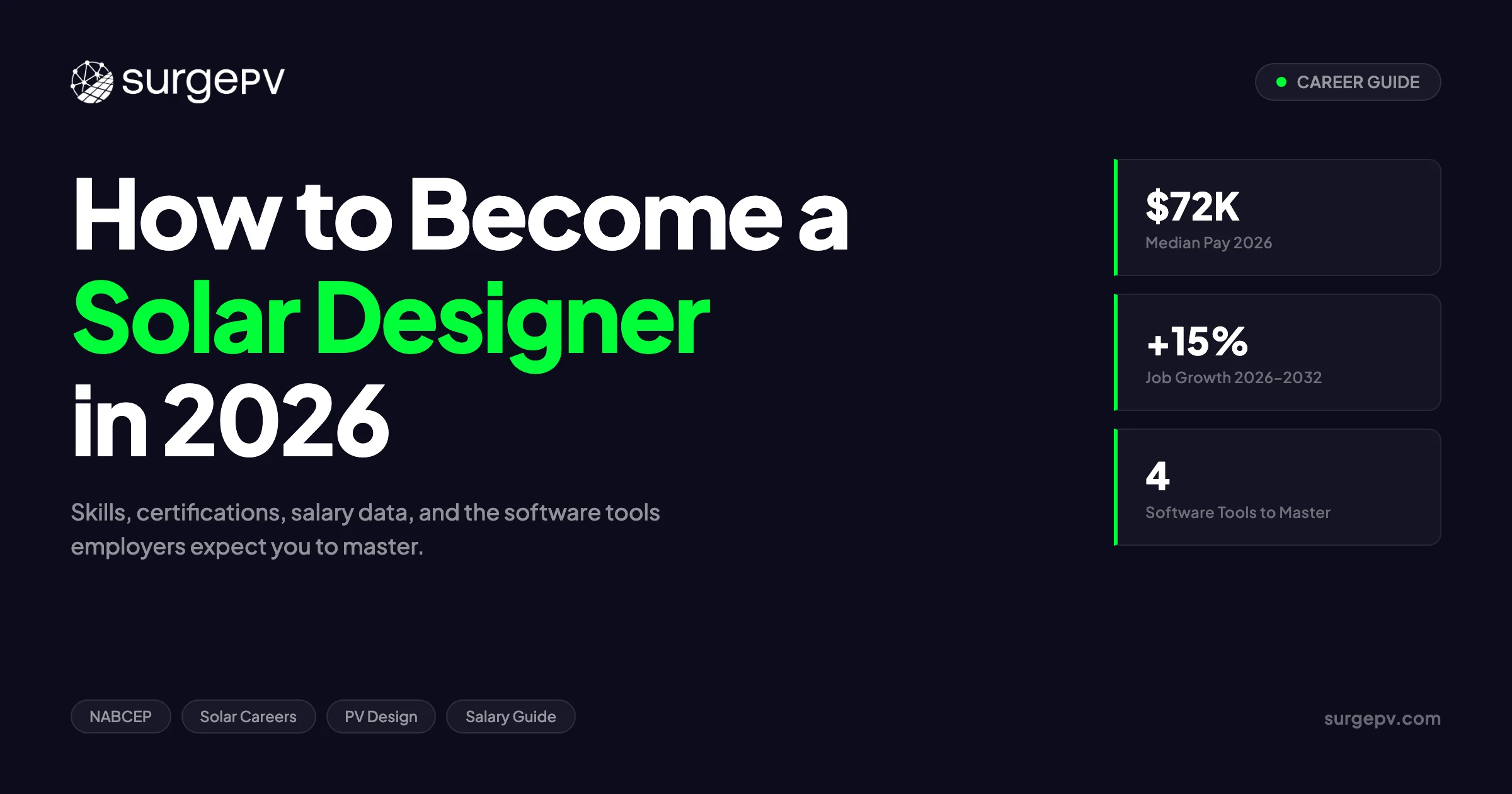
Solar designers earn $52K–$112K depending on experience and location. The fastest path is a 3–6 month bootcamp plus NABCEP PV Associate certification, followed by 2–3 years of hands-on design work. You must master at least one PV design platform (Aurora, Helioscope, or SurgePV) and understand NEC Article 690. A portfolio of 3–5 real or practice projects matters more than your degree for most entry-level roles.
In this guide:
- What a solar designer does — daily tasks and responsibilities
- Solar designer salary by experience level and US region
- Four education paths compared: degree, bootcamp, vocational, self-study
- Essential technical skills: electrical, mechanical, and software
- Solar design software comparison table with employer preferences
- Certifications that boost starting pay and advancement
- Portfolio building: projects that get you hired
- Career progression from junior designer to lead engineer
- Where to find solar designer jobs in 2026
What Does a Solar Designer Do?
A solar designer translates a client’s roof or land into a fully specified photovoltaic system. The output is a set of drawings, an energy production estimate, a bill of materials, and a financial proposal — everything an installer needs to price, permit, and build the project.
Daily Tasks of a Solar Designer
Site assessment and modeling. The designer starts with satellite imagery, drone photos, or a physical site survey. They model the roof or ground area in 3D, identify obstructions (chimneys, HVAC units, trees), and calculate available surface area.
Shade analysis. Using solar shadow analysis software, the designer models how nearby objects cast shadows across the array throughout the year. A 5% shading loss on a residential system can reduce annual revenue by $200–$400. Accurate shade analysis is one of the most valued skills in the role.
System layout and string design. The designer places modules on the available surface, groups them into strings, and assigns each string to an inverter input. String sizing must respect voltage and current limits across the full temperature range. A single string voltage miscalculation can void an inverter warranty or trigger a code violation.
Energy yield simulation. The designer runs hourly production simulations using Typical Meteorological Year (TMY) weather data. The output — typically a P50/P90 production estimate — becomes the basis for financial modeling and client proposals.
Financial modeling and proposal generation. The designer or sales engineer packages the technical design into a client-facing proposal: system cost, incentives, financing options, payback period, and 25-year savings. Solar proposal generation automates much of this, but the designer must verify that every number is grounded in the actual system design.
Permit documentation. For residential projects, the designer produces roof plans, electrical single-line diagrams, and structural load letters. For commercial projects, a licensed engineer stamps the drawings — but the designer does the initial layout and calculations.
Solar Designer vs. Solar Engineer
| Aspect | Solar Designer | Solar Engineer |
|---|---|---|
| Primary output | System layout, energy model, proposal | Stamped drawings, structural calcs, interconnection |
| Software focus | Aurora, Helioscope, PVsyst, SurgePV | AutoCAD, ETAP, PVSyst (advanced) |
| Code knowledge | NEC Article 690, local AHJ rules | NEC full code, IEEE 1547, structural codes |
| License required | No | PE license for stamping (commercial) |
| Typical employer | Residential installer, sales company | EPC, utility, large developer |
| Salary range | $52K–$112K | $78K–$145K |
Most solar designers work at residential or small commercial installers. Solar engineers work at EPC firms, utilities, and developers on projects above 500 kW. Many designers transition into engineering roles after 4–6 years by pursuing a PE license.
Key Takeaway — The Designer’s Role
The solar designer is the bridge between sales and installation. A good designer catches problems before they become change orders: incompatible module-inverter pairings, shade losses that kill ROI, or roof structures that cannot handle the load. This error-prevention role is why experienced designers command premium salaries.
Solar Designer Salary in 2026
Solar designer compensation has risen steadily as the industry grows and the skill set becomes more technical. The following data combines Bureau of Labor Statistics occupational data, Indeed salary reports, and Glassdoor aggregated listings for “solar designer” and “PV designer” roles in the United States.
Salary by Experience Level
| Level | Years | Salary Range | Median | Typical Bonus/Commission |
|---|---|---|---|---|
| Junior / Entry-Level | 0–2 | $52,000 – $68,000 | $58,000 | $2,000 – $5,000 |
| Mid-Level Designer | 2–5 | $65,000 – $88,000 | $76,000 | $3,000 – $8,000 |
| Senior Designer | 5–8 | $82,000 – $105,000 | $92,000 | $5,000 – $12,000 |
| Lead / Principal | 8+ | $95,000 – $112,000 | $104,000 | $8,000 – $15,000 |
| Freelance / Contract | Varies | $65–$120/hr | $85/hr | Project-based |
Sources: BLS Occupational Outlook Handbook (Solar Photovoltaic Installers category, adjusted for designer roles), Indeed US salary data (May 2026), Glassdoor aggregated listings. Freelance rates based on Upwork and industry contractor surveys.
Salary by US Region
| Region | Entry-Level | Senior | Notes |
|---|---|---|---|
| California | $58,000 – $75,000 | $95,000 – $125,000 | Highest cost of living; strong union presence |
| Texas | $52,000 – $68,000 | $85,000 – $108,000 | Fastest-growing market; no state income tax |
| Florida | $48,000 – $64,000 | $78,000 – $98,000 | Large residential market; lower wages |
| Northeast (MA, NY, NJ) | $55,000 – $72,000 | $90,000 – $115,000 | Strong incentive programs; high permitting complexity |
| Arizona / Nevada | $50,000 – $66,000 | $80,000 – $102,000 | Utility-scale hub; fewer residential roles |
| Midwest (IL, OH, MI) | $48,000 – $62,000 | $75,000 – $95,000 | Emerging market; lower cost of living |
California remains the highest-paying market, but Texas is closing the gap as utility-scale and residential deployment accelerates. The Northeast pays well due to complex incentive structures (SMART in Massachusetts, NYSERDA in New York) that require specialized design knowledge.
What Drives Higher Pay
Certifications. NABCEP PV Design Specialist holders earn 12–18% more than uncertified designers at the same experience level, according to industry salary surveys.
Software specialization. Designers proficient in commercial-grade tools (PVsyst, AutoCAD) command $8,000–$15,000 more than those limited to residential platforms.
Bilingual skills. Spanish-English bilingual designers are in high demand in California, Texas, and Florida, with 5–10% pay premiums.
Performance-based compensation. Many residential installers tie designer bonuses to sales conversion rates or project throughput. Top performers at high-volume shops can exceed base salary by 20–30%.
Pro Tip — Negotiating Your First Solar Designer Offer
Entry-level offers are often negotiable by $3,000–$5,000 if you can demonstrate software proficiency. Before your interview, complete the free certification course for your target platform (Aurora, Helioscope, or SurgePV) and bring a portfolio project to discuss. Employers regularly prefer a candidate with proven software skills over one with a relevant degree but no design tool experience.
Education Path: Degrees, Bootcamps, and Self-Study
There is no single required path into solar design. The field attracts career changers from construction, electricians transitioning into design, recent graduates with engineering degrees, and self-taught designers who built portfolios online.
Four Paths Compared
| Path | Duration | Cost | Best For | Job-Readiness Timeline |
|---|---|---|---|---|
| Bachelor’s Degree (Engineering/Environmental) | 4 years | $40K–$120K | Those seeking PE license or management track | 0–6 months post-grad |
| Solar Design Bootcamp | 8–16 weeks | $3,000–$8,000 | Career changers; fastest entry | 1–3 months post-program |
| Vocational / Community College | 1–2 years | $5,000–$15,000 | Hands-on learners; local job placement | 0–3 months post-program |
| Self-Study + Certification | 3–12 months | $500–$2,000 | Self-motivated; budget-constrained | 3–6 months |
Path 1: Bachelor’s Degree
A four-year degree in electrical engineering, mechanical engineering, environmental science, or renewable energy technology provides the deepest foundation. It is the only path that qualifies you for a Professional Engineer license — essential if you want to stamp drawings or move into engineering management.
Best programs for solar design:
- Oregon Institute of Technology — Renewable Energy Engineering
- SUNY Canton — Electrical Engineering Technology
- San Juan College — Solar Energy Technology
- Appalachian State University — Appropriate Technology
Pros: Qualifies for PE track; preferred by large EPCs and utilities; broad technical foundation Cons: Highest cost; slowest path; much of the curriculum is not solar-specific
Path 2: Solar Design Bootcamp
Bootcamps have emerged as the fastest path into the industry. Programs like Solar Energy International (SEI), HeatSpring, and Everblue Training offer intensive 8–16 week programs focused exclusively on PV system design.
What you learn: Site assessment, shade analysis, string sizing, NEC 690, inverter selection, energy modeling, and proposal generation. Most programs include hands-on projects with real design software. For more on this topic, see Inverter Selection Solar Design Guide.
Pros: Fastest path; industry-focused curriculum; networking with employers Cons: Less depth than a degree; may limit advancement without additional credentials
Path 3: Vocational and Community College
Two-year associate degree programs in electrical technology or renewable energy provide a middle ground. Schools like Lansing Community College, San Diego City College, and Hudson Valley Community College offer programs with strong local employer connections.
Pros: Lower cost than bachelor’s; hands-on labs; often include internship placement Cons: Two-year commitment; may not cover latest software tools
Path 4: Self-Study
The self-study path is viable because most solar design skills are software-based and well-documented. The core resources are free or low-cost.
Self-study curriculum:
- NEC Article 690 — Read the National Electrical Code sections on solar PV systems. Free access through many public libraries.
- NREL PVWatts — Run 10+ practice simulations at pvwatts.nrel.gov to understand how system parameters affect yield.
- Free software trials — Aurora, Helioscope, and SurgePV all offer free trials or free tiers. Build 3–5 practice projects.
- YouTube and manufacturer training — SolarEdge, Enphase, and FranklinWH publish free string sizing and design webinars.
- NABCEP PV Associate — $150 exam that validates baseline knowledge. Study using the free NABCEP resource guide.
Key Takeaway — Pick Your Path Based on Your Goal
If you want to become a lead engineer or start your own design firm, pursue a bachelor’s and PE license. If you want to start earning as a designer within 6 months, choose a bootcamp or intensive self-study path. The majority of working solar designers did not follow the degree route — they learned the software, passed NABCEP, and built a portfolio.
Essential Technical Skills
Solar design sits at the intersection of electrical engineering, structural assessment, and software proficiency. The following skills appear in 80%+ of solar designer job postings.
Electrical Fundamentals
DC circuit analysis. You must understand voltage, current, power, and resistance relationships. Solar arrays are DC circuits operating at 400–1,000V. String voltage calculations must account for temperature coefficients — a cold morning can push open-circuit voltage 15–20% above standard test conditions.
NEC Article 690. The National Electrical Code governs all solar installations in the US. Key sections include:
- 690.7 — Voltage temperature corrections
- 690.8 — Circuit sizing and current calculations
- 690.12 — Rapid shutdown requirements
- 690.47 — Grounding and bonding
Inverter selection and sizing. You must match inverter power rating to array DC capacity (typically 1.1–1.3 DC/AC ratio for string inverters), understand MPPT voltage windows, and know when to specify string inverters versus microinverters versus power optimizers.
Module specifications. Key datasheet parameters: Pmax, Voc, Isc, Vmp, Imp, temperature coefficients, and degradation rate. You must verify that module electrical characteristics are compatible with the selected inverter across the full temperature range.
Mechanical and Structural
Roof assessment. Identify roof type ( asphalt shingle, metal, tile, flat membrane), age, condition, and structural capacity. A typical residential roof can support 2–5 lbs/sq ft of additional load from solar racking. Older roofs may require reinforcement or replacement before solar installation.
Racking and mounting. Understand the difference between rail-based, rail-less, and shared-rail systems. Know when to specify ballasted mounts (flat commercial roofs) versus penetrating mounts (residential pitched roofs). Account for wind and snow loads per ASCE 7.
Azimuth and tilt optimization. For fixed-tilt systems in the continental US, south-facing at latitude-tilt is the baseline. East-west arrays lose 10–15% annual production but distribute generation across more hours — sometimes preferred for time-of-use tariff structures.
Software and Simulation
Irradiance and weather data. Understand the difference between TMY2, TMY3, and NSRDB data sources. Know how to interpret global horizontal irradiance (GHI), direct normal irradiance (DNI), and diffuse horizontal irradiance (DHI). For Global-specific compliance details, see Global net-metering-by-country. For Global-specific compliance details, see Global solar-permitting-speed-by-country.
Shade modeling. Horizon line analysis, 3D obstruction modeling, and shade factor calculations. A tree that shades 10% of the array in December may shade 40% in June depending on solar altitude angles.
Performance ratio and loss factors. System performance ratio (PR) typically ranges from 78–85% for residential systems. Key loss categories: temperature (5–8%), soiling (2–5%), mismatch (1–2%), wiring (1–2%), inverter (2–3%), and availability (1–2%).
Financial modeling basics. Understand simple payback, net present value (NPV), internal rate of return (IRR), and levelized cost of energy (LCOE). The generation and financial tool at SurgePV automates these calculations, but designers should understand the underlying math.
Pro Tip — Learn One Tool Deeply First
Employers care more about deep proficiency in one platform than shallow knowledge of five. Pick Aurora if you are targeting residential installers, PVsyst if you want commercial EPC work, or SurgePV if you want a cloud-based tool that covers both. Spend 40+ hours building real projects in your chosen tool before listing it on your resume.
Solar Design Software You Must Learn
Software proficiency is the single most important differentiator for solar designer candidates. The following table compares the platforms most commonly requested by employers.
| Software | Best For | Price | Learning Curve | Employer Type |
|---|---|---|---|---|
| Aurora Solar | Residential design, sales proposals | $$$ (enterprise) | Moderate | Residential installers, sales orgs |
| Helioscope | Commercial design, large arrays | $$ (subscription) | Moderate | Commercial EPCs, developers |
| PVsyst | Detailed energy simulation, research | $$ (license) | Steep | Engineers, large EPCs, academics |
| OpenSolar | Free design, small installers | Free | Low | Entry-level, freelance, small shops |
| SurgePV | Cloud-based design + proposal | $$ (subscription) | Low–Moderate | Installers of all sizes, international |
| AutoCAD | Structural drawings, permit docs | $$$ (license) | Steep | Engineering firms, utilities |
| SketchUp | 3D modeling, visualization | $ (subscription) | Low | Designers who present to clients |
| EnergyToolbase | Utility-scale financial modeling | $$$ (enterprise) | Moderate | Large developers, IPPs |
Aurora Solar
Aurora dominates the US residential market. Its LIDAR-based remote site assessment and auto-design features allow designers to produce a complete proposal without visiting the site. Over 7,000 solar companies use Aurora.
Key skills to demonstrate: Remote shade analysis, auto-stringing, financing integration, and sales proposal customization.
Helioscope
Helioscope (by Folsom Labs) is the standard for commercial and industrial projects. Its 3D layout engine handles complex roof geometries and large ground-mount arrays efficiently.
Key skills to demonstrate: 3D module placement, DC/AC ratio optimization, and production loss analysis.
PVsyst
PVsyst is the gold standard for detailed energy yield simulation. It is used for bankable energy assessments on utility-scale projects and research applications. The learning curve is steep, but PVsyst proficiency signals serious technical depth.
Key skills to demonstrate: Hourly simulation setup, loss diagram interpretation, and P50/P90 uncertainty analysis.
SurgePV
SurgePV is a cloud-based solar PV design software that combines 3D roof modeling, physics-based shade analysis, string design, energy simulation, and integrated proposal generation. It is designed for installers who want to move from site survey to signed proposal without switching platforms.
Key skills to demonstrate: Rapid site modeling, automated string sizing, integrated financial modeling, and multi-language proposal generation.
Which Tool Should You Learn First?
| Your Goal | Start With | Add Within 1 Year |
|---|---|---|
| Residential installer designer | Aurora or SurgePV | OpenSolar (free practice) |
| Commercial EPC designer | Helioscope | PVsyst (for energy modeling depth) |
| Freelance designer | OpenSolar or SurgePV | Aurora (if targeting US residential) |
| Engineering track | PVsyst | AutoCAD, Helioscope |
Learn Solar Design on the Platform Employers Use
SurgePV’s cloud-based solar PV design software gives you hands-on experience with 3D roof modeling, shade analysis, string sizing, and proposal generation — the exact skills listed on solar designer job postings. Start building your portfolio with real design tools.
Book a DemoNo commitment required · 20 minutes · Live project walkthrough
Certifications That Boost Designer Pay
Certifications signal verified competency to employers and can increase starting offers by 10–20%. The following credentials are most valued in the solar design field.
NABCEP Certifications
The North American Board of Certified Energy Practitioners (NABCEP) is the most recognized certification body in the US solar industry.
| Certification | Level | Requirements | Exam Cost | Salary Impact |
|---|---|---|---|---|
| PV Associate | Entry | None; recommended 18 hrs training | $150 | Baseline credential |
| PV Design Specialist | Professional | 58 hrs advanced training + experience | $375 | +12–18% salary |
| PV Technical Sales | Professional | 48 hrs training + sales experience | $375 | +8–12% salary |
| PV Installation Professional | Professional | 58 hrs training + installation experience | $375 | N/A (installer track) |
NABCEP PV Design Specialist is the credential most relevant to solar designers. It covers system design, electrical theory, NEC compliance, and safety standards. Employers list it as preferred or required on 60–70% of senior designer job postings.
To sit for the PV Design Specialist exam, you need:
- 58 hours of advanced PV training (SEI, HeatSpring, or equivalent)
- Completion of 5–10 installed systems OR 2+ years of design experience
- OSHA-10 certification
OSHA-10 Construction
The OSHA 10-Hour Construction certification is a near-universal requirement for anyone working on job sites. Even designers who rarely visit sites are often required to hold OSHA-10 because they produce documents that field crews rely on. Cost: $60–$100. Time: 1–2 days online.
Additional Valuable Credentials
| Certification | Issuer | Cost | Value |
|---|---|---|---|
| LEED Green Associate | USGBC | $250 | Required for commercial/government projects |
| AutoCAD Certified Professional | Autodesk | $200 | Signals CAD proficiency for permit drawing roles |
| Electrical Apprentice License | State board | Varies | Path to electrician-to-designer transition |
| SurgePV Certified Designer | SurgePV | Free | Platform-specific credential; valued by SurgePV partner installers |
Key Takeaway — Certification Strategy
Start with NABCEP PV Associate ($150) and OSHA-10 ($75) as your foundation. After 2–3 years of design work, pursue the NABCEP PV Design Specialist. If you are targeting commercial projects, add LEED Green Associate. These three credentials cover 90% of certification requirements on solar designer job postings.
Building a Portfolio: Real Projects That Get Interviews
A portfolio matters more than a degree for most entry-level solar design roles. Employers want to see that you can produce a complete, accurate design — not just that you completed a course.
What to Include in Your Portfolio
Project 1: Residential rooftop design. Model a typical suburban home (2,000 sq ft, asphalt shingle roof, minimal obstructions). Include:
- 3D roof layout with module placement
- Shade analysis showing annual loss percentage
- String diagram with voltage calculations
- Energy production estimate (monthly and annual)
- Simple payback calculation with local incentives
Project 2: Challenging roof design. Find a real address with a complex roof (multiple planes, dormers, chimney obstruction). Show how you optimized module placement around obstacles. This demonstrates problem-solving ability.
Project 3: Commercial flat roof. Design a 100–250 kW system on a flat commercial roof. Include:
- Ballasted racking layout with row spacing
- Electrical single-line diagram
- Performance ratio estimate
- Structural load summary
Project 4: Ground-mount design. Design a 500 kW–1 MW ground-mount array. Include:
- Terrain and grading considerations
- Tracker vs. fixed-tilt comparison
- P50/P90 energy estimate
- Interconnection voltage assessment See our guide on Agricultural Solar Case Study for more. Read more about Floating Solar Farms France.
Project 5: Financial proposal. Package one of the above designs into a client-facing proposal. Include system cost, incentives, financing options, and 25-year savings projection. Use solar proposal platform to generate a professional output.
Where to Find Practice Projects
Google Maps / Google Earth. Pick real addresses in your target market. Use Street View and satellite imagery to assess roof conditions.
NREL PVWatts. Run energy simulations for your practice projects at pvwatts.nrel.gov to validate your software’s production estimates.
Free software trials. Aurora, Helioscope, and SurgePV offer trial periods. Use them to build your initial portfolio. OpenSolar is free indefinitely for basic designs.
How to Present Your Portfolio
Create a simple PDF or personal website with:
- One-page summary of each project (address, system size, key design decisions)
- Screenshots of the 3D model, shade analysis, and string diagram
- Energy production summary table
- Brief narrative explaining your design choices
Bring this to interviews. Walk the interviewer through one project from site assessment to final proposal. This demonstrates both technical skill and communication ability — the two traits employers value most in designers.
Pro Tip — Use Real Addresses
Employers can spot generic practice projects. Use real addresses from your local market. If you are applying to a California installer, show California roofs with California incentives. If you are targeting Texas commercial work, show flat roofs with Texas utility interconnection requirements. Market-specific knowledge signals job-readiness.
Career Path: From Junior Designer to Lead Engineer
Solar design offers a clear advancement path for those who continue building skills. The typical trajectory spans 8–12 years from first job to senior leadership.
Career Progression Timeline
| Stage | Years | Title | Salary | Key Responsibilities |
|---|---|---|---|---|
| 1 | 0–2 | Junior Designer / Design Assistant | $52K–$68K | Basic layouts, shade analysis, permit docs under supervision |
| 2 | 2–4 | Solar Designer | $65K–$82K | Full residential designs, client proposals, code compliance |
| 3 | 4–6 | Senior Designer | $82K–$98K | Commercial projects, team mentoring, quality review |
| 4 | 6–8 | Lead Designer / Design Manager | $95K–$112K | Team management, process improvement, vendor relations |
| 5 | 8–12 | Director of Design / VP Engineering | $120K–$160K | Department strategy, hiring, technology selection |
| Alternative | 4–8 | Solar Engineer (PE) | $95K–$145K | Stamped drawings, structural calcs, utility interconnection |
| Alternative | 6+ | Freelance Design Consultant | $85–$150/hr | Project-based work for multiple clients |
Transitioning to Engineering
Many senior designers pursue a Professional Engineer (PE) license to move into engineering roles. Requirements vary by state but generally include:
- ABET-accredited engineering degree (or equivalent experience)
- 4 years of progressive engineering experience
- Passing the FE (Fundamentals of Engineering) and PE exams
Some states allow experience-based pathways for non-degree holders, but this route takes 8–12 years of documented engineering work.
Specialization Tracks
Residential design specialist. Deep expertise in rooftop layouts, homeowner sales psychology, and local permitting. Often transitions into sales engineering or operations management. Read How to Design Residential Solar System for a complete walkthrough.
Commercial/utility-scale designer. Focuses on large arrays, complex electrical design, and utility interconnection. Higher pay but more travel and longer project cycles.
Energy modeling specialist. Becomes the in-house expert on yield simulation, P50/P90 analysis, and bankable production estimates. Critical role for developers seeking project financing.
Software/technology specialist. Leads the evaluation and implementation of new design tools. Often bridges design and IT departments.
Key Takeaway — Advancement Requires Breadth
The designers who reach lead roles fastest are those who develop skills beyond pure design: project management, client communication, code interpretation, and team coaching. Technical depth gets you to senior designer. Breadth gets you to leadership. Start volunteering for cross-functional work after your second year.
Where to Find Solar Designer Jobs in 2026
The solar industry job market is active but fragmented across multiple channels. The following sources consistently list solar design positions.
Job Boards
| Board | Best For | Volume |
|---|---|---|
| IREC Solar Jobs Board | All solar roles | Moderate; high quality |
| Indeed | General search | High; filter by “solar designer” |
| LinkedIn Jobs | Professional networking | High; set alerts for keywords |
| Glassdoor | Salary research + listings | Moderate |
| ZipRecruiter | Entry-level roles | Moderate |
| Solar Power World | Industry-specific | Low; senior roles |
Company Types That Hire Solar Designers
Residential installers. Companies like Sunrun, SunPower, Trinity Solar, and local/regional installers employ the largest number of designers. These roles focus on fast turnaround — 5–15 designs per day — with standardized system configurations.
Commercial EPCs. Mortenson, McCarthy, and specialty solar EPCs hire designers for 100 kW–10 MW projects. These roles require deeper technical knowledge and often involve travel to job sites.
Solar sales organizations. Companies that sell leads or full-service solar packages employ designers to create proposals that sales teams present to homeowners.
Equipment manufacturers. SolarEdge, Enphase, and FranklinWH employ application engineers who support installer customers with design questions. These roles blend design expertise with customer-facing technical support.
Software companies. Solar design software providers (Aurora, Helioscope, SurgePV) hire designers as product specialists, trainers, and customer success managers.
Utilities and developers. NextEra, Duke Energy, and independent power producers hire designers for utility-scale project development. These are the highest-paying roles but typically require 5+ years of experience. Read more about Battery Solar System Design UK.
Application Strategy
Tailor your resume to the company type. Residential installers care about speed and software proficiency. Commercial EPCs care about code knowledge and large-project experience. Software companies care about communication and training ability.
Lead with your portfolio. Include a link to your design portfolio in your resume header. Many hiring managers will review your portfolio before deciding to interview.
Get certified before you apply. NABCEP PV Associate takes 2–4 weeks of study and costs $150. Listing this credential on your resume moves you past the initial screen at many companies.
Network at industry events. Solar Power International (RE+), Intersolar, and local SEIA chapter events are where hiring managers meet candidates. The solar industry is relationship-driven — a warm introduction beats a cold application.
Pro Tip — Start as a Design Assistant
If you are struggling to land a designer role, apply for design assistant or CAD drafter positions. These roles handle permit documentation and basic layouts under a senior designer’s supervision. After 6–12 months, you will have real project experience and internal references that make designer promotion natural.
Conclusion
Becoming a solar designer in 2026 is a matter of choosing your path, building the right skills, and demonstrating them through a portfolio. The industry is growing fast enough that competent designers are in demand across every market segment.
The clearest path: complete a bootcamp or self-study program in 3–6 months, earn NABCEP PV Associate certification, master one design platform, build 3–5 portfolio projects, and start applying. With starting salaries at $52K–$68K and senior roles at $95K–$112K, the financial return on a $3,000–$8,000 training investment is measured in months, not years.
The solar industry needs more skilled designers. Every rooftop that goes unassessed, every shade analysis that is skipped, and every string that is sized incorrectly costs the industry money and reputation. Good design is the foundation of every successful solar project.
Three actions to take this week:
- Sign up for a free trial of Aurora, Helioscope, or SurgePV and build your first practice project using a real address from your local market
- Register for the NABCEP PV Associate exam and schedule 2–3 weeks of focused study using the free NABCEP resource guide
- Join your local SEIA chapter or attend a virtual solar industry event to start building professional connections
For the broader context of solar industry growth and opportunities, see our guide to solar energy policies in Europe and our analysis of community solar projects in Germany. For installers building design teams, all-in-one solar software that compresses the design-to-proposal cycle helps small firms compete for talent by reducing repetitive work. Also see: Germany solar subsidies. Also see: European Solar Incentives.
Frequently Asked Questions
How do I become a solar designer with no experience?
Start with a NABCEP PV Associate entry-level certification, learn one solar design tool (SurgePV, Helioscope, or Aurora), and build 3–5 practice portfolio projects using free irradiance data from NREL PVWatts. Apply for junior designer roles at local installers or EPC firms. Most employers value demonstrated software skill over formal degrees for entry-level positions.
What degree do you need to be a solar designer?
No degree is strictly required. Approximately 40% of solar designers hold a bachelor’s in engineering, electrical technology, or environmental science. The other 60% enter through bootcamps, vocational programs, or self-study combined with NABCEP certification. What matters most is proficiency in PV system design software and understanding of NEC code requirements.
How much does a solar designer make in 2026?
Solar designer salaries in the United States range from $52,000 for entry-level junior designers to $112,000 for senior lead designers, with a national median of approximately $72,000. Geographic location matters significantly — California and Texas designers earn 15–25% above the national median. Freelance designers bill $65–$120 per hour.
What software do solar designers use?
Solar designers use PV simulation software (PVsyst, Helioscope, Aurora Solar, OpenSolar), CAD tools (AutoCAD, SketchUp), and proposal platforms (SurgePV, EnergyToolbase). The specific stack varies by employer — residential installers favor Aurora and OpenSolar, while commercial EPCs standardize on PVsyst and AutoCAD. Cloud-based tools like SurgePV are gaining share because they combine design, simulation, and proposal generation in one platform. For software options, see 7 Best Aurora Solar Alternatives in.
Is NABCEP certification worth it for solar designers?
Yes — NABCEP PV Design Specialist certification is the most recognized credential in the US solar industry. Employers list it as preferred or required on 60–70% of senior designer job postings. The certification signals verified competency in system design, NEC compliance, and safety standards. Entry-level designers should start with the PV Associate credential, then advance to the PV Design Specialist after 2–3 years of field experience.
How long does it take to become a solar designer?
The fastest path takes 3–6 months: complete a solar design bootcamp (6–12 weeks), earn NABCEP PV Associate certification (2–4 weeks of study), and build a portfolio of 3–5 design projects. A traditional engineering degree path takes 4 years. Most junior designers are job-ready within 6–12 months of starting their training, regardless of the path taken.
What is the difference between a solar designer and a solar engineer?
A solar designer creates system layouts, performs shade analysis, sizes inverters and strings, and generates client proposals using specialized software. A solar engineer performs structural load calculations, electrical single-line diagrams, grounding designs, and utility interconnection applications — work that typically requires a Professional Engineer (PE) license. Designers focus on the front-end system configuration; engineers handle the back-end technical compliance and stamp drawings.
Where this fits
This article is part of SurgePV's Solar Incentives & Policy hub, which works through the topic from first principles to the decisions a project team actually has to make.

