

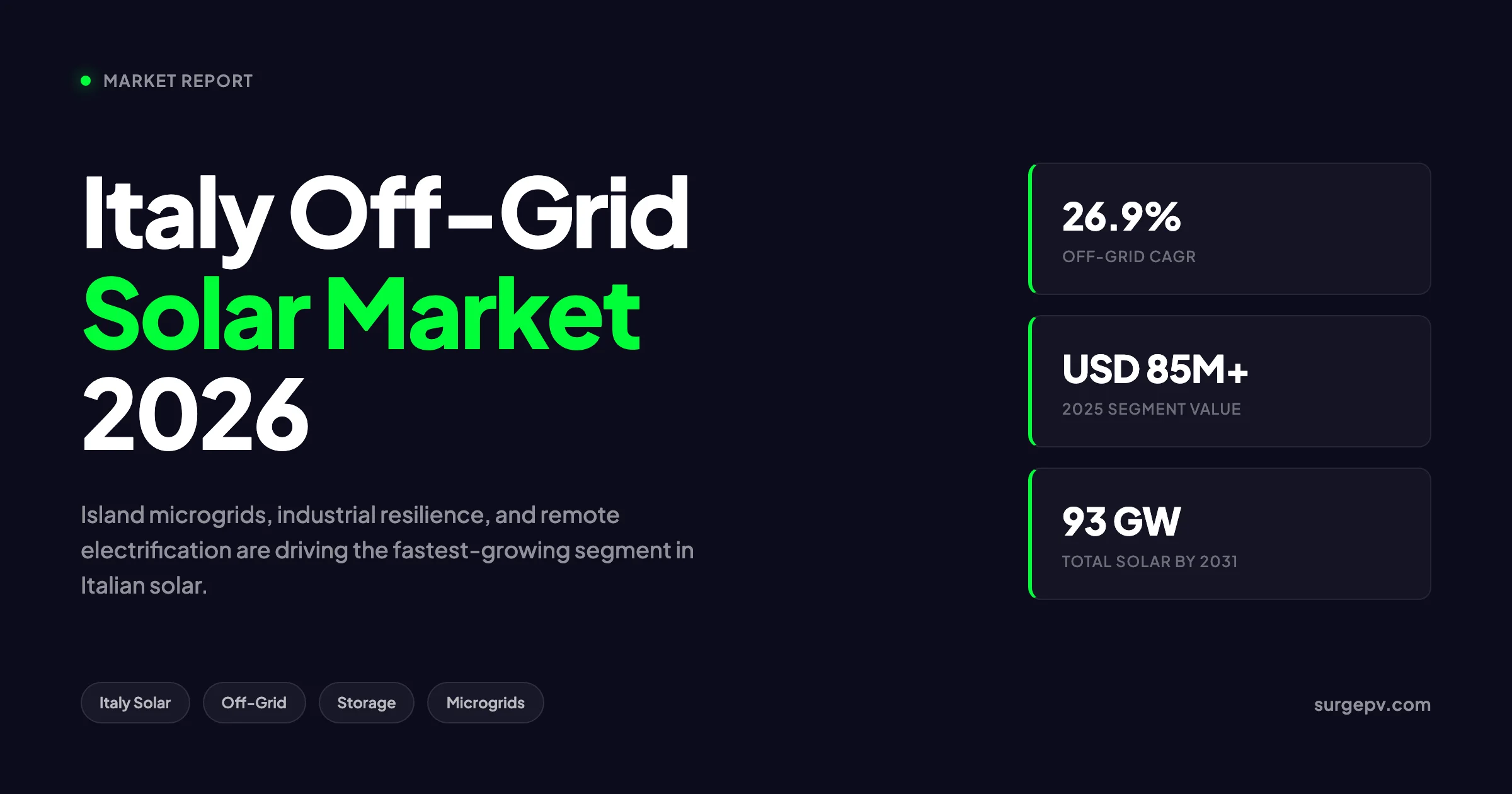
Italy’s solar market is scaling faster than almost anywhere in Europe. Cumulative capacity is expected to jump from 43.5 GW in 2025 to 49.4 GW in 2026 and then to 93 GW by 2031. Hidden inside that headline is a smaller, faster-moving segment: off-grid solar. While on-grid systems still dominate with 97.6% market share, the off-grid slice is growing at a 26.9% CAGR — the fastest grid-type category in the country.
For solar installers, EPCs, and sales teams, that growth matters. Off-grid projects carry different economics, different customer profiles, and different design constraints than standard rooftop net-metering jobs. The buyers are island municipalities, Alpine hut operators, remote farms, industrial plants seeking resilience, and tourism developers who cannot wait two years for a grid connection.
This guide breaks down the Italy off-grid solar market in 2026: market size, growth drivers, active incentives, the main use cases, technology choices, and the practical barriers installers face when quoting these projects.
Quick Answer
Italy’s off-grid solar market is worth roughly USD 85–90 million in 2025 and is projected to grow at 26.9% CAGR through 2031. Growth is driven by island microgrids, industrial solar-plus-storage resilience, remote rural electrification, and a regulatory shift that lets off-grid plants export limited surplus power into local networks.
In this guide:
- 2026 market size and growth forecast for Italy off-grid solar
- The four demand drivers reshaping the segment
- Incentives and policy rules that apply to off-grid systems
- Primary use cases: islands, Alps, farms, industry, tourism
- Technology stack: panels, inverters, batteries, and backup
- Barriers and how installers can overcome them
- FAQ section for sales conversations
Italy Off-Grid Solar Market Size and Growth Forecast
Off-grid solar in Italy is still a niche within a massive market, but the growth rate is impossible to ignore. The table below summarizes the key numbers.
| Metric | Value | Source / Context |
|---|---|---|
| Italy total solar capacity (2025) | 43.5 GW | Cumulative installed base |
| Italy total solar capacity (2026e) | 49.4 GW | 13.5% annual growth |
| Italy total solar capacity (2031f) | 93.1 GW | 13.5% CAGR |
| On-grid share (2025) | 97.6% | Dominant segment |
| Off-grid share (2025) | ~2.4% | Small but fastest-growing |
| Off-grid CAGR (2026–2031) | 26.9% | Fastest grid-type segment |
| Italy off-grid market value (2025) | ~USD 85–90 million | Estimated segment value |
| Global off-grid solar market (2025) | ~USD 3.0 billion | For comparison |
The 26.9% CAGR is not a speculative figure. It reflects real project pipelines: island diesel replacement programs, factory microgrids built after the 2022 energy price shock, and remote sites where grid extension is simply too slow or too expensive.
The contrast with on-grid solar is useful. On-grid projects benefit from net metering, simpler permitting, and established financing. Off-grid projects require larger batteries, backup generators, and precise load analysis. But they also command higher margins and stickier customer relationships because the system must work without the grid as a safety net.
For solar companies, the off-grid segment is a natural upsell from standard residential or commercial solar. The same customer who wants a 6 kWp rooftop system may also want a battery. The customer who cannot connect to the grid at all needs a full off-grid design. PV design software that handles both grid-tied and off-grid sizing makes it easier to quote either path without switching tools.
Four Demand Drivers for Italy Off-Grid Solar
The Italy off-grid solar market is not growing for one reason. Four distinct demand drivers are converging at the same time.
1. Island Diesel Replacement
Italy has dozens of non-interconnected minor islands, many of them in Sicily. Most still rely on diesel generators that produce electricity at costs above €0.35/kWh. Diesel must be shipped by boat, stored on the island, and burned in aging plants. It is expensive, polluting, and vulnerable to supply disruption.
The 2017 Minor Islands Decree set quantitative renewable-energy targets for these islands. Regional programs and EU Clean Energy for EU Islands funding are now backing hybrid solar, wind, and battery plants on islands like Salina, Pantelleria, and Linosa. Roof-mounted PV alone could technically cover diesel production on 11 of 14 analyzed Sicilian minor islands, according to a Politecnico di Torino study.
The economics are simple: every kWh produced by solar replaces a kWh that would have been generated from imported diesel. At €0.35/kWh or more, solar-plus-storage pays back quickly even with high upfront costs.
2. Industrial Energy Resilience
After the 2022 price spikes and supply scares, Italian factories, data centers, food processors, and mines started treating energy independence as a risk-management issue, not just a cost issue. A solar-plus-storage microgrid lets a facility keep production running during grid outages or price spikes.
These systems are often technically “off-grid capable” rather than fully off-grid. They remain connected to the grid for normal operations but can island during outages. For installers, this is a large and growing segment because industrial buyers have budgets, clear ROI thresholds, and repeat sites.
3. Grid Saturation and Interconnection Delays
Parts of northern Italy face grid saturation. New on-grid projects can wait up to two years for interconnection approval. For a factory, hotel, or farm that needs power now, an off-grid or hybrid system is the faster route. The recent rule allowing off-grid plants to export up to 5 GWh per year into local distribution networks makes hybrid designs even more attractive.
4. Remote Rural and Alpine Electrification
Mountain huts, telecom repeaters, remote farms, and agriturismi often lack grid access or rely on weak, expensive lines. Off-grid solar with batteries and a small backup generator is now cheaper than extending the grid over long distances. Snow reflection can increase yield at high altitude, making bifacial panels particularly effective in Alpine settings.
| Demand Driver | Typical Customer | Main Motivation | Key Technology |
|---|---|---|---|
| Island diesel replacement | Municipalities, island utilities | Cut fuel cost and supply risk | Solar + battery + backup genset |
| Industrial resilience | Factories, data centers, mines | Avoid outages and price spikes | Solar + storage + islanding inverter |
| Grid delays | Commercial developers, farms | Bypass interconnection queues | Hybrid on-grid/off-grid system |
| Remote electrification | Alpine huts, farms, tourism sites | Power where grid does not reach | Solar + LFP battery + small genset |
Incentives and Policy Rules for Off-Grid Solar
Off-grid solar in Italy does not qualify for net metering or dedicated surplus sale mechanisms, because those programs assume a grid connection. But several incentives still apply.
Detrazione Fiscale 50% (Ecobonus)
Residential off-grid PV systems installed on a primary or secondary home can claim a 50% personal income-tax deduction, spread over 10 years. The deduction covers panels, inverter, batteries, meters, and installation. The maximum eligible expense is €48,000 per real estate unit. This is the most important active incentive for residential off-grid solar in 2026.
Reduced 10% VAT
Complete residential PV systems, including batteries, qualify for 10% VAT instead of the standard 22%, provided the system serves family self-consumption and is sized under roughly 20 kW.
Corporate Hyper-Depreciation
The 2026 Budget Law introduced hyper-depreciation for companies investing in self-production of renewable energy. Businesses can deduct:
- 180% for investments up to €2.5 million
- 100% for investments from €2.5–10 million
- 50% for investments from €10–20 million
This applies to tangible assets for self-consumption, including storage. It is highly relevant for industrial microgrids.
Regional and EU Funds
Sicily, Sardinia, Calabria, Puglia, and other regions offer grants for renewable energy and storage. Lombardy’s AxEL program, for example, can cover up to €2,000 of battery costs. EU Clean Energy for EU Islands funding supports island transition plans. These programs change frequently, so installers should verify current calls before quoting.
The 5 GWh Export Rule
A recent regulatory development allows off-grid plants to export surpluses into local distribution networks up to 5 GWh per year. This is not full grid connection, but it lets hybrid systems monetize occasional excess production. The rule blurs the line between off-grid and grid-connected systems and opens new design possibilities for developers.
| Incentive | Applies To | Rate / Value | Notes |
|---|---|---|---|
| Detrazione Fiscale 50% | Residential PV + storage | 50% tax deduction over 10 years | Max €48,000 eligible expense per property unit |
| Reduced VAT | Residential PV systems | 10% instead of 22% | Requires self-consumption use, under ~20 kW |
| Hyper-depreciation | Corporate self-production assets | 180% / 100% / 50% by investment band | 2026–2028 window |
| Regional grants | Varies by region | €500–€3,000+ | Check current calls; examples include Lombardy AxEL |
| EU island funds | Non-interconnected islands | Project-dependent | Clean Energy for EU Islands initiative |
| 5 GWh export rule | Off-grid plants | Surplus export up to 5 GWh/year | Creates hybrid on-grid/off-grid models |
For a deeper look at Italian solar incentives, see our European solar incentives guide and solar panel ROI Italy posts.
Main Use Cases for Off-Grid Solar in Italy
Off-grid solar in Italy is not one market. It is a collection of verticals with different load profiles, budgets, and decision-makers.
Islands and Coastal Microgrids
Sicily’s minor islands are the highest-profile use case. These communities currently burn diesel for most of their electricity. Solar-plus-storage microgrids can cut fuel use by 60–90% and stabilize prices. Projects often combine rooftop PV, ground-mounted arrays, batteries, and a retained diesel generator for seasonal peaks or long cloudy spells.
Alpine and Mountain Sites
Italian Alpine huts, ski-lift support buildings, and telecom repeaters need reliable power in harsh conditions. Off-grid solar with LFP batteries and a small propane or diesel backup is a proven configuration. Snow load, wind exposure, and access for maintenance are the main design constraints.
Agriculture and Rural Businesses
Remote farms, wineries, olive mills, and agriturismi often face high costs for grid extension. Off-grid solar powers irrigation pumps, cold storage, processing equipment, and guest facilities. The load is usually daytime-heavy, which reduces the battery size needed.
Industrial and Commercial Resilience
Factories, logistics hubs, and data centers use off-grid-capable microgrids to keep critical loads online. These systems are larger, more complex, and often include advanced energy management systems. They also offer the highest project values for installers and EPCs.
Tourism and Hospitality
Eco-resorts, glamping sites, and remote restaurants market off-grid power as part of the guest experience. These customers care about aesthetics and noise as much as cost, which favors clean solar-plus-battery systems over diesel generators.
| Use Case | Typical System Size | Battery Focus | Key Sales Point |
|---|---|---|---|
| Island microgrid | 100 kW–10 MW+ | Long-duration storage, multi-day autonomy | Diesel cost replacement |
| Alpine hut / telecom | 3–20 kW | Cold-weather LFP, small backup | Reliability in harsh conditions |
| Farm / agriturismo | 10–100 kW | Daytime load matching, irrigation timing | Avoid grid extension cost |
| Industrial microgrid | 250 kW–5 MW+ | High-cycle LFP or flow batteries | Outage protection and price hedging |
| Tourism / hospitality | 5–50 kW | Quiet, clean power | Guest experience and marketing value |
Designing these systems requires more than a standard rooftop layout. Installers need tools that model battery autonomy, generator runtime, and seasonal solar variation. A solar design platform with off-grid sizing and irradiance and shading analysis can cut proposal time and reduce the risk of undersizing storage.
Technology Stack: Panels, Inverters, Batteries, and Backup
Off-grid solar is harder to design than grid-tied solar because the system must balance generation, storage, and load every hour of the year. The component choices matter more.
Solar Modules
Standard monocrystalline modules work well for most Italian off-grid projects. Bifacial panels are attractive in high-albedo environments like snow-covered Alps or white island roofs. Agri-PV and floating solar may appear in larger island or reservoir projects, but they add permitting complexity.
Inverters and Charge Controllers
Off-grid systems need either a standalone off-grid inverter or a hybrid inverter that can island from the grid. Hybrid inverters are increasingly popular because they allow the same system to operate grid-tied normally and off-grid during outages. MPPT charge controllers are still used in smaller DC-coupled systems.
Batteries
Lithium iron phosphate (LFP) is the default for residential and light commercial off-grid systems in 2026. Typical costs:
| Battery Size | Typical Price Range (Italy 2026) | Use Case |
|---|---|---|
| 5 kWh LFP | €2,800–€3,800 | Small cabin or backup |
| 10 kWh LFP | €4,800–€7,000 | Residential off-grid home |
| 15 kWh LFP | €7,000–€10,000 | Larger home or small farm |
| 100+ kWh LFP / flow | €150,000–€300,000+ | Industrial microgrid or island plant |
LFP offers 6,000+ cycles at 80% depth of discharge, strong safety characteristics, and stable pricing. For long-duration island microgrids, vanadium flow batteries can provide 8–12 hours of discharge and longer calendar life.
Backup Generators
Most off-grid systems in Italy still include a backup generator, at least for seasonal peaks. Diesel, propane, or even biomass generators can cover multi-day cloudy periods. The design goal is to minimize generator runtime while keeping the battery from deep cycling too often.
Energy Management Systems
Larger microgrids need an energy management system (EMS) to dispatch solar, battery, generator, and optional grid import/export. The EMS handles peak shaving, frequency control, and economic optimization. This is where off-grid projects start to look like small utilities.
Barriers and How Installers Can Overcome Them
Off-grid solar is growing, but it is not easy. The most successful installers treat the barriers as part of the sales and design process.
Upfront Capital Cost
Off-grid systems cost more than grid-tied systems because of batteries and backup. A residential off-grid home can easily run €30,000–€60,000 for a 10–15 kW array with 50–80 kWh of storage. Installers should present financing, phased deployment, and incentive stacking clearly. Phasing — solar first, battery later — can spread the investment.
Load Forecasting
A grid-tied system can tolerate some oversizing or undersizing. An off-grid system cannot. Installers must collect detailed load data, including seasonal variation, startup surges, and future growth. Remote monitoring and smart meters help, but customer interviews are still essential.
Permitting and Grid Interaction
Even off-grid systems may need building permits, environmental approvals, and fire-safety sign-off. Hybrid systems that export surplus require grid-operator notification. The 5 GWh export rule helps, but the paperwork does not disappear. Experienced installers build permit timelines into the project schedule.
Skilled Labor in Remote Areas
Remote islands and mountain sites lack local solar technicians. Installers should plan for travel, spare parts logistics, and remote monitoring. Standardized system designs and pre-wired battery enclosures reduce on-site labor.
Customer Education
Many buyers expect off-grid solar to work exactly like grid power without any behavior change. Installers need to set expectations around load management, generator runtime, and battery maintenance. A clear operations manual and remote monitoring dashboard reduce post-installation problems.
Design Off-Grid Solar Projects Faster
SurgePV’s solar design software handles off-grid sizing, battery autonomy, and Italian tariff modeling in one platform.
Book a DemoNo commitment required · 20 minutes · Live project walkthrough
Conclusion: Where the Italy Off-Grid Solar Market Is Headed
Italy’s off-grid solar market is small today, but it is the fastest-growing part of one of Europe’s largest solar markets. The 26.9% CAGR through 2031 is built on four solid foundations: expensive diesel on islands, industrial demand for resilience, grid saturation on the mainland, and remote sites where grid extension is impractical.
For solar installers and EPCs, the opportunity is to move beyond standard rooftop quotes and offer integrated off-grid and hybrid designs. The customers are different — municipalities, industrial risk managers, Alpine hut owners, farmers — but the underlying need is the same: reliable, independent power at a predictable cost.
The winners in this market will be the companies that can:
- Size batteries and backup generators accurately
- Navigate Italian incentives and regional grant programs
- Explain total cost of ownership against diesel or grid extension
- Deliver remote monitoring and maintenance for hard-to-reach sites
If your team is quoting Italian solar projects, make sure your solar software suite can model off-grid economics alongside grid-tied ROI. The off-grid segment is no longer a niche — it is becoming a core growth vertical for the Italian solar business.
Frequently Asked Questions
How big is the Italy off-grid solar market in 2026?
Italy’s off-grid solar segment was valued at roughly USD 85–90 million in 2025 and is projected to grow at a 26.9% CAGR through 2031. That makes it the fastest-growing grid-type segment in Italy’s solar market, even though it still represents under 3% of total installed capacity.
What incentives are available for off-grid solar in Italy?
The Superbonus 110% is closed to new standalone PV applications. Active incentives include the 50% Detrazione Fiscale (Ecobonus) for residential systems, 10% reduced VAT, and corporate hyper-depreciation up to 180% for self-production assets. Regional grants and EU island-transition funds also support off-grid projects in Sicily, Sardinia, and other remote areas.
Where are off-grid solar systems most used in Italy?
Key use cases include Sicily’s non-interconnected minor islands, Alpine huts and telecom sites, remote farms and agriturismi, industrial microgrids for factories, and isolated tourism or mining operations. Any location with weak grid access or high diesel costs is a candidate.
Can an off-grid solar system in Italy sell surplus power?
Yes, under recent rules off-grid plants can export limited surpluses into local distribution networks up to 5 GWh per year. This creates a hybrid model: the system operates mostly islanded but can monetize occasional excess production without full grid dependence.
What battery technology works best for Italian off-grid solar?
Lithium iron phosphate (LFP) is the standard for residential and light commercial off-grid systems thanks to safety, cycle life above 6,000 cycles, and falling costs. Larger industrial or island microgrids may use vanadium flow batteries for long-duration discharge profiles.
What is the main challenge facing Italy’s off-grid solar market?
Upfront capital cost remains the biggest barrier, especially for rural households and small islands. Permitting complexity, skilled-labor shortages in remote regions, and the need for accurate load forecasting also slow deployment.
Where this fits
This article is part of SurgePV's Solar Business & Operations hub, which works through the topic from first principles to the decisions a project team actually has to make.


