

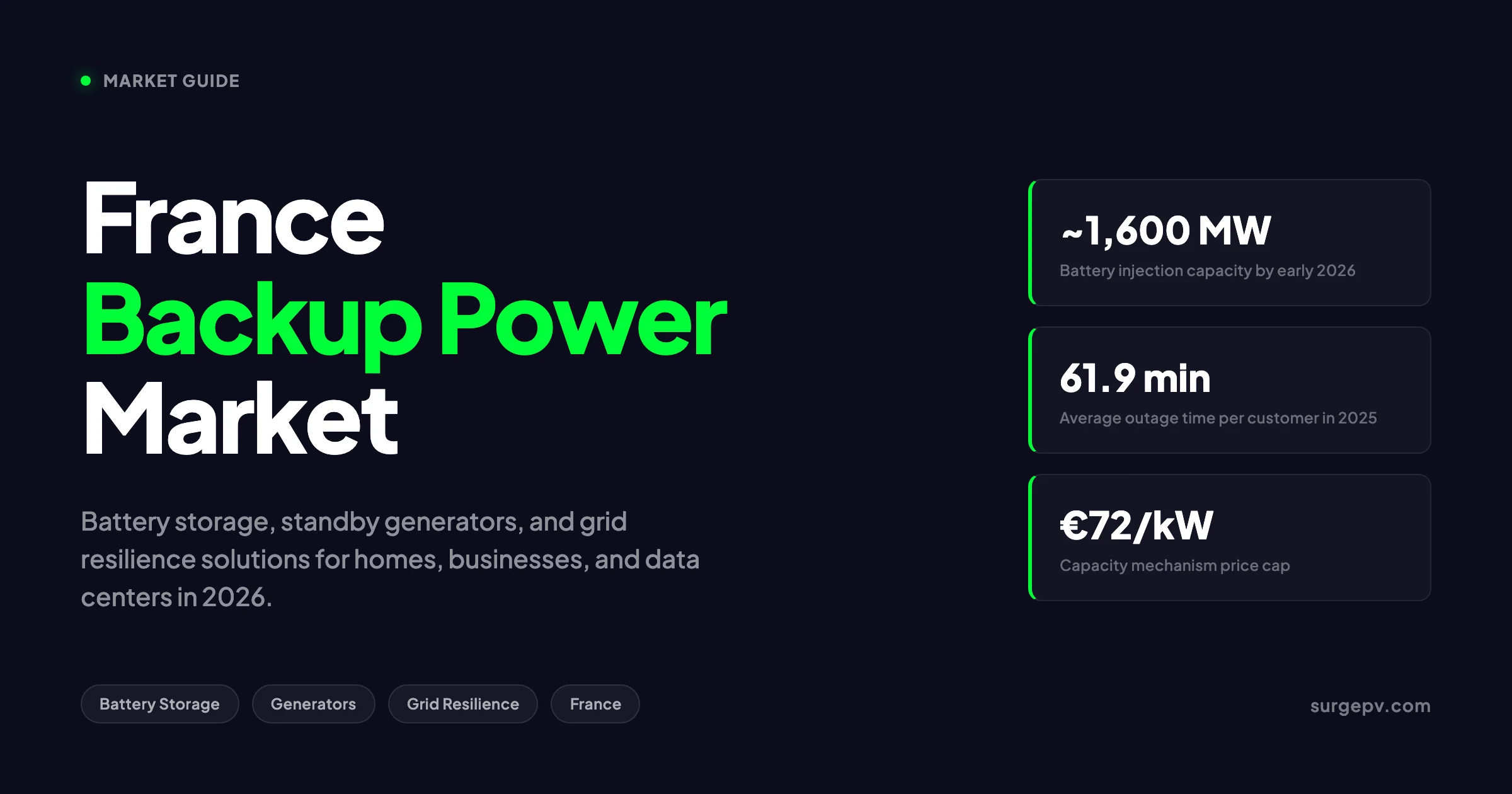
Answer: France’s backup-power market includes standby generators, UPS systems, batteries and hybrid installations. Buyers should compare the critical load, required operating duration, transfer performance and maintenance obligations before comparing prices. A grid-connected solar installation does not automatically operate during a power cut. French storage tariffs and capacity-market participation require specific eligibility checks and should not be treated as guaranteed battery income.
Reviewed against primary French network and regulator sources on 30 September 2026. Procurement guidance, not a market-size forecast, electrical installation instruction or revenue guarantee.
Define the market before comparing growth figures
“Backup power” describes a function, not a single equipment category. The French market includes residential emergency supply, commercial continuity systems, industrial standby generation and UPS installations for sensitive loads. Grid-scale batteries may provide flexibility without backing up a customer’s premises.
A market estimate needs a defined boundary: equipment sales or installed project value, annual revenue or cumulative capacity, France or a wider region, and the source year. Battery power in MW is not stored energy in MWh, and neither is market revenue. This guide does not retain the previous unsupported billion-dollar totals or growth forecasts because their scope and methodology were not established.
For installers, a more useful segmentation is the customer requirement:
| Buyer | Requirement to investigate | Procurement implication |
|---|---|---|
| Household | Named essential circuits and acceptable outage duration | Avoid assuming whole-home backup from battery capacity alone |
| Office or shop | Data protection, payment systems and controlled shutdown | Assess UPS performance and load-specific runtime |
| Factory | Process interruption, restart sequence and motor demand | Study transient power and continuity needs with the facility team |
| Data centre or critical facility | Documented service-continuity standard and recovery plan | Follow the site’s engineering and operational requirements |
| Storage developer | Grid-connected energy or flexibility services | Separate network and market participation from customer backup |
These are different buying journeys. A household storage quote should not inherit grid-scale capacity-market assumptions, and a UPS vendor’s market projection should not be used to size a factory generator.
Backup power technologies: compare the operating job
Batteries and solar-plus-storage
Batteries can supply energy without an on-site combustion engine, but backup capability depends on the complete system. Establish the supported output, protected circuits, available energy, transfer behavior and whether PV can restart or continue supplying the protected system during an outage.
Enedis explains why ordinary domestic grid-connected PV shuts down during a network cut. Solar ownership alone therefore does not establish autonomous supply. The proposed backup architecture and manufacturer documentation must support the actual function being sold.
A battery used every day for self-consumption can start an outage partly discharged. A guaranteed reserve reduces the energy available for daily shifting. State both assumptions in the proposal instead of promising maximum savings and maximum backup from the same stored energy.
Diesel and gas standby generators
Generators are candidates where duration and refuelling arrangements are important. Assess fuel availability, storage or supply constraints, startup and load-acceptance performance, ventilation, exhaust, noise, maintenance and the site’s applicable permissions. Gas supply availability must be evaluated rather than assumed from an electricity outage scenario.
Do not select a generator solely by adding appliance nameplate watts. Motor starting, phase balance, sensitive loads and acceptable voltage/frequency behavior need qualified assessment. A national claim that diesel is always permitted, always prohibited or subject to a uniform runtime limit is not a substitute for site-specific environmental and safety checks.
UPS systems
A UPS protects specified equipment through interruptions and, depending on its design, power-quality disturbances. Schneider Electric’s French UPS guide distinguishes load power and runtime: more load reduces available battery autonomy. Use the selected product’s load/runtime curve and transfer specification rather than applying one generic runtime to every UPS.
UPS procurement can target time for a controlled shutdown or time until another source takes over. Those are different requirements from running an entire premises for hours. Review both watt and VA ratings, load characteristics and the product’s limits.
Hybrid systems
A hybrid arrangement can combine UPS, battery, PV and generator functions, but their presence alone does not establish compatibility. Controls, transfer behavior, restart sequencing, maintenance access and commissioning evidence matter. Ask the responsible designer to describe normal operation, the loss-of-grid sequence and restoration to normal operation without relying on a marketing diagram.
Size the critical load before quoting runtime
Collect the customer’s protected-load list and identify what can stop, what must shut down safely and what must continue operating. Record steady demand, startup events, duty cycles and the required duration. Keep safety-critical and ordinary convenience requirements distinct.
For a screening example, assume 6 kWh of energy deliverable at the protected AC output, already accounting for the declared reserve and conversion assumptions:
| Constant protected load | Simple energy-limited runtime |
|---|---|
| 0.75 kW | 6 ÷ 0.75 = 8 hours |
| 1.5 kW | 6 ÷ 1.5 = 4 hours |
| 3 kW | 6 ÷ 3 = 2 hours |
These are hypothetical arithmetic results, not product guarantees. If an inverter cannot supply the load or a startup event, sufficient kWh does not solve the power problem. Variable demand, temperature, age, standby consumption and the actual starting charge can change runtime. If the energy figure is a DC nameplate rating rather than deliverable AC energy, the worksheet needs the additional limits and losses explicitly.
France’s storage policies: distinguish tariffs from revenue
The optional injection-withdrawal TURPE component
CRE’s published scope describes an optional annual injection-withdrawal component from 1 August 2026 for storage connected at HTA, HTB 1 and HTB 2, in specified eligible zones. Its purpose is to encourage operation that reduces local network peaks.
This does not mean every battery receives a grid-support payment or that an ordinary low-voltage home battery qualifies. Check connection level, location, the current tariff decision and the proposed operating schedule. A tariff saving must be calculated against the applicable alternative; it is not a separate revenue line merely because the tariff exists.
The new capacity mechanism
RTE’s current participation page provides mechanism rules, certification and contractual documentation for the new delivery periods. Its guidance includes defined participant roles and site documentation; the rules take precedence over explanatory material.
For a project business case, request evidence of the relevant participation route, certified capacity, delivery commitments, aggregator or participant terms and fees. Do not treat an auction price cap as the payment received by every installed kW. Check whether market operation leaves enough energy available for the customer’s promised backup service.
Solar export support is a separate question
A PV purchase contract or self-consumption premium is not automatically a battery subsidy. Eligibility, application timing, installation scope and the treatment of stored energy require the applicable scheme and contract. Use the France feed-in tariff guide for the solar-contract questions; do not reuse obsolete tariff tables as current storage revenue.
Build a defensible business case
Separate three types of value:
- Continuity value: customer-estimated interruption consequences, with the incident scenario and remaining risks stated.
- Energy-bill effect: incremental avoided imports and changed export proceeds, including losses, tariffs and reserve constraints.
- Contracted market value: only eligible, evidenced services with fees, availability obligations and operating conflicts accounted for.
Avoid counting one energy discharge twice across self-consumption and export revenue, or one available kW twice across incompatible commitments. Peak reduction has value only where the customer’s actual tariff makes the relevant peak or subscribed capacity financially significant.
Request itemized quotations for equipment, installation, protection and controls, commissioning, service, fuel arrangements where relevant and replacement. Generic residential price bands or a nationwide five-to-eight-year payback conceal the load and contract assumptions that determine the result. Financing and discounting also belong in a lifetime cash-flow evaluation, rather than a simple payback label.
Use the production-estimate assumption register to retain the PV side of a hybrid proposal. Keep backup load, reserve, transfer performance and market commitments in their own clearly identified fields.
Questions to ask before accepting a proposal
Ask what remains energized during an outage, at what power and for what declared duration. Request the starting-charge assumption, outage operating sequence, restart limitations, monitoring arrangements and commissioning record. Ask which permissions and network agreements are still outstanding and which party is responsible for completing them.
For generators, require a documented fuel, maintenance and operating plan. For batteries and UPS, require product-specific performance and service information. For any revenue forecast, request the actual source or contract and a scenario without that income. A responsible proposal explains its limits as clearly as its benefits.
Frequently asked questions
How big is the France backup power market?
There is no verified combined market value established in this guide. Generator sales, UPS equipment, residential batteries and grid-scale storage are different datasets; adding their reported values can double-count systems and mix incompatible market boundaries.
Will rooftop solar keep working during a French power cut?
Ordinary grid-connected PV shuts down when the public network is unavailable. Backup operation requires a system designed and commissioned for that function, with appropriate isolation, controls, storage or other supply, and a defined protected-load boundary.
Is a battery always better than a generator?
No. Compare the required power, duration, transfer performance, operating environment and maintenance. A battery has finite stored energy; a generator needs suitable fuel, installation and maintenance. Some critical sites use several technologies together.
Does the August 2026 French storage tariff pay every battery owner?
No. CRE describes an optional injection-withdrawal network tariff component for eligible storage in specified zones and connection voltage levels. It is a tariff arrangement, not an automatic grant or payment to every home battery.
Can backup batteries earn French capacity-market revenue?
Potential participation depends on the current RTE mechanism rules, certification, contracts and delivery obligations. Reserve energy promised for customer backup may conflict with market dispatch commitments; model that constraint before counting revenue.
How should an installer estimate battery backup duration?
Use deliverable AC energy for the declared starting state of charge and reserve, divided by the protected load for a simple screening estimate. Check inverter power, startup demand, changing load and manufacturer performance separately; the screening result is not a guaranteed runtime.
Where this fits
This article is part of SurgePV's Solar Business & Operations hub, which works through the topic from first principles to the decisions a project team actually has to make.


