

Solar procurement stopped being a back-office function sometime around 2022. Today, an EPC procurement manager wakes up to tariff headlines, FEOC rule changes, module technology switches, and transformer lead times measured in years. One wrong sourcing call can erase the margin on a whole project.
This guide is for the people making those calls. It covers how to source modules, inverters, racking, and balance of system for solar EPC projects in 2026. You will get a supplier scorecard, a contract framework, a compliance checklist, and a workflow you can use on the next RFQ.
In this guide, you will learn:
- What EPC sourcing actually covers — and why it is different from everyday procurement
- How 2026 trade rules and market conditions affect buying decisions
- How to build a solar BOM that matches the project, not just the catalog
- A 10-point supplier scorecard with weights you can adjust
- Contract and pricing models that protect margins
- How to calculate FEOC exposure using MACR
- Supply chain risk tactics that work when lead times stretch
- The most expensive sourcing mistakes EPCs repeat
Quick Answer
EPC sourcing is the structured procurement of all engineered equipment and materials for a solar project — modules, inverters, racking, BOS, and spares — plus the contracts that control price, delivery, quality, and compliance risk. In 2026, it is also a trade-policy and finance discipline.
What Is EPC Sourcing?
EPC sourcing sits inside the procurement phase of Engineering, Procurement, and Construction. But it is not the same as buying office supplies or even general construction materials. It is the process of specifying, selecting, pricing, contracting, and delivering the equipment that defines system performance for the next 25 years.
The scope usually includes:
- Solar modules — technology, wattage, efficiency, warranty, country of origin
- Inverters — string, central, or micro; grid support functions; monitoring
- Racking and mounting — roof, ground, or carport; structural loads; corrosion resistance
- Balance of system — cables, combiners, disconnects, transformers, switchgear, monitoring
- Spares and consumables — replacement modules, fuses, connectors, fasteners
- Logistics and documentation — Incoterms, customs, certificates, manuals, as-builts
The EPC is often the single point of accountability. That means the sourcing team is not just buying boxes. It is allocating technical, financial, schedule, and compliance risk across suppliers.
There are three common procurement models:
| Model | Who buys | Best for | Risk note |
|---|---|---|---|
| EPC-procured | EPC contractor | Turnkey projects, tax credit optimization | EPC controls schedule and warranty compatibility |
| Owner-supplied | Project owner | Large utilities, captive procurement teams | Owner carries specification and delivery risk |
| Hybrid | Owner buys long-lead items, EPC buys BOS | Projects with owner financing advantages | Clear scope split is critical to avoid gaps |
In most commercial and industrial projects, EPC-procured equipment is the cleanest path. It keeps one throat to choke when modules arrive with the wrong frame thickness or inverters show up without the right grid settings.
The 2026 EPC Sourcing Landscape
The solar EPC market is growing, but the growth is uneven. Global EPC revenue was estimated at roughly $864 billion in 2025 and is projected to reach about $1.18 trillion by 2035, according to Expert Market Research. Solar and battery storage are the fastest-growing segments inside that total.
For solar specifically, the market is being shaped by four forces in 2026:
- Module oversupply and price pressure — Global module manufacturing capacity far exceeds demand, which keeps headline prices low. But US-bound modules face tariff stacks that can double the landed cost compared to other markets.
- FEOC and domestic content rules — The Inflation Reduction Act and follow-on guidance now tie tax credits to the origin of manufacturers, not just the place of assembly.
- Inverter and transformer shortages — Lead times for medium-voltage transformers can reach one year, and high-voltage transformers can stretch to two to four years.
- Technology transition — N-type TOPCon modules are now the mainstream choice, with HJT and bifacial options gaining share. Mono PERC is fading.
Module Prices in 2026
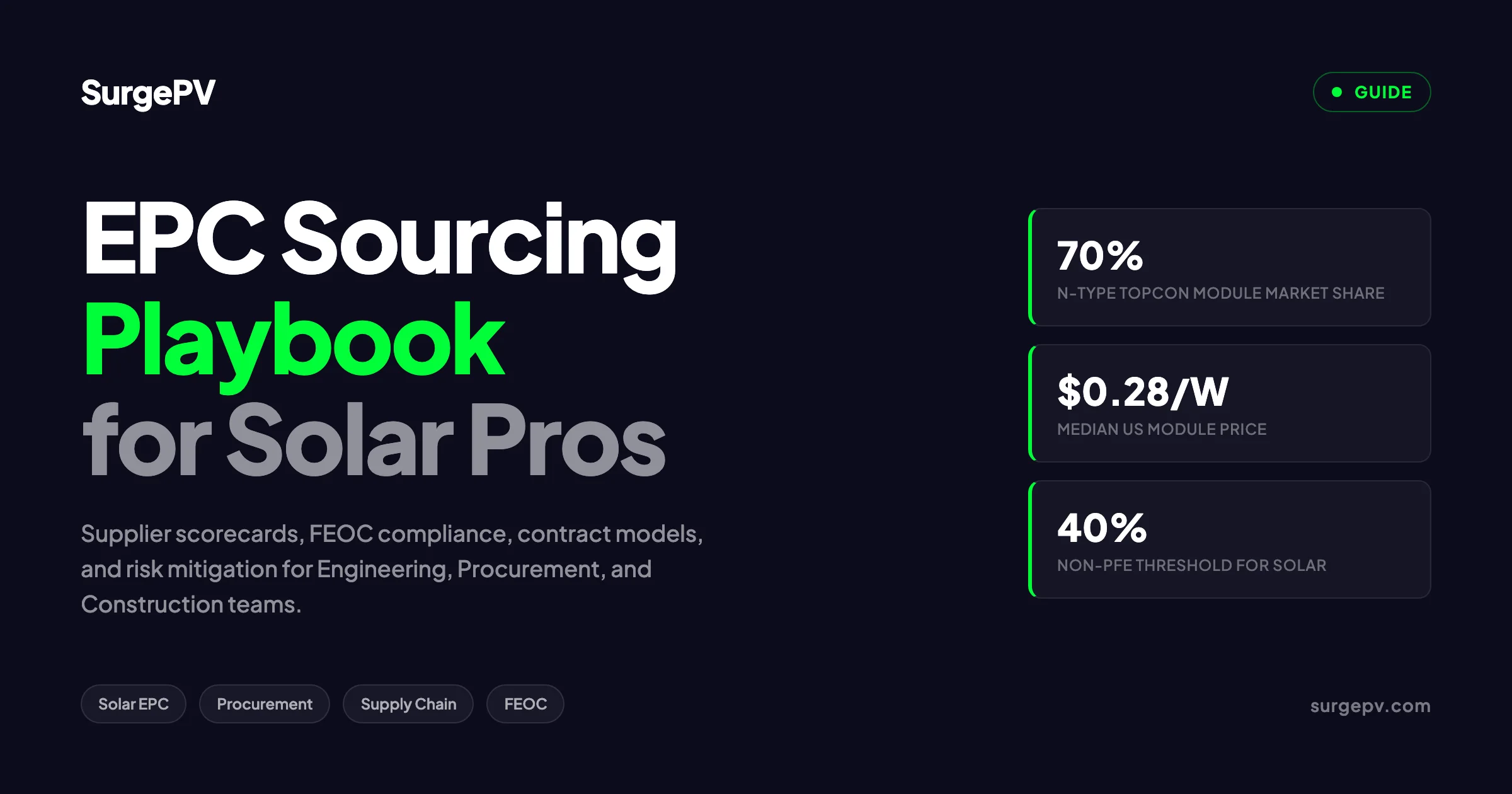
According to Anza data cited by PV Magazine USA, the median US module price in Q1 2026 was about $0.28/W, up from roughly $0.25/W in early 2025. FEOC-compliant modules carried a premium of around 4.9%, while non-FEOC modules spiked by about 9.2% during safe-harbor buying rushes.
All-in installed costs vary sharply by segment:
| Segment | Typical 2026 cost per watt |
|---|---|
| Utility-scale | $0.90–$1.30/W |
| Commercial and industrial | $1.40–$2.20/W |
| Residential | $2.50–$3.50/W |
Soft costs — labor, permitting, interconnection, overhead, and margin — now dominate the total installed cost, especially in residential and small C&I projects. That makes module savings less impactful than they look on a $/W basis.
Inverter and Transformer Lead Times
Inverter sourcing is a growing pain point. String inverters for commercial projects often ship in 8–16 weeks, but central inverters and power conversion systems for utility-scale projects can take 6–12 months. Medium-voltage transformers are worse. Anza notes MV transformer lead times can reach one year, and HV transformers can take two to four years.
For EPCs, this means inverter and transformer procurement must start before civil work, not after module delivery.
How to Build a Solar EPC Bill of Materials
A good BOM is not a copy-paste from the last project. It is a specification document that ties every line item to the site, the design, the contract, and the warranty.
Start with the design outputs:
- Single-line diagram
- Array layout and stringing plan
- Structural drawings and load calculations
- Electrical calculations and voltage drop analysis
- Site environmental conditions — wind, snow, salt, dust, temperature
Then build the BOM in categories:
1. Solar Modules
Key decisions:
- Technology: N-type TOPCon is the default for new projects in 2026. HJT offers higher efficiency but at a premium. Bifacial is worth considering on high-albedo ground mounts.
- Power class: Match the module to the inverter input window and the racking compatibility. A 620 W module in a 400 W design creates more problems than it solves.
- Frame thickness: Critical for clamp selection. Always confirm before ordering racking hardware.
- Certifications: IEC 61215, IEC 61730, and UL 61730 for the target market.
- Warranty: 25-year power warranty is standard; 30-year warranties are increasingly available.
2. Inverters
Key decisions:
- Topology: String inverters for commercial rooftops, central inverters for utility-scale, microinverters for complex roofs or shading.
- Grid support: LVRT, HVRT, frequency-watt, volt-var, and ride-through settings must match the local utility.
- Efficiency: Peak efficiency of 98–99% is common; weighted efficiency matters more than peak.
- Monitoring: Native monitoring, Modbus/SunSpec compatibility, and remote firmware update capability.
3. Racking and Mounting
Key decisions:
- Roof type: Tile, trapezoidal metal, corrugated, standing seam, or flat roof each needs different attachments.
- Material: Aluminum for corrosion resistance, galvanized steel for ground mounts where cost matters.
- Loads: Wind and snow loads from local codes, not catalog values.
- Grounding: Bonding methods must meet NEC or local standards.
4. Balance of System
BOS is where small items cause big delays. A typical list includes:
- DC cable, connectors, and cable management
- AC cable, conduit, and terminations
- Combiner boxes and recombiners
- DC disconnects and AC disconnects
- Transformers and switchgear
- Monitoring hardware and communications
- Safety labels, signage, and PPE
5. Spares
Carry spares for items that are hard to replace quickly:
- 1–2% spare modules, minimum one full string
- Replacement fuses and connectors
- Inverter spare parts if the manufacturer has long lead times
- Fasteners and small hardware for coastal or high-wind sites
Pro Tip
Never create a final BOM before you have roof drawings, module datasheets, and the single-line diagram. We have seen projects re-procure racking because the clamp was designed for a 35 mm frame and the modules arrived with 40 mm frames. That mistake costs more than the savings from a cheaper module.
Supplier Evaluation: The 10-Point Scorecard
Supplier selection is the highest-leverage decision in EPC sourcing. A low price from a supplier that misses delivery or goes insolvent is the most expensive option.
Use this scorecard and weight the categories to match your project risk profile.
| Category | What to check | Weight suggestion |
|---|---|---|
| Technology and product fit | Module tech, inverter topology, compatibility with design | 15% |
| Certifications and quality | IEC/UL, factory audits, EL testing, ISO 9001 | 15% |
| Financial health | Audited financials, debt, cash flow, credit checks | 15% |
| Track record | Reference projects, MW delivered, years in market | 10% |
| Lead time and capacity | Production slots, shipping routes, buffer capacity | 10% |
| Warranty and support | Warranty terms, local service, response time | 10% |
| Compliance and origin | FEOC status, domestic content, tariff exposure | 10% |
| Total cost of ownership | Price, freight, payment terms, testing, duties | 10% |
| Logistics and packaging | Incoterms, customs experience, damage rates | 3% |
| ESG and sustainability | Labor standards, recycled content, carbon disclosure | 2% |
A score above 80 is a strong primary supplier. A score between 60 and 80 is acceptable as a secondary or for non-critical items. Below 60 is a red flag, even if the price is attractive.
Financial Health: The Most Overlooked Filter
In a market with oversupply and price wars, supplier insolvency is a real risk. Request audited financials for the last two to three years. Look at:
- Revenue trend and gross margin
- Debt-to-equity ratio
- Operating cash flow
- Days payable outstanding
If the supplier is private and will not share financials, ask for a bank reference or use a trade credit report. A module warranty from a company that does not exist in year five is worthless.
Do Not Rely Only on Tier-1 Lists
BloombergNEF Tier-1 status is a bankability indicator, not a quality certificate. It measures the supplier’s ability to get non-recourse project finance, not the reliability of every batch. Use Tier-1 as one input, then add factory audits, independent testing, and reference checks.
Contract and Pricing Models That Protect EPC Margins
The contract form determines who eats the cost when steel prices jump, modules arrive late, or the inverter firmware does not match the grid code.
Lump Sum Fixed Price
The EPC quotes a fixed price for a defined scope. This is the cleanest model for owners and the riskiest for EPCs if the BOM is not locked.
Best for: Well-defined projects with approved designs and stable commodity prices. Risk note: Any specification change becomes a variation order.
Cost-Plus with Fee
The owner reimburses actual costs plus an agreed fee. This transfers cost risk to the owner but reduces the EPC’s incentive to control spending.
Best for: Fast-track projects, early-stage developments, or projects with high uncertainty. Risk note: Requires strong cost reporting and audit rights.
Target Price with Gainshare/Painshare
The EPC and owner agree a target cost. Savings below the target are shared; overruns are shared.
Best for: Collaborative projects where both parties want cost control without full lump-sum risk. Risk note: The sharing formula must be clear and fair.
Full Turnkey
The EPC delivers a fully operational plant. This usually includes design, procurement, construction, commissioning, and sometimes initial O&M.
Best for: Owners who want one counterparty and a guaranteed outcome. Risk note: The EPC must price performance risk, not just equipment.
Payment Terms That Protect Cash Flow
Standard terms for major equipment:
- 10–20% advance payment on order
- 60–70% on shipment or delivery
- 10–20% retention until commissioning or practical completion
Avoid paying more than 30% upfront unless the supplier posts a performance bond or letter of credit. For long-lead items, use milestone payments tied to factory acceptance tests or bills of lading.
Trade Compliance: FEOC, Tariffs, and Domestic Content
Trade compliance is now a core EPC sourcing competency. The rules change the math on every BOM line item.
FEOC and Non-PFE Requirements
For solar projects beginning construction in 2026, at least 40% of manufactured product costs must come from non-Prohibited Foreign Entities to qualify for the full federal clean energy tax credit. The threshold rises 5 percentage points each year, reaching 60% for projects starting after 2029.
Energy storage has a stricter schedule: 55% non-PFE in 2026, rising to 75% after 2029.
The calculation uses the Material Assistance Cost Ratio, or MACR:
MACR = (A - B) / AWhere:
- A = direct cost of all equipment used in the project
- B = direct cost of equipment supplied by Prohibited Foreign Entities
For example, if a project uses $1,000,000 of equipment and $550,000 comes from PFE suppliers, the MACR is 45%. That clears the 2026 solar threshold of 40%.
Key 2026 Tariff and Trade Measures
- Section 201 tariffs: Applied to imported crystalline silicon cells and modules since 2018, extended in 2022, with the first 12.5 GW of cells exempt annually. The current extension is set to end February 2026.
- Section 301 tariffs: In 2024, tariffs on Chinese solar cells, modules, wafers, and polysilicon rose to 50%.
- AD/CVD duties: Active against China and Taiwan since 2012/2014. Southeast Asian circumvention duties began in June 2024 for products using Chinese wafers plus two other Chinese inputs.
- China VAT rebate cancellation: China eliminated VAT export rebates for PV products as of April 1, 2026, adding roughly 3–5% to landed costs.
What EPCs Must Do
- Map every manufactured product in the BOM to a supplier.
- Obtain a signed non-PFE certification from each supplier.
- Calculate MACR at the qualified facility level.
- Document contracts, deposits, payments, and physical construction start.
- Retain records for at least six years.
The IRS can challenge compliance for six years, and miscalculations can trigger penalties of 20% of the claimed credit.
Key Takeaway
FEOC compliance is about the entity, not just the country of assembly. A module assembled in the U.S. can still fail the test if the manufacturer is owned or controlled by a Prohibited Foreign Entity. Always verify entity status in writing.
Supply Chain Risk Mitigation
Even the best supplier can be hit by a port strike, a customs hold, or a sudden tariff announcement. EPCs need buffers, not just promises.
Dual Sourcing
Maintain approved vendor lists with at least two qualified suppliers for every critical category: modules, inverters, racking, transformers, and cables. Dual sourcing is not about playing suppliers against each other. It is about having a backup when the primary cannot deliver.
Inventory Buffers
For long-lead items, keep 30–60 days of buffer inventory. For transformers and central inverters, consider ordering early and storing off-site. The carrying cost is usually lower than the delay cost.
Letters of Credit and Payment Discipline
Use letters of credit or escrow arrangements for large upfront payments. Avoid wiring 50% deposits to suppliers you have not worked with before. Tie major payments to milestones: factory acceptance test, bill of lading, arrival at port, and commissioning.
Freight and Logistics
Lock freight rates early and confirm Incoterms. DDP terms shift customs and duty risk to the supplier but usually cost more. FOB terms give the EPC more control but require customs expertise.
Currency Hedging
For international purchases, consider hedging major currency exposure if the project has a fixed-price contract. A 10% currency swing can erase the margin on a module order.
Common EPC Sourcing Mistakes
These are the mistakes we see most often on solar EPC projects.
1. Buying on $/W Alone
The cheapest module is rarely the lowest total cost. Add tariffs, freight, warranty risk, degradation rate, and compatibility cost. A module that saves $0.02/W but causes a 2% clipping loss or a racking mismatch can cost far more over the project life.
2. Ignoring Frame Thickness and Racking Compatibility
Module frame thickness varies by manufacturer and power class. A 35 mm clamp will not fit a 40 mm frame. Verify before ordering.
3. Late Inverter Procurement
Inverters and transformers have the longest lead times. Waiting until modules arrive to order inverters is a common schedule killer.
4. Weak Contract Terms
Vague delivery clauses, missing liquidated damages, and unclear warranty start dates create disputes. Define acceptance criteria, delay penalties, and warranty start date in the purchase order.
5. Skipping Financial Due Diligence
A low price from a financially stressed supplier is a trap. If the supplier fails, the warranty fails with it. Always check financial health before placing large orders.
Design and Source Faster with SurgePV
SurgePV helps solar EPCs move from site assessment to BOM-ready design in one cloud platform. Generate layouts, run shadow analysis, and build proposals that match your procurement strategy.
Book a DemoNo commitment required · 20 minutes · Live project walkthrough
EPC Sourcing Workflow: From RFQ to Delivery
Here is a practical workflow for solar EPC sourcing. Adjust the timeline based on project size and region.
Step 1: Lock the Design Inputs
Finalize the single-line diagram, array layout, structural drawings, and environmental loads. The BOM cannot be accurate until the design is stable.
Step 2: Issue Technical Specifications
Write a specification for each major category: modules, inverters, racking, BOS. Include performance criteria, certifications, origin requirements, and acceptance tests.
Step 3: Pre-Qualify Suppliers
Run the 10-point scorecard. Eliminate suppliers below 60. Keep at least two qualified options for each critical category.
Step 4: Request Quotations
Send RFQs with a consistent scope. Ask for:
- Itemized pricing
- Lead time and delivery schedule
- Incoterms and shipping terms
- Payment terms
- Warranty terms and start date
- Certificates and test reports
- Non-PFE or domestic content confirmation
Step 5: Evaluate on Total Cost of Ownership
Compare quotes on a consistent basis. Include freight, insurance, duties, testing, financing cost, and warranty value. A $0.26/W module with $0.04/W of freight and duty is not cheaper than a $0.28/W module delivered DDP.
Step 6: Negotiate and Award
Negotiate price, payment terms, and delivery. Award the order and issue purchase orders with clear acceptance criteria and delay penalties.
Step 7: Track and Inspect
Monitor production, factory acceptance tests, shipping, customs clearance, and site delivery. Inspect on arrival and document any damage immediately.
How SurgePV Fits into EPC Sourcing
Good sourcing starts with good design data. SurgePV gives EPC teams a cloud-based platform to design smarter and sell faster.
- Solar design software helps you lay out arrays, select string configurations, and generate accurate BOMs from real module and inverter data.
- Shadow analysis lets you validate irradiance and shading before you commit to a module count.
- Generation and financial tool models energy yield and project economics so you can justify module and inverter choices to the owner.
- Solar proposals turns the BOM and financial model into a professional proposal.
If your procurement team is still working from spreadsheets passed down from sales, the handoff is costing you money. A shared design platform reduces specification errors and speeds up RFQ preparation.
Conclusion
EPC sourcing in 2026 is a risk management job. The winners are not the buyers who find the lowest $/W. They are the buyers who build a BOM that matches the design, choose suppliers who will still be around in year ten, and write contracts that allocate risk clearly.
Three actions to take this week:
- Run your current top three suppliers through the 10-point scorecard. If any score below 60, find a backup.
- Calculate MACR for your next US project. Know your FEOC exposure before you sign purchase orders.
- Review your payment terms. If you are paying more than 30% upfront without security, renegotiate.
For more on European procurement conditions, read our post on solar procurement challenges in Europe. For a deeper look at tariff impacts, see solar trade tariffs impact analysis.
Frequently Asked Questions
What is EPC sourcing?
EPC sourcing is the process of selecting, pricing, and procuring all engineered equipment and materials for a solar Engineering, Procurement, and Construction project. It covers modules, inverters, racking, balance of system, spares, and the contracts that govern delivery and risk.
How do EPCs evaluate solar module suppliers in 2026?
Use a 10-point scorecard: technology and efficiency, certifications, factory audit results, financial health, warranty enforceability, lead time and logistics, local support, track record, compliance with FEOC or domestic content rules, and total cost of ownership including tariffs and financing terms.
What is the 2026 FEOC non-PFE requirement for solar projects?
For solar projects beginning construction in 2026, at least 40% of manufactured product costs must come from non-Prohibited Foreign Entities to qualify for federal clean energy tax credits. The threshold rises 5 percentage points each year until it reaches 60% for projects starting after 2029.
What are the main solar EPC contract types?
The four common models are lump sum fixed price, cost-plus with a fee, target price with gainshare/painshare, and full turnkey. Each shifts risk differently between the EPC and the owner.
How can EPCs mitigate supply chain risk?
Maintain approved vendor lists with at least two qualified suppliers per critical category, keep 30–60 days of buffer inventory for long-lead items, use letters of credit or milestone payments instead of large upfront deposits, and lock freight rates early.
What is the typical US solar module price in 2026?
Median US module prices were around $0.28/W in Q1 2026 according to Anza, up from roughly $0.25/W in early 2025. FEOC-compliant modules carry a small premium, while non-FEOC modules saw sharper price spikes during safe-harbor rushes.
What is MACR in FEOC compliance?
MACR stands for Material Assistance Cost Ratio. It equals the direct cost of all equipment minus the direct cost of equipment from Prohibited Foreign Entities, divided by the direct cost of all equipment. Solar projects starting in 2026 need a MACR of at least 40%.
Should EPCs buy equipment or let the owner supply it?
EPC-procured equipment gives one point of accountability and better schedule control. Owner-supplied equipment can reduce markup but shifts warranty and compatibility risk to the owner. The right choice depends on financing, tax credit strategy, and the owner’s procurement capability.
Where this fits
This article is part of SurgePV's Solar Business & Operations hub, which works through the topic from first principles to the decisions a project team actually has to make.

