

Quick Answer
Conventional wisdom says US solar tariffs raised module costs by 20–30%. Anza's Q1 2026 pricing report puts median US delivered module pricing at $0.28/W against a global benchmark closer to $0.11/W. Anyone modeling delivered cost without all eight layers will produce a number that misses reality by $0.10–0.15/W. Active. 50% on cells and modules; covers wafers + polysilicon since Jan 2025.
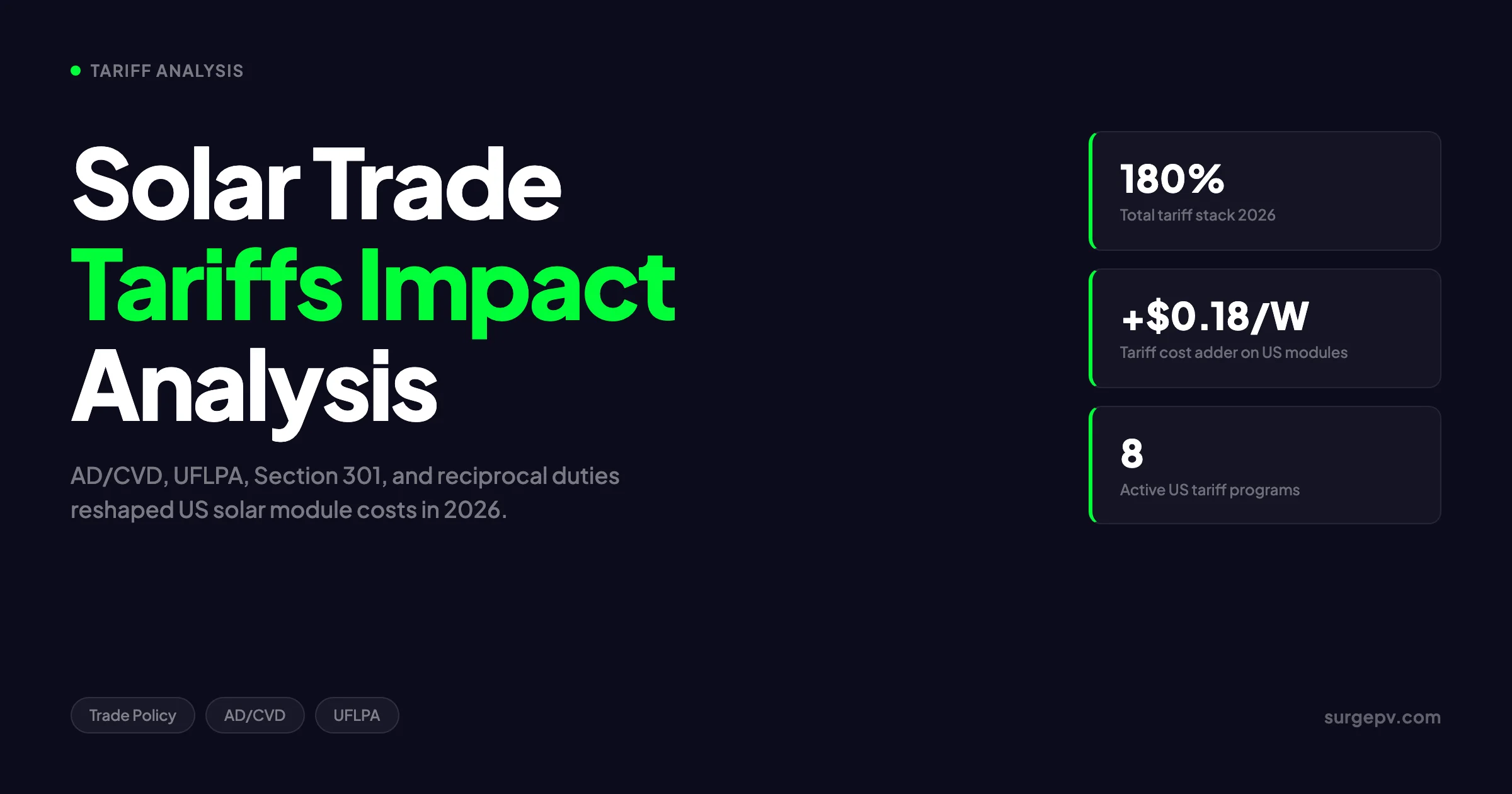
Conventional wisdom says US solar tariffs raised module costs by 20–30%. The real number for a Cambodia-origin delivered module in 2026 sits closer to 180% when you stack the antidumping duty, the countervailing duty, the 49% reciprocal rate, and the residual Section 301 exposure on Chinese-origin cells. The Department of Commerce’s April 2025 final determination assigned a 3,403% CVD rate to Cambodia and an effective combined rate that has, for practical purposes, eliminated Cambodia, Vietnam, and Thailand as economically viable origins for US-bound product. That outcome was the explicit goal of the petitioners — Hanwha Qcells, First Solar, Mission Solar, REC Silicon, and Meyer Burger — but it has not produced the manufacturing renaissance their case promised. Anza’s Q1 2026 pricing report puts median US delivered module pricing at $0.28/W against a global benchmark closer to $0.11/W. The gap is being absorbed by developers, ratepayers, and the federal Treasury through Section 45X tax credits — not by Chinese exporters.
Conventional wisdom says US solar tariffs raised module costs by 20–30%. Anza’s Q1 2026 pricing report puts median US delivered module pricing at $0.28/W against a global benchmark closer to $0.11/W. Anyone modeling delivered cost without all eight layers will produce a number that misses reality by $0.10–0.15/W. For Global-specific compliance details, see Global net-metering-by-country. For Global-specific compliance details, see Global solar-permitting-speed-by-country.
This solar trade tariffs impact analysis covers every active US duty layer in 2026, the EU’s structurally different approach, how the delivered cost math actually works, and what most published analyses get wrong about who pays.
TL;DR — Solar Trade Tariffs 2026
Section 201 expired Feb 6, 2026. AD/CVD on Cambodia, Malaysia, Thailand, Vietnam cells became effective June 16, 2025 — combined effective rates of 34% (Malaysia) to 652% (Cambodia). Section 301 on Chinese cells doubled to 50% in 2024 and now covers wafers and polysilicon. UFLPA has detained $3.94B in shipments since 2022, with solar capturing 82% by value. EU has no active solar MIP and applies 0% MFN. US delivered modules hold at $0.28/W versus a $0.10–0.13/W global benchmark — a ~$0.18/W tariff-driven adder.
In this guide:
- Every active US solar tariff layer in 2026 — AD/CVD, Section 301, UFLPA, reciprocal duties, Section 232 polysilicon
- Why the AD/CVD case reshaped Southeast Asia sourcing and where cells moved next
- UFLPA enforcement data — CBP detentions, Entity List expansion, polysilicon traceability
- What most tariff analyses get wrong about who actually pays
- EU’s tariff floor approach versus the US stack
- Delivered module cost math line by line for a 100 MW utility project
- How developers, EPCs, and module buyers are sourcing around the stack
- 2026–2028 policy outlook and Section 232 risk
Tariff Stack on US Solar Imports 2026
US solar trade policy is no longer one tariff. It is a layered stack of at least eight active duty programs, plus the Foreign Entity of Concern (FEOC) restrictions inside the Inflation Reduction Act, plus the rebuttable presumption created by the Uyghur Forced Labor Prevention Act. Anyone modeling delivered cost without all eight layers will produce a number that misses reality by $0.10–0.15/W.
Every Active US Solar Tariff Program — May 2026
| Program | Status | Rate / Scope | Effective |
|---|---|---|---|
| Section 201 Safeguard | Expired | 14% final year rate, bifacial covered | Feb 6, 2026 |
| Section 301 (China) | Active | 50% on cells and modules; covers wafers + polysilicon since Jan 2025 | Aug 1, 2024 |
| AD/CVD — Cambodia cells | Active | Combined effective 652% average | Jun 16, 2025 |
| AD/CVD — Vietnam cells | Active | Combined effective 396% average | Jun 16, 2025 |
| AD/CVD — Thailand cells | Active | Combined effective 375% average | Jun 16, 2025 |
| AD/CVD — Malaysia cells | Active | Combined effective 34% average | Jun 16, 2025 |
| Reciprocal Tariffs (SE Asia) | Active | 24% (Malaysia) to 49% (Cambodia) | Jul 9, 2025 |
| UFLPA Rebuttable Presumption | Active | Detention of any product traceable to Xinjiang inputs | Jun 21, 2022 |
| 10% Base Tariff (China) | Active | Additive 10% on all Chinese goods | Feb 4, 2025 |
| Section 232 on Polysilicon | Under investigation | Pending — potential national-security rate | Investigation opened 2026 |
Sources: International Trade Administration final AD/CVD determinations (April 2025); USTR Section 301 review memo (May 2024); SolarPowerWorld reporting on Section 201 expiry (Feb 2026); Anza Q1 2026 Pricing Report.
Why Stacking Matters
Most reporting on solar tariffs focuses on a single program in isolation. The mistake is that the duties are additive on landed value, not alternative. A module imported from Vietnam in May 2026 carries:
- The AD rate assigned to the manufacturer (up to 271.28% per the DOC final determination)
- The CVD rate assigned to the manufacturer (up to 542.64%)
- The 46% reciprocal tariff that took effect July 9, 2025
- Any Section 301 component duty if cells were Chinese-origin
- UFLPA detention risk on any polysilicon trace to Xinjiang
A buyer paying a $0.20/W FOB Vietnam invoice books an estimated landed cost approaching $0.55/W before insurance, shipping, and inland transport. That is the math driving the $0.28/W median Anza pricing — most product no longer comes from the four hit countries.
Pro Tip — Modeling Delivered Cost
Procurement teams should model three landed cost scenarios per supplier: pre-AD/CVD baseline, post-AD/CVD with current reciprocal rate, and post-AD/CVD with a 10% upside reciprocal surge. The Q1 2026 reciprocal regime is unstable — the July 9, 2025 increase has been challenged in the Court of International Trade and could revert or escalate. Building all three scenarios into procurement contracts via tariff-pass-through clauses is now standard for serious utility-scale buyers.
AD/CVD on Southeast Asia — Why It Reshaped Sourcing
The April 2024 petition filed by the American Alliance for Solar Manufacturing Trade Committee was the most consequential trade action in solar’s modern history. The petitioners — Hanwha Qcells, First Solar, Mission Solar Energy, REC Silicon, and Swiss-headquartered Meyer Burger — argued that Chinese-owned manufacturers had simply moved cell assembly to Cambodia, Malaysia, Thailand, and Vietnam to circumvent the existing AD/CVD orders on China-origin solar.
The Department of Commerce agreed. On April 21, 2025, Commerce issued final affirmative determinations. The International Trade Commission voted unanimously on June 9, 2025, confirming material injury. AD/CVD orders took effect June 16, 2025, and US Customs and Border Protection began collecting duties on entries from that date forward. For more on this topic, see Solar Sales Commission Structure.
Final AD/CVD Rates by Country and Manufacturer
| Country | AD Rate (range) | CVD Rate (range) | Notable Manufacturer | Combined Effective Rate |
|---|---|---|---|---|
| Cambodia | up to 125.37% | up to 3,403.96% | Various | ~652% average per InfoLink |
| Vietnam | up to 271.28% | up to 542.64% | JA Solar, Trina, JinkoSolar (Vietnam ops) | ~396% average |
| Thailand | up to 202.90% | up to 799.55% | LONGi (Thailand), Astronergy | ~375% average |
| Malaysia | up to 81.24% | up to 168.80% | Hanwha Qcells (Malaysia) | ~34% average |
| Malaysia — Hanwha Qcells | 0% AD | 14.64% CVD | Hanwha Qcells | ~14.64% |
Sources: International Trade Administration final determinations (April 21, 2025); PV Tech reporting on June 2025 AD/CVD orders; InfoLink Consulting policy analysis.
Why Malaysia Survived
Malaysia is the only Southeast Asian origin that remains commercially viable in 2026, and only narrowly. Hanwha Qcells — a Korean-owned petitioner that maintains Malaysian manufacturing — received a 0% AD margin and a 14.64% CVD rate. That outcome is not an accident. Petitioners in AD/CVD cases routinely receive lower or zero rates because they cooperate fully with Commerce on data submission and have the legal infrastructure to produce timely responses. Non-cooperating respondents get hit with “adverse facts available” — the highest rate available in the record. That is how Cambodia ended up at 3,403.96% CVD.
This is one of the AD/CVD case’s structural features: the rates do not necessarily reflect actual dumping margins. They reflect the speed and quality of the respondent’s lawyer response. Cambodia’s headline rate is essentially a paperwork penalty.
Where Production Moved
By Q1 2026, US import data shows the four-country share of US solar cell imports collapsing from approximately 76% in 2024 to under 12% by March 2026. The replacement origins:
- Indonesia and Laos — newly built cell lines targeting US-bound modules
- India — boosted by PLI scheme support
- South Korea — Hanwha Qcells US-bound product
- United States — IRA Section 45X production picking up at First Solar, Hanwha Qcells Cartersville, Silfab, Heliene, and several greenfield projects Also see: Best Solar Design Software India. For India-specific information, see 5kW Solar Panel Price in India.
The shift is the textbook AD/CVD policy outcome — but the unintended effect is that an entirely new round of AD/CVD petitions is now in preparation against Indonesia and India, according to industry reporting in Q1 2026. The treadmill of country-hopping is the most predictable feature of solar trade enforcement. See our guide on Solar Energy India for more.
Narrative Fragment — A 200 MW Texas Developer’s Sourcing Pivot
A Texas-based independent power producer running a 200 MW utility project that I advised in late 2025 had a Vietnam supply contract for 380,000 modules at $0.22/W FOB delivered in three batches through 2026. The June 2025 AD/CVD order vaporized batch two and batch three economically — the landed cost on those batches went from $0.27/W to roughly $0.58/W after duty deposits, kicking off a 14-week force majeure dispute. They eventually re-sourced batch three from a Hanwha Qcells Cartersville Georgia facility at $0.31/W using the 10% domestic content adder to claw back margin. Project COD slipped by 11 months. The lesson is not “buy domestic” — it is that supply contracts written before April 2024 with no tariff pass-through clause are now toxic liabilities on US developer balance sheets.
UFLPA Enforcement — Polysilicon Origin Traceability
The Uyghur Forced Labor Prevention Act took effect June 21, 2022, and it has done more to reshape solar supply chains than any tariff. UFLPA creates a rebuttable presumption that any product manufactured in whole or part in Xinjiang — or by any entity on the UFLPA Entity List — is the product of forced labor and barred from entry into the United States. The importer carries the burden to prove otherwise with documentary evidence.
Xinjiang produces approximately 45% of the world’s polysilicon, which means UFLPA is a de facto China solar import ban for any module whose polysilicon cannot be cleanly traced to a non-Xinjiang origin.
UFLPA Detention Data
| Metric | Value | Source |
|---|---|---|
| Total shipments detained since 2022 | ~$3.94 billion | CBP via Reuters/Investing.com |
| Semiconductor devices share (includes solar) | $3.26 billion (82%) | CBP guide to data classification |
| 2023 total detained | ~$1.58 billion | Biden administration CBP data |
| 2024 total detained | ~$1.40 billion | Biden administration CBP data |
| 2025 total detained | ~$183 million | CBP under new administration |
| Entity List size — Jan 2025 | 144 firms | DHS FLETF |
| Entities added Jan 15, 2025 | 37 firms (6 silicon/solar) | DHS Federal Register notice |
Sources: US Customs and Border Protection enforcement data via Reuters; Department of Homeland Security Forced Labor Enforcement Task Force; Renewable Energy World on January 2025 Entity List expansion; The Wall Street Journal reporting on 2025 detention slowdown.
The 2025 Enforcement Decline
The sharp drop in CBP detentions during 2025 — from $1.40 billion in 2024 to $183 million in 2025 — has generated significant industry debate. Three interpretations are circulating:
- Compliance improved. Importers built robust supplier mapping and polysilicon traceability documentation, reducing the rate at which UFLPA-suspect shipments enter the queue.
- Enforcement softened. The new administration deprioritized UFLPA action, particularly on solar where downstream constituents (utilities, developers) lobbied against import delays.
- Supply chain bifurcation. Major Chinese manufacturers have built parallel non-Xinjiang polysilicon supply chains exclusively for US-bound product, effectively segregating their inventory.
The third interpretation is best supported by DHS public statements. Department officials have said they expect a 200% increase in North American polysilicon production by 2026, driven partly by sourcing diversification away from Xinjiang.
The January 2025 Entity List Expansion
On January 15, 2025, the Forced Labor Enforcement Task Force added 37 China-based companies to the UFLPA Entity List. Six were silicon or solar:
| Sector | Companies Added | Implication |
|---|---|---|
| Silicon/Solar (wafer makers) | 4 ingot/wafer producers | Wafers from these firms cannot enter US; modules made overseas using these wafers are also barred |
| Silicon/Solar (other) | 2 polysilicon-adjacent firms | Adds upstream traceability burden on Tier 1 module manufacturers |
| Cotton | 26 firms | Apparel sector impact |
| Mining | 5 firms | Critical minerals trace |
Industry analysts characterized the four wafer maker designations as “quite impactful” because they affect the upstream supply that Tier 1 module manufacturers in Vietnam, Cambodia, and Malaysia were drawing on. The Entity List does not stop at the named firm — it requires importers to prove their wafer or polysilicon origin does not pass through the listed entity at any step of the supply chain.
Pro Tip — UFLPA Compliance Documentation
Module buyers should require manufacturers to produce a polysilicon origin certificate naming the specific polysilicon supplier, the geographic origin of quartz feedstock, the ingot and wafer manufacturing locations with company-level identification, and the cell and module assembly locations. Many large utility buyers are now requiring blockchain-verified or independently-audited supply chain documentation as a contractual condition. Boilerplate “no Xinjiang” supplier attestations no longer pass CBP scrutiny on a detention review.
Section 201 and Section 301 — Still Active in 2026
Section 201 of the Trade Act of 1974 — the safeguard tariff that initiated the modern era of US solar trade protection in 2018 — expired on February 6, 2026, after eight years and one renewal. Its final-year rate was 14%, down from the 30% original rate set in the first Trump administration. The Section 201 expiration is the only tariff layer that actually reduced US solar import costs in 2026.
Section 301 is the opposite story. Originally applied to Chinese solar at 25% in 2018, the Section 301 rate on PV cells and modules was doubled to 50% on August 1, 2024, under a USTR memorandum directed by President Biden. Coverage broadened to upstream inputs — polysilicon, wafers, tungsten — effective January 1, 2025. A further 10% base tariff on Chinese goods took effect February 4, 2025.
Section 301 Rate Evolution
| Date | Section 301 Solar Rate | Notes |
|---|---|---|
| Aug 2018 | 25% | Original USTR action |
| Aug 1, 2024 | 50% | Biden memo doubled rate |
| Jan 1, 2025 | 50% on cells + new coverage of wafers, polysilicon, tungsten | Closed upstream loopholes |
| Feb 4, 2025 | 50% + 10% base tariff = 60% effective | Additive base duty |
| 2026 | 60%+ effective | No further increases announced |
Source: USTR Section 301 review memorandum (May 14, 2024); pv magazine reporting on 286% combined-rate scenarios.
Why Section 301 Matters More Than Section 201 Expiration
The Section 201 expiration removes 14% from a layered stack that, in some configurations, exceeded 150%. Removing 14% is a $0.02–0.04/W cost relief on a $0.28/W delivered module — material but not transformational.
Section 301’s persistence at 60% effective is the binding constraint on Chinese-direct module imports. Combined with the AD/CVD on China cells dating back to 2012, China-direct solar product has been functionally absent from the US market since 2018. Section 301 is what keeps it absent.
This is one of the structural facts that the policy debate consistently misses: the United States has not bought meaningful volumes of Chinese-origin modules directly since 2018. The trade fight in 2024–2026 has been over Chinese-owned production in third countries, not Chinese-origin modules. That distinction matters because it explains why each successive AD/CVD case targets a new country every 3–4 years — the manufacturers are largely the same Chinese firms; the country of cell assembly is what shifts.
What Most Tariff Analyses Get Wrong
The standard published analysis of US solar tariffs frames the question as “how much do tariffs raise module prices?” That frame is incomplete in three structural ways. After fifteen years of structuring solar project finance and modeling delivered cost curves for utility-scale projects, I have come to view the tariff impact through a different lens.
Misconception 1: The “Tariff Cost” Is Borne by Foreign Exporters
The standard political narrative claims tariffs are paid by foreign exporters. The math says otherwise. CBP collects duty deposits from US importers — the buyer of record at port of entry. When a Vietnam-origin module carrying a 271% AD rate and 49% reciprocal rate enters the US, the US importer wires the deposit to Treasury that week.
The question is who absorbs that cost: the developer, the EPC, the utility, the ratepayer, the federal Treasury via 45X production credits, or the foreign exporter through price concession. Empirical work from Princeton, Goldman Sachs, and the Federal Reserve on the 2018–2019 China tariffs all converged on the same finding: foreign exporters absorbed roughly 0–10% of the tariff cost on average. The rest passed through to US buyers.
Anza’s $0.28/W median 2026 US module price versus a $0.11/W global benchmark suggests that pattern continues. The $0.17/W gap is overwhelmingly absorbed by US developers and ratepayers, not Chinese exporters.
Misconception 2: Tariffs Are Producing a Manufacturing Renaissance
The case for solar tariffs rests on the claim that protection will rebuild US manufacturing. The data shows partial success and partial failure.
Partial success: US solar manufacturing capacity grew from approximately 7 GW in 2022 to roughly 50 GW announced by Q1 2026, per SEIA tracking. Hanwha Qcells Cartersville, First Solar Series 7 capacity, Silfab, Heliene, ES Foundry, and several greenfield projects are real. For more on this topic, see Solar Racking Design Guide.
Partial failure: Almost all of this capacity is module assembly. The upstream — polysilicon, ingots, wafers, cells — remains overwhelmingly imported. REC Silicon’s Moses Lake polysilicon restart, the most-watched US upstream project, struggled with technical and commercial issues through 2025. North American polysilicon capacity, while projected to grow 200% per DHS statements, will not displace meaningful Chinese supply before 2028.
The result: US modules are assembled in the US but contain imported cells and imported polysilicon. The IRA’s Section 45X production credit subsidizes this assembly at $40/kW for modules plus $7/kW for cells. The Treasury cost of 45X credits is climbing toward $30B by 2030 per CBO estimates. The “manufacturing renaissance” is, in significant part, a federal subsidy program that backfills the tariff-driven cost gap.
Misconception 3: Tariffs Don’t Affect IRA Project Economics
The standard developer position in 2023 was that the IRA Investment Tax Credit and Production Tax Credit would compensate for any tariff-driven cost increases. Two years of project finance modeling shows this is partially false.
The 30% ITC applies to total project CAPEX, not just modules. If tariffs raise modules by $0.10/W and that flows into a $1.05/W utility EPC price, the 30% ITC offsets only $0.03/W of that increase. The other $0.07/W flows to the project balance sheet as a higher levelized cost. For a 100 MW project, that is $7 million in unrecovered tariff cost per project — exactly the kind of math that has pushed dozens of project IRRs below hurdle in the past 18 months.
The domestic content bonus credit (10% adder) helps. It is also genuinely earned only when the project meets stringent steel and manufactured-product percentages, which most utility-scale projects in 2025–2026 have struggled to qualify for. The 10% adder pays for itself only on projects that actually achieve domestic content qualification.
Quotable Take — The Policy Trilemma
Solar trade policy is now caught in a three-way contradiction. Climate goals require fast deployment, which favors cheap imports. Industrial policy goals require domestic manufacturing, which favors high tariffs. Affordability goals require low ratepayer impact, which is incompatible with both fast deployment of expensive product and slow deployment of cheap product. The 2026 tariff stack is the political compromise of all three goals, and as a result it serves none of them well.
Model Tariff-Loaded Project Economics in Minutes
SurgePV’s solar proposal platform lets you model delivered module cost scenarios with AD/CVD layers, domestic content adders, and reciprocal duty bands built in. Stop rebuilding the cost stack manually for every prospect.
Book a DemoNo commitment · 20 minutes · Walkthrough with your real project
EU Tariff Floor Price — Brussels’ Different Approach
The European Union runs solar trade policy on a structurally different model. There are no AD/CVD orders on solar modules in force. The Most Favored Nation (MFN) tariff on solar modules is 0%. The original EU-China solar Minimum Import Price undertaking, negotiated in 2013, was allowed to expire in September 2018 and has not been replaced. Also see: European Solar Tax Credits.
That does not mean the EU is laissez-faire on solar trade. Brussels has built a different toolkit:
EU Solar Trade Tools in 2026
| Tool | Status | Coverage |
|---|---|---|
| Anti-dumping duty on Chinese modules | Inactive (expired Sept 2018) | Was 47% with MIP undertaking |
| Net-Zero Industry Act (NZIA) | Active (effective Q3 2024) | 40% domestic manufacturing target by 2030 |
| EU Forced Labour Regulation | Active (effective Dec 2027) | Bans products made with forced labor across all sectors |
| Carbon Border Adjustment Mechanism (CBAM) | Phase-in through 2026 | Currently does NOT cover finished solar modules |
| Foreign Subsidies Regulation (FSR) | Active | Reviews of subsidized non-EU bidders in tenders |
| EU-China BEV MIP mechanism | Active (Jan 2026) | Precedent for solar MIP if EU re-imposes |
Sources: European Commission DG Trade public notices; pv magazine reporting on EU MIP history; electrive.com on January 2026 Chinese BEV MIP guidance.
Why Europe Didn’t Replicate the US Stack
European solar deployment grew from 39 GW added in 2022 to over 60 GW added in 2024, per SolarPower Europe data — a pace that would have been impossible at US delivered module costs. Brussels’ implicit calculation has been that decarbonization speed matters more than manufacturing onshoring at this stage, and that European competitiveness in inverter, tracker, and BoS technology is sufficient industrial policy.
The political ground has shifted in 2025–2026. The Net-Zero Industry Act sets a 40% European manufacturing share target by 2030. The Forced Labour Regulation enters force in December 2027 and may functionally replicate UFLPA on a sector-by-sector basis. A reinstated solar MIP using the same mechanism as the January 2026 Chinese BEV MIP is now under active discussion by SolarPower Europe and the European Solar Manufacturing Council.
The current state is best characterized as: the EU is one solar manufacturer bankruptcy away from importing the US tariff playbook. Meyer Burger, the Swiss-headquartered petitioner in the US AD/CVD case, closed its Freiberg Germany module line in 2024 — a development that intensified EU policy debate. Also see: Germany solar subsidies. For Germany-specific information, see Community Solar Projects Germany.
What EU Buyers Pay in 2026
| Metric | US Delivered Price | EU Delivered Price | Gap |
|---|---|---|---|
| Median module price (Q1 2026) | $0.28/W | $0.11–0.13/W | ~$0.15/W |
| Utility-scale all-in EPC | $1.05/W | $0.65–0.80/W | ~$0.30/W |
| LCOE (utility, sunbelt) | $40–60/MWh | $30–45/MWh | ~$10–15/MWh |
Sources: Anza Q1 2026; SolarPower Europe Market Outlook; BloombergNEF Solar Module Tracker.
The gap between US and EU solar economics in 2026 is the single largest tariff-driven price divergence in any developed-economy commodity market. For European installers building competitive proposals, solar software that incorporates EU-specific module pricing and regulatory data delivers materially different ROI numbers than US-tuned tools.
Delivered Module Cost Math 2026
The simplest way to understand the tariff impact is to walk through a delivered cost build for a 100 MW utility-scale project sourcing from three different origins in May 2026. The numbers below use Anza Q1 2026 benchmark pricing and DOC final AD/CVD determinations.
Scenario A: Vietnam-Origin Tier 1 Module
| Cost Line | $/W | Notes |
|---|---|---|
| Module FOB Vietnam port | $0.215 | Pre-tariff factory gate |
| Ocean freight to US West Coast | $0.012 | 40-foot HC container, ~0.5 MW per container |
| Marine insurance | $0.002 | 0.1% of value |
| CIF landed (pre-duty) | $0.229 | |
| AD duty deposit (avg 271%) | $0.583 | Applied to CIF value |
| CVD duty deposit (avg 125%) | $0.286 | Additive |
| Reciprocal tariff (46%) | $0.105 | |
| Customs broker, HMF, MPF | $0.004 | Standard fees |
| Total landed cost | $1.207 | Per watt |
| Inland transport US | $0.008 | Truck/rail to project site |
| Delivered to project | $1.215 |
This is mathematically not a viable supply. No US utility project at $50/MWh PPA can absorb $1.21/W modules. Vietnam-origin Tier 1 cells with AD/CVD attached have effectively exited the US market.
Scenario B: Hanwha Qcells Malaysia Module
| Cost Line | $/W | Notes |
|---|---|---|
| Module FOB Malaysia | $0.240 | Qcells pricing reflects higher cost structure |
| Ocean freight | $0.012 | |
| Marine insurance | $0.002 | |
| CIF landed | $0.254 | |
| AD duty deposit (Qcells: 0%) | $0.000 | Petitioner status |
| CVD duty deposit (Qcells: 14.64%) | $0.037 | |
| Reciprocal tariff (24% Malaysia) | $0.061 | |
| Customs fees | $0.004 | |
| Total landed | $0.356 | |
| Inland transport | $0.008 | |
| Delivered | $0.364 |
Qcells Malaysia is now the price-setting Southeast Asian supply for the US market — the only origin in that region with a viable delivered economics.
Scenario C: Hanwha Qcells Cartersville Georgia Module
| Cost Line | $/W | Notes |
|---|---|---|
| Module ex-works Cartersville | $0.330 | Higher US production cost |
| Section 45X production credit | -$0.040 | Module-level 45X |
| Section 45X cells (if domestic cells) | -$0.007 | If cells US-made |
| Net producer cost | $0.283 | After 45X |
| Domestic content bonus (10% of project ITC) | -$0.020 | Project-level adder |
| Effective delivered | $0.263 | At project level |
This is the math that explains why US module assembly has scaled aggressively in 2024–2026. With the 45X credit and the domestic content bonus, US-assembled modules now price below Vietnam-origin AD/CVD-loaded modules and within $0.01/W of Qcells Malaysia.
What This Means for 100 MW Project Economics
| Origin | $/W Delivered | Module Cost (100 MW) | vs Pre-Tariff Vietnam |
|---|---|---|---|
| Pre-tariff Vietnam baseline | $0.229 | $22.9M | — |
| Vietnam post-AD/CVD | $1.215 | $121.5M | +$98.6M |
| Qcells Malaysia | $0.364 | $36.4M | +$13.5M |
| Qcells Cartersville (net of 45X) | $0.263 | $26.3M | +$3.4M |
The tariff regime has not made modules unaffordable. It has redirected procurement to two specific supply routes — Qcells Malaysia and US domestic — and made everything else uneconomic. That is concentration risk on a scale the US solar industry has not navigated before.
Pro Tip — The Domestic Content Threshold
The 10% domestic content adder on the IRA ITC requires steel and iron components to be 100% US-melted and US-poured, and manufactured products to be at least 40% US-cost (rising to 55% by 2027). Most utility projects in 2025–2026 have qualified on steel but failed manufactured product thresholds because Chinese-origin cells inside US-assembled modules trip the rule. Engineering the project bill of materials to qualify is now the single largest design variable in solar project financial modeling.
How Developers Are Sourcing Around Tariffs
The four-country AD/CVD order did not eliminate Chinese-owned solar production. It moved it. By Q1 2026, three new patterns dominate sourcing strategy for US-bound utility-scale modules:
Pattern 1: Indonesia and Laos Cell Production
Chinese module manufacturers have built new cell capacity in Indonesia (notably West Java) and Laos (small but growing) since the AD/CVD petition was filed in April 2024. These origins are not yet subject to AD/CVD. Industry reporting in Q1 2026 indicates the American Alliance for Solar Manufacturing is preparing a new petition that would extend AD/CVD coverage to Indonesia, Laos, and potentially India. The treadmill continues.
Pattern 2: India Module + Imported Cell Strategy
Indian module manufacturers have moved aggressively into the US market under the PLI (Production Linked Incentive) scheme. Waaree, Adani Solar, ReNew, and Vikram Solar are now visible US suppliers. The structural challenge: most Indian module manufacturers still import cells from China or Southeast Asia. As long as cells are not yet subject to UFLPA-traceable Xinjiang polysilicon and AD/CVD do not cover Indian cell production, this route remains open.
Pattern 3: Domestic Content Capture
The economics shown in Scenario C above — US-assembled modules at $0.263/W effective delivered after 45X and the 10% bonus — explain why developers are paying premiums for genuinely domestic content. This is the cleanest path through the tariff stack: pay 10–15% more on module price, capture 10% more on project ITC, comply with FEOC restrictions on debt financing, and avoid all tariff exposure. The math works on most utility-scale projects with 30%+ ITC.
Pattern 4: Pre-Order Inventory Drawdown
Jefferies analysts noted in early 2026 that the true AD/CVD impact would not hit projects until mid-2026 as pre-order inventory from late 2024 and early 2025 drained. This explains the relative price stability through Q1 2026 — much of what is being installed was bought before the June 16, 2025 effective date. By Q4 2026, that inventory tailwind is gone.
Pattern 5: Tariff Pass-Through in EPC Contracts
The most important contract-level change in 2025–2026 has been the introduction of explicit tariff pass-through clauses in EPC contracts. Standard pre-2024 EPC contracts treated tariffs as a contractor risk. Post-2024 contracts increasingly carve tariffs out as owner risk with quarterly reconciliation. This shifts cost certainty back toward developers but also lets EPCs sign contracts without pricing in worst-case tariff scenarios.
Quotable Take — The Procurement Office’s New Mandate
Three years ago, a utility-scale solar procurement office’s job was to negotiate $/W down 5%. Today its job is to engineer a bill of materials that simultaneously qualifies for 45X production credits, meets FEOC compliance, satisfies UFLPA documentation, captures domestic content adders, and lands below project budget. The procurement function has changed from price negotiation to compliance engineering. Most solar developers are still understaffing this function.
For solar installers and EPCs working on smaller commercial projects, the tariff impact is less acute — most commercial projects use module quantities small enough to source from boutique domestic assemblers without dealing with the full procurement complexity above. For solar sales professionals quoting commercial customers, the key is communicating delivered cost with current tariff load built in, not stale 2023 pricing.
2026–2028 Policy Outlook
Three policy variables will determine the trajectory of US solar tariffs through 2028:
Variable 1: Section 232 on Polysilicon
The Department of Commerce opened a Section 232 national security investigation on polysilicon in early 2026. Section 232 allows the President to impose tariffs on imports judged to threaten national security. The semiconductor industry — which competes with solar for high-purity polysilicon — is the lead political constituency.
A Section 232 polysilicon tariff would have asymmetric effects: solar polysilicon (lower purity, larger volume) and electronic-grade polysilicon (high purity, smaller volume) would likely receive different rates. If implemented at meaningful levels — 25%+ — Section 232 would push delivered module prices in the US toward $0.35/W and create new pressure on US polysilicon investment.
Anza explicitly identifies Section 232 polysilicon risk as the largest single upside factor on US module pricing in their Q1 2026 outlook.
Variable 2: Indonesia/India AD/CVD Round 2
Industry reporting indicates a new AD/CVD petition targeting Indonesian and Indian cell imports is under preparation by the American Alliance for Solar Manufacturing. If filed in 2026 and treated on the same timeline as the 2024 Southeast Asia case, AD/CVD orders could take effect in late 2026 or early 2027. That would functionally close the cell-sourcing escape valves currently keeping US delivered costs at $0.28/W.
Variable 3: Reciprocal Tariff Stability
The July 2025 reciprocal tariff regime is the least stable element of the current stack. Court of International Trade challenges, ongoing trade negotiations, and political pressure could move reciprocal rates significantly — up or down — by mid-2026. A reciprocal tariff scaling back to 10% across Southeast Asia would reduce delivered cost by approximately $0.05–0.07/W. An escalation to 60% would increase it by similar magnitude.
Trade-off Analysis
Every tariff layer presents a trade-off: protection for domestic manufacturers versus deployment cost for utilities and ratepayers. The 2026 policy environment has not resolved this trade-off — it has accumulated tools without retiring any. Section 201 expiration was the first major retirement. Whether that pattern continues or reverses is the central political question of the next 18 months.
| Scenario | Probability (subjective) | Delivered Module Impact |
|---|---|---|
| Section 232 polysilicon 25%+ | 35% | +$0.06–0.10/W |
| Indonesia/India AD/CVD by end of 2026 | 55% | +$0.08–0.15/W on those origins |
| Reciprocal tariffs roll back to 10% | 30% | -$0.05–0.07/W |
| EU adopts solar MIP | 25% | EU prices rise toward US convergence |
| UFLPA enforcement reactivation | 40% | Pre-existing Tier 1 supply re-detained |
Subjective probabilities based on Q1 2026 policy environment, not formal forecasting.
Conclusion
Solar trade policy in 2026 is best understood not as a single tariff but as a layered compliance regime that affects every dollar of US solar CAPEX. The Section 201 expiration in February removed one element. AD/CVD, Section 301, UFLPA, reciprocal duties, and FEOC restrictions remain — and a Section 232 polysilicon case is approaching.
The clearest numbers: US delivered modules hold at $0.28/W against an $0.11/W global benchmark. The $0.17/W gap is structurally tariff-driven and is not being absorbed by foreign exporters. It is paid by US developers, US utilities, and US ratepayers — partially offset by 45X production credits funded by the federal Treasury.
Three actions for procurement, finance, and policy teams in 2026:
- Build delivered cost models with all eight tariff layers loaded — single-layer analyses are no longer fit for purpose
- Insert explicit tariff pass-through clauses in every EPC and module supply contract signed in 2026 — fixed-price contracts without such clauses have become balance sheet liabilities
- Engineer project bills of materials to qualify for the 10% domestic content bonus — the math works on most utility-scale projects and is the most reliable hedge against further tariff escalation
For broader market context, see our analysis of solar installation cost per kWp in Europe, the European solar incentives framework that operates without the US tariff stack, and our guide to solar IRA tax credits in the US. For project-level modeling, solar design platform with integrated tariff scenarios produces materially more accurate proposals than spreadsheet workflows in the 2026 environment.
Frequently Asked Questions
What is the total US solar tariff stack in 2026?
The total US solar tariff stack on Southeast Asian and Chinese modules in 2026 reaches roughly 180% for the worst-case delivered module. Cambodia-origin product carries combined AD/CVD rates north of 3,500% on cells plus 49% reciprocal duties, and Chinese-origin cells face a 50% Section 301 rate plus 10% base. The delivered median module price has stabilized near $0.28/W per Anza Q1 2026 data, up from $0.18–0.22/W FOB pre-stack.
Is the Section 201 solar tariff still active in 2026?
No. The Section 201 safeguard tariff on imported solar cells and modules expired on February 6, 2026, ending an eight-year run that started under the first Trump administration and was extended by President Biden. The final 2025 rate was 14%. AD/CVD duties, Section 301, UFLPA, and reciprocal tariffs remain in force.
How does UFLPA enforcement affect solar module imports in 2026?
UFLPA detentions cover solar panels and cells under a rebuttable presumption that any product touching Xinjiang polysilicon is barred from US entry. The UFLPA Entity List expanded to 144 firms in January 2025, adding 6 silicon and solar names. Since enforcement began, CBP has detained roughly $3.94 billion in shipments, with semiconductor devices — the customs category that captures solar cells and modules — accounting for $3.26 billion or 82% of the value.
What countries are subject to US solar AD/CVD tariffs in 2026?
Cambodia, Malaysia, Thailand, and Vietnam. The Department of Commerce issued final AD/CVD orders on June 9, 2025, with average effective rates of 652% (Cambodia), 34% (Malaysia), 375% (Thailand), and 396% (Vietnam). The petitioners — Hanwha Qcells, First Solar, Mission Solar, REC Silicon, and Meyer Burger — represent the US-based manufacturing alliance.
How much have US solar module prices risen because of tariffs?
US median module pricing reached $0.28/W in Q1 2026 according to Anza, compared with $0.18–0.22/W FOB pre-tariff and $0.25/W in early 2025. That is a 27–55% delivered cost increase against an unencumbered global benchmark of $0.10–0.13/W from Chinese-origin product. A full container (~0.5 MW) of mid-tier panels went from roughly $125,000 to $165,000 post-stack.
What is the Section 301 tariff on Chinese solar in 2026?
Section 301 on Chinese-origin solar cells and modules doubled from 25% to 50% on August 1, 2024, under a USTR directive. Upstream coverage broadened to polysilicon, wafers, and tungsten effective January 1, 2025. An additional 10% base tariff on Chinese goods took effect in February 2025, pushing the combined effective Section 301 rate on Chinese solar to 60%+ depending on classification.
Did the EU impose new solar tariffs on China in 2026?
The EU has not reinstated a solar Minimum Import Price. The original solar MIP undertaking with China expired in September 2018 and has not been replaced. The Commission has applied a parallel MIP mechanism to Chinese-origin battery electric vehicles in January 2026, but solar modules remain on the standard 0% MFN rate. The EU’s current solar focus is the Net-Zero Industry Act and the Forced Labour Regulation, not tariff escalation.
How are US developers sourcing around the 2026 tariff stack?
Three patterns: domestic content procurement to capture the 10% IRA bonus credit, which now closes most of the price gap; shifting cells to Indonesia, Laos, and India where AD/CVD rates do not yet apply; and holding inventory bought before the June 2025 AD/CVD order date. Jefferies analysts said in early 2026 that the true AD/CVD impact would not hit projects until mid-2026 as pre-order inventory drains.
Sources and external references:
- International Trade Administration — Final AD/CVD Determinations, Southeast Asia Solar Cells (April 2025)
- PV Tech — US DOC issues AD/CVD tariffs on Southeast Asian solar cells
- Solar Power World — End of an Era: Sec. 201 tariffs expire (February 2026)
- Utility Dive — Commerce finalizes tariff rates on Southeast Asian solar imports
- pv magazine USA — US solar module prices and FEOC rules, Q1 2026
- White House Fact Sheet — Section 301 doubling on Chinese solar (May 2024)
- DOE — Overview of Trade and Policy Measures for US Solar Manufacturing
- Solar Builder — Four Chinese wafer makers added to UFLPA Entity List Also see: Us Residential Solar Market Trends 2026.
Where this fits
This article is part of SurgePV's Solar Business & Operations hub, which works through the topic from first principles to the decisions a project team actually has to make.

