

Quick Answer
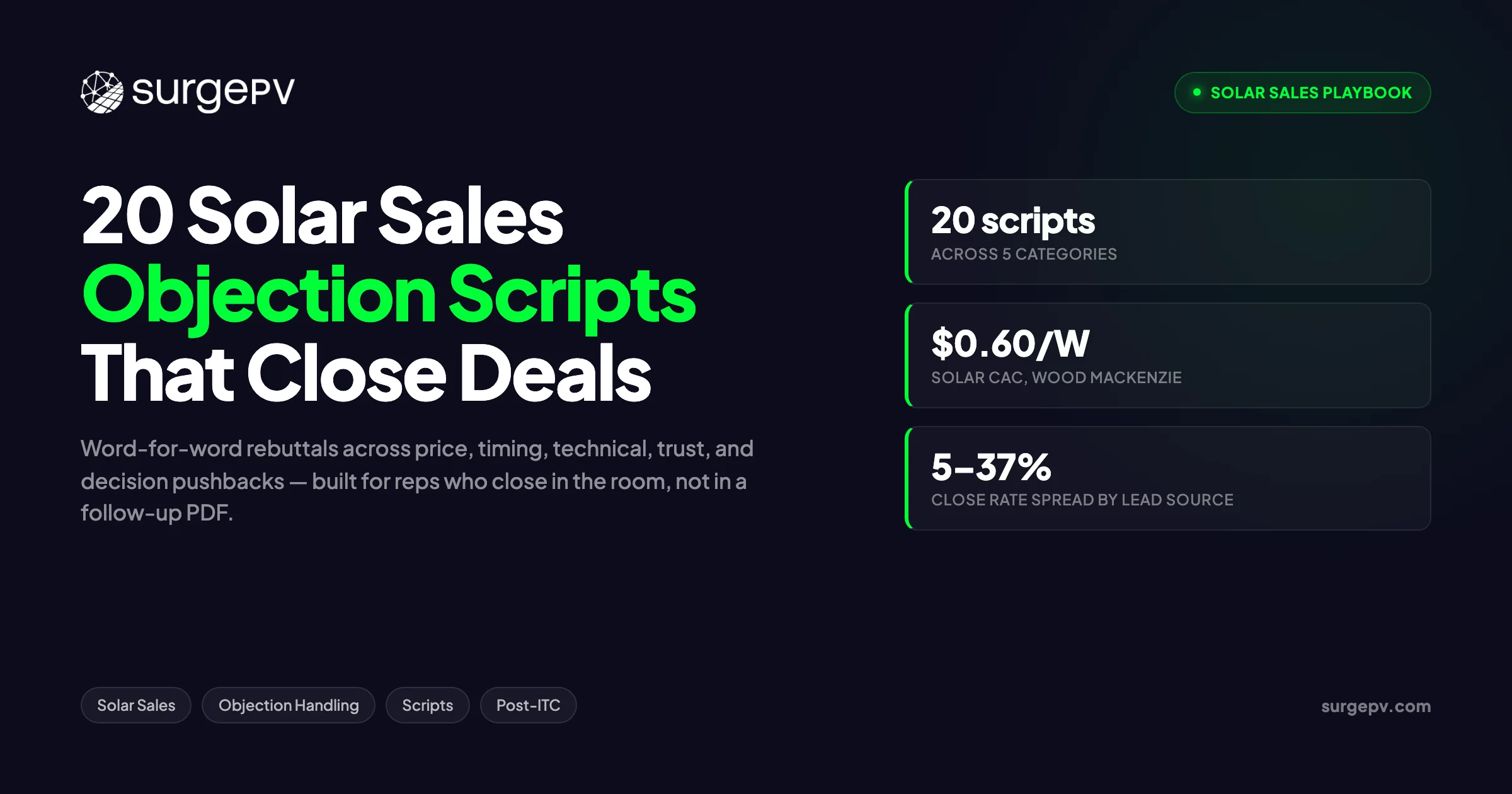
Purchased leads close at 5–8% in residential solar. The gap between that number and a 20–30% referral close rate lives almost entirely in objection handling. At $0.60/W in 2025, a 5 kW system costs $3,000 to acquire before a single panel ships. Highest objection sensitivity; small lifts move the most volume Inbound / SEO. 10–20%.
Solar customer acquisition cost hit $0.60 per watt in 2025 (Wood Mackenzie, as of March 2026) and is projected to reach $0.84/W in 2026. That number climbs whether or not you close — so every lost deal costs more than the one before it. Purchased leads close at 5–8% in residential solar. The gap between that number and a 20–30% referral close rate lives almost entirely in objection handling.
Purchased leads close at 5–8% in residential solar. The gap between that number and a 20–30% referral close rate lives almost entirely in objection handling. At $0.60/W in 2025, a 5 kW system costs $3,000 to acquire before a single panel ships.
This guide gives you 20 word-for-word scripts across the five objection categories that kill the most residential deals: price, timing, technical, trust, and decision. Each script is grounded in the post-ITC reality of 2026 — the federal residential tax credit expired December 31, 2025, and reps still pitching the 30% credit are misinforming buyers. If you sell for solar sales professionals, you already know the market shifted. This is how you sell into that shift.
TL;DR — Solar Sales Objection Handling
Residential solar CAC ran $0.60/W in 2025 (Wood Mackenzie, as of March 2026) and close rates on purchased leads sit at 5–8%. The gap lives in objection handling. This guide delivers 20 word-for-word scripts across 5 categories — price, timing, technical, trust, and decision — grounded in the 2026 post-ITC reality where the federal residential tax credit is gone and state incentives carry the financial story.
In this guide:
- The CAC math that makes objection handling the highest-return skill in solar
- Six proven frameworks every rep should have memorized before the first call
- 20 objections with primary script, backup script, killer stat, and what not to say
- How to model objections away live on screen during the appointment
- The 10 rep mistakes that kill deals after the objection is already handled
- Frequently asked questions on ITC status, warranty, spouse objections, and technology timing
Solar objection handling is the process of isolating the real concern underneath a stated pushback, acknowledging it without agreeing with it, and responding with a combination of emotional reframing and real data — all in a few seconds. The LAER method (Listen, Acknowledge, Explore, Respond) plus a reallocation reframe — replacing “this is a new cost” with “this replaces a cost you already have” — handles roughly 70% of price and timing objections before any script is needed.
Why Objection Handling Is the #1 Skill in Solar Sales
Customer acquisition cost is the bluntest metric in solar sales. At $0.60/W in 2025, a 5 kW system costs $3,000 to acquire before a single panel ships. At the projected 2026 rate of $0.84/W, that number climbs to $4,200. Solar software costs more per lead every year — close rate is the only variable a rep fully controls.
The close-rate ladder shows where objection sensitivity concentrates:
| Lead source | Typical close rate | What it means for objection handling |
|---|---|---|
| Purchased leads | 5–8% | Highest objection sensitivity; small lifts move the most volume |
| Inbound / SEO | 10–20% | Pre-qualified; price and timing dominate |
| Referral | 29–37% | Trust mostly resolved; objections are mainly logistics |
A rep converting purchased leads at 8% instead of 6% closes 33% more deals on the same budget. No other variable — not panel brand, not roof type, not lead quality — produces a return that fast.
The ITC reality in 2026. The federal Section 25D residential solar tax credit expired December 31, 2025. It does not apply to systems installed in 2026. Reps still pitching “you get 30% back” are giving false information. The homeowner will find out at tax time, cancel, or both. This guide treats the ITC as a historical data point and builds every financial script around what’s actually available: state programs, utility incentives, and LCOE math.
The market context. Residential solar declined 31% year-over-year in 2024 to 4.7 GWdc (SEIA/Wood Mackenzie). That contraction means fewer buyers in the funnel and higher stakes for each appointment. The reps who convert objectors take market share from those who don’t.
The product works. 90% of solar owners report satisfaction and 80% would recommend it to a neighbor (McKinsey). When a homeowner objects, they’re not rejecting solar — they’re expressing uncertainty. That’s a solvable problem.
The 6 Frameworks Every Solar Rep Should Master
Scripts without frameworks are improv. Frameworks give you the structure; scripts give you the words. Learn both, in that order.
LAER (Listen, Acknowledge, Explore, Respond)
LAER is the base layer for every other framework. Listen through the full objection without interrupting — most reps start forming the rebuttal at “it’s too expensive” and miss the second half of the sentence. Acknowledge what’s true or reasonable in the concern without agreeing with the underlying conclusion. Explore with a question to find the real issue. Respond only after you know what you’re actually responding to. The biggest mistake reps make is skipping Explore and jumping straight to a price rebuttal when the real concern is trust.
Feel, Felt, Found
This framework borrows social proof to normalize the objection without validating it. “I understand how you feel — a lot of homeowners we’ve worked with felt exactly the same way when they first heard the number. What they found, once we ran the actual 25-year model, was that they were comparing a one-time price to a recurring cost they were already paying.” It works best with trust and price objections because it implies the homeowner is not alone in their hesitation — and that the hesitation resolved.
Sandler Reverse / Negative Reverse
The Sandler reverse turns the objection back as a question or a gentle challenge. “That’s totally fine — not everyone decides at the first meeting. Can I ask: is there a scenario where waiting doesn’t make financial sense for you?” It works because most homeowners haven’t thought about the opportunity cost of waiting. They’ve thought about the risk of acting. The reverse makes them argue against inaction instead of against you.
The Isolation Question
When a homeowner gives a vague objection — “I need to think about it” — the isolation question surfaces the real one. “That makes complete sense. If you were to move forward, what would need to be true for you to feel good about it?” Or more directly: “Is it the price, the timing, or something I haven’t addressed yet?” Isolation prevents you from rebutting a decoy objection while the real one stays buried.
Tie-Down / Trial Close
A tie-down checks for agreement before moving forward. “If the monthly payment came in under your current electricity bill, would there be any reason not to move forward today?” It works in two ways: it confirms the objection is actually about the stated issue, and it pre-commits the homeowner to a logical resolution. If they say yes, you have a conditional close. If they add a new condition, you’ve found the real objection.
Pre-Frame / Inoculation
Pre-framing means raising the objection before the homeowner does, so they don’t experience it as their own brilliant resistance — they experience it as a known variable you’ve already accounted for. “A lot of people we work with have concerns about financing rates right now — I’ll show you the exact number we’re working with and how it compares to the utility bill trajectory.” Pre-framing works especially well with timing and policy objections, because the homeowner feels informed rather than sold.
Framework Selection Matrix:
| Objection category | First-choice framework | Backup framework |
|---|---|---|
| Price | Tie-down / trial close | LAER |
| Timing | Sandler reverse | Pre-frame |
| Technical | LAER | Live model (SurgePV) |
| Trust | Feel, felt, found | Pre-frame |
| Decision | Isolation question | Sandler reverse |
Run the numbers before the objection lands
SurgePV models a 3D roof, runs physics-based shadow analysis, and renders a payback scenario in a few minutes — live on the call. See the full sales workflow.
Book a DemoNo commitment required · 20 minutes · Live walkthrough on your own roof address
For a direct comparison, see Arka 360 vs SurgePV.
The 20 Most Common Solar Sales Objections (With Scripts)
Price Objections
“Solar is too expensive”
“Look, I appreciate what you’re doing, but solar is just too expensive for us right now.”
What’s really going on: This is usually a sticker-shock reaction to the total system price, not a calculated affordability judgment. The homeowner is comparing a lump-sum number to their current month-to-month utility bill without framing them in the same time horizon.
Primary script (Tie-down / trial close): “Yeah, I hear that a lot at first glance. Can I ask — are you looking at the total system price, or are you thinking about it as a monthly number? Because most of our customers are paying between $160 and $190 a month for electricity right now. The loan payment on a system like yours comes in around $145. If that number holds up when we run the actual model, does the ‘too expensive’ concern change?”
Backup script (LAER): “That’s fair, and I want to make sure I understand what you mean by expensive. Is it the total number on the quote, or is it more about whether the monthly payment makes sense given everything else going on financially? Because those are two different conversations, and I don’t want to respond to the wrong one.”
The number to drop: Median quoted price was $2.48/W as of September 2025 (EnergySage). On a 7 kW system, that’s $17,360 before any state incentives — compared to ~$0.17/kWh on the national grid average (EIA, 2025), which compounds every year.
What NOT to say: Don’t immediately offer a discount. Discounting before understanding the real concern trains the homeowner that pushing back equals a lower price — and you haven’t solved anything.
“The competitor quoted us cheaper”
“We got a quote from another company that was about $3,000 less than yours.”
What’s really going on: The homeowner has a price anchor from another quote and is either genuinely price-shopping or using the competitor number as a negotiating tactic. Either way, the risk is that they’re comparing systems that aren’t equivalent.
Primary script (Isolation question): “Honestly, that’s worth comparing side by side — if the systems are the same and they’re legitimately cheaper, you should go with them. Can I ask: do you have their quote in front of you? I want to look at the panel wattage, the inverter type, and whether it includes workmanship warranty. A $3,000 gap usually lives somewhere in those three places, and it’s worth knowing which one before you decide.”
Backup script (Feel, felt, found): “I get it — a lot of homeowners we’ve worked with got a lower quote from someone else and went back and compared line by line. What they found was usually a lower-grade panel, a string inverter versus microinverters, or a shorter workmanship warranty. Sometimes the cheaper quote is genuinely the better deal. But you should know what you’re comparing before you sign.”
The number to drop: LCOE for solar is approximately $0.06/kWh versus ~$0.17/kWh for the national grid average (EIA, 2025). A $3,000 system price difference is roughly $0.04/W on a 7 kW system — that’s a rounding error on a 25-year LCOE comparison. For France-specific information, see Agricultural Solar Case Study. For the latest details on France, see Floating Solar Farms France.
What NOT to say: Don’t attack the competitor’s reputation or quality without seeing the actual quote. Vague “they use cheaper panels” claims without evidence damage your credibility.
“We can’t afford the monthly payment”
“Even spread out, I don’t think we can handle another monthly payment.”
What’s really going on: The homeowner is treating the solar loan payment as an additive cost rather than a replacement cost. The real question is whether the loan payment is higher or lower than the utility bill it replaces — and whether they’ve thought about the utility bill as a cost they’re already committed to paying indefinitely.
Primary script (LAER + reallocation reframe): “That makes sense — and I want to show you something real quickly, because I think the framing might be off. You’re not adding a payment; you’re replacing one. Let me pull up your utility bill trajectory on the model. Right now you’re paying X a month for electricity. The loan payment on this system comes in at Y. If Y is under X, you’re not taking on a new payment — you’re locking in a lower one. Can I show you the actual numbers?”
Backup script (Sandler reverse): “Fair enough. Can I ask — what does your electricity bill run right now? Because if the loan payment is lower than what you’re paying the utility today, it’s not actually a new payment. Would that change the math for you?”
The number to drop: Solar LCOE runs approximately $0.06/kWh versus ~$0.17/kWh for the national grid (EIA, 2025). Utility rates have increased an average of ~2.9% annually from 2014 to 2024 (EIA, 2024). The loan payment is fixed; the utility bill is not.
What NOT to say: Don’t say “it basically pays for itself” — that’s vague and sounds like a sales line. Show the actual numbers on screen.
Live SurgePV play: Open the Generation & financial tool and model their address with the actual utility rate. Show the 25-year utility bill trajectory stacked against the fixed loan payment — the crossover point is usually year 2 or 3.
“Financing rates are too high”
“With interest rates where they are, I don’t think a solar loan makes sense right now.”
What’s really going on: The homeowner is anchoring to mortgage or personal loan rates and applying that mental model to a solar loan. Solar loans are a different product — often with dealer fees built in and tax credit assumptions baked into the original structure that no longer apply in 2026.
Primary script (Pre-frame + live model): “Look, I’m not going to pretend rates are where they were in 2021. The median solar loan rate in H1 2025 ran 7.5% as of September 2025 (EnergySage). But the question isn’t whether 7.5% is a good rate in the abstract — it’s whether the loan payment is lower than the utility bill it replaces. On your address, let me show you the actual payback scenario. If the loan costs less than the electricity you’d be buying anyway, the rate debate kind of answers itself.”
Backup script (Sandler reverse): “That’s a reasonable concern — 38% of solar contractors reported loan demand dropping in 2025 because of exactly this as of September 2025 (EnergySage). Can I ask: if the payment came in under your current electricity bill and the payback period was under 9 years, would the rate still be the deciding factor? Because if it is, cash purchase might be worth modeling.”
The number to drop: Median solar loan rate was 7.5% as of September 2025 (EnergySage). 38% of solar contractors reported decreased loan demand that period as of September 2025 (EnergySage). But LCOE for solar at $0.06/kWh versus ~$0.17/kWh grid average (EIA, 2025) still creates positive cashflow on most financed systems in states with reasonable irradiance.
What NOT to say: Don’t dismiss the rate concern. 7.5% is genuinely higher than five years ago. Acknowledge it and move directly to the cashflow comparison. See our guide on France Solar Feed-in Tariffs for more.
Live SurgePV play: Open the Generation & financial tool and toggle between cash and loan scenarios. Show the IRR and payback period for both — some homeowners move to cash purchase once they see the modeled comparison.
“We missed the ITC, there’s no point now”
“I heard the tax credit went away. If we can’t get that 30% back, it doesn’t make financial sense.”
What’s really going on: The homeowner built their mental go/no-go decision around the federal ITC. It was a real, meaningful incentive and its expiration is a legitimate change in the economics. The rep’s job is not to minimize this — it’s to reframe around what’s still available and re-run the LCOE math.
Primary script (LAER + reallocation reframe): “You’re right — the federal Section 25D residential credit expired December 31, 2025, and I’m not going to pretend otherwise. But here’s what’s still on the table: [name applicable state program — NY-Sun, MA SMART, NJ SuSI/SRECs, SC 25%, CA SGIP]. Let me run the actual payback on your address with today’s incentives. In most markets with decent irradiance, the LCOE math still works without the ITC — it just adds a year or two to payback. Want to see the actual number?”
Backup script (Sandler reverse): “If I could show you that the payback period on your specific address is still under 10 years without any federal credit, would the ITC expiration still be a dealbreaker? Because in a lot of states it’s actually not the swing factor people think it is.”
The number to drop: LCOE for solar runs approximately $0.06/kWh versus ~$0.17/kWh for the national grid (EIA, 2025). The ITC reduced the investment cost — it didn’t change the ongoing energy economics. State programs vary, but NY-Sun, MA SMART, NJ SuSI, SC’s 25% state credit, and CA SGIP remain active in 2026.
What NOT to say: Don’t say “the ITC isn’t that big a deal” — it was. Don’t pivot immediately to state incentives without acknowledging the ITC loss honestly.
Live SurgePV play: Open the Generation & financial tool, apply the relevant state incentive, and run the payback comparison with and without state programs. Show payback in years — it’s a more intuitive number than IRR for most homeowners.
Timing Objections
“This is not a good time for us”
“We’ve got a lot going on right now. This isn’t a good time to be making big decisions.”
What’s really going on: “Not a good time” is almost never about the calendar. It’s a soft no that’s masking a real objection — usually price, trust, or a decision dynamic that hasn’t surfaced yet. It can also be genuine life-event timing (job change, divorce, health issue) — read the room before pressing.
Primary script (Isolation question): “I completely understand — and I’m not here to push you into something before you’re ready. Can I ask you something directly? When you say it’s not a good time, is it more about what’s happening in your life right now, or is there something about the solar decision itself that you’d want more time to think through? Because those are two different situations, and I don’t want to follow up in the wrong direction.”
Backup script (Sandler reverse): “That’s fair. Out of curiosity — is there a time of year or a specific trigger where you’d feel better about revisiting it? I ask because utility rates in your area have been climbing about ~2.9% per year nationally from 2014 to 2024 (EIA, 2024), so a 6-month delay has a real cost attached to it. I’m not saying that to pressure you — just want to make sure you have the number.”
The number to drop: Residential solar costs have fallen 70% since 2010 (SEIA/NREL). The steep deflation curve has flattened — median quoted prices held at a record-low $2.48/W from H2 2024 into H1 2025 (EnergySage, 2025). Waiting is no longer buying meaningfully cheaper panels.
What NOT to say: Don’t immediately ask “when would be a better time?” — it implies you’re willing to reschedule indefinitely and loses the appointment’s momentum. Surface the real objection first.
“Policy is too uncertain right now”
“With everything going on in Washington, I don’t know what’s going to happen with solar incentives. I don’t want to make a big decision in that environment.”
What’s really going on: The homeowner has read the headlines — ITC phase-out, tariff changes on imported panels, potential NEM rollbacks — and is genuinely uncertain about the policy floor. This is a legitimate concern. The script doesn’t dismiss it; it separates the knowns from the unknowns.
Primary script (Pre-frame): “Honestly, you’re right to pay attention to that. Here’s what I can tell you is certain right now: the federal residential ITC is already gone — that decision is made. The Section 48E commercial credit is still available through 2027 for lease and PPA structures, but that doesn’t apply to a direct purchase. What’s still solid at the state level is [NY-Sun / MA SMART / NJ SuSI / SC 25% / CA SGIP — use the applicable one]. The policy uncertainty is real, but waiting for it to clear up typically means waiting for something that won’t fully clear. The knowns are good enough to model.”
Backup script (LAER): “That’s a legitimate thing to be watching. Can I ask — which specific policy are you most worried about? Because the residential ITC is already expired, so that uncertainty resolved. If it’s state incentives or utility rate policy, I can show you where your state stands right now, specifically.”
The number to drop: The residential solar market declined 31% year-over-year in 2024 to 4.7 GWdc (SEIA/Wood Mackenzie). Much of that decline came from ITC uncertainty — which is now resolved (it expired). Homeowners who waited in 2024 still paid the same utility bills.
What NOT to say: Don’t say “there’s nothing to worry about” — there are real policy uncertainties. Acknowledge them and separate the resolved from the ongoing.
“We are worried about the economy”
“With inflation still up and everything feeling uncertain, we just don’t want to take on something big right now.”
What’s really going on: This is a real financial anxiety that shouldn’t be dismissed. But solar is one of the few capital expenditures where the economic case gets stronger in an inflationary environment, because the LCOE is fixed while the utility rate compounds.
Primary script (Reallocation reframe): “I hear you — and I want to make sure I’m not being tone-deaf here. But I’ll tell you what I show homeowners when they bring this up: your electricity bill isn’t inflation-neutral. It’s been going up 2–4% a year on average for the past decade, and there’s no reason to think that stops. Going solar right now locks in a fixed cost. In an inflationary environment, a fixed cost against a rising alternative is actually the conservative move.”
Backup script (Feel, felt, found): “A lot of the homeowners we’ve worked with over the last two years felt exactly the same way — they didn’t want to take on anything big in an uncertain economy. What they found when we modeled it out was that the loan payment was lower than the utility bill it replaced. They weren’t taking on financial risk — they were reducing it. Would it be worth running that comparison for your address?”
The number to drop: LCOE for solar is approximately $0.06/kWh versus ~$0.17/kWh for the national grid (EIA, 2025). Utility rates have risen ~2.9% annually from 2014 to 2024 (EIA, 2024). A 25-year fixed-rate solar loan eliminates exposure to that compounding increase.
What NOT to say: Don’t lecture the homeowner about economics. Acknowledge the anxiety, then pivot to the specific math for their situation.
“We will wait for prices and technology to improve”
“Solar keeps getting cheaper and panels keep getting better. We’d rather wait another couple of years.”
What’s really going on: The homeowner remembers the dramatic cost curves from 2010–2020 and is extrapolating forward. The problem: costs and efficiency have flattened significantly, and the opportunity cost of waiting is compounding every month.
Primary script (Sandler reverse): “That logic made a lot of sense in 2015, when prices were dropping 10–15% a year. Can I show you something? Solar costs have come down about 70% since 2010 (SEIA/NREL). But median quoted prices were essentially flat from H2 2024 to H1 2025 at $2.48/W (EnergySage, 2025). The steep part of the curve is behind us. Meanwhile, you’re paying your current utility bill every single month you wait. Want me to run the math on what two years of waiting costs in electricity bills versus what you’d gain from a 2-percentage-point efficiency bump on future panels?”
Backup script (LAER + opportunity cost): “That’s a reasonable thing to think about. Can I ask — what specifically are you waiting to improve: the price per watt, the panel efficiency, the battery technology? Because those have different trajectories, and they might change the math. Average panel efficiency in 2024 was 21.4% (SEIA). The panels being installed today are genuinely very good. The question is whether the efficiency gain in year 3 exceeds the utility bills you’d pay in the meantime.”
The number to drop: Solar costs fell 70% from 2010 to 2024 (SEIA/NREL). Average panel efficiency reached 21.4% in 2024 (SEIA). Median quoted prices were essentially flat from H2 2024 to H1 2025 at $2.48/W (EnergySage, 2025). Two years of waiting at current utility rates typically exceeds the savings from future panel efficiency gains.
What NOT to say: Don’t say “you can’t wait forever” — it sounds dismissive. Focus on the opportunity cost calculation, not the urgency.
Technical Objections
“Our roof is too old”
“Our roof is probably 15 years old. I’d be worried about putting solar on a roof that needs to be replaced soon.”
What’s really going on: This is a legitimate practical concern, not a smokescreen. A homeowner who installs solar on a roof that fails in 3 years has to pay to remove and reinstall the panels. The rep’s job is to assess the actual roof condition, not dismiss the concern.
Primary script (LAER): “That’s a really practical question and it’s the right one to ask. A 15-year-old roof isn’t automatically a problem — it depends on the material and the condition. Asphalt shingle roofs typically run 20–25 years; metal and tile run longer. If the roof needs to be replaced in the next 3–5 years, you’re right that we should address that first or bundle it with the solar install. Let me pull up your roof on the model and look at the actual surface — can I see the installation date on your last roof permit?”
Backup script (Pre-frame): “Actually, roof age comes up on almost every appointment. Here’s what we look at: the key factor is the remaining lifespan relative to the 25-year panel warranty, not just the age. If you’re replacing the roof in the next 4 years anyway, doing it before solar makes more sense. Some installers bundle roofing and solar into one financing package. Let me model the roof geometry first and we can talk through the timing.”
The number to drop: Removal and reinstallation typically runs $300 to $350 per panel, or roughly $4,500 to $5,250 for a typical 15-panel system (Paradise Solar Energy, 2025). Panel manufacturers typically offer 25-year product and performance warranties. Inverter warranties run 10–12 years. A roof with under 5 years of remaining life creates a timing mismatch that’s worth addressing before signing.
What NOT to say: Don’t say “the roof will be fine” without actually assessing it. If the roof does fail under solar panels, you own that problem.
Live SurgePV play: Open solar design software and run the 3D roof model on the homeowner’s address. Show the actual roof pitch, surface area, and module layout. This turns a vague “too old” concern into a specific geometry conversation you can address.
“We have too much shade”
“We have a bunch of big trees on the south side of our property. I don’t think solar will work for us.”
What’s really going on: Homeowners consistently overestimate the impact of shade. They’re picturing panels going dark under a shadow when in reality microinverters and DC optimizers mitigate string-level shading losses significantly. The rep should run the actual irradiance analysis before accepting “too much shade” as a disqualifier.
Primary script (LAER + live model): “Yeah, shade is worth taking seriously — I’m not going to tell you it doesn’t matter. But ‘too much shade’ is really a question of how many peak sun hours the shaded sections still get, not whether there’s any shade at all. I want to show you something on screen: let me run the irradiance map for your roof right now. It’ll show you per-panel shade loss across every month of the year. A lot of roofs with ‘too much shade’ end up being fine on the east or west faces.”
Backup script (Feel, felt, found): “I hear that a lot, and a lot of times it turns out differently than expected once we actually model it. We worked with a homeowner in a heavily treed neighborhood last fall — they were convinced the shade made solar impossible. The irradiance model showed the southwest section of their roof got 5.2 peak sun hours per day on average. They installed 14 panels and hit 92% of projected output in year one. Want to see what your roof actually shows?”
The number to drop: Modern microinverters and DC optimizers reduce shade-related losses dramatically compared to older string systems.
What NOT to say: Don’t promise specific production numbers without running the model. “You’ll still generate plenty of power” without data is a claim you can’t support.
Live SurgePV play: Open solar shadow analysis software and run the annual irradiance map for the homeowner’s address. Show the seasonal sun path, per-roof-section shade loss, and panel-level production estimates. This turns an assumption into a data point.
“Solar panels are ugly / our HOA will not allow it”
“I actually think solar panels look terrible on a house. And our HOA might not even allow it.”
What’s really going on: Two separate concerns that often travel together. Aesthetics are subjective and often solvable with all-black panel options or specific mounting configurations. HOA restrictions are frequently misunderstood — most states have solar access laws that limit HOA authority to block solar installations. For more on this topic, see Solar Racking Design Guide.
Primary script (Isolation question): “Those are two different questions and I want to address both. On the HOA side — in most states, an HOA can’t actually prohibit solar outright. They can specify placement and aesthetics, but they typically can’t block a complete installation. I can pull up your state’s solar access law right now if you want to verify. On the aesthetics side — totally fair concern. The all-black panel options we install look significantly different from the blue-cell panels people picture. Can I show you some recent installs in your neighborhood?”
Backup script (Pre-frame): “HOA concerns come up a lot, and the answer is usually better than homeowners expect. [State] has a solar access law that limits what an HOA can restrict — they can ask for specific panel placement, but they can’t block the install entirely. On aesthetics, the all-black monocrystalline options that most installers use now are a lot cleaner than the older framed panels. Homes with solar sell for an average of 6.9% more, approximately $29,000 on a median-priced home (SolarReviews, 2024) — that’s an argument even an HOA-heavy neighborhood can appreciate.”
The number to drop: Homes with solar sell for an average of 6.9% more, approximately $29,000 on a median-priced home (SolarReviews, 2024). More than 30 states have solar access laws that limit HOA authority to prohibit installations (Palmetto, 2026).
What NOT to say: Don’t tell the homeowner their HOA can’t stop them without knowing the state law. Pull it up or tell them you’ll verify and send it before the follow-up.
“Batteries do not make sense for us”
“We don’t lose power that often. I’m not sure a battery is worth the extra cost.”
What’s really going on: This is often a legitimate cost-benefit question, especially in markets with net metering that still provides reasonable compensation for exported power. In California post-NEM 3.0 (net billing), the battery calculus changed significantly — TOU arbitrage often makes the math work even without outage protection. In Texas, where there’s no statewide net metering, batteries have a different value proposition.
Primary script (Tie-down + live model): “You might be right — a battery isn’t a good fit for every installation. Can I ask: does your utility have time-of-use pricing? Because if they charge peak rates between 4 and 9 PM, a battery that charges on cheap solar during the day and discharges at peak is a different financial conversation than ‘insurance against outages.’ Let me pull up the TOU scenario for your utility on the model.”
Backup script (LAER): “That’s a fair point, and I’d rather show you the actual numbers than tell you a battery makes sense without them. Battery attach rates hit 41% nationally in H1 2025 — 79% in California, 61% in Texas, 47% in Arizona as of September 2025 (EnergySage). Those states aren’t leading on batteries because homeowners are being oversold; it’s because the TOU math works. Your market is different. Let me run it for your address.”
The number to drop: Battery attach rate was 41% nationally in H1 2025; CA 79%, TX 61%, AZ 47% as of September 2025 (EnergySage). In California, NEM 3.0 (net billing) shifted the economics heavily toward battery storage — solar-only systems export power at much lower rates than under NEM 2.0. For more on this topic, see Adding Battery Storage Services.
What NOT to say: Don’t push a battery on a homeowner in a state with favorable net metering unless the TOU math independently supports it. A misfit battery recommendation kills the whole deal and generates a cancellation or a refund request.
Live SurgePV play: Open the Generation & financial tool and run the TOU arbitrage scenario for the homeowner’s utility rate schedule. Show the financial model with and without battery — let the numbers make the case.
Trust Objections
“Solar companies keep going out of business”
“I’ve read about solar companies going under. What happens to my warranty if you go out of business?”
What’s really going on: This is a well-founded concern. Sunrun competitors, regional installers, and national brands have exited the market over the past three years. The homeowner isn’t being paranoid — they’ve seen the news. The answer lives in how solar warranties are structured.
Primary script (Feel, felt, found): “That’s one of the most legitimate concerns anyone asks us. Here’s what I want you to understand about how solar warranties actually work: there are three separate layers. Panel manufacturer warranty — 25 years, backed by the panel brand (LG, Qcells, REC, etc.), not us. Inverter manufacturer warranty — 10 to 12 years, backed by the inverter brand. Installer workmanship warranty — that’s ours, and yes, that one is at risk if we closed tomorrow. But the first two survive any installer closure. I’d encourage you to look up the panel brand warranty directly on their site before you sign with anyone.”
Backup script (Pre-frame): “I’m going to pre-empt this one because it comes up a lot and it’s worth being direct about. Our workmanship warranty covers X years. If we closed, that specific warranty would be at risk — I won’t pretend otherwise. The manufacturer warranties — 25 years on the panels, 10–12 on the inverters — survive regardless of what happens to the installer. The question you should ask every solar company you talk to is: what are the panel and inverter brands, and can I verify those warranties directly with the manufacturer?”
The number to drop: 90% of solar owners report satisfaction; 80% would recommend it (McKinsey). Panel manufacturer warranties are direct contracts between the homeowner and the manufacturer — they do not depend on the installer’s solvency.
What NOT to say: Don’t say “we’re not going anywhere” — no one can make that promise. Address the warranty structure honestly instead of making a stability claim you can’t back up.
“Our neighbor had a bad experience”
“Our neighbor went solar two years ago and had nothing but problems — delays, poor installation, the system underperformed for months.”
What’s really going on: Negative word-of-mouth from a neighbor is one of the hardest objections to overcome, because it’s specific, local, and personal. The rep can’t know the full story and shouldn’t try to dismiss it.
Primary script (LAER): “I appreciate you telling me that, and I want to hear more about it — not to argue, but because the specific problem matters a lot. Was it a poor installation, a system performance issue, or a customer service problem? Those are three different failure modes with different causes. If it was installation workmanship, I want to show you our review history and our monitoring reports. If it was system underperformance, I’d actually want to look at their roof and shade data — because that’s often a design error, not a product failure.”
Backup script (Feel, felt, found): “I’m not going to tell you your neighbor is wrong — I don’t know what happened. What I can tell you is that 90% of solar owners report being satisfied with their decision, and 80% say they’d recommend it (McKinsey). That’s a real number against a bad experience. If it would help, I can give you references from homeowners in your zip code who’ve had our systems for 2-plus years. You’d be talking to someone whose situation is closer to yours.”
The number to drop: 90% solar owner satisfaction; 80% would recommend (McKinsey). The national install rate was 4.7 GWdc of residential solar in 2024 (SEIA/Wood Mackenzie) — hundreds of thousands of successful installs in that year alone. Also see: Us Residential Solar Market Trends 2026. For United States-specific compliance details, see United States arizona/phoenix. For United States-specific compliance details, see United States california/los-angeles.
What NOT to say: Don’t say “that company is terrible” about a competitor. It sounds defensive and shifts focus to a conflict instead of the homeowner’s concern.
“I do not trust door-to-door reps”
“No offense, but I have a policy of not buying anything from someone who shows up at my door.”
What’s really going on: This is a trust-structure objection, not a product objection. The homeowner may be genuinely interested in solar but views the sales channel as untrustworthy. It’s worth respecting the policy while offering a different path.
Primary script (Sandler reverse): “I respect that completely — and honestly, given some of the things that have happened in solar door-to-door sales, that policy is reasonable. Can I ask: if you were interested in exploring solar through a different channel — like a scheduled appointment you initiated, or a referral from your neighbor — would the trust concern change? Because I’m not here to sell you anything today. I’m here to introduce the product and let you decide whether it’s worth a longer conversation on your terms.”
Backup script (Pre-frame): “That’s fair, and I’ll be direct with you: the door-to-door model has some legitimate trust problems in this industry. What I can offer is this — I’m not asking you to decide anything today. I’ll leave my information, a company overview, and a link to our Google reviews. If you want to initiate a scheduled appointment after you’ve checked us out, I’d be glad to come back. That’s your call to make.”
What NOT to say: Don’t argue with the policy. You won’t win, and arguing turns a potentially recoverable interaction into a hard no.
“What about the warranty?”
“These systems are on my roof for 25 years. How do I know the warranty actually means something?”
What’s really going on: The homeowner wants assurance that the warranty is enforceable, backed by a solvent entity, and clearly defined. This is a reasonable due-diligence question that deserves a specific, structured answer rather than a brochure recitation.
Primary script (LAER + structured breakdown): “Great question — and the answer matters, so let me break it into three parts. First, the panel product warranty: 25 years, direct from the manufacturer. You can register it on their site yourself — it’s not through us. Second, the panel performance warranty: typically guarantees 80–85% of rated output at year 25. Third, our workmanship warranty: covers installation defects for X years. That’s the one that’s tied to our business. I’d recommend reading all three documents before signing — not just the installer contract.”
Backup script (Feel, felt, found): “Warranty concerns are the right thing to think hard about. Here’s what I tell every homeowner: verify the panel manufacturer warranty directly on the manufacturer’s website before signing anything. That warranty exists independently of us. The inverter warranty — 10 to 12 years — same thing. The one warranty you’re trusting us on is workmanship. Check our BBB rating, our Google reviews, and ask for references. That’s the right process.”
The number to drop: Panel product and performance warranties typically run 25 years and are direct manufacturer contracts. Inverter warranties run 10–12 years depending on manufacturer. These survive installer closure.
What NOT to say: Don’t say “the warranty covers everything.” Be specific about what each warranty covers and what it doesn’t — vague warranty claims are exactly what creates the trust problem in the first place.
Decision Objections
“I need to think about it”
“This is a big decision. I need some time to think it through.”
What’s really going on: “I need to think about it” is almost never about thinking time — it’s an exit signal covering an unexpressed objection. The rep’s job is to surface the real concern without making the homeowner feel interrogated.
Primary script (Isolation question): “Absolutely — this should be a considered decision, and I’d never want you to feel pressured. Before I leave, can I ask you one thing? When you imagine yourself moving forward with this, what’s the thing that gives you the most pause? Is it the financial side, the technical side, the company — or something else? Because if there’s a specific concern I haven’t addressed, I’d rather know now than leave you with something unresolved.”
Backup script (Tie-down): “Of course — take whatever time you need. Can I ask: if those concerns got answered to your satisfaction, is there any reason you wouldn’t move forward? I ask because sometimes ‘I need to think about it’ means ‘I have a question I haven’t asked yet,’ and I want to make sure I’ve done my job here.”
The number to drop: Close rates on purchased leads sit at 5–8% (industry estimate).
What NOT to say: Don’t say “take your time” and walk out. That’s not respecting the homeowner’s process — it’s giving up. Surface the objection or schedule a specific follow-up before leaving.
“I need to talk to my spouse”
“I’m interested, but I can’t make a decision without my husband/wife.”
What’s really going on: This is a legitimate decision-structure objection in most cases — major home investments require both partners. It can also be a soft exit if the present spouse isn’t fully sold. Either way, the right move is not to push for a solo close.
Primary script (Isolation question + schedule): “That makes complete sense — this is a joint decision and it should be. Before we figure out the best way to get your spouse involved, can I ask: setting aside the ‘need to talk to them’ piece, do you yourself have any concerns about moving forward? Because sometimes when both people are on the same call, the questions that come up are cleaner when I know where you’re starting from. I’d rather come back prepared than walk in blind.”
Backup script (Sandler reverse + schedule): “Totally fair. Would it make sense to schedule a joint call — even 20 minutes over video — so both of you can see the actual model and ask questions at the same time? In our experience, installs where only one partner saw the presentation have a higher cancellation rate after signing, and I’d rather get to a real yes than a yes that turns into a call three days later.”
The number to drop:
What NOT to say: Don’t try to extract a verbal commitment “subject to spouse approval.” It doesn’t hold, and it creates resentment when the spouse raises objections the rep already claimed were resolved.
“I need to get three quotes first”
“I always get at least three quotes before making a decision this size. Can I have your proposal and we’ll be in touch?”
What’s really going on: Three-quote shopping is a rational consumer behavior for a $15,000–$25,000 purchase. The rep who fights it looks desperate. The rep who supports it while differentiating on the spot wins the comparison.
Primary script (Pre-frame + differentiation): “That’s a smart approach — you absolutely should. Here’s what I’d suggest paying attention to across the three quotes: panel brand and wattage, inverter type (string vs. microinverter), workmanship warranty length, and whether the production estimate was modeled with actual shade analysis or just a flat kWh multiplier. Those four things create most of the price differences you’ll see. I’ll put your proposal together with all four clearly labeled so you have an apples-to-apples comparison tool.”
Backup script (Tie-down): “Of course — and I’ll get you a full proposal. Quick question while I’m here: is there anything beyond price that would factor into your decision? Because if it’s purely price, that’s one comparison. If workmanship quality, monitoring capability, or the company’s local track record matters, I want to make sure I’m showing you the right things when I send it over.”
The number to drop: Median quoted price was $2.48/W as of September 2025 (EnergySage). Price differences between quotes are often driven by panel grade, inverter type, and whether the production estimate uses a real irradiance model — not just installer markup.
What NOT to say: Don’t say “our price is very competitive” without evidence. And don’t tell the homeowner they don’t need three quotes — it’s condescending and signals you’re afraid of the comparison.
How to Model Objections Away in Real Time
The most expensive mistake in solar sales is leaving the appointment with a verbal “I’ll think about it” and following up 48 hours later with a PDF proposal. In that window, the homeowner shops, the concern cools, the objection hardens, and the deal dies. The rep who runs the financial and technical model live — in the room, on screen, on the homeowner’s actual address — closes the objection before it can compound.
The core problem with the PDF-in-48-hours approach is that it outsources the convincing to a document. A document can’t answer questions, adjust assumptions, or show a side-by-side comparison when the homeowner says “but what if I did it without the battery?”
Here’s the live-model playbook for the most common technical and financial objections:
| Objection | Feature | What the rep shows |
|---|---|---|
| “Too much shade” | Shadow analysis | Annual irradiance map per roof section; seasonal sun path; per-panel shade loss |
| “Roof is too old / wrong orientation” | 3D roof model | Actual roof pitch, surface area, module layout options |
| “Can’t afford it / financing too high” | Generation & financial tool | Side-by-side: utility bill trajectory vs. loan payment; IRR / payback toggle |
| “Batteries don’t make sense” | Financial tool TOU scenario | TOU arbitrage savings with and without battery |
The workflow is straightforward. Open solar design software running live in a browser — no download, no waiting. Model the 3D roof on the homeowner’s actual address. Run shadow analysis on the specific sections in question. Pull the financial model with their real utility rate. When the objection is “we have too much shade,” solar shadow analysis software shows actual irradiance, not your verbal estimate. When the objection resolves, generate the proposal on the spot. Solar proposal tools renders a branded PDF before you leave the driveway — not a generic quote sheet.
Clara AI at /clara-ai handles natural-language design queries within the platform, which speeds up the modeling step when a homeowner asks a specific configuration question mid-appointment.
The rep who closes objections in the room — with data, on the homeowner’s actual roof, before anyone checks their phone — outperforms the rep who promises a follow-up document every time.
Common Rep Mistakes That Lose Deals
These are the patterns that kill deals after the framework and script have done their job.
-
Rebutting the stated objection, not the real one. “Too expensive” often means “I don’t trust you yet.” Jumping to price rebuttals when the underlying issue is trust trains the homeowner to keep expressing price resistance because it keeps getting answered.
-
Discounting before isolating. Offering a price reduction before understanding whether the concern is total price, monthly payment, or comparison shopping teaches the homeowner that pushing back works — and you’ll discount again before signing.
-
Pitching the federal ITC in 2026. The Section 25D residential credit expired December 31, 2025. Reps still using the 30% credit as a selling point are either uninformed or dishonest. Either one loses the deal at tax time.
-
Leaving without an isolated next step. “Let me know if you have questions” is not a follow-up plan. Every appointment should end with a specific next action: scheduled joint call, proposal delivery date with review appointment, or an answered objection with a conditional close tied to it.
-
Overselling the battery without running TOU math. Battery add-on revenue is real, but a battery that doesn’t make financial sense for the homeowner’s market becomes a cancellation or a refund request. Run the model, not the pitch.
-
Treating “I need to talk to my spouse” as a close opportunity. Solo closes on joint decisions have higher post-sign cancellation rates. Schedule the joint meeting. Don’t try to get a commitment that will unravel 72 hours later.
-
Attacking competitors by name without evidence. “They use cheaper panels” without a spec sheet comparison sounds defensive and shifts the homeowner’s attention to a conflict instead of their own decision.
-
Promising verbally what the model should show. “You’ll definitely offset 100% of your bill” before running the irradiance data creates a gap when the actual model comes in at 87%. Let the model make the promise.
-
Skipping the framework and going straight to scripts. Scripts without LAER or an isolation question land as canned responses. The homeowner feels processed, not heard. The framework creates the environment where the script works.
-
Using urgency tactics without a real deadline. “This price is only good until Friday” when it isn’t destroys trust the moment the homeowner tests it — and they will test it.
We built SurgePV for solar sales professionals who want to close objections in the room, not follow up with a PDF and hope.
Frequently Asked Questions
How do you handle a solar sales objection about price without offering a discount?
Isolate the concern first — ask whether the total system price or the monthly payment is the real issue. Then reframe using a live financial model on screen. A solar loan payment that comes in under the homeowner’s current utility bill isn’t a new cost — it’s a cost swap. Tie-down rebuttals work better than discounts because discounting before exploring the concern teaches the homeowner to push harder. Show the actual cashflow model before touching the price.
What do I say when a homeowner says solar companies are going out of business?
Explain the three-layer warranty structure directly: panel manufacturer (25-year product and performance warranty, direct with the manufacturer), inverter manufacturer (10–12 years, also direct), and installer workmanship (varies, and yes, this one is at risk if the installer closes). The first two layers survive any installer closure. Tell the homeowner to verify the panel manufacturer warranty on the manufacturer’s website before signing any contract. Don’t claim business stability — explain the warranty architecture instead.
Is there still a federal solar tax credit in 2026?
No. The Section 25D residential solar tax credit expired on December 31, 2025, and does not apply to systems installed in 2026. Commercial Section 48E remains available for lease and PPA structures where construction begins by July 4, 2026. State programs including NY-Sun, MA SMART, NJ SuSI/SRECs, SC’s 25% state credit, and CA SGIP remain active in 2026. Reps pitching the 30% residential credit in 2026 are providing false information.
How do I handle a homeowner who wants to wait for better solar technology?
Run the opportunity-cost math on screen. Two years of utility bills at the homeowner’s current rate almost always exceeds the lifetime savings from a 1–2 percentage-point efficiency gain on a future panel. Solar costs fell 70% from 2010 to 2024 (SEIA/NREL), but median quoted prices were essentially flat from H2 2024 to H1 2025 at $2.48/W (EnergySage, 2025). The steep deflation curve is behind us — waiting is no longer buying meaningfully cheaper or more efficient technology.
What is the best way to close a “need to talk to my spouse” objection?
Don’t attempt a solo close. Households that sign without both decision-makers seeing the model have significantly higher post-sign cancellation rates. Before leaving, use an isolation question to check whether the present partner has any unspoken concerns of their own. Then schedule a joint meeting — virtual or in person — with both partners present and the financial model ready. A real yes from both people is worth more than a conditional yes from one.
Conclusion
Solar objection handling in 2026 is a different job than it was in 2023. The federal ITC is gone, loan rates are higher, and the residential market contracted 31% in 2024 to 4.7 GWdc (SEIA/Wood Mackenzie). Reps who use the same scripts from three years ago are operating on false premises.
The fundamentals haven’t changed. The product works — 90% of solar owners are satisfied and 80% would recommend it (McKinsey). The LCOE math still makes a compelling case at $0.06/kWh solar versus ~$0.17/kWh grid average (EIA, 2025). State incentives still exist in most major markets. The opportunity is real.
What separates the reps who take share from the ones who don’t is this: they close objections in the room, with data, on the homeowner’s actual roof, before the homeowner walks away to “think about it.” A live financial model running on the homeowner’s address resolves more objections than any script. The script gets you to the model. The model closes the deal.
The 20 scripts in this guide are a starting point. The frameworks behind them — LAER, isolation questions, pre-framing, Sandler reverse — are the actual skill. Learn the framework. Customize the script. Run the model.
Built for how solar is actually sold
3D roof modeling, physics-based shade analysis, and live financial scenarios — running in your browser during the call. The reps who close objections in the room outperform those who promise a follow-up PDF.
See SurgePV for sales prosFor solar sales professionals · live design + proposal · no desktop install
Where this fits
This article is part of SurgePV's Solar Sales & Proposals hub, which works through the topic from first principles to the decisions a project team actually has to make.


