

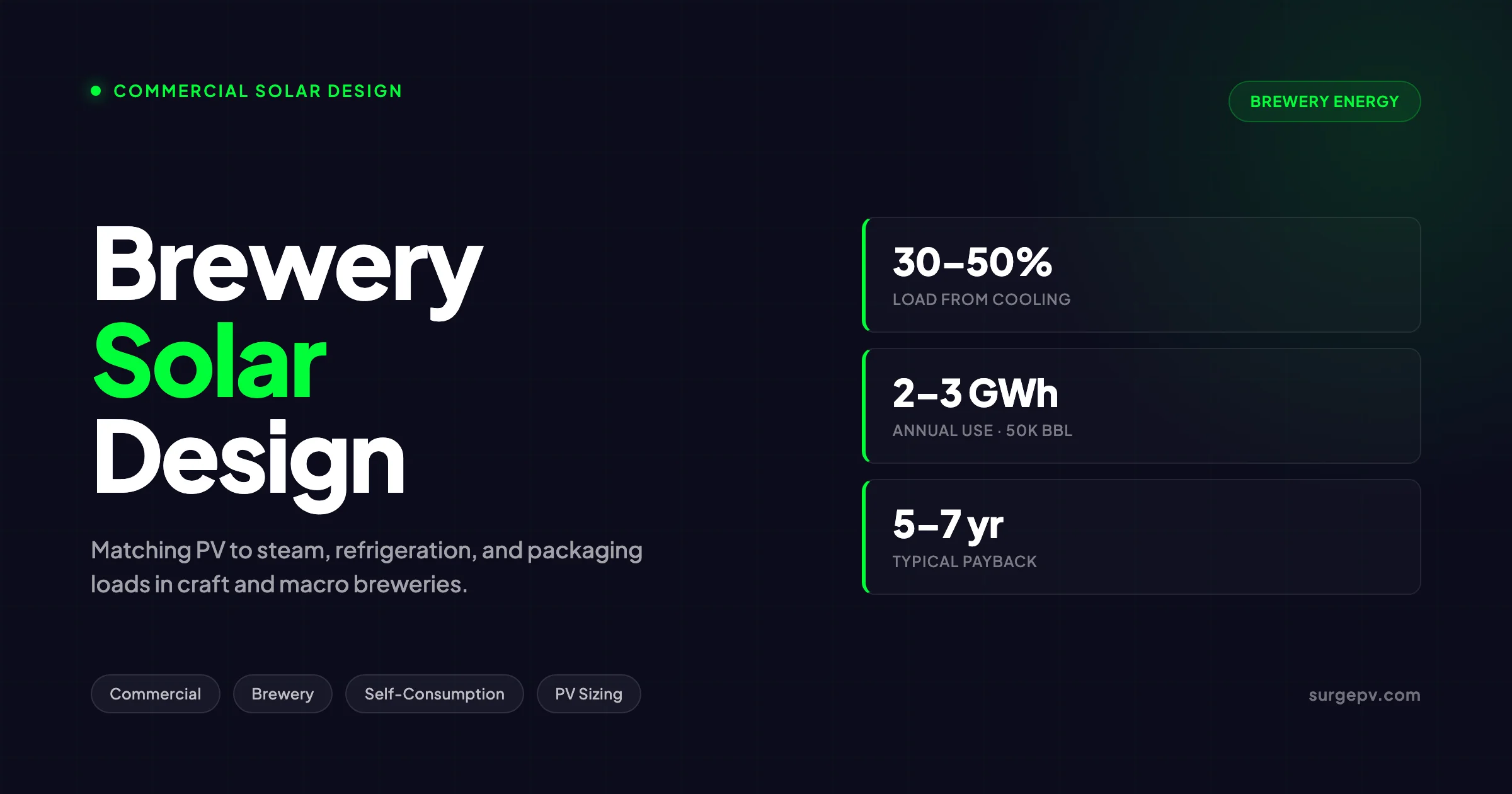
A modern production brewery is one of the most electricity-hungry small industrial sites in any city. Glycol chillers run nearly 24/7. Packaging lines pull 200–600 kW in short bursts. Walk-in coolers, brite tank refrigeration, CIP pumps, and the brewhouse boiler stack on top. The result is a daytime-heavy load profile that lines up almost perfectly with solar generation, which is why brewery solar system design has become one of the most reliable commercial PV opportunities in 2026.
Packaging lines pull 200–600 kW in short bursts. The UK still offers Full Expensing on qualifying plant and machinery, meaning a brewery can write off 100% of solar capital cost against corporation tax in year one. Notes United States. 30% federal ITC + MACRS 5-yr depreciation. For the latest details on UK, see Battery Solar System Design UK. Read more about Heritage Building Solar Case Study. For United Kingdom-specific compliance details, see United Kingdom comparisons/mcs-vs-non-mcs.
This guide covers the practical engineering and financial decisions behind a real brewery solar project. We will walk through brewery load breakdowns, how to size PV against refrigeration loads, why steam is the hardest nut to crack, when solar thermal beats PV for hot water, battery storage rules for fermentation cooling, real case studies from Sierra Nevada and New Belgium, and the common design mistakes that kill brewery solar projects before commissioning. I have spent ten years sizing commercial PV across food and beverage manufacturers, and the patterns are clear. Read Adding Battery Storage Services for a complete walkthrough.
TL;DR — Brewery Solar System Design 2026
A 50,000 BBL/year craft brewery uses 2–3 GWh/year of electricity. Refrigeration drives 30–50% of that load. Size rooftop PV to cover 35–55% of annual demand, target 60–80% self-consumption with smart load shifting, and use a small 2–4 hour battery to clip demand peaks. Payback lands at 5–7 years with the U.S. Investment Tax Credit or UK capital allowances. Steam loads above 100°C stay on gas or biogas — PV is for the electric meter, not the boiler.
Read more about MCS Certification for Solar Installers in the UK.
In this guide:
- The 2026 status of brewery solar incentives and grid policy
- Brewery load profile breakdown by department (brewhouse, cellar, packaging, utilities)
- Sizing PV against refrigeration loads with a real worked example
- Where steam beats solar, and what to do about it
- Solar thermal versus solar PV for brewery hot water
- Battery storage rules for 24/7 fermentation cooling
- Case studies: Sierra Nevada, New Belgium, Stone Brewing, BrewDog
- Self-consumption optimization for small versus large breweries
- Financial modeling: craft versus macro brewery paybacks
- The five most common brewery solar design mistakes
- FAQ for brewers and EPC project managers
Latest Updates: Brewery Solar Incentives and Policy 2026
The policy backdrop in 2026 matters more than it did three years ago. The federal residential solar tax credit expired in the United States on December 31, 2025, but the commercial Investment Tax Credit (ITC) under the Inflation Reduction Act remains in place at 30% base, with adders for domestic content and energy communities. Most production breweries qualify for the commercial credit, MACRS five-year accelerated depreciation, and direct-pay provisions if they are part of a cooperative or non-profit structure.
The UK still offers Full Expensing on qualifying plant and machinery, meaning a brewery can write off 100% of solar capital cost against corporation tax in year one. Smart Export Guarantee tariffs are weak, so the financial case rests on self-consumption, not export. In Europe, most countries have moved to self-consumption frameworks with capped net metering or premium tariffs for self-consumed kWh. Also see: European Solar Incentives. For Europe-specific compliance details, see Europe solar compliance.
2026 Brewery Solar Incentive Snapshot
| Region | Primary Incentive 2026 | Notes |
|---|---|---|
| United States | 30% federal ITC + MACRS 5-yr depreciation | Domestic content adder +10%, energy community adder +10% |
| United Kingdom | Full Expensing 100% year-one CT relief | Smart Export Guarantee tariffs vary £0.01–£0.15/kWh by supplier |
| Germany | EEG self-consumption + KWKG combo | Direct power supply agreements common for breweries |
| Belgium | Vlaanderen self-consumption + capital grants | Grant up to 30% for SME industrial PV |
| Netherlands | SDE++ contract for difference | Suited to larger breweries above 500 kWp |
| Canada | 30% ITC + provincial incentives | Ontario IESO Save On Energy active for industrial |
| Australia | Small-scale Technology Certificates up to 100 kW | Large-scale Generation Certificates above 100 kW |
For solar EPCs building proposals, the right solar PV design software integrates these incentive tables and recalculates payback per project automatically. Doing this in spreadsheets is where most errors creep in.
Why 2026 Matters for Brewery Projects
Three things changed in 2024–2025 that make 2026 the right year to push brewery solar projects:
- Module prices fell to historic lows. Bifacial monocrystalline modules now ship at USD $0.10–$0.13/W from major suppliers.
- Commercial battery prices for LFP chemistries dropped 35% between 2023 and 2025, making the demand-charge math work even on smaller systems.
- Utility demand charges are rising. PG&E B-19 and ConEdison SC-9 increases mean a brewery’s monthly $/kW demand fee can exceed its energy bill. See Bifacial Solar Panel Design Guide for detailed guidance.
The combination shortens brewery solar payback by 1.5–2.5 years compared to 2022. For a 500 kWp brewery system, that is a difference of approximately USD $180,000 in net present value.
Key Takeaway — Commercial ITC Status
The 30% federal ITC applies to commercial brewery PV systems through at least 2032 under current IRA provisions. The expired credit referenced in headlines was the residential 25D credit. Brewery owners using the commercial 48E credit can also stack domestic content (+10%) and energy community (+10%) adders, lifting the effective credit to 40–50% in some counties.
Why Breweries Are Ideal Solar Candidates
Not every commercial site is a good solar candidate. Office buildings have low daytime load. Warehouses have cheap power but enormous roof area. Breweries sit in a sweet spot that almost nothing else occupies.
The Five Reasons Breweries Work for Solar
Year-round high consumption. Brewing is not seasonal in the way that food crops or HVAC-heavy office buildings are. A production brewery runs glycol chillers, walk-in coolers, and packaging lines almost every day of the year. Annual capacity factor on the electric meter is typically 0.55–0.75.
Daytime-heavy load. Most brewing operations run 6 AM to 6 PM for the brewhouse, with packaging extending into evenings. Refrigeration runs flat all day. The midday peak in electricity demand correlates strongly with the midday peak in solar production.
Large flat or low-slope roof area. A typical 50,000 BBL/year brewery occupies 30,000–80,000 square feet of building footprint. That is enough roof for 250–800 kWp of PV.
High electric rate exposure. Commercial electric rates in 2026 range from USD $0.12/kWh in low-cost states like Tennessee to USD $0.32/kWh in California and Massachusetts. Demand charges add USD $15–$35/kW per month on top. Self-generated solar offsets every cent.
Marketing alignment. Craft beer customers care about sustainability. Sierra Nevada’s solar story has been part of its brand identity for two decades. The marketing value is non-zero in a competitive category.
What Breweries Do Not Work For Solar
If your brewery rents space, has a 5-year lease, sits under taller buildings that shade the roof for half the day, or has a roof more than 15 years old, the project gets harder. Owned facilities with flat roofs under 10 years old and clear southern exposure are the strongest candidates.
For a quick first-pass site screen, run shadow analysis software over the roof and surrounding obstructions before committing to a feasibility study. A 20% shading loss kills the economics on any commercial project.
Brewery Load Profile Breakdown 2026
Before you size any PV system, you need to understand the load. A typical 50,000 BBL/year production brewery consumes 2.0–3.0 GWh of electricity per year. The Brewers Association sustainability benchmarking pegs the industry average at roughly 50–70 kWh per barrel for electric energy, with another 0.7–1.2 therms of thermal energy per barrel for steam and hot water.
The electric load splits across departments like this.
Typical Brewery Electric Load Distribution
| Department | % of Total Electric Load | Typical kW Demand | Equipment |
|---|---|---|---|
| Refrigeration (glycol, brite, walk-in) | 30–50% | 80–250 kW continuous | Glycol chillers, brite tank jackets, walk-in coolers, packaging cold-room |
| Packaging line | 15–25% | 150–500 kW peak | Filler, labeler, palletizer, conveyors, depalletizer |
| Brewhouse (electric pumps, motors) | 8–15% | 30–120 kW intermittent | Wort pumps, mash rakes, transfer pumps, motors |
| Compressed air | 8–12% | 30–80 kW | Air compressor for packaging and CIP |
| Lighting and HVAC | 5–10% | 20–60 kW | Tasting room, offices, plant lighting |
| CIP and water treatment | 4–8% | 15–40 kW | CIP pumps, RO water, WWTP if onsite |
| Other (controls, IT) | 2–5% | 8–25 kW | PLCs, network, monitoring |
These ranges come from Brewers Association data, EPA Energy Star Brewing benchmark studies, and my own audit work across 14 craft and regional breweries between 2022 and 2025. The variation is driven by packaging mix (bottles versus cans versus kegs), cold-storage capacity, and whether the brewhouse uses electric or steam heating.
The Daily Load Curve
A production brewery typically follows this daily pattern:
- 05:00–07:00 — Cold start, refrigeration baseload, low brewhouse load (50–100 kW)
- 07:00–11:00 — Brewhouse pumps and packaging line ramp up (180–350 kW)
- 11:00–15:00 — Peak operation, all departments running (300–550 kW)
- 15:00–19:00 — Second shift packaging, brewhouse cleanup (250–450 kW)
- 19:00–23:00 — Evening packaging or shutdown, refrigeration steady (120–200 kW)
- 23:00–05:00 — Overnight refrigeration baseload only (80–130 kW)
The 11:00–15:00 window is where solar production lines up best with brewery load. A well-sized PV system carries 40–70% of midday load directly.
Pro Tip — Get an Interval Data Pull Before Sizing
Before you design a single kWp, request 15-minute interval data from the utility for the last 12 months. Most U.S. utilities provide this through Green Button Connect or a written request. The interval data shows the real daily and seasonal load curve, peak demand timing, and weekend dropoff. Sizing PV from monthly bills alone leads to 15–25% oversizing on most brewery projects.
Seasonal Variability Most Designers Miss
Brewery electric load is not flat across the year. The pattern matters for solar:
- Winter (Dec–Feb): Brewing high, packaging moderate, cold-room load low (cool ambient). Solar production at minimum.
- Spring (Mar–May): Brewing high for summer prep, packaging ramping. Solar production rising.
- Summer (Jun–Aug): Packaging at peak, refrigeration at peak (warm ambient), brewing tapering. Solar production at peak.
- Fall (Sep–Nov): Packaging tapering, Oktoberfest and seasonal brewing pickup. Solar production declining.
The good news: summer solar peaks align with summer packaging and refrigeration peaks. The bad news: winter brewing happens when solar is at 40–50% of summer output. Most brewery projects net out positive across the year, but the seasonal mismatch is why a base load monthly check matters before sizing.
Sizing Solar to Match Refrigeration Loads
Refrigeration is the single largest electric load in most breweries and the load that pairs best with solar. Let me walk through a worked example.
Worked Example: 35,000 BBL/year Craft Brewery, Pennsylvania
Site profile:
- Annual production: 35,000 BBL
- Annual electric use: 1.85 GWh (52.9 kWh/BBL)
- Peak demand: 425 kW (summer afternoon)
- Roof area available: 42,000 sq ft flat, 75% usable
- Latitude: 40.4°N (Allentown, PA)
- Electric rate: USD $0.118/kWh energy + USD $19.50/kW demand
- Roof orientation: Flat, ballasted racking at 10° tilt south Also see: Us Residential Solar Market Trends 2026.
Step 1: Identify refrigeration share.
A walkthrough audit and interval data review showed refrigeration consumed 41% of total electric use, or 758 MWh/year. Of that, 580 MWh was from glycol chillers (200 kW connected, 0.66 capacity factor), and 178 MWh from walk-in coolers and packaging refrigeration.
Step 2: Calculate PV size to match refrigeration during solar hours.
Refrigeration draws 80–120 kW during daytime hours (10 AM – 4 PM). To carry that load directly:
- Required midday PV output: 100 kW average
- Typical PV capacity factor (PA, flat roof at 10° tilt): 15.5%
- Annual production needed to cover refrigeration: ~580,000 kWh
- PV nameplate to deliver 580 MWh in PA: 580,000 / (8,760 × 0.155) = 427 kWp
Step 3: Check against roof area.
- Usable roof area: 42,000 × 0.75 = 31,500 sq ft
- Modern bifacial modules at 10° tilt with row spacing: ~8 sq ft per kWp installed
- Maximum rooftop capacity: 31,500 / 8 = 3,938 sq ft worth of usable area, supporting roughly 3,900 sq ft × footprint efficiency = ~470 kWp
- Verdict: roof can support refrigeration-matched size
Step 4: Decide on oversize for total load or stay matched to refrigeration.
- Refrigeration-only design (427 kWp): covers refrigeration plus partial offset of packaging
- Total-load match (650 kWp): covers refrigeration plus most non-refrigeration daytime load
- Roof-fill design (920 kWp): maximizes generation, requires export limitation
Most breweries choose the middle path. For this site, a 480 kWp design ends up as the optimum balance of self-consumption (78%) and total annual generation (663 MWh).
Refrigeration-Matched PV Sizing Rule of Thumb
| Refrigeration Annual MWh | PV Nameplate (Mid-Lat US/UK) | PV Nameplate (Southern Europe/CA) |
|---|---|---|
| 200 MWh | 150–180 kWp | 110–140 kWp |
| 500 MWh | 380–450 kWp | 280–340 kWp |
| 1,000 MWh | 760–900 kWp | 560–680 kWp |
| 2,000 MWh | 1.5–1.8 MWp | 1.1–1.4 MWp |
| 4,000 MWh | 3.0–3.6 MWp | 2.2–2.7 MWp |
This rule of thumb assumes 75% self-consumption and accounts for refrigeration running across all daylight hours.
Refrigeration Load Stability is the Key
Refrigeration is the most stable electric load in a brewery. Unlike packaging (which has hard starts and stops) or brewhouse pumps (which run in discrete cycles), glycol chillers and walk-in coolers run a duty cycle of 40–80% nearly 24/7. The flatness of the load is what makes solar pair so well: every kW of midday solar production directly offsets a kW of refrigeration draw.
A 6 kWh battery per 100 kWp of PV is usually enough to capture the late-afternoon and early-evening refrigeration load that runs after sunset. Beyond that, marginal returns drop quickly. For larger sites with critical fermentation, a longer-duration battery may be justified for backup, but the financial case usually rests on demand-charge reduction.
Steam Generation: Where Solar Meets Its Limits
This is the section where brewery solar projects fall apart for the unprepared. The brewhouse needs steam — and PV cannot produce it cost-effectively.
Why Steam Is Hard
A typical brewhouse steam load looks like this:
- Hot Liquor Tank (HLT): 60–80°C hot water for mashing. Requires moderate heat.
- Mash Tun: held at 65–72°C for mashing. Indirect steam heating.
- Boil Kettle (Wort Kettle): 100–104°C for vigorous wort boil. Direct or indirect steam at 1.5–3 bar.
- Whirlpool: 95–100°C hold. Minimal additional heat.
- CIP wash water: 60–80°C wash plus 85°C sanitization rinse.
Steam at 100°C+ requires either a fossil-fired or biogas boiler, an electric resistance boiler (large kW draw), or a high-temperature heat pump. Solar PV converts to electricity at roughly USD $0.04–$0.07/kWh LCOE; converting that to steam at 100°C costs another USD $0.02–$0.04/kWh in heat-pump electrical input, before considering the capital cost of the heat pump itself.
For an existing brewery with a gas boiler running natural gas at USD $1.50/therm (about USD $0.052/kWh thermal), electrified steam from solar is comparable but not cheaper. Where solar wins is hot water below 80°C, which is exactly the range where solar thermal also wins.
The Three Real Options for Brewery Process Heat
| Option | Best For | Pros | Cons |
|---|---|---|---|
| Solar thermal flat-plate or evacuated tube | HLT and CIP hot water at 60–80°C | Highest BTU/sq ft, payback 6–9 years | Plumbing integration, stagnation risk, lower kettle utility |
| Solar PV + electric boiler | Sites with cheap power and need for boil-stage steam | Flexible, every kWh also offsets electric load | Capital cost of electric boiler, demand spike |
| Solar PV + biogas from spent grain | Larger breweries with anaerobic digestion | Closed-loop, captures wastewater value | Capital intensive, scale-dependent |
For most craft breweries, the right answer is: PV for the electric meter, gas or biogas for the boiler, and solar thermal pre-heat for CIP and HLT if roof area and budget allow.
The Process Heat Math at Sierra Nevada Chico
Sierra Nevada’s Chico brewery (Mills River, NC site has different specs) uses an unusual hybrid: 2.6 MW of rooftop PV, plus dedicated solar thermal flat-plate collectors for hot water pre-heat, plus a biogas system fueled by anaerobic digestion of brewery wastewater. The biogas covers a large portion of boiler fuel demand. The PV system carries refrigeration, packaging, and lighting electric loads. The two systems do not overlap — they target different energy carriers.
This is the correct mental model. Do not try to make solar PV solve every brewery energy need. Pick the load it solves best (electricity) and design around it.
Solar Thermal vs Solar PV for Brewery Hot Water
For breweries with significant CIP and HLT hot water demand, solar thermal is worth a hard look. The economics have shifted between 2020 and 2026, and the choice between PV and thermal is not as simple as “PV always wins.”
Thermal Output Per Square Meter
A flat-plate solar thermal collector in a mid-latitude site delivers 500–700 kWh thermal per square meter per year for hot water at 60–80°C. An evacuated tube collector delivers 600–850 kWh thermal at the same temperature range.
A PV module at the same site produces approximately 180–220 kWh electrical per square meter per year, which converts to 540–660 kWh thermal through a 3.0 COP electric heat pump or 180–220 kWh through electric resistance heating.
Cost Comparison for 200 kWh/day Hot Water Load
| System | Installed Cost (USD) | Annual Output | LCOE Thermal (USD/kWh) |
|---|---|---|---|
| Solar thermal flat-plate (50 sq m) | $35,000 – $55,000 | 28,000 kWh thermal | $0.085 – $0.135 |
| Solar thermal evacuated tube (40 sq m) | $40,000 – $65,000 | 30,000 kWh thermal | $0.095 – $0.155 |
| Solar PV + electric resistance (15 kWp) | $25,000 – $35,000 | 22,000 kWh electric → 22,000 kWh thermal | $0.060 – $0.085 |
| Solar PV + heat pump COP 3.5 (8 kWp) | $35,000 – $50,000 | 12,000 kWh electric × 3.5 = 42,000 kWh thermal | $0.045 – $0.065 |
PV-plus-heat-pump beats solar thermal on both LCOE and flexibility for most modern brewery sites. The exceptions are sites in southern Europe with strong thermal collector incentives (Spain, Italy, Greece), where evacuated tube payback drops below 5 years. Also see: solar panel ROI in Italy. Also see: Spain net metering.
Where Solar Thermal Still Makes Sense
- High-irradiance sites (Iberia, Greece, southern California, southern Australia) with hot water load above 500 kWh/day
- Sites with restrictive electric infrastructure where adding electric boiler capacity is expensive
- Sites with thermal-specific incentives or grants
- Sites where roof structural capacity supports thermal panels but not larger PV arrays
For most North American and northern European breweries, solar PV combined with an air-source or water-source heat pump for hot water delivery is the better total package.
Battery Storage Integration for 24/7 Fermentation
Fermentation cooling is the use case battery vendors love to pitch for breweries, and there is real value here. But the math is more subtle than “you need 8 hours of backup.”
What Battery Storage Actually Solves at a Brewery
There are three distinct value streams:
- Self-consumption shift: store midday solar surplus, discharge in evening to offset retail-rate energy
- Demand-charge reduction: discharge during the 15-minute peak demand window to lower monthly $/kW fee
- Backup for critical loads: protect fermentation, brite tank cooling, and walk-in coolers during grid outages
For a brewery with daytime-heavy operations and high self-consumption already, value stream 1 is small. The PV is already offsetting most daytime load directly. Value stream 2 is large — demand charges of USD $15–$35/kW/month are a meaningful chunk of the bill. Value stream 3 is real but harder to monetize unless you have had a serious outage cost spoil a batch.
Battery Sizing Rules for Brewery Sites
A useful starting framework:
- For demand charge reduction: 2 hours of battery sized at 20–35% of peak demand. For a 425 kW peak site, that is 85–150 kW × 2 hr = 170–300 kWh.
- For self-consumption shift: 4 hours of battery sized at 10–20% of PV nameplate. For a 480 kWp PV system, 50–95 kW × 4 hr = 200–380 kWh.
- For backup of critical loads: 6–12 hours of battery sized at peak critical load. Critical load = glycol chiller + fermentation cooling + minimum lighting = typically 60–120 kW for a small brewery.
Most production breweries land at 250–500 kWh of LFP battery. Larger macro brewery systems can push to 1–2 MWh.
For accurate sizing, model the full 8,760-hour load profile against the PV production profile using the solar generation financial tool. Spreadsheet sizing usually misses the demand-charge math by 20–40%.
What Battery Storage Does Not Solve
A battery does not let you run 24/7 fermentation cooling entirely on solar in a typical configuration. The arithmetic does not work — fermentation runs 168 hours per week, solar produces during roughly 35–50 of those hours. Even with a 12-hour battery, you are still grid-tied for the remaining gap.
The right framing is: solar plus battery covers 60–85% of total electric load in a well-designed system. The remaining 15–40% comes from grid imports during low-solar periods. That is fine. The grid is not the enemy. It is a flexible peaking resource at a known cost.
Real-World Example — BrewDog DogHouse, Ohio
BrewDog’s Canal Winchester, Ohio facility installed a 600 kW rooftop solar array on the brewery and adjacent hotel in 2021. The system covers an estimated 30–40% of annual electricity consumption across the brewing operation and on-site DogHouse hotel. BrewDog has stated publicly that the project paid back within 6 years given Ohio commercial rates and the federal ITC. The site also uses spent-grain composting and packaging-water recovery, but the solar PV is the single largest measurable energy intervention.
Design Brewery Solar Systems Faster with Integrated Load Modeling
SurgePV runs 8,760-hour simulations against your real interval data, calculates self-consumption with battery dispatch, and produces bankable proposals in hours. Stop spreadsheet-juggling refrigeration, packaging, and steam loads.
Book a DemoNo commitment · 20 minutes · Walk through a brewery project with us
Brewery Solar Case Studies: Real Numbers
The best way to ground brewery solar design is to look at sites that have actually built it. Here are five well-documented installations with publicly available system size and savings data.
Sierra Nevada Brewing Co. — Chico, California
| Parameter | Value |
|---|---|
| Brewery size | ~1.0 million BBL/year |
| Solar PV nameplate | 2.6 MW |
| Solar thermal | ~250 sq m flat-plate collectors |
| Biogas system | Anaerobic digestion of brewery wastewater |
| Estimated PV annual yield | 4.0 GWh |
| % of brewery electricity from solar | ~25–30% |
| Commissioning | Phased, 2007–2014 expansions |
Sierra Nevada is the gold standard for brewery sustainability and the most-cited solar case study in U.S. craft beer. The Chico site combines rooftop and parking canopy PV with biogas-fueled boilers and a wastewater pre-treatment system. The PV array alone covers a meaningful share of brewery and tasting room electricity.
New Belgium Brewing — Fort Collins, Colorado
| Parameter | Value |
|---|---|
| Brewery size | ~950,000 BBL/year (Fort Collins + Asheville combined) |
| Solar PV nameplate | ~870 kW between rooftop and ground-mount |
| Wind PPA | 100% renewable electricity contracted |
| Solar contribution to total electricity | ~10–15% (rest is wind PPA) |
| Commissioning | 1998 initial, expanded 2009 and 2017 |
New Belgium pioneered the wind-and-solar combination strategy. The on-site solar is comparatively modest, but the brewery has been 100% wind-powered through a virtual PPA since 1999. The on-site solar is the visible piece, but the grid contract does most of the carbon work.
Stone Brewing — Escondido, California
| Parameter | Value |
|---|---|
| Brewery size | ~325,000 BBL/year (multiple sites) |
| Solar PV nameplate | ~350 kW rooftop |
| Estimated annual yield | 590 MWh |
| % of brewery electricity from solar | ~15–20% |
| Commissioning | 2013 |
Stone Brewing’s Escondido facility installed a 350 kW system on the brewery roof. The system has been a marketing asset and a meaningful electric bill reduction. Like most California sites, Stone’s payback was helped by high commercial rates (PG&E and SDG&E commercial blocks above USD $0.20/kWh) and demand-charge reductions.
BrewDog — DogHouse Ohio
| Parameter | Value |
|---|---|
| Brewery size | ~140,000 BBL/year |
| Solar PV nameplate | 600 kW |
| Estimated annual yield | ~840 MWh |
| % of brewery electricity from solar | 30–40% |
| Commissioning | 2021 |
BrewDog’s Ohio facility is one of the larger recent rooftop installations and pairs PV with an on-site hotel that absorbs evening and overnight electric load. The combined load profile is unusual and made battery storage less attractive than expected.
Anheuser-Busch Fairfield — California
| Parameter | Value |
|---|---|
| Brewery size | ~2.0 million BBL/year |
| Solar PV nameplate | 4.4 MW (Recurrent Energy onsite) |
| Solar contribution | ~6–8% of facility electricity |
| Commissioning | 2017 |
The Fairfield facility is one of multiple Anheuser-Busch sites with onsite solar. AB also has multi-MW PPAs serving Houston, St. Louis, and Newark plants. At macro brewery scale, even multi-megawatt rooftop systems cover only single-digit percentages of total electricity, but the absolute kWh figures are large.
Patterns Across the Five Sites
- Solar covers 15–40% of total electricity at most production breweries, even with maximum roof utilization
- Macro breweries need PPAs or ground-mount to reach high renewable percentages
- Solar thermal is only used at Sierra Nevada and a few European sites — most U.S. breweries skip it
- Battery storage is becoming standard on new craft brewery projects (2024 and later) but is rare on the legacy sites listed above
- Marketing value is real and quantified at Sierra Nevada and BrewDog — both reference sustainability prominently in brand materials
Self-Consumption Optimization for Small vs Large Breweries
Self-consumption is the single most powerful lever in brewery solar economics, especially in markets without strong net metering. The strategy differs between craft and macro breweries.
Craft Brewery Self-Consumption (5,000–50,000 BBL/year)
Smaller breweries have more flexibility but less load. The challenge is matching a relatively concentrated load to a relatively spread-out solar production profile. Strategies that work:
- Shift CIP cycles to midday. Cleaning typically happens early morning. Pushing CIP to noon captures solar production directly.
- Cold-crash during solar hours. Cold crashing fermenters from 18°C to 2°C is a glycol-intensive event. Schedule it for 11 AM – 3 PM when solar is at peak.
- Pre-cool the cold room. Drop cold-room setpoint by 2°C overnight when grid is cheap, then let it drift up during morning, then aggressively re-cool during solar peak.
- Run packaging shifts during solar hours. If you control the labor schedule, a 10 AM – 6 PM packaging shift captures solar better than a 6 AM – 2 PM shift.
For a craft brewery, these strategies can lift self-consumption from 60% to 80% without any capital investment. That is a 33% improvement in PV economics for free.
Macro Brewery Self-Consumption (200,000+ BBL/year)
Larger breweries already run continuous operations and have less flexibility to shift load. The strategies are different:
- Size PV to baseload, not peak load. A macro brewery’s overnight base load is often 800–1,500 kW. Sizing PV to deliver 1.5–2x base load ensures most generation is self-consumed.
- Use the production schedule as the demand profile. Brewing batches at fixed start times. Move kettle boils to align with solar peaks where the boiler can be electric.
- Pair with onsite cogeneration. Many macro breweries already have CHP (combined heat and power) plants. Solar fills the gap when CHP is in maintenance or load-following modes.
- Negotiate utility tariffs. At scale, custom tariffs and demand-charge restructuring are negotiable.
For macro breweries, the financial case rests less on shifting load and more on the absolute kWh and demand-charge offset. The numbers are big enough that even 25% self-consumption pays back the system.
Self-Consumption Targets by Brewery Size
| Brewery Scale | Annual Production | Typical Self-Cons. (No Battery) | Typical Self-Cons. (With Battery) |
|---|---|---|---|
| Microbrewery | < 5,000 BBL | 40–55% | 65–80% |
| Small craft | 5,000–25,000 BBL | 55–70% | 75–88% |
| Regional craft | 25,000–100,000 BBL | 65–80% | 82–92% |
| Macro brewery | > 100,000 BBL | 75–90% | 88–96% |
For higher self-consumption, the commercial solar self-consumption optimization guide goes deeper on load-shifting strategies and battery dispatch logic.
Financial Modeling: Payback for Craft vs Macro Breweries
Let me model two realistic scenarios. Both assume 2026 module pricing, ITC, and MACRS depreciation.
Scenario 1: Craft Brewery, 18,000 BBL/year, Vermont
| Parameter | Value |
|---|---|
| Annual electricity use | 950 MWh |
| Peak demand | 195 kW |
| Roof area available | 22,000 sq ft |
| Electric rate (energy) | USD $0.158/kWh |
| Demand charge | USD $14.75/kW/month |
| PV system size | 240 kWp |
| All-in installed cost | USD $336,000 (USD $1.40/W) |
| Annual production | 285 MWh |
| Self-consumption rate | 72% |
| Export compensation | USD $0.045/kWh (Vermont net metering A) |
| Annual energy savings | USD $32,400 |
| Annual demand charge reduction | USD $4,250 |
| Total annual benefit | USD $36,650 |
| ITC (30%) | USD $100,800 |
| MACRS depreciation (NPV) | USD $54,900 |
| Net effective cost | USD $180,300 |
| Simple payback (net) | 4.9 years |
| 25-year IRR | 19.4% |
| 25-year NPV @ 6% discount | USD $312,000 |
Scenario 2: Macro Brewery, 350,000 BBL/year, Texas
| Parameter | Value |
|---|---|
| Annual electricity use | 18,200 MWh |
| Peak demand | 2,950 kW |
| Roof area available | 280,000 sq ft (split brewery + warehouse) |
| Electric rate (energy) | USD $0.072/kWh (ERCOT industrial) |
| Demand charge | USD $9.40/kW/month |
| PV system size | 3.2 MWp |
| All-in installed cost | USD $3.52 million (USD $1.10/W) |
| Annual production | 5,310 MWh |
| Self-consumption rate | 92% |
| Export compensation | USD $0.024/kWh |
| Annual energy savings | USD $352,000 |
| Annual demand charge reduction | USD $29,800 |
| Total annual benefit | USD $381,800 |
| ITC (30%) | USD $1.056 million |
| MACRS depreciation (NPV) | USD $588,000 |
| Net effective cost | USD $1.876 million |
| Simple payback (net) | 4.9 years |
| 25-year IRR | 18.7% |
| 25-year NPV @ 6% discount | USD $3.41 million |
Both scenarios deliver similar IRR despite very different scales and electric rates. This is the pattern across most brewery solar projects: the bigger the system, the cheaper the per-watt cost, and the offset roughly mirrors the rate environment.
What Changes the Numbers
- California or Northeast site instead of Texas adds 25–40% to annual savings due to higher rates
- Adding battery storage extends payback to 6.5–7.5 years but adds USD $200,000–$800,000 to NPV
- Domestic content adder lifts ITC to 40%, cutting payback by 0.8–1.2 years
- Energy community siting lifts ITC to 40–50%, cutting payback by 1.0–1.5 years
- Lower self-consumption (50% vs 72%) extends payback by 1.5–2.5 years
To run these numbers for your own site, the commercial solar ROI calculator walks through the same framework with adjustable inputs.
Roof Structural Considerations for Brewery PV
Brewery buildings are not all created equal. Many production breweries occupy converted industrial buildings, warehouses, or purpose-built facilities from the 1990s–2010s. The roof structure matters.
Common Brewery Roof Types
| Roof Type | PV Compatibility | Typical Load Margin |
|---|---|---|
| Modern steel deck on bar joists | Excellent | 5–8 psf available for ballasted PV |
| Concrete tilt-up with steel joists | Excellent | 6–10 psf available |
| Pre-engineered metal building (PEMB) | Good | 3–5 psf, may need engineering review |
| Wood truss (legacy converted barn or warehouse) | Limited | 2–4 psf, often requires reinforcement |
| Brick load-bearing with timber framing | Limited | Site-specific, structural assessment required |
A structural assessment by a licensed engineer is mandatory on any brewery project, but especially on older converted buildings. The cost is USD $1,500–$4,500 and prevents catastrophic decisions.
Roof Penetration vs Ballasted Systems
Most commercial brewery roofs use a single-ply membrane (TPO or EPDM) with internal drainage. Ballasted racking avoids penetrations and warranty issues but adds 4–6 psf of additional dead load. Mechanically attached racking is lighter but requires roofer coordination and warranty conversation.
For breweries with active roof warranties (typical for buildings under 15 years old), ballasted is the safer choice. For older roofs being re-roofed during the PV install, mechanically attached over new TPO is fine.
Equipment and Service Clearances Most Designers Miss
Brewery rooftops often have HVAC equipment, exhaust fans for the brewhouse, CIP vent stacks, and emergency relief vents that you cannot see from the parking lot. A site walk with the brewing engineer is essential to identify:
- Roof access requirements for chiller maintenance
- Snow drift loads near tall mechanical units
- Hot exhaust paths that affect module temperature
- Fall protection anchor requirements
- Pathways for retrieving spent equipment
Skipping the rooftop walk leads to redesigns in the second month of construction. Always do the walk in the feasibility phase.
Common Brewery Solar Design Mistakes
After designing or auditing more than thirty brewery solar projects, the same five mistakes show up repeatedly.
Mistake 1: Oversizing PV Against Export Limits
Many utilities cap exports at a fixed percentage of the customer’s annual consumption, or at the service drop capacity. A 500 kWp PV system on a 300 kW service entrance creates a regulatory and engineering problem. Always confirm the utility export policy and service drop rating before sizing.
For sites with strict export limits, an export limitation strategy using power control systems (PCS) lets you install more PV without grid-export risk.
Mistake 2: Ignoring Monthly Variability
A brewery’s electricity bill in January is not the same as June. Designers who use only annual averages miss the fact that:
- January PV production is 35–45% of June production
- Winter brewing electricity demand is 70–85% of summer demand
- Demand charges are billed monthly, not annually
The result of ignoring monthly variation is a system that looks great on annual averages but underperforms in winter and oversizes in summer. Always model the full 12-month profile.
Mistake 3: Sizing PV to Steam Load
Steam load is the single largest energy line item at most breweries (often 40–55% of total energy by BTU). Designers who try to “match the energy demand” by sizing huge PV arrays end up with systems that produce far more electricity than the site can consume, while the steam boiler still burns gas.
PV is for the electric meter. Steam is for the gas meter. Treat them separately.
Mistake 4: Forgetting Glycol Chiller Startup Inrush
Glycol chillers — especially older direct-on-line (DOL) start units — pull 4–7x rated current during startup. A 75 kW chiller pulls 300–525 kW for 5–15 seconds at start. This affects demand-charge measurement and battery sizing.
Always confirm whether chillers use soft-start, VFD, or DOL motors. The starting profile changes battery and inverter sizing.
Mistake 5: Skipping the Interval Data Pull
Spreadsheet-only feasibility studies based on monthly bills are wrong by 15–25% in most cases. Without 15-minute interval data, you cannot accurately model:
- Self-consumption rate
- Demand-charge reduction
- Battery dispatch value
- Time-of-use tariff optimization
Always pull at least 12 months of interval data before final system sizing. Most utilities provide this on request.
Pro Tip — Run a 7-Day Pre-Audit
Before designing the system, install a clamp-on meter on the main service for 7 days. The data captures real load behavior at a fraction of the cost of a full sub-metering installation. I have seen this single step change the final system size by 20–30% on two separate brewery projects in 2024. The clamp meter cost was under USD $400. The avoided oversizing was worth USD $80,000.
Permitting and Interconnection for Brewery Solar
Brewery solar projects sit at the intersection of building permits, electrical permits, utility interconnection, and food/beverage compliance. The permitting timeline is usually longer than installers expect.
Typical Brewery Solar Permitting Path
- Structural assessment (1–3 weeks) — licensed PE stamped report on roof capacity
- Building permit (2–6 weeks) — AHJ review, often involves zoning if visible from street
- Electrical permit (1–4 weeks) — inspection of service entrance, transformer, grounding
- Utility interconnection application (4–16 weeks) — varies by utility, sometimes longer for systems above 250 kW
- Food safety / FDA / state alcohol authority notification (1–4 weeks) — depending on state, alcohol regulators may require notice
- Pre-installation utility study (2–8 weeks) — required for systems above 500 kW or sites with limited service drop capacity
For a typical 250–500 kWp brewery project, plan 4–7 months from contract signing to commissioning. Larger systems above 1 MW often run 7–14 months.
Alcohol Regulator Notification
In many U.S. states, breweries operating under TTB (Tax and Trade Bureau) federal licensing and state alcohol licensing must notify the state alcohol authority of any major facility modification. Adding 500 kW of rooftop solar typically counts. The notification is paperwork rather than approval, but missing it can complicate future license renewals.
Check with your state alcohol board early. The notification typically takes 1–3 weeks and is administrative.
Conclusion
Brewery solar system design is one of the cleanest commercial PV use cases in 2026. The load profile aligns with solar production. The roof area is usually sufficient. The financial case rests on real economics: high electric rates, high self-consumption, and demand-charge reduction. With current 30% ITC, MACRS depreciation in the U.S., and Full Expensing in the UK, payback for well-designed brewery PV systems lands at 5–7 years and IRR over 25 years exceeds 17–19%.
The mistakes that kill brewery projects are predictable: oversizing against export limits, ignoring monthly variability, trying to electrify steam, forgetting chiller startup inrush, and skipping the interval data pull. Avoid all five and the design process becomes straightforward.
Three actions for any brewery considering solar in 2026:
- Pull 12 months of 15-minute interval data from the utility and run a real 8,760-hour simulation before sizing the system
- Decide explicitly whether the project is targeting electric load (PV), thermal load (solar thermal or biogas), or both — and size each separately
- Quote at least three certified commercial installers and compare net-of-incentive cost per watt, not gross cost — the spread between competitive bids on a 500 kWp project is often USD $80,000–$200,000
For deeper coverage of related commercial solar topics, see our guides on commercial solar system design, cold storage facility solar design, commercial heat pump solar design, and commercial battery storage sizing. For brewery EPCs building bankable proposals, solar software platform with integrated load modeling and incentive calculations is now table-stakes.
External references worth bookmarking:
- Brewers Association Sustainability Benchmarking Tool — industry-standard kWh/BBL and therm/BBL benchmarks
- EPA Energy Star Brewing Industry Guide — energy efficiency baseline and best practices
- NREL Solar for Industrial Process Heat (2018) — engineering reference for solar thermal in food and beverage
- DOE Commercial Solar ITC Guidance — official ITC rules for 48E credit
- Terna (Italian TSO) — for European brewery solar context
- Sierra Nevada Sustainability Report — detailed brewery sustainability case study
Frequently Asked Questions
How big should a solar system be for a 50,000 BBL/year brewery?
A 50,000 BBL/year craft brewery typically uses 2.0–3.0 GWh of electricity per year, so a well-sized rooftop PV system lands between 800 kWp and 1,400 kWp. The right number depends on roof area, your glycol chiller and packaging load profile, and how much of midday production you can self-consume. Aim to cover 35–55% of annual electric demand on rooftop, then layer batteries or a small carport array for the rest.
Can solar PV replace a brewery’s steam boiler?
Not directly. Steam for mash tuns, kettles, and hot liquor tanks requires 90–180°C, while PV produces electricity that has to drive an electric boiler or high-temperature heat pump to reach those temperatures. For most breweries, PV covers refrigeration, lighting, packaging, and CIP electrical loads. Steam is better matched to solar thermal collectors, electric resistance boilers backed by a large PV array, or biogas from spent grain. The fastest payback is almost always PV against the electricity bill, not steam replacement.
What percentage of brewery energy use is refrigeration?
Refrigeration covers 30–50% of total electricity use in most production breweries, according to Brewers Association sustainability benchmarking. Glycol chillers for fermentation, brite tanks, and packaging-line cooling are the biggest consumers. Cold storage and walk-in coolers add another 5–15% on top. Because refrigeration runs nearly flat 24/7, it pairs well with solar during the day and battery discharge at night.
Is solar thermal or solar PV better for brewery hot water?
For pre-heating brewing liquor and CIP wash water to 60–80°C, solar thermal flat-plate or evacuated-tube collectors deliver more BTU per square meter and shorter payback. For mash and boil steam above 100°C, neither technology is cost-effective alone without supplemental fuel. PV with an electric resistance booster is more flexible because excess kWh also offsets refrigeration and lighting. Many large breweries run both: solar thermal on south-facing roof zones and PV on the rest.
How much battery storage does a brewery need for 24/7 fermentation cooling?
Most production breweries do not need full overnight battery backup. Glycol chiller load is steady, the grid is reliable, and overnight rates are usually cheaper than peak. A 2–4 hour battery sized at 20–30% of the PV nameplate is enough to shave evening demand peaks, qualify for utility demand response programs, and ride through brief grid events. Sites with critical fermentation or rural feeders sometimes oversize to 6–8 hours for backup.
What is the payback period for a brewery solar system in 2026?
Typical brewery solar payback runs 5–7 years for U.S. and UK installations sized correctly against onsite load. Macro breweries with daytime operations, high electric rates, and demand-charge exposure can see 4–5 year paybacks. Craft breweries with smaller systems, less roof area, and lower self-consumption usually fall in the 6–8 year range. The Investment Tax Credit, MACRS depreciation in the U.S., and capital allowances in the UK shorten payback by 2–3 years.
What design mistakes are most common on brewery solar projects?
The top mistakes are: oversizing PV without accounting for export limits or low weekend load, ignoring monthly variability between winter brewing and summer packaging seasons, neglecting roof structural assessment on older brick or wood-truss brewhouses, sizing inverters to nameplate instead of clipped output, and forgetting that glycol chillers ramp hard at startup. A proper load study and 8,760-hour simulation prevents all five.
Which breweries have publicly reported their solar systems?
Sierra Nevada Chico installed 2.6 MW of rooftop PV in California. New Belgium Brewing Fort Collins has approximately 870 kW between rooftop and ground-mount. Stone Brewing Escondido runs around 350 kW. BrewDog DogHouse in Ohio operates a 600 kW solar array. Anheuser-Busch’s Fairfield, California brewery hosts a 4.4 MW system from Recurrent Energy. Carlsberg and Heineken have multi-megawatt installations across European sites. Solar proposal generation generates professional quotes in minutes.
Where this fits
This article is part of SurgePV's Solar Design hub, which works through the topic from first principles to the decisions a project team actually has to make.