

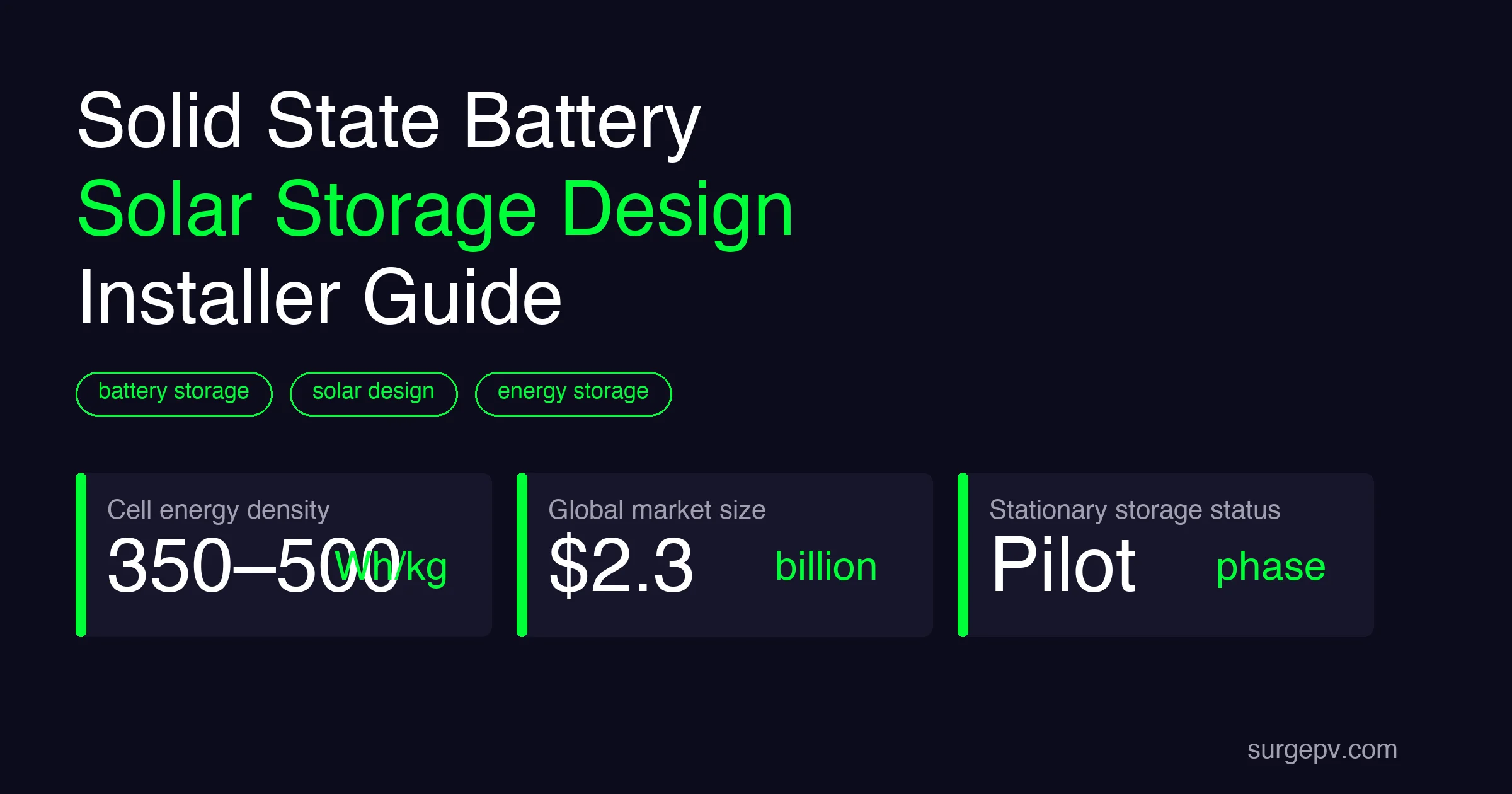
Solid-state batteries have been “five years away” for more than a decade. In 2026 the gap between laboratory promise and field deployment is finally narrowing. Toyota, Factorial Energy, QuantumScape, and Samsung SDI all have pilot lines or vehicle test programs running. The technology is real, but it is not yet a product you can order from a solar distributor for next month’s installation. That distinction matters for solar designers who must deliver systems that work for 15–20 years, not prototypes that look good in press releases.
This guide is written for installers and EPCs who need to answer three practical questions. What changes when solid-state batteries finally reach stationary solar? How do you design differently compared to today’s LFP and NMC systems? And what should you specify right now so a customer can upgrade later without replacing the entire system? We will separate proven facts from marketing claims, show where the design rules change, and give you a clear decision framework for 2026 projects.
In this guide, you will learn:
- How solid-state batteries work and why they differ from lithium-ion at the cell level
- The real 2026 commercialization status across automotive and stationary storage
- A side-by-side comparison with LFP and NMC on energy density, cycle life, safety, and cost
- Design impacts on voltage, BMS, thermal management, enclosure sizing, and inverter selection
- How to future-proof a solar-plus-storage system for a solid-state upgrade
- Five rules for deciding whether to specify solid-state batteries today
- Answers to the most common installer questions on compatibility, sizing, and safety
Solid-state batteries replace the liquid electrolyte in lithium-ion cells with a solid material, enabling higher energy density, wider temperature tolerance, and reduced fire risk. In 2026 they remain primarily in pilot production and premium EV programs, with limited availability for stationary solar storage. Designers should treat them as a future-ready option, not a drop-in replacement for LFP.
TL;DR
True all-solid-state batteries are not yet available for residential or commercial solar installations in 2026. LFP remains the safe, cost-effective choice. The right design strategy today is to install a storage-ready inverter, size DC cabling and breakers for future capacity, and choose a battery architecture that can accept firmware upgrades when solid-state products arrive.
What Is a Solid-State Battery?
A solid-state battery replaces the liquid or gel electrolyte and porous separator of a conventional lithium-ion cell with a solid electrolyte. The solid material can be a ceramic oxide, a sulfide compound, a polymer composite, or a thin-film glass. Lithium ions still move between anode and cathode during charge and discharge, but they do so through a rigid or semi-rigid medium that does not flow, leak, or boil.
The solid electrolyte enables two important changes at the cell level. First, it allows the use of a lithium-metal anode instead of the graphite anode used in conventional cells. Metallic lithium stores roughly ten times more charge per unit volume than graphite. This is the main reason solid-state cells can reach 350–500 Wh/kg at the cell level, compared with 160–250 Wh/kg for current lithium-ion chemistries.
Second, the solid electrolyte is non-flammable. Conventional lithium-ion cells can enter thermal runaway if internal temperatures exceed roughly 180–270°C, depending on chemistry. The liquid electrolyte decomposes and releases flammable gas. Solid electrolytes have much higher decomposition temperatures and do not produce the same volume of flammable gas, which reduces fire risk and propagation between cells.
The trade-offs are real. Solid electrolytes are brittle. Ceramic materials can crack during charge and discharge as the anode expands and contracts. Sulfide electrolytes conduct ions well but react violently with moisture, requiring dry-room manufacturing conditions. Polymer electrolytes are flexible but have lower ionic conductivity and narrower temperature ranges. These manufacturing and materials challenges are why commercial solid-state cells have taken longer to scale than early forecasts suggested.
2026 Commercialization Status: Where the Technology Actually Stands
The solid-state battery market reached roughly $2.3 billion in 2026, according to Grand View Research, with a projected compound annual growth rate of 31.8% through 2033. That growth is driven almost entirely by automotive and consumer electronics investment, not stationary energy storage.
Several major programs are worth tracking because they will eventually produce cells that migrate into solar storage:
| Company / Partnership | Electrolyte Approach | Reported Cell-Level Energy Density | Target Application | Commercial Timeline |
|---|---|---|---|---|
| Toyota / Idemitsu Kosan | Sulfide | 450–500 Wh/kg | Premium Lexus EVs | 2027–2028 limited production |
| Factorial Energy / Mercedes-Benz | Sulfide, lithium-metal | ~450 Wh/kg | Mercedes EQS-class EVs | 2027–2028 vehicle testing |
| QuantumScape / Volkswagen PowerCo | Sulfide, lithium-metal | 350–450 Wh/kg prototype | Automotive | Pilot line active; scale TBD |
| Solid Power / BMW / Samsung SDI | Sulfide, lithium-metal | 350–400 Wh/kg | Premium EVs | 2027–2028 demo vehicles |
| Samsung SDI | Sulfide | 350–400 Wh/kg target | EVs and ESS | Mass production H2 2027 |
| Great Power (China) | Oxide | 280 Wh/kg | Various | Mass production 2026 |
| Dongfeng / IM Motors (China) | Semi-solid “Lightyear” | 350 Wh/kg | Premium EVs | In limited production |
The key takeaway from the table is that 2026 is a pilot and demonstration year, not a mass-market stationary storage year. The cells with the highest energy density are aimed at electric vehicles, where weight and range command premium prices. Stationary solar storage values cycle life, safety, and cost per kilowatt-hour over gravimetric energy density. It will take several years after automotive introduction for solid-state products to be optimized and priced for rooftop and ground-mount installations.
Solid-State vs. LFP vs. NMC for Solar Storage
Most solar designers specify LFP for residential and commercial storage today. A smaller number use NMC where space or cold-weather performance is critical. Solid-state batteries will enter this market as a third option, not as a universal replacement.
| Metric | LFP (Current) | NMC (Current) | Solid-State (Projected) |
|---|---|---|---|
| Cell energy density | 160–210 Wh/kg | 250–320 Wh/kg | 350–500 Wh/kg |
| Pack energy density | 140–160 Wh/kg | 180–230 Wh/kg | 250–350 Wh/kg |
| Cycle life to 80% SOH | 6,000–10,000 | 2,000–4,000 | 1,000–10,000 (unproven at scale) |
| Daily DoD limit | 90–100% | 80–90% | 90–100% projected |
| Thermal runaway onset | ~270°C | ~180–210°C | >300°C projected |
| Operating temperature | -10°C to +50°C typical | -10°C to +45°C typical | -20°C to +60°C projected |
| Installed cost (2026) | $700–1,200/kWh | $900–1,500/kWh | $1,500–3,000/kWh early products |
| Commercial availability | Mature | Mature | Limited / pilot |
The cycle-life row deserves special attention. Solid-state cells could theoretically outlast LFP because the solid electrolyte does not decompose the way liquid electrolytes do. In practice, published cycle-life data for solid-state cells is scattered. Some prototype cells show 1,000 cycles. Others claim 10,000 cycles under tightly controlled conditions. Solar installers should not specify a chemistry based on theoretical longevity. Warranty terms, independent test reports, and field data matter more than laboratory claims. See battery degradation modeling for methods to project capacity fade across chemistries.
Energy density matters less for stationary solar than most people assume. A 10 kWh LFP battery weighs 80–120 kg and mounts on a garage wall. A solid-state equivalent might weigh 40–50 kg. That is a meaningful installation benefit, but it does not change the economics the way cycle life and cost do. For ground-mount commercial systems, weight and volume are even less important.
The safety advantage is clearer. Solid-state cells eliminate the flammable liquid electrolyte, reduce gas venting, and raise thermal runaway onset temperatures. That does not mean they are immune to failure. Dendrites can still form in lithium-metal anodes, especially at high charge rates or low temperatures. Cell cracking and interface resistance remain failure modes. The safety improvement is real but not absolute.
How Solid-State Batteries Change Solar Storage Design
When solid-state storage products do become available, they will require design changes across the system. Solar designers should prepare for these differences now.
Voltage and Charge Profiles
Solid-state cells with lithium-metal anodes operate at different voltages than LFP or NMC cells. An LFP cell is 3.2V nominal. An NMC cell is 3.6–3.7V nominal. A lithium-metal solid-state cell can operate at 3.8–4.2V nominal depending on cathode chemistry. This changes the number of cells in series needed to reach a 48V system voltage, the charge termination voltage, and the float voltage.
Inverters and charge controllers will need firmware that recognizes the new chemistry. A 48V LFP system charges to roughly 57.6V. A 48V solid-state system might charge to 58.8–60V. If the inverter’s maximum voltage window is fixed, the system may not fully charge or may trigger overvoltage faults. Early solid-state products will likely ship with their own inverter or a restricted compatibility list.
Battery Management System (BMS) Requirements
The BMS in a solid-state battery has new responsibilities. It must monitor stack pressure in designs that require mechanical compression of the cell stack. It must track electrolyte cracking indicators through impedance measurements. It must manage charge rates more aggressively because lithium-metal anodes are more prone to dendrite formation at low temperatures or high currents.
Communication protocols will also matter. A solar installer specifying a system today should choose batteries and inverters that use standard CAN, Modbus, or SunSpec protocols. Proprietary communication locks the customer into one vendor and makes future upgrades harder.
Thermal Management
Solid-state cells have a wider operating temperature range than liquid-electrolyte cells, but they are not temperature-agnostic. Sulfide-based cells perform best at moderately elevated temperatures, sometimes 40–60°C, which is hotter than typical LFP operation. Oxide-based cells can operate at higher temperatures but may require initial heating to reach acceptable ionic conductivity. Polymer-based cells are limited to lower temperatures.
This means a solid-state battery enclosure may need heating rather than cooling in cold climates, and precise temperature control in hot climates. Designers who are used to sizing LFP enclosures for passive cooling will need to read manufacturer thermal specs carefully. A smaller battery does not automatically mean simpler thermal management.
Enclosure and Mounting
Smaller size and lower weight are genuine advantages. A solid-state residential battery might occupy half the wall space of an equivalent LFP unit. That helps in apartments, townhouses, and commercial electrical rooms with limited wall area. However, mounting loads, seismic bracing, and service clearances still apply. A lighter battery can actually be harder to secure against tipping if the center of gravity changes.
For commercial installations, the footprint reduction could allow more energy in the same NFPA 855-rated room. That improves project economics where floor space is expensive. Designers should still model egress, ventilation, and fire suppression requirements based on the new product’s UL 9540A test report, not assumptions carried over from LFP.
Inverter and Charge Controller Compatibility
This is the most practical issue for installers. A solar-plus-storage system is a 15–20 year asset. If you install an inverter today that cannot communicate with tomorrow’s solid-state battery, the customer cannot upgrade without replacing the inverter. The safest approach is to specify hybrid inverters from manufacturers that have announced solid-state battery roadmaps or that support open communication standards.
Designers should also size DC cabling, breakers, and busbars for the maximum future storage capacity the site is likely to need. Pulling new cables through a finished conduit is expensive. Oversizing the DC circuit protection now removes a major upgrade barrier later.
LCOS and Economic Reality
Levelized cost of storage (LCOS) is the right way to compare battery options over time. It divides total lifetime costs by total lifetime energy delivered. Solid-state batteries will not beat LFP on LCOS in the first commercial generation.
Consider a 10 kWh residential storage system cycled 300 equivalent full cycles per year:
LFP system today:
- Installed cost: $10,000 ($1,000/kWh)
- Usable capacity: 9 kWh (90% DoD)
- Annual energy delivered: 2,700 kWh
- Cycle life: 6,000 cycles (20 years at 300/year)
- Round-trip efficiency: 92%
- LCOS: approximately $0.25/kWh
Early solid-state system projected:
- Installed cost: $20,000 ($2,000/kWh)
- Usable capacity: 9.5 kWh (95% DoD)
- Annual energy delivered: 2,850 kWh
- Cycle life: 5,000 cycles (17 years projected)
- Round-trip efficiency: 95%
- LCOS: approximately $0.55/kWh
The solid-state system is more efficient and slightly more compact, but the upfront cost doubles the LCOS. That math changes only when solid-state pack prices fall below roughly $120/kWh at the system level and cycle life is proven beyond 6,000 cycles. BloombergNEF and other analysts do not expect that crossover for stationary storage until the early 2030s.
For commercial projects, the economics depend more on available incentives, demand-charge reductions, and backup power value than on cell energy density. A solid-state battery that reduces a peak demand charge by $50,000 per year may justify a premium if it is reliable. Until field data proves reliability, most CFOs will prefer the known economics of LFP. SurgePV’s solar yield and financial analysis models LCOS, demand-charge savings, and payback period for any storage chemistry.
Safety, Codes, and Insurance
Solid-state batteries will change the safety conversation, but they will not eliminate code requirements. NFPA 855, the International Fire Code, UL 9540, and UL 9540A will still apply. In some ways the requirements may become simpler because solid-state cells have lower fire propagation risk. In other ways they may become more complex because the technology is new and fire marshals will want extra documentation.
Installers should expect the following in the first generation of solid-state storage products:
- UL 9540A test reports specific to the exact battery model
- Manufacturer-specific installation and clearance requirements
- Restrictions on parallel strings or maximum system size
- New shipping and handling rules for lithium-metal cells
- Possible changes to recycling and end-of-life handling
Insurance underwriters will also take time to adjust. A battery with a lower fire risk should eventually receive better rates, but only after actuaries have enough loss data. Early adopters may pay higher premiums until the industry catches up.
Future-Proofing a Solar-Plus-Storage System Today
The best design strategy for 2026 is not to wait for solid-state batteries. It is to build systems that can accept them when they make economic sense. Here are the practical steps.
Specify a storage-ready or hybrid inverter. A solar-only inverter cannot add batteries later without major rework. A hybrid inverter with DC-coupled battery input and open communication protocols gives the most flexibility. Some manufacturers already offer firmware upgrade paths for future chemistries.
Oversize the DC circuit. Size cables, breakers, and busbars for at least 150% of the initially installed battery capacity. This costs slightly more upfront but avoids replacing conduit and switchgear later.
Leave physical space. Design the battery location so a future unit with different dimensions can fit. Wall-mounted LFP batteries are tall and shallow. Future solid-state units might be shorter and deeper. A little extra floor or wall space removes a common upgrade barrier.
Document the intent. Include a note on the as-built drawings that the system is designed for future storage expansion. List the maximum DC current, voltage window, and communication protocols. The installer who returns in 2030 will thank you.
Choose open standards. Battery and inverter combinations that use proprietary communication are harder to upgrade. SunSpec Modbus, IEEE 2030.5, and standard CAN bus profiles reduce vendor lock-in.
SurgePV’s solar design software lets you model storage capacity upgrades, cable sizing, and inverter voltage windows in the same project file. That makes it easier to show a customer the upgrade path without designing two separate systems.
Design storage-ready solar systems today
SurgePV’s solar design platform models current LFP and NMC batteries plus future storage expansion paths, so your proposals stay accurate as battery technology evolves.
Book a DemoNo commitment required · 20 minutes · Live project walkthrough
5 Rules for Deciding Whether to Specify Solid-State Batteries
-
Do not specify all-solid-state batteries for projects breaking ground in 2026. No mainstream stationary storage product is available. If a vendor claims otherwise, ask for independent test reports, warranty documents, and a UL 9540A report with the exact model number.
-
Use LFP as the default chemistry. It has the best combination of cycle life, safety, cost, and availability for residential and commercial solar. Only deviate when a specific site constraint genuinely favors another option.
-
Treat energy density claims with skepticism. Cell-level numbers of 450–500 Wh/kg are real in prototypes. Pack-level numbers for installed products will be 30–40% lower once housings, BMS, thermal management, and connectors are included.
-
Plan for the upgrade, not the product. Size circuits, choose hybrid inverters, and leave space so a future battery swap is straightforward. The customer who buys LFP today should be able to add or replace it with solid-state later without rewiring the house.
-
Run LCOS, not headline price. A battery that is smaller or lighter is not automatically cheaper over its lifetime. Model installed cost, cycle life, efficiency, degradation, and replacement timing before recommending any chemistry. Solar proposal software should show these lifetime numbers clearly to customers.
Frequently Asked Questions
What is a solid-state battery for solar storage?
A solid-state battery uses a solid electrolyte instead of the liquid or gel electrolyte found in conventional lithium-ion cells. For solar storage, this means higher theoretical energy density, better thermal stability, and lower fire risk. Most designs pair the solid electrolyte with a lithium-metal anode to maximize capacity.
Are solid-state batteries available for home solar in 2026?
No, not in mainstream home solar products. In 2026 solid-state cells are in pilot production, automotive testing, and limited premium EV programs. Stationary solar storage products using true all-solid-state cells are expected in the 2029–2032 window, with cost-competitive versions arriving later.
How do solid-state batteries compare to LFP for solar?
Solid-state batteries project 350–500 Wh/kg cell-level energy density versus 160–210 Wh/kg for LFP, plus wider operating temperatures and lower fire risk. However, LFP currently offers proven 6,000–10,000 cycle life, established supply chains, and installed costs of $700–1,200/kWh. Solid-state remains more expensive and less proven for long solar duty cycles.
What design changes are needed for solid-state batteries?
Designers must account for different nominal voltages, stack-pressure or clamping requirements, higher operating temperatures during fast charging, and new BMS protocols. Inverters and charge controllers will need firmware updates or replacement. Enclosures may be smaller but require more precise thermal management.
Can I replace an LFP battery with a solid-state battery later?
Only if the inverter, BMS, and charge profiles are compatible. The safest approach is to specify a hybrid inverter with firmware upgrade paths and communication standards such as CAN or Modbus that can adapt to future battery chemistries. Treat solid-state as a future upgrade, not a guaranteed retrofit.
When should a solar designer specify solid-state batteries?
Specify them only when a commercial product is available with verified cycle-life data, warranty terms, and inverter compatibility. Until then, use LFP for residential and commercial solar-plus-storage projects, and plan the system architecture to accommodate future storage upgrades.
Where this fits
This article is part of SurgePV's Energy Storage hub, which works through the topic from first principles to the decisions a project team actually has to make.
