

Quick Answer
DC-coupled storage sends solar DC power straight into a battery via a hybrid inverter, skipping one conversion. Your choice hinges on whether you are adding storage to existing solar or designing a new system. That inverter converts DC to AC, which then powers home loads or feeds into the grid.
When you add battery storage to a solar array, the electrical path between panels and battery matters more than most homeowners realize. That path defines your round-trip efficiency, upfront cost, and whether your system can restart after a multi-day outage. The choice comes down to two architectures: AC-coupled, which routes power through alternating current, and DC-coupled, which keeps power in direct current until it reaches your loads. Both work. Both have clear winners depending on your project type. Getting the design right starts with a sound solar designing workflow and accurate modeling tools.
Featured Snippet Answer
What is the difference between AC and DC coupled solar storage?
AC-coupled storage sends solar DC power through a solar inverter to AC, then a battery inverter converts it back to DC for storage. DC-coupled storage sends solar DC power straight into a battery via a hybrid inverter, skipping one conversion. DC coupling is more efficient; AC coupling is easier to retrofit.
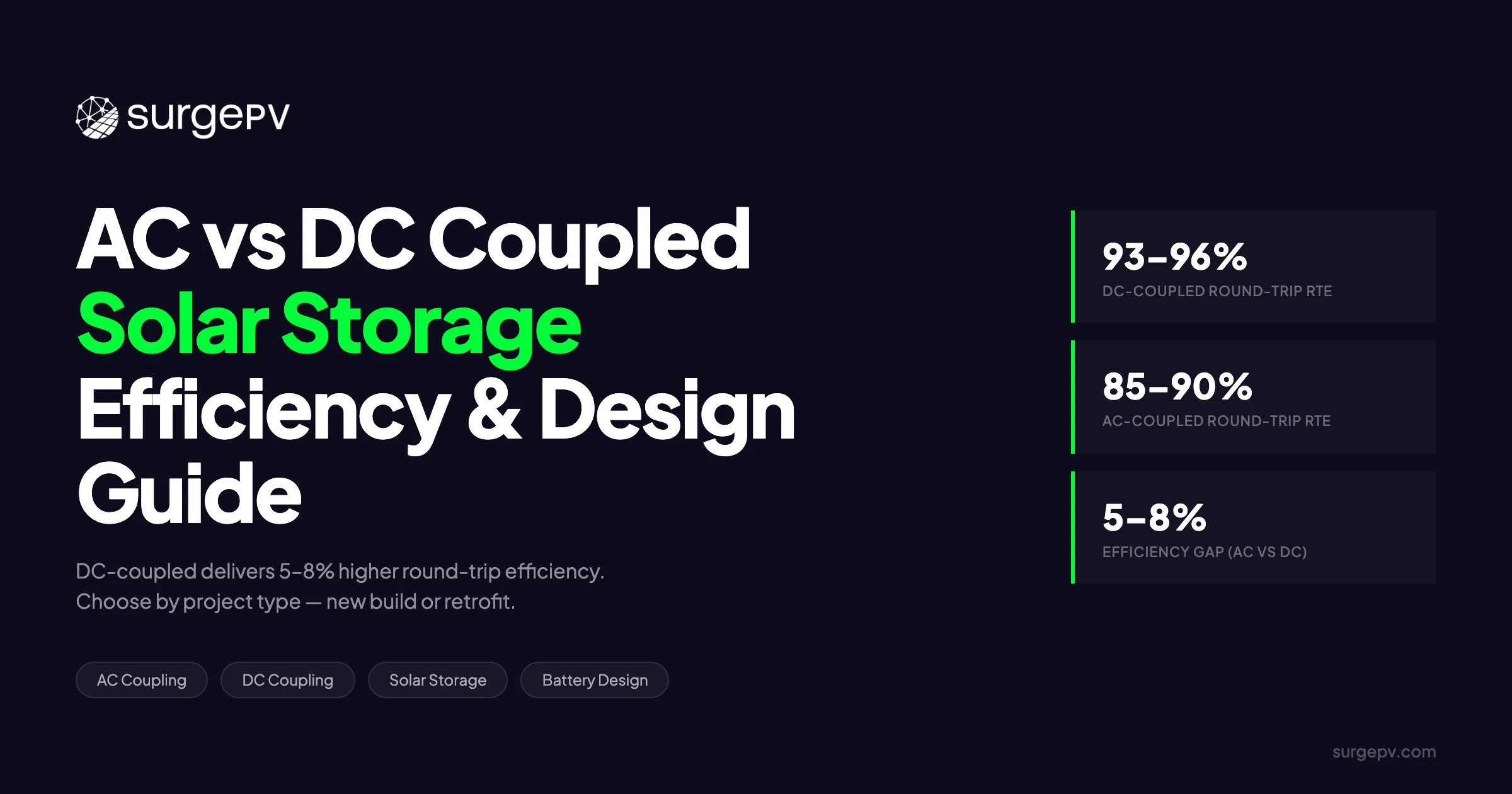
TL;DR: DC-coupled systems deliver 5–8% higher round-trip efficiency and lower upfront costs for new solar-plus-storage builds. AC-coupled systems dominate retrofits because they avoid inverter replacement. Your choice hinges on whether you are adding storage to existing solar or designing a new system. For either path, solar design tools eliminates guesswork.
What you’ll learn:
- How power flows differ between AC and DC coupling architectures
- Exact round-trip efficiency numbers from NREL ATB 2024 and real manufacturer specs
- Upfront cost differences and 20-year TCO for new builds versus retrofits
- Which inverter and battery combinations work together (and which do not)
- How DC coupling recovers clipped energy — with worked sizing math
- What installers report about backup performance, idle draw, and failure modes
- A clear decision framework based on project type and local regulations
How AC-Coupled and DC-Coupled Systems Work
Understanding the physical path of electrons is the first step to choosing an architecture. In both systems, photovoltaic modules generate DC power. What happens after that depends entirely on where the inversion happens. You can use solar design suite to model both paths and see how component placement affects annual yield before you buy hardware.
AC-coupled power flow
In an AC-coupled system, PV modules feed DC power into a dedicated solar inverter. That inverter converts DC to AC, which then powers home loads or feeds into the grid. When production exceeds demand, the surplus AC flows to a separate battery inverter/charger. This device converts AC back to DC and stores the energy in the battery.
During discharge, the process reverses: DC power leaves the battery, passes through the battery inverter (DC to AC), and supplies the home. This creates a triple conversion loss for any energy that enters storage: DC to AC at the solar inverter, AC to DC at the battery charger, and DC to AC again at the battery inverter during discharge. Direct self-consumption bypasses the battery entirely and avoids those losses, which is why AC-coupled systems still make sense when most generation is used in real time.
DC-coupled power flow
In a DC-coupled system, PV modules connect to a charge controller or MPPT input on a hybrid inverter. The hybrid inverter manages a shared DC bus where both the array and the battery sit. Surplus solar charges the battery directly in DC form without an intermediate inversion step. When the home needs power, the hybrid inverter draws from either the PV array or the battery — whichever source is available — and performs a single DC-to-AC conversion to supply the load. See DC Bus Voltage Optimization for detailed guidance.
Because stored energy only passes through one inverter instead of two, DC-coupled architectures cut conversion losses significantly. The trade-off is that the hybrid inverter must handle both solar and battery management, making it a single point of failure and limiting your choice of compatible batteries.
Architecture at a Glance
| Element | AC-Coupled | DC-Coupled |
|---|---|---|
| Inverter count | 2 (solar + battery) | 1 (hybrid/bidirectional) |
| PV-to-battery path | DC→AC→DC | DC→DC |
| Round-trip efficiency | 85–90% | 92–96% |
| Retrofit difficulty | Low | High |
| Grid charging | Yes (standard) | Limited / requires extra hardware |
Round-Trip Efficiency: Counting Every Conversion Loss
Efficiency numbers on datasheets tell only part of the story. What matters for your customer is how many kilowatt-hours actually come back out of the battery after a full charge-discharge cycle. Every extra conversion step bleeds energy as heat. Modern solar software and production modeling tools let you quantify those losses for a specific load profile and climate, which is why we recommend running both architectures through a solar financial analysis tool during the design phase.
The efficiency gap in numbers
NREL’s Annual Technology Baseline 2024 lists a representative round-trip efficiency of 85% for AC-coupled residential storage. That figure assumes AC-to-AC storage, meaning the energy is measured at the AC output of the solar inverter and again at the AC output of the battery inverter. DC-coupled systems benchmark at 92–96% round-trip efficiency. NREL notes that utility-scale PV-charged DC systems can show lower realized efficiency — around 87% — when auxiliary loads and temperature effects are included, but residential hybrid inverters with high-voltage batteries routinely hit the mid-nineties.
Manufacturer datasheets confirm the gap. The Enphase IQ Battery 5P lists a 90% AC round-trip efficiency and a 96% DC round-trip efficiency. Tesla Powerwall 3 lists 89% round-trip efficiency. These are laboratory-weighted numbers; real-world performance varies with temperature, charge rate, and battery age. The key point is that the 5–8 percentage point gap between AC and DC coupling is consistent across sources.
That gap only applies to stored energy. If your customer self-consumes 70% of generation in real time and stores only 30%, the effective system penalty is smaller. But in markets with low export tariffs or time-of-use rates that encourage storage, the battery sees heavy cycling — and the conversion penalty compounds.
Worked example — 10 kWh stored per day
Assume a home stores 10 kWh of daily surplus and discharges it at night, 365 days per year, at a blended electricity rate of $0.15 per kWh.
With an AC-coupled system at 87.5% round-trip efficiency, the battery delivers 8,750 kWh per year. The annual loss is 1,250 kWh. With a DC-coupled system at 94% round-trip efficiency, the battery delivers 9,400 kWh per year. The annual loss is 600 kWh.
The delta is 650 kWh per year. At $0.15 per kWh, that equals roughly $97.50 per year. Over a 25-year analysis period, the value of that lost energy approaches $2,437. In high-rate markets like California, where stored energy displaces $0.30 to $0.40 retail power, the financial gap doubles.
Annual Energy Loss Comparison
| Scenario | RTE | kWh Delivered | kWh Lost | 25-Year Value of Loss |
|---|---|---|---|---|
| AC-coupled (mid) | 87.5% | 8,750 | 1,250 | ~$2,437 |
| AC-coupled (high) | 90% | 9,000 | 1,000 | ~$1,950 |
| DC-coupled (mid) | 94% | 9,400 | 600 | ~$1,125 |
| DC-coupled (high) | 96% | 9,600 | 400 | ~$750 |
Cost Breakdown: New Build vs Battery Retrofit
Efficiency is only one line item. Installed cost and long-term maintenance often drive the final decision, especially when the customer is comparing a retrofit quote against a new-build package. You can use solar proposal software to present both scenarios side by side with payback curves that account for inverter replacement, degradation, and changing utility rates.
Upfront installed costs
A 2016 benchmark from NREL and RMI — still widely cited after inflation adjustment — found that DC-coupled new systems cost roughly $27,703 for a baseline residential installation, while AC-coupled new systems cost $29,568, a 6.7% premium. The gap widened for retrofits: adding AC-coupled storage to existing solar cost $32,786, roughly 11% more than a simultaneous DC-coupled install.
In 2026, residential battery costs range from $600 to $1,200 per kWh installed, depending on chemistry, enclosure rating, and local labor rates. The hybrid inverter premium for DC-coupled designs typically adds $1,000 to $3,000 compared to a standard string inverter. For new builds, that premium is offset by eliminating the separate battery inverter and reducing installation labor. For retrofits, the hybrid inverter cost is additive because you are replacing a functioning solar inverter.
20-year total cost of ownership
Over two decades, three cost drivers separate the architectures. First, inverter replacement: a hybrid inverter is a single point of failure, and when it dies, the entire system goes down. Replacing it costs more than replacing a standalone battery inverter. Second, efficiency loss value: as calculated above, AC coupling bleeds more energy over time. Third, battery degradation: all lithium-ion batteries lose roughly 1.5–2% of capacity per year, regardless of coupling type, which reduces the effective value of stored energy in later years.
20-Year TCO Model (5.6 kW PV + 10 kWh Battery)
| Cost Driver | AC-Coupled | DC-Coupled |
|---|---|---|
| Initial hardware + labor | $14,500 | $13,200 |
| Inverter replacement (1x) | $1,200 (battery inverter only) | $2,800 (hybrid inverter) |
| Efficiency loss value (20 yr) | $1,950 | $900 |
| Total 20-year TCO | $17,650 | $16,900 |
Note: TCO is scenario-dependent; AC retrofits avoid hybrid inverter swap on existing PV.
Inverter Architecture and Battery Compatibility
Your choice of coupling locks you into specific hardware pairings. That lock-in affects warranty risk, monitoring complexity, and how easily you can swap a battery years from now.
Single hybrid vs dual inverter setups
AC-coupled systems use two inverters with independent warranties and separate monitoring apps. If the battery inverter fails, the solar inverter keeps producing. If the solar inverter fails, the battery inverter can still charge from the grid (where permitted) and supply backup power. This independence is why many installers prefer AC coupling for customers who rank uptime over peak efficiency.
DC-coupled systems consolidate everything into one box. Fewer components mean fewer connections and potentially lower installation time. But a hybrid inverter failure takes the entire system offline — no solar production, no battery discharge, no backup. Installer sentiment consistently flags this as the primary downside of DC coupling. If your customer lives in an area with frequent outages, the ability to keep generating during a battery inverter failure is a real advantage.
Compatibility matrix
DC-coupled designs create brand lock-in. A SolarEdge Home Battery must pair with a SolarEdge Energy Hub inverter. SMA Sunny Boy Storage requires SMA-certified batteries. AC-coupled options are agnostic: an Enphase IQ Battery, Tesla Powerwall, or FranklinWH can pair with almost any existing string inverter, provided the AC wiring and load panel have capacity.
Residential Inverter + Battery Compatibility
| Hybrid Inverter | Compatible Batteries | AC-Coupled Option? |
|---|---|---|
| SolarEdge Energy Hub | SolarEdge Home Battery | Any AC battery |
| Fronius Symo Hybrid | BYD Battery-Box, LG Chem | Any AC battery |
| SMA Sunny Boy Storage | SMA-certified batteries | Any AC battery |
| Victron MultiPlus | Pylontech, BYD, self-build | Any AC battery |
| Deye SUN-5K-SG03LP1 | Deye, Pylontech, Voltronics | Any AC battery |
| Growatt SPH | Growatt, Pylontech | Any AC battery |
Installers report that buyers want explicit compatibility statements, not vague claims. If you specify a DC-coupled system, document the exact inverter and battery SKU in the contract.
Design Edge: Clipping Recovery and DC-to-AC Ratios
One hidden advantage of DC coupling is the ability to capture energy that would otherwise be lost to inverter clipping. Array sizing and PV shade analysis directly affect how much clipped energy is available, so these calculations should be part of every storage design.
How DC coupling recovers clipped energy
Clipping happens when the DC array is producing more power than the inverter’s AC output limit. On a cool, sunny day, an 8 kW DC array on a 6 kW AC inverter might hit the 6 kW ceiling for several hours. In an AC-coupled system, that clipped DC energy is lost — the solar inverter cannot push extra AC, and there is no DC path to the battery.
In a DC-coupled system, the hybrid inverter’s DC bus sits between the array and the battery. When the AC output limit is reached, surplus DC current diverts into the battery before inversion. The energy is stored instead of discarded. This is not theoretical; it is a standard behavior of hybrid inverters with active MPPT and battery management.
Sizing math — 1.3:1 DC:AC ratio example
Consider an 8 kW DC array on a 6 kW AC hybrid inverter, a 1.33:1 ratio. In a location with 4.5 peak sun hours, clipping analysis shows roughly 450 kWh per year lost to the 6 kW AC ceiling. A DC-coupled battery with available capacity captures roughly 60% of that clipped energy, or about 270 kWh per year extra. For more on this topic, see AC Coupled vs DC Coupled Battery Solar.
At $0.15 per kWh, that recovered energy is worth about $40.50 per year. In markets with aggressive net-metering export limits, the value is higher because the clipped energy would have been exported at a fraction of retail rates anyway. Ratios above 1.3:1 increase clipping volume and make DC coupling more attractive.
Clipping Recovery Value by DC:AC Ratio
| DC:AC Ratio | Annual Clipped Energy | Recovered via DC Coupling | Value at $0.15/kWh |
|---|---|---|---|
| 1.1:1 | ~120 kWh | ~72 kWh | ~$10.80 |
| 1.3:1 | ~450 kWh | ~270 kWh | ~$40.50 |
| 1.5:1 | ~780 kWh | ~468 kWh | ~$70.20 |
Real-World Backup, Black Start, and Installer Sentiment
Datasheets do not tell you how a system behaves on day three of a grid outage. Installer forums and field reports fill that gap.
Backup behavior and black start
Black start is the ability to restart a dead system from zero state of charge using only solar. In a DC-coupled system, the hybrid inverter can black start if the battery hits 0% during a multi-day outage. The PV array recharges the battery directly through the DC bus. Once the battery has enough voltage, the inverter starts and supplies AC loads again.
AC-coupled systems struggle here. The battery inverter needs the battery to hold a minimum reserve voltage to wake up. If the battery drains fully during a long outage, some AC-coupled systems require grid power or a manual restart procedure to resume operation. Not all battery inverters support black start; check the spec sheet carefully.
Idle draw is another field concern. Some AC-coupled battery inverters draw 50–200 W in standby, continuously consuming generation. On overcast days, that idle load can consume a meaningful share of a small array’s output. DC-coupled hybrid inverters typically draw 30–80 W, a modest but real advantage in low-irradiance conditions.
What installers actually report
On Reddit’s r/solarpower, installers note that AC coupling losses are often overstated for retrofits. Daytime surplus is frequently exported at 2–10 cents per kWh, so the AC penalty matters less financially than the installation savings. On Whirlpool and DIY Solar Forum threads, contractors warn that DC retrofits are difficult to quote and warranty. Mixing vintage PV modules with a new hybrid inverter creates liability, and many installers refuse to touch mixed-vintage systems.
Surge capacity is another forum theme. Standalone inverters in AC-coupled systems — like the Sol-Ark 15K and EG4 18kPV — are praised for handling motor startup surges. Many all-in-one hybrid inverters are criticized for weak surge ratings relative to their continuous output, which can cause shutdowns when well pumps or HVAC compressors start.
Installer Sentiment Summary
| Topic | AC-Coupled | DC-Coupled |
|---|---|---|
| Retrofit ease | Excellent | Poor |
| Surge capacity | Good (separate inverters) | Variable (hybrid dependent) |
| Idle draw | 50–200W typical | 30–80W typical |
| Warranty risk | Low (independent) | Higher (single box) |
| Installer availability | High | Moderate |
Regional Rules That Influence Your Choice
Local regulations and tariff structures can override pure engineering logic. A design that wins on paper may lose on interconnection cost or export limits.
NEM 3.0 and self-consumption economics
California’s NEM 3.0 export rates have cratered to roughly 5–8 cents per kWh. That makes self-consumption extremely valuable. In this environment, the DC efficiency advantage matters more because every stored kWh displaces $0.30–$0.40 retail power instead of being exported cheaply. Conversely, AC grid-charging capability matters for time-of-use arbitrage where off-peak grid charging is allowed and profitable.
Export limits and interconnection
In Australia, some distributed network service providers limit solar export to 5 kW. DC-coupled oversizing with high DC:AC ratios helps maximize self-consumption without triggering export penalties. In Europe, self-consumption tariffs in several markets favor DC-coupled designs that push every available watt into the home before it reaches the meter. In the United States, AC retrofits often avoid new interconnection agreements because the original solar inverter and its approved AC rating remain unchanged. Also see: European Solar Incentives. For the latest details on Australia, see Solar Energy in Australia. For Australia-specific compliance details, see Australia comparisons/lgc-vs-stc.
Decision Framework: Which Architecture Wins
The right choice is almost always determined by whether the solar array already exists. Everything else — efficiency, cost, and design flexibility — follows from that starting condition.
Design Solar + Storage Systems Faster
SurgePV’s generation and financial tool models AC and DC-coupled configurations, self-consumption, and payback in minutes.
Book a DemoNo commitment required · 20 minutes · Live project walkthrough
For a direct comparison, see Arka 360 vs SurgePV.
Choose Your Architecture
| Your Situation | Recommended Coupling | Key Reason |
|---|---|---|
| Existing solar, adding battery | AC-coupled | No inverter swap, lower labor, preserves warranty |
| New solar + storage build | DC-coupled | Higher efficiency, lower hardware count, clipping recovery |
| High DC:AC ratio planned (above 1.3:1) | DC-coupled | Captures clipped energy before inversion |
| Need grid charging / TOU arbitrage | AC-coupled | Standard grid-charging support |
| Off-grid or unstable grid | DC-coupled | Black start, direct PV-to-battery charging |
| Mixed-brand existing inverter | AC-coupled | Inverter-agnostic battery options |
If you are still unsure, run both scenarios in solar design platform to see exact production and payback differences for your specific location, load profile, and rate structure. AI-assisted design tools like Clara AI can also flag compatibility issues and sizing mismatches before you finalize hardware.
Frequently Asked Questions
What is the efficiency difference between AC and DC coupled batteries?
DC-coupled systems achieve 92–96% round-trip efficiency; AC-coupled systems achieve 85–90%. The 5–8 point gap comes from extra DC-to-AC and AC-to-DC conversions in AC-coupled architecture.
Can I add a DC-coupled battery to my existing solar system?
Technically possible but rarely done. You must replace your existing solar inverter with a hybrid inverter, rewire the DC bus, and often file a new interconnection agreement. Most installers recommend AC-coupled for retrofits.
Is Tesla Powerwall AC or DC coupled?
Powerwall 3 is DC-coupled and integrates directly with Tesla solar inverters. Powerwall 2 and earlier were AC-coupled, allowing connection to any existing solar inverter.
How much does AC coupling reduce battery efficiency?
For every 10 kWh stored daily, AC coupling wastes roughly 1.0–1.5 kWh more than DC coupling. Over 25 years, that gap can cost $1,000–$1,700 in lost energy value at average US retail rates.
Can AC-coupled batteries charge from the grid?
Yes. AC-coupled battery inverters can charge from grid AC power, making them ideal for time-of-use arbitrage. DC-coupled systems typically charge from solar DC only; grid charging requires additional hardware.
What happens if my hybrid inverter fails in a DC-coupled system?
The entire system shuts down — both solar production and battery discharge stop. This single point of failure is the main reliability trade-off against DC coupling’s efficiency advantage.
Which is cheaper to install: AC or DC coupled battery?
For new simultaneous installs, DC-coupled is 3–7% cheaper. For retrofits, AC-coupled is cheaper because it avoids inverter replacement and rewiring.
Where this fits
This article is part of SurgePV's Energy Storage hub, which works through the topic from first principles to the decisions a project team actually has to make.
