

Quick Answer
Battery pack prices fell to roughly $108/kWh in 2025 ($108/kWh average across all lithium-ion segments (BloombergNEF, 2025)), and storage is now a standard part of commercial proposals. The model must also account for round-trip efficiency losses of roughly 15%, auxiliary standby power, and capacity fade. A model that ignores battery degradation will overstate returns in years 8–10 when capacity has fallen 15–20%.
Solar plus storage projects are won or lost in the spreadsheet. A customer asking about payback does not want a rough estimate—they want numbers that survive due diligence. Battery pack prices fell to roughly $108/kWh in 2025 ($108/kWh average across all lithium-ion segments (BloombergNEF, 2025)), and storage is now a standard part of commercial proposals. The problem is that most financial models treat batteries as simple add-ons rather than dispatchable assets. This guide fixes that. It gives installers the exact formulas, tables, and assumptions needed to model NPV, IRR, and payback for real projects.
Battery pack prices fell to roughly $108/kWh in 2025 ($108/kWh average across all lithium-ion segments (BloombergNEF, 2025)), and storage is now a standard part of commercial proposals. The model must also account for round-trip efficiency losses of roughly 15%, auxiliary standby power, and capacity fade.
TL;DR
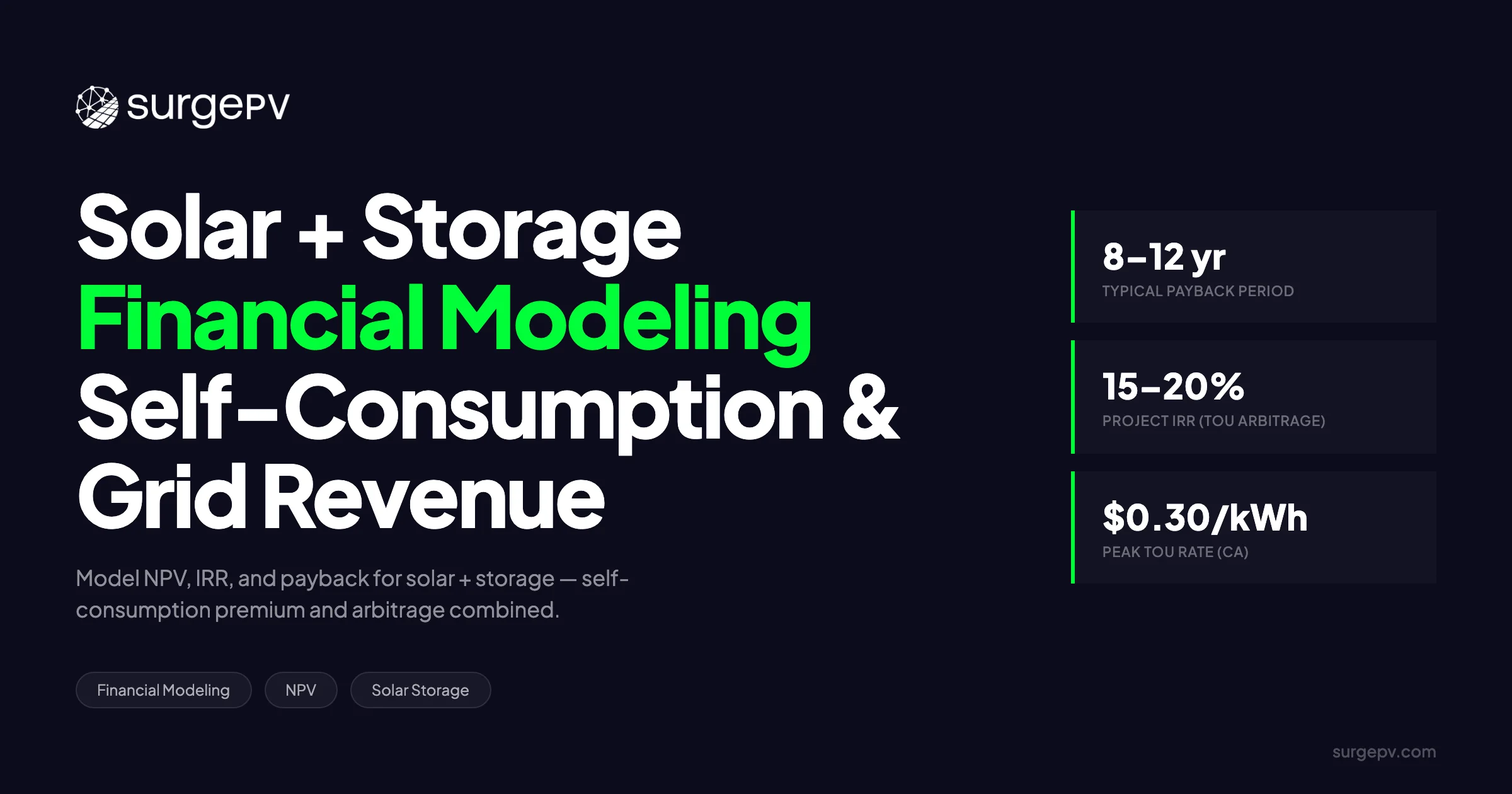
Solar plus storage projects live or die by the numbers. A typical commercial solar plus storage project yields an IRR of 8–15% and simple payback of 5–10 years, assuming electricity rates of $0.12/kWh with 3% annual escalation, a 6% discount rate, and LFP battery degradation of 20% over 10 years. The Section 48E ITC provides a 30% credit for commercial and utility storage projects placed in service after 2023. The residential ITC expired on December 31, 2025.
What You’ll Learn
- How to calculate NPV, IRR, and payback period for solar + storage projects with worked formulas
- Why self-consumption premiums matter more than export rates in most markets
- How demand charge reduction contributes 20–40% of total savings in commercial projects
- How to model LFP battery degradation (20% capacity loss over 10 years) in year-by-year cash flows
- Which tax incentives apply to commercial vs. residential storage in 2026
- How revenue stacking combines multiple value streams into one financial model
- The five most common modeling mistakes that distort project returns
What Solar Storage Financial Modeling Actually Means
A complete solar storage financial model is a 20–25 year cash flow projection that decides whether a battery makes economic sense. Unlike standalone solar modeling, which tracks energy production against a flat bill, storage modeling must account for when the battery charges, when it discharges, and what each cycle earns. For more on this topic, see Off Grid Solar System Sizing.
The model starts with interval data. Solar generation changes by hour and season. Battery dispatch depends on tariff design: time-of-use rates create arbitrage windows, and demand charges create peak-shaving value. The model must also account for round-trip efficiency losses of roughly 15%, auxiliary standby power, and capacity fade.
The difference between a spreadsheet that functions and one that produces actionable results lies in how revenue streams are stacked. A model that only counts self-consumption savings will understate returns for commercial projects where demand charges dominate. A model that ignores battery degradation will overstate returns in years 8–10 when capacity has fallen 15–20%.
A complete storage model must include:
- Hourly or 15-minute interval load and generation profiles
- Dispatch logic for self-consumption, peak shaving, and arbitrage
- Battery round-trip efficiency and auxiliary standby losses
- Capacity degradation curves specific to battery chemistry
- Electricity rate escalation of 2–4% per year
- Incentive timing and eligibility rules
- Replacement CapEx if the analysis period exceeds battery life
Standalone solar models assume energy not used immediately is exported at a fixed rate. Storage breaks that assumption. The battery can store midday generation for evening use, or discharge during a 15-minute demand peak that occurs after sunset. A spreadsheet that simply subtracts solar production from annual consumption will miss these events entirely. The gap between a rough estimate and a bankable model often determines whether a proposal closes. solar design platform has moved beyond layout-only tools. Financial accuracy now determines which proposals win. SurgePV’s PV generation and financial modeling automates the year-by-year cash flow modeling that spreadsheets handle poorly.
Core Financial Metrics: NPV, IRR, and Payback
Every storage proposal stands on three metrics: Net Present Value, Internal Rate of Return, and payback period. These figures answer the questions customers actually ask. Is this project worth more than leaving the capital in the business? What is the effective annual return? When do I get my money back?
Net Present Value (NPV)
NPV answers whether the project beats the alternative investment. The formula is:
NPV = -Initial Cost + Σ(Annual Cash Flow_t / (1 + discount rate)^t)Where Initial Cost is CapEx after incentives, Annual Cash Flow_t is all revenue minus OpEx in year t, and the discount rate is the hurdle rate (typically 6–8% for commercial projects, 4–6% for residential). A positive NPV means the project generates returns above the hurdle rate. A negative NPV means the capital earns more elsewhere.
Internal Rate of Return (IRR)
IRR is the discount rate that forces NPV to zero. It represents the effective annualized return. For commercial solar plus storage, a typical IRR range is 8–15% before financing. Projects below 6% rarely attract outside capital unless resilience or ESG targets justify the spend.
Simple Payback vs. True Payback
Simple payback is the fastest metric to calculate:
Payback = Initial Cost / Annual SavingsFor example, a $180,000 system saving $28,000 in year one has a simple payback of 6.4 years. True payback factors in discounting, incentive timing, and degradation. It typically runs 6–12 years for commercial projects. solar software should calculate both figures automatically so the customer sees the optimistic and conservative scenarios side by side.
How do you calculate payback period for solar + storage?
Use simple payback: Payback = Initial Cost / Annual Savings. For solar plus storage, annual savings include self-consumption value, demand charge reduction, and any grid services revenue. For accuracy, use discounted cash flows that account for battery degradation, rate escalation, and incentive timing.
Key Financial Metrics at a Glance
| Metric | Formula | Typical Range | Decision Rule |
|---|---|---|---|
| NPV | -CapEx + Σ(CF_t / (1+r)^t) | $50k–$500k+ (commercial) | Greater than 0 |
| IRR | Rate where NPV = 0 | 8–15% (commercial) | Exceeds hurdle rate |
| Simple Payback | CapEx / Year 1 Savings | 5–10 years | Under investor maximum |
| Discounted Payback | Years to NPV = 0 | 6–12 years | Under project lifetime |
The Revenue Streams That Drive Solar + Storage Economics
Solar plus storage projects generate value through three primary mechanisms. The mix depends on local tariff design, project scale, and whether the customer pays demand charges.
Self-Consumption Premium
The self-consumption premium is the gap between the retail electricity rate and the export rate. Every kilowatt-hour consumed on-site avoids the full retail rate; every kilowatt-hour exported earns only the lower export rate.
Self-Consumption Premium by Market
| Market | Retail Rate | Export Rate | Premium |
|---|---|---|---|
| US | $0.12–0.18/kWh | $0.02–0.08/kWh | $0.10–0.15/kWh |
| Germany | €0.25–0.40/kWh | €0.08–0.20/kWh | €0.08–0.15/kWh |
| UK | £0.20–0.35/kWh | £0.05–0.15/kWh | £0.12–0.18/kWh |
Self-Consumption Rate Improvement
| Configuration | Self-Consumption Rate | Annual Utilization |
|---|---|---|
| Solar only | 30–40% | Low |
| Solar + 20 kWh battery | 70–90% | High |
Without storage, typical self-consumption rates sit at 30–40%. With a properly sized battery, rates climb to 70–90%. SurgePV’s solar financial analysis tool auto-calculates these rates using interval load data and battery size. For a direct comparison, see Arka 360 vs SurgePV.
Demand Charge Reduction
For commercial customers in the United States, demand charges typically range from $5–30/kW/month ($5–30/kW/month common range for U.S. commercial buildings (NREL Utility Rate Database, via Facilities Dive, 2025)) and can drive 20–40% of the annual bill. Batteries shave peak demand by discharging during the highest 15-minute intervals. For United States-specific compliance details, see United States arizona/phoenix. For United States-specific compliance details, see United States california/los-angeles.
Demand Charge Savings Example
| Peak Before Battery | Peak After Battery | Demand Rate | Monthly Savings | Annual Savings |
|---|---|---|---|---|
| 150 kW | 75 kW | $15/kW | $1,125 | $13,500 |
| 200 kW | 100 kW | $20/kW | $2,000 | $24,000 |
A properly sized battery can reduce peak demand by 50–90% with accurate dispatch control. Modeling requires 15-minute interval data and discharge thresholds.
Revenue Stacking
Revenue stacking combines multiple value streams from one battery asset. The constraint is physical: each service consumes cycles, and the total cannot exceed the battery’s cycle life.
Revenue Stream Stacking
| Revenue Stream | Typical Utilization | Revenue Stability |
|---|---|---|
| Self-consumption | Daily | High |
| Demand charge reduction | Monthly | High |
| Energy arbitrage | Intraday | Medium |
| Grid services / VPP | Event-based | Low |
Stacking multiple revenue streams manually in Excel creates version-control errors. SurgePV’s generation and financial tool automates the stacking logic. Financial outputs feed into customer-ready solar proposals.
How to Model Battery Degradation and Replacement
Battery capacity declines with every cycle. For LFP batteries, the dominant chemistry for stationary storage, industry-standard assumptions model 20% capacity loss over 10 years (20% capacity loss over 10 years, aligning with 70–80% end-of-warranty thresholds (Clean Energy Reviews, 2025)). NMC chemistries degrade faster, losing 25–30% over the same period, but are less common in commercial solar applications.
In a financial model, degradation hits cash flows in two ways. First, reduced self-consumption savings: in year 10, a battery with 80% remaining capacity shifts only 80% of the energy it moved in year 1. A model that assumes flat savings for 25 years will overstate returns. Second, replacement timing: most analyses assume a 25-year PV life and a 10–15-year battery life. The model must include replacement CapEx in year 10 or 12.
Year-by-Year Degradation Impact (LFP)
| Year | Remaining Capacity | Savings vs. Year 1 |
|---|---|---|
| 1 | 100% | 100% |
| 3 | 97% | 97% |
| 5 | 94% | 94% |
| 8 | 88% | 88% |
| 10 | 80% | 80% |
| 12 | 78% | 78% (replacement) |
| 15 | 100% (new battery) | 100% |
Battery size relative to load affects how quickly degradation becomes visible. A battery cycled twice daily will show capacity loss earlier than one cycled once daily. [commercial battery storage sizing](/blog/commercial-battery-storage-sizing) explains how to match battery capacity to load profile for accurate degradation curves. Read Adding Battery Storage Services for a complete walkthrough.
Tax Credits and Incentives: What Counts in 2026
Federal incentives can shift project returns by several percentage points, but eligibility rules are strict. The model must apply credits in the correct tax year and distinguish between commercial and residential projects.
Commercial and Utility: Section 48E ITC
The Inflation Reduction Act created the Section 48E Clean Electricity ITC for commercial and utility-scale projects placed in service after 2023. The base rate is 6%, but projects that meet Prevailing Wage and Registered Apprenticeship requirements qualify for the full 30% credit. Standalone storage is explicitly eligible under 48E—unlike the prior framework that required solar pairing.
| Project Type | Base Rate | With PWA | Eligible? |
|---|---|---|---|
| Commercial / C&I storage | 6% | 30% | Yes |
| Utility-scale storage | 6% | 30% | Yes |
| Residential storage (new installs) | 0% | 0% | No |
Bonus credits are available for domestic content (+10%), energy community placement (+10%), and low-income benefit (+20%). These stack on top of the 30% base for qualifying projects.
Residential: Credit Expired
Warning: The Section 25D Residential Clean Energy Credit expired on December 31, 2025. New residential solar plus storage installations after that date do not qualify for the federal solar tax credit. Financial models for homeowner projects must exclude ITC benefits unless the project was placed in service before the deadline. Never claim this incentive for homeowner storage projects in current proposals.
State and utility rebates may still apply to residential projects, but the federal credit is no longer available. Always verify state-level incentives separately.
A Worked Example: 10 kW Solar + 20 kWh Battery
This example models a commercial behind-the-meter project with stacked revenue streams. The numbers are realistic for a small commercial installation in a market with moderate demand charges.
Project Assumptions
| Parameter | Value | Notes |
|---|---|---|
| Solar capacity | 10 kW | ~15,000 kWh/year production |
| Battery capacity | 20 kWh | LFP, 85% round-trip efficiency |
| Total CapEx | $65,000 | $45k solar + $20k battery |
| 48E ITC | 30% | $19,500 credit |
| Net CapEx | $45,500 | After ITC |
| Electricity rate | $0.12/kWh | Starting retail rate |
| Rate escalation | 3%/year | Compounded annually |
| Discount rate | 6% | WACC / hurdle rate |
| Analysis period | 25 years | PV module life |
| Battery replacement | Year 12 | $15,000 replacement cost |
| Battery degradation | 20% over 10 years | LFP standard |
| Self-consumption (no battery) | 35% | Baseline |
| Self-consumption (with battery) | 75% | 40-point improvement |
| Demand charge rate | $10/kW/month | Commercial tariff |
| Peak demand reduction | 8 kW | Battery covers evening peak |
| Annual OpEx | $500 | Monitoring, insurance |
Calculation Walkthrough
Year 1 self-consumption savings: 15,000 kWh × (75% − 35%) = 6,000 kWh shifted × $0.12/kWh = $720
Year 1 demand charge savings: 8 kW × $10/kW/month × 12 months = $960
Year 1 total savings: $720 + $960 = $1,680
Simple payback: $45,500 / $1,680 = 27.1 years
This simple payback looks unfavorable because the system is small relative to fixed costs. However, with electricity rate escalation at 3% per year and battery replacement in year 12, the 25-year NPV at 6% discount rate is approximately $8,200 and the IRR is approximately 7.2%.
Scaling Insight: A 100 kW solar plus 200 kWh battery system with proportional economics achieves simple payback of roughly 6.5 years and IRR of roughly 11%. Economies of scale on installation labor, permitting, and fixed soft costs improve returns as system size increases.
Model Solar + Storage Financials Instantly
SurgePV’s generation and financial tool calculates payback, IRR, and self-consumption revenue for any project.
Book a DemoNo commitment required · 20 minutes · Live project walkthrough
Common Modeling Mistakes That Kill Project Returns
Even experienced modelers introduce errors that produce inflated returns. The five most common mistakes:
1. Ignoring demand charges Commercial models that only count kilowatt-hour savings miss 20–40% of total value. Always request 15-minute interval data from the utility to identify peak demand events.
2. Using flat electricity rates Assuming $0.12/kWh forever ignores 2–4% annual escalation. Over 25 years, escalation adds 30–50% to cumulative savings. Flat-rate assumptions understate long-term returns.
3. Omitting battery degradation A battery that loses 20% capacity in 10 years cannot produce flat savings. Models must either degrade annual savings or include replacement CapEx. Assuming no degradation is the fastest way to disappoint an investor.
4. Wrong self-consumption rates Assuming 90% self-consumption without interval load matching is unrealistic. Use actual load data or conservative defaults of 60–75% with battery. Overstating self-consumption directly inflates savings.
5. Applying residential ITC post-2025 Including a 30% federal credit for new homeowner projects after December 31, 2025 violates current law and produces impossible economics. Commercial projects use 48E; residential projects use state rebates only.
Tools for Solar Storage Financial Modeling
Three categories of tools dominate the market.
Spreadsheets (Excel / Google Sheets): Flexible but error-prone. Templates offer 40-year forecasts, but manual formula maintenance creates version-control risks. Degradation curves, dispatch logic, and incentive timing must be built from scratch. One broken cell reference can invalidate an entire proposal.
Open-source engines (NREL SAM / PySAM): Free and rigorous. SAM integrates performance and financial modeling with hourly resolution. The learning curve is steep, and storage dispatch requires advanced configuration. Best suited for engineers who need bank-grade accuracy and have time to build custom modules.
Cloud platforms: cloud solar design software like SurgePV automates the entire workflow. The generation and financial tool ingests interval load data, sizes the battery, models degradation, stacks revenue streams, and exports NPV, IRR, and payback into proposals. This removes the manual transcription errors that plague spreadsheet workflows. Inverter choice affects round-trip efficiency assumptions; see the hybrid inverter guide for how efficiency ratings flow into the model.
Conclusion
Solar plus storage financial modeling is not a guessing exercise. It is a structured projection of cash flows over two decades, built from interval data, dispatch logic, and realistic degradation curves. The installers who win proposals are those who can show customers exactly how the battery earns its keep—through self-consumption premiums, demand charge reduction, and stacked revenue streams.
Use the formulas and tables in this guide as a checklist. Verify every assumption. Account for degradation. Apply the correct incentive. And when you are ready to stop building spreadsheets by hand, use a tool that automates the math so you can focus on closing the deal.
Frequently Asked Questions
How do you calculate the payback period for solar + storage?
Divide the total system cost by the total annual savings. Annual savings include self-consumption value (units consumed from solar multiplied by the retail rate), demand charge reduction (peak kW reduced multiplied by the demand charge rate), and any export revenue. For example, a $30,000 system saving $4,500 per year has a 6.7-year payback. For a more accurate figure, use discounted cash flows that account for battery degradation, electricity rate escalation, and the timing of incentives.
What is a good IRR for a solar + storage project?
Commercial solar plus storage projects typically target 8–15% IRR before financing. Projects in markets with high electricity rates, significant demand charges, or access to grid services such as VPP or ancillary markets can reach 12–18% IRR. IRR below 8% is generally considered too low for commercial investment unless non-financial benefits such as resilience or ESG targets are prioritized.
Does the ITC apply to battery storage in 2026?
The ITC 48E (30% tax credit) applies to commercial and utility-scale battery storage projects placed in service after 2023, whether standalone or paired with solar. The residential ITC for homeowners expired on December 31, 2025, and is no longer available. State and utility rebates may still apply to residential projects, but the federal credit is gone.
How does self-consumption rate affect battery payback?
Higher self-consumption means more solar energy is consumed at the retail rate instead of being exported at lower feed-in tariff rates. Adding a battery typically lifts self-consumption from 30–40% to 70–90%. In markets with a $0.15/kWh premium between retail and export rates, a 10 kWh battery with 8 daily cycles can generate $1,500–$2,000 in annual savings.
What financial model assumptions should I use for solar + storage?
Standard assumptions include: system cost at current installed prices, electricity rate at the current local tariff, 2–4% annual rate escalation, 6–8% discount rate for commercial projects (4–6% for residential), a 25-year analysis period for solar, and battery replacement at year 10–12 for NMC or year 12–15 for LFP. Always match battery size to load profile and apply degradation curves specific to the chemistry you are modeling.
Where this fits
This article is part of SurgePV's Energy Storage hub, which works through the topic from first principles to the decisions a project team actually has to make.
