

Quick Answer
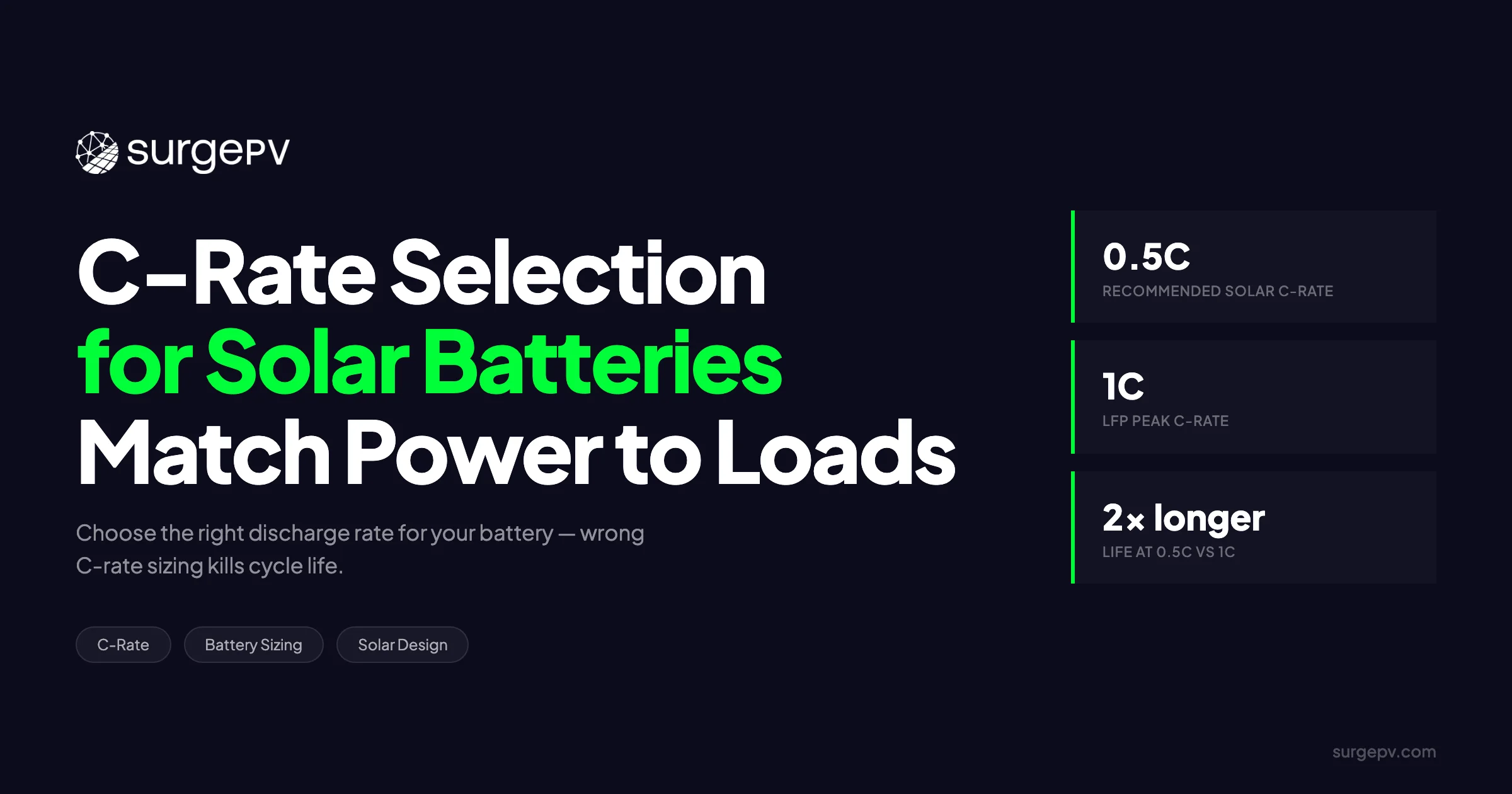
If a battery has a rated capacity of 200 Ah, a 1C discharge rate equals 200 amps. A 20 kWh battery sounds generous for residential backup, but at 0.5C it delivers only 10 kW of continuous power. A 20 kWh battery with the same 5 kW load only needs 0.25C, giving more headroom.
Battery capacity in kWh tells you how long a system runs, but C-rate determines whether it can handle peak loads at all. Installers who size storage by kilowatt-hours alone risk inverter overloads, BMS shutdowns, and angry callbacks when the AC compressor starts or the Level 2 EV charger kicks in. This guide gives you the formulas, chemistry comparisons, and load-matching methods to size battery discharge rates correctly. For France-specific information, see Agricultural Solar Case Study. See our guide on Floating Solar Farms France for more.
If a battery has a rated capacity of 200 Ah, a 1C discharge rate equals 200 amps. A 20 kWh battery sounds generous for residential backup, but at 0.5C it delivers only 10 kW of continuous power. A 20 kWh battery with the same 5 kW load only needs 0.25C, giving more headroom.
TL;DR
C-rate measures discharge speed relative to capacity. A 10 kWh battery at 0.5C delivers 5 kW; at 1C it delivers 10 kW. Most residential solar batteries operate at 0.5C continuous. Size your battery so its continuous C-rate multiplied by capacity exceeds your peak load plus a 20% margin. LFP chemistry is preferred for stationary solar due to thermal stability and cycle life.
What You’ll Learn
- How to calculate required C-rate from peak household load and battery capacity
- The exact power output difference between 0.5C and 1C batteries in real systems
- Why LFP and NMC chemistries behave differently under high discharge loads
- How BMS current limits and inverter specs interact to cap usable power
- Five specification mistakes that cause battery shutdowns under heavy load Also see: Us Residential Solar Market Trends 2026.
What Is C-Rate and Why It Matters More Than kWh
C-rate measures how fast a battery charges or discharges relative to its total capacity. A 1C rate means the battery delivers its full capacity in one hour; 0.5C means two hours. For installers, C-rate determines the maximum power a battery can output, independent of how many kilowatt-hours it stores.
Technically, C-rate is the ratio of charge or discharge current to the battery’s rated capacity in ampere-hours (Ah). If a battery has a rated capacity of 200 Ah, a 1C discharge rate equals 200 amps. At 0.5C, the current is 100 amps. The time-to-discharge mapping is straightforward: 0.2C equals five hours to empty, 0.5C equals two hours, 1C equals one hour, and 2C equals 30 minutes.
The distinction between energy and power is where most sizing errors begin. A 20 kWh battery sounds generous for residential backup, but at 0.5C it delivers only 10 kW of continuous power. If the home’s peak load includes a 5-ton AC unit, pool pump, and electric oven running together, 10 kW may not be enough. The battery has plenty of energy to run the house for hours at low load, yet it cannot start or sustain everything at once.
Solar installers have good reasons to focus on kWh. Customers ask “how long will my lights stay on during an outage?” and that question is answered in kilowatt-hours. Utility programs and incentives are often structured around energy capacity, not power output. But backup duration means nothing if the battery cannot start the loads in the first place. An undersized C-rate leads to inverter overload faults, voltage sag during motor startup, and BMS-triggered shutdowns that leave the customer in the dark despite a full battery.
Good solar design platform handles both calculations simultaneously. It checks that energy capacity meets runtime targets while C-rate covers peak demand. Skipping the power verification is a common cause of post-installation service calls.
C-Rate Formula and Discharge Time Calculations
The core calculation every installer needs is simple: divide peak discharge power by battery energy capacity.
C-rate = Peak Discharge Power (kW) / Battery Capacity (kWh)
For example, a home with a 5 kW peak load paired with a 10 kWh battery needs a minimum continuous C-rate of 0.5. A 20 kWh battery with the same 5 kW load only needs 0.25C, giving more headroom. If that same 20 kWh battery is rated for 1C continuous, it can deliver 20 kW — enough to support heavier loads or future EV charging without adding more cells.
When working with ampere-hours and voltage, the relationships expand as follows:
- Discharge Current (A) = C-rate × Rated Capacity (Ah)
- Power (W) = C-rate × Capacity (Ah) × Nominal Voltage (V)
- Runtime (hours) = Capacity (Ah) / Discharge Current (A)
Consider a 48V nominal battery with 200 Ah capacity. At 0.5C, discharge current is 100A, power output is 4.8 kW, and runtime at that rate is two hours. At 1C, current doubles to 200A, power reaches 9.6 kW, and runtime shrinks to one hour. The total energy extracted is the same in both cases, approximately 9.6 kWh after efficiency losses, but the rate at which it is delivered changes the practical application entirely.
| C-Rate | Discharge Time | Peak Power (10 kWh Battery) | Typical Use Case | Heat Generation |
|---|---|---|---|---|
| 0.2C | 5 hours | 2 kW | Off-grid backup, low continuous loads | Minimal |
| 0.5C | 2 hours | 5 kW | Standard residential backup | Low |
| 1C | 1 hour | 10 kW | Whole-home backup, moderate peak shaving | Moderate |
| 2C | 30 minutes | 20 kW | EV charging support, commercial peak cut | High |
The 10 kWh battery column is the one to show customers. It makes the trade-off concrete: doubling C-rate from 0.5C to 1C doubles available power from 5 kW to 10 kW but halves runtime at full discharge. Most homeowners do not run at full load continuously, so the real-world runtime is usually longer than the table suggests. What matters is that the battery can surge to the peak when needed.
Use the generation and financial tool to model how different C-rate assumptions affect backup duration and financial returns for each project.
C-Rate Comparison: 0.2C to 2C for Solar Applications
Different C-rate levels suit different solar use cases, and the choice involves trade-offs between upfront cost, cycle life, and thermal management complexity.
| C-Rate | Discharge Time | Typical Use Case | Heat Generated | Cycle Life Impact |
|---|---|---|---|---|
| 0.2C | 5 hours | Essential backup, lights and fridge | Minimal | Negligible |
| 0.5C | 2 hours | Residential self-consumption, whole-home backup | Low | Slight reduction |
| 1C | 1 hour | AC startup, peak shaving, pool pumps | Moderate | Measurable wear |
| 2C | 30 minutes | Level 2 EV charging, commercial demand response | High | Significant if sustained |
For budget-conscious residential installs where the customer only needs lights, refrigeration, and device charging during outages, 0.2C to 0.5C batteries are adequate and cost-effective. The cells stay cool, cycle life is maximized, and no active cooling is required. These systems are also the easiest to maintain because there are no fans or pumps to fail.
When the customer wants whole-home backup including HVAC, water heating, or kitchen appliances, 0.5C to 1C becomes necessary. A 10 kWh battery at 0.5C provides 5 kW, which covers most homes if load management is used. At 1C, the same battery provides 10 kW. This removes the need for load shedding in many cases. This is the sweet spot for most residential projects in temperate climates.
The 2C tier enters the picture for EV charging and commercial demand response. A Level 2 charger at 7.2 kW needs sustained power for hours, not seconds. A 15 kWh battery at 2C can deliver 30 kW, enough for two EV chargers or a significant commercial peak-shaving application. The cost is higher heat generation and faster degradation if the battery is routinely operated at its limit. Customers who need this tier should budget for enhanced thermal management and expect slightly shorter warranty periods.
Spec the lowest C-rate that meets the load profile with a safety margin. Overspecifying wastes money and shortens cycle life; underspecifying leads to service calls and damaged reputation.
LFP vs NMC: C-Rate Specifications and Chemistry Trade-offs
Lithium iron phosphate (LFP, or LiFePO4) and nickel manganese cobalt oxide (NMC, or LiNiMnCoO2) are the two dominant chemistries in stationary solar storage. They handle C-rate differently, and those differences should drive specification decisions.
| Parameter | LFP (LiFePO4) | NMC (LiNiMnCoO2) |
|---|---|---|
| Typical continuous discharge C-rate | 0.5C–1C | 1C–2C |
| Peak discharge C-rate | 2C–3C | 3C–5C+ |
| Thermal runaway threshold | ~270°C thermal runaway onset (Battery University, 2010) | ~210°C thermal runaway onset (Battery University, 2010) |
| Cycle life at 1C (to 80% SOH) | 2,000–8,000+ cycles depending on depth of discharge (PNNL, 2022) | 800–3,200 cycles depending on cell type and depth of discharge (Samsung SDI, 2015; PNNL, 2022) |
| Standard charge C-rate | 0.5C typical | 0.5C–1C |
LFP cells use an olivine crystal structure that is mechanically and thermally stable. The phosphate bond is strong, which limits energy density but also makes the chemistry far less prone to thermal runaway. NMC achieves higher energy density by using nickel-rich layered oxides, but the trade-off is lower thermal stability and faster degradation under stress.
In practice, this means LFP tolerates sustained 1C discharge with modest temperature rise and minimal cycle life penalty. NMC can deliver higher peak power, but sustained operation above 1C accelerates capacity fade and requires more aggressive thermal management. For stationary solar, where weight and volume are rarely constraints, LFP’s safety margin and longevity make it the default choice.
Manufacturer datasheets confirm the pattern. CATL’s 280 Ah LFP prismatic cell is rated for 1C continuous discharge and 3C maximum pulse (CATL, 2024). BYD’s Blade battery, also LFP, achieves approximately 2.45C continuous and a 10.5C peak for five seconds (BYD, 2024). On the NMC side, Samsung SDI’s 94 Ah automotive-style cell supports approximately 1.6C continuous (Samsung SDI, 2015). The NMC numbers look higher, but the sustained-use story favors LFP for stationary applications.
Installers typically specify LFP for residential and light commercial solar storage unless space or weight constraints force NMC. NMC makes sense in mobile applications, compact commercial cabinets, or sites where shipping weight drives installation cost. Even then, the thermal design must account for NMC’s lower thermal runaway threshold and faster degradation at high C-rates.
Sizing Batteries for Peak Load: The Installer Calculation Method
Accurate battery sizing requires four steps that move from the AC load panel to the battery datasheet. Read Solar Battery Sizing Guide for a complete walkthrough.
Step 1: Determine peak AC load in kilowatts. Use the panel schedule for new construction or interval meter data for existing homes. Look at the highest 15-minute average, not the instantaneous spike. Motor inrush is handled by peak C-rate, not continuous.
Step 2: Account for inverter efficiency. Most hybrid inverters operate at 90–95% efficiency during battery discharge. Divide the AC load by inverter efficiency to get the required DC power from the battery. A 10 kW AC load at 93% efficiency needs 10.75 kW from the battery side.
Step 3: Required battery DC power = Peak AC load / Inverter efficiency.
Step 4: Required C-rate = Required battery DC power (kW) / Battery energy capacity (kWh).
Real-world example: 10 kWh battery at 0.5C versus 1C
A 10 kWh battery at 0.5C delivers 5 kW continuous. After 93% inverter efficiency, that is 4.65 kW AC. This covers essential backup: lights, refrigerator, router, and a small well pump. It does not cover much more. The same battery at 1C delivers 10 kW, or 9.3 kW AC after losses. That supports whole-home backup including AC startup and an electric oven, provided the peak load does not exceed 9.3 kW for extended periods.
Real-world example: EV charging from solar battery
A Level 2 charger at 7.2 kW AC requires 7.6 kW DC from the battery at 95% inverter efficiency. A 15 kWh battery at 0.5C delivers 7.5 kW. That is technically insufficient, and the BMS will throttle or the inverter will fault. The same battery at 1C delivers 15 kW. This provides a comfortable margin. A 20 kWh battery at 0.5C delivers 10 kW, also sufficient. The lesson: either increase capacity or specify a higher C-rate; do not assume kWh alone solves the problem.
| Load Type | Typical Power | C-Rate Needed (10 kWh Battery) |
|---|---|---|
| Essential backup | 1–2 kW | 0.1C–0.2C |
| Whole-home backup | 5–8 kW | 0.5C–0.8C |
| AC unit startup | 3–7 kW surge | 0.5C continuous, 1C+ peak |
| Level 2 EV charging | 3.3–11 kW | 0.33C–1.1C |
The rule of thumb is straightforward: size battery continuous discharge to equal or exceed the inverter’s rated power, then verify peak C-rate for motor loads and EVs. If the battery cannot match the inverter, the inverter’s capacity is wasted and the system will fault under heavy load. Good solar software flags this mismatch during design, before equipment is ordered.
Inverter Compatibility and BMS Current Limits
The battery and inverter must agree on current. If the inverter requests more than the battery can safely deliver, the result is throttling, voltage sag, or shutdown.
Required inverter current (A) = Battery C-rate × Battery capacity (Ah)
A 200 Ah battery at 0.5C requires an inverter capable of handling 100A continuous discharge current. At 1C, the inverter must support 200A. If the inverter’s battery-side current rating is lower, the system cannot use the battery’s full power potential even if the inverter’s AC output rating is higher.
The battery management system (BMS) enforces the real limit. Core BMS functions include charge and discharge rate control, overcurrent protection, cell balancing, and temperature monitoring. Communication between battery and inverter typically runs over CAN bus or RS485. It carries real-time current limits, state of charge, and fault states.
When the inverter requests more current than the BMS allows, several things can happen. The BMS may immediately throttle discharge current. The inverter then sees voltage sag and reduces output. If the mismatch is severe, the inverter may trip an overload fault and disconnect. In worst cases, the BMS opens the contactors entirely. This shuts down the battery and forces a manual restart. None of these outcomes are acceptable for a customer expecting uninterrupted backup power.
Case study: A 10 kW hybrid inverter is paired with two 8 kWh batteries, each rated at 0.5C continuous.
- Combined battery capacity: 16 kWh
- Combined max discharge at 0.5C: 8 kW
- Inverter rated power: 10 kW
- Deficit: 2 kW
During battery-only operation, the system cannot meet the inverter’s rated output. If the home demands 9 kW during an evening peak, the batteries max out at 8 kW. The inverter either sheds non-critical loads or shuts down to protect itself. The installer specified enough energy but not enough power. The fix is either a third battery or upgrading to batteries with a higher C-rate.
Always read BMS current limits in the technical datasheet, not the marketing brochure. Marketing materials highlight peak pulse ratings; the BMS datasheet lists continuous limits. Proposed internal link: hybrid inverter guide.
Thermal Stability and Cooling Requirements by C-Rate
Higher C-rates generate more heat. The chemistry determines how much heat, and the installation design determines whether that heat is safely dissipated.
LFP is significantly more thermally stable at high C-rates than NMC. Laboratory data shows LFP cells at 2.5C discharge reach peak surface temperatures of approximately 40°C from a 27°C ambient (IIETA, 2023). NMC cells under identical test conditions reach approximately 61°C at the same 2.5C rate (IIETA, 2023). The difference matters because the BMS begins throttling output as cell temperature approaches its internal threshold, and thermal runaway risk increases with temperature.
| C-Rate | Thermal Management Need |
|---|---|
| under 0.5C | Natural convection typically sufficient |
| 0.5C–1C | Passive cooling/heat sinks adequate for most residential installs |
| 1C–1.6C | Forced air cooling recommended for enclosed installs |
| above 1.6C | Liquid cooling or active thermal management required |
| 4C+ | Liquid cooling essential; cell temperature rise exceeds 20K |
Most residential solar designs stay at or below 1C continuous for two reasons. First, passive cooling is sufficient, avoiding the cost and complexity of fans, ducting, or liquid loops. Second, cycle life is preserved. An LFP battery operated consistently at 0.5C will outlast the same battery operated at 1C, all else equal. The cost savings from omitting active cooling often cover the incremental price of a slightly larger battery bank.
Ambient temperature derating is often overlooked. In hot climates such as Phoenix, Dubai, and parts of India, garage or outdoor battery enclosures can exceed 40°C ambient in summer. The BMS reduces allowable discharge current to protect cells, effectively lowering the usable C-rate. A battery rated for 1C at 25°C may only deliver 0.8C at 45°C. Size for the worst-case ambient, not the datasheet standard test condition. Installers in tropical regions should also consider shade structures or ventilation gaps as part of the standard design package. Shadow analysis software identifies shading issues before installation. Also see: Best Solar Design Software India.
Common Installer Mistakes When Specifying Battery C-Rate
Five specification errors cause most battery shutdowns under heavy load. Each is preventable with basic arithmetic and datasheet discipline.
Mistake 1: Selecting battery by kWh alone without checking C-rate for peak load demands.
A 20 kWh battery sounds right for a large home, but if it is only rated for 0.5C, it delivers 10 kW continuous. Add a pool pump, central AC, and an electric dryer running together, and 10 kW disappears fast. The battery has energy to spare but power to lack. Common triggers for this mismatch are EV charging, pool equipment, and AC compressor startup.
Mistake 2: Confusing continuous versus peak C-rate.
Datasheets often list a 2C or 3C peak rating in large print, with the continuous rating buried in a footnote. A battery that supports 2C for ten seconds cannot run a motor load or EV charger at that rate. Those loads need sustained power for minutes or hours. Always design to the continuous C-rate; treat peak C-rate as a surge margin for motor inrush only.
Mistake 3: Ignoring inverter efficiency in calculations.
A 10 kW AC load does not need 10 kW from the battery. It needs 10 kW divided by inverter efficiency, roughly 10.5 to 11 kW DC. Skipping this step means the battery is undersized by 5–10% before any safety margin is applied.
Mistake 4: Overlooking temperature derating.
High ambient temperatures reduce effective C-rate and cause premature BMS throttling. A battery sized for 25°C laboratory conditions will underperform in a 45°C equipment shed. Check the manufacturer’s derating curve and size accordingly. Read Temperature Derating Solar Conductors for a complete walkthrough.
Mistake 5: Mismatching battery chemistry to the application.
Specifying NMC for high-C-rate solar backup without adequate thermal design or ventilation is a recipe for short cycle life and potential safety issues. NMC has its place, but stationary solar backup is usually not it unless space constraints override longevity concerns. For detailed sizing methodology across multiple battery types, see our [commercial battery storage sizing](/blog/commercial-battery-storage-sizing) guide and the solar EV charging integration guide for load calculation examples.
How SurgePV Models C-Rate in System Design
Modern solar PV design software should validate C-rate automatically, not leave it as a manual afterthought. SurgePV’s platform models battery discharge against the project’s actual load profile. It flags mismatches before they become installation errors. For a direct comparison, see Arka 360 vs SurgePV.
During system design, the battery library includes both energy capacity and C-rate specifications. When you add a battery to a project, the software checks whether the combined continuous discharge power meets or exceeds the inverter’s rated output. If the battery bank is undersized for power, you get a warning before the proposal goes to the customer. This means you catch specification errors during the design phase rather than at commissioning.
solar proposal tools reports both numbers clearly: battery energy capacity in kWh for runtime estimates, and peak discharge power in kW for load coverage. Customers understand what they are buying, and you avoid the “why can’t my battery run my AC?” call six months after install. Transparency in the proposal builds trust and reduces post-sale disputes about system performance.
The generation and financial tool extends this to financial modeling. Backup duration, self-consumption savings, and peak-shaving revenue all depend on how fast the battery can discharge, not just how much it holds. Modeling a 0.5C versus 1C battery changes the economics for customers on time-of-use rates or demand-charge tariffs. Accurate C-rate input prevents post-installation service calls and inverter faults. Every project exports with battery power limits documented, so the installation team knows exactly what the system can deliver before they arrive on site.
Design Solar + Storage Projects Faster
SurgePV’s generation and financial tool models battery sizing, C-rate requirements, and system performance in minutes.
Book a DemoNo commitment required · 20 minutes · Live project walkthrough
Frequently Asked Questions
What is the C rating of a solar battery?
C-rate measures how fast a battery charges or discharges relative to its total capacity. A 1C rate delivers the full battery capacity in one hour; 0.5C takes two hours. It determines the maximum power output, separate from how many kilowatt-hours the battery stores.
Is a higher C rate better for solar batteries?
Not always. Higher C-rates deliver more power but generate extra heat and reduce cycle life. For most residential solar installations, 0.5C to 1C offers the right balance between peak power and longevity.
What C rate do I need for my solar system?
Divide your peak load in kW by your battery capacity in kWh. If your peak load is 10 kW and your battery is 20 kWh, you need at least 0.5C continuous. Add a 20% margin to account for inverter efficiency and temperature derating.
What happens if C-rate is too low for home backup?
The battery BMS will throttle output or shut down to protect the cells. You will see inverter overload faults, voltage sag during motor startup, and the inability to run multiple high-wattage appliances at the same time.
Can I use a solar battery for EV charging?
Only if the battery’s continuous C-rate supports the sustained load. A 7.2 kW Level 2 charger needs roughly 0.5C from a 15 kWh battery, or 0.36C from a 20 kWh battery. Always verify the continuous rating, not the peak pulse rating.
What is the difference between 0.5C and 1C battery?
A 1C battery discharges its full capacity in one hour; 0.5C takes two hours. In a 10 kWh battery, 1C equals 10 kW of peak output, while 0.5C equals only 5 kW. The practical impact is that a 1C battery can run more appliances at once without triggering BMS throttling or inverter overloads.
Where this fits
This article is part of SurgePV's Energy Storage hub, which works through the topic from first principles to the decisions a project team actually has to make.
