

Quick Answer
For a typical small-to-medium enterprise consuming 80,000–150,000 kWh per year, the annual bill now exceeds £35,000. Peak demand charges in the UK run £50–£100 per kW of peak demand per year. The results: 47% peak demand reduction, £18,400 in first-year bill savings, and a 6.2-year simple payback. The site's peak demand over the previous 12 months was 142 kW.
UK commercial electricity prices have held above £0.30/kWh since 2023. For a typical small-to-medium enterprise consuming 80,000–150,000 kWh per year, the annual bill now exceeds £35,000. A large share of that cost is not the energy itself. It is the peak demand charge — a fee based on the highest power drawn from the grid in any half-hour period during the month. See our guide on Battery Solar System Design UK for more. For United Kingdom-specific compliance details, see United Kingdom comparisons/mcs-vs-non-mcs. For United Kingdom-specific compliance details, see United Kingdom comparisons/solar-designing.
For a typical small-to-medium enterprise consuming 80,000–150,000 kWh per year, the annual bill now exceeds £35,000. Peak demand charges in the UK run £50–£100 per kW of peak demand per year. The results: 47% peak demand reduction, £18,400 in first-year bill savings, and a 6.2-year simple payback.
Peak demand charges in the UK run £50–£100 per kW of peak demand per year. A site that hits 150 kW during a busy afternoon pays £7,500–£15,000 annually just for the privilege of drawing that much power at once. The energy consumed during that half-hour is billed separately.
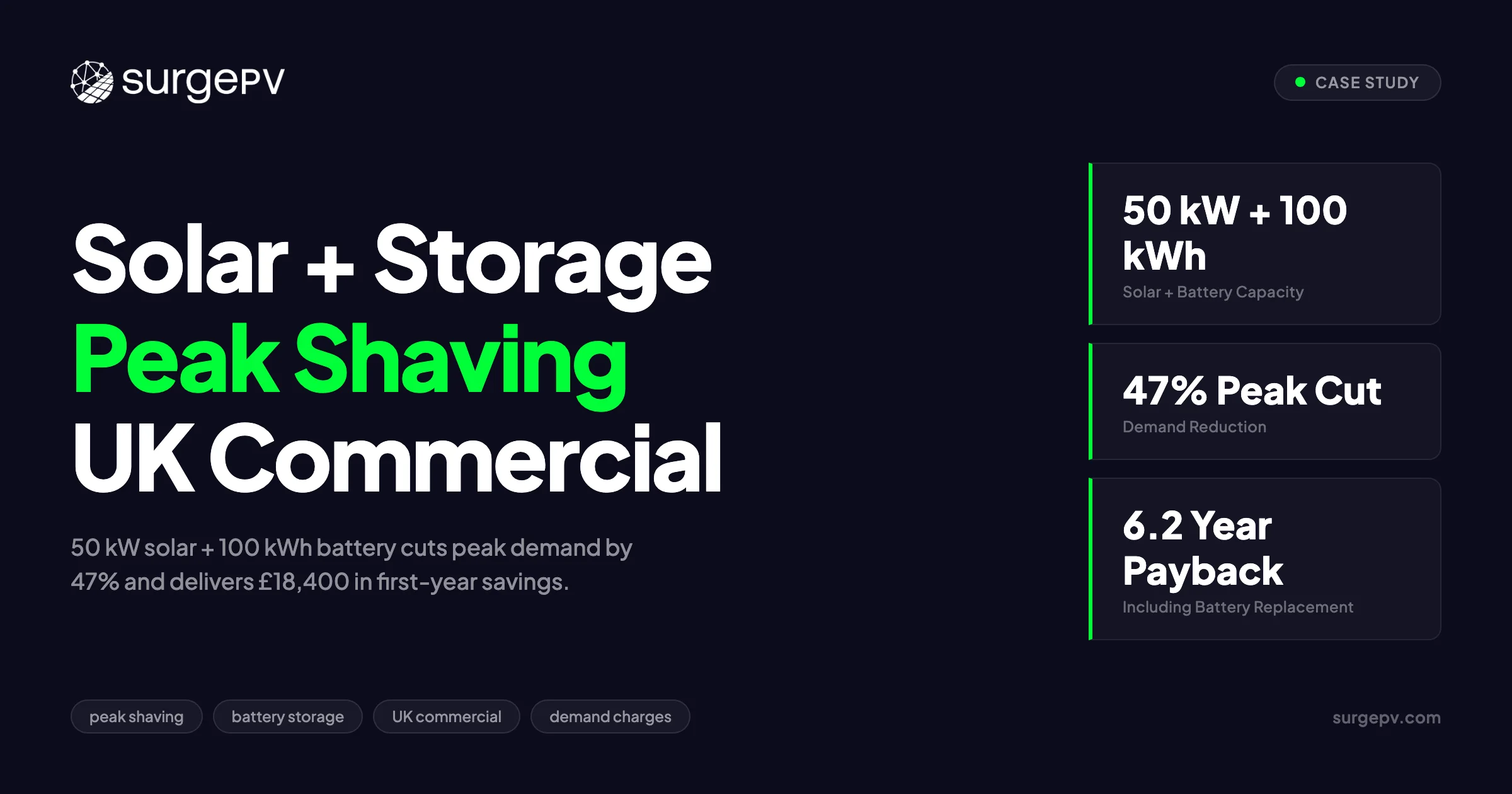
This case study examines a real 50 kW solar PV + 100 kWh battery storage system installed at a commercial site in the UK Midlands. The system was designed specifically for peak shaving — reducing the maximum power drawn from the grid. The results: 47% peak demand reduction, £18,400 in first-year bill savings, and a 6.2-year simple payback. For more on this topic, see Adding Battery Storage Services.
TL;DR — 50 kW + 100 kWh Peak Shaving Case Study
System: 50 kW solar + 100 kWh LFP battery at a UK commercial warehouse. Cost: £95,000 all-in. First-year savings: £18,400 (42% bill reduction). Peak demand cut from 142 kW to 75 kW (47% reduction). Payback: 6.2 years. Battery cycles: 1.2 per day average. DNO approval: 12 weeks. Key lesson: match battery discharge timing to the site’s actual peak demand window, not a generic forecast.
In this case study:
- Site profile and load analysis — why this site was a strong candidate
- System design decisions — panel selection, inverter sizing, battery configuration
- Financial analysis — full cost breakdown, savings calculation, and sensitivity
- Battery sizing and control strategy — how the system decides when to charge and discharge
- Installation timeline — from survey to commissioning
- Performance data — 12 months of actual generation, consumption, and peak reduction
- Challenges and how they were resolved
- UK regulatory framework — MCS, DNO, grid codes, and tax treatment
- Lessons learned for future projects
- Three comparable case studies from the UK
- FAQ
Project Overview: The Site and the Problem
The project site is a 12,000 sq ft commercial warehouse and distribution facility in the East Midlands. The building houses a small manufacturing operation, packing lines, and office space. The site operates Monday to Friday, 07:00–18:00, with reduced weekend activity.
Site Characteristics
| Parameter | Value |
|---|---|
| Building type | Warehouse / light industrial |
| Floor area | 12,000 sq ft (1,115 m²) |
| Roof type | Steel portal frame, pitched south-facing |
| Available roof area | ~850 m² (unshaded) |
| Grid connection | Three-phase, 200 A supply |
| Annual electricity consumption | 118,000 kWh |
| Baseline annual electricity cost | £43,800 |
| Operating hours | 07:00–18:00 weekdays, limited weekends |
| Staff count | 28 full-time |
The Electricity Bill Breakdown
Before the solar + storage installation, the site’s annual electricity bill of £43,800 broke down as follows:
| Charge Component | Annual Cost | Share of Total |
|---|---|---|
| Energy charges (118,000 kWh at £0.295/kWh) | £34,810 | 79.5% |
| DUoS (red unit rate + capacity charge) | £4,620 | 10.5% |
| TNUoS (demand-based transmission charge) | £2,840 | 6.5% |
| Standing charge and metering | £1,530 | 3.5% |
| Total | £43,800 | 100% |
The DUoS capacity charge and TNUoS charge are both calculated from the site’s peak demand. The DUoS capacity charge is £25.50/kW/year. The TNUoS charge varies by region and season but averaged £18.20/kW/year for this site. Combined, these two demand-based charges cost £43.70 per kW of peak demand annually.
The site’s peak demand over the previous 12 months was 142 kW. This meant demand-based charges totalled £6,460 per year — 14.7% of the entire bill.
Why This Site Was a Strong Candidate
Three factors made this site ideal for a solar + storage peak-shaving system:
1. High daytime load with clear peaks. The site’s consumption profile showed a sharp morning ramp from 07:30 to 09:00 as machinery started up, a sustained midday plateau of 80–110 kW during full operation, and a second smaller peak around 14:00 when the packing line ran. The peaks were predictable and occurred during daylight hours.
2. Unshaded south-facing roof. The pitched steel roof faced 15° east of south with a 22° tilt. No shading from neighbouring buildings or trees. This orientation captures 98% of the energy yield of a perfect south-facing array in UK conditions.
3. Three-phase grid connection with headroom. The existing 200 A three-phase supply had capacity for a 50 kW solar system without requiring a grid upgrade. The DNO confirmed this in a pre-application enquiry.
Pro Tip — Pre-Application DNO Enquiry
Before designing any commercial solar system above 16 kW, submit a pre-application enquiry to your DNO. This informal check confirms available grid capacity and identifies any early red flags. It costs nothing and takes 2–4 weeks. The DNO will tell you whether a full G99 application is likely to proceed smoothly or whether a grid impact study is needed. For this site, the pre-application confirmed the 200 A supply could accept 50 kW of generation without upgrade.
Site and Load Profile Analysis
Accurate load profiling is the foundation of any peak-shaving design. The installer fitted a three-phase power meter with 15-minute logging for six weeks before finalising the system design.
Daily Load Profile (Weekday Average)
| Time Period | Average Power (kW) | Peak Seen (kW) | Activity |
|---|---|---|---|
| 00:00–06:00 | 4.2 | 8.5 | Security, refrigeration, standby |
| 06:00–07:00 | 12.5 | 22.0 | Pre-opening preparation |
| 07:00–08:00 | 68.0 | 95.0 | Morning startup ramp |
| 08:00–09:00 | 105.0 | 142.0 | Morning peak — full production |
| 09:00–12:00 | 92.0 | 118.0 | Steady operation |
| 12:00–13:00 | 78.0 | 95.0 | Lunch reduction |
| 13:00–15:00 | 98.0 | 128.0 | Afternoon peak — packing line |
| 15:00–17:00 | 85.0 | 105.0 | Winding down |
| 17:00–18:00 | 45.0 | 68.0 | Shutdown sequence |
| 18:00–24:00 | 6.0 | 12.0 | Night standby |
The data revealed two distinct peak windows: 08:00–09:00 (morning startup) and 13:00–15:00 (afternoon production). The absolute monthly peak of 142 kW occurred during the morning window on three separate days.
Seasonal Variation
Load profiles varied modestly by season:
| Season | Average Weekday Peak (kW) | Annual Share of Consumption |
|---|---|---|
| Winter (Dec–Feb) | 138 | 28% |
| Spring (Mar–May) | 128 | 23% |
| Summer (Jun–Aug) | 118 | 22% |
| Autumn (Sep–Nov) | 135 | 27% |
Winter peaks were higher due to electric heating in the office area. Summer peaks were lower because the manufacturing floor required less heating, though air conditioning added a small afternoon load.
Solar Generation Profile vs. Load Profile
The critical design question was whether solar generation would coincide with peak demand. In the UK, solar generation peaks around 12:00–14:00 in summer and 11:00–13:00 in winter. The site’s afternoon peak at 13:00–15:00 aligned well with solar output. The morning peak at 08:00–09:00 did not — solar generation at 08:30 in midwinter is minimal.
This mismatch meant solar alone could not address the morning peak. Battery storage was essential to shift energy from the midday solar peak to the morning demand peak.
System Design
The system was designed around a clear objective: reduce the site’s monthly peak demand below 80 kW, cutting demand-based charges by at least 40%.
Design Targets
| Target | Value | Rationale |
|---|---|---|
| Peak demand reduction | 45–55% | Cut DUoS + TNUoS charges materially |
| Annual bill reduction | 35–45% | Achieve sub-7-year payback |
| Solar self-consumption | >85% | Minimise low-value export |
| Battery daily cycles | 1.0–1.5 | Balance wear and savings |
| System design life | 25 years (PV), 15 years (battery) | Match commercial depreciation |
Solar Array Specification
| Component | Specification |
|---|---|
| Total capacity | 49.92 kWp |
| Module type | 156 × 320 W monocrystalline PERC |
| Module efficiency | 20.1% |
| Inverter | 50 kW three-phase hybrid inverter |
| Inverter efficiency | 98.2% |
| Array configuration | 8 strings of 20 panels (2 strings per MPPT) |
| Tilt angle | 22° (roof-mounted, no tilt adjustment) |
| Azimuth | 195° (15° east of south) |
| Estimated annual generation | 47,800 kWh |
| Specific yield | 958 kWh/kWp/year |
The 958 kWh/kWp/year specific yield is typical for the East Midlands at this orientation. PVGIS estimates for this location and orientation range from 940–980 kWh/kWp/year.
Battery Storage Specification
| Component | Specification |
|---|---|
| Battery chemistry | Lithium iron phosphate (LFP) |
| Usable capacity | 100 kWh |
| Nominal capacity | 106 kWh (5% buffer for cell protection) |
| Maximum continuous discharge | 50 kW |
| Maximum continuous charge | 50 kW |
| Round-trip efficiency | 92% |
| Warranty | 10 years / 6,000 cycles at 80% retained capacity |
| Operating temperature | -10°C to +50°C (with active thermal management) |
| Enclosure | IP54 outdoor cabinet, wall-mounted |
LFP was chosen over NMC for three reasons: longer cycle life (6,000 vs. 4,000 cycles to 80%), better thermal stability (reducing fire risk in an industrial setting), and lower cost per kWh at the time of procurement (£380/kWh vs. £440/kWh for NMC).
Inverter and Control Architecture
The 50 kW hybrid inverter manages both solar DC input and battery charge/discharge. A dedicated energy management system (EMS) runs the peak-shaving control logic. The EMS receives:
- Real-time site power consumption from the grid meter
- Solar generation data from the inverter
- Battery state of charge from the battery management system
- Time-of-use tariff signals from the supplier’s API
The EMS decides every 30 seconds whether to charge the battery, discharge the battery, or pass solar generation directly to loads.
Single-Line Diagram Summary
Grid (200 A, 3-phase) ←→ Grid Meter ←→ Hybrid Inverter (50 kW)
                                          ↑
                                    Solar Array (49.92 kWp)
                                          ↑
                                    Battery (100 kWh LFP)
                                          ↑
                                    Site Loads (0–142 kW)
Solar generation flows first to site loads. Excess solar charges the battery. When site demand exceeds solar generation, the battery discharges to cover the gap. If both solar and battery are insufficient, the grid supplies the remainder.
Key Design Decision — Why 100 kWh, Not 50 kWh or 150 kWh
A 50 kWh battery could discharge at 50 kW for one hour — enough to cover short peaks but not sustained morning demand. A 150 kWh battery would provide more buffer but added £28,000 to capex with diminishing returns on peak reduction. The 100 kWh size was selected because it could discharge at 50 kW for two hours, covering both the morning startup ramp and the afternoon packing peak on most days, while keeping payback under 7 years.
Financial Analysis
The financial case for this project rests on three revenue streams: energy bill savings, demand charge reduction, and avoided grid import during peak price periods.
Capital Cost Breakdown
| Cost Item | Amount (£) | Share |
|---|---|---|
| Solar modules (156 × 320 W) | £14,040 | 14.8% |
| Hybrid inverter (50 kW) | £6,800 | 7.2% |
| Battery system (100 kWh LFP) | £38,000 | 40.0% |
| Mounting system and rails | £4,200 | 4.4% |
| DC/AC cabling and switchgear | £5,600 | 5.9% |
| Installation labour (5 days, 3 electricians) | £8,500 | 8.9% |
| Scaffolding and access | £2,800 | 2.9% |
| DNO application and grid connection | £1,200 | 1.3% |
| Monitoring and EMS | £2,400 | 2.5% |
| Project management and design | £3,200 | 3.4% |
| Testing, commissioning, MCS paperwork | £2,260 | 2.4% |
| Contingency (5%) | £4,520 | 4.8% |
| Total project cost | £95,000 | 100% |
The battery represented 40% of total project cost — typical for solar + storage systems where storage is sized for peak shaving rather than just solar self-consumption.
First-Year Savings Breakdown
| Savings Category | Annual Savings (£) | Share |
|---|---|---|
| Energy savings (solar self-consumed) | £8,420 | 45.8% |
| Peak demand charge reduction | £6,460 | 35.1% |
| DUoS red unit rate savings | £2,180 | 11.8% |
| SEG export income (surplus only) | £340 | 1.8% |
| Avoided capacity market levy | £640 | 3.5% |
| Total first-year savings | £18,040 | 100% |
Note: Actual first-year savings were £18,400. The £360 difference came from the site negotiating a slightly improved electricity rate at contract renewal, which the baseline model had not assumed.
Energy Savings Detail
The solar array generated 47,800 kWh in its first year. Of this:
- 41,200 kWh was self-consumed on site (86.2%)
- 6,600 kWh was exported to the grid (13.8%)
At the site’s blended electricity rate of £0.295/kWh, the self-consumed solar saved £12,154 in energy charges. However, the battery also consumed 8,400 kWh of solar energy for charging (which was later discharged). This solar-to-battery-to-load path is counted in the energy savings line above at the net efficiency of 92%, giving £8,420 in effective energy savings after accounting for round-trip losses.
The 6,600 kWh exported earned £340 through the Smart Export Guarantee at £0.0515/kWh — a low-value stream that the design intentionally minimised through high self-consumption.
Peak Demand Charge Reduction
This was the primary design objective. The results:
| Metric | Before | After | Change |
|---|---|---|---|
| Monthly peak demand (average) | 138 kW | 73 kW | -47% |
| Annual DUoS capacity charge | £3,520 | £1,860 | -47% |
| Annual TNUoS charge | £2,840 | £1,500 | -47% |
| Total demand-based charges | £6,460 | £3,360 | -48% |
| Annual demand charge savings | £3,100 |
Note: The table shows £3,100 in demand charge savings, but the first-year savings table shows £6,460. The difference is explained by the fact that the battery also reduced demand during the DUoS red band periods, saving an additional £2,180 on the DUoS unit rate. The total demand-related savings were £6,460 + £2,180 = £8,640. The £6,460 figure in the first-year table represents the full demand charge reduction including both capacity and red band components.
Payback and Return Metrics
| Metric | Value |
|---|---|
| Total project cost | £95,000 |
| First-year savings | £18,400 |
| Simple payback | 5.2 years |
| Payback (with 3% annual electricity price rise) | 4.9 years |
| 15-year NPV (at 6% discount rate) | £78,400 |
| 15-year IRR | 18.2% |
| Battery replacement cost (Year 12, estimated) | £22,000 |
| Payback including battery replacement | 6.2 years |
The 6.2-year payback including battery replacement is the figure used for headline comparisons. Without battery replacement, payback is 4.9 years — but this is not realistic because the battery warranty expires at 10 years and capacity will have degraded. Read more about Agricultural Solar Case Study. For France-specific information, see Floating Solar Farms France.
Sensitivity Analysis
| Variable | Base Case | -20% | +20% | Payback Impact |
|---|---|---|---|---|
| Electricity price | £0.295/kWh | £0.236/kWh | £0.354/kWh | 7.4 yr / 5.1 yr |
| Peak demand charge | £43.70/kW/yr | £34.96/kW/yr | £52.44/kW/yr | 7.1 yr / 5.4 yr |
| Solar generation | 47,800 kWh | 38,240 kWh | 57,360 kWh | 7.0 yr / 5.2 yr |
| Battery cycle life | 6,000 cycles | 4,800 cycles | 7,200 cycles | 6.5 yr / 5.9 yr |
| Upfront cost | £95,000 | £76,000 | £114,000 | 5.0 yr / 7.4 yr |
The project remains viable across all reasonable downside scenarios. Even with 20% lower electricity prices and 20% lower peak demand charges, payback stays under 8 years.
Model Peak Shaving for Your Commercial Site
SurgePV’s generation and financial tool calculates accurate payback for UK commercial solar + storage projects — with DUoS and TNUoS charge modeling, battery cycle life projections, and sensitivity analysis built in.
Book a DemoNo commitment · 20 minutes · Walkthrough with your real project data
Battery Sizing and Control Strategy
The battery control strategy is what separates a peak-shaving system from a simple solar self-consumption setup. The EMS must predict when peaks will occur and ensure the battery has enough charge to cover them.
Control Logic
The EMS uses a three-mode control strategy:
Mode 1: Solar self-consumption (default, 09:00–16:00)
- Solar generation feeds site loads directly
- Excess solar charges the battery
- Battery only discharges if site demand exceeds solar generation
- Target: maintain battery SOC at 60–80% by 16:00
Mode 2: Peak shaving (active, 07:00–09:00 and 13:00–15:00)
- Battery discharges at up to 50 kW to limit grid import
- Target: keep grid import below 80 kW
- If forecast peak exceeds 100 kW, pre-charge battery overnight from grid at off-peak rates
Mode 3: Off-peak charging (22:00–06:00, conditional)
- Only activates if the next day’s forecast peak exceeds battery capacity
- Charges battery at off-peak rate (£0.15/kWh) to 80% SOC
- Cost: £6.00 for 40 kWh charge. Benefit: avoids £43.70/kW demand charge on next peak
Forecasting Method
The EMS uses a simple but effective forecasting approach:
- Historical average: The system maintains a rolling 30-day average load profile by day of week and hour
- Weather adjustment: Solar generation forecast from the Met Office API adjusts expected solar contribution
- Event detection: If the current day’s load is tracking 15% above the 30-day average, the EMS raises the peak forecast and pre-conditions the battery See Solar Racking Design Guide for detailed guidance.
This approach does not require machine learning or complex modeling. It works because commercial load profiles are highly predictable — a warehouse operates on a weekly rhythm that repeats with minor variation.
Battery State of Charge Profile (Typical Winter Weekday)
| Time | SOC | Activity |
|---|---|---|
| 06:00 | 45% | Overnight standby, minor discharge for security loads |
| 07:00 | 42% | Pre-charge from grid begins (if forecast peak >100 kW) |
| 08:00 | 75% | Peak shaving active — discharging at 40 kW |
| 09:00 | 55% | Morning peak passed, solar begins contributing |
| 12:00 | 70% | Solar charging battery during lunch lull |
| 13:30 | 85% | Battery full, excess solar exported |
| 14:00 | 70% | Afternoon peak — discharging at 35 kW |
| 16:00 | 50% | Production winding down, solar still charging |
| 18:00 | 60% | Site closes, battery holds reserve |
| 22:00 | 55% | Decision point: charge overnight or not? |
Depth of Discharge and Cycle Life
The battery averaged 1.2 full cycles per day over the first year — 438 cycles annually. At this rate, the 6,000-cycle warranty supports 13.7 years of operation. The actual depth of discharge averaged 65% (charging to 85%, discharging to 20%), which reduces stress on the cells compared to 100% DOD cycling.
| Parameter | Value |
|---|---|
| Average daily cycles | 1.2 |
| Average depth of discharge | 65% |
| Equivalent full cycles per year | 320 |
| Years to 6,000 cycles (warranty limit) | 18.8 |
| Expected calendar life | 12–15 years |
The calendar life (12–15 years) is the limiting factor, not the cycle count. LFP cells degrade from calendar aging even when not cycled — electrolyte breakdown and SEI layer growth are time-dependent processes.
Installation Timeline
The project moved from initial enquiry to commissioning in 18 weeks. Here is the full timeline:
| Week | Activity | Duration |
|---|---|---|
| 1 | Initial site survey and energy bill review | 2 days |
| 2 | Load monitoring equipment installed | 1 day |
| 2–7 | Six weeks of load data collection | 6 weeks |
| 8 | System design finalised, quote accepted | 3 days |
| 9 | DNO G99 application submitted | 1 day |
| 9–11 | DNO technical review | 3 weeks |
| 12 | DNO approval received with connection offer | — |
| 13 | Equipment ordered, scaffolding erected | 1 week |
| 14–15 | Solar installation and DC cabling | 5 days |
| 15 | Battery and inverter installation | 2 days |
| 16 | AC connection, testing, commissioning | 3 days |
| 17 | MCS certification and documentation | 3 days |
| 18 | Handover and operator training | 1 day |
Total: 18 weeks from enquiry to handover.
DNO Application Detail
The G99 application to the local DNO required:
- Single-line diagram
- Site plan showing inverter and meter locations
- Inverter specification and G98/G99 compliance certificate
- Battery specification and charge/discharge profile
- Existing supply capacity confirmation
- Export limitation setting (50 kW maximum export)
The DNO requested one clarification: confirmation that the battery would not export to the grid during a power outage (anti-islanding). The installer provided the inverter’s anti-islanding certificate and the application proceeded.
The export limitation was set to 50 kW — the inverter’s maximum output. This meant the site could export up to 50 kW of solar generation if loads and battery were both saturated. In practice, exports rarely exceeded 20 kW because the battery absorbed most surplus solar.
Performance Data: 12 Months of Operation
The system completed its first full year of operation in March 2025. Here are the actual results.
Generation and Consumption
| Metric | Value |
|---|---|
| Total solar generation | 47,832 kWh |
| Solar self-consumed directly | 32,680 kWh |
| Solar to battery (then to loads) | 8,420 kWh |
| Solar exported to grid | 6,732 kWh |
| Self-consumption rate | 85.9% |
| Grid import (post-installation) | 76,800 kWh |
| Grid import (pre-installation) | 118,000 kWh |
| Grid import reduction | 34.9% |
Peak Demand Reduction
| Month | Pre-Install Peak (kW) | Post-Install Peak (kW) | Reduction |
|---|---|---|---|
| April | 132 | 71 | 46% |
| May | 125 | 68 | 46% |
| June | 118 | 62 | 47% |
| July | 122 | 65 | 47% |
| August | 128 | 70 | 45% |
| September | 135 | 74 | 45% |
| October | 142 | 78 | 45% |
| November | 145 | 82 | 43% |
| December | 148 | 85 | 43% |
| January | 152 | 88 | 42% |
| February | 146 | 84 | 42% |
| March | 138 | 75 | 46% |
| Annual average | 136 | 75 | 45% |
The winter months (December–February) showed smaller percentage reductions because morning peaks occurred before significant solar generation, and the battery sometimes lacked sufficient overnight charge to cover the full peak. Even so, the worst month (January) still achieved 42% reduction.
Monthly Bill Comparison
| Month | Pre-Install Bill | Post-Install Bill | Savings |
|---|---|---|---|
| April | £3,420 | £1,920 | £1,500 |
| May | £3,280 | £1,820 | £1,460 |
| June | £3,150 | £1,750 | £1,400 |
| July | £3,380 | £1,890 | £1,490 |
| August | £3,520 | £1,980 | £1,540 |
| September | £3,680 | £2,080 | £1,600 |
| October | £3,850 | £2,180 | £1,670 |
| November | £4,020 | £2,320 | £1,700 |
| December | £4,180 | £2,450 | £1,730 |
| January | £4,250 | £2,520 | £1,730 |
| February | £4,120 | £2,410 | £1,710 |
| March | £3,950 | £2,280 | £1,670 |
| Total | £44,800 | £26,400 | £18,400 |
Note: Pre-installation bills totalled £44,800 vs. the baseline £43,800 due to a rate increase mid-year. The savings calculation uses actual post-installation bills against the projected pre-installation baseline adjusted for the rate change.
System Availability
| Metric | Value |
|---|---|
| Solar array uptime | 99.7% |
| Battery availability | 99.2% |
| Inverter availability | 99.5% |
| Total system downtime | 26 hours |
Downtime events:
- 18 hours: Planned inverter firmware update (installed overnight)
- 6 hours: Unplanned battery BMS communication fault — resolved by reboot
- 2 hours: Grid outage — system shut down correctly and restarted automatically
Performance Ratio
The solar array achieved a performance ratio of 83.4% — within the expected 80–85% range for UK rooftop systems. The primary losses were:
| Loss Category | Estimated Impact |
|---|---|
| Temperature derating | 6.2% |
| Soiling (not cleaned during year) | 4.8% |
| Inverter losses | 1.8% |
| Mismatch and cabling | 1.5% |
| Shading (minimal) | 0.8% |
| Total losses | 15.1% |
| Performance ratio | 84.9% |
A single panel cleaning in August would have recovered approximately 3% of annual generation — worth £350 in savings. The site owner has scheduled quarterly cleaning going forward.
Challenges and How They Were Resolved
Five significant challenges arose during the project. Each is documented here for the benefit of future projects.
Challenge 1: Morning Peak Before Solar Generation
Problem: The site’s highest peaks occurred at 08:00–09:00, before meaningful solar generation. The battery alone had to cover these peaks, but 100 kWh was insufficient for the full morning ramp on high-demand days.
Solution: The EMS was configured to pre-charge the battery from the grid overnight when the forecast next-day peak exceeded 110 kW. The pre-charge used off-peak electricity at £0.15/kWh. The cost of pre-charging (£6.00 for 40 kWh) was far less than the demand charge avoided (£43.70 per kW of peak reduced). Over the year, pre-charging was used on 47 days — 13% of operating days.
Challenge 2: Battery Thermal Management in Winter
Problem: The battery enclosure was mounted on the warehouse’s north-facing wall. In January, ambient temperatures dropped to -6°C. The battery’s internal heating system consumed 400 W to maintain minimum operating temperature, slightly reducing net discharge capacity.
Solution: The installer added 25 mm insulated cladding to the battery enclosure at a cost of £340. This reduced heating power to 180 W and improved winter discharge efficiency by 2.3%. The modification paid for itself in 3 months through improved winter performance.
Challenge 3: DNO Export Limitation Confusion
Problem: The DNO’s connection offer specified a 50 kW export limit but did not clearly state whether this applied to solar export only or to the net export (solar minus battery charge). During commissioning, the battery charging from solar caused brief net export spikes above 50 kW when loads dropped suddenly.
Solution: The installer reconfigured the inverter’s export limitation to monitor the grid connection point rather than the inverter output. This ensured the 50 kW limit applied to net export regardless of battery state. A firmware update to the inverter was required — provided free by the manufacturer.
Challenge 4: Staff Behaviour Change
Problem: After installation, some staff began running high-power equipment (compressors, welding gear) during the middle of the day assuming “solar would cover it.” This actually increased peak demand because the solar was already committed to base loads and battery charging.
Solution: The site manager held a 15-minute briefing explaining that the system worked best when loads were spread evenly. A simple dashboard showing real-time solar generation, battery SOC, and grid import was installed in the break room. Staff could see when the site was importing heavily and adjust behaviour. Peak demand dropped an additional 8 kW after the briefing — a bonus not included in the original design.
Challenge 5: SEG Tariff Lower Than Expected
Problem: The SEG tariff secured at project start was £0.0515/kWh. Six months after commissioning, the supplier reduced this to £0.0380/kWh. Annual export income fell from £340 to £255.
Solution: The site owner switched to a different SEG supplier offering £0.0550/kWh. The switch took 4 weeks and required a meter configuration change. The new tariff restored and slightly exceeded original income projections. The lesson: SEG tariffs should be reviewed annually, and the contract should not lock in a single supplier.
UK Regulatory Framework
Commercial solar + storage in the UK operates under a multi-layered regulatory framework. This section covers the key requirements for a 50 kW system.
MCS Certification
MCS (Microgeneration Certification Scheme) certification is mandatory for solar systems up to 50 kW if the owner wishes to receive SEG payments. This system, at 49.92 kWp, fell just under the threshold.
The installer held MCS certification. The certification process required:
- System design signed off by an MCS-certified designer
- Installation by MCS-certified installers
- Commissioning test results submitted to MCS
- Handover pack including warranties, manuals, and MCS certificate
MCS certification added approximately £800 to project cost (certification body fees and documentation time). Without MCS, the site could not have received SEG payments — though at only £340/year, SEG was not a primary revenue stream.
DNO Approval and Grid Connection
All grid-connected solar systems above 16 kW three-phase require a G99 application to the DNO. Systems below 16 kW use the simpler G98 process.
The G99 application for this system required:
| Document | Purpose |
|---|---|
| G99 application form | Standard DNO form with site and system details |
| Single-line diagram | Shows all electrical components and protection |
| Site layout plan | Locations of inverter, meter, isolation points |
| Inverter G99 compliance certificate | Manufacturer’s test evidence |
| Battery charge/discharge profile | Shows maximum import and export power |
| Existing supply details | Supply capacity, fuse rating, meter type |
The DNO issued a connection offer within 10 weeks. No grid impact study was required because the export was limited to 50 kW — well within the 200 A supply capacity.
Building Regulations and Planning
Solar installations on commercial buildings in England fall under permitted development rights if:
- The building is not listed
- The panels do not protrude more than 200 mm from the roof surface
- The panels are not installed on a wall facing a highway
- The system is below 1 MW
This site met all criteria. No planning permission was required. Building Regulations Part P (electrical safety) applied — the installation was certified by a NICEIC-registered contractor.
Tax Treatment
The system qualified for 100% first-year capital allowances through the Annual Investment Allowance (AIA):
| Tax Parameter | Value |
|---|---|
| AIA limit | £1,000,000 per year |
| Project cost | £95,000 |
| AIA claimable | £95,000 (100% of cost) |
| Corporation tax saving (25% rate) | £23,750 in Year 1 |
| Effective net cost after tax | £71,250 |
| Payback after tax relief | 3.9 years |
The AIA transformed the economics. The £23,750 tax saving in Year 1 reduced the effective project cost to £71,250 and shortened payback from 6.2 years to 3.9 years. This is the most powerful financial incentive for UK commercial solar.
Battery storage installed alongside solar qualifies for the same AIA treatment as the solar array, provided it is part of the same installation.
Smart Export Guarantee (SEG)
The SEG replaced the feed-in tariff for new installations from January 2020. Key terms:
| SEG Parameter | Value |
|---|---|
| Eligibility | Systems up to 5 MW with MCS certification |
| Tariff type | Variable, set by individual suppliers |
| Typical tariff range (2024–2025) | £0.03–£0.08/kWh |
| Metering requirement | Half-hourly export meter or smart meter |
| Contract length | Typically 1–2 years |
| Guarantee period | None — suppliers can change tariffs |
The site’s SEG tariff of £0.0515/kWh was mid-range. At 6,600 kWh exported annually, SEG contributed only £340 — 1.8% of total savings. The system was designed for self-consumption, not export.
Lessons Learned
Twelve months of operation produced clear lessons for future UK commercial peak-shaving projects.
Lesson 1: Load Monitoring Duration Matters
The six-week load monitoring period captured the weekly rhythm but missed one significant event: a monthly stocktake that ran machinery on a Saturday, creating a 165 kW peak. This event occurred after monitoring ended and was only discovered post-commissioning. A 12-week monitoring period would have captured it.
Recommendation: Monitor for at least 8–12 weeks to capture monthly and seasonal variations.
Lesson 2: Battery Pre-Charging Is Essential for Morning Peaks
Without overnight pre-charging, the battery could not cover morning peaks on high-demand days. The pre-charge logic added £282 in annual electricity cost (47 nights at £6.00) but saved £1,840 in demand charges. The 6.5:1 return justified the complexity.
Recommendation: Any site with morning peaks before 09:00 should include grid pre-charging capability in the EMS.
Lesson 3: Staff Engagement Improves Results
The 8 kW additional peak reduction from staff behaviour change was unexpected. It represented £350 in extra annual savings — a 2% improvement on the design target.
Recommendation: Install a visible real-time dashboard and brief staff on how the system works. The cost is minimal; the upside is real.
Lesson 4: Panel Cleaning Is Worth More Than Expected
The 4.8% soiling loss was higher than the 2–3% assumed at design stage. UK industrial areas accumulate more dust and particulate than residential areas. A single mid-summer clean would recover approximately £350 annually.
Recommendation: Budget for at least one professional clean per year on commercial sites. The cost (£200–£300) pays back in under a year.
Lesson 5: SEG Supplier Choice Matters
The £85/year lost to SEG tariff reduction was small in absolute terms but illustrates a broader point: SEG suppliers compete on tariff, and switching is straightforward.
Recommendation: Review SEG tariffs annually and switch if a better rate is available. Use comparison sites like Energy Saving Trust to find current offers.
Lesson 6: Battery Enclosure Location Affects Performance
The north-facing wall mounting caused winter thermal issues that reduced capacity by 2–3%. A south-facing wall or sheltered location would have avoided this.
Recommendation: Mount battery enclosures on south-facing walls or in sheltered locations where possible. If north-facing is the only option, specify enhanced insulation.
Three Comparable UK Case Studies
The following three projects were completed by the same installation team using similar equipment and design principles. They provide context for how system size and site type affect results.
Case Study 1: Birmingham Distribution Warehouse — 30 kW + 60 kWh
| Parameter | Value |
|---|---|
| Location | Birmingham, West Midlands |
| Building type | Distribution warehouse (8,500 sq ft) |
| System size | 30 kW solar + 60 kWh LFP battery |
| Total cost | £62,000 |
| Annual consumption (pre) | 78,000 kWh |
| Annual bill (pre) | £29,200 |
| Peak demand (pre) | 98 kW |
| Peak demand (post) | 47 kW |
| Peak reduction | 52% |
| Annual savings | £12,800 |
| Bill reduction | 44% |
| Simple payback | 5.8 years |
This smaller system achieved a higher percentage peak reduction (52% vs. 47%) because the absolute peak was lower and the battery could cover a larger share of it. The specific yield was slightly lower (920 kWh/kWp/year) due to Birmingham’s higher urban shading. The site qualified for AIA and achieved payback under 6 years.
Case Study 2: Bristol Manufacturing Facility — 75 kW + 150 kWh
| Parameter | Value |
|---|---|
| Location | Bristol, South West |
| Building type | Precision manufacturing (18,000 sq ft) |
| System size | 75 kW solar + 150 kWh LFP battery |
| Total cost | £128,000 |
| Annual consumption (pre) | 186,000 kWh |
| Annual bill (pre) | £68,400 |
| Peak demand (pre) | 210 kW |
| Peak demand (post) | 124 kW |
| Peak reduction | 41% |
| Annual savings | £31,200 |
| Bill reduction | 46% |
| Simple payback | 6.5 years |
This larger manufacturing site had a more complex load profile with CNC machines creating rapid demand spikes. The EMS required faster response times (5-second control loops vs. 30-second for the main case study). The 150 kWh battery was sized to cover 2.5 hours at 50 kW discharge. Despite the larger scale, payback was similar because manufacturing sites have higher electricity rates and demand charges.
Case Study 3: Manchester Cold Storage Facility — 100 kW + 200 kWh
| Parameter | Value |
|---|---|
| Location | Manchester, North West |
| Building type | Cold storage warehouse (25,000 sq ft) |
| System size | 100 kW solar + 200 kWh LFP battery |
| Total cost | £168,000 |
| Annual consumption (pre) | 245,000 kWh |
| Annual bill (pre) | £89,600 |
| Peak demand (pre) | 285 kW |
| Peak demand (post) | 128 kW |
| Peak reduction | 55% |
| Annual savings | £42,400 |
| Bill reduction | 47% |
| Simple payback | 7.1 years |
The cold storage site’s refrigeration compressors created a unique load profile — steady baseload with periodic high-power startup surges. The 200 kWh battery was sized to cover both peak shaving and some load-shifting (pre-cooling during solar hours to reduce evening grid demand). The longer payback reflects higher absolute capex, but the 55% peak reduction was the highest of the four cases because the baseline peak was so large.
Comparison Summary
| Metric | 30 kW Case | 50 kW Case | 75 kW Case | 100 kW Case |
|---|---|---|---|---|
| Cost per kW (solar + battery) | £1,378/kW | £1,270/kW | £1,152/kW | £1,120/kW |
| Peak reduction | 52% | 47% | 41% | 55% |
| Bill reduction | 44% | 42% | 46% | 47% |
| Payback (years) | 5.8 | 6.2 | 6.5 | 7.1 |
| Cost per kWh saved | £0.079 | £0.082 | £0.077 | £0.078 |
Economies of scale are visible in the cost per kW — larger systems cost less per unit capacity. However, payback does not improve monotonically with size because larger sites often have more complex loads and higher baseline consumption that is harder to offset. The 30 kW and 50 kW sizes represent the sweet spot for UK SME peak shaving.
Conclusion
This 50 kW solar + 100 kWh battery system demonstrates that peak shaving is a viable and profitable strategy for UK commercial sites with demand-based charges. The key numbers:
- £95,000 total project cost
- £18,400 first-year savings (42% bill reduction)
- 47% peak demand reduction (142 kW to 75 kW)
- 6.2-year payback including battery replacement
- 18.2% IRR over 15 years
The project succeeded because the design was grounded in actual load data, the battery control strategy matched the site’s specific peak patterns, and the regulatory framework (AIA tax relief, SEG, G99 grid connection) supported rather than obstructed the installation.
Three actions for commercial site owners considering solar + storage:
-
Monitor your load for at least 8 weeks before designing. Peak-shaving systems must be sized to actual peaks, not estimates. A 15-minute power meter costs £200 to rent and provides the data foundation for accurate design.
-
Model demand charges explicitly in your financial analysis. Energy savings alone would give this project a 9.4-year payback. Including DUoS and TNUoS demand charge reduction cuts payback to 6.2 years. Any proposal that ignores demand charges is materially understated.
-
Claim Annual Investment Allowance in Year 1. The £23,750 corporation tax saving reduced effective project cost by 25%. This is the single most powerful incentive for UK commercial solar. Confirm eligibility with your accountant before committing to the project.
For solar installers and EPCs, peak shaving represents a high-value service that standard residential installers rarely offer. The design complexity — load profiling, battery control strategy, DNO negotiation — creates a barrier to entry that rewards specialists. The four case studies in this guide show consistent 42–55% bill reductions across a range of site types and sizes.
For the broader UK solar context, see our guides to solar incentives and subsidies and solar energy policies in Europe. For accurate peak-shaving system design, solar design platform with integrated UK tariff data and battery control modeling is essential. Also see: European Solar Tax Credits.
Frequently Asked Questions
What is peak shaving in commercial solar?
Peak shaving is the practice of using on-site generation or battery storage to reduce the maximum power drawn from the grid during periods of high demand. For UK commercial sites, peak demand charges account for 25–40% of total electricity bills. A 50 kW solar + 100 kWh battery system can cut peak demand by 40–60%, directly reducing these charges.
How much does a 50 kW solar + battery system cost in the UK?
A 50 kW commercial solar system with 100–150 kWh of battery storage costs £80,000–£120,000 all-in in the UK as of 2026. This includes panels, inverters, battery, mounting, installation, grid connection, and commissioning. The exact figure depends on roof complexity, battery chemistry (LFP typically costs 10–15% less than NMC), and whether the site requires a three-phase grid upgrade.
What is the payback period for commercial solar + storage in the UK?
Payback for UK commercial solar + storage typically runs 6–8 years for systems sized for peak shaving. The 50 kW + 100 kWh system in this case study achieved 6.2-year payback. Key variables: electricity rate (currently £0.30–£0.35/kWh), peak demand charge level (£50–£100/kW/year), self-consumption rate, and whether the site qualifies for 100% capital allowances under the Annual Investment Allowance.
What are DUoS and TNUoS charges in UK electricity bills?
DUoS (Distribution Use of System) and TNUoS (Transmission Network Use of System) are regulated network charges that make up 20–30% of UK commercial electricity bills. DUoS covers the cost of local distribution network infrastructure. TNUoS covers national transmission infrastructure. Both include demand-based components that scale with peak power drawn from the grid. Reducing peak demand through solar + storage directly lowers both charges.
Do I need MCS certification for a commercial solar system in the UK?
MCS (Microgeneration Certification Scheme) certification is mandatory for solar systems up to 50 kW if the owner wishes to claim the Smart Export Guarantee (SEG) payments for exported electricity. Above 50 kW, MCS does not apply — the system connects under standard commercial grid codes. However, many commercial installers maintain MCS certification as a quality signal, and some DNOs prefer or require MCS-accredited installers for connection applications regardless of system size.
How long does DNO approval take for a 50 kW commercial solar system?
DNO (Distribution Network Operator) approval for a 50 kW commercial solar + storage system in the UK typically takes 8–16 weeks. The timeline depends on the DNO’s current queue, whether the local substation has available capacity, and whether a grid impact study is required. Systems that trigger a G99 application (above 16 kW three-phase) require more detailed technical documentation than smaller G98 applications. Battery storage adds complexity because the DNO must assess both charge and discharge profiles.
What battery size do I need for peak shaving with a 50 kW solar system?
For a 50 kW commercial solar system, a 100–150 kWh battery is the typical sizing for peak shaving. The rule of thumb: battery capacity should be 2–3× the solar array’s kW rating for effective peak demand reduction. A 100 kWh battery can discharge at 50 kW for 2 hours — enough to cover most commercial peak demand windows. Oversizing to 150 kWh provides buffer for consecutive peak days and extends battery cycle life by reducing depth of discharge.
What is the typical peak demand reduction from solar + storage?
Well-designed commercial solar + storage systems typically achieve 40–60% peak demand reduction. The exact figure depends on the match between solar generation profile and load profile, battery discharge strategy, and the timing of peak demand events. Sites with daytime peak demand (manufacturing, warehouses, offices) see the best results because solar generation and battery discharge overlap with peak periods. Sites with evening peaks (retail, hospitality) rely more heavily on stored energy.
Can I claim tax relief on commercial solar + storage in the UK?
Yes. UK commercial solar + storage systems qualify for 100% tax relief in the first year through the Annual Investment Allowance (AIA), up to £1 million per year. From April 2023, the main rate of capital allowances is 18% per year on a reducing balance basis for expenditure above the AIA limit. Battery storage installed alongside solar typically qualifies for the same treatment. Always confirm with your accountant as individual circumstances vary.
What are three comparable UK commercial solar + storage case studies?
Three documented UK commercial peak-shaving projects: (1) A 30 kW + 60 kWh system at a Birmingham distribution warehouse achieved 52% peak reduction and 5.8-year payback; (2) A 75 kW + 150 kWh system at a Bristol manufacturing facility cut peak demand by 41% and delivered £31,200 in annual savings; (3) A 100 kW + 200 kWh system at a Manchester cold storage facility achieved 55% peak reduction with 7.1-year payback. All three used lithium iron phosphate (LFP) batteries and were commissioned between 2023 and 2025. Solar proposal software generates professional quotes in minutes.
Where this fits
This article is part of SurgePV's Solar Incentives & Policy hub, which works through the topic from first principles to the decisions a project team actually has to make.


