

Quick Answer
US solar installed 11.7 GWdc in Q3 2025 alone, a 20% year-over-year increase, with solar accounting for 58% of all new US generating capacity through that quarter (SEIA). The demand signal is strong. 45% of US homeowners researched solar in the past 2 years (InMyArea), and 46% have seriously considered rooftop solar (Pew Research).
Most solar companies have a lead problem. Not a volume problem — a system problem. They spend money on Google Ads, buy shared leads from aggregators, post sporadically on Instagram, and then wonder why their cost per acquisition keeps climbing while close rates stay flat.
US solar installed 11.7 GWdc in Q3 2025 alone, a 20% year-over-year increase, with solar accounting for 58% of all new US generating capacity through that quarter (SEIA). The demand signal is strong. 45% of US homeowners researched solar in the past 2 years (InMyArea), and 46% have seriously considered rooftop solar (Pew Research).
Solar marketing is not a collection of tactics you layer on top of each other. It is a system: a deliberate chain that connects a stranger’s first Google search to a signed proposal, with each stage feeding the next. Companies that treat it as a system, knowing their CPL by channel, their close rate by lead source, and their response time to the minute, consistently outperform peers spending twice as much on the same channels.
The 2026 market context makes this more urgent. US solar installed 11.7 GWdc in Q3 2025 alone, a 20% year-over-year increase, with solar accounting for 58% of all new US generating capacity through that quarter (SEIA). More installers are chasing a larger but more competitive pool of homeowners and business owners. This guide covers the full stack — SEO, paid search, social, email, CRO, attribution, and a 90-day execution plan — with the unit economics you need to make every channel decision with confidence.
TL;DR — Solar Marketing in 2026
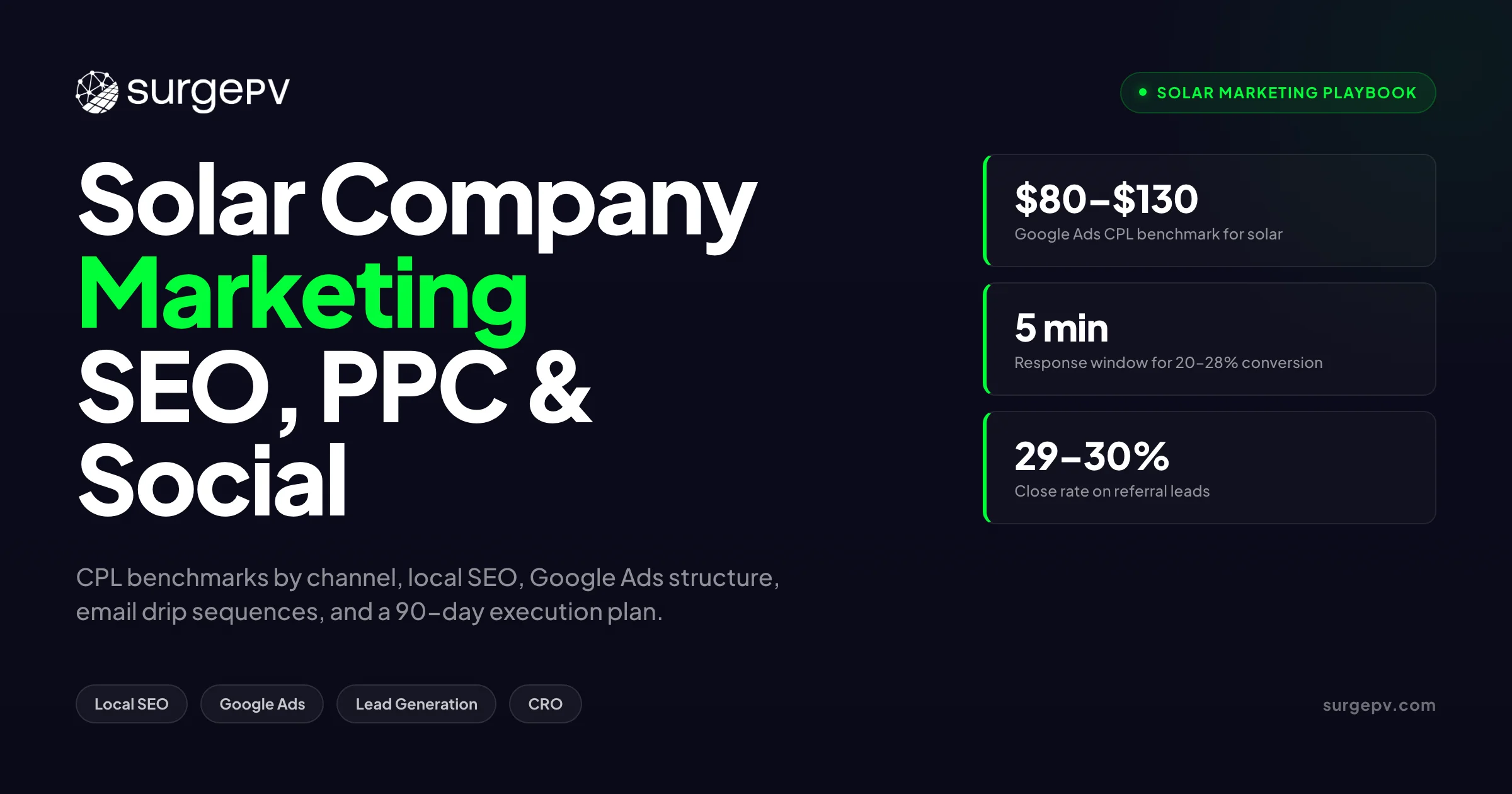
Solar companies that respond to a lead within 5 minutes convert at 20–28%, vs. 1–4% after 24 hours (MIT/InsideSales). This guide covers the full stack: SEO, paid search, social, email, CRO, and attribution — with unit economics and a 90-day plan.
In this guide:
- Build the funnel that turns strangers into installations
- Calculate CAC, CPL, LTV, and ROAS
- Win Local Pack rankings and Google Business Profile traffic
- Run Google Ads and Local Services Ads inside benchmark CPL
- Build a 6-email solar drip sequence
- Track what’s actually working with multi-touch attribution
- Execute a 90-day phased plan
Why Solar Marketing Demands a Different Playbook
Solar is not a commodity sale. A homeowner signing a $25,000 installation contract is making a 25-year financial decision tied to their roof, their utility rate, and their credit. The research window runs 3–6 months for most buyers. That changes everything about how you market.
The demand signal is strong. 45% of US homeowners researched solar in the past 2 years (InMyArea), and 46% have seriously considered rooftop solar (Pew Research). That is a massive addressable pool. But “considered” does not mean “ready to buy,” which is why most solar ads that interrupt people at the top of the funnel produce low-quality leads that never convert.
The regulatory environment adds complexity. Incentive structures vary by state and utility territory. Net metering rules differ county by county.
This means your marketing copy — especially claims about savings and payback — has to be locally accurate, not generically optimistic. Homeowners who do 3 months of research will catch inflated claims fast. A bad review citing a misleading quote will follow your Google Business Profile for years.
There is also a trust deficit specific to solar. Door-to-door abuses from prior boom cycles, high-pressure sales tactics, and news coverage of installer bankruptcies have made buyers cautious. Your marketing system has to build credibility before it asks for a commitment.
The residential and commercial solar funnels diverge significantly. Residential buyers are motivated primarily by utility bill savings and home value. Commercial buyers — property owners, business operators, C&I managers — evaluate solar against an internal rate of return, balance sheet treatment, and operational disruption. Both need a marketing approach tailored to how they actually make the decision.
Four common mistakes that break solar marketing systems before they start:
- Running paid ads without a response protocol — leads expire in hours, not days
- Treating all leads as equal regardless of source (referral leads close at 29–30%; aggregator leads close at 3–8%)
- Skipping Local Pack optimization while spending on national display campaigns
- Sending every lead into the same drip sequence regardless of whether they came from a branded search or a cold Meta ad
The Solar Marketing Funnel: From Stranger to Signed Contract
Every sale starts with a stranger who has a problem: a high electricity bill, a neighbor who just installed solar, a policy change that makes the numbers interesting. Your job is to move them through five stages at an appropriate pace for a high-consideration purchase.
Stage 1: Awareness. The prospect knows solar exists but hasn’t thought about it for their situation. They are not searching for installers yet. Channels: Meta awareness campaigns, YouTube pre-rolls, Nextdoor organic posts, local press coverage.
Stage 2: Education. They’ve started researching. They’re reading articles, watching explainer videos, comparing federal and state incentives. Channels: blog content, Google organic search, YouTube how-to videos, email from a lead magnet.
Stage 3: Consideration. They’re comparing specific companies in their area. They’re reading Google reviews, checking Better Business Bureau ratings, looking at proposal examples. Channels: Google Ads branded + local queries, Local Services Ads, review sites, referral calls.
Stage 4: Decision. They’re ready for a quote. Channels: contact form, phone call, Live chat. This is where response time determines the outcome.
Stage 5: Advocacy. Post-install. A satisfied customer becomes a referral source, a review writer, and a case study. Most solar companies underinvest here.
| Stage | Channel | Conversion Goal | Benchmark Metric |
|---|---|---|---|
| Awareness | Meta ads, YouTube, Nextdoor | Impression share, video view rate | CPM under $12 |
| Education | SEO blog, email, YouTube organic | Time on page, email opt-in | 3+ min session, 15%+ opt-in |
| Consideration | Google Ads, LSA, Local Pack, reviews | Profile views, ad clicks, form fills | CTR 8–12% (branded) |
| Decision | Contact form, phone, chat | Lead submitted | CPL $80–$130 (Google Ads) |
| Advocacy | Referral program, review requests | Review count, referrals per install | 1 review per 3 installs min |
Industry average lead-to-sale conversion sits at 8–12%, with top performers hitting 15% or higher (Agentzap). The funnel stage where most companies lose is Stage 4 to Stage 5: the gap between a submitted lead and a closed contract.
Most of that gap is response time, proposal quality, and channel mix. We address all three in this guide.
Unit Economics: CAC, CPL, LTV, and ROAS
Before you allocate a dollar to any channel, you need to know what a customer is worth and what you can afford to pay to acquire them.
CAC (Customer Acquisition Cost) is the total spend — across all marketing channels plus sales labor — divided by installs closed. The national average is approximately $0.43/W, which works out to roughly $2,580 for a 6 kW system. In competitive markets like California, Massachusetts, and New Jersey, CAC can reach $10,000 per customer (Wood Mackenzie via RocketLaunch Media). If your current CAC is above your market average, you either have a cost problem (overpaying for leads) or a conversion problem (not closing enough of the leads you buy).
CPL by channel varies significantly:
| Channel | CPL Range | Lead Type | Notes |
|---|---|---|---|
| Google Ads | $80–$130 | Exclusive, high intent | Search intent at point of purchase |
| Meta Ads | $60–$90 | Exclusive, medium intent | Profile-match targeting |
| Shared aggregator leads | $20–$60 | Non-exclusive | 3–8% close rate; erodes margins fast |
| Exclusive aggregator leads | $100–$150 | Exclusive | Better quality; verify exclusivity in writing |
| Referral | Near $0 direct | Exclusive, very high intent | 29–30% close rate |
| Organic SEO | $0 per click | Exclusive | High long-run ROI; 4–12 months to build |
Source: RocketLaunch Media
LTV (Customer Lifetime Value) for a solar customer is larger than the initial job. A residential customer who paid $25,000 for their system may add battery storage ($10,000–$20,000) in years 2–4, may refer 1–2 neighbors (each worth $25,000 in revenue), and may be a candidate for an EV charger or panel upgrade in years 5–8. A conservative LTV for a residential solar customer, counting only the primary job and one referral conversion, is $35,000–$50,000. For more on this topic, see Adding Battery Storage Services.
ROAS (Return on Ad Spend) is straightforward for solar if you track installs back to lead source. Here is a worked example:
- Google Ads monthly budget: $5,000
- CPL at $100: 50 leads
- Close rate at 10%: 5 installs
- Average system revenue: $18,000
- Monthly revenue attributed: $90,000
- ROAS: 18:1
An 18:1 ROAS is excellent. A 5:1 ROAS is viable. Below 3:1, the channel is not covering its own cost once you factor in sales labor and overhead.
CAC formula for solar installers:
Total CAC = (Total Ad Spend + Sales Labor Cost + Creative/Agency Fees) ÷ Installs Closed
Run this calculation monthly, segmented by channel, and compare against your average system gross margin. If a channel’s CAC exceeds 15% of average contract value, it needs fixing — either by improving conversion or cutting spend and reallocating to better-performing channels.
Pro Tip
Shared leads are not inherently bad — but they demand a response system. If you can call a shared lead within 5 minutes, you compete. If you call 4 hours later, you have already lost to the 2 other installers who got the same lead and called first. The CPL looks cheap until you account for the wasted sales time chasing leads that already signed elsewhere.
SEO for Solar: Own the Local Search Results
Local search is where residential solar buyers make their final decision about which companies to consider. 93% of local-intent searches surface a Local Pack — the map results at the top of the page — and 32–44% of all clicks go to those top 3 positions (BrightLocal). If your company is not in the Local Pack for “[city] solar installation” searches, you are invisible to the segment of buyers closest to a purchasing decision.
Your SEO work has four layers: Google Business Profile, on-page city and service pages, content cluster, and technical.
Google Business Profile: 10-Step Checklist
- Claim and verify your GBP listing — mail verification takes 7–14 days; start immediately.
- Set primary category to “Solar Energy Company” (not “Electrician” or “General Contractor”).
- Add all relevant secondary categories — “Solar Panel Cleaner,” “Roofing Contractor” if applicable.
- Upload 20+ photos: crew, installs, equipment, office, before/after. Businesses with photos on their Google profile receive 42% more requests for driving directions and 35% more click-throughs to their websites (Google via BrightLocal).
- Write a description that includes your primary city, service area, and 2–3 differentiators. Do not keyword-stuff — Google’s guidelines prohibit it.
- Add all services with descriptions and pricing ranges where possible.
- Enable messaging and respond to every inquiry within 1 hour.
- Post weekly — short GBP posts about recent installs, incentive updates, and project spotlights.
- Respond to every review, positive and negative, within 48 hours.
- Request reviews from every install — a separate section covers the timing and ask strategy.
Local Pack Mechanics
Google weights GBP rankings on three factors: relevance (does your profile match the search?), distance (how close are you to the searcher?), and prominence (how many reviews, how recent, how well-responded?). You cannot control distance. You can control relevance through profile optimization and prominence through a systematic review program.
Proximity bias means a company 2 miles from the searcher will often outrank a better-known company 10 miles away. This has a practical implication: if your service area spans multiple cities or counties, consider whether a second GBP location (with a real physical address, not a P.O. box) makes sense for a major secondary market.
On-Page City and Service Pages
One page is rarely enough. Build a page for every city and service combination that gets meaningful search volume in your area. Structure:
/solar-installation-[city]/— primary city page/solar-installation-[city]/residential/— residential sub-page/solar-installation-[city]/commercial/— commercial sub-page/battery-storage-[city]/— storage-specific page if you offer it
Each page needs: a local H1 with city name, a description of local utility rates and incentives (show you know the market), a Google Map embed, local reviews embedded or quoted, and a contact form above the fold. Generic “we serve [city]” pages that share 80% of content with other city pages will not rank.
Content Cluster Structure
Build a topical cluster around solar in your primary market:
- Hub page: “Solar Panels in [City]: 2026 Cost & Savings Guide”
- Spoke pages: “Net Metering in [State],” “[Utility] Solar Billing Explained,” “Solar Tax Credit [State] 2026,” “Best Solar Panels for [Climate Type] Weather”
Internal links from spoke pages to the hub page — and from the hub to relevant spoke pages — build topical authority. This is how a small regional installer can outrank a national aggregator for a local query.
A solar design software tool with a public-facing solar estimator embedded on your hub page gives you a unique content asset that aggregators cannot replicate. It also keeps visitors on your site longer — a positive signal for user behavior in search rankings.
Technical SEO
Mobile traffic is 54.2% of US web traffic (StatCounter). If your site loads slowly on mobile, you are losing more than half your potential visitors before they read a word. Target Core Web Vitals in the “Good” range: Largest Contentful Paint under 2.5s, Cumulative Layout Shift under 0.1, Interaction to Next Paint under 200ms.
Add LocalBusiness schema markup to your homepage and all city pages. Add FAQPage schema to any page with a Q&A section. Add Review schema if you embed customer testimonials. These structured data types increase the chance of rich results appearing in search — expanding your visual footprint without improving rankings directly.
Link-building tactics that work for solar: local press coverage of installs (pitch to the local paper, especially for schools, community buildings, or notable projects), partnerships with roofing companies (swap links), supplier or manufacturer installer directories, and sponsoring local home improvement shows or events.
PPC and Paid Search: Google Ads and Local Services Ads
88% of consumers trust online reviews as much as personal recommendations, and 93% of people aged 35–54 read online reviews before contacting a local business (Blue Corona). Google Ads puts you in front of buyers at the moment they are actively searching — which is why it commands a higher CPL than most other channels.
Local Services Ads
Local Services Ads (LSAs) appear above standard Google Ads results and above organic listings. They display your business name, star rating, and a “Google Guaranteed” badge. You pay per lead, not per click, and you only pay when a prospect calls or messages through the ad. LSA CPL for solar ranges from $60–$120 depending on market. This is often lower than standard search CPL because you are not paying for clicks that never convert.
To qualify for Google Guarantee, you need a background check (for your business and key employees), proof of licensing, and proof of insurance. Start the verification process early — it can take 3–6 weeks.
| Feature | Local Services Ads | Standard Search Ads |
|---|---|---|
| Position | Above all search results | Below LSA, above organic |
| Billing model | Per lead (call/message) | Per click |
| Quality signal | Star rating + review count | Ad Quality Score |
| Targeting control | City/zip + service category | Full keyword control |
| Best for | High-trust, first contact | Keyword-level intent targeting |
| Approximate CPL | $60–$120 | $80–$130 |
3-Campaign Search Structure
Organize your Google Ads account into three campaigns:
Campaign 1 — Branded. Keywords: your company name and variations. Protect your brand from competitors bidding on your name. CPC here is low ($0.50–$2.00) and conversion rate is high (25–40%). Always run this.
Campaign 2 — Competitor. Keywords: competitor company names in your market. Higher CPCs, but these searchers are actively evaluating — which means they are close to a decision. Use ad copy that highlights your differentiators (reviews, warranty, local installer) without naming the competitor directly (against Google policy).
Campaign 3 — Generic. Keywords: “solar installation [city],” “solar panels cost [city],” “solar company near me.” These carry the highest CPCs (Google Ads CPC for solar ranges from $1.50 to $8.00+ per WordStream) and drive the most volume. This is where most of your budget goes and where negative keywords matter most.
Negative Keyword List
Add these from day one to prevent wasted spend:
- DIY, do it yourself, how to install
- Free, cheap, discount
- Solar panels for sale (product intent, not service intent)
- Solar farm, solar farm jobs
- [Competitor names] — exclude from Generic campaign if you’re not running a Competitor campaign
Bidding Strategy
Start with Maximize Conversions while you accumulate 30–50 conversions in the account. Once you have that data, switch to Target CPA set at your maximum sustainable CPL. Do not set Target CPA until you have conversion data — Google’s algorithm needs training data to optimize.
Ad Copy Patterns That Work
Lead with the local market context: “Solar in [City]: See How Much You Save.” Include a proof element: “47 Five-Star Reviews.” Add a specific call to action: “Get Your Free Quote — We Call You in 5 Minutes.” Extensions matter too. Add all sitelinks (Residential, Commercial, Battery Storage, FAQ), callout extensions (Google Guaranteed, Local Installer Since 2015), and structured snippets (Services: Design, Permitting, Installation, Monitoring).
Landing page alignment is not optional. If your ad says “[City] Solar Installation — Free Quote,” the landing page must be the [city]-specific page with the quote form above the fold. Sending paid traffic to your homepage wastes CPL.
Social Media Advertising for Solar Companies
Social ads work differently from search ads. On Google, you reach someone at the moment they’re searching. On social, you reach someone who matches a profile but may not be thinking about solar at all. This changes both creative strategy and expectation-setting on CPL and close rates.
Meta (Facebook and Instagram) is the dominant social platform for residential solar lead generation. LinkedIn works for commercial solar targeting. YouTube functions as both a discovery and education platform. Nextdoor is underused but often delivers high-quality residential leads in specific neighborhoods.
| Platform | Best For | Avg CPL | Targeting Strength | Content Format |
|---|---|---|---|---|
| Meta (FB/IG) | Residential homeowners | $60–$90 | Homeowner, income, geography | Video, carousel, lead form |
| C&I decision-makers | $120–$200 | Job title, company size, industry | Sponsored content, InMail | |
| YouTube | Awareness + education | $15–$40 CPV | Interest, intent, demographics | Pre-roll (15–30 sec) |
| Nextdoor | Neighborhood residential | Varies | Specific neighborhoods | Organic + sponsored posts |
Meta 3-Layer Architecture
Structure your Meta campaigns in three layers:
Layer 1 — Awareness (5–10% of Meta budget). Video ads (45–90 seconds) showing a recent local install, the homeowner’s before/after utility bill, and a quick explanation of the process. Objective: video views. Target: homeowners in your service area, aged 30–65, household income $75k+.
Layer 2 — Retargeting (30–40% of Meta budget). Target people who watched 50%+ of your awareness video, visited your website in the past 30 days, or engaged with your Facebook page. Objective: Lead Generation (Meta Lead Forms) or Conversions (landing page). This pool is warmer and your CPL will be lower.
Layer 3 — Lookalike (50–60% of Meta budget). Upload your past customer list (minimum 1,000 emails for a quality seed) and build a 1–3% lookalike audience. Target: homeowners in your market who look like your existing customers. This scales efficiently once you have 50+ past customers in your seed list.
Conversions API and iOS 14 Impact
iOS 14 privacy changes in 2021 broke pixel-based tracking for a significant portion of iPhone users. Meta’s Conversions API (CAPI) sends conversion events server-side, bypassing browser-level blocking. Installing CAPI reduces reported CPL by 15–25% — not because leads become cheaper, but because more of them are accurately attributed (LanderLab). If you’re measuring Meta CPL without CAPI, your data is understating performance. See Solar Racking Design Guide for detailed guidance.
Creative Patterns That Work for Solar
- Real installs. A photo of a completed install with the homeowner’s address visible (with permission) outperforms stock imagery because it proves local presence.
- Bill reveal. Show a July utility bill before ($240) and after ($18 with net metering credit). This is the outcome, not the product.
- Quick stat. A 15-second reel: “Our average [City] customer saves $1,200 a year. Here’s what that looks like.” Cut to a testimonial clip.
- Avoid: generic solar panel fields. Solar farm stock photos signal “big company” not “local installer.” Buyers want to know you’ve done their type of roof, their neighborhood, their utility.
Mobile traffic is 64.35% globally and 54.2% in the US (StatCounter). Design every creative for vertical video first. If it does not work at 9:16 on a phone screen, rebuild it before spending. For Global-specific compliance details, see Global net-metering-by-country. For Global-specific compliance details, see Global solar-permitting-speed-by-country.
Organic social — particularly Nextdoor — works for residential solar in specific ZIP codes. A post in a neighborhood Facebook group or Nextdoor showing your latest install 3 streets over generates inquiries that no paid channel can replicate. Build a post-install social workflow: take a photo at completion (with homeowner permission), tag the neighborhood, write one sentence about the system size and expected annual savings. Do it for every job.
Email Marketing and Lead Nurturing Sequences
Email returns $36–$42 per $1 spent on average (HubSpot State of Marketing). For solar, where the research window is 3–6 months, email is the only channel that lets you stay present with a prospect for the entire consideration period without paying per touch.
The critical rule: the 5-minute response time applies to the first acknowledgment, not the full follow-up. An automated email that hits immediately — confirming receipt, setting expectations, and offering a direct calendar link — satisfies the buyer’s need for acknowledgment while your sales team handles the call queue (MIT/InsideSales).
6-Email Solar Drip Sequence
| Timing | Subject Line | Goal | |
|---|---|---|---|
| 1 — Confirmation | Immediate | “Your solar quote request — what happens next” | Set expectations, establish credibility |
| 2 — Education | Day 2 | “How [State] net metering affects your savings” | Build trust with local knowledge |
| 3 — Social proof | Day 5 | “How [City] homeowners are saving $1,100/year on average” | Close-rate signal from real installs |
| 4 — Objection handling | Day 9 | “The 3 questions every smart solar buyer asks” | Pre-empt price, quality, and timeline concerns |
| 5 — Urgency | Day 14 | “Your quote is ready — schedule your site visit” | Push toward appointment |
| 6 — Re-engagement | Day 28 | “Still thinking about solar? Here’s what’s changed.” | Revive cold leads before they drop out |
Each email should be under 300 words. A single call to action per email. Link to your scheduling tool, not a form that triggers another sequence.
Post-Install Reactivation
Set a 6-month post-install trigger for every closed customer. The reactivation email targets battery storage, monitoring upgrades, and referral requests — three actions with near-zero marketing cost and high revenue potential. A simple “How is your system performing?” email with a referral ask generates a meaningful share of new business — well-structured solar referral programs see 15–30% of installed customers actively engage when prompted (ConnectReward).
Segmentation
Do not send the same sequence to every lead. Segment at minimum by:
- Lead source (Google Ads, referral, Meta, organic) — because their level of prior education varies
- System type interest (residential, commercial, battery) — different content, different timelines
- Stage (new inquiry vs. received proposal vs. proposal follow-up) — your drip should match where they are in the funnel
Tools like HubSpot, Klaviyo, or a solar-specific CRM (OpenSolar, MarketSharp) allow automation triggers tied to proposal status. When a proposal is sent, automatically trigger a 3-email sequence: confirmation, FAQ follow-up, then a “5 reasons our installs outperform” value-add email. This sequenced follow-up is what solar sales professionals need automated — doing it manually for every lead is unsustainable at scale.
Conversion Rate Optimization for Solar Websites
You can double the output of your marketing budget without spending an extra dollar on ads — by fixing what happens when traffic arrives on your site.
The 3-second above-the-fold test: open your homepage on a mobile device you have never used before. In 3 seconds, can you tell (1) what the company does, (2) where it operates, and (3) what you should do next? If any of those three questions are unclear, you are losing conversions to ambiguity.
Quote Form Design
Form fields are the single biggest CRO lever on a solar website. Every field you add reduces submission rate. The minimum viable solar quote form has 4 fields: name, email, phone, address (or ZIP code). That is enough to qualify the lead and start the conversation.
If you need more information — roof type, bill size, ownership status — use a progressive disclosure form: show 2 fields, then ask 2 more on the next step, then 2 more after that. Multi-step forms in home services typically produce 30–40% more submissions than single long forms.
Trust Signals
88% of consumers trust online reviews as much as personal recommendations (Blue Corona). Place these trust elements above the fold or within the first scroll on every landing page:
- Star rating with review count (link to Google or Yelp)
- Number of installs completed
- Year the company was founded
- License number and state certification
- BBB or NABCEP badge if you hold them
These are not decorations. Each removes a specific objection a first-time visitor will have before they’re willing to submit a form.
Page Speed
A 1-second delay in page load time reduces conversions by approximately 7% (Akamai/Aberdeen Group). For a page generating 100 leads per month at a $100 CPL, a 2-second delay costs $1,400 per month in wasted ad spend. Compress images, eliminate render-blocking scripts, and use a CDN. Run PageSpeed Insights on your primary landing pages weekly.
A/B Test Priority Matrix
| Test | Difficulty | Estimated Lift | Test First? |
|---|---|---|---|
| Headline: “Free Quote” vs. “See Your Savings” | Low | High | Yes |
| Form position: sidebar vs. inline | Low | High | Yes |
| Field count: 4 vs. 6 fields | Low | Medium-High | Yes |
| CTA button color | Low | Low | No |
| Video on landing page | Medium | Medium | After basics |
| Trust badge placement | Low | Medium | Yes |
| Social proof type: star rating vs. photo testimonial | Low | Medium | Yes |
The top 3 items on that list — headline, form position, and field count — account for 60–70% of the conversion lift available on most solar landing pages. Run them before anything else.
When a lead arrives via form, the confirmation page matters too. Use it to set the response expectation: “Our team will call you within 15 minutes during business hours.” This primes the prospect to pick up your call and reduces no-answer rates.
A professional solar proposal software that lets you deliver a branded proposal the same day as the site visit also functions as a CRO tool. Buyers who receive a same-day proposal close at materially higher rates than those who wait 5–7 business days — because in the interim, a competitor calls back, or the homeowner loses urgency.
See How SurgePV Closes Leads Faster
Solar proposals that look polished and reach the homeowner the same day as the site visit. Book a 20-minute walkthrough with your own project.
Book a DemoNo commitment required · 20 minutes · Live project walkthrough
Read more about Solar Software Poland. For a direct comparison, see Arka 360 vs SurgePV.
Referrals and Review Generation: Your Lowest-CAC Channel
Referral leads close at 29–30% (Agentzap). Google Ads leads close at 8–12%. If you could shift 20% of your lead volume to referrals, the economics of your entire marketing system change.
Most solar companies have a passive referral program: a line in the post-install email that says “Tell your friends!” This does not work. A referral program requires a specific ask, a specific incentive, and a specific timing.
The $200 referral scenario. Assume you complete 40 installs per year. If 15% of customers refer one neighbor — a conservative benchmark for companies with a formal program — that is 6 additional installs. At an average contract value of $25,000, that is $150,000 in revenue generated at a CAC of $200 per install (the cost of the referral reward). Compare that to $1,000+ CAC on paid channels. The math is not close.
Timing the referral ask. The best moment to ask for a referral is 2 weeks after installation — after the system has turned on and the homeowner has seen their first generation data, but before the novelty has worn off. A simple text message with a direct link to your referral form, sent manually by the sales rep who closed the deal, outperforms automated email by a large margin.
Review generation. Reviews are a dual asset: they improve Local Pack rankings (a proximity-and-prominence signal) and they convert skeptical prospects into leads. 93% of people aged 35–54 read online reviews before contacting a local business (Blue Corona).
Ask for a Google review first — it has the most direct impact on search visibility. Provide a QR code or a direct link (never ask them to search for your business and then find the review button themselves). For customers who leave a Google review, follow up 1 week later with a request to also post on Yelp or Trustpilot if they are willing. Do not ask for reviews on multiple platforms simultaneously — it feels demanding.
Proposal-driven referrals. A branded, professional proposal does something that a generic quote PDF does not: it travels. Homeowners share proposals with spouses, parents, and neighbors who ask “how did you find out about this company?” That proposal is marketing collateral. Generating it through a purpose-built solar proposal software — with your company branding, system design visualization, and financial model — converts a routine deliverable into a referral trigger.
The first responder wins 78% of sales where multiple companies are competing (MIT/InsideSales). A referral lead who calls you because their neighbor recommended you is almost always exclusive — but they will still call another company if you don’t pick up. Speed matters even for referrals.
Tracking and Attribution: Know What Actually Works
The biggest waste in solar marketing budgets is not bad channel selection — it is spending on channels you cannot measure. If you do not know which leads turned into installs and why, you will keep funding channels based on gut feeling rather than data.
The 5 Attribution Models
| Model | Logic | Solar Use Case | Limitation |
|---|---|---|---|
| Last-touch | 100% credit to last channel before conversion | Simple, default in many CRMs | Ignores 3–5 month research journey |
| First-touch | 100% credit to first channel | Useful for awareness channel ROI | Ignores the channels that closed the deal |
| Linear | Equal credit to all channels touched | Fair starting point | Treats a 2-second Nextdoor glance the same as a direct site visit |
| Time-decay | More credit to recent touchpoints | Good for high-intent close channels | May undervalue top-funnel awareness |
| Data-driven | ML-based on actual conversion path data | Most accurate at scale | Requires 1,000+ conversions to train |
Start with last-touch for immediate actionability, layer in first-touch to evaluate awareness spend, and move toward data-driven as your conversion volume grows.
GA4 Minimum Setup
Every solar marketing stack needs these four GA4 configurations before you spend a dollar on ads:
- Goal events — form submission, phone click, chat initiation. Tag each with the source page.
- Conversions — mark those goal events as conversions in GA4.
- Source/Medium attribution — ensure UTM parameters are appended to every ad URL, email link, and social link.
- Enhanced measurement — enable scroll depth, outbound clicks, and file downloads.
Call Tracking and Dynamic Number Insertion
Most solar leads call before they fill out a form. Without call tracking, you are blind to a significant portion of your conversion data. Use a call tracking platform (CallRail, CallTrackingMetrics) with dynamic number insertion (DNI): the phone number displayed on your website changes based on how the visitor arrived.
Google Ads visitors see a different number than organic visitors, who see a different number than direct visitors. Each call is attributed to its actual source.
CRM Data Hygiene
Tag every lead at the moment of entry with its source and channel. Do not rely on sales reps to fill this in after the fact — it will never be accurate. Use your CRM’s web-to-lead forms or your ad platform’s lead form integrations to capture source automatically.
Offline conversion import closes the loop between digital and physical. When a deal closes in your CRM, import that conversion back into Google Ads with the original click ID. This tells Google which clicks actually became customers (not just form fills) and dramatically improves Target CPA bidding accuracy over time.
Common attribution mistakes:
- Counting form fills as conversions without verifying lead quality downstream
- Not importing closed deals back to Google Ads
- Using UTM parameters inconsistently across channels
- Relying on Meta’s reported conversions without CAPI verification
- Treating all installs as equivalent regardless of system size or margin
How SurgePV Turns Your Design Tool Into a Marketing Asset
Most solar software enters the workflow after a lead arrives. SurgePV integrates earlier — and the earlier you use it, the more return you get from the same marketing spend.
Interactive design as a lead magnet. Embed a solar estimator on your landing page that lets a homeowner enter their address, see a 3D rooftop model, and get a preliminary system size and annual savings estimate. The visitor who spends 8 minutes interacting with your solar design tools before submitting their name is a warmer lead than someone who filled out a 4-field form in 30 seconds. They self-qualified. They are invested.
Shadow analysis as objection handling. “My roof is too shaded” is one of the most common objections in residential solar sales. A physics-based solar shadow analysis software that produces a shade report with irradiance maps by month answers that objection with data rather than salesmanship. Share the shade report with the homeowner during the consultation. It builds trust and it differentiates you from every competitor who just says “your roof looks fine.”
Branded proposals driving referrals. A proposal generated with solar software that includes your company branding, a system design visualization, a shading analysis summary, and a financial model is not just a quote document. It is a marketing artifact the homeowner keeps, shares with family members, and may show to a neighbor who asks about solar. The quality of the proposal signals the quality of the install.
Clara AI for speed-to-lead. Clara AI drafts proposal copy based on the system design — reducing the time from site visit to delivered proposal from hours to minutes. Speed-to-lead determines win rate in competitive markets. The first company to deliver a professional proposal after a site visit typically wins the job, especially when the homeowner is comparing 2–3 installers simultaneously.
Generation and financial tool for IRR/NPV proof. The generation and financial tool models yield, payback period, IRR, and NPV — the exact outputs that commercial buyers and financially oriented residential buyers need to approve a project. Instead of quoting a monthly bill savings number and hoping the buyer trusts it, you show them a 25-year cash flow model with sensitivity analysis. This turns your proposal from a price document into a financial case.
The 2-hour scenario. Site visit ends at 2 PM. Your team runs the 3D roof model and string design while on-site. Shadow analysis runs automatically. Clara AI drafts the proposal narrative based on the design output. By 4 PM, the homeowner has a branded, data-backed PDF proposal in their inbox — while the competitor they also met that morning is still building theirs. That 2-hour turnaround is not a sales tactic. It is a marketing differentiator.
Your 90-Day Solar Marketing Plan
The sequence matters. Foundation before activation, activation before scale. Companies that launch Google Ads before their GBP is optimized, their tracking is set up, and their landing page converts will burn budget without building anything.
| Phase | Days | Actions | Success Metric |
|---|---|---|---|
| Foundation | 1–30 | GBP optimization, GA4 + call tracking, LSA application, first 5 review requests | GBP fully optimized, tracking live, LSA application submitted |
| Activation | 31–60 | Google Ads launch ($1,500–$3,000/mo), 6-email drip live, CRO test 1 running, first referral asks | 20–30 leads generated, first closed job attributed to paid |
| Scale | 61–90 | Meta retargeting layer, attribution model reviewed, content calendar live, lookalike audience seeded | CPL tracked by channel, ROAS above 5:1, 2+ organic city pages ranking |
Days 1–30: Foundation
- Complete GBP 10-step checklist
- Set up GA4 with conversion events and call tracking
- Apply for Local Services Ads (Google Guarantee verification)
- Request reviews from last 10 installs
- Audit landing page against the 3-second test and form field count
- Build your customer email list from CRM for future lookalike audiences
Days 31–60: Activation
- Launch Google Ads: Branded campaign first (lowest risk, highest conversion), then Generic
- Activate 6-email drip sequence for new inquiries
- Run first CRO A/B test: headline variation on primary landing page
- Make first formal referral ask to 3 most satisfied recent customers
- Publish first local blog post targeting “[City] solar installation guide 2026”
Days 61–90: Scale
- Launch Meta retargeting: website visitors and video viewers from past 30 days
- Review attribution data: which channels produced installs (not just leads)?
- Shift budget away from underperforming channels based on CPL-to-CAC data
- Seed lookalike audience from customer email list in Meta
- Build out content cluster: 2 spoke pages around primary city hub
- Establish monthly reporting cadence: CPL by channel, close rate by source, CAC vs. average contract value
Conclusion
The solar companies winning in 2026 are not the ones with the biggest ad budgets. They are the ones who close the loop between marketing spend and installed jobs — and who continuously optimize that loop based on what the data shows.
Three specific next steps:
- Run the GBP 10-step checklist this week. It costs nothing and is the highest-ROI 4 hours you will spend on marketing this year. Local Pack presence directly affects lead volume.
- Set up call tracking before launching any paid campaign. Without it, you are flying blind on attribution. The setup takes one afternoon and pays for itself in the first month of paid spend.
- Measure your CPL and close rate by channel for the last 6 months. Not impressions, not click volume — CPL and close rate. That analysis will tell you immediately whether to increase, maintain, or cut each channel.
The system outlined in this guide is not built in a day. But the foundational pieces — GBP, tracking, and a response protocol — can be live within 30 days. Start there.
Your Marketing Is Only as Good as Your Proposal
SurgePV turns a site visit into a branded, data-backed proposal in under 2 hours. Start closing more of the leads your marketing generates.
Book a DemoNo commitment required · 20 minutes · Live project walkthrough
Frequently Asked Questions
How much should a solar company spend on marketing?
Most solar companies allocate 5–10% of revenue to marketing. A company doing $2M in annual installs should budget $100,000–$200,000 across paid search, SEO, email, and creative. Smaller installers doing under 30 jobs per year often start with $3,000–$5,000 per month focused on Local Services Ads and Google Business Profile before adding paid social.
What is a good cost per lead for a solar company?
Google Ads solar CPL benchmarks at $80–$130 for exclusive leads, Meta at $60–$90, and shared aggregator leads at $20–$60 (RocketLaunch Media). A sustainable CPL depends on your close rate and average system value. A company closing 10% of leads on $18,000 systems can sustain a CPL up to $180 before marketing exceeds 10% of revenue.
How long does SEO take to work for solar companies?
Most solar companies see measurable organic traffic growth within 4–6 months of consistent SEO work. Competitive city-plus-service pages typically take 6–12 months to rank in the top 10. Google Business Profile optimization, by contrast, can produce Local Pack visibility within 4–8 weeks.
Is Google Ads or Facebook Ads better for solar?
Google Ads targets buyers actively searching for solar — higher intent, higher CPL ($80–$130). Meta targets homeowners who match a profile but are not actively searching — lower CPL ($60–$90) but lower close rates. Most companies running 50+ jobs per year run both: Google for inbound intent, Meta for top-of-funnel awareness and retargeting.
What is the average solar lead-to-sale conversion rate?
The industry average is 8–12% from lead to closed sale. Top-performing residential installers reach 15% or higher. Referral leads close at 29–30%. Shared aggregator leads close at 3–8% (Agentzap). The spread is wide enough that improving lead quality — your channel mix — often matters more than improving the sales process itself.
How does response time affect solar lead conversion?
Dramatically. MIT and InsideSales research shows a 5-minute response window produces a 20–28% conversion rate; waiting 24 hours drops it to 1–4% (MIT/InsideSales). The first company to respond wins 78% of sales where multiple companies are competing. In practice: automated inquiry acknowledgment plus a same-day personal follow-up call is not optional in competitive markets — it is the baseline.
Where this fits
This article is part of SurgePV's Solar Sales & Proposals hub, which works through the topic from first principles to the decisions a project team actually has to make.

