

Quick Answer
SEIA and Wood Mackenzie project a 19% residential market contraction as homeowners who were waiting on the credit either delay or drop out entirely. California's NEM 3.0 gutted export buyback rates by roughly 75%, which means a solar-only system in the state's largest market no longer pencils without storage factored in.
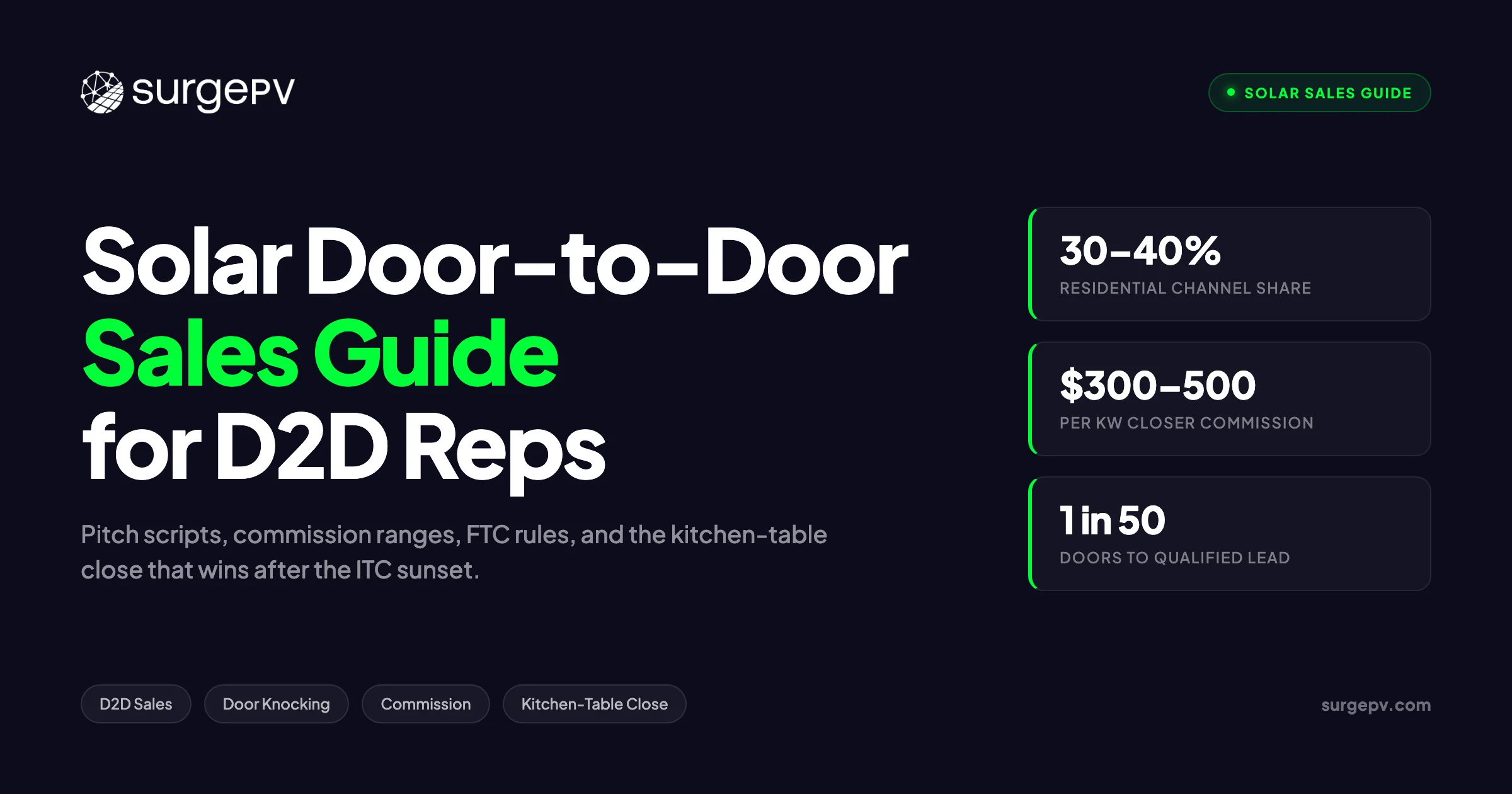
30 to 40% of US residential solar still gets sold at the door (Daly Advertising, 2026), and the reps who win in 2026 are not the ones knocking the most doors — they’re the ones who can prove value before they leave the driveway. The Section 25D residential ITC expired December 31, 2025. SEIA and Wood Mackenzie project a 19% residential market contraction as homeowners who were waiting on the credit either delay or drop out entirely. The pitch that worked in 2024 — open with the 30% tax credit, paper the savings, leave with a signature — is now a liability.
SEIA and Wood Mackenzie project a 19% residential market contraction as homeowners who were waiting on the credit either delay or drop out entirely. California’s NEM 3.0 gutted export buyback rates by roughly 75%, which means a solar-only system in the state’s largest market no longer pencils without storage factored in.
The new deal-size lever is battery storage. Sunrun reported 70% battery attach in Q3 2025. EnergySage data showed 45% battery attach in H2 2024. California’s NEM 3.0 gutted export buyback rates by roughly 75%, which means a solar-only system in the state’s largest market no longer pencils without storage factored in. The rep who understands that shift — and can run a live battery-plus-solar financial model at the kitchen table — has a structural advantage over every rep still pitching the dead credit. Read Adding Battery Storage Services for a complete walkthrough.
This guide covers everything a D2D solar rep needs to operate in that environment: the post-ITC pitch reframe, rep economics and commission structures, FTC compliance, doorstep scripts, the five-phase kitchen-table close, objection handling for the 6 objections that kill deals in 2026, weekly KPIs, the three-layer software stack, and an onboarding ramp plan.
TL;DR
D2D still accounts for 30 to 40% of US residential solar sales (Daly Advertising, 2026). With the Section 25D ITC gone, the channel’s winners are the reps who build trust fastest — by running a live design and proposal at the table instead of promising a credit that no longer exists.
In this guide you will learn:
- Why D2D remains the dominant residential solar channel despite the ITC sunset
- The economics of D2D solar: commission structures, OTE ranges, and time-to-earnings
- FTC compliance, cooling-off rules, and the enforcement cases every rep must know
- Territory selection and pre-knock intelligence
- Doorstep openers, qualifying questions, and the micro-commitment ladder
- The five-phase kitchen-table close with live design and proposal
- Objection handling scripts for the 6 deals killers reps face in 2026
Why D2D Still Dominates Residential Solar
Digital lead generation promised to replace the door knock. It has not. The cost-per-lead from paid search runs an industry-observed $150 to $350 per unqualified inquiry, while a trained canvasser generates a qualified appointment for $50 to $200. The math still favors boots on the ground in most markets.
The channel comparison explains the persistence:
| Channel | Avg. lead cost | Close rate | Avg. cycle time |
|---|---|---|---|
| D2D canvassing | $50–$200/appt | 20–30% of sits | 7–21 days |
| Digital / paid search | $150–$350/lead | 8–15% | 30–60 days |
| Referral | $0–$100 | 35–50% | 14–30 days |
| Telemarketing | $80–$250/contact | 5–10% | 30–45 days |
Sources: Spotio, EnergySage installer data; internal aggregator benchmarks.
Referrals close at higher rates, but you cannot scale referrals on demand. Digital leads close at lower rates and take twice as long. D2D is the only channel where a company can open a new territory on Monday and have signed contracts by Friday.
The human element matters too. Solar is a 25-year commitment attached to someone’s home. Homeowners who are uncertain about contractors, financing, and long-term performance want to look a person in the eye. A rep who shows up, knows the local utility rate, pulls up the homeowner’s address on a tablet, and generates a system design on the spot builds more trust in 30 minutes than three weeks of email follow-ups.
The channel is not shrinking. The reps who cannot adapt to post-ITC financing conversations are.
Where D2D Fits in the 2026 Sales Funnel
The full D2D funnel runs in sequence: knock → qualify → set → sit → design → propose → sign → install. Each handoff has a defined owner.
The canvasser knocks doors, qualifies homeowners against basic criteria (own the home, monthly bill over $150, no HOA block), and secures an appointment. The setter may be the same person or a dedicated role who confirms the appointment and ensures both decision-makers will be present. The closer runs the kitchen-table presentation — design, financial model, proposal, signature. The project manager takes over at contract and manages install coordination.
Customer acquisition cost (CAC) for residential solar was $0.87/Wdc in Q4 2024 per Wood Mackenzie. A 10 kW system at that rate carries $8,700 in acquisition cost — which is why commission compression is real and why close rate efficiency matters more than raw knock volume.
The 2026 Market: Selling Solar After the ITC Sunset
The Section 25D residential tax credit expired December 31, 2025, as part of the One Big Beautiful Budget Act signed July 4, 2025. Any homeowner who did not have a system placed in service by that date is ineligible. The rep who opens a pitch with “you can get a 30% tax credit” in 2026 is either uninformed or misrepresenting the product — both outcomes that generate FTC exposure.
What does still work:
| Incentive | Who qualifies | Approx. value | Notes |
|---|---|---|---|
| Section 48E commercial ITC | TPO / lease providers | 30% of system cost | Flows through to lease/PPA pricing |
| State income tax credits | Varies by state | $500–$5,000 | CA, NY, MA, NJ active |
| Net metering / NEM | Varies by utility | Reduces payback 2–4 yrs | NEM 3.0 reality in CA below |
| PACE / solar loans | Homeowners | Financing only | Rate-sensitive in 2026 |
| Utility rebates | Select utilities | $200–$1,500/kW | Xcel, PSE&G examples |
The Section 48E commercial ITC is now the key financing lever for lease and PPA providers. Because the credit flows to the system owner — the TPO company — it can be priced into the lease rate, which means monthly payments on a lease deal can still be positioned against a customer’s utility bill with favorable economics. Reps selling TPO products should understand this structure well enough to explain it simply.
California’s NEM 3.0 is the single biggest market-specific change. Export buyback rates dropped roughly 75% compared to NEM 2.0. A standard solar-only system in California that exported 40% of its generation now earns far less per kWh than it would have two years ago. The practical result: payback periods for solar-only systems in California have extended significantly. Battery storage changes the calculation by shifting consumption to self-use rather than export. Sunrun’s 70% battery attach rate in Q3 2025 is a direct response to NEM 3.0 economics.
SEIA and Wood Mackenzie forecast a 19% contraction in residential installations in 2026, primarily from the ITC expiration. That contraction will hit reps and dealers who do not adapt. It will not hit reps who can lead with bill savings, battery economics, and state-level incentives from the first sentence.
Pro Tip
Lead with monthly bill savings and net-zero financing, not a tax credit that no longer applies. If you pitch a 30% credit to a homeowner in 2026, you will lose the deal and possibly face FTC scrutiny for misrepresentation.
Reframing the Pitch Without the ITC
The ITC-era pitch was credit-first. The 2026 pitch is bill-first.
| Element | Old ITC-led opening | New bill-savings-led opening |
|---|---|---|
| First sentence | “You can get a 30% federal tax credit…” | “Most homes on this block pay $220 a month to the utility. We typically reduce that to under $40.” |
| Financial anchor | Tax credit dollar amount | Monthly delta between loan payment and current bill |
| Deal-size driver | Maximize system size to maximize credit | Battery attach for self-consumption and backup |
| Close | “Lock in before the credit expires” | “Your rate is going up. The loan payment is fixed.” |
A scripted pivot for reps still in the habit: “I know a lot of people in solar are still talking about tax credits. The federal residential credit ended December 31, 2025. What’s actually working now is locking in a fixed monthly payment that’s lower than your utility bill — and adding a battery so you’re not exporting cheap and buying back expensive.”
Battery storage is also the new deal-size lever. A solar-plus-battery system on a 10 kW residential install at $3.50/W all-in runs $35,000 before incentives. The same home with a 10 kWh battery adds $8,000 to $12,000 — deal size goes from $35K to $45K, and the monthly payment increase is typically $30 to $50, which is easy to justify with backup power and NEM 3.0 self-consumption math.
Rep Economics: Commission, Draw, and OTE
D2D solar compensation varies widely by role, employer structure, and market. The table below uses published benchmarks from Sales Cookie (August 2020), Solar Energy Partners (January 2026), and Work In Solar (March 2024).
| Role | Structure | Typical range | Top-rep ceiling |
|---|---|---|---|
| Canvasser / setter | Per confirmed appt | $50–$200/appt | $60K–$80K OTE |
| Closer (W-2 + draw) | $300–$500/kW closed | $60K–$120K OTE | — |
| Closer (1099 commission-only) | $300–$500/kW closed | $80K–$180K OTE | $300K+ |
| Team lead / override | % of team production | Varies | Uncapped |
The draw vs. commission-only distinction matters for new reps. A W-2 draw provides guaranteed income against future commissions — typically $2,000 to $4,000 per month — which is clawed back once commission earnings begin. It reduces early-month cash stress but caps upside and often comes with non-compete clauses. The 1099 commission-only structure has no floor and no ceiling. New reps who choose it should have three to four months of expenses saved before starting.
What kills earnings on both structures:
- High cancel rate: if 25% of your signed contracts rescind within the 3-day cooling-off window, your effective close rate is much lower than your gross numbers show
- Slow funding: some dealers pay on install, not on signature — cash flow gap can be 60 to 90 days after signing
- Chasing unqualified leads: sitting with renters, low-bill households, or homeowners with shading problems that make the system uneconomical wastes sits that could have been billable
- Poor CRM discipline: missed follow-ups cost confirmed appointments; every untracked reschedule is lost revenue
Cancel rate is a real issue in D2D solar. CRL data from July 2024 shows cancel rates vary by dealer but can exceed 20% in markets where reps over-promise or use pressure tactics. High cancel rates trigger dealer-level scrutiny from lenders and can result in rep termination or chargeback liability.
Time to first earnings: Most new reps go 60 to 90 days before a funded deal hits their commission statement. Full ramp to consistent monthly income typically takes 4 to 12 months depending on market, product, and manager quality (D2D Experts onboarding observations, Daly Advertising).
Is D2D solar a pyramid scheme? No. A pyramid scheme compensates participants for recruiting others into the program. D2D solar compensates reps for closing solar system sales to homeowners. Team lead override structures exist, where senior reps earn a percentage of their team’s production — this is standard direct-sales tiered compensation, not MLM. The FTC has brought enforcement actions against solar companies (Pink Energy, 2022) for deceptive sales practices, which are misrepresentation cases, not pyramid scheme cases.
Ramp Timeline: When Does a New Rep Turn Profitable?
| Week | Focus | Typical output |
|---|---|---|
| 1–2 | Training: product, compliance, scripts | 0 doors knocked |
| 3–4 | Ride-alongs with senior rep | 0–1 appointments set |
| 5–8 | First independent canvassing | 1–3 appointments set/week |
| 9–12 | First independent sits | 1–2 sits/week; first close attempt |
| Month 3–4 | First funded deal | 1 install funded |
| Month 5–12 | Full ramp | 2–4 funded deals/month |
Turnover in D2D solar runs 60 to 80% annually (D2D Experts). The drop-off concentrates in weeks 3 to 8 — after training, before the first commission check. Reps who track their own KPIs weekly and have a manager who reviews those numbers with them stay longer.
Pro Tip
Set a personal KPI dashboard from week 1. Track doors knocked, appointments set, sits completed, and closes weekly — even before you have numbers worth showing. The habit of measurement is what separates the reps who stay from the reps who quit at month 2.
Compliance and Legal Guardrails Every D2D Rep Must Know
Ignorance of the FTC Cooling-Off Rule is not a defense. The rep — and the dealer — can both be liable for violations. The past three years have produced some of the most significant D2D solar enforcement actions in the industry’s history, and the pattern in every case is the same: reps overpromised, homeowners felt misled, regulators acted.
Recent enforcement:
- Vivint Solar — California settlement, February 2026: $4.3 million settlement with the California Attorney General over allegations that reps misrepresented savings projections and tax credit eligibility to homeowners, including claiming the Section 25D ITC was available for lease customers (it was not).
- Pink Energy — FTC lawsuit, October 2022: The FTC sued Pink Energy (formerly PowerHome Solar) alleging the company made false claims about energy savings, equipment performance, and federal tax credit eligibility. The company subsequently filed for bankruptcy.
- Sunnova — Congressional probe and investor lawsuits, 2024–2025: Multiple investor class action suits and a Congressional inquiry into whether Sunnova reps systematically misrepresented loan terms and energy production estimates to homeowners, particularly in Puerto Rico.
The pattern is consistent: misrepresentation about credits, savings, and loan terms. Every rep and dealer operating in 2026 should treat compliance as existential.
Licensing: Most states require solar sales reps to work under a licensed contractor. The contractor license covers the installation; the sales registration or salesperson license covers the rep. Requirements vary by state — covered in detail in Section 4.4 below.
FTC Cooling-Off Rule (16 CFR 429)
The FTC Cooling-Off Rule gives any consumer 3 business days to cancel a contract signed at their home for $25 or more. Key operational implications:
- The rep must hand the homeowner a completed cancellation form at the time of signing — not later, not by email, at the time of signing
- The installer cannot deliver equipment or begin work during the 3-day window
- The form must be in the same language in which the sale was negotiated (California specifically enforces Spanish-language requirements)
- The clock starts the day after signing, not the day of signing
A practical script note: proactive disclosure of the cooling-off right actually increases close rate with skeptical homeowners. Saying “you have 3 business days to cancel with no penalty and I’m required to give you this form right now” signals that you are not a fly-by-night operation. Use it as a trust tool, not just a legal obligation.
Do Not Knock Registries
Many municipalities maintain local Do Not Knock (DNK) registries separate from the national Do Not Call list. Canvassing a home on a DNK list can result in fines ranging from $100 to $1,500 per offense.
Orangetown, New York is a frequently cited example: first offense is $1,500, with escalating fines for repeat violations. Several California cities and a growing number of Texas municipalities have adopted similar programs.
How to check before a route:
- Search “[city name] do not knock registry” before entering any new territory
- Ask your dealer’s compliance team for a pre-screened territory file
- Cross-reference your canvassing app’s DNK overlay feature if available (Spotio and SalesRabbit both offer this)
Common mistakes that generate DNK violations:
- Assuming a “No Soliciting” sign does not apply to you because solar is not soliciting — it does apply
- Canvassing after dark in a city with an 8 p.m. cutoff
- Returning to a home that has verbally asked you not to return
Recording Consent
Many reps and dealers record conversations for training and compliance purposes. Recording consent law varies by state.
One-party consent states allow recording with only one party’s knowledge (typically the rep). All-party (two-party) consent states require all parties to consent before recording begins.
The 11 all-party consent states are: California, Connecticut, Delaware, Florida, Illinois, Maryland, Massachusetts, Montana, Nevada, New Hampshire, Pennsylvania, and Washington.
Practical rule: if you are in any of these states, disclose recording at the start of every in-home conversation. “I record my calls and presentations for quality and training purposes — is that okay with you?” A verbal yes is sufficient in most jurisdictions, though California practice is to get written acknowledgment.
Licensing Requirements by State
| State | Rep / sales licensing requirement |
|---|---|
| California | Salesperson registration under a C-46 or C-10 licensed contractor; Home Improvement Salesperson (HIS) registration with CSLB required |
| Texas | No state solar-specific license; TREC regulates home improvement contractors; reps must work under a licensed contractor |
| Florida | Solar contractor license (CVC08) or electrical contractor (EC) required at the company level; individual rep registration varies by county |
| Arizona | ROC (Registrar of Contractors) license required at company level; solar salesperson registration in process as of 2025 |
Requirements change. Always verify current state requirements with your dealer’s compliance officer before canvassing.
Before You Knock a Single Door
Verify your dealer holds a valid contractor license in the state you are working. Ask to see the license number and check it against the state licensing board database. If a dealer cannot produce a license number, do not work for them.
Territory and Pre-Knock Intelligence
Not all neighborhoods are equal. A rep who spends 4 hours canvassing a block of renters with $80 monthly bills will set zero appointments. The same 4 hours in a homeowner-occupied neighborhood with $250 utility bills and 10-year-old roofs will set 3 to 5.
Pre-knock territory screening criteria:
| Signal | Why it matters | Where to find it |
|---|---|---|
| High average utility bill | Larger savings delta = easier close | EnergySage local data, utility rate maps |
| Roof age 5–15 years | Old enough to be owned, new enough for 25-year panel life | County permit records |
| Homeowner-occupied, not rental | Decision-maker is present | Census tract data, county assessor records |
| Prior solar adoption nearby | Social proof in neighborhood | Google Maps satellite view, prior install permits |
| HOA restrictions | Can block install entirely | HOA map tools, county records |
| Avg. household income $80K+ | Financing eligibility and decision-making authority | Census ACS data |
Route planning matters as much as territory selection. Top performers canvass the same blocks 3 times to reach 90% of homes (Spotio canvassing benchmarks) — not because they did not knock the first time, but because the homeowner was not home, or the timing was wrong, or they answered at the door but were not ready to set an appointment. The second and third knock often outperforms the first.
Satellite prep is part of territory intelligence. Before walking a block, pull up the addresses in Google Maps satellite view and identify homes with south- or west-facing roof planes, minimal tree canopy, and no roof obstacles. Cross those with your canvassing app’s pin history to avoid already-contacted homes.
For precision shading analysis on specific addresses before a sit, solar shadow analysis software can generate a physics-based obstruction model from a satellite-rendered 3D roof — which means you can pre-qualify a site before you ever walk up the driveway. See Solar Shading Analysis Guide for detailed guidance.
Pro Tip
Check rooftop shading before setting an appointment in heavily treed neighborhoods. A 10-minute shadow analysis on the address eliminates the awkward discovery mid-sit that the roof gets 3 hours of direct sun in December. Set the appointment only when the roof pre-qualifies.
Digital Canvassing Tools
Modern canvassing apps do more than log pin drops. Key capabilities to use:
- Territory mapping: Draw custom polygons to define rep zones; avoid overlap
- Pin disposition logging: Track every knock outcome — no answer, not interested, appointment set, do not return
- DNK overlay: Surface local Do Not Knock registry addresses before the rep reaches the door
- Rep GPS tracking: Managers can verify route compliance and coverage density
- Lead handoff: Push a confirmed appointment directly to the CRM with contact info pre-populated
Note the distinction between a canvassing app and a design/proposal tool. Spotio and SalesRabbit handle the territory and route layer. They do not generate a 3D roof model, run a financial analysis, or produce a branded proposal. That layer requires a separate tool — covered in Section 11.
The Doorstep: Openers, Qualification, and Setting the Sit
The doorstep interaction has one job: get inside. Not explain solar. Not quote a system size. Not discuss financing. Get inside.
Every second you spend at the door educating a homeowner is a second they spend forming objections without context. The kitchen table is where the conversion happens. The doorstep is where you earn the right to sit at it.
Three 15-second opener scripts:
Script A — Utility bill anchor: “Hi, I’m [Name] with [Company]. We’re working with homeowners on this block who are paying [local utility] rates — most people around here are paying $180 to $250 a month. We have a program that takes most of that off your bill permanently. I just need 20 minutes at your kitchen table to show you whether it pencils for your home. Is now a good time, or is tomorrow evening better?”
Script B — Neighborhood reference: “Hi, I’m [Name] with [Company]. We just finished a project two doors down at [neighbor’s visible address] — I can show you the install if you want to walk over. We’re talking with homeowners on this block about a program that locks in a fixed energy payment lower than what [local utility] charges. Do you have 20 minutes this week?”
Script C — Direct qualifier: “Hi, quick question — do you own this home? Great. We’re only talking with homeowners today. We have a program that cuts [local utility] bills by 60 to 80% with no upfront cost. I can show you the numbers in about 20 minutes. Is now okay or would tomorrow work better?”
5 qualifying questions before setting the sit:
| Question | What it screens for |
|---|---|
| Do you own the home? | Decision-maker authority — renters cannot sign |
| What’s your average monthly electric bill? | Savings delta threshold (target $150+/month) |
| Is there a spouse or partner who should be in this conversation? | Spouse veto prevention — both decision-makers must be present |
| How old is your roof? | Financing eligibility; a roof under 5 years or over 20 years flags re-roof risk |
| Any HOA restrictions you know of? | Deal-killer pre-screening |
The micro-commitment ladder: each question the homeowner answers is a small yes that builds toward the larger yes of sitting down. Ask in order. Do not ask all five in one breath. Let them answer. Nod. Continue.
The LAER framework — Listen, Acknowledge, Explore, Respond — applies at the door as much as at the table. When a homeowner says “I’m not interested,” listen to what they said after that. “I’m not interested, I had a guy come by last year and it seemed like a scam” tells you exactly what you need to address before asking for the sit.
The Goal at the Door
The goal at the door is one thing: get inside. Not educate, not pitch, not quote. A 20-minute kitchen-table sit closes at 20 to 30%. A 20-minute doorstep pitch closes at under 5%.
Canvasser vs. Closer: Who Does What at the Door?
| Action | Canvasser / setter | Closer |
|---|---|---|
| Initial knock and opener | Yes | Only on one-knock close |
| Qualifying questions | Yes | Confirms at sit |
| Appointment setting | Yes | — |
| Running the full kitchen-table presentation | No | Yes |
| Handling complex financing objections | No | Yes |
In a two-rep model, the canvasser sets the appointment and hands off to the closer, who runs the sit. In a one-rep model — common in smaller dealers and rural markets — the same rep does both. The one-knock close (setter and closer is the same rep, closes the same visit) has a lower sit rate than a scheduled appointment model but eliminates the no-show problem. In high-density urban markets, an industry-observed range for one-knock close rates is 8 to 12% per door knocked — meaning a 4-hour canvass of 80 doors can produce 6 to 10 on-the-spot sits.
The Kitchen-Table Close: From Sit to Signed Contract
The kitchen table is where D2D solar gets decided. A rep who runs a structured, evidence-based presentation — and generates a live design and proposal on a tablet while the homeowner watches — closes at materially higher rates than a rep who leaves and sends a quote a day or two later. The reason is simple: when homeowners wait, doubt grows. When they watch their roof get modeled in 3D, see their shading analysis run, and see their monthly savings number appear in real time, the decision context is immediate and concrete.
The five-phase structure:
Phase 1 — Rapport and discovery (5 minutes)
Sit at the kitchen table, not on a couch. Sitting at a surface where documents will be signed is a behavioral anchor. Ask about the home, when they bought it, what they pay to the utility, and whether they have looked at solar before. Take notes visibly — it signals that you are here to solve a problem, not run a script.
“Before I show you anything, I want to make sure this actually makes sense for your home. Can you grab your last two utility bills? I want to use your real number, not an estimate.”
Phase 2 — Education (5 minutes)
Brief. Cover: how solar offsets the utility bill, what net metering does, why battery matters now in California (or relevant state), and that there is no federal residential tax credit to factor in as of 2026. Do not overcomplicate. The design phase will answer most technical questions visually.
“The way this works: the panels generate electricity during the day, that offsets what you buy from the grid, and you only pay the utility for whatever you need above what the panels produce. In California, the new NEM rules mean the math works best when you consume what you generate rather than export it — which is why most of our customers are adding a battery.”
Phase 3 — Live design at the table (10 minutes)
Open PV design software on a tablet. Type in the homeowner’s address. Let them watch the 3D roof model render. Place modules on the roof plane — adjust for obstructions and shading. Run the solar shadow analysis software so they can see actual obstruction modeling on their specific roof.
Scripted dialogue for this phase:
Rep: “I’m pulling up your address right now — watch this. [Pause for model to render.] This is your roof in 3D. See those two panels I just placed? I’m going to fill in the south-facing plane — this is where you get the most production.”
Homeowner: “What about that tree on the left?”
Rep: “Great question. [Activate shadow analysis.] See this overlay? That’s your shading pattern across the year. The tree casts shadow across these two panels in December — I’m pulling those out of the array. The rest of the roof stays clean. This is exactly why I run this before I give you any numbers, because an oversized quote with shading losses is a lie.”
Phase 4 — Financial presentation (10 minutes)
Pull up the generation and financial tool. Enter system size from the design phase, local utility rate, current monthly bill, and loan terms. Show:
- Monthly solar loan payment vs. current utility bill (the delta is the savings)
- 25-year cumulative savings
- Payback period
- Battery scenario: show the export-only vs. self-consumption comparison for NEM 3.0 markets
Run the solar proposal generation to generate the branded PDF. The proposal pulls the design output and financial model into a single document — system specs, monthly savings table, and a production guarantee.
Financing transparency: show the dealer fee (the difference between the loan amount and the net dealer proceeds) if the customer asks. Do not hide it. The Sunnova lawsuits were partly driven by reps who obscured loan terms. A rep who says “here is the full loan amount, here is the interest rate, and here is what you are paying over 25 years versus staying on the utility” is protected. A rep who deflects those questions is creating liability.
Phase 5 — Close (5 to 10 minutes)
Trial close after presenting the financial summary: “Based on what you’re seeing here — the monthly payment is $148 and your current bill is $240 — does the math make sense to you?”
If yes: move to the assumptive close. “Let me get the contract pulled up. I’ll need your driver’s license and we’ll walk through the cancellation form I’m required to give you — you have 3 days to change your mind with no penalty.”
If hesitation: do not skip the cooling-off disclosure. Proactively mentioning the 3-day right signals integrity and pre-empts the “I need to think about it” objection.
Run the financial model live with SurgePV’s generation and financial tool — payback, IRR, and NPV update in real time as you adjust system size, add a battery, or change the financing term. For a direct comparison, see Arka 360 vs SurgePV.
Close More Deals Before You Leave the Driveway
SurgePV gives D2D reps a live 3D design, shadow analysis, and branded proposal in a few minutes — at the kitchen table, on a tablet, with the homeowner watching.
Book a DemoNo commitment required · 20 minutes · Live project walkthrough
Objection Handling: The 6 That Kill D2D Solar Deals in 2026
| Objection | Rep’s move |
|---|---|
| “It’s too expensive / I can’t afford it” | Reframe as bill swap: monthly loan payment is less than the current bill; show the delta live on the financial model |
| “I need to think about it / talk to my spouse” | Spouse should be in the room; if not, set a specific callback time or second sit — never leave without a defined next step |
| “Solar is a scam / I’ve heard bad things” | Acknowledge Vivint and Pink Energy; show your license number; give the FTC cancellation form proactively |
| “My roof needs work / won’t support panels” | Pull up the 3D model; structural suitability is visually apparent; offer a free site assessment |
| “NEM 3.0 ruined solar in California” | Agree with the premise: export-only is the wrong model now; show the battery self-consumption scenario |
| “The contractor who came before offered a better price” | Ask to see the quote; most low quotes omit monitoring, extended warranty, or undersize the system; compare BOM line by line |
“It’s too expensive.”
This objection almost always means the homeowner is thinking about the system cost, not the monthly payment. Redirect immediately to the monthly comparison: “I hear you. Let me show you the actual monthly numbers. Your bill right now is $240. The loan payment on this system is $148. The question is whether paying $148 instead of $240 works for you — not whether $35,000 feels like a lot.” Run the delta on screen. Do not argue about system cost. For the latest details on France, see Agricultural Solar Case Study. See our guide on Floating Solar Farms France for more.
“I need to think about it / talk to my spouse.”
The spouse objection is usually a sign the decision-maker in the room does not have full authority. Address it before the sit when qualifying at the door. If you are already at the table without the spouse: “Completely understand. What would be the best way to get [partner’s name] looped in? I can do a quick 10-minute call right now if they’re available, or I can come back tomorrow evening when you’re both here.” Never leave without a confirmed next step — a date, a time, and a contact method.
“Solar is a scam / I’ve heard bad things.”
Do not get defensive. “You’re right to be skeptical — there have been real problems in this industry. Pink Energy went bankrupt after the FTC sued them for misleading customers. Vivint just settled a case in California. Here is what I do differently: I’m going to show you the FTC cancellation form right now, which gives you 3 days to back out with zero penalty. And here is our contractor license number — you can look it up on the [state] licensing board website in 30 seconds.” The acknowledgment of real problems, combined with a proactive compliance disclosure, neutralizes most scam objections.
“My roof needs work / won’t support panels.”
Do not guess. Pull up the 3D model and run a quick visual inspection. Most roof structural issues are visible from satellite imagery — missing sections, obvious sagging, severe pitch problems. If the roof looks serviceable from the model: “From what I can see here, the south-facing plane looks solid. The only way to know for sure is a site assessment, which we do at no cost. If the roof needs work, we will tell you upfront and can refer you to a roofing contractor before we do anything else. You are not committing to anything by letting me send an assessor.”
“NEM 3.0 ruined solar in California.”
This objection is now a gift. Agree with it completely and immediately pivot to the battery scenario. “You’re right — if you’re designing a solar system in California the same way you would have in 2021, it’s a bad deal. The buyback rate dropped about 75%. But the math on solar-plus-battery is completely different. Let me show you.” Switch to the battery self-consumption model in the financial tool. Show the export scenario vs. the self-consumption scenario side by side. The gap in 25-year savings is usually $15,000 to $30,000 — which makes the battery attachment obvious.
“The contractor who came before offered a better price.”
Ask to see the quote before saying anything else. Most low quotes from competing reps fall into one of three categories: (1) they undersized the system and the homeowner will still have a significant utility bill, (2) they excluded monitoring hardware and extended warranty, or (3) they quoted a lower-tier panel with degradation rates that erode production over 25 years. Compare BOM line by line. “I’m not going to tell you that quote is wrong without seeing it. Can we put them side by side?” If their system is genuinely similar, compete on service reputation and the live design you just ran in front of them — not price.
Canvasser-to-Closer Handoff SOP
A bad handoff wastes the canvasser’s effort and starts the sit at a deficit. The closer should never walk into a sit without knowing the homeowner’s name, approximate utility bill, roof age, whether both decision-makers will be present, and the address confirmed on satellite.
Handoff checklist (8 items):
- Homeowner full name(s) — both decision-makers
- Confirmed appointment date, time, and location
- Average monthly utility bill (rep’s estimate from the door)
- Roof age (approximate, from the homeowner)
- HOA status (yes/no; name if yes)
- Prior solar interest or prior rep contact
- Address pre-screened in canvassing app for shading and roof orientation
- Any specific objections or concerns raised at the door
CRM handoff fields to populate:
Every field above plus: canvasser name, canvass date, territory zone, lead source disposition code.
T-up script (canvasser text to homeowner, sent day before the sit):
“Hi [Name], it’s [Canvasser] from [Company]. Just confirming [Closer]’s visit tomorrow at [time]. She’ll have a full design for your home ready to show you — takes about 20 minutes. Looking forward to it.”
Common handoff failures:
- Canvasser does not communicate the spouse objection to the closer — closer arrives and only one decision-maker is home
- Canvasser inflates the monthly bill estimate to make the savings look larger — closer’s numbers do not match and homeowner feels misled
- Appointment not entered in CRM — closer does not have the address until 10 minutes before
- No pre-screening of the address — closer runs a sit only to discover the roof is entirely shaded
Disposition Criteria: When Is a Lead Ready to Pass?
| Dispo code | Definition | Action |
|---|---|---|
| M1 — Hot | Both decision-makers confirmed, bill over $150, owns home, appointment in CRM | Pass to closer immediately |
| M2 — Warm | One decision-maker confirmed, bill unknown, appointment tentative | Canvasser follows up to confirm second decision-maker before passing |
| No-sit | Renter, bill under $100, known HOA block, explicit no-interest | Do not pass; log and suppress |
No-sit threshold: do not set or accept an appointment if the homeowner’s monthly utility bill is under $100 unless there is a documented reason the system still pencils (e.g., significant battery interest, time-of-use rate plan with high peak pricing).
Metrics That Matter: Tracking the D2D Solar KPI Stack
Most D2D reps track close rate. Top D2D reps track the full funnel and review it weekly.
| Metric | Definition | Benchmark | Top-performer target |
|---|---|---|---|
| Knock rate | Doors knocked per hour | 15–20/hr | 20–25/hr |
| Set rate | Appointments set / doors knocked | 1 in 50 knocks (Spotio/Knockio) | 1 in 30 |
| Sit rate | Sits completed / appointments set | 60–70% | 80% |
| Close rate | Deals signed / sits completed | 20–30% (Arrivy / Solar United Neighbors) | 40%+ |
| Cancel rate | Rescissions / signed contracts | Not publicly benchmarked | Below 15% |
| CAC per watt | Customer acquisition cost / system Wdc | $0.87/Wdc Q4 2024 (Wood Mackenzie) | Below $0.75/Wdc |
| Average deal size (kW) | kWdc per closed deal | 8–12 kW residential | 12+ kW with battery |
Weekly rep scorecard: Track all seven metrics, not just close rate. A rep with a 35% close rate but a 50% sit rate (half of set appointments are no-shows) has a broken funnel at the appointment confirmation stage. A rep with a 25% close rate but a 80% sit rate and 1-in-30 set rate is a more productive rep.
Cancel rate defense: Cancel rate over 15% is a red flag — it means something in the close is generating buyer’s remorse. Common causes: overstated production estimates, underdisclosed loan terms, and pressure tactics that produce regret closes. High cancel rates trigger lender audits. Two funded deals per month with a 10% cancel rate beats four signed contracts per month with a 30% cancel rate.
Ramp context: New reps should not benchmark their KPIs against a 12-month veteran. The relevant benchmark in months 1 to 3 is directional improvement week over week — not the absolute number.
The Software Stack for the Modern D2D Solar Rep
The modern D2D rep uses three layers of software. Each layer has a distinct job, and confusing them creates gaps in the workflow.
| Layer | What it does | Examples |
|---|---|---|
| Canvassing / territory | Pin-drop logging, route planning, DNK overlay, rep GPS | Spotio, SalesRabbit, Knockio |
| CRM / pipeline | Lead dispo, follow-up sequences, team reporting, contract management | Sunbase, HubSpot, Salesforce |
| Design + proposal | Live 3D design, shadow analysis, financial model, branded PDF proposal | SurgePV |
Most dealers equip reps with a canvassing app and a CRM. Many skip the design and proposal layer, expecting reps to email a quote from the office after the sit. That gap is where deals die.
SurgePV fills the design and proposal layer built for the kitchen-table close. A rep with a tablet and a SurgePV account can pull up any residential address, generate a 3D rooftop model, add panels, run shadow analysis, and produce a complete financial model — payback, monthly bill comparison, 25-year savings — in a few minutes while the homeowner watches. The solar proposal software then generates a branded PDF that the homeowner receives before the rep leaves the table. See our guide on France Solar Feed-in Tariffs for more.
The solar software stack at SurgePV covers every stage of the design-to-proposal workflow: 3D layout and string sizing with solar design software, obstruction modeling with solar shading analysis tool, energy yield and financial modeling with the generation and financial tool, and proposal generation with solar proposals. Clara AI assists with proposal copy for reps who want customized text without writing from scratch.
Most canvassing apps stop at the door. SurgePV takes over at the table.
Pro Tip
Run a practice sit before your first real appointment. Open SurgePV on your tablet, pull up your own address, run the full design and financial model, and generate a proposal. The first time a homeowner sees their roof in 3D should not also be the first time you run the tool.
Onboarding and Training: Week-by-Week Ramp Plan
Effective onboarding is the primary lever against 60 to 80% annual turnover. Reps who reach their first funded deal stay. Reps who do not reach it by month 3 usually quit. The ramp plan below is structured to get a new rep to first funded deal as fast as possible.
| Week | Focus | Daily activity | Success metric |
|---|---|---|---|
| 1 | Product knowledge + compliance | Study system types, financing structures, ITC sunset facts, FTC Cooling-Off Rule | Pass compliance quiz |
| 2 | Script practice + ride-alongs | Shadow senior rep; debrief every doorstep interaction and sit | 3 ride-along sits observed |
| 3 | First independent doors | Canvass own block under supervision | First independent appointment set |
| 4 | First independent sit | Run a full kitchen-table close with manager available by phone | First sit attempted |
| Month 2 | Solo pipeline building | Own territory, daily dispo reporting in CRM | 5+ sits booked per month |
| Month 3 | First funded deal target | Full solo operation; weekly KPI review with manager | 1 funded install confirmed |
Software onboarding milestone: By end of week 2, the rep should be able to complete a full SurgePV design and proposal run in a few minutes without prompting. By end of week 4, a few minutes. The speed of the design phase at the kitchen table directly affects close rate — a homeowner who waits 25 minutes for a roof model to load loses the decision-making energy that a 5-minute render maintains.
What separates reps who stay from reps who quit:
- Weekly manager review of their personal KPI scorecard
- At least one funded deal before month 4
- A defined territory with sufficient homeowner density to sustain knock volume
- A dealer who pays on funded deal, not on install completion (30-day faster cash cycle)
- A functioning CRM with no-show prevention reminders automated
The Retention Variable
The single biggest predictor of D2D solar rep retention is time to first funded deal. Every onboarding decision — territory assignment, script training, software setup — should be evaluated against how much it accelerates or delays that milestone.
Reputation, Ethics, and Long-Term Career Growth
The D2D solar industry has an earned reputation problem. Vivint Solar. Pink Energy. Sunnova. Each of those names represents hundreds of homeowners who signed contracts based on misrepresented savings, credits, or loan terms. Each also represents significant regulatory, legal, and reputational fallout for the companies involved.
A rep operating in 2026 works in that context. Homeowners who answer the door already know about the FTC cases. They have read the news articles. The rep who acknowledges that context directly — and then demonstrates, through their process, that they operate differently — wins the trust that closes the deal. The rep who acts as though the scandals did not happen loses it.
Self-audit: green-flag rep behaviors:
- Proactively discloses the FTC cooling-off right at signing, without being asked
- Never claims a tax credit that does not apply to the homeowner’s situation
- Shows the contractor license number before starting the design
- Uses a real address-specific design, not a generic savings estimate
- Provides a written proposal the homeowner keeps, whether or not they sign
- Does not pressure for a same-day decision when the homeowner asks for time
Long-term earnings trajectory: A rep who closes 2 deals per month at $350/kW on a 10 kW average deal earns $84,000 annually in commission. A rep who reaches 4 deals per month at $400/kW on a 12 kW average (with battery) earns $230,400. Team lead override on a 3-rep team at 10% of their production adds $25,000 to $60,000 on top. The ceiling is real — but it requires the kind of reputation that generates referrals from previous customers, not just cold door knocks.
Pro Tip
Ask every signed customer for one referral before you leave the house. A referral appointment from a happy customer closes at 35 to 50% — more than double a cold knock. The rep who builds a referral pipeline alongside their canvassing territory becomes nearly impossible to out-compete on CAC.
Conclusion
D2D solar in 2026 is harder than it was in 2023. The Section 25D ITC is gone. NEM 3.0 has changed the California pitch entirely. Residential demand is projected to contract 19%. The reps who survive that contraction are not the ones with the best opener script — they are the ones who adapted their pitch, understand their financial model, and can prove value on a tablet before they leave the driveway.
Three concrete actions to take this week:
- Audit your pitch today. If it still mentions the Section 25D residential ITC in any form, rewrite it. Open with the monthly bill comparison. Close with the fixed payment vs. utility escalation argument.
- Track your funnel KPIs weekly. Build a simple spreadsheet: doors knocked, appointments set, sits completed, deals signed, cancellations. Review it every Friday. The numbers will tell you exactly which stage of your funnel to fix.
- Run a live design and proposal at your next sit. Do not leave the table to email a quote. Pull up the address, run the 3D model, show the financial output, hand them the proposal before you stand up. That single change will move your close rate more than any other adjustment you can make.
For a deeper look at the tools and training resources built specifically for solar sales professionals, the SurgePV platform covers the full workflow from design to signed contract.
See the Kitchen-Table Close in Action
Book a 20-minute demo and we’ll walk through a live D2D scenario — address to signed proposal — using SurgePV.
Book a DemoNo commitment required · 20 minutes · Live project walkthrough
Frequently Asked Questions
What is a good close rate for door-to-door solar sales?
A 20% to 30% close rate from sit to signed contract is the typical co-op benchmark, with 33% cited as a strong target by Arrivy and Solar United Neighbors. Reps often conflate set rate, sit rate, and close rate — track all three separately. A rep who closes 25% of sits with a 70% sit rate outperforms a rep who closes 35% of sits that rarely show up.
How much do door-to-door solar sales reps make?
Canvassers typically earn $50 to $200 per confirmed appointment. Closers earn $300 to $500 per kW for own sales and $200 to $350 per kW for referred sales (Sales Cookie, 2020). Typical OTE on a 1099 commission-only structure is $80,000 to $180,000, with top reps exceeding $300,000 (Solar Energy Partners, 2026). Expect a 60 to 90 day gap before your first funded deal hits the commission statement.
Is door-to-door solar sales a pyramid scheme?
No. A pyramid scheme pays you for recruiting people into the program. D2D solar pays you for closing solar systems. Override structures exist for team leads, which is standard direct-sales tiered compensation — not multi-level marketing. The FTC has prosecuted solar companies for deceptive sales practices (Pink Energy, October 2022), but those were misrepresentation cases, not pyramid scheme cases.
Can a homeowner cancel a solar contract signed at the door?
Yes. The FTC Cooling-Off Rule (16 CFR 429) gives consumers 3 business days to cancel any in-home sale over $25. The rep must provide a written cancellation form at the time of signing. The installer cannot deliver equipment or begin work during the cancellation window. Some states extend the window further; California requires Spanish-language notices when the sales pitch was conducted in Spanish.
How many doors do you need to knock to sell one solar system?
Industry data suggests roughly 1 qualified lead per 50 doors knocked (Spotio, Knockio). Top performers canvass the same blocks 3 times to reach 90% of homes. The quality of each sit matters more than raw knock volume — one well-prepared kitchen-table presentation can outperform 100 unqualified doorstep pitches.
What time can solar sales reps knock on doors?
Federal law does not specify hours, but municipal ordinances typically prohibit solicitation before 8 to 9 a.m. or after 8 to 9 p.m. Some cities maintain Do Not Knock registries with fines up to $1,500 for first offenses (Orangetown, NY). Always verify local ordinances and DNK lists before canvassing a new territory.
What software do door-to-door solar reps use?
The modern D2D rep uses a three-layer stack: a canvassing app (Spotio, SalesRabbit) for territory and route planning, a CRM (Sunbase, HubSpot) for pipeline management and follow-up, and a design and proposal tool for the kitchen-table close. SurgePV handles the design and proposal layer with live 3D modeling, shadow analysis, and a branded PDF generated in a few minutes at the table — while the homeowner is watching.
Where this fits
This article is part of SurgePV's Solar Incentives & Policy hub, which works through the topic from first principles to the decisions a project team actually has to make.

