

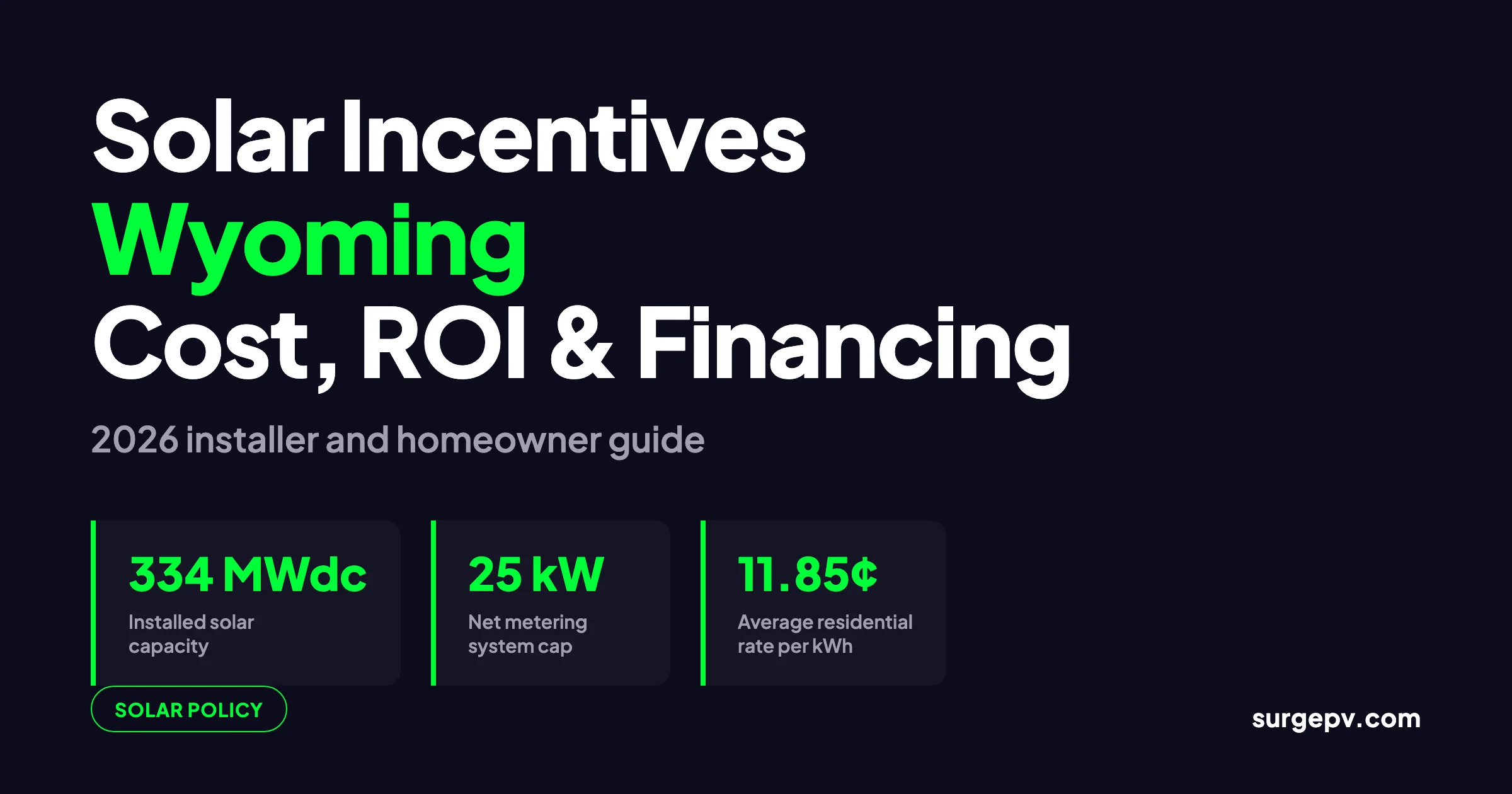
Wyoming had roughly 334 MWdc of installed solar capacity by early 2026, enough to power about 53,950 homes, according to SEIA. The state ranks 45th nationally and hosts only about 182 solar jobs across 11 companies. For anyone researching solar incentives Wyoming, that scale means a small installer market and a policy stack that is thinner than in leading solar states.
The incentive story changed on January 1, 2026. The federal Residential Clean Energy Credit under Section 25D expired for homeowner-owned systems. Wyoming homeowners can no longer subtract 30% of system cost from their federal taxes. Wyoming also has no state income tax, so there is no state tax credit to fall back on. The state also lacks a residential sales tax exemption and a property tax exemption for solar.
The real incentives that remain are net metering, federal commercial tax credits for eligible projects, USDA REAP for rural and agricultural customers, and a handful of local utility efficiency programs. This guide explains every active 2026 incentive, the real dollar value of each program, and how to model payback accurately. For the national context, see our solar incentives in USA 2026 guide. For payback modeling, SurgePV’s generation and financial tool can pull Wyoming utility rates and net metering rules into a single proposal.
Quick Answer
Wyoming solar incentives in 2026 are thin. The state offers net metering for systems up to 25 kW under Wyo. Stat. § 37-16-101, with monthly rollover and annual true-up at avoided cost. There is no state income tax credit, no state sales tax exemption for residential solar, and no property tax exemption. Commercial, lease, and PPA systems may still qualify for federal Section 48E.
In this guide:
- Latest 2026 status of every active Wyoming solar incentive
- How the federal ITC expiration changes the math
- Wyoming net metering rules and export value by utility
- Utility-specific rules for Rocky Mountain Power, Black Hills Energy, and rural co-ops
- Real installed costs and payback scenarios
- Financing options and who should lease versus buy
- Common mistakes and how to avoid them
Latest Updates: Wyoming Solar Incentives 2026
Wyoming did not lose its solar incentives in 2026. It never had a large state-level incentive stack to begin with. The biggest change is the federal residential credit expiration. The programs that remain are durable but modest. They also vary by utility, so the first question in any Wyoming solar proposal is: who is the electric utility?
Wyoming Solar Incentive Status — June 2026
| Incentive | Type | Status | Key Terms |
|---|---|---|---|
| Federal residential ITC | Tax credit | Expired | Section 25D ended December 31, 2025 |
| Federal Section 48E | Tax credit | Active for commercial/TPO | 30% through 2027 with safe-harbor deadlines |
| Wyoming state solar tax credit | State tax credit | Does not exist | Wyoming has no state income tax |
| Wyoming sales tax exemption | Tax exemption | Does not exist for residential solar | Repealed June 30, 2012 |
| Wyoming property tax exemption | Tax exemption | Does not exist | Solar may increase assessed value |
| Wyoming net metering | Export credit | Active | Required by law; systems up to 25 kW |
| Rocky Mountain Power net metering | Utility bill credit | Active | Schedule 135; year-end payout at avoided cost |
| Black Hills Energy net metering | Utility bill credit | Active | Systems up to 25 kW; co-op tariff terms vary |
| USDA REAP grants | Rural grant | Active | Up to 50% of eligible project cost for farms and rural small businesses |
| Utility efficiency rebates | Local rebate | Limited | Black Hills Energy, Lower Valley Energy, and others offer efficiency programs |
Key Changes Since 2025
Federal ITC expiration: The 30% residential Investment Tax Credit expired for systems placed in service after December 31, 2025, under the One Big Beautiful Bill Act. Homeowners who buy solar with cash or a loan in 2026 cannot claim it. Commercial, third-party-owned, and leased systems may still qualify under Section 48E, according to IRS guidance.
Net metering cap unchanged: Wyoming lawmakers considered raising the net metering cap from 25 kW to 200 kW in the 2025 legislative session, but the bill was amended and did not pass in a form that expanded the cap, according to Oil City News (2025). The 25 kW limit remains in effect for 2026.
No new state tax exemptions: Wyoming lawmakers have not enacted a statewide solar sales tax or property tax exemption as of mid-2026. Installers should not assume these benefits exist.
Key Takeaway
2026 is a utility-territory year in Wyoming. The statewide incentive stack is thin. Net metering is the most important ongoing benefit. The value of that benefit depends heavily on whether your utility credits exports at retail rate through the year or forces an annual avoided-cost true-up.
Why Wyoming’s Solar Market Matters in 2026
Wyoming is not the sunniest state, but it is not solar-poor either. The state receives roughly 5.0 to 6.0 average daily peak sun hours, with the southern and eastern plains sunnier than the mountain west, based on NREL solar resource data. Combine that with relatively low retail electricity rates, and solar economics become a matter of careful sizing rather than automatic jackpot.
Market Size and Targets
Wyoming had 334 MWdc of installed solar capacity and about 3,413 installations by early 2026, according to SEIA. Solar supplied roughly 1.14% of the state’s electricity. The industry supports about 182 jobs and $437 million in investment. SEIA projects Wyoming will add another 785 MW over the next five years.
Utility Rate Snapshot — Spring 2026
The average residential electricity price in Wyoming reached 11.85 cents per kWh in 2026, according to Electricity Cost Comparison (2026) citing EIA data. That is well below the national average of 18.05 cents. Low rates make solar payback longer because every kilowatt-hour offset by solar avoids a cheaper grid purchase. This is why careful system sizing and financing terms matter more in Wyoming than in high-rate states.
| Utility | Service Area | Approximate Residential Rate (2026) |
|---|---|---|
| Rocky Mountain Power | Most of Wyoming | 11–13¢/kWh |
| Black Hills Energy | Cheyenne and southeast Wyoming | 11–14¢/kWh |
| Rural electric cooperatives | Statewide rural areas | 11–14¢/kWh |
| Municipal utilities | Various towns | 10–13¢/kWh |
Wyoming Net Metering: How It Works
Net metering is the most important ongoing solar incentive in Wyoming. It is also the most misunderstood. Wyoming established statewide net metering in 2001 under Wyo. Stat. § 37-16-101 et seq., according to Wyoming Statutes.
The Legal Framework
Wyoming law requires electric utilities to offer net metering to eligible customer-generators. Key rules include:
- System size cap of 25 kW AC at a single site
- Eligible technologies include solar, wind, biomass, and hydropower
- Systems must be located on the customer-generator’s premises
- Systems must operate in parallel with the utility’s grid
- Systems must be intended primarily to offset the customer’s own electricity use
How Credits Are Calculated
Utilities measure the difference between electricity supplied by the utility and electricity generated by the customer over the billing period. Self-consumed solar is worth the full retail rate because it displaces a grid purchase. Exported solar is credited as kilowatt-hours on the next bill. At the beginning of each calendar year, any remaining unused credits are sold to the utility at the utility’s filed avoided-cost rate.
This is a critical distinction. A kilowatt-hour you use on-site saves you roughly 12 cents. A kilowatt-hour exported and eventually true-up’d may earn only 2 to 3 cents. That makes system sizing important. A right-sized system that matches daytime consumption will pay back faster than an oversized system that exports most of its production.
Utility-Specific Net Metering Notes
Rocky Mountain Power is Wyoming’s largest electric utility. Its Wyoming net metering tariff, Schedule 135, applies to inverter-based systems up to 25 kW. Customers receive a bidirectional meter. Excess generation is credited as full kilowatt-hours on the next bill. Unused credits at year-end are purchased at the Schedule 37 avoided-cost rate, which is roughly 3 cents per kWh, according to EnergySage (2026).
Black Hills Energy serves Cheyenne and parts of southeast Wyoming. The utility offers net metering for systems up to 25 kW under its co-op tariff terms. Customers should confirm the current export credit rate and interconnection requirements directly with Black Hills Energy.
Rural electric cooperatives and municipal utilities must offer net metering under Wyoming law, but specific tariff terms vary. Some co-ops offer favorable terms. Others impose fees, restrictions, or low compensation. For installers, co-op territories require a quick tariff review before proposal.
Utility-Specific Rules in Wyoming
Wyoming is split between one large investor-owned utility territory, Black Hills Energy in the southeast, and dozens of smaller cooperatives and municipal utilities. The territory determines the rate, the net metering tariff, and often the interconnection timeline.
Rocky Mountain Power
Rocky Mountain Power, a division of PacifiCorp, serves the majority of Wyoming electric customers. Its Wyoming Schedule 135 net metering tariff is the framework most residential solar customers will encounter. The utility also offers the Blue Sky renewable energy program, which lets customers support renewable energy development for a monthly fee, but this is not a solar installation rebate.
Black Hills Energy
Black Hills Energy provides electric service to Cheyenne and surrounding parts of Laramie County. The utility has pursued climate targets including a 40% reduction in electric utility emission intensity by 2030, according to the Greater Cheyenne MSA Priority Climate Action Plan (2024). Black Hills Energy also offers residential and commercial rebates for efficiency measures such as lighting, air conditioning, and electric vehicle charging stations, but these are not solar-specific rebates.
Rural Electric Cooperatives and Municipal Utilities
Wyoming has a large number of rural electric cooperatives and municipal utilities. Net metering is required by state law, but policies range from favorable to restrictive. Some co-ops offer reasonable export compensation. Others impose standby charges, capacity fees, or low buyback rates. For installers, co-op and muni territories require a quick tariff review before proposal.
Federal Solar Tax Credit Status in Wyoming for 2026
The biggest change for Wyoming homeowners in 2026 is federal. The 30% Residential Clean Energy Credit under Internal Revenue Code Section 25D expired for homeowner-owned systems placed in service after December 31, 2025. That means a Wyoming homeowner who buys a system with cash or a loan in 2026 should not expect a federal residential tax credit.
Commercial, lease, and power purchase agreement systems may still qualify under Section 48E. The safe-harbor rules are tight. Eligible projects generally must begin construction by July 4, 2026, or be placed in service by December 31, 2027, to claim the 30% Investment Tax Credit. This is why some third-party ownership products and installer financing partnerships still advertise a benefit in 2026: the owner of the system is a commercial entity that can claim Section 48E, and part of that benefit is passed through as a lower monthly payment.
For homeowners who want the direct tax benefit, the window closed. For homeowners who want solar anyway, the math shifts to utility-rate savings, net metering value, and financing that does not depend on tax equity.
Cost, ROI, and Payback Scenarios
The federal credit expiration made financing structure and utility territory the most important levers in a Wyoming solar proposal. The same system can look very different depending on whether it is purchased with cash, financed with a loan, or leased.
Hypothetical 8 kW System in Cheyenne
Consider a 2,200-square-foot home in Cheyenne served by Black Hills Energy. The household uses 10,800 kWh per year and pays an average rate of 12.5¢/kWh. An 8 kW system is priced at $3.15/W, for a gross cost of $25,200.
| Cost Component | Amount |
|---|---|
| Gross system cost | $25,200 |
| State sales tax, 4% | $1,008 |
| Total upfront cost | $26,208 |
| Estimated first-year production | 11,200 kWh |
| First-year utility savings | $1,400 |
| Simple payback | 18.7 years |
| 25-year savings (undiscounted) | ~$35,000 |
This is a hypothetical example for illustration. Actual production depends on roof orientation, shading, and equipment. The payback is longer than in high-rate states because Wyoming electricity is cheap.
Scenario Comparison by Utility Territory
| Scenario | Gross Cost | Incentives | Net Cost | Est. Payback |
|---|---|---|---|---|
| Rocky Mountain Power customer, cash purchase, 8 kW south-facing | $25,200 | Net metering only | $25,200 plus sales tax | 13–17 years |
| Black Hills Energy customer, cash purchase, 8 kW | $25,200 | Net metering only | $25,200 plus sales tax | 14–18 years |
| Rural co-op customer, cash purchase, 8 kW | $25,200 | Net metering only | $25,200 plus sales tax | 14–19 years |
| Lease/PPA, any territory | $0 | Passed to lessor | Monthly payment | Immediate savings, lower lifetime total |
The Rocky Mountain Power customer may see slightly shorter payback because of the transparent Schedule 135 net metering terms. The Black Hills Energy and rural co-op customers rely entirely on bill savings and net metering. The low Wyoming retail rate makes all scenarios slower than in states like California or Colorado.
Financing Impact on ROI
A cash purchase produces the highest lifetime savings but requires the most upfront capital. A solar loan spreads the cost over 10 to 25 years. In 2026, with no federal tax credit to reduce loan principal, loan payments can be close to or even exceed monthly utility savings in the early years. A lease or PPA requires no upfront cost and may offer immediate monthly savings, but the homeowner does not own the system or receive net metering benefits directly.
Financing Options for Wyoming Solar in 2026
Cash Purchase
Cash is the cleanest option. The homeowner owns the system, captures all utility savings, and benefits from net metering. With no federal residential tax credit, the payback is longer than it was in 2024 or 2025, but lifetime savings are still positive for most homes with good sun and moderate-to-high usage.
Solar Loan
Solar loans are widely available through installers, credit unions, and national lenders. In 2026, the absence of the federal tax credit means there is no large lump sum to pay down the loan in year one. Borrowers should compare total interest cost against expected savings. A loan with a low teaser rate and a balloon payment can turn solar into a net negative if refinancing is required.
Lease and PPA
Leases and power purchase agreements remain available. The system owner, usually a financing company, claims any available commercial tax benefits and passes part of the savings through as a lower monthly payment. Homeowners should compare the lease rate to their current and projected utility rates. They should also understand who pays for inverter replacements, roof repairs, and system removal at the end of the term.
USDA REAP
The USDA Rural Energy for America Program offers grants and guaranteed loans to agricultural producers and rural small businesses. Grants can cover up to 50% of eligible project costs, and loan guarantees can cover up to 75%. Agricultural producers can apply regardless of location. Rural small businesses must be in an eligible area with a population under 50,000. REAP is one of the best financing tools for Wyoming farms and ranches.
Commercial Tax Benefits
Wyoming businesses can still use Section 48E for solar projects. Combined with MACRS depreciation, commercial projects can reach effective costs 40% to 60% below sticker price. Wyoming also does not impose a corporate income tax, which improves after-tax returns for businesses.
Commercial, Agricultural, and Rural Considerations
Commercial and agricultural customers in Wyoming have additional tools. The Section 48E credit can cover 30% of project cost for projects that meet the construction or placed-in-service deadlines. Businesses can also use MACRS depreciation, which front-loads tax deductions over five years.
Rural small businesses and agricultural operations may qualify for USDA REAP grants and loan guarantees. REAP can cover up to 50% of project cost, but applications must be submitted before construction begins. This makes early planning critical.
For commercial project modeling, SurgePV’s solar design software can size arrays, run shade analysis, and export production and financial reports. The solar proposals feature can package the incentive stack into a client-ready document.
Common Mistakes and How to Avoid Them
Wyoming’s thin incentive stack makes errors more costly. The most expensive mistakes are usually assumptions, paperwork, or sizing problems.
Assuming Wyoming Has a State Solar Tax Credit
Many national solar sites still list Wyoming as having a state tax credit or sales tax exemption. Those claims are outdated or incorrect. Wyoming has no state income tax, no statewide income tax credit, and no current sales tax exemption for residential solar equipment.
Oversizing Beyond Consumption
Because Wyoming utilities true up unused annual credits at the avoided-cost rate, an oversized system leaves value on the table. The safer design rule is to size for 90–100% of annual consumption and treat exports as a bonus.
Ignoring the 25 kW Net Metering Cap
Wyoming’s net metering law limits qualifying systems to 25 kW. Larger systems must operate under different tariff structures that may offer lower compensation. Commercial customers should verify whether their proposed array exceeds the cap before signing a contract.
Ignoring Property Tax Impact
Unlike many states, Wyoming does not shield the added value of a solar system from property taxation. In some counties, the system may increase assessed value and annual property taxes. Installers should mention this in proposals.
Missing the Annual True-Up Date
Wyoming net metering credits roll forward month to month, but unused credits are purchased at avoided cost at the beginning of each calendar year. Customers who do not understand this true-up may be surprised by the low payout for surplus generation.
Frequently Asked Questions
What solar incentives are available in Wyoming in 2026?
Wyoming offers net metering for customer-owned solar systems up to 25 kW under Wyo. Stat. § 37-16-101. Excess generation is credited month to month and any remaining annual credits are purchased by the utility at avoided cost. There is no state solar tax credit, no state sales tax exemption for residential solar equipment, and no property tax exemption. Federal Section 48E may still apply to commercial, lease, or PPA systems.
Does Wyoming have a state solar tax credit?
No. Wyoming does not levy a state income tax, so it cannot offer a state income tax credit for solar. The state also does not offer a statewide solar rebate or performance-based incentive for residential systems.
Is the federal solar tax credit still available in Wyoming in 2026?
The 30% federal Residential Clean Energy Credit under Internal Revenue Code Section 25D expired for homeowner-owned systems placed in service after December 31, 2025. Commercial projects and third-party-owned residential systems, including leases and power purchase agreements, may still qualify under Section 48E if construction begins by July 4, 2026, or the system is placed in service by December 31, 2027.
Does Wyoming have net metering for solar?
Yes. Wyoming law requires electric utilities, including investor-owned utilities and electric cooperatives, to offer net metering for eligible customer-generators with systems up to 25 kW. Excess kilowatt-hours are credited to the next month’s bill. At the beginning of each calendar year, any remaining unused credits are sold to the utility at the utility’s filed avoided-cost rate.
How does Rocky Mountain Power net metering work in Wyoming?
Rocky Mountain Power Wyoming customers with inverter-based systems of 25 kW or less qualify for net metering under Schedule 135. Exported energy is credited as full kilowatt-hours on the next bill. Unused credits at year-end are purchased at the Schedule 37 avoided-cost rate, which is roughly 3 cents per kWh.
Does Wyoming have a sales tax exemption for solar equipment?
No. Wyoming previously allowed a sales tax exemption for renewable energy equipment under Wyo. Stat. § 39-15-105(a)(viii)(N), but the residential exemption for systems of 25 kW or less was repealed effective June 30, 2012. Wyoming’s state sales tax rate is 4%, and local taxes can add up to 2% or more.
Will solar increase my property taxes in Wyoming?
Wyoming does not have a statewide property tax exemption for residential solar energy systems. The added value of a solar installation may increase assessed value and property taxes, depending on the county assessor’s practice. Homeowners should factor this into long-term savings models.
Can I lease solar in Wyoming and still get incentives?
Leases and power purchase agreements do not pass net metering benefits directly to the homeowner. The third-party owner keeps the incentives and may claim commercial tax benefits such as Section 48E. Homeowners who want the full value of net metering and any available incentives should purchase the system with cash or a loan.
What is the typical solar payback period in Wyoming in 2026?
Payback periods for well-designed residential solar systems in Wyoming typically range from 12 to 17 years in 2026 without the federal residential tax credit. Payback is shorter for homes with high electricity usage, good sun exposure, and retail-rate offset. Customers who export heavily see weaker returns because annual true-up pays only the avoided-cost rate.
Are solar batteries incentivized in Wyoming in 2026?
No statewide battery rebate or tax credit exists in Wyoming in 2026. Batteries paired with solar may still qualify for federal commercial incentives if the system is third-party owned or meets Section 48E deadlines. Standalone residential batteries do not receive a Wyoming state incentive.
Bottom Line
Wyoming solar in 2026 is a viable but patient investment. The economics do not rely on a generous incentive stack. They rely on low system costs, careful sizing, and the right financing. Net metering is the main state-side benefit, but the annual avoided-cost true-up means oversizing hurts returns.
Three actions will put you ahead:
- Confirm your utility territory first, because net metering value varies by service area.
- Size the system to actual consumption, not maximum roof area, because excess annual credits are purchased at avoided-cost rates.
- Compare cash, loan, and lease options honestly, because the federal residential tax credit no longer reduces upfront cost for homeowner-owned systems.
For installers, accuracy is the new competitive advantage. SurgePV’s generation and financial tool lets you pull Wyoming utility rates, net metering assumptions, and incentive values into one proposal. Book a demo to see how it works, or check pricing for your team.
Where this fits
This article is part of SurgePV's Solar Incentives & Policy hub, which works through the topic from first principles to the decisions a project team actually has to make.
