

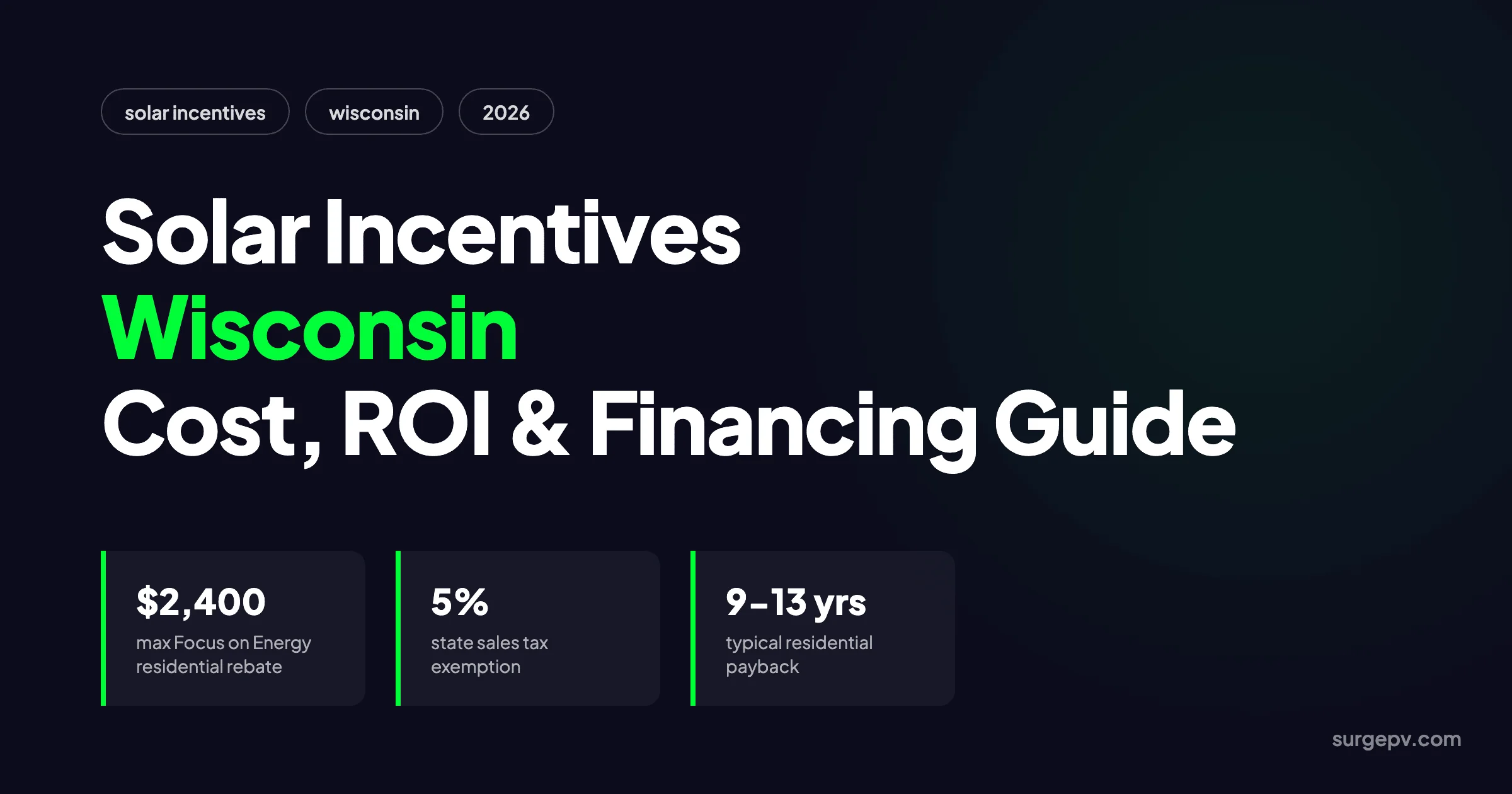
Wisconsin ranks 18th nationally in total installed solar capacity with roughly 3.2 GW online, according to SEIA’s 2025 Year in Review. Yet fewer than 1% of Wisconsin homes have rooftop solar. The gap exists because the state’s incentive stack is smaller than in leading solar markets and because a patchwork of 81 municipal utilities and several investor-owned utilities creates inconsistent net metering rules.
For installers, EPCs, and homeowners, the message is clear: Wisconsin solar works, but the math is local. This guide covers every active 2026 incentive, the real dollar value of each, and how payback changes by utility territory. For the broader U.S. picture, see our solar incentives in USA 2026 guide. For payback comparisons across states, see state solar incentives in the US.
If you are modeling Wisconsin projects, a solar design platform can capture utility rates, net metering rules, and Focus on Energy rebates automatically. That cuts proposal time by hours. Build the system, run the financials, and generate solar proposals in minutes. Check pricing or book a demo to see how SurgePV handles Wisconsin.
Quick Answer
Wisconsin’s 2026 solar incentives include Focus on Energy rebates of $600 per kW up to $2,400 per residential system, a 100% state sales tax exemption, a 100% property tax exemption, utility-specific net metering, and Milwaukee Shines low-interest loans. The federal residential tax credit expired in 2025.
In this guide:
- Latest 2026 status of every active Wisconsin solar incentive
- How the federal ITC expiration changes the math
- Focus on Energy rebates for residential, commercial, and agricultural systems
- Wisconsin sales tax and property tax exemptions
- Net metering rules by utility type
- Milwaukee Shines and local financing programs
- Cost, ROI, and payback scenarios by utility territory
- Common mistakes and how to avoid them
Wisconsin Solar Incentives at a Glance — 2026
Wisconsin does not have a large state rebate or tax credit. The value comes from stacking a modest upfront rebate, two tax exemptions, and utility-specific net metering. Utility territory matters more here than in most states.
| Incentive | Type | 2026 Status | Typical Value |
|---|---|---|---|
| Federal residential ITC | Tax credit | Expired | $0 for cash or loan residential purchases |
| Federal Section 48E | Commercial tax credit | Active, deadlines apply | 30% for eligible commercial, lease, or PPA systems |
| Focus on Energy residential rebate | State rebate | Active | $600/kW, max $2,400 per system |
| Focus on Energy commercial rebate | State rebate | Active | $600/kW up to $2,400, then $50/kW, max $25,000 |
| Focus on Energy agricultural bonus | State rebate | Active | Additional $10,000 for agricultural producers |
| Sales tax exemption | Tax exemption | Active | 100% of state sales tax waived |
| Property tax exemption | Tax exemption | Active | Added system value excluded from assessment |
| Net metering | Bill credit | Utility-specific | Varies by utility, often 120% of usage or 20 kW cap |
| Milwaukee Shines loan | Financing | Active | Up to $25,000 at Prime + 1.5% to 2.25% |
The state had about 3.2 GWdc of installed solar capacity by early 2026 and ranked 18th nationally, according to Solar Insure’s Wisconsin solar incentive overview (2026). Most of that capacity is utility-scale solar built since 2020. The residential market remains small but is growing as electricity rates rise.
Key Takeaway
Wisconsin solar works in 2026, but the math is driven by the Focus on Energy rebate, sales tax exemption, and net metering. There is no state tax credit, and the federal residential ITC is gone. Accurate utility-specific modeling separates profitable projects from marginal ones.
The Federal ITC Is Gone for Homeowners. What Still Works?
The 30% federal Residential Clean Energy Credit under Internal Revenue Code Section 25D expired on December 31, 2025. Homeowners who buy solar with cash or a loan in 2026 cannot claim it. This is the single largest change in Wisconsin’s solar math.
Commercial, third-party-owned, and leased systems may still access the federal Investment Tax Credit under Section 48E. The usual safe-harbor rules apply: construction must begin before July 4, 2026, or the system must be placed in service by December 31, 2027. Lease and power-purchase-agreement providers can pass a portion of that credit through as lower monthly payments. That makes third-party ownership more attractive in Wisconsin now than it was when the residential ITC was available.
For cash and loan buyers, the federal credit is gone. The rest of the stack must carry the project. That means every installer proposal in Wisconsin should lead with the Focus on Energy rebate, net metering, and sales tax exemption. Do not lead with a federal tax credit that no longer exists.
Focus on Energy Solar Rebates
Focus on Energy is Wisconsin’s statewide energy efficiency and renewable energy program. It is funded by participating utilities and administered by a third-party contractor. For solar, it is the most widely available direct incentive in the state.
How the 2026 Residential Rebate Works
Starting January 1, 2026, the residential solar rebate increased significantly, according to Clean Wisconsin (2026).
- Rebate amount: $600 per kW of installed solar capacity.
- Maximum rebate: $2,400 per system.
- Eligibility: Available to all income levels for customers of participating utilities.
- Timing: Applications must be submitted before installation begins.
- Restriction: Customers taking the federal tax credit cannot participate.
A typical 7 kW residential system qualifies for the full $2,400 rebate. At an average installed price of $3.25 per watt, that is an effective 10.5% upfront discount, according to Clean Wisconsin’s rebate analysis (2026).
Commercial and Agricultural Rebates
Non-residential rebates changed in 2026 as well.
- Commercial systems: $600 per kW up to $2,400, then $50 per kW for additional capacity.
- Maximum commercial rebate: $25,000 per system.
- Agricultural producers: Additional $10,000 bonus.
A 100 kW commercial array would receive $2,400 on the first 4 kW and $4,800 on the remaining 96 kW at $50 per kW. The total Focus on Energy rebate would be $7,200. An agricultural producer could add another $10,000.
Why Focus on Energy Changes the Payback Math
The rebate is not large enough to carry a project alone, but it is predictable. Unlike SREC markets, the rebate is a fixed dollar amount. That makes it easy to model in a proposal. For residential systems, it typically shortens the payback period by one to two years.
Sales Tax and Property Tax Exemptions
Wisconsin offers two permanent tax exemptions that reduce the lifetime cost of solar. Both apply automatically if the system meets basic qualifications.
Sales Tax Exemption
Solar energy systems are exempt from Wisconsin’s 5% state sales tax, according to All Energy Solar (2026).
- The system must generate at least 200 watts of AC power per day or 600 BTUs per day.
- The exemption applies to equipment and installation labor.
- Standalone battery storage may not qualify unless sold as part of the primary solar system.
On a typical $25,000 installation, the sales tax exemption saves $1,250 upfront.
Property Tax Exemption
Wisconsin law excludes the value of a qualifying solar energy system from a homeowner’s property tax assessment. The exemption took effect on January 1, 2014, according to Solar Insure (2026).
- The added home value from solar cannot be taxed.
- Studies cited by industry sources estimate solar adds 5-10% to home value.
- The exemption lasts for the life of the system.
This is meaningful in a state where home values have risen. A $300,000 home with a 5% solar premium would add $15,000 in value without adding to the property tax bill.
Net Metering in Wisconsin
Net metering is the most financially significant ongoing solar benefit for most Wisconsin homeowners. It is also the most inconsistent because Wisconsin has no single statewide net metering law. Each utility sets its own rules.
How Net Metering Works
Under a typical net metering arrangement, exported solar kilowatt-hours earn a credit on the customer’s bill. The customer pays only the net difference between imports and exports. Credits may roll over month to month. At the end of an annual period, any remaining surplus credits are often settled at a lower avoided-cost or wholesale rate.
The exact rules depend on the utility:
- Investor-owned utilities such as We Energies, Madison Gas & Electric, Wisconsin Public Service, and Xcel Energy each have their own tariffs.
- Municipal utilities and electric cooperatives set their own policies.
- Some utilities use net billing rather than true net metering, paying a lower buyback rate for exports.
Common Residential Limits
Many Wisconsin utilities apply one or both of these limits:
- System size may not exceed 120% of the customer’s average annual electricity usage.
- Residential systems may be capped at 20 kW.
These limits mean installers must gather 12 months of usage data before finalizing a design. A system sized without this data risks failing interconnection review.
Design Implication
Surplus credits are often settled at a lower rate. The conservative design rule is to size for roughly 90-100% of annual consumption. Treat exports as a bonus, not a primary revenue source.
A generation and financial tool can test system size against actual hourly usage and the customer’s actual retail rate. It can also model a lower future export rate to show the range of possible outcomes.
Milwaukee Shines and Local Programs
Beyond statewide programs, some Wisconsin communities offer targeted solar support. Milwaukee Shines is the best-known example.
Milwaukee Shines Solar Program
Milwaukee Shines promotes solar adoption in the city through group-buy programs and low-interest loans, according to Solar Insure (2026).
- Loan amount: Up to $25,000 per homeowner.
- Loan term: Up to 15 years.
- Interest rate: Prime plus 1.5% to 2.25%.
- Eligibility: Homeowners within Milwaukee city limits.
- Funding: The program had up to $2 million in funding.
PACE financing is also available for businesses in Milwaukee.
Focus on Energy Design Assistance
Buildings enrolled in Focus on Energy’s Energy Design Assistance or Energy Design Review programs can qualify for a $2,500 Solar Ready Buildings incentive. This is most relevant for new construction or major renovation projects that plan for future solar.
Cost, ROI, and Payback Scenarios
The following examples use illustrative 2026 costs and incentive values. Actual figures depend on location, utility, roof conditions, installer quote, and whether the homeowner qualifies for local programs. The scenarios assume a 25-year system life, 3% annual electricity escalation, and a Focus on Energy rebate of $2,400 for residential systems.
Scenario 1 — 7 kW Residential, We Energies Territory, Milwaukee
| Item | Amount |
|---|---|
| Gross installed cost ($3.25/W) | $22,750 |
| Sales tax exemption savings (5%) | -$1,138 |
| Focus on Energy rebate | -$2,400 |
| Net cost | $19,212 |
| Annual bill savings (~9.5 MWh at 18¢/kWh) | $1,710 |
| Payback | 11.2 years |
Scenario 2 — 7 kW Residential, Madison Gas & Electric Territory
| Item | Amount |
|---|---|
| Gross installed cost ($3.20/W) | $22,400 |
| Sales tax exemption savings (5%) | -$1,120 |
| Focus on Energy rebate | -$2,400 |
| Net cost | $18,880 |
| Annual bill savings (~9.5 MWh at 17¢/kWh) | $1,615 |
| Payback | 11.7 years |
Scenario 3 — 100 kW Commercial Rooftop, Xcel Energy Territory
| Item | Amount |
|---|---|
| Gross installed cost ($2.50/W) | $250,000 |
| Sales tax exemption savings (5%) | -$12,500 |
| Focus on Energy commercial rebate | -$7,200 |
| Section 48E tax credit (if eligible) | -$75,000 |
| Net cost | $155,300 |
| Annual bill savings and demand reduction | $28,000 |
| Payback | 5.5 years |
Commercial projects can still access the federal Section 48E credit. For larger systems, load profiling and shadow analysis matter more than simple bill offset.
Financing Options in Wisconsin
Most Wisconsin homeowners finance solar with one of four structures. Each has a different impact on incentive ownership and long-term value.
Cash Purchase
A cash purchase preserves full ownership of the Focus on Energy rebate, sales tax exemption, and net metering credits. It also delivers the highest lifetime savings if the homeowner can afford the upfront cost. The main downside is the 9- to 13-year payback without a federal tax credit.
Solar Loan
A solar loan also preserves incentive ownership. The monthly loan payment is often close to the old electric bill, but the homeowner keeps the long-term value. The key is to compare the loan interest rate against the effective return from bill savings and the Focus on Energy rebate.
Lease or Power Purchase Agreement
A lease or PPA transfers system ownership to a third party. The provider may claim the Section 48E credit and pass part of the savings through as a lower monthly rate. The trade-off is that the homeowner usually does not own the Focus on Energy rebate or the SRECs. Always check the contract to see who keeps the incentives.
Milwaukee Shines Loan
For Milwaukee homeowners, the Milwaukee Shines loan offers a lower-interest option than many solar loans. It can be combined with cash or a separate solar loan. The Prime-based rate changes over time, so homeowners should model rising payments.
Common Mistakes and Misconceptions
Wisconsin’s thinner incentive stack means mistakes cost more.
Quoting the Expired Federal ITC
The most expensive error is telling a homeowner they can claim the 30% federal tax credit on a cash or loan purchase in 2026. Section 25D ended on December 31, 2025. Only commercial, lease, or PPA structures can still access federal credits.
Assuming All Utilities Offer the Same Net Metering
Wisconsin has 81 municipal utilities and several investor-owned utilities. Each can set its own net metering rules. Do not assume that a design that works for We Energies will pass interconnection for a municipal utility 30 miles away.
Oversizing for Export
Many utilities cap net-metered systems at 120% of annual usage or 20 kW. Annual surplus credits are often settled at a lower rate. A system sized to 130% of annual consumption may look good in a simple production estimate but leaves value on the table. Size for what the household uses.
Ignoring Utility Territory
A 7 kW system in We Energies territory can have a materially different payback than the same system in a municipal utility territory. The retail rate, fixed charges, and net metering rules all differ. Always model the customer’s actual utility and rate schedule.
Missing the Focus on Energy Application Window
The Focus on Energy rebate requires an application before installation begins. If the installer starts work without pre-approval, the homeowner may lose the rebate entirely.
Treating the Sales Tax Exemption as Automatic for Batteries
Standalone battery storage may not qualify for the sales tax exemption. If a homeowner adds a battery later, they may owe sales tax on that portion. Bundle the battery with the original solar system if the exemption matters.
Conclusion
Wisconsin’s solar incentive stack in 2026 is modest but functional. The federal residential tax credit is gone. The value now comes from the Focus on Energy rebate, the 100% state sales tax exemption, the 100% property tax exemption, and utility-specific net metering. Milwaukee Shines adds financing support for city residents.
For solar professionals, the competitive edge is the ability to model each utility territory correctly. The proposal that wins in Wisconsin is the one that shows the homeowner exactly how the Focus on Energy rebate, net metering, and local rates interact over 25 years.
Tools like SurgePV’s solar design software and generation and financial tool let you build Wisconsin-specific proposals. They reflect real utility rates, the Focus on Energy rebate, and net metering assumptions. For installers scaling in the state, our guide for solar installers covers proposal automation and compliance workflows.
Three actions to take now:
- Submit the Focus on Energy application before installation — pre-approval is required.
- Confirm utility-specific net metering rules before quoting — rules vary across Wisconsin’s 81 municipal utilities and investor-owned utilities.
- Size for self-consumption — exported energy is worth less at annual settlement and may face capacity caps.
For the national picture, see our solar incentives in USA 2026 guide and state solar incentives in the US overview, both linked earlier in this guide.
Frequently Asked Questions
What solar incentives are available in Wisconsin in 2026?
Wisconsin’s 2026 solar incentives include Focus on Energy rebates of $600 per kW up to $2,400 per residential system, a 100% state sales tax exemption, a 100% property tax exemption, utility-specific net metering programs, and Milwaukee Shines low-interest loans for city residents. Commercial and agricultural projects can access larger Focus on Energy rebates. The federal residential tax credit expired in 2025.
Does Wisconsin have a state solar tax credit in 2026?
No. Wisconsin does not offer a state income tax credit for residential solar in 2026. The main financial incentives are the Focus on Energy rebate, sales tax exemption, property tax exemption, and utility net metering. Local programs such as Milwaukee Shines provide additional financing support.
Is the federal solar tax credit still available in Wisconsin in 2026?
No. The 30% federal Residential Clean Energy Credit under Internal Revenue Code Section 25D expired for homeowner-owned systems placed in service after December 31, 2025. Commercial, third-party-owned, and leased systems may still qualify under Section 48E if construction began before July 4, 2026 or the system is placed in service by December 31, 2027.
How much is the Focus on Energy solar rebate in 2026?
The Focus on Energy residential solar rebate is $600 per kW up to a maximum of $2,400 per system starting January 1, 2026. Commercial systems receive $600 per kW up to $2,400 and then $50 per kW for additional capacity up to $25,000 total. Agricultural producers may qualify for an additional $10,000. Applications must be submitted before installation begins.
How does net metering work in Wisconsin in 2026?
Net metering in Wisconsin is utility-specific rather than governed by a single statewide rule. Most investor-owned and municipal utilities offer some form of net metering, but credit rates, size limits, and annual reconciliation rules vary. Common residential limits include systems sized to 120% of annual usage or a maximum of 20 kW. Customers should confirm the exact rules with their utility before designing a system.
Does Wisconsin have a sales tax exemption for solar panels?
Yes. Wisconsin offers a 100% state sales tax exemption for solar energy systems. The system must be capable of generating at least 200 watts of AC power or 600 BTUs per day. Standalone battery storage may not qualify unless it is sold as part of the primary solar system. On a typical $25,000 installation, the exemption saves approximately $1,250.
Does Wisconsin have a property tax exemption for solar panels?
Yes. Wisconsin law exempts solar energy systems from property tax assessments. The added value of a solar installation cannot increase property taxes. This exemption has been in effect since January 1, 2014. It applies for the life of the system.
What is the Milwaukee Shines Solar Program?
Milwaukee Shines is a city program that supports solar adoption in Milwaukee through group-buy programs and low-interest loans. The loan program offers up to $25,000 for homeowners within Milwaukee city limits, with terms up to 15 years and interest rates set at Prime plus 1.5% to 2.25%. The program had up to $2 million in funding.
What is the typical solar payback period in Wisconsin in 2026?
Payback periods for well-designed residential solar systems in Wisconsin typically range from 9 to 13 years in 2026 without the federal residential tax credit. The exact result depends on utility territory, system size, roof conditions, shading, and whether the homeowner qualifies for the Focus on Energy rebate or Milwaukee Shines financing. Commercial projects that qualify for Section 48E can pay back in 6 to 9 years.
What is the most common mistake when sizing a solar system in Wisconsin?
The most common mistake is oversizing for export. Many Wisconsin utilities limit net-metered systems to 120% of annual consumption or cap residential systems at 20 kW. Annual surplus credits are often settled at a lower avoided-cost or wholesale rate. The safer design rule is to size for roughly 90-100% of annual consumption and treat exports as a bonus.
Where this fits
This article is part of SurgePV's Solar Incentives & Policy hub, which works through the topic from first principles to the decisions a project team actually has to make.
