

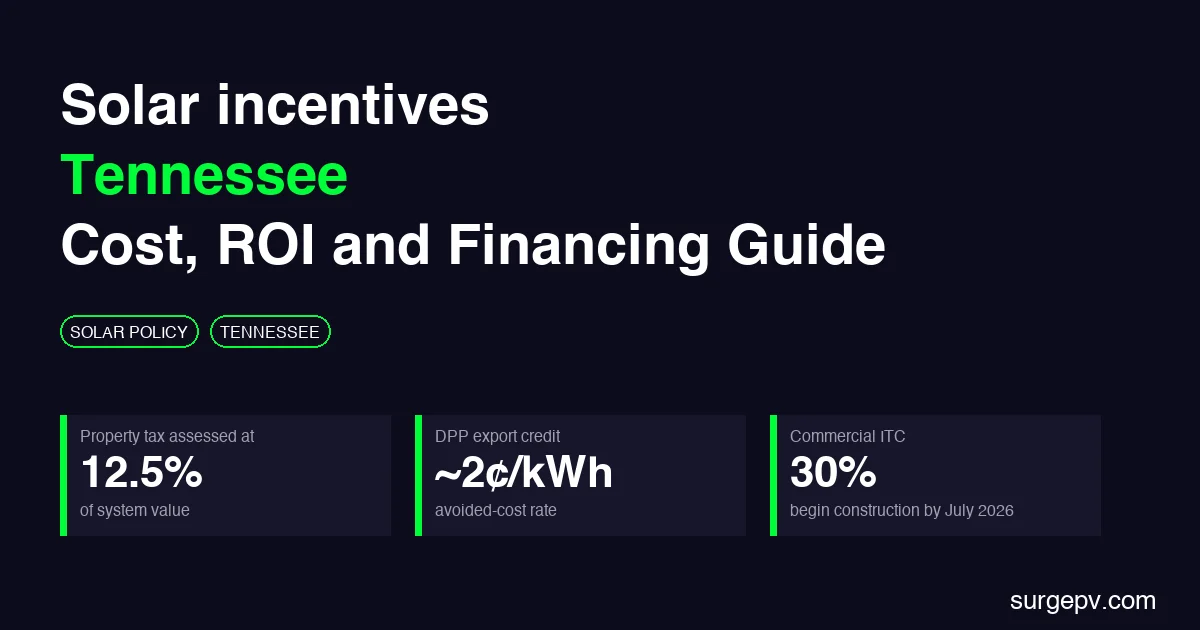
Tennessee homeowners paid an average residential electricity rate of 14.94 cents per kWh in April 2026, up from 13.91 cents a year earlier, according to the U.S. Energy Information Administration (2026). That is still below the national average of 18.83 cents, but the 7.4% year-over-year increase is the real story. Tennessee households also use more power than most, averaging about 1,457 kWh per month compared with the U.S. average of 903 kWh, based on Memphis-area utility analysis (2025). More usage plus rising rates means solar incentives Tennessee homeowners can use in 2026 still matter, even though the state does not offer the generous rebate stack found in California or New York.
This guide covers every active Tennessee solar incentive in 2026, how the lack of net metering changes ROI, and how to stack the programs that actually exist. For installers and EPCs, the winning proposal is the one that models the customer’s actual utility, self-consumption pattern, and financing correctly. SurgePV’s solar design software and generation and financial tool let you do exactly that. You can build accurate, territory-specific proposals, generate professional solar proposals in minutes, then check pricing or book a demo. For the national picture, see our solar incentives in USA 2026 guide and state solar incentives in the US overview.
Quick Answer
Tennessee’s 2026 solar incentives include the Green Energy Property Tax Assessment (12.5% of system value taxed), a certified Green Energy Production Facility sales and use tax exemption, TVA’s Dispersed Power Production program for excess generation, USDA REAP grants and loans for rural businesses and farms, and the federal commercial ITC with begin-construction deadlines. There is no statewide net metering, no state solar tax credit, and no residential sales tax exemption.
In this guide:
- Why Tennessee solar math is different from net-metering states
- Federal solar tax credit status for homeowners and businesses in 2026
- Tennessee state tax exemptions and who qualifies
- TVA Dispersed Power Production and why export credits are weak
- Financing options including loans, leases, REAP, and C-PACER
- Real 2026 cost and payback examples for homes and businesses
- Common mistakes and how to avoid them
Tennessee Solar Incentives at a Glance — 2026
Tennessee is not a high-incentive solar state. The economics work because of sunny summers, rising usage, and above-average electricity consumption, not because of big rebates. The table below summarizes the main programs active in 2026.
| Incentive | Type | 2026 Status | Typical Value / Notes |
|---|---|---|---|
| Federal residential ITC | Tax credit | Expired | $0 for cash or loan residential purchases placed in service after 2025 |
| Federal Section 48E ITC | Commercial tax credit | Active, deadlines apply | 30% for eligible commercial, lease, or PPA systems |
| Green Energy Property Tax Assessment | Property tax assessment cap | Active | Assessed at 12.5% of installed cost |
| Certified Green Energy Production Facility sales tax exemption | Sales tax exemption | Active for qualifying commercial | 100% of state and local sales tax on eligible equipment |
| TVA Dispersed Power Production | Export buyback | Active | ~2 cents/kWh on 5-year contract |
| TVA Green Power Providers | Production incentive | Ended in 2019 | No longer open to new applicants |
| Tennessee Solar Easement Law | Legal protection | Active | Voluntary written agreement to protect sunlight access |
| USDA REAP grants | Rural grant | Active | Up to 50% of eligible project cost for farms and rural small businesses |
| USDA REAP guaranteed loans | Rural loan | Active | Up to 75% of eligible project cost |
| C-PACER (Memphis) | Commercial financing | Active | $500K–$5MM for City of Memphis commercial properties |
| Pathway Lending EELP | Loan | Active | $20K–$5MM at below-market rates for TN businesses and nonprofits |
| MACRS depreciation | Tax deduction | Active | 5-year schedule for commercial solar; bonus depreciation may apply |
Tennessee receives 5.0 to 5.9 peak sun hours per day in summer and 3.0 to 3.2 in winter, according to NREL data cited by WattBuild (2025). That solar resource is enough to make solar work, but the value of every kilowatt-hour depends on whether it is consumed on-site or exported.
Key Takeaway
Tennessee solar works in 2026, but the math is driven by self-consumption, rising electricity rates, and the 12.5% property tax assessment cap. Export-heavy designs perform poorly because TVA pays only avoided-cost rates for excess generation.
Why Tennessee Solar Math Depends on Self-Consumption, Not Export
Most solar-friendly states have mandatory net metering. That means excess solar sent to the grid earns a credit at or near the full retail rate. Tennessee does not work that way.
Nearly all Tennessee electric utilities buy power from the Tennessee Valley Authority (TVA), a federal corporation that sets wholesale rates and interconnection terms for its local power companies. TVA does not offer retail-rate net metering. Instead, customer-owned generators can participate in the Dispersed Power Production (DPP) program. Under DPP, TVA buys excess generation at TVA’s monthly avoided cost, which is usually around 2 cents per kWh, according to Memphis-area installer analysis (2025). The typical Tennessee homeowner pays 12 to 15 cents per kWh for retail electricity. That gap makes export a losing trade.
The practical result is simple. A kilowatt-hour you use directly from your panels offsets a full retail-rate kWh. A kilowatt-hour you export earns only a wholesale credit. The difference can cut your effective savings by 80% or more on exported power.
This is why battery storage and right-sizing matter in Tennessee. A battery stores daytime surplus for evening use, keeping more solar value at the full retail rate. A system sized too large produces excess that earns almost nothing. The safer design rule is to size for roughly 90-100% of your daytime usage and treat any export as a small bonus.
SurgePV’s shadow analysis and generation and financial tool help installers model this correctly. You can test different system sizes, self-consumption rates, and battery configurations before quoting the customer.
Federal Solar Tax Credit: What Changed in 2026
The biggest single change in Tennessee solar math is federal. The 30% Residential Clean Energy Credit under Internal Revenue Code Section 25D expired for homeowner-owned systems placed in service after December 31, 2025, under the One Big Beautiful Bill Act. Homeowners who buy solar with cash or a loan in 2026 cannot claim it.
This is the same federal policy shift that changed the economics in Michigan, Texas, and every other state. For Tennessee, where state incentives are already thin, the loss of the residential credit is especially painful.
Commercial, leased, and power-purchase-agreement systems may still access the Investment Tax Credit under Section 48E. The usual safe-harbor rules apply: construction must generally begin before July 4, 2026, or the system must be placed in service by December 31, 2027, according to IRS guidance on the One Big Beautiful Bill Act (2025). Lease and PPA providers can pass part of that credit through as lower monthly payments.
For cash and loan buyers, the federal credit is gone. The rest of the stack must carry the project. That means every Tennessee installer proposal should lead with the property tax assessment cap, utility export rules, and financing options. Do not lead with a federal tax credit that no longer exists for residential customers.
Systems placed in service in 2025 can still be claimed on the 2025 tax return using IRS Form 5695. Homeowners should verify current eligibility with a tax professional before signing a contract based on the credit.
Tennessee State Tax Exemptions
Tennessee offers two main state-level tax benefits, but one of them is widely misunderstood.
Green Energy Property Tax Assessment
Tennessee law caps the property tax assessment of a certified green energy facility at 12.5% of its total installed cost. For a residential solar system, that means only 12.5% of the added system value is taxed. The full value can still help your home resale value, but it does not push your property tax bill up proportionally.
At Tennessee’s average property tax rate of roughly 0.64%, a $30,000 solar system would add about $24 in annual property taxes instead of $192, according to EnergySage Tennessee solar data (2026). Over 25 years, that saves about $4,200. The assessment cap is automatic for certified systems, but homeowners should confirm the installation is documented with the county assessor.
Sales and use tax exemption
Here is the common misconception. Tennessee does not offer a general sales tax exemption for residential rooftop solar. The exemption that does exist applies to certified Green Energy Production Facilities that produce electricity for use off the premises, typically commercial or industrial projects, according to Tennessee Solar Authority (2026) and DSIRE (2026). A homeowner buying a typical rooftop system should expect to pay Tennessee’s 7% state sales tax plus applicable local tax.
For qualifying commercial systems, the certified facility exemption can eliminate sales tax on panels, inverters, racking, and wiring. On a $200,000 commercial array, that saves $14,000 or more in state tax alone.
Solar easements
Tennessee law allows property owners to create voluntary solar easements. These written agreements protect a system’s access to sunlight by restricting shading from neighboring trees or structures. They are not a financial incentive, but they can protect long-term production in tight lots or wooded areas.
TVA and Local Power Company Programs
Most Tennessee solar customers interact with TVA indirectly through their local power company (LPC). TVA sets the rules for customer generation, and the LPCs handle interconnection and billing.
Dispersed Power Production (DPP)
The DPP program is the main pathway for customer-owned solar to interact with the grid. It applies to qualifying facilities under the federal Public Utility Regulatory Policies Act (PURPA). Participants sign a five-year agreement to sell all or part of their generation to TVA at TVA’s monthly avoided cost rate.
The avoided cost rate changes monthly and is well below retail. Industry sources report it at roughly 2 cents per kWh, according to Memphis-area installer data (2025). Because the rate is low, DPP is usually not the main revenue stream for a residential system. It is a safety valve for occasional excess production.
Green Power Providers
TVA’s Green Power Providers program offered long-term contracts at fixed prices above avoided cost. It ended in 2019 and is no longer open to new applicants, according to TenneSEIA’s timeline of Tennessee renewable energy programs. Some older systems still receive payments under legacy contracts.
Green Connect and community solar
TVA also offers Green Connect, a community solar subscription program. Customers of participating LPCs can subscribe to solar generation from a TVA-supported facility and receive bill credits. This is an option for renters or homeowners with unsuitable roofs, but it is not a direct incentive for rooftop solar ownership.
Financing Options for Tennessee Solar
Without a residential federal tax credit, financing becomes even more important. Tennessee homeowners and businesses have several paths.
Cash purchase
Cash delivers the simplest math. You own the system, keep all bill savings, and avoid interest. In 2026, the main benefit of cash is avoiding financing costs, not capturing a tax credit.
Solar loans
Secured and unsecured solar loans let homeowners spread the cost over 10 to 25 years. In 2026, loan rates and terms vary widely. The key comparison is the loan payment versus the monthly utility savings. A well-sized system in Tennessee can produce positive cash flow in year one if the loan term is long enough and the interest rate is reasonable.
Leases and power purchase agreements
Under a lease or PPA, a third party owns the system and sells you electricity at a fixed rate. The owner can claim the commercial Section 48E credit and pass part of the savings through. This can make sense for homeowners who do not have the tax appetite for a credit or who want $0 down. The tradeoff is lower lifetime savings and no ownership of the equipment.
Pathway Lending Energy Efficiency Loan Program
Pathway Lending offers below-market loans to Tennessee businesses and nonprofits for energy efficiency and renewable energy projects. Loans range from $20,000 to $5,000,000, with 5-year rates at 4% and 10-year rates at 6%, according to Pathway Lending (2025). The program can cover lighting, solar, HVAC, cool roofs, and other upgrades.
C-PACER for Memphis commercial properties
Commercial property owners in the City of Memphis may qualify for Commercial Property Assessed Clean Energy and Resiliency (C-PACER) financing. C-PACER covers solar, energy efficiency, and resiliency projects from $500,000 to $5,000,000, repaid through a voluntary property tax assessment with terms up to 30 years, according to Pathway Lending (2025). This is useful for large commercial or industrial projects that need long-term, fixed-rate capital.
USDA REAP
The Rural Energy for America Program (REAP) is the most important federal incentive for Tennessee farms and rural businesses. REAP provides grants and guaranteed loans for renewable energy systems and energy efficiency improvements. Grants can cover up to 50% of eligible project costs, and loan guarantees can cover up to 75%, according to USDA Rural Development.
Eligible applicants include agricultural producers with at least 50% of gross income from farming and rural small businesses in areas with a population under 50,000. Agricultural producers can apply regardless of location. The program is competitive, and applications require a technical report or energy audit.
Cost, ROI, and Payback Scenarios for 2026
Tennessee solar economics depend on system cost, electricity rate, self-consumption, and financing. As of June 2026, the average solar panel cost in Tennessee is $3.58 per watt, according to EnergySage (2026). SolarReviews reports a lower average of $2.92 per watt, according to SolarReviews Tennessee cost data (2026). Actual quotes vary by installer, equipment, roof complexity, and location.
Example 1: 8 kW residential system, cash purchase, no federal credit
- Gross cost at $3.25/W: $26,000
- Tennessee sales tax at 9.25% (state plus local estimate): $2,405
- Total upfront cost: $28,405
- Annual production in Middle Tennessee: ~10,400 kWh
- Assumed self-consumption: 75%
- Retail rate: 14 cents/kWh
- Annual savings: 10,400 kWh × 75% × $0.14 = $1,092
- Exported energy value at 2 cents/kWh: 10,400 kWh × 25% × $0.02 = $52
- Total first-year savings: ~$1,144
- Simple payback: $28,405 ÷ $1,144 = ~24.8 years
This example shows why Tennessee residential solar without the federal credit is a long-term play. The payback stretches unless the system is cheaper, the self-consumption rate is higher, or electricity rates rise faster than expected.
Example 2: 8 kW residential system with battery
- Same gross cost: $26,000
- Battery cost: $12,000
- Sales tax on total: $3,515
- Total upfront cost: $41,515
- Self-consumption rises to 90%
- Annual savings: 10,400 kWh × 90% × $0.14 = $1,310
- Exported value: 10,400 kWh × 10% × $0.02 = $21
- Backup power value: not quantified here
- Simple payback: $41,515 ÷ $1,331 = ~31.2 years
The battery does not pay for itself through bill savings alone in this example. The value comes from backup power, higher self-consumption, and resilience during Tennessee’s frequent storms. For many homeowners, that non-financial value is the deciding factor.
Example 3: 200 kW commercial warehouse with ITC and MACRS
- Gross cost at $2.50/W: $500,000
- Certified Green Energy Production Facility sales tax exemption: ~$35,000 to $50,000 saved
- 30% federal ITC: $150,000
- MACRS 5-year depreciation: roughly $85,000 to $100,000 in tax value
- Net effective cost after incentives: ~$300,000 to $330,000
- Annual production: ~262,000 kWh
- Self-consumption: 85%
- Retail/commercial rate: 12 cents/kWh
- Annual savings: 262,000 kWh × 85% × $0.12 = $26,724
- Simple payback: ~11 to 12 years before rate escalation; faster if rates rise
This is a hypothetical example for illustration. Real project economics depend on roof condition, demand charges, financing, and utility rate structure. The commercial stack is far stronger than the residential stack in Tennessee in 2026.
Common Mistakes and Misconceptions
Tennessee’s thin incentive stack makes accuracy important. These are the most common errors.
Oversizing for export
Because TVA pays only avoided cost for exports, a system that produces 50% more than you use on-site is not 50% more valuable. It may be only 10% more valuable. Size for self-consumption first.
Assuming a sales tax exemption
Many homeowners hear “solar is tax-exempt” and expect no sales tax. Tennessee’s sales tax exemption is for certified Green Energy Production Facilities, not typical residential rooftop systems. Quote sales tax in the budget.
Promising the federal residential credit
Promising a 30% federal credit for a 2026 residential installation without verifying current law is a consumer-protection risk. The safer approach is to model both scenarios and explain that the credit expired for new residential systems after 2025.
Ignoring the county assessor
The 12.5% property tax assessment cap is automatic for certified systems, but only if the assessor knows the system exists. Make sure the installation is documented after final inspection.
Treating all utilities the same
TVA rules apply to most of Tennessee, but Memphis Light, Gas and Water (MLGW) is a municipal utility with its own distributed generation process. Some rural electric cooperatives have additional requirements. Always confirm the rules with the serving utility before quoting.
FAQ
What solar incentives are available in Tennessee in 2026?
Tennessee offers the Green Energy Property Tax Assessment, a certified Green Energy Production Facility sales and use tax exemption for qualifying commercial projects, TVA’s Dispersed Power Production program for exported solar, USDA REAP grants and loans for rural businesses and farms, and the federal commercial Investment Tax Credit with construction deadlines. There is no state solar tax credit, no mandatory net metering, and no residential sales tax exemption.
Does Tennessee have net metering for solar?
No. Tennessee does not have a statewide net metering law. Most utilities are tied to TVA, and TVA does not offer retail-rate net metering. Excess generation is typically purchased through the DPP program at TVA’s monthly avoided cost, often around 2 cents per kWh.
Is the federal solar tax credit still available in Tennessee in 2026?
The 30% federal Residential Clean Energy Credit under Section 25D expired for homeowner-owned systems placed in service after December 31, 2025. Commercial, leased, and PPA systems may still qualify for Section 48E. Verify current law with a tax professional.
What is the Green Energy Property Tax Assessment in Tennessee?
Tennessee law caps the property tax assessment of a certified green energy facility at 12.5% of its total installed cost. For a residential solar system, only 12.5% of the added value is taxed.
Can homeowners claim a Tennessee solar sales tax exemption?
No. Tennessee does not offer a general sales tax exemption for residential rooftop solar. The exemption applies to certified Green Energy Production Facilities that produce electricity for use off the premises.
What is TVA’s Dispersed Power Production program?
The DPP program lets qualifying customer-owned generators sell excess electricity to TVA at TVA’s monthly avoided cost, typically around 2 cents per kWh. Participation requires a five-year agreement and an interconnection application through your local power company.
Are solar batteries incentivized in Tennessee?
There is no statewide battery rebate or tax credit. Some batteries installed as part of a certified commercial facility may qualify for the sales tax exemption. For most homeowners, battery value comes from self-consumption and backup power.
What is the typical solar payback period in Tennessee in 2026?
A cash-purchased residential system typically pays back in 10 to 15 years without the federal residential credit. Commercial projects that qualify for the federal ITC, MACRS, and sales tax exemption can pay back in 4 to 7 years.
Can Tennessee farmers get help paying for solar?
Yes. USDA REAP offers grants and guaranteed loans to agricultural producers and rural small businesses. Grants can cover up to 50% of eligible costs, and loan guarantees can cover up to 75%.
What is the most common mistake when sizing a solar system in Tennessee?
Oversizing for export. Because Tennessee does not have full retail net metering, excess solar earns only the avoided-cost DPP rate. Size for self-consumption and use a battery to shift surplus to evening use.
Where this fits
This article is part of SurgePV's Solar Incentives & Policy hub, which works through the topic from first principles to the decisions a project team actually has to make.
