

Solar incentives South Carolina homeowners can use changed sharply in 2026. The federal Residential Clean Energy Credit under Section 25D expired on December 31, 2025, so the value of a new system now depends almost entirely on state, local, and utility programs. South Carolina still ranks 23rd nationally for installed solar capacity, with roughly 3,118 MWdc online and enough solar to power about 377,000 homes, according to SEIA. The state also has strong sun hours and a stack of incentives that can make rooftop solar work without the federal credit.
For installers and EPCs, that shift matters. A proposal that only mentions the old 30% federal credit will mislead homeowners. A proposal that models the 25% South Carolina state credit, the property tax exemption, the sales tax exemption, and the correct utility export rate will close more deals. This guide covers every active program, the real dollar value of each, and how to stack them without surprises.
If you are modeling projects across states, our U.S. solar incentives overview and state-by-state solar incentives guide provide the national context. For payback and proposal automation, SurgePV’s generation and financial tool can apply utility rates, net metering rules, and rebates automatically.
Quick Answer
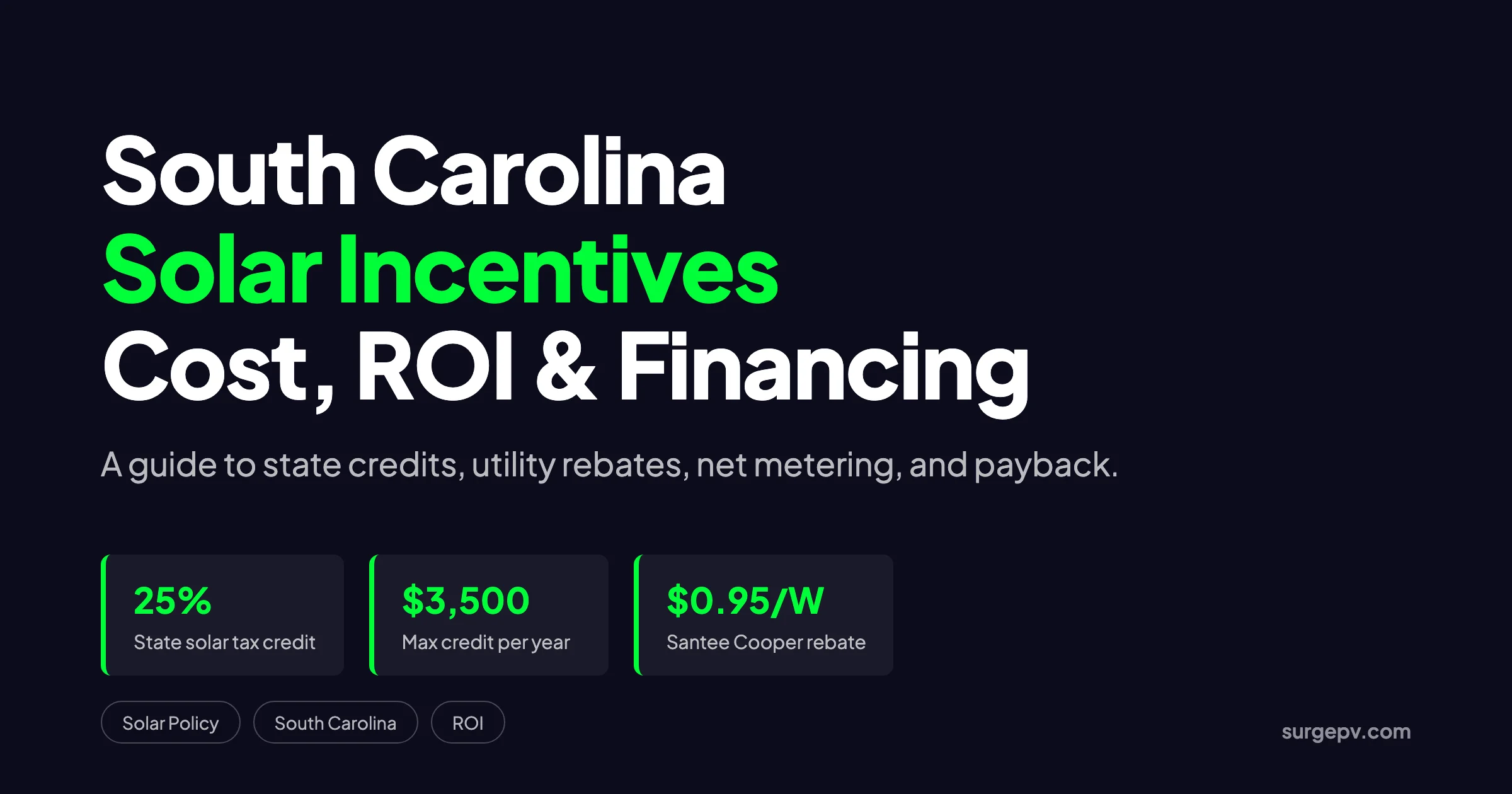
South Carolina’s 2026 solar incentives include a 25% state tax credit (up to $3,500/year and $35,000 lifetime), a 100% property tax exemption for residential systems up to 20 kW, a 6% sales tax exemption, utility-specific net metering, and rebates from Santee Cooper and Duke Energy. The federal residential tax credit expired in 2025.
In this guide:
- Latest 2026 status of every active South Carolina solar incentive
- How the federal ITC expiration changes the math
- South Carolina Solar Energy Tax Credit (TC-38) limits and carryforward rules
- Property tax and sales tax exemptions
- Net metering and export compensation by utility territory
- Santee Cooper, Duke Energy, and Dominion Energy rebates
- Three real-world ROI scenarios by utility
- Financing options and incentive stacking order
- Common mistakes and how to avoid them
Solar Incentives South Carolina: Latest Updates for 2026
South Carolina’s solar policy environment changed in 2025 and 2026. The federal residential credit disappeared, the legislature passed H.3309 in May 2025, and several utility programs set capacity limits or deadlines. The programs that remain are valuable, but they require careful sequencing.
South Carolina Solar Incentive Status — June 2026
| Incentive | Type | Status | Key Terms |
|---|---|---|---|
| Federal residential ITC | Tax credit | Expired | Section 25D ended December 31, 2025 |
| South Carolina Solar Energy Tax Credit (TC-38) | State tax credit | Active | 25% of cost; $3,500/year; $35,000 lifetime; 10-year carryforward |
| Property tax exemption | Tax exemption | Active | 100% of added value for systems up to 20 kW-AC |
| Sales tax exemption | Tax exemption | Active | 6% state sales tax waived on qualifying equipment |
| Net metering | Export credit | Active, utility-specific | Required for IOUs over 100,000 customers; credit rates vary |
| Santee Cooper EmpowerSolar rebate | Utility rebate | Active through Nov 30, 2026 | $0.95/W-AC; cap 6 kW; Trade Ally required |
| Santee Cooper Smart Energy Loan | On-bill financing | Active | Up to $40,000; up to 10 years |
| Duke Energy PowerPair | Solar + battery rebate | Active, capacity-limited | Up to $9,000 total; Trade Ally required |
| Duke battery control credits | Demand response | Active | Up to ~$91/month for enrolled batteries |
| Dominion Energy net metering | Export credit | Active | 1:1 kWh credits; annual true-up each November |
Key Changes Since 2025
Federal ITC expiration: The 30% residential credit ended for systems placed in service after December 31, 2025. Homeowners who purchase solar with cash or a loan in 2026 cannot claim it. Commercial, leased, and third-party-owned systems may still qualify under Section 48E if construction begins by July 4, 2026, and systems are placed in service by December 31, 2027.
H.3309 energy legislation: South Carolina passed a large energy bill on May 7, 2025. The law increased the residential net metering size limit, raised the commercial behind-the-meter cap from 1 MW to 5 MW, and authorized the South Carolina Public Service Commission to approve demand-side management programs that include customer solar and storage, according to analysis by the Southern Alliance for Clean Energy (2025).
Utility rate increases: Several South Carolina utilities filed for rate increases effective in 2026. Higher retail rates improve the value of every kilowatt-hour offset by solar, but they also make export-heavy designs less attractive where net metering credits are discounted.
Key Takeaway
2026 is a state-incentive-driven market in South Carolina. The most reliable benefits are the 25% state tax credit, the property tax exemption, and the sales tax exemption. Utility rebates and net metering terms vary sharply by territory, so design each proposal around the customer’s specific utility.
South Carolina Solar Market Snapshot
South Carolina is not the sunniest state, but it is one of the better Southeast markets for rooftop solar. High summer air-conditioning loads, rising rates, and strong state incentives keep residential projects viable even after the federal credit expired.
Market Size and Solar Resource
The state had roughly 3,118 MWdc of installed solar capacity in early 2026, according to SEIA. That includes utility-scale, commercial, and residential systems. The residential market alone has grown to more than 36,000 installations. South Carolina averages about 5.2 peak sun hours per day, according to Palmetto (2026), with coastal and Midlands locations receiving the strongest resource.
Electricity Rates and Consumption
South Carolina’s average residential rate was 17.06 cents per kWh in April 2026, according to the U.S. Energy Information Administration (2026). That is below the national average, but the state’s hot, humid summers push household usage well above the national average. A typical South Carolina home uses about 13,000 kWh per year, according to Electric Choice (2026). High usage means that even a modest rate creates a large annual bill, which improves solar savings.
Utility Territories
South Carolina is a regulated market. Your utility is determined by address. The major providers are:
- Dominion Energy South Carolina — Midlands and Lowcountry, about 750,000 customers.
- Duke Energy Carolinas — Upstate, about 700,000 customers.
- Duke Energy Progress — Pee Dee region, about 200,000 customers.
- Santee Cooper — State-owned utility serving about 190,000 direct customers and wholesaling power to 20 electric cooperatives.
- Electric cooperatives — Buy wholesale power, primarily from Santee Cooper, and set their own distributed generation tariffs.
Because each provider offers different export credit rates and rebate programs, the first step in any South Carolina solar proposal is to confirm the utility territory.
South Carolina State Solar Tax Credit (TC-38)
The South Carolina Solar Energy Tax Credit is one of the strongest state-level incentives in the country. It is also one of the most misunderstood because it is non-refundable and subject to annual limits.
How the Credit Works
Homeowners and businesses can claim 25% of the total cost of a solar energy system as a credit against South Carolina income tax. The credit is claimed on Form TC-38. Key limits include:
- Annual cap: $3,500 per taxpayer per year.
- Lifetime cap: $35,000 per taxpayer.
- Liability limit: The credit cannot exceed 50% of the taxpayer’s South Carolina income tax liability in any year.
- Carryforward: Unused credit can be carried forward for up to 10 years.
A $25,000 solar system generates a $6,250 state credit. Because the annual cap is $3,500, the homeowner uses $3,500 in year one and carries $2,750 forward to year two. If the taxpayer’s state liability is only $4,000, the 50% rule limits the first-year use to $2,000.
Non-Refundability Is the Hidden Constraint
The credit is non-refundable. It can reduce state tax liability to zero, but it will never generate a refund check. Households with low state tax liability may need several years to absorb the full credit. Installers should ask customers for a recent tax return or estimate before promising a payback period.
Stacking with Other Incentives
The state credit stacks with the property tax exemption, sales tax exemption, and utility rebates. However, the credit basis is generally the net cost after utility rebates. The South Carolina Department of Revenue publishes the current Form TC-38 and instructions.
Property Tax and Sales Tax Exemptions
South Carolina offers two automatic tax benefits that reduce the lifetime cost of solar without requiring a tax return.
Property Tax Exemption
Residential solar energy systems up to 20 kW-AC are 100% exempt from property tax on the value they add. The exemption covers the panels, advanced inverters, and paired battery storage. Because solar can raise a home’s market value, this exemption prevents the added value from increasing the annual property tax bill.
The exemption became statewide in 2025. In most counties, it is applied automatically once the system is permitted and the county assessor records it. Homeowners should still verify the exemption with their county tax assessor, especially in the first year after installation.
Sales Tax Exemption
Solar energy equipment is exempt from South Carolina’s 6% state sales tax. The exemption applies at the point of purchase, so it lowers the invoice price directly. On a $20,000 system, the exemption saves $1,200 upfront. The exemption covers solar panels, inverters, racking, wiring, and other qualifying equipment used in the installation.
A note of caution: the sales tax exemption applies to state sales tax. Local sales taxes, permit fees, and contractor labor classifications can vary, so confirm the exact invoice treatment with the installer.
Net Metering and Export Compensation by Utility
Net metering is the single biggest driver of solar value in most states. In South Carolina, the rules are utility-specific and often weaker than full retail net metering.
State Net Metering Requirement
South Carolina law requires investor-owned utilities with more than 100,000 customers to offer net metering for residential solar systems up to 20 kW. The statewide program cap is 2% of each utility’s average peak demand over the prior five years. Once a utility hits its cap, it can stop accepting new net metering applications.
Export Credit Rates by Utility — 2026
| Utility | Export Credit | Rollover | True-Up / Payout | Notes |
|---|---|---|---|---|
| Dominion Energy SC | 1:1 kWh credit | Monthly | Annual true-up in November; surplus paid at avoided cost (~2.8–3.4¢/kWh) | Most favorable export terms in SC |
| Duke Energy Carolinas / Progress | ~2.6–4.0¢/kWh | Monthly | Excess paid out each March | No 1:1 net metering since 2021 |
| Santee Cooper | $0.0416/kWh summer; $0.0384/kWh non-summer | Monthly | Credited monthly | $10/month DG rider applies |
| Electric cooperatives | ~3.8–5.9¢/kWh | Monthly | Varies by co-op | Tariffs set by each cooperative |
Dominion Energy South Carolina offers the closest thing to traditional net metering. Every kilowatt-hour exported earns a kilowatt-hour credit that offsets future usage. Unused credits are true-up each November at a lower avoided-cost rate. Duke Energy customers receive a cash credit for exports that is well below the retail rate, which makes self-consumption and batteries more valuable. Santee Cooper credits exports at roughly 4 cents per kWh in summer and slightly less in winter, minus a $10 monthly distributed generation rider.
The Self-Consumption Lesson
Because most South Carolina utilities credit exports at a discount, the best financial design usually maximizes on-site consumption rather than total production. A battery can store midday solar for evening use, capturing the full retail rate instead of the export credit. That is why Duke Energy’s PowerPair program pairs solar with storage.
Utility Rebates and Battery Incentives
Beyond state tax benefits, South Carolina utilities run the strongest cash incentives. These programs have capacity limits and application deadlines.
Santee Cooper EmpowerSolar Rooftop Rebate
Santee Cooper pays a one-time rebate of $0.95 per watt-AC for residential rooftop solar systems installed through its Trade Ally network. The rebate is capped at 6 kW-AC per customer, for a maximum of $5,700. Systems can be larger than 6 kW, but only the first 6 kW receive the rebate.
Key rules:
- The system must be installed by a Santee Cooper Trade Ally or a NABCEP-certified installer.
- The customer must pay a $100 non-refundable interconnection fee.
- Applications must be submitted during the program period ending November 30, 2026, or until funding is committed.
- A $10 monthly distributed generation rider applies to solar customers.
- The rebate is paid after final inspection and meter exchange, typically within six weeks.
Santee Cooper Smart Energy Loan
Santee Cooper offers on-bill financing for qualifying residential customers through the Smart Energy Loan program. Borrowers can receive up to $40,000 with repayment terms up to 10 years. The loan is repaid through the monthly electric bill. Because the loan is tied to the utility bill, it can be a simple financing option for customers who do not want a separate solar loan.
Duke Energy PowerPair
Duke Energy Carolinas and Duke Energy Progress customers in South Carolina can receive up to $9,000 through the PowerPair program. The incentive is split into two parts:
- Solar rebate: $0.36 per watt-AC for solar capacity up to 10 kW-AC, worth up to $3,600.
- Battery rebate: $400 per kWh of battery storage up to 13.5 kWh, worth up to $5,400.
The solar and battery must be installed together by a Duke Energy Trade Ally. The program operates on a first-come, first-served basis and has capacity limits. As of early 2026, capacity remained available in Duke Energy Carolinas territory, but availability changes quickly.
Duke Energy Battery Control Credits
Duke Energy customers who enroll a home battery in Power Manager (Carolinas) or EnergyWise Home (Progress) can earn monthly bill credits. The program allows Duke to discharge the battery during peak demand events up to 36 times per year. Credits are based on the battery’s continuous discharge capacity and can reach up to $91 per month, or about $1,092 per year, according to Palmetto (2026).
Dominion Energy Rebate Status
Dominion Energy South Carolina does not currently offer a statewide residential solar rebate comparable to Santee Cooper or Duke PowerPair. Its main solar value comes from the 1:1 net metering tariff. Commercial and larger behind-the-meter customers should check Dominion’s current tariff schedules because the 2025 legislation raised the commercial cap to 5 MW.
Cost, ROI, and Payback Scenarios (2026)
The financial value of solar in South Carolina depends heavily on utility territory. Below are three realistic scenarios for a 7.5 kW-AC residential system installed in 2026.
Assumptions Used Across Scenarios
- System size: 7.5 kW-AC (roughly 8.5 kW-DC)
- Gross installed cost: $2.50 per watt-DC, or $21,250 total
- Annual production: 10,500 kWh
- Annual consumption: 13,000 kWh
- Self-consumption rate: 70% without battery, 85% with battery
- Financing: 6.5% solar loan over 20 years
- Escalation: 2.5% annual utility rate increase
Scenario 1: Santee Cooper Territory with EmpowerSolar Rebate
| Line Item | Value |
|---|---|
| Gross system cost | $21,250 |
| Sales tax exemption (6%) | -$1,275 |
| Santee Cooper rebate ($0.95/W × 6 kW) | -$5,700 |
| Net upfront cost | $14,275 |
| State tax credit (25%, capped at $3,500/year) | -$3,500 in year 1, -$1,813 carried to year 2 |
| First-year avoided bill (10,500 kWh × 70% × $0.114) | ~$838 |
| Less DG rider ($10 × 12) | -$120 |
| Plus export credits (3,150 kWh × $0.04) | ~$126 |
| Net first-year savings | ~$844 |
The Santee Cooper rebate cuts the upfront cost dramatically. The payback period falls in the 8 to 10 year range for cash buyers and roughly 10 to 12 years for financed systems.
Scenario 2: Duke Energy Territory with PowerPair
| Line Item | Value |
|---|---|
| Gross system cost | $21,250 |
| Sales tax exemption (6%) | -$1,275 |
| PowerPair solar rebate ($0.36/W × 7.5 kW) | -$2,700 |
| PowerPair battery rebate ($400/kWh × 10 kWh) | -$4,000 |
| Battery cost adder | +$8,000 |
| Net upfront cost | $21,275 |
| State tax credit (25%, capped) | -$3,500 in year 1, -$1,319 carried to year 2 |
| First-year avoided bill with battery (10,500 kWh × 85% × $0.13) | ~$1,160 |
| Battery control credits (up to $91/month) | ~$1,092 |
| Export credits (1,575 kWh × $0.035) | ~$55 |
| Net first-year savings | ~$2,307 |
Adding a battery raises upfront cost but also raises self-consumption and creates a new income stream. The payback period is roughly 9 to 11 years for the combined system. Without PowerPair, Duke Energy payback stretches toward 11 to 14 years because export credits are low.
Scenario 3: Dominion Energy Territory without Battery
| Line Item | Value |
|---|---|
| Gross system cost | $21,250 |
| Sales tax exemption (6%) | -$1,275 |
| Net upfront cost | $19,975 |
| State tax credit (25%, capped) | -$3,500 in year 1, -$1,494 carried to year 2 |
| First-year avoided bill (10,500 kWh × 70% × $0.14) | ~$1,029 |
| Export credits (3,150 kWh, netted 1:1 within month) | Variable; modest surplus |
| Net first-year savings | ~$1,029 plus rollover credits |
Dominion’s 1:1 net metering is the most valuable export program in the state. A cash buyer can see payback in roughly 9 to 12 years. Financed payback is longer but still attractive for customers who plan to stay in the home.
The Tradeoff: Battery vs. No Battery
Batteries add cost but improve value under weak net metering. In Santee Cooper and Duke Energy territories, where export credits are discounted, a battery usually improves ROI. In Dominion territory, where exports earn full retail credit, a battery is less critical unless the customer wants backup power.
Financing Options
South Carolina homeowners have four main ways to pay for solar in 2026.
Cash Purchase
A cash purchase captures the full state tax credit, property tax exemption, and sales tax exemption. It also delivers the highest lifetime savings because there is no loan interest. The main drawback is the upfront capital requirement.
Solar Loan
Solar loans are the most common option. The homeowner owns the system and can claim the state tax credit. Monthly payments are often lower than the pre-solar electric bill, but loan interest reduces total savings. Rates in 2026 typically range from 5% to 9% APR.
Santee Cooper Smart Energy Loan
Santee Cooper customers can finance up to $40,000 through on-bill repayment. The loan is simple because it appears on the monthly electric bill, and there is no prepayment penalty. It pairs naturally with the EmpowerSolar rebate.
Lease or Power Purchase Agreement (PPA)
Leases and PPAs require no upfront payment and often include maintenance. However, the homeowner does not own the system and cannot claim the state tax credit. In 2026, the federal residential credit is gone, so the lease company may instead use the commercial Section 48E credit and pass a portion of the savings through as a lower monthly rate. Always compare the lease payment against a loan quote over 20 years.
Common Mistakes and Misconceptions
Even experienced installers can misprice South Carolina projects. Here are the most common errors.
Mistake 1: Assuming the State Credit Is Refundable
The 25% credit is non-refundable. If a retiree has little South Carolina income tax liability, the credit may take many years to use. Always model the customer’s actual tax situation, not the full credit amount.
Mistake 2: Oversizing for Export Under Weak Net Metering
A 10 kW system that exports 40% of its production may produce less value than a 7 kW system that is fully consumed on-site. In Duke and Santee Cooper territories, size for self-consumption first, then treat exports as a bonus.
Mistake 3: Missing Utility-Specific Rebate Deadlines
Santee Cooper’s 2026 EmpowerSolar program accepts applications through November 30, 2026, or until funding is committed. Duke PowerPair is capacity-limited. Proposals should include application deadlines and a realistic installation schedule.
Mistake 4: Ignoring the DG Rider
Santee Cooper charges solar customers a $10 monthly distributed generation rider. That is $120 per year and should be subtracted from projected savings. It also reduces the attractiveness of very small systems.
How to Stack Incentives in the Right Order
Stacking incentives correctly protects the customer and maximizes value. The recommended order is:
- Confirm utility territory and roof suitability. Net metering rules, rebate availability, and rate structures depend on the utility.
- Size the system for self-consumption. In most South Carolina territories, on-site use is worth more than exports.
- Apply the sales tax exemption. The installer should exclude state sales tax from the invoice.
- Reserve utility rebates before installation. Santee Cooper and Duke Energy require pre-installation applications or Trade Ally enrollment.
- Install, inspect, and interconnect. Submit final documentation to the utility to release rebate checks.
- Claim the state tax credit. File Form TC-38 with the South Carolina Department of Revenue. Track carryforward amounts.
- Verify the property tax exemption. Confirm with the county assessor that the system’s value has been excluded.
For installers using SurgePV’s solar design software, these inputs can be built into the proposal once and reused across projects. The solar yield and financial analysis applies the correct utility rate, export credit, and rebate values automatically.
FAQ
What solar incentives are available in South Carolina in 2026?
South Carolina offers a 25% state income tax credit up to $3,500 per year and $35,000 lifetime, a 100% property tax exemption for residential systems up to 20 kW, and a 6% sales tax exemption on solar equipment. Utility customers may also receive Santee Cooper rooftop rebates of $0.95 per watt-AC up to 6 kW, Duke Energy PowerPair incentives up to $9,000 for solar-plus-battery systems, and monthly battery control credits. Net metering is required for investor-owned utilities but credit rates vary by provider.
Does South Carolina have a state solar tax credit?
Yes. South Carolina allows taxpayers to claim 25% of qualified solar energy property costs as a state income tax credit using Form TC-38. The credit is capped at $3,500 per year and has a lifetime maximum of $35,000. Any unused portion can be carried forward for up to 10 years, but the credit is non-refundable and cannot exceed 50% of a taxpayer’s state liability in any year.
Is the federal solar tax credit still available in South Carolina in 2026?
No. The 30% federal Residential Clean Energy Credit under Internal Revenue Code Section 25D expired for homeowner-owned systems placed in service after December 31, 2025. Commercial, third-party-owned, and leased systems may still qualify under Section 48E if they meet construction-start and placed-in-service deadlines. South Carolina’s state and utility incentives now carry most of the residential value.
How does net metering work in South Carolina?
State law requires investor-owned utilities with more than 100,000 customers to offer net metering for residential solar systems up to 20 kW. Dominion Energy South Carolina provides monthly 1:1 kilowatt-hour credits, with annual true-ups each November at an avoided-cost rate. Duke Energy credits excess exports at roughly 2.6 to 4 cents per kWh. Santee Cooper credits exports at $0.0416/kWh in summer and $0.0384/kWh in non-summer months. Most programs require a time-of-use rate.
What is the Santee Cooper solar rebate in 2026?
Santee Cooper’s EmpowerSolar Home program pays a one-time rebate of $0.95 per watt-AC for residential rooftop solar, capped at 6 kW per customer for a maximum of $5,700. Systems must be installed by a Santee Cooper Trade Ally and applications must be submitted during the program period ending November 30, 2026, or until funding is committed. A $10 monthly distributed generation rider applies.
Does South Carolina have a property tax exemption for solar?
Yes. Residential solar energy systems up to 20 kW-AC are fully exempt from property tax on the value they add to a home. The exemption also covers paired battery storage and advanced inverters. The benefit is typically applied automatically, but homeowners should confirm with their county assessor that the exemption has been recorded.
Are solar batteries incentivized in South Carolina?
Batteries are not eligible for the Santee Cooper rooftop solar rebate, but Duke Energy customers can receive battery incentives through the PowerPair program. PowerPair pays $400 per kWh of battery storage up to 13.5 kWh, worth up to $5,400, plus $0.36/W-AC for solar up to 10 kW. Enrolled battery owners can also earn monthly bill credits through Duke’s Power Manager or EnergyWise Home demand-response programs.
What is the typical solar payback period in South Carolina in 2026?
A well-designed residential solar system in South Carolina typically pays back in 9 to 13 years in 2026. Santee Cooper territory with the $0.95/W rebate and strong self-consumption can fall near 8 to 10 years. Duke Energy territory without PowerPair may stretch toward 11 to 14 years because export credits are below the retail rate. Payback depends on utility territory, system size, financing cost, and how much solar generation is used on-site.
What is the most common mistake when claiming South Carolina solar incentives?
The most common mistake is assuming all incentives stack automatically. The state tax credit is non-refundable and limited to 50% of annual state tax liability, so a household with low state tax liability may need several years to use it. Another mistake is oversizing for export under weak net metering; because most utilities credit exports at a discount, designing for high self-consumption or adding a battery usually produces a better return.
Can renters access solar incentives in South Carolina?
Renters generally cannot claim rooftop solar incentives because they do not own the property. However, Santee Cooper’s Solar Share community solar program allows customers to subscribe to a share of the Colleton Solar Farm and receive bill credits. The program sells subscriptions in 1-kW increments and offers a rebate that lowers the upfront cost. Community solar subscribers remain subject to the distributed generation rider.
South Carolina solar still works in 2026, but the math is now state-driven and utility-specific. Installers who model the 25% state tax credit, the correct export rate, and the right utility rebate will deliver proposals that hold up under scrutiny.
If you want to see how SurgePV handles South Carolina utility rates, net metering rules, and incentive stacking, book a demo or review pricing. For the national context, read our U.S. solar incentives overview and state-by-state guide.
Where this fits
This article is part of SurgePV's Solar Incentives & Policy hub, which works through the topic from first principles to the decisions a project team actually has to make.
