

Pennsylvania homeowners paid an average of about 20 cents per kWh for electricity in early 2026, up roughly 20% year over year, according to NuWatt Energy market data (2026). That makes rooftop solar a useful hedge against rising rates. It also makes accurate incentive modeling essential, because Pennsylvania does not offer the sales tax exemptions, property tax exemptions, or large state rebates that neighbors like New Jersey and Maryland provide. The federal residential Investment Tax Credit expired for systems placed in service after December 31, 2025.
The financial case for solar in Pennsylvania in 2026 rests on a few levers: Solar Renewable Energy Credit (SREC) income, full retail-rate net metering, and a small set of local and financing programs. This guide covers each lever, the real dollar value, and how payback changes by utility territory. For the national picture, see our solar incentives in USA 2026 guide and state solar incentives in the US overview. For installers who need to model SREC revenue, net metering, and utility rates in one place, SurgePV’s solar design software and generation and financial tool let you build accurate, territory-specific proposals. Generate professional solar proposals in minutes, then check pricing or book a demo.
Quick Answer
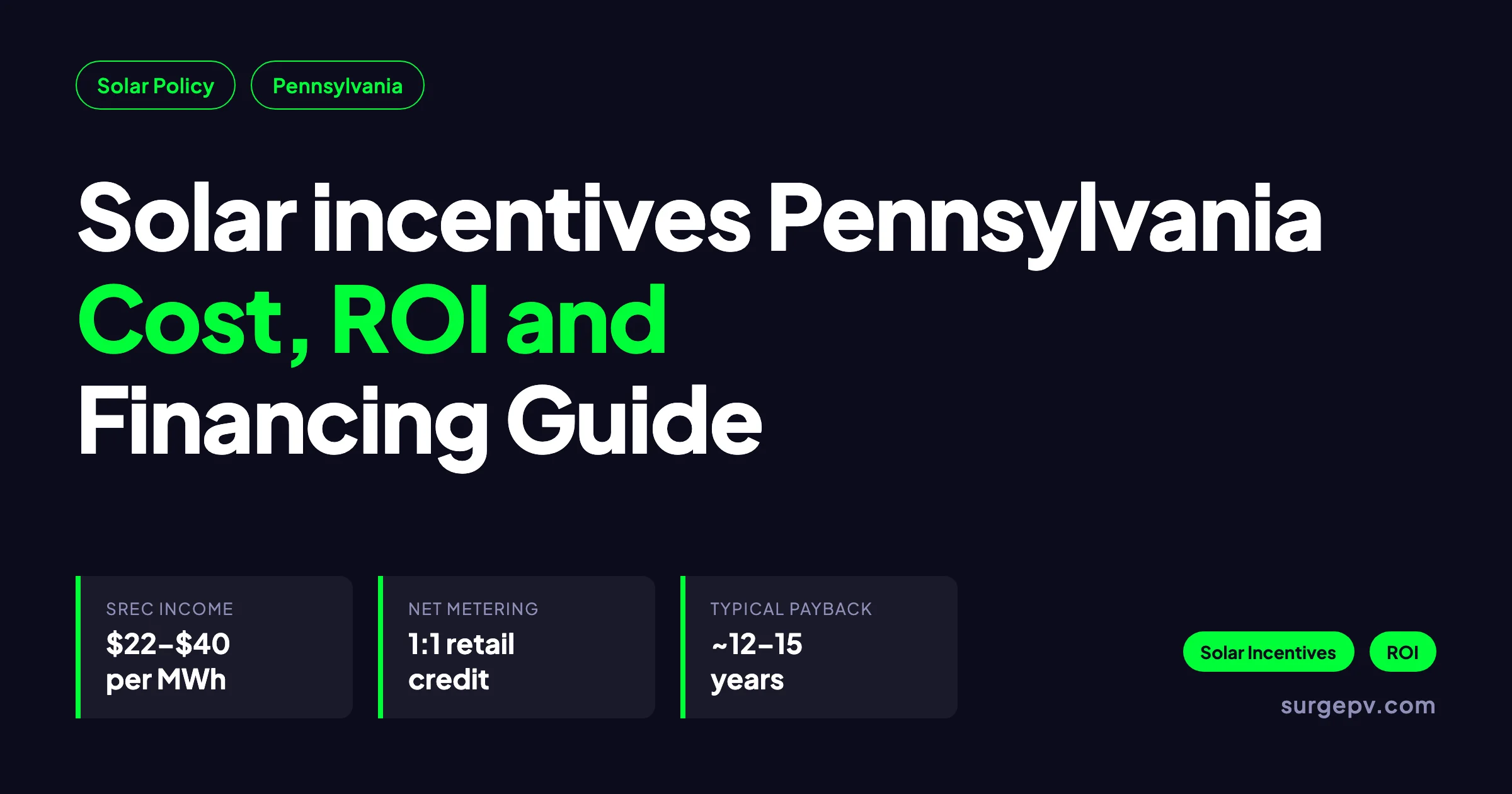
Pennsylvania’s 2026 solar incentives include SRECs worth roughly $22-$40 per MWh, mandatory 1:1 retail net metering for systems up to 50 kW, the Philadelphia Solar Rebate waitlist at $0.20/W, and HEELP loans at 1%. There is no state sales or property tax exemption for residential solar. A typical residential system pays back in about 12-15 years.
In this guide:
- Latest 2026 status of every active Pennsylvania solar incentive
- How the federal ITC expiration changes the math
- How Pennsylvania SRECs work and what they are worth
- Net metering rules, capacity limits, and annual true-up
- Sales tax, property tax, and local programs such as HEELP
- Cost, ROI, and payback scenarios by utility territory
- Financing options and common mistakes to avoid
Pennsylvania Solar Incentives at a Glance — 2026
Pennsylvania is not an incentive-rich state. The value comes from stacking a few ongoing programs rather than relying on one large upfront rebate. Utility territory matters more here than in most states.
| Incentive | Type | 2026 Status | Typical Value |
|---|---|---|---|
| Federal residential ITC | Tax credit | Expired | $0 for cash or loan residential purchases |
| Federal Section 48E | Commercial tax credit | Active, deadlines apply | 30% for eligible commercial, lease, or PPA systems |
| Pennsylvania SRECs | Performance credit | Active | $22-$40 per MWh produced |
| Net metering | Bill credit | Active | 1:1 retail credit for residential systems up to 50 kW |
| Sales tax exemption | Tax exemption | Not available | 6% state tax applies, plus local tax |
| Property tax exemption | Tax exemption | Not available | Added system value is assessable |
| Philadelphia Solar Rebate | Local rebate | Waitlist | $0.20/W residential, $0.10/W commercial |
| HEELP loan | Financing | Active | $1,000-$10,000 at 1% for 10 years |
| SEP loans | Financing | Active | Up to $5 million or $3.00/W for solar projects |
The state had about 3,086 MWdc of installed solar capacity by mid-2026 and ranked 22nd nationally, according to SEIA’s Pennsylvania state solar overview (2026). That is enough solar to power roughly 388,000 homes, but it is only 1.35% of the state’s electricity. The market is growing, but the policy stack is modest.
Key Takeaway
Pennsylvania solar works in 2026, but the math is driven by net metering and SRECs, not by tax exemptions. The absence of sales and property tax exemptions adds thousands of dollars to the effective cost compared with New Jersey or Maryland.
The Federal ITC Is Gone for Homeowners. What Still Works?
The 30% federal Residential Clean Energy Credit under Internal Revenue Code Section 25D expired on December 31, 2025. Homeowners who buy solar with cash or a loan in 2026 cannot claim it. This is the single largest change in Pennsylvania’s solar math.
Commercial, third-party-owned, and leased systems may still access the federal Investment Tax Credit under Section 48E. The usual safe-harbor rules apply: construction must begin before July 4, 2026, or the system must be placed in service by December 31, 2027. Lease and power-purchase-agreement providers can pass a portion of that credit through as lower monthly payments. That makes third-party ownership more attractive in Pennsylvania now than it was when the residential ITC was available.
For cash and loan buyers, the federal credit is gone. The rest of the stack must carry the project. That means every installer proposal in Pennsylvania should lead with SREC income, net metering, and local rebates, not with a federal tax credit that no longer exists.
How Pennsylvania SRECs Work
Solar Renewable Energy Credits are Pennsylvania’s main state-level financial incentive for solar. The program is created by the Alternative Energy Portfolio Standards Act (Act 213 of 2004). That law requires electric distribution companies and generation suppliers to source a percentage of their electricity from alternative energy, including a small solar carve-out.
Every 1,000 kWh of solar production earns one SREC. A typical 8 kW residential system that produces about 10 MWh per year earns about 10 SRECs per year. Those SRECs can be sold through brokers or trading platforms such as Flett Exchange (2026) or Xpansiv Managed Solutions (2026). Prices are set by supply and demand.
SREC Basics
- One SREC equals 1 MWh of solar generation.
- SRECs are tracked through the PJM Generation Attribute Tracking System (PJM-GATS).
- Credits are eligible for the year they are generated and the following two energy years.
- Income is taxable as ordinary income.
- Only system owners can sell SRECs; leases usually transfer SREC rights to the financing company.
SREC Prices in 2026
Pennsylvania SRECs have traded in a range of roughly $22 to $40 per credit in 2026. The price is lower than in Maryland or New Jersey because Pennsylvania’s solar carve-out is only about 0.5% of electricity sales. Several proposed bills, including versions of the Promoting Environmental Stewardship and Sustainability (PRESS) legislation, would increase the carve-out. If any of those bills pass, SREC prices could rise. Systems installed before a carve-out increase would still benefit, because SRECs are earned on ongoing production.
A typical 8 kW system producing 10 MWh per year at a $30 SREC price earns about $300 per year. Over 15 years, that is about $4,500 of additional income. It is not enough to carry the project alone, but it shortens the payback period by one to two years.
Net Metering in Pennsylvania
Net metering is the most financially significant ongoing solar benefit for most Pennsylvania homeowners. The rules are set in Pennsylvania Code Title 52, Chapter 75, Subchapter B. All investor-owned utilities must offer net metering to residential customers with systems up to 50 kW.
How Net Metering Works
Under current rules, exported solar kilowatt-hours earn a credit equal to the full retail electricity rate. The customer pays only the net difference between imports and exports. Credits roll over month to month. At the end of each 12-month billing cycle, usually May 31, any remaining surplus credits are paid at the price-to-compare (PTC) rate. The PTC covers generation and transmission but not distribution, so it is lower than the full retail rate.
Key details from Solar United Neighbors (2026) and DSIRE (2026):
- Residential system cap: 50 kW.
- Non-residential system cap: 3,000 kW.
- No statewide cap on total net-metered capacity.
- Virtual meter aggregation is allowed for properties owned by the same customer within two miles.
- Customers of municipal utilities, rural electric cooperatives, and competitive generation suppliers are not guaranteed net metering.
Utility Rate Snapshot — Early 2026
| Utility | Service Area | All-in Residential Rate |
|---|---|---|
| PECO | Philadelphia / southeast | ~20.0¢/kWh |
| PPL Electric | Central / eastern | ~21.0¢/kWh |
| Duquesne Light | Pittsburgh / southwest | ~23.0¢/kWh |
| Met-Ed | Reading / Lehigh edge | ~19.0¢/kWh |
| Penelec | Northern / western | ~21.0¢/kWh |
| Penn Power | Western | ~19.0¢/kWh |
| West Penn Power | Southwestern | ~17.0¢/kWh |
Source: Sunwise utility rate comparison (2026) and NuWatt Energy (2026).
Higher rates improve the value of every kilowatt-hour offset by solar. That is why a system in Duquesne Light territory can pay back faster than the same system in West Penn Power territory, even with identical sun exposure and installed cost.
Design Implication
Surplus credits are settled at the lower price-to-compare rate. The conservative design rule is to size for roughly 90-100% of annual consumption. Treat exports as a bonus, not a primary revenue source.
Sales Tax, Property Tax, and Local Programs
This is where Pennsylvania’s incentive picture is weaker than neighboring states. Solar equipment is not exempt from sales tax, and the added value of a solar system is not exempt from property taxes.
Sales Tax
Solar panels, inverters, racking, and installation labor are subject to Pennsylvania’s 6% state sales tax. In Allegheny County, the combined rate is 7%. In Philadelphia, it is 8%. On a $25,000 system, sales tax adds $1,500 to $2,000 to the out-of-pocket cost.
Property Tax
Pennsylvania does not exclude solar equipment from a home’s property tax assessment. A Zillow study cited by Palmetto (2026) found that homes with solar sell for about 4.1% more than comparable homes without solar. That value increase can raise annual property taxes. Installers should warn homeowners that the added value is assessable.
Philadelphia Solar Rebate Program
The City of Philadelphia offers one of the few true cash rebates in the state. It pays $0.20 per watt for residential projects and $0.10 per watt for commercial projects, capped at $100,000 per project. However, the program is currently closed to new awards due to budget cuts and is maintaining a waiting list, according to the City of Philadelphia Solar Rebate Program page (2026). Homeowners should verify current funding before counting on it.
HEELP Loans
The Pennsylvania Housing Finance Agency’s Homeowners Energy Efficiency Loan Program (HEELP) offers loans of $1,000 to $10,000 at a fixed 1% interest rate for 10 years, according to the Pennsylvania Department of Environmental Protection (2026). HEELP is not a solar-only program, but it can finance electrical panel upgrades, roof repairs, or wiring improvements that are prerequisites for solar.
Pennsylvania Solar Energy Program
The Pennsylvania Solar Energy Program, administered by the Department of Community and Economic Development, provides loans and grants for solar energy generation or distribution projects. Loans are capped at $5 million or $3.00 per watt, whichever is less, according to DCED’s Solar Energy Program page (2026). This program is most useful for commercial, community solar, or institutional projects rather than typical residential systems.
Cost, ROI, and Payback Scenarios
The following examples use illustrative 2026 costs and incentive values. Actual figures depend on location, utility, roof conditions, installer quote, and whether the homeowner qualifies for local programs. The scenarios assume a 25-year system life, 3% annual electricity escalation, and a $30 SREC price.
Scenario 1 — 8 kW Residential, PECO Territory, Philadelphia
| Item | Amount |
|---|---|
| Gross installed cost ($3.00/W) | $24,000 |
| Sales tax (8% in Philadelphia) | -$1,920 |
| Philadelphia Solar Rebate (if funded) | -$1,600 |
| Net cost | $23,320 to $24,920 |
| Annual bill savings (~10 MWh at 20¢/kWh) | $2,000 |
| Annual SREC income (10 SRECs at $30) | $300 |
| Payback with rebate | 10.2 years |
| Payback without rebate | 10.9 years |
Scenario 2 — 7 kW Residential, PPL Electric Territory, No Local Rebate
| Item | Amount |
|---|---|
| Gross installed cost ($3.05/W) | $21,350 |
| Sales tax (6%) | -$1,281 |
| Net cost | $22,631 |
| Annual bill savings (~8.4 MWh at 21¢/kWh) | $1,764 |
| Annual SREC income (8.4 SRECs at $28) | $235 |
| Payback | 11.7 years |
Scenario 3 — 150 kW Commercial Rooftop, PECO Territory
| Item | Amount |
|---|---|
| Gross installed cost ($2.55/W) | $382,500 |
| Sales tax (6%) | -$22,950 |
| Section 48E tax credit (if eligible) | -$121,635 |
| Net cost | $283,815 |
| Annual bill savings and demand reduction | $40,000 |
| Annual SREC income (180 SRECs at $30) | $5,400 |
| Payback | 6.2 years |
Commercial projects can still access the federal Section 48E credit. For larger systems, load profiling and shadow analysis matter more than simple bill offset. The chart below compares the residential payback periods across the two main utility territories.
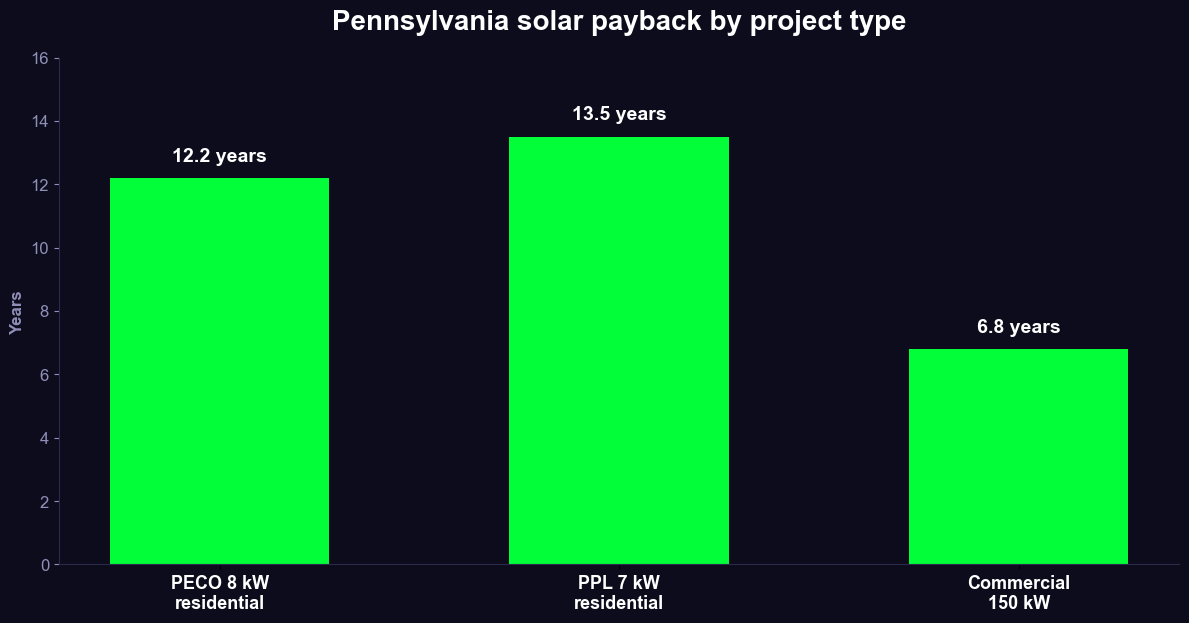
The numbers show why utility territory is the first question a Pennsylvania installer should ask. A system in PECO territory with the Philadelphia rebate pays back almost a year and a half faster than the same system in PPL territory with no local rebate.
Financing Options in Pennsylvania
Most Pennsylvania homeowners finance solar with one of four structures. Each has a different impact on incentive ownership and long-term value.
Cash Purchase
A cash purchase preserves full ownership of SRECs and net metering credits. It also delivers the highest lifetime savings if the homeowner can afford the upfront cost. The main downside is the 12- to 15-year payback without a federal tax credit.
Solar Loan
A solar loan also preserves SREC ownership. The monthly loan payment is often close to the old electric bill, but the homeowner keeps the long-term value. The key is to compare the loan interest rate against the effective return from SRECs and bill savings.
Lease or Power Purchase Agreement
A lease or PPA transfers system ownership to a third party. The provider may claim the Section 48E credit and pass part of the savings through as a lower monthly rate. The trade-off is that the homeowner usually does not own the SRECs. Always check the contract to see who keeps the SRECs and whether the escalator is capped.
HEELP Loan
HEELP is a low-interest option for the supporting work, not the panels themselves. A homeowner can use HEELP at 1% to pay for an electrical panel upgrade and then use a solar loan or cash for the array. This keeps the high-interest solar loan smaller.
Common Mistakes and Misconceptions
Pennsylvania’s thinner incentive stack means mistakes cost more.
Quoting the Expired Federal ITC
The most expensive error is telling a homeowner they can claim the 30% federal tax credit on a cash or loan purchase in 2026. Section 25D ended on December 31, 2025. Only commercial, lease, or PPA structures can still access federal credits.
Treating the Philadelphia Rebate as Guaranteed
The Philadelphia Solar Rebate is currently closed to new awards and is maintaining a waiting list. Do not promise it in a 2026 proposal without confirming that funding has been restored.
Oversizing for Export
Pennsylvania’s annual true-up pays surplus credits at the price-to-compare rate, which is below full retail. A system sized to 120% of annual consumption may look good in a simple production estimate but leaves value on the table. Size for what the household uses.
Ignoring Utility Territory
A 7 kW system in Duquesne Light territory can have a materially different payback than the same system in West Penn Power territory. The retail rate differs by several cents per kWh. Always model the customer’s actual utility and rate schedule.
Missing the SREC Registration Window
SRECs are not automatic. The installer or homeowner must register the system with the Pennsylvania Public Utility Commission and PJM-GATS. If registration is delayed, months of production can be lost.
Choosing a Competitive Supplier Without Checking Net Metering
Pennsylvania customers can shop for electricity supply. However, competitive generation suppliers are not required to offer net metering. Customers on a competitive supply plan may need to return to default utility service to get net metering credits.
Conclusion
Pennsylvania’s solar incentive stack in 2026 is modest but functional. The federal residential tax credit is gone. The value now comes from SREC income, full retail net metering, the Philadelphia Solar Rebate when it reopens, and low-interest HEELP financing for supporting upgrades. Sales tax and property tax are not waived, so accurate cost modeling matters more than in neighboring states.
For solar professionals, the competitive edge is the ability to model each utility territory correctly. The proposal that wins in Pennsylvania is the one that shows the homeowner exactly how SRECs, net metering, and local rates interact over 25 years.
Tools like SurgePV’s solar design software and solar financial modeling let you build Pennsylvania-specific proposals. They reflect real utility rates, SREC income, and net metering rules. For installers scaling in the state, our guide for solar installers covers proposal automation and compliance workflows.
Three actions to take now:
- Register SRECs immediately after interconnection — delayed registration loses production credits.
- Size for self-consumption — exported energy is worth less at annual true-up and may be worth less under future rules.
- Confirm local rebate status before quoting — the Philadelphia Solar Rebate is currently a waiting list, not a live incentive.
For the national picture, see our solar incentives in USA 2026 guide and state solar incentives in the US overview, both linked earlier in this guide.
Frequently Asked Questions
What solar incentives are available in Pennsylvania in 2026?
Pennsylvania’s 2026 solar incentives include Solar Renewable Energy Credits worth roughly $22-$40 per MWh, mandatory 1:1 retail net metering for residential systems up to 50 kW, the Philadelphia Solar Rebate waitlist at $0.20 per watt, HEELP loans at 1% interest, and federal commercial credits through leases or PPAs. The state does not offer a residential sales tax or property tax exemption for solar.
Does Pennsylvania have a state solar tax credit in 2026?
No. Pennsylvania does not offer a state income tax credit or a statewide upfront rebate for residential solar in 2026. The main financial incentives are SREC sales, net metering, and local programs such as the Philadelphia Solar Rebate and HEELP loans.
Is the federal solar tax credit still available in Pennsylvania in 2026?
No. The 30% federal Residential Clean Energy Credit under Internal Revenue Code Section 25D expired for homeowner-owned systems placed in service after December 31, 2025. Commercial, third-party-owned, and leased systems may still qualify under Section 48E if construction began before July 4, 2026 or the system is placed in service by December 31, 2027.
How much are Pennsylvania SRECs worth in 2026?
Pennsylvania SRECs have traded in a range of roughly $22 to $40 per credit in 2026, depending on market supply and demand. Prices are lower than in neighboring states because Pennsylvania’s solar carve-out under the Alternative Energy Portfolio Standard is only 0.5%. A typical 8 kW residential system producing 10 MWh annually earns about 10 SRECs per year.
How does net metering work in Pennsylvania in 2026?
Pennsylvania requires investor-owned utilities to credit exported solar generation at the full retail rate on a monthly basis. Credits roll over month to month and are reconciled each May 31, with remaining surplus paid at the price-to-compare rate. Residential systems must be 50 kW or smaller. Customers of municipal utilities, electric cooperatives, and competitive generation suppliers are not guaranteed net metering.
Does Pennsylvania have a sales tax exemption for solar panels?
No. Solar equipment and installation labor are subject to Pennsylvania’s 6% state sales tax. The total rate is 7% in Allegheny County and 8% in Philadelphia. On a $25,000 system, sales tax adds $1,500 to $2,000.
Does Pennsylvania have a property tax exemption for solar panels?
No. Pennsylvania does not exempt the added value of a residential solar system from property tax assessments. Solar can increase assessed home value, which may raise annual property taxes. This differs from New Jersey, Maryland, and many other states that exclude solar from property taxes.
What is the Philadelphia Solar Rebate Program?
The Philadelphia Solar Rebate Program pays $0.20 per watt for residential projects and $0.10 per watt for commercial projects, capped at $100,000 per project. However, the program is currently closed to new awards due to budget cuts and is maintaining a waiting list. Homeowners should verify current funding before counting on it.
What is the typical solar payback period in Pennsylvania in 2026?
Payback periods for well-designed residential solar systems in Pennsylvania typically range from 12 to 15 years in 2026 without the federal residential tax credit. The exact result depends on utility territory, system size, roof conditions, SREC prices, and whether local rebates apply. Commercial projects that qualify for Section 48E can pay back in 6 to 9 years.
What is the most common mistake when sizing a solar system in Pennsylvania?
The most common mistake is oversizing for export. Annual surplus credits are settled at the lower price-to-compare rate, and future net metering rules may reduce export value further. The safer design rule is to size for roughly 90-100% of annual consumption and treat exports as a bonus.
Where this fits
This article is part of SurgePV's Solar Incentives & Policy hub, which works through the topic from first principles to the decisions a project team actually has to make.
