

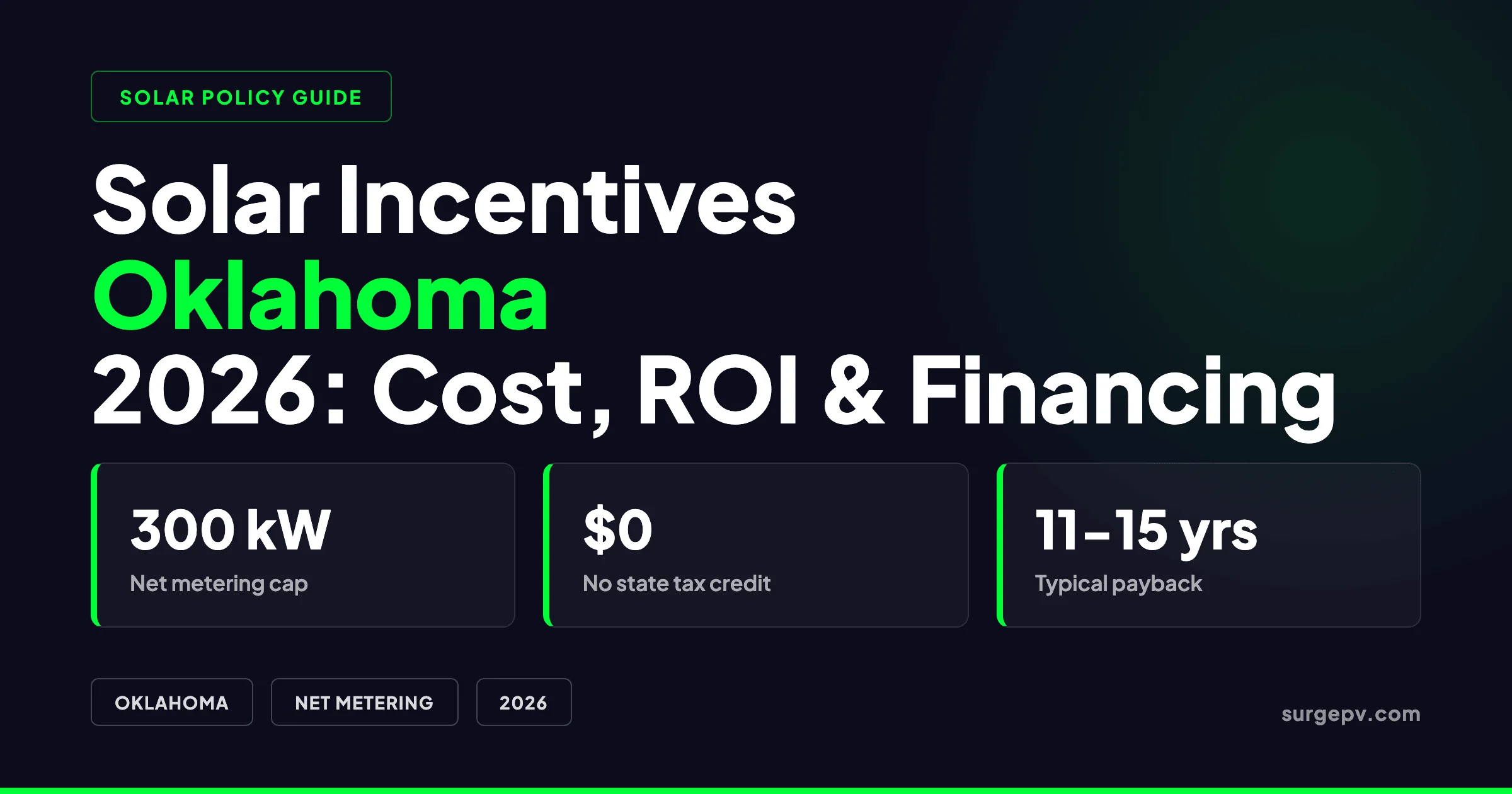
Oklahoma has some of the best sunshine in the central United States, with 4.5 to 5.5 peak sun hours per day across most of the state, according to NREL solar resource data. Yet for homeowners considering rooftop solar, the incentive stack in 2026 is thin. The state has no income tax credit, no statewide property tax exemption, and no statewide sales tax exemption for residential solar. The federal Residential Clean Energy Credit ended on December 31, 2025.
What Oklahoma does have is net metering for regulated utilities, a large rural land area where farms and small businesses can qualify for USDA REAP grants, and electricity rates that have risen 9.6% year over year to about 13.56 cents per kWh as of March 2026, according to U.S. Energy Information Administration monthly electric power data. Those rate increases are the real economic driver for solar in the state. This guide explains every active program, the federal policy change that removed the 30% homeowner credit, and how installers should model cost and ROI after that change.
For the national picture, see our solar incentives in USA 2026 guide and state solar incentives in the US overview. For installers who need to model net metering, avoided-cost exports, and utility-specific rates in one proposal, SurgePV’s solar design software and solar yield and financial analysis handle territory-specific calculations. You can also generate professional solar proposals, check pricing, or book a demo.
Quick Answer
Oklahoma’s 2026 solar incentives are limited: net metering for regulated utilities up to 300 kW, avoided-cost export credits, voluntary REC sales, and community group purchasing. The federal residential solar tax credit expired December 31, 2025. There is no state solar tax credit, no statewide property tax exemption, and no statewide sales tax exemption for residential solar.
TL;DR — Oklahoma Solar Incentives 2026
Active programs: net metering under 17 O.S. § 156 and OAC 165:40:9, voluntary REC sales through NAR, community group purchasing such as Solarize OKC when campaigns run, and USDA REAP grants for eligible rural businesses and farms. Expired: federal Section 25D residential credit for cash and loan buyers. Not available: state tax credit, statewide property tax exemption, statewide sales tax exemption, and state battery rebate. Typical residential payback: 11 to 15 years.
In this guide:
- Oklahoma solar market snapshot and why the incentive stack is thin
- How Oklahoma net metering works and why export credits are below retail
- The federal tax credit change that reshapes 2026 economics
- What Oklahoma does not offer: property tax, sales tax, and state rebate reality
- RECs, community purchasing, and USDA REAP for rural properties
- Real 2026 cost, ROI, and payback examples
- Financing options and common mistakes to avoid
Oklahoma Solar Incentives at a Glance — 2026
Oklahoma is not an incentive-rich state. The value of going solar comes from combining strong sunshine with net metering and steadily rising utility rates, not from stacking rebates. The table below summarizes the programs that matter in 2026.
| Incentive | Type | 2026 Status | Typical Value |
|---|---|---|---|
| Federal Section 25D residential credit | Tax credit | Expired | $0 for cash or loan residential purchases |
| Federal Section 48E | Commercial tax credit | Active, deadlines apply | 30% for eligible commercial, lease, or PPA systems |
| Oklahoma net metering | Bill credit | Active at regulated IOUs | Retail-rate credit for on-site use; avoided-cost credit for exports |
| Oklahoma state tax credit | Tax credit | Not available | $0 |
| Property tax exemption | Tax exemption | Not available statewide | $0 for residential; manufacturer exemption for large solar/BESS is sunsetting |
| Sales tax exemption | Tax exemption | Not available statewide | Standard state and local sales tax applies |
| Voluntary RECs | Performance credit | Active | Roughly $50 to $300 per year for an 8 kW system |
| Solarize OKC | Community purchasing | Campaign-based | Discounts of 10% to 40% when active |
| USDA REAP | Federal grant/loan | Active with restrictions | Up to 50% grant for eligible rural businesses and farms |
Oklahoma had about 1,111 MWdc of installed solar capacity by early 2026, according to SEIA’s Oklahoma state solar overview. Most of that capacity is utility-scale, but residential adoption continues to grow in high-rate territories served by Oklahoma Gas & Electric and Public Service Company of Oklahoma.
Key Takeaway
Oklahoma solar works in 2026 because of strong sunshine and rising electricity rates, not because of generous incentives. Accurate modeling is essential because the federal credit is gone and export credits are below retail.
How Oklahoma Net Metering Actually Works
Net metering is the single most important Oklahoma solar incentive for homeowners. It is governed by 17 O.S. § 156 and Oklahoma Corporation Commission rules OAC 165:40:9. The rules apply to regulated investor-owned utilities and electric cooperatives under the Commission’s jurisdiction. Municipal utilities and many rural co-ops are not required to participate.
The structure has three parts:
- On-site offset: Solar generation first powers your home. Every kilowatt-hour used on site avoids buying that kilowatt-hour from the utility at the full retail rate, which is typically 13 to 14 cents per kWh.
- Monthly netting: Within a billing period, the utility nets your solar production against your consumption. You pay only for the net electricity drawn from the grid.
- Export credit: If your system produces more than you use in a billing period, the surplus is credited at the utility’s avoided cost rate, not the retail rate. The OCC purchase-rate rule states that excess energy shall be credited or paid “at the utility’s avoided energy cost.” That rate typically ranges from $0.02 to $0.08 per kWh.
The maximum system size for the residential net metering pathway is 300 kW, which is far above any home solar system. The practical limit is the 125% peak-load rule. Systems sized above 125% of the customer’s recorded peak demand at the service location may be excluded from net metering and placed on a small power producer or qualifying facilities tariff.
Dollar-based credits roll forward indefinitely. They can be applied to future bills, including fixed service charges and grid purchases when the sun is not shining. Key participating utilities include Oklahoma Gas & Electric, Public Service Company of Oklahoma, Oklahoma Electric Cooperative, and Northeast Oklahoma Electric Cooperative. Always confirm current terms with your utility before signing a contract because utilities may apply to the OCC for approval to charge a fixed enrollment fee.
The Federal Incentive Stack Is Gone for Homeowners
The 30% federal Residential Clean Energy Credit under Internal Revenue Code Section 25D expired on December 31, 2025. Homeowners who buy solar with cash or a loan in 2026 cannot claim it. This is the single largest change in Oklahoma’s solar math.
The expiration was accelerated by the One Big Beautiful Bill Act, signed into law on July 4, 2025. The credit went from 30% to 0% for new residential owner-owned systems on January 1, 2026. Systems placed in service in 2025 can still be claimed on the 2025 tax return using IRS Form 5695. Unused credits from 2025 installations can carry forward to future tax years.
Commercial, third-party-owned, and leased systems may still access the federal Investment Tax Credit under Section 48E. The usual deadlines apply: construction must begin before July 4, 2026, or the system must be placed in service by December 31, 2027. Lease and power-purchase-agreement providers can pass a portion of that credit through as lower monthly payments. That makes third-party ownership more attractive in Oklahoma now than it was when the residential credit was available.
For cash and loan buyers, the federal credit is gone. The rest of the stack must carry the project. That means every installer proposal in Oklahoma should lead with electricity savings, net metering, RECs, and financing programs, not with a federal tax credit that no longer exists.
What Oklahoma Does Not Offer
Many national solar guides list Oklahoma as having a property tax exemption and a sales tax exemption. Those claims are incorrect for residential systems. This section clarifies what is not available so homeowners and installers do not overstate savings.
No Statewide Property Tax Exemption
Oklahoma does not have a statewide property tax exemption that shields the added value of a residential solar system from local property taxes. The Database of State Incentives for Renewables and Efficiency and EnergySage both classify Oklahoma as having no residential property tax exemption for solar. Some market guides cite 17 O.S. § 156, but that statute governs net metering, not property taxes.
The only relevant property tax program is the five-year manufacturer ad valorem exemption under 68 O.S. § 2902. That exemption applies to large solar generation and battery storage facilities that meet manufacturing criteria. Senate Bill 237, passed by the Oklahoma Legislature in 2026, sets a January 5, 2028 sunset date for solar and battery projects qualifying under that exemption. Homeowners should confirm their county assessor’s treatment of solar before installation.
No Statewide Sales Tax Exemption
Oklahoma also does not provide a statewide sales tax exemption for residential solar equipment. The state’s manufacturer sales tax exemption under 68 O.S. § 1359 requires a Manufacturer’s Sales Tax Exemption Permit and applies to qualifying manufacturing operations, not rooftop solar installations. Homeowners should budget for the standard 4.5% state sales tax plus any applicable local sales tax.
No State Solar Tax Credit or Rebate
Oklahoma has never offered a state income tax credit or cash rebate for residential solar. The state relies on net metering and voluntary RECs instead.
RECs, Community Purchasing, and Rural Grants
Even though the state incentive menu is short, a few additional programs can improve project economics.
Voluntary Renewable Energy Certificates
Oklahoma has no mandatory Renewable Portfolio Standard, so there is no active SREC market. However, solar owners can register their systems with the North American Renewables Registry and sell voluntary RECs. A typical 8 kW residential system producing 10 to 13 MWh per year might earn roughly $50 to $300 annually, depending on market conditions. This income is best treated as a small bonus rather than a core financial driver.
Solarize Oklahoma City
Solarize OKC was a community group-purchasing campaign that ran from 2023 to 2024. It helped homeowners, businesses, and nonprofits access volume discounts through a competitively selected installer. Participants signed more than 150 contracts and achieved discounts of up to 40% off regular retail prices, according to the City of Oklahoma City. Similar campaigns may return in the future, so homeowners in central Oklahoma should check with the Oklahoma Renewable Energy Council and local sustainability offices for active enrollment windows.
USDA REAP for Rural Properties
The USDA Rural Energy for America Program provides grants and loan guarantees to agricultural producers and rural small businesses for renewable energy systems and energy efficiency improvements. Eligible solar projects can receive grants of up to 50% of eligible costs, with a maximum grant request of $1,000,000 for renewable energy systems in fiscal years 2025 through 2027, according to USDA Rural Development. REAP is highly competitive, has specific eligibility rules, and should be verified with the local USDA state office before counting it in a proposal.
Cost, Payback, and ROI Scenarios
Numbers make the policy shift concrete. In 2026, a typical Oklahoma residential solar system costs about $2.60 to $3.10 per watt before incentives, based on national pricing data from EnergySage and SolarReviews. For an 8 kW system, that is roughly $20,800 to $24,800 before any incentives.
With 4.5 to 5.5 peak sun hours per day, an 8 kW system in Oklahoma can produce roughly 10,000 to 13,000 kWh per year, depending on roof orientation, shading, and weather. At an average retail rate of 13.5 cents per kWh, the annual value of offsetting that consumption is about $1,350 to $1,755. If the system exports 15% to 25% of production at avoided-cost rates of $0.02 to $0.08 per kWh, those exports add only $30 to $260 per year.
A simple cash-payback estimate looks like this:
| Cost driver | Value |
|---|---|
| Gross system cost (8 kW) | $23,000 |
| Federal residential tax credit | $0 |
| Net system cost | $23,000 |
| Annual bill savings (retail offset) | $1,650 |
| Annual export credit (avoided cost) | $120 |
| Simple payback | 13.0 years |
| 25-year net savings (after payback) | roughly $20,000 to $28,000 |
The exact payback range for most Oklahoma homeowners in 2026 is 11 to 15 years. Homes with high usage, low shading, and roofs facing south tend to land near the lower end. Homes with high export rates, older roofs, or financing costs land near the higher end.
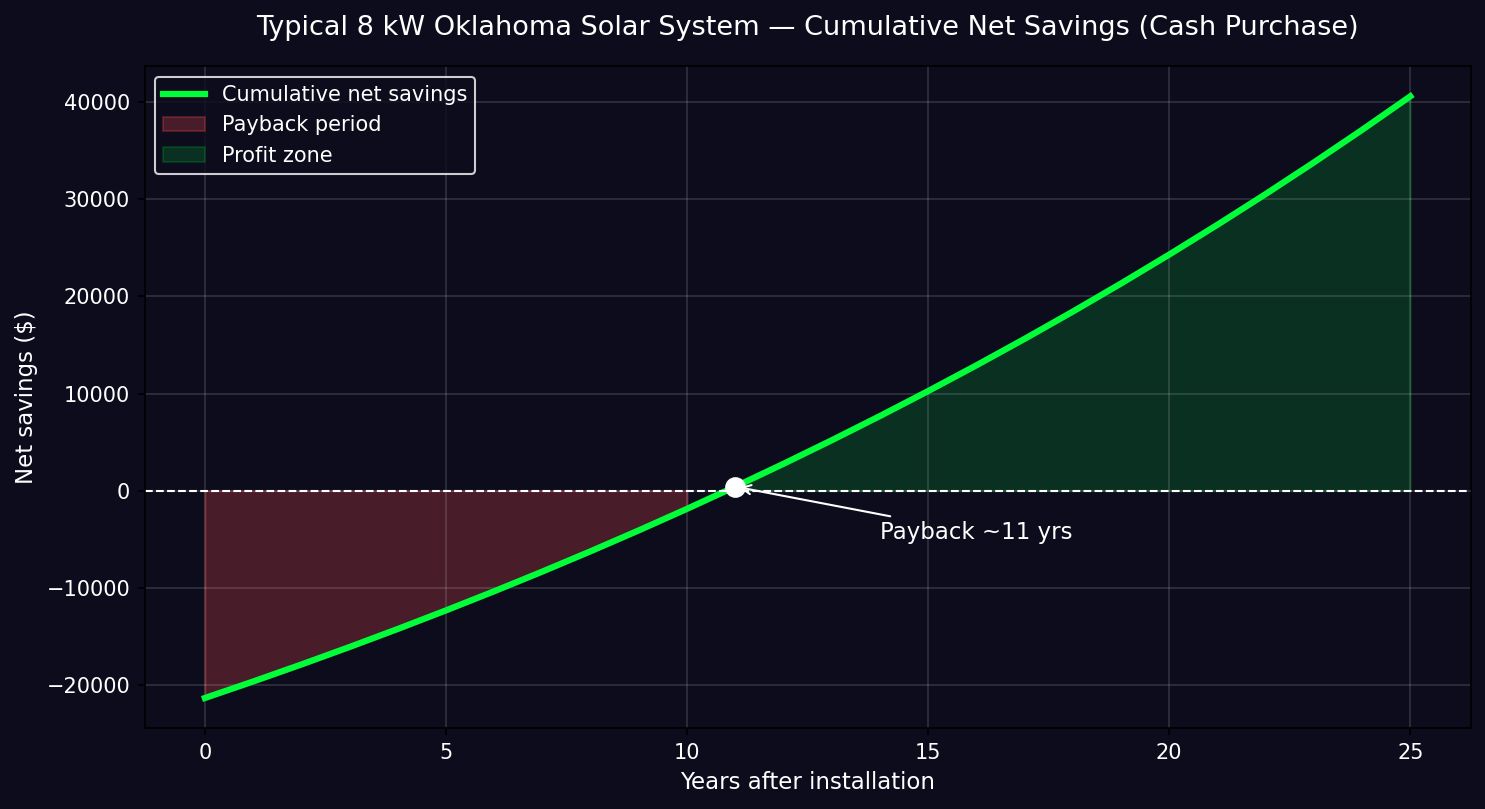
The chart above shows cumulative net savings for a cash-purchased 8 kW system. The crossover point, where cumulative savings turn positive, is the payback period. After payback, every kilowatt-hour produced is effectively free electricity.
Financing Options in Oklahoma
Because the federal tax credit is no longer available to cash and loan buyers, financing structure matters more than before.
Cash purchase: Preserves all bill savings, REC income, and net metering credits. Lifetime savings are highest, but the upfront cost is also highest. Best for homeowners with cash available and stable tax liability.
Solar loan: Spreads the upfront cost over 10 to 25 years. Monthly payments may be lower than the average electric bill, producing immediate cash-flow savings. Interest increases total cost and lengthens payback compared with cash.
Lease or PPA: No upfront cost. The third-party owner claims the commercial Section 48E credit and sells electricity back to the homeowner at a fixed or escalating rate. Savings are usually smaller than ownership, but the barrier to entry is low. Homeowners should compare the escalator and term length carefully.
HELOC or home equity loan: Can offer lower interest rates than unsecured solar loans. The homeowner owns the system and captures all incentives and savings.
USDA REAP: For agricultural producers and rural small businesses with eligible energy use, REAP grants can cover up to 50% of project costs. This is the strongest financial incentive available for qualifying Oklahoma properties in 2026.
Common Mistakes to Avoid
Oklahoma’s thin incentive stack makes accurate design and honest sales language critical. The most common mistakes we see are:
- Oversizing for export. Because export credits are below retail, a system that produces far more than the home uses is a bad investment. Size for 90 to 100% of annual usage.
- Promising the federal tax credit. The Section 25D credit expired for new owner-owned systems. Promising it in 2026 is a consumer-protection risk.
- Assuming retail net metering. Oklahoma does not offer full retail net metering for exports. Only on-site consumption avoids the full retail rate.
- Ignoring co-op rules. Rural electric cooperatives and municipal utilities are not required to offer net metering. Co-op customers must verify their specific tariff before installing.
- Skipping the utility application. The interconnection application determines how exports are metered and credited. Start the utility process early.
How to Apply for Oklahoma Net Metering
For most homeowners, the installer handles the paperwork. The high-level steps are:
- Confirm utility eligibility. Call your utility or check its website for the current net metering tariff, system size limits, and any enrollment fee.
- Size the system. Use 12 months of usage history and a site-specific production estimate. Tools like NREL PVWatts provide a free starting point.
- Submit the interconnection application. The installer typically files this with the utility before installation.
- Install and inspect. After local permitting and inspection, the utility installs a bi-directional meter if needed.
- Receive Permission to Operate. Once the utility grants PTO, the system can export to the grid and credits begin accruing.
Installers can add real value by giving homeowners a clear summary of their net metering terms, expected export percentage, and how credits appear on the bill.
FAQ
What solar incentives are available in Oklahoma in 2026? Oklahoma’s active 2026 incentives include net metering for regulated investor-owned utilities, avoided-cost export credits, voluntary Renewable Energy Certificate sales, community group purchasing such as Solarize OKC when active, and USDA REAP grants for eligible rural businesses and farms. The federal residential solar tax credit expired at the end of 2025. Oklahoma does not offer a state tax credit, statewide property tax exemption, or statewide sales tax exemption for residential solar.
Does Oklahoma have net metering for solar? Yes, for regulated utilities. Under 17 O.S. § 156 and OAC 165:40:9, investor-owned utilities must offer net metering for distributed generation systems up to 300 kW. Solar production offsets on-site consumption at the retail energy rate each billing period. Surplus energy is credited at the utility’s avoided cost rate, roughly $0.02 to $0.08 per kWh. Rural electric cooperatives and municipal utilities are not required to offer net metering.
Is there a state solar tax credit in Oklahoma? No. Oklahoma does not offer a state income tax credit, rebate, or grant for residential solar installations. The main state-level support is the net metering framework.
Is the federal solar tax credit still available in Oklahoma in 2026? No. The 30% federal Residential Clean Energy Credit under Section 25D expired for homeowner-owned systems placed in service after December 31, 2025. Cash and loan buyers in 2026 receive no federal credit. Third-party-owned systems through leases or PPAs may still access the commercial Section 48E credit.
Does Oklahoma have a property tax exemption for solar panels? No. Despite claims by some market guides, Oklahoma does not have a statewide residential property tax exemption for solar. The manufacturer ad valorem exemption for large solar and battery facilities is being sunset beginning January 5, 2028.
Does Oklahoma have a sales tax exemption for solar panels? No. Oklahoma does not provide a statewide sales tax exemption for residential solar equipment. Homeowners should expect to pay standard state and local sales tax unless a specific local exemption applies.
How much are Oklahoma solar RECs worth? Oklahoma has no mandatory SREC market. Voluntary RECs through the North American Renewables Registry might produce roughly $50 to $300 per year for a typical 8 kW system, depending on buyer demand.
What is the typical solar payback period in Oklahoma in 2026? A well-designed residential solar system in Oklahoma typically pays back in 11 to 15 years in 2026 without the federal tax credit.
Are solar batteries incentivized in Oklahoma? No. Oklahoma does not offer a state battery rebate, and the federal Section 25D battery credit expired for owner-installed systems at the end of 2025.
What is the most common mistake when sizing a solar system in Oklahoma? Oversizing for export. Because exported energy is credited at avoided-cost rates, the safest design rule is to size for roughly 90 to 100% of annual usage and treat export credits as a small bonus.
Conclusion
Oklahoma solar in 2026 is a sunshine-and-rates play, not a rebate-stacking play. The federal residential tax credit is gone, the state offers no tax credits or exemptions for residential systems, and net metering exports are credited at avoided-cost rates. The projects that still make financial sense are sized for on-site consumption, built on good roofs, and sold with honest numbers.
Three actions to take next:
- Get utility-specific net metering terms in writing before you design the system.
- Model payback with zero federal credit and below-retail export credits.
- Use SurgePV’s solar design software and solar yield and financial analysis to build proposals that reflect Oklahoma’s real 2026 incentive stack.
Where this fits
This article is part of SurgePV's Solar Incentives & Policy hub, which works through the topic from first principles to the decisions a project team actually has to make.
