

Missouri homeowners paid an average residential electricity rate of about 14 cents per kWh in mid-2026, according to the U.S. Energy Information Administration (2026). That is below the national average, which is one reason Missouri’s solar incentive stack has never been as deep as states like Illinois or Minnesota. The bigger change in 2026 is federal: the Residential Clean Energy Credit expired for homeowner-owned systems at the end of 2025.
This guide explains what is actually available for solar incentives Missouri in 2026. It covers net metering under RSMo 386.890, the Columbia Water & Light rebate, and the ended investor-owned utility rebates. It also covers the property tax exemption court ruling and how financing choices affect ROI. For the national picture, see our solar incentives in USA 2026 guide and state solar incentives in the US overview. For installers, accurate utility-specific modeling is now the difference between a proposal that closes and one that gets rejected. SurgePV’s solar design software and solar financial modeling let you model each incentive stream, utility rate, and financing scenario in one place.
Quick Answer
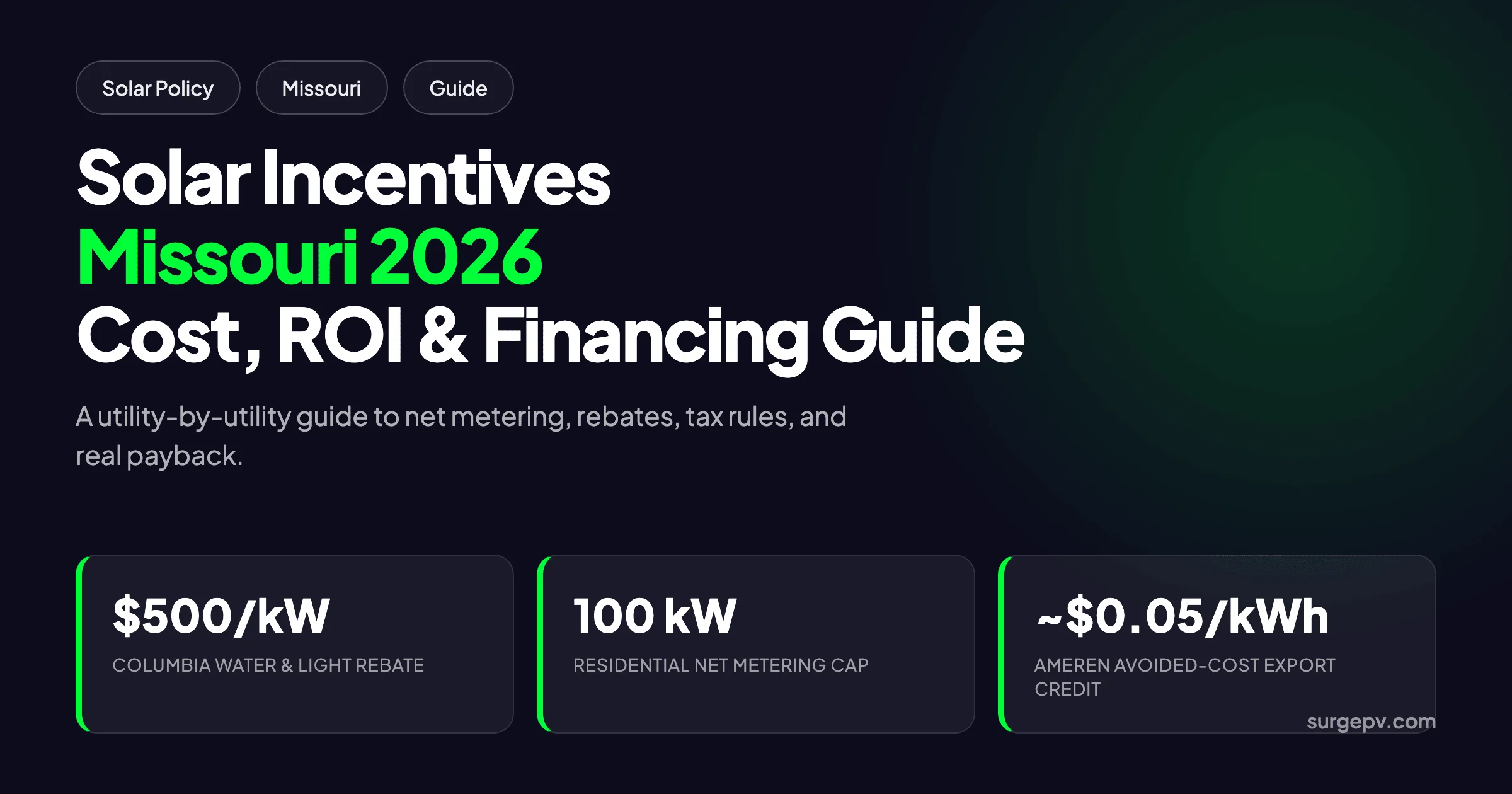
Missouri’s 2026 solar incentives are limited. The federal residential ITC expired at the end of 2025. Active benefits include net metering under RSMo 386.890, the Columbia Water & Light $500/kW solar rebate, and the Solar Access Law (RSMo 442.404). Missouri has no state solar tax credit, no enforceable property tax exemption, and no statewide sales tax exemption. Most investor-owned utility rebates ended in 2023.
In this guide:
- Missouri solar incentive snapshot and what changed in 2026
- Federal tax credit status for residential and commercial projects
- How net metering works under RSMo 386.890
- Utility-specific rules for Ameren, Evergy, Liberty, and Columbia Water & Light
- Property tax, sales tax, and other state rules
- Cost, ROI, and payback scenarios by utility territory
- Financing options and common mistakes
Missouri Solar Incentives at a Glance — 2026
Missouri is a utility-driven solar market. The same system can have very different economics in St. Louis, Kansas City, Columbia, or Joplin because the export credit rate and rebate availability differ. The table below summarizes the main programs active in 2026.
| Incentive | Type | 2026 Status | Typical Value |
|---|---|---|---|
| Federal residential ITC (Section 25D) | Tax credit | Expired | $0 for cash or loan residential purchases |
| Federal Section 48E | Commercial tax credit | Active, deadlines apply | 30% for eligible commercial, lease, or PPA systems |
| Missouri state solar tax credit | Tax credit | Not available | $0 |
| Missouri property tax exemption | Tax exemption | Struck down 2022 | No statutory protection; assessor discretion |
| Missouri sales tax exemption | Tax exemption | Not available | Standard state and local sales tax applies |
| Net metering (RSMo 386.890) | Bill credit | Active | Varies by utility; retail or avoided cost |
| Columbia Water & Light rebate | Utility rebate | Active | $500/kW, plus premium tier |
| Ameren Missouri rebate | Utility rebate | Ended 2023 | $0 for new installs |
| Liberty Utilities rebate | Utility rebate | Ended 2023 | $0 for new installs |
| Evergy Missouri rebate | Utility rebate | Not offered | $0 |
| HOA solar access (RSMo 442.404) | Legal protection | Active | HOAs cannot ban solar |
| Residential PACE | Financing | Prohibited | No new residential PACE after August 2024 |
The biggest misconception is that Missouri still offers a property tax exemption or a state tax credit. It does not. The real money is in net metering, the Columbia Water & Light rebate, and avoiding future utility rate increases. The biggest risk is designing a system for a utility rebate or export rate that no longer exists.
What Changed in 2026
Three changes shape Missouri solar proposals in 2026. Two of them are federal and state legal shifts. The third is the natural expiration of utility rebate programs.
The Federal Residential Tax Credit Expired
The 30% federal Residential Clean Energy Credit under Section 25D expired on December 31, 2025, according to IRS guidance. Homeowner-owned systems placed in service on or after January 1, 2026 no longer qualify. This is a hard stop, not a phase-down.
For Missouri homeowners, this removes the largest single incentive that existed in prior years. Installers once led with “30% federal tax credit plus net metering.” In 2026, proposals must stand on net metering, the Columbia rebate, and avoided utility costs.
Commercial and third-party-owned residential systems still have a path. Section 48E offers 30% for projects that begin construction by July 4, 2026, or are placed in service by December 31, 2027. This is why solar leases and power purchase agreements can still advertise lower monthly payments in 2026. The system owner, not the homeowner, claims the credit.
The Property Tax Exemption Was Struck Down
Missouri Revised Statute 137.100(10) once exempted solar energy systems “not held for resale” from property taxation. The Missouri Supreme Court unanimously struck down that provision in Johnson v. Springfield Solar 1, LLC in August 2022, according to Solar Assure’s Missouri property tax analysis (2026).
The court held that the Missouri Constitution limits property tax exemptions to specifically enumerated property classes. Solar energy systems are not on that list, so the legislature could not create the exemption by statute. The statute remains on the books, but it is unenforceable.
In practice, many county assessors have continued to treat residential rooftop solar as not adding assessed value. That is a matter of local administrative practice, not legal right. Homeowners should ask their county assessor how rooftop solar is treated before assuming any property tax benefit.
Utility Rebates Ended
Ameren Missouri and Liberty Utilities (formerly Empire District) offered residential solar rebates of $0.25 per watt through 2023. Both programs have ended. Evergy Missouri has not offered a residential solar rebate in recent years. Columbia Water & Light is now the only Missouri utility with an active residential solar rebate.
Many aggregator websites still list the Ameren, Liberty, and Evergy rebates as current. They are not. Always confirm program status with the utility before signing a contract.
How Missouri Net Metering Works
Net metering is the billing rule that determines how much a solar customer gets paid for exports. In Missouri, it is governed by the Net Metering and Easy Connection Act, RSMo 386.890.
The law requires every Missouri retail electric supplier to offer net metering for customer-owned systems up to 100 kW. That includes investor-owned utilities, municipal utilities, and rural electric cooperatives. The utility must install a bi-directional meter at no charge, and applications for systems of 10 kW or less must be processed within 30 business days.
The catch is that the statute sets a floor, not a uniform rate. Each utility implements the credit differently.
Ameren Missouri: Avoided-Cost Credit
Ameren Missouri credits net excess generation at the utility’s avoided-cost rate rather than the full retail rate. Recent filings show a summer avoided-cost rate of roughly 5.39 cents per kWh and a winter rate of roughly 3.92 cents per kWh. Source: Missouri Solar Authority (2026).
That is materially lower than Ameren’s retail rate. A kilowatt-hour consumed on site avoids the full retail rate. A kilowatt-hour exported earns only the avoided-cost credit. This makes self-consumption the most valuable design strategy for Ameren customers.
Credits roll forward month to month. At the 12-month anniversary, any remaining credits are settled at avoided cost. There is no cash payout for leftover credits, so oversizing a system for export wastes money.
Evergy and Liberty Utilities: Retail-Offset Credit
Evergy Missouri and Liberty Utilities have historically credited monthly excess solar generation at the retail rate. That means a kilowatt-hour exported in a given month offsets a kilowatt-hour drawn from the grid at the same retail price. At the annual true-up, any remaining credits are still settled at avoided cost with no cash payout.
Some 2026 Missouri installer sources still reference a $0.25 per watt upfront rebate for Evergy and Liberty residential customers. Other sources state those rebate programs ended in 2023. The safest approach is to verify current rebate availability directly with the utility before quoting.
Municipal Utilities and Cooperatives
Municipal utilities and rural electric cooperatives are required to offer net metering, but they set their own tariff details. Columbia Water and Light, City Utilities of Springfield, Independence Power and Light, and individual cooperatives each have their own interconnection rules and credit rates. Always model the specific utility tariff, not a generic Missouri assumption.
Active Utility Rebates and Programs
Missouri’s only active residential solar rebate in 2026 is in Columbia. Other utility programs are either efficiency-focused or closed to new solar applicants.
Columbia Water & Light Solar Rebate
Columbia Water and Light offers a standard rebate of $500 per installed kW for residential solar systems, according to DSIRE (2025). The program also pays a premium rebate for systems designed to perform well during peak demand periods. The premium depends on panel azimuth, tilt, and shading.
A typical 8 kW system qualifies for a $4,000 standard rebate. Columbia Water and Light also offers solar loans up to $15,000 for residential customers. Rates are 1% for terms up to 3 years, 3% for 4 to 5 years, and 5% for 6 to 10 years. Source: City of Columbia Utilities (2026). Pre-project approval is required before installation begins.
Ended Investor-Owned Utility Rebates
Ameren Missouri’s residential solar rebate ended December 31, 2023. The legacy program paid $0.25 per watt up to 25 kW. Liberty Utilities ended its Missouri solar rebate in August 2023. Evergy Missouri has not offered a residential solar rebate in recent years.
Installers should not include these rebates in 2026 proposals unless the customer has written pre-approval from a grandfathered program.
Missouri Solar Access Law
Missouri’s Solar Access Law, RSMo 442.404, prohibits homeowners associations from banning residential solar panels outright. HOAs may impose reasonable aesthetic restrictions, such as panel color or conduit routing, but they cannot block the installation.
This is not a financial incentive, but it removes a common non-economic barrier. Installers working in deed-restricted communities should cite the statute in HOA submission packets.
Tax Exemptions and What Missouri Does Not Have
Missouri’s tax treatment of solar is weaker than many neighboring states. The key facts are negative, but they need to be stated clearly so proposals are accurate.
No State Solar Tax Credit
Missouri has never offered a state income tax credit for residential solar. Any proposal that includes a “Missouri solar tax credit” is incorrect. The only tax-related benefit is the indirect federal Section 48E credit captured by lease or PPA providers.
No Enforceable Property Tax Exemption
As noted above, the Missouri Supreme Court struck down the solar property tax exemption in 2022. Some county assessors may still choose not to add solar value to a home’s assessment, but that is discretionary. Homeowners should not count on a permanent exemption.
For planning purposes, a $25,000 solar system might add roughly 4% to home market value, according to Solar Assure (2026). At Missouri’s average effective property tax rate of roughly 0.97%, that could add about $240 per year in taxes if the assessor counts the full value.
No Sales Tax Exemption
Missouri does not exempt residential solar equipment or installation labor from state and local sales tax. A $25,000 system in an area with a 7.5% combined sales tax rate incurs about $1,875 in sales tax. Installers should make this explicit in the quote.
Financing Options in Missouri
Without the federal residential tax credit, financing choice matters more. The best option depends on the customer’s tax situation, credit score, and preference for ownership.
Cash Purchase
Cash delivers the highest lifetime savings because there is no interest. The customer captures the full Columbia Water & Light rebate and all net metering credits. Payback is typically 13 to 17 years in Missouri, and the system produces free electricity for 15 to 25 years after that.
Solar Loan
A solar loan preserves ownership of net metering credits and rebates. However, loan interest reduces net savings. A 20-year loan at 7% to 9% interest can add 30% to 50% to the total cost of the system compared to cash. In 2026, the federal tax credit cannot reduce loan principal for new homeowner-owned systems. That removes one of the main arguments for solar loans.
Lease or Power Purchase Agreement
Leases and PPAs require no upfront payment and provide immediate monthly savings. The system owner, usually a financing company or installer, claims any available federal Section 48E credit. The homeowner receives a lower electricity rate, typically 10% to 20% below utility rates.
The downside is that the homeowner does not own the system or capture utility rebates directly. Leases and PPAs can also complicate home sales.
PACE and C-PACE
Residential Property Assessed Clean Energy financing is no longer available in Missouri for new projects. Senate Bill 736, signed in 2024, prohibited new residential PACE assessment contracts after August 28, 2024, according to LegiScan SB736 text. Commercial PACE remains available for qualifying properties.
Columbia Water & Light Solar Loan
For Columbia customers, the municipal solar loan is one of the lowest-cost financing options. Rates start at 1% for short terms, well below market solar loan rates. The loan can be stacked with the Columbia rebate.
USDA REAP for Rural Properties
Agricultural producers and rural small businesses may qualify for USDA Rural Energy for America Program grants and loan guarantees. REAP can cover up to 50% of eligible project costs, but applications must be submitted before construction begins.
Cost, ROI, and Payback Scenarios
The financial case for solar in Missouri depends heavily on utility territory. The examples below use illustrative 2026 costs and incentive values. Actual figures depend on location, roof conditions, installer quote, and whether the customer qualifies for local programs.
Typical System Costs
As of mid-2026, Missouri residential solar costs average roughly $2.90 to $3.10 per watt before incentives. A typical 8 kW system costs $23,200 to $24,800 before incentives. The state receives roughly 4.3 average daily peak sun hours, according to Solar Ledger (2026).
Scenario 1: Columbia Water & Light, 8 kW System
| Line Item | Value |
|---|---|
| Gross system cost | $24,000 |
| Columbia Water & Light rebate | -$4,000 |
| Net upfront cost | $20,000 |
| Estimated first-year production | 10,800 kWh |
| First-year utility savings at $0.14/kWh | $1,500 |
| Simple payback | 13-14 years |
This assumes the system offsets most annual consumption and exports a modest surplus. The Columbia rebate is the single largest upfront incentive available to Missouri homeowners in 2026.
Scenario 2: Ameren Missouri, 8 kW System
| Line Item | Value |
|---|---|
| Gross system cost | $24,000 |
| Utility rebate | $0 |
| Net upfront cost | $24,000 |
| Estimated first-year production | 10,800 kWh |
| First-year utility savings with avoided-cost exports | $1,250 |
| Simple payback | 16-18 years |
Ameren’s avoided-cost export credit reduces the value of exported solar. The better design strategy is to size the system close to actual consumption and maximize self-consumption.
Scenario 3: Evergy or Liberty Territory, 8 kW System
| Line Item | Value |
|---|---|
| Gross system cost | $24,000 |
| Utility rebate (if confirmed active) | -$2,000 |
| Net upfront cost | $22,000 |
| Estimated first-year production | 10,800 kWh |
| First-year utility savings with retail-offset net metering | $1,500 |
| Simple payback | 12-15 years |
If the Evergy or Liberty $0.25/W rebate is still funded, the payback shortens materially. If the rebate is not available, the payback moves closer to the Ameren scenario.
These scenarios are illustrative. Actual results depend on roof orientation, shading, equipment, financing, and future utility rate changes. SurgePV’s generation and financial tool can model specific projects with current Missouri rates and incentives.
Common Mistakes and Misconceptions
Missouri’s thin incentive stack means mistakes are costly. Here are the most common errors.
Quoting the Expired Federal ITC
The most expensive error is telling a homeowner they can claim the 30% federal tax credit on a 2026 cash or loan purchase. Section 25D ended on December 31, 2025. Only commercial, lease, or PPA structures can still access federal credits.
Assuming the Property Tax Exemption Still Applies
Many websites still list Missouri’s solar property tax exemption as active. The Missouri Supreme Court struck it down in 2022. Proposals should not assume a property tax benefit unless the local assessor confirms it in writing.
Ignoring Utility Territory
A system in Columbia can have a very different payback than the same system in St. Louis or Kansas City. The retail rate, export credit, and rebate availability all differ. The first question in any Missouri proposal should be: who is the utility?
Oversizing for Export
Export credits are worth less than self-consumed production, especially for Ameren customers. The safer design rule is to size the system for roughly 90% to 100% of annual consumption and treat exports as a bonus.
Relying on Outdated Utility Rebates
Ameren and Liberty solar rebates ended in 2023. Do not include them in 2026 proposals without current written confirmation from the utility.
Conclusion
Missouri solar incentives in 2026 are limited, but solar can still make financial sense in the right territory. The federal residential tax credit is gone for homeowner-owned systems. The value now comes from net metering, the Columbia Water & Light rebate, and protection from future utility rate increases.
- Verify your utility territory and current net metering tariff before signing a contract.
- Size the system for self-consumption, not export, because export credits vary widely by utility.
- Compare cash, loan, lease, and Columbia Water & Light loan options using a territory-specific financial model.
For installers, accurate Missouri proposals require precise modeling of net metering value, utility rebates, and local tax treatment. SurgePV’s solar design software and generation and financial tool help you build proposals that show real payback and ROI for both residential and commercial projects. Generate professional solar proposals, then check pricing or book a demo.
Frequently Asked Questions
What solar incentives are available in Missouri in 2026?
Missouri’s active solar incentives in 2026 include net metering under RSMo 386.890, the Columbia Water & Light rebate, and HOA protections under RSMo 442.404. The federal residential tax credit expired for homeowner-owned systems after December 31, 2025. Missouri has no state solar tax credit, no enforceable property tax exemption, and no statewide sales tax exemption.
Does Missouri have a state solar tax credit in 2026?
No. Missouri does not offer a state income tax credit for residential solar installations. The only tax-related benefits are indirect, such as the ability of lease or PPA providers to claim the federal Section 48E commercial credit.
Is the federal solar tax credit still available in Missouri in 2026?
The 30% federal Residential Clean Energy Credit under Internal Revenue Code Section 25D expired for homeowner-owned systems placed in service after December 31, 2025. Commercial, lease, and power purchase agreement systems may still qualify under Section 48E. Construction must begin by July 4, 2026, or the system must be placed in service by December 31, 2027.
Does Missouri have net metering for solar?
Yes. Missouri’s Net Metering and Easy Connection Act (RSMo 386.890) requires utilities to offer net metering for residential systems up to 100 kW. Excess generation is credited to the customer’s bill. The value of that credit varies by utility. Ameren Missouri credits excess at avoided cost, while Evergy and Liberty Utilities have historically credited monthly excess at retail rates.
How does Ameren Missouri net metering work?
Ameren Missouri credits excess solar generation at the utility’s avoided-cost rate, roughly 5.39 cents per kWh in summer and 3.92 cents per kWh in winter. Credits roll forward monthly, and any remaining balance at the 12-month anniversary is settled at avoided cost with no cash payout.
What is the Columbia Water and Light solar rebate?
Columbia Water and Light offers a standard rebate of $500 per installed kW for residential solar systems. A premium tier rewards systems that perform well during peak demand periods. Pre-project approval is required before installation begins.
Does Missouri have a property tax exemption for solar panels?
Not as an enforceable statewide exemption. The Missouri Supreme Court struck down RSMo 137.100(10) in Johnson v. Springfield Solar 1, LLC in August 2022, ruling that the legislature could not create a property tax exemption for solar systems by statute. Some county assessors still do not add solar value to assessments, but homeowners should verify local practice.
Does Missouri have a sales tax exemption for solar equipment?
No. Missouri does not exempt residential solar equipment from state and local sales tax. Installers should include sales tax in the quoted system price.
Can an HOA ban solar panels in Missouri?
No. Missouri’s Solar Access Law (RSMo 442.404) prohibits homeowners associations from banning residential solar panels outright. HOAs may enforce reasonable aesthetic rules, such as conduit color or panel placement, but they cannot block the installation entirely.
What is the typical solar payback period in Missouri in 2026?
A well-designed residential solar system in Missouri typically pays back in 13 to 17 years in 2026 without the federal residential tax credit. Payback is shorter for Columbia Water & Light customers who receive the $500/kW rebate and shorter still for customers on utilities with retail-rate net metering. Ameren customers with avoided-cost credits generally see the longest payback.
Where this fits
This article is part of SurgePV's Solar Incentives & Policy hub, which works through the topic from first principles to the decisions a project team actually has to make.
