

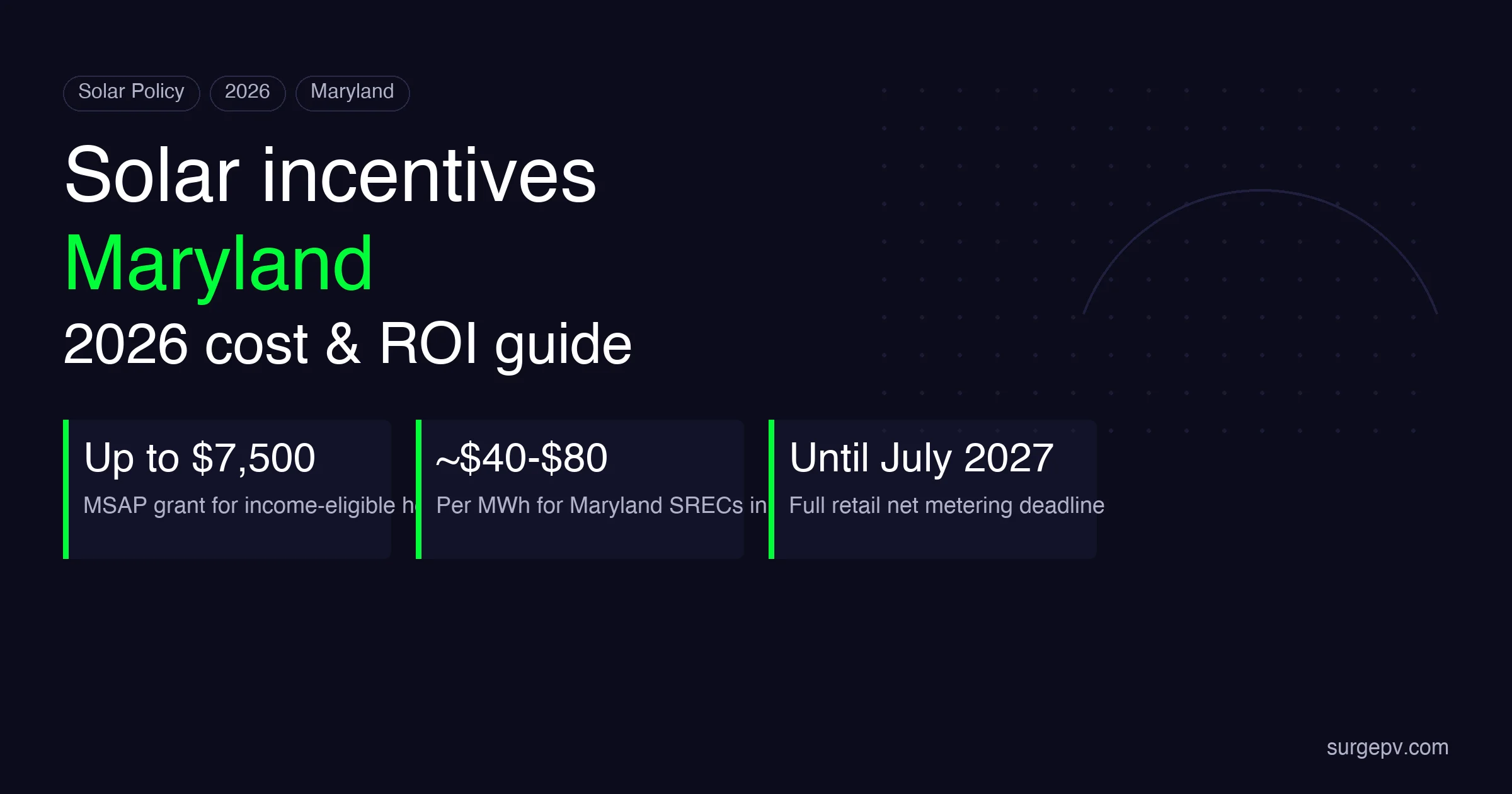
Maryland’s solar market reached roughly 2.2 GW of total installed capacity by early 2026, ranking it among the top twenty states for cumulative solar deployment, according to SEIA’s 2025 Year in Review. The state has long offered one of the stronger East Coast incentive stacks, but the policy picture changed at the start of 2026. The federal residential Investment Tax Credit expired on December 31, 2025. At the same time, Maryland’s net metering program received a sunset date of July 1, 2027 under the Utility RELIEF Act passed in April 2026.
For installers, EPCs, and homeowners, the message is simple: Maryland solar still works, but the math is now state-driven and time-sensitive. This guide covers every active 2026 incentive, the real dollar value of each, and how to stack them before the net metering window closes. For the broader U.S. picture, see our solar incentives in USA 2026 guide. For payback comparisons across states, see state solar incentives in the US.
If you are modeling Maryland projects, a solar design platform can capture utility rates, net metering rules, and SREC income automatically. That cuts proposal time by hours. Build the system, run the financials, and generate solar proposals in minutes. Check pricing or book a demo to see how SurgePV handles Maryland.
Quick Answer
Maryland’s 2026 solar incentive stack includes the Maryland Solar Access Program grant up to $7,500 for income-eligible homeowners, Solar Renewable Energy Credits worth roughly $40-$80 per MWh, full retail-rate net metering until July 1, 2027, a 6% sales tax exemption, a 100% property tax exemption, and additional county credits. The federal residential tax credit expired in 2025.
In this guide:
- Latest 2026 status of every active Maryland solar incentive
- How the federal ITC expiration changes the math
- MSAP grants, income limits, and FY27 timing
- Maryland SRECs and Certified BT SRECs
- Net metering rules and the July 2027 sunset
- Sales tax, property tax, battery, and county incentives
- Three real-world stacking scenarios by utility territory
- Common mistakes and how to avoid them
Latest Updates: Maryland Solar Incentives 2026
Maryland’s solar policy environment tightened in 2026. The federal credit disappeared, the MSAP FY26 budget was fully requested, and the legislature set an end date for full retail net metering. The programs that remain are valuable, but several have deadlines or capacity limits.
Maryland Solar Incentive Status — June 2026
| Incentive | Type | Status | Key Terms |
|---|---|---|---|
| Federal residential ITC | Tax credit | Expired | Section 25D ended December 31, 2025 |
| Maryland Solar Access Program (MSAP) | State grant | FY26 closed; FY27 expected summer 2026 | $750/kW, max $7,500; ≤150% AMI |
| Net metering | Export credit | Active, sunset July 1, 2027 | 1:1 retail credit; 3 GW statewide cap |
| Solar Renewable Energy Credits | Tradeable certificate | Active | 1 SREC per 1,000 kWh; ~$40-$80/MWh |
| Certified BT SRECs | Tradeable certificate | Active through January 1, 2028 | 1.5x multiplier for qualifying systems |
| Sales tax exemption | Tax exemption | Active | 6% waived on equipment and labor |
| Property tax exemption | Tax exemption | Active statewide | 100% of added value excluded |
| RCES battery grant | State grant | FY26 closed June 5, 2026 | Up to $5,000 residential |
| County property tax credits | Local credit | Varies by county | Up to $5,000 in several counties |
| Community solar | Subscription credit | Active, permanent | 5-20% bill discount |
Key Changes Since 2025
Federal ITC expiration: The 30% residential Investment Tax Credit under Section 25D expired for systems placed in service after December 31, 2025. Homeowners who buy solar in 2026 with cash or a loan cannot claim it. Commercial, third-party-owned, and leased systems may still qualify under Section 48E.
MSAP FY26 closure: The Maryland Solar Access Program received $12 million for FY26 and closed to new applications on April 17, 2026 after total funding requests exceeded the budget, according to the Maryland Energy Administration (2026). FY27 funding is anticipated to launch in summer 2026.
Net metering sunset: The Maryland General Assembly passed the Utility RELIEF Act on April 13, 2026. The law clarifies the existing net metering timeline. The 1:1 retail-rate program ends July 1, 2027 or when the statewide cap of 3 GW is reached, whichever comes first. The deadline is based on analysis by the Chesapeake Climate Action Network (2026). The Maryland Public Service Commission must design a replacement program expanding capacity to 6 GW. The credit rate has not been finalized and is expected to be lower than the current retail rate.
Key Takeaway
2026 is a transition year in Maryland. The most reliable ongoing benefits are sales tax exemption, property tax exemption, and SREC income. Net metering remains full retail but has a hard deadline. MSAP is closed for FY26 but expected to return. Interconnect before July 1, 2027 if you want the current net metering terms.
Why Maryland’s Solar Market Matters in 2026
Maryland is not the sunniest state, but it is one of the most incentive-rich on the East Coast. High electricity rates in the Baltimore-Washington corridor, a mature SREC market, and strong net metering have kept residential solar viable even after the federal credit expired.
Market Size and Targets
Maryland ranked 17th nationally in installed solar capacity with roughly 2.2 GW online by early 2026, according to SEIA (2025). The state has a binding renewable portfolio standard requiring 50% renewable electricity by 2030 and 100% clean electricity by 2035, with a meaningful solar carve-out. That carve-out is what creates demand for SRECs.
Residential electricity rates vary sharply by utility. The Maryland Office of People’s Counsel reported that BGE, Pepco, and Delmarva Power have raised distribution rates repeatedly since Exelon’s 2016 acquisition of Pepco Holdings. Pepco’s average distribution rate rose 132% from 2015 to 2026, according to OPC (2026). Higher rates improve the value of every kilowatt-hour offset by solar.
Utility Rate Snapshot — Spring 2026
| Utility | Service Area | Price to Compare (through May 2026) |
|---|---|---|
| BGE | Baltimore, Central MD | 16.64¢/kWh |
| Pepco | Montgomery, Prince George’s | 13.25¢/kWh |
| Delmarva Power | Eastern Shore | 12.09¢/kWh |
| Potomac Edison | Western MD | 11.19¢/kWh |
Source: Choose Energy Maryland electric rates (2026).
These rates are the price to compare for customers who have not selected a competitive supplier. They are not perfect proxies for net metering credit value. Even so, they explain why solar economics are stronger for BGE and Pepco customers than for Potomac Edison customers.
Maryland Solar Access Program (MSAP)
MSAP is the largest direct upfront grant available to Maryland homeowners in 2026. It replaced the older Residential Clean Energy Rebate Program and was created by the Brighter Tomorrow Act of 2024.
How MSAP Works
- Grant amount: $750 per kW of installed solar capacity.
- Maximum grant: $7,500 per household.
- Eligibility: Homeowners at or below 150% of the statewide area median income.
- Installer requirement: The contractor must be on the MEA-approved participating contractor list.
- Timing: Applications must be submitted before installation begins.
For a household of four, the income limit is $195,375 for FY26, according to the Maryland Energy Administration (2026).
FY26 Status and FY27 Outlook
The FY26 program opened July 21, 2025 and closed to new applications on April 17, 2026 after the $12 million budget was fully requested. Homeowners who already reserved funds must complete installation within 180 days of their reservation date unless MEA grants an extension. FY27 funding is anticipated to launch in summer 2026, but the budget and exact timing have not been announced.
Why MSAP Changes the Payback Math
A 10 kW system qualifies for the full $7,500 grant. At an average installed price of $2.70 per watt, that is a 28% effective upfront discount, larger than the expired federal ITC for many system sizes. For income-eligible homeowners, MSAP is the single most important incentive in the stack.
Solar Renewable Energy Credits (SRECs)
Maryland’s Renewable Portfolio Standard requires utilities to source a percentage of electricity from solar. SRECs are the compliance currency. Every 1,000 kWh of solar generation earns one SREC, which can be sold to utilities or brokers.
SREC Basics
- One SREC = 1 MWh of solar generation.
- SRECs are earned for 15 years from the system’s interconnection date.
- SRECs have a three-year useful life: a 2026 SREC can be used for compliance through 2028.
- Income is taxable as ordinary income.
SREC Prices in 2026
Market prices have varied. Standard Maryland SRECs have traded in a range of roughly $40 to $80 per MWh in 2026, according to data reported by Palmetto (2026) and Maryland Solar Guide (2026). Prices depend on supply, demand, and the Solar Alternative Compliance Payment level.
Certified BT SRECs
The Brighter Tomorrow Act created a premium SREC tier for qualifying systems installed between July 1, 2024 and January 1, 2028. Certified BT SRECs carry a 1.5x compliance multiplier, meaning each BT SREC satisfies 1.5 times the obligation of a standard SREC. To qualify, systems generally must be 20 kW or smaller. They must be located on a rooftop, parking canopy, or brownfield. Registration must also occur within the first 300 MW AC of eligible capacity for that size tier.
A typical 8 kW system producing 10 MWh annually earns 10 SRECs per year. At a BT SREC price of roughly $55 per MWh, that is about $550 per year in additional income for 15 years.
Net Metering Rules and the July 2027 Sunset
Net metering is the most financially significant ongoing solar benefit for most Maryland homeowners. It is also the one with the most urgent deadline.
How Maryland Net Metering Works
Under current rules, exported solar kilowatt-hours are credited at the full retail electricity rate. The customer pays only the net difference between imports and exports. Credits roll over month to month indefinitely, with an annual true-up in April. At true-up, any remaining surplus credits are settled at the avoided-cost rate, which is lower than the retail rate.
The July 1, 2027 Sunset
The Utility RELIEF Act of 2026, passed April 13, 2026, clarified the net metering timeline. The existing program ends July 1, 2027 or when the statewide cap of 3 GW is reached, whichever comes first, according to CCAN analysis (2026). The Maryland PSC is required to develop a replacement program with up to 6 GW of capacity. The replacement is expected to credit exports at a rate below full retail, similar to net billing transitions in other states.
Projects that have a queue position and have paid for required grid upgrades may still qualify for current net metering. This grandfathering pathway can apply even if the project is placed in service after July 1, 2027. This grandfathering pathway matters for large commercial projects but is harder for residential homeowners to rely on.
Design Implication
Surplus credits are settled at avoided cost, and the future export rate is uncertain. The conservative design rule is to size for 90-100% of annual consumption rather than maximum generation. Treat net metering as a self-consumption benefit first and an export benefit second.
A generation and financial tool can test system size against actual hourly usage and the current retail rate. It can also model a lower future export rate to show the range of possible outcomes.
Tax Exemptions, Battery Grants, and Community Solar
Beyond MSAP, SRECs, and net metering, Maryland offers several smaller but meaningful programs.
Sales Tax Exemption
Solar energy equipment and installation labor are exempt from Maryland’s 6% sales and use tax. The exemption is automatic at the point of purchase. On a $25,000 system, the savings are roughly $1,500.
Property Tax Exemption
Maryland excludes the value of a qualifying solar energy system from a homeowner’s property tax assessment. This is statewide and lasts for the life of the system. It prevents the added home value from increasing property tax bills.
Residential and Commercial Energy Storage Grant (RCES)
The RCES program replaced the Maryland Energy Storage Income Tax Credit after it expired in 2024. For FY26, it offered up to $5,000 for residential battery systems and up to $150,000 for commercial systems, with a total budget of $2 million. The FY26 program closed to new applications on June 5, 2026, according to the Maryland Energy Administration (2026).
Community Solar
Maryland’s permanent community solar program allows renters, condo owners, and homeowners with unsuitable roofs to subscribe to a share of an off-site solar array. Standard subscribers typically receive a 5-15% discount on electricity costs. Low-income subscribers below 80% of area median income can receive discounts of 20% or more. The program introduced consolidated billing in January 2026.
County and Local Incentives
Several Maryland counties offer property tax credits on top of the statewide exemption. These are often first-come, first-served and may require a pre-installation application.
County Property Tax Credits
| County | Maximum Credit | Notes |
|---|---|---|
| Anne Arundel | $2,500 | Confirm current availability with county assessor |
| Baltimore County | $5,000 | One-time credit, limited annual budget |
| Howard | $5,000 or 50% of cost | Also $1,500 for solar water heating |
| Montgomery | $5,000 or 50% of cost | Verify pre-installation requirements |
| Prince George’s | $5,000 | Check current program status |
Source: Maryland Solar Guide (2026).
Montgomery County Green Bank
Montgomery County offers low-interest solar and battery loans through the Montgomery County Green Bank. Rates are as low as 0% for the first ten years for homes in Equity Emphasis Areas and 2.99% APR for standard qualifying loans, according to Aduu Solar (2026).
How to Stack Incentives: Three Real-World Scenarios
The following examples use illustrative 2026 costs and incentive values. Actual figures depend on location, utility, roof conditions, installer quote, and whether the homeowner qualifies for income-limited programs.
Scenario 1 — 8 kW BGE Customer, Baltimore County, MSAP-Eligible
| Item | Amount |
|---|---|
| Gross installed cost | $21,600 |
| Sales tax exemption savings | -$1,296 |
| MSAP grant | -$6,000 |
| Net cost | $14,304 |
| Annual bill savings (16.6¢/kWh) | $1,800 |
| Annual SREC income (10 SRECs at $55) | $550 |
| Payback | 6.1 years |
Scenario 2 — 7 kW Pepco Customer, Montgomery County, Not MSAP-Eligible
| Item | Amount |
|---|---|
| Gross installed cost | $18,900 |
| Sales tax exemption savings | -$1,134 |
| Net cost | $17,766 |
| Annual bill savings (13.3¢/kWh) | $1,450 |
| Annual SREC income (9 SRECs at $50) | $450 |
| Payback | 8.6 years |
Scenario 3 — 150 kW Commercial Rooftop, Baltimore City
| Item | Amount |
|---|---|
| Gross installed cost | $405,000 |
| Sales tax exemption savings | -$24,300 |
| Section 48E tax credit (if eligible) | -$121,500 |
| Annual bill savings and demand reduction | $42,000 |
| Annual SREC income (180 SRECs at $50) | $9,000 |
| Payback | 5.8 years |
Commercial projects can still access the federal Section 48E credit. Construction must begin by July 4, 2026, or the system must be placed in service by December 31, 2027. For commercial installers, load profiling and shadow analysis matter more than simple bill offset.
Common Mistakes and Misconceptions
Even experienced installers lose money in Maryland by misunderstanding how incentives interact.
Quoting the Expired Federal ITC
The most expensive mistake is telling a homeowner they can claim the 30% federal tax credit. That credit does not apply to systems purchased in 2026. Section 25D expired for homeowner-owned systems on December 31, 2025. Lease and PPA providers may still access commercial credits, but the customer does not receive a direct federal credit on a cash or loan purchase.
Assuming MSAP Will Be Available
MSAP FY26 is closed to new applicants. FY27 funding is expected, but the budget, income limits, and timing have not been finalized. Do not promise MSAP in a 2026 proposal without confirming the program is open and the installer is an approved contractor.
Oversizing for Export
Maryland’s net metering credits exports at full retail today. The program ends July 1, 2027, and annual surplus credits are settled at avoided cost. A system that produces 120% of annual consumption may look good on paper but leaves value on the table. Size for what the household uses.
Ignoring Utility Differences
A 7 kW system in Pepco territory can have a materially different payback than the same system in Potomac Edison territory. The retail rate differs by several cents per kWh. Always model the customer’s actual utility and rate schedule, not a state average.
Missing the BT SREC Registration Window
Certified BT SREC status is tied to the interconnection date and capacity limits. If registration is delayed, the system may only qualify for standard SRECs. Register at interconnection, not months later.
Forgetting County Applications
Several county credits require an application before installation. If the installer waits until after the system is operational, the homeowner may miss the credit entirely.
Conclusion
Maryland’s solar incentive stack in 2026 is still one of the strongest on the East Coast, but it is no longer anchored by a federal tax credit. The value now comes from MSAP grants for income-eligible homeowners, SREC income for all system owners, and full retail net metering until July 1, 2027. Statewide sales and property tax exemptions add further value. County credits and battery grants add further value where available.
For solar professionals, the competitive edge is the ability to model the stack accurately and move quickly. The net metering sunset creates urgency. Homeowners who interconnect before July 1, 2027 lock in the most valuable export credit Maryland has offered. After that, the PSC’s replacement program is likely to pay less for exports.
Tools like SurgePV’s solar design software and generation and financial tool let you build Maryland-specific proposals. They reflect real utility rates, SREC income, and the net metering deadline. For installers scaling in the state, our guide for solar installers covers proposal automation and compliance workflows.
Three actions to take now:
- Confirm program status before quoting — MSAP and RCES are closed for FY26; FY27 timing is pending.
- Interconnect before July 1, 2027 — lock in full retail net metering while it remains available.
- Size for self-consumption — exported energy is worth less after the annual true-up and may be worth far less under the replacement program.
For the national picture, see our solar incentives in USA 2026 guide and state solar incentives in the US analysis, both linked earlier in this guide.
Frequently Asked Questions
What solar incentives are available in Maryland in 2026?
Maryland’s 2026 solar incentives include the Maryland Solar Access Program grant up to $7,500 for income-eligible homeowners. Other active programs include Solar Renewable Energy Credits worth roughly $40-$80 per MWh. Full retail-rate net metering continues until July 1, 2027 or the 3 GW cap. The state also offers a 6% sales tax exemption and a 100% statewide property tax exemption. Battery storage grants up to $5,000 and additional county property tax credits are also available. The federal residential tax credit expired in 2025.
Is the federal solar tax credit still available in Maryland in 2026?
No. The 30% federal Residential Clean Energy Credit under Internal Revenue Code Section 25D expired for homeowner-owned systems placed in service after December 31, 2025. Commercial, third-party-owned, and leased systems may still qualify under Section 48E. Maryland’s state and local incentives now carry most of the financial value for residential solar.
What is the Maryland Solar Access Program (MSAP)?
MSAP is a state grant created by the Brighter Tomorrow Act of 2024. It provides $750 per kW of installed solar capacity, up to $7,500 per household, for income-eligible Maryland homeowners. Eligibility is limited to households at or below 150% of the statewide area median income. The FY26 program closed to new applications on April 17, 2026 after the $12 million budget was fully requested. FY27 funding is anticipated in summer 2026.
How does Maryland net metering work in 2026?
Maryland currently offers full retail-rate net metering, meaning every kilowatt-hour exported earns a credit equal to the retail rate you would pay to import it. Credits roll over month to month and are trued up annually in April. The current program ends July 1, 2027 or when the statewide cap of 3 GW is reached, whichever comes first. The sunset is set by the Utility RELIEF Act of 2026. The Maryland Public Service Commission must design a replacement program, but the new credit structure has not been finalized.
How much are Maryland SRECs worth in 2026?
Standard Maryland Solar Renewable Energy Credits have traded in a range of roughly $40 to $80 per MWh in 2026, depending on market supply and demand. Certified Brighter Tomorrow Act SRECs, available for qualifying systems installed between July 1, 2024 and January 1, 2028, carry a 1.5x compliance multiplier and typically trade at a premium. A typical 8 kW residential system producing 9-11 MWh annually earns 9-11 SRECs per year.
Does Maryland have a sales tax exemption for solar panels?
Yes. Solar energy equipment and installation labor are exempt from Maryland’s 6% sales and use tax. The exemption is applied automatically at the point of purchase and does not require a separate application. On a typical $25,000 installation, this saves approximately $1,500 upfront.
Does Maryland have a property tax exemption for solar?
Yes. Maryland law excludes the value of a qualifying solar energy system from a homeowner’s property tax assessment. Several counties also offer additional local property tax credits. Anne Arundel County offers up to $2,500. Baltimore, Howard, Montgomery, and Prince George’s counties each offer up to $5,000. County programs have limited budgets and may require pre-installation applications.
Are solar batteries incentivized in Maryland in 2026?
Yes. The Maryland Residential and Commercial Energy Storage Grant Program offers up to $5,000 for residential battery systems and up to $150,000 for commercial systems. The FY26 program had a $2 million budget and closed to new applications on June 5, 2026. Standalone batteries no longer qualify for the expired federal residential Section 25D credit. Batteries paired with commercial or third-party-owned systems may still be included in a Section 48E claim.
What is the typical solar payback period in Maryland in 2026?
Payback periods for well-designed residential solar systems in Maryland typically range from 7 to 11 years in 2026. The exact result depends on utility territory, system size, roof orientation, shading, and whether MSAP or county credits apply. Homes served by BGE, Pepco, or Delmarva Power generally see shorter paybacks than those served by Potomac Edison because retail electricity rates are higher.
What is the most common mistake when sizing a solar system in Maryland?
The most common mistake is oversizing for export. Maryland’s current net metering program ends July 1, 2027. Annual surplus credits are settled at a lower avoided-cost rate. A system that produces far more than the household consumes can leave value on the table. The safer design rule is to size for roughly 90-100% of annual consumption. Treat exports as a bonus, and lock in interconnection before the net metering sunset.
Where this fits
This article is part of SurgePV's Solar Incentives & Policy hub, which works through the topic from first principles to the decisions a project team actually has to make.
