

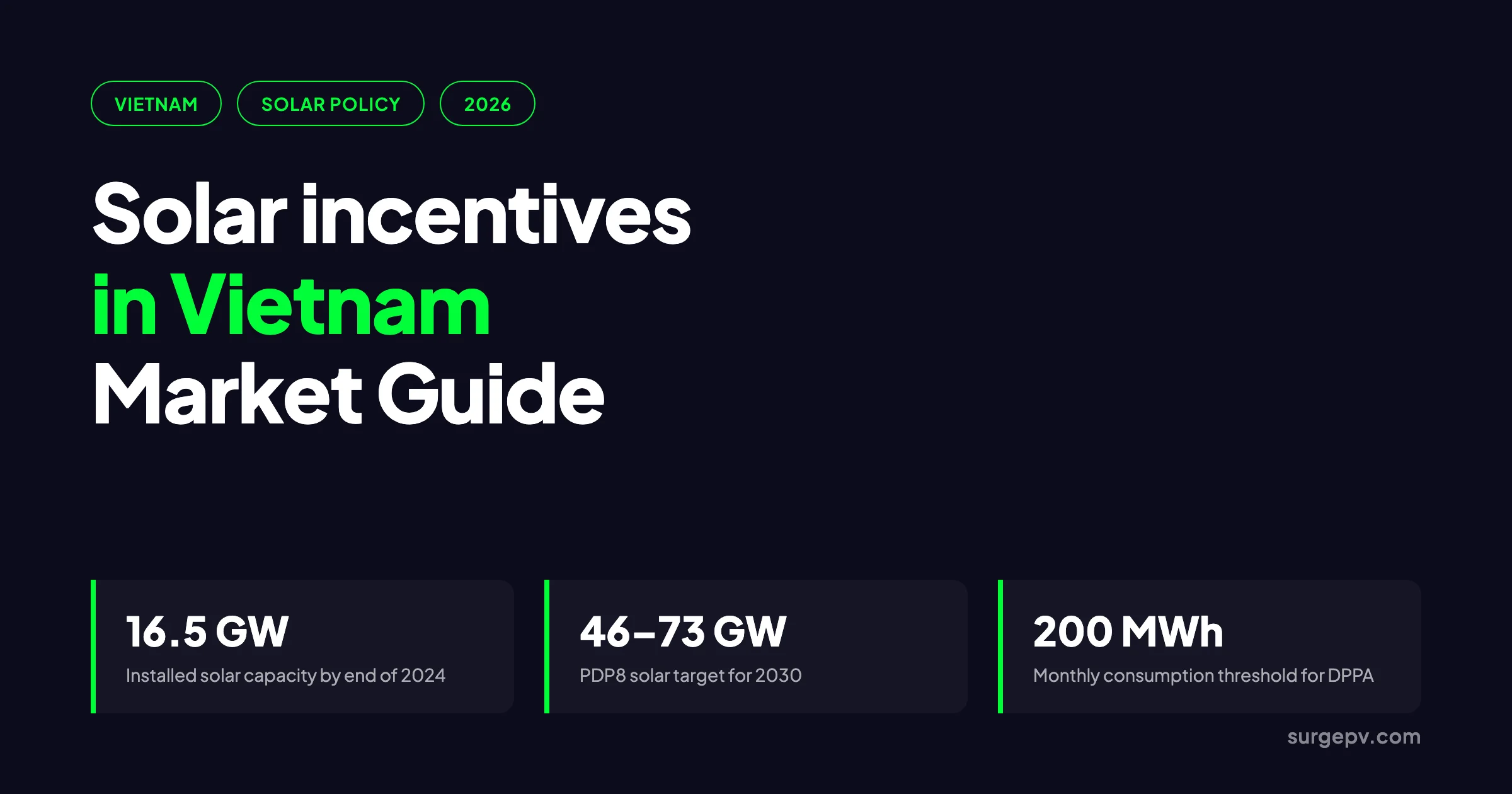
Vietnam’s solar market is entering a new phase in 2026. After the 2019–2020 feed-in tariff boom added roughly 17 GW of capacity, the country spent several years resolving legacy payments and grid congestion. Now policy is shifting toward self-consumption, corporate procurement, and larger renewable targets. By the end of 2024 Vietnam had installed approximately 16.5 GW of solar capacity, representing about 25% of the national power system, according to B&Company market analysis citing EVN data (2025).
This guide is a practical market manual, not a generic cost forecast. It explains the 2026 legal framework, the incentives that actually reduce project cost, how EVN compensates surplus generation, and the mistakes that waste money. For a broader regional view, see our global solar market forecast for 2026. For payback comparisons across countries, see solar payback period by country.
If you are designing systems or writing proposals for Vietnamese clients, a solar design platform that models self-consumption ratios, EVN tariffs, and export value can save hours per project. Model payback automatically, then generate solar proposals in minutes. Check pricing or book a demo to see how SurgePV handles Vietnam.
Quick Answer
Vietnam’s 2026 solar incentives center on self-produced, self-consumed rooftop solar under Decree 135, regional feed-in tariffs for utility-scale and floating solar, direct power purchase agreements for large consumers, corporate income tax holidays, and import duty relief. There is no universal residential subsidy, but the economics work through bill savings, tax benefits, and DPPA offtake.
In this guide:
- Latest 2026 status of every active Vietnamese solar incentive
- The legal foundation: PDP8, the 2024 Electricity Law, and Decree 135
- How rooftop solar self-consumption and surplus sales work
- 2025 feed-in tariffs and battery storage premiums
- Tax incentives: CIT holidays, import duty, VAT, and land rent
- Direct Power Purchase Agreements and corporate procurement
- Commercial and industrial routes beyond rooftop net metering
- Regional differences and where the market is hottest
- Three real-world stacking scenarios with payback impact
- Common mistakes and how to avoid them
Latest Updates: Vietnam Solar Incentives 2026
Vietnam’s solar policy environment changed substantially in 2024 and 2025. The National Assembly adopted a new Electricity Law, the government issued Decree 135 to restart rooftop solar, and the Prime Minister approved a revised PDP8 that raised solar targets sharply. At the same time, the legacy FiT cleanup continues to create uncertainty for older projects.
Vietnam Solar Incentive Status — June 2026
| Incentive | Type | Status | Key Terms |
|---|---|---|---|
| Self-consumption rooftop solar | Self-consumption + surplus sale | Active | Decree 135; surplus capped at 20% of installed capacity |
| Regional feed-in tariffs | Guaranteed purchase price | Active | Decision 988/2025; varies by region and technology |
| BESS premium tariff | Storage incentive | Active | Higher FiT for solar with at least 10% storage |
| Direct Power Purchase Agreements | Corporate procurement | Active | Decree 57/2025; private wire and grid-connected models |
| Corporate income tax holiday | Tax incentive | Active | 10% CIT for 15 years; 4 years exemption, 9 years 50% reduction |
| Import duty exemption | Customs relief | Active | On goods forming fixed assets |
| Land rental relief | Land incentive | Active | 3–15 years exemption or reduction depending on location |
| Rooftop solar in industrial parks | Regulatory | Active | Expanded eligibility under Decree 135 |
| Legacy FiT adjustment | Retroactive price review | Ongoing | Some older projects face 25–46% revenue reductions |
| PDP8 revised solar target | Planning | Active | 46,459–73,416 MW by 2030 |
Key Changes Since 2025
April 2025 — Revised PDP8 approved: Decision 768 replaced the 2023 version of PDP8 and raised the 2030 solar target from 12,836 MW to 46,459–73,416 MW, according to Watson Farley & Williams (2025). The revised plan explicitly includes rooftop solar in national planning and requires concentrated solar power projects to integrate storage equal to at least 10% of installed capacity.
October 2024 — Decree 135 on rooftop solar: The government issued Decree 135/2024/ND-CP to encourage self-produced, self-consumed rooftop solar. It removes licensing requirements for many systems, allows surplus sales capped at 20% of installed capacity, and extends eligibility to industrial parks, export processing zones, and high-tech zones, according to Luat Vietnam’s translation of Decree 135 (2024).
March 2025 — Decree 57 replaces Decree 80 on DPPAs: The new DPPA mechanism was updated to align with the amended Electricity Law. It retained the private wire and grid-connected models and clarified that rooftop solar systems can participate, according to Duane Morris (2025).
April 2025 — Regional FiT update: Decision 988 introduced differentiated maximum prices for ground-mounted and floating solar by region, with premium rates for projects integrating battery storage, according to Vietnam Briefing (2025).
Legacy FiT uncertainty: In late 2023 and 2024, authorities moved to retroactively revise purchase prices for 173 solar and wind projects, reducing expected revenues by 25% to 46%, according to IEEFA (2025). This remains a live risk for projects that achieved commercial operation under the old FiT deadlines.
Key Takeaway
2026 is a restart year. The most reliable incentives are self-consumption value under Decree 135, corporate tax holidays, and DPPA offtake. Legacy FiT exposure and regional grid constraints remain the biggest risks for older and larger projects.
Why Vietnam’s Solar Market Matters in 2026
Vietnam has some of the strongest solar resources in Southeast Asia. Central and southern regions receive Global Horizontal Irradiation of around 1,753 kWh/m²/year, making both utility-scale and rooftop deployment attractive, according to B&Company (2025). Northern provinces have weaker irradiation but higher industrial demand and higher FiT ceilings.
Market Size and Targets
Vietnam’s total installed solar capacity reached approximately 16.5 GW by the end of 2024, representing roughly 25% of the country’s total power system capacity of about 82.4 GW, according to B&Company citing EVN data (2025). Solar generation in the first half of 2024 reached 13.91 billion kWh.
The revised PDP8 sets a 2030 solar target of 46,459–73,416 MW, including self-consumption and concentrated solar power, according to KPMG Vietnam (2025). For context, that is roughly 2.8 to 4.5 times the installed base at the end of 2024.
| Metric | Figure | Source |
|---|---|---|
| Installed solar capacity end-2024 | ~16.5 GW | B&Company/EVN (2025) |
| Share of national power capacity | ~25% | B&Company/EVN (2025) |
| 2030 solar target under revised PDP8 | 46,459–73,416 MW | KPMG Vietnam (2025) |
| 2030 energy storage target | 10,000–16,300 MW | IEEFA (2025) |
| DPPA-eligible large consumers | ~7,700 users | EnergyBox/Grid CRR (2024) |
The Demand Driver
Vietnam’s electricity demand is growing at roughly 10% per year. Manufacturing and foreign direct investment are expanding rapidly, especially in northern industrial provinces. Many exporters now face renewable energy requirements from global buyers. That combination makes solar attractive even without a subsidy, because it reduces exposure to regulated retail tariffs and supports green manufacturing claims.
For solar professionals, the opportunity is to show both generation and avoided cost at the customer’s actual tariff tier. That requires hourly load modeling and accurate shading analysis, both of which are built into modern solar design software.
The Legal Foundation: PDP8, the Electricity Law, and Decree 135
Vietnam’s electricity sector is governed by a layered framework. The National Power Development Plan VIII sets capacity targets. The 2024 Electricity Law reorganizes market participation. Decree 135 provides the operating rules for rooftop solar.
National Power Development Plan VIII
PDP8 was originally approved in May 2023 under Decision 500 and revised in April 2025 under Decision 768. Key changes for solar include:
- Solar capacity target raised to 46,459–73,416 MW by 2030.
- Rooftop solar explicitly included in national planning.
- Concentrated solar power projects must integrate storage equal to at least 10% of capacity with two hours discharge time.
- Offshore wind added as a priority source with 6,000 MW by 2030.
The revised plan also targets 41% of electricity production from renewable sources by 2030, with approximately 30% of that available for DPPA participation, according to Norton Rose Fulbright (2025).
The 2024 Electricity Law
The amended Law on Electricity took effect on 1 February 2025. It provides the legal basis for direct electricity trading, competitive electricity markets, and clearer roles for EVN, the Electricity Regulatory Authority of Vietnam, and private participants. Decrees 57 and 58 implement the law for DPPAs and renewable energy development respectively.
Decree 135: Self-Produced, Self-Consumed Rooftop Solar
Decree 135 is the most important single document for distributed solar in 2026. It applies to rooftop systems on houses, offices, industrial parks, export processing zones, high-tech zones, and production facilities. The decree defines two models:
- Grid-connected rooftop solar: The system is connected to the EVN grid and can self-consume plus sell surplus.
- Off-grid rooftop solar: The system is not connected to the national grid and is used entirely on site.
Key provisions include:
- Systems under 100 kW at households or independent houses are exempt from electricity operation licenses.
- Off-grid systems of any capacity are exempt from licensing.
- Grid-connected systems below 1 MW that do not sell surplus are exempt from registration.
- Systems of 1,000 kW or more must install monitoring and control systems meeting EVN technical requirements.
- Surplus electricity sales are capped at 20% of installed capacity.
- The surplus purchase price is based on the average market electricity price of the previous year.
Rooftop Solar: Self-Consumption and Net Metering
Vietnam does not operate a pure net metering system in the sense that exported kWh directly offset imported kWh on a rolling basis. Instead, Decree 135 creates a self-consumption-plus-surplus-sale model.
How the Mechanism Works
- The solar system generates electricity during daylight hours.
- On-site loads consume as much as possible in real time.
- Surplus is exported to the EVN grid through a bidirectional meter.
- The owner pays the normal retail tariff for grid imports.
- EVN pays for surplus export at the previous year’s average market price.
- Settlement is monthly or as agreed in the model power purchase agreement.
The model PPA term for surplus sales is five years from commercial operation, after which it can be extended or renewed under applicable law, according to Decree 135 (2024).
Why Self-Consumption Matters
Retail electricity tariffs in Vietnam vary by voltage level, time of use, and customer category. Industrial customers on high-voltage connections often pay significantly less per kWh than commercial or residential customers. But every customer saves most by consuming solar generation on site rather than exporting it.
Surplus exports are compensated at the average market price, which is materially lower than the retail tariff for most customer classes. That makes the standard design rule simple: size the system to match daytime load, not to maximize roof coverage.
Household vs Commercial Rooftop
| Aspect | Household | Commercial / Industrial |
|---|---|---|
| License requirement | Exempt under 100 kW | Exempt if below 1 MW and no surplus sale |
| Surplus cap | 20% of installed capacity | 20% of installed capacity |
| Monitoring | Basic metering | Required for 1,000 kW and above |
| Main value | Bill savings | Bill savings + green claims + DPPA eligibility |
| Typical size | 3–10 kW | 100 kW–several MW |
For residential and small commercial designers, accurate consumption profiling is essential. A PV generation and financial modeling can test system size against hourly load data and local EVN tariffs.
Feed-in Tariffs and Utility-Scale Solar
Vietnam’s original solar FiT of USD 9.35 cents/kWh under Decision 11/2017 drove the 2019–2020 boom. That top-tier rate is no longer available for new projects. The current framework uses regional maximum prices updated annually.
2025 Solar Feed-in Tariffs
Decision 988, issued on 10 April 2025 and effective under Circular 09/2025, sets maximum purchase prices excluding VAT, according to Vietnam Briefing (2025):
| Region | Ground-mounted (no storage) | Ground-mounted (with storage) | Floating (no storage) | Floating (with storage) |
|---|---|---|---|---|
| North | VND 1,382.7/kWh | VND 1,571.98/kWh | VND 1,685.8/kWh | VND 1,876.57/kWh |
| Central | VND 1,107.1/kWh | VND 1,257.05/kWh | VND 1,336.1/kWh | VND 1,487.18/kWh |
| South | VND 1,012/kWh | VND 1,149.86/kWh | VND 1,228.2/kWh | VND 1,367.13/kWh |
To qualify for the storage premium, the battery system must:
- Have capacity of at least 10% of the power plant’s capacity.
- Provide two hours of storage/discharge time.
- Have a charging power output ratio of 5% of the plant’s output.
What the Regional Structure Means
Southern Vietnam has the best solar resource, so it receives the lowest tariff ceiling. Northern Vietnam has weaker irradiation but higher industrial demand and grid constraints, so it receives the highest ceiling. Central Vietnam sits in the middle. The policy intentionally tries to spread development geographically rather than concentrating it in the sunniest regions.
Transitional Projects
Projects that missed the original FiT deadlines but were approved under transitional arrangements face lower negotiated prices. Decision 21/2023 set maximum prices of VND 1,185–1,508/kWh for transitional solar projects, according to The Investor (2023). Many developers argue these rates do not cover financing costs, which is why the 2025 framework and DPPA mechanism are critical for new investment.
Tax and Fiscal Incentives
Vietnam does not offer a direct federal tax credit for homeowners who buy solar panels. The real tax value lies in corporate income tax holidays, import duty relief, and land incentives for project companies.
Corporate Income Tax
Renewable energy is classified as a promoted sector under Vietnam’s investment incentive regime. Qualifying solar projects can receive:
- A preferential CIT rate of 10% for 15 years, compared to the standard 20% rate.
- Four years of full CIT exemption from the first year of taxable income.
- Nine years of 50% CIT reduction after the exemption period.
- Possible extensions for large strategic projects approved by the Prime Minister.
These incentives apply to the project company’s income from the renewable energy activity, according to Vietnam Briefing (2025) and PwC Tax Summaries (2026).
Import Duty Exemption
Solar power projects are exempt from import duty on goods imported to create fixed assets. They can also receive duty exemption for five years on raw materials, components, and semi-finished products imported for production that cannot be produced domestically, according to Clifford Chance (2017) and confirmed in current incentive guidance.
Value-Added Tax
The standard VAT rate in Vietnam is 10%. Exported goods and certain essential services receive 0% or 5% rates. Construction and equipment supply for solar projects may qualify for VAT exemptions or refunds depending on contract structure and project classification. Always confirm VAT treatment with a local tax advisor before quoting.
Land Rental Relief
Projects in encouraged locations can receive land rental exemptions or reductions ranging from 3 to 15 years, or in some cases for the entire project term. Solar projects in difficult socio-economic areas or special economic zones typically receive the longest relief periods.
Practical Impact
For a 50 MW solar park with a capex of roughly USD 40 million, the combined effect of the 10% CIT rate, import duty exemption on modules and inverters, and land rent relief can improve project IRR by 2 to 4 percentage points. That is often the difference between a bankable and a non-bankable project under the current FiT levels.
Direct Power Purchase Agreements
The DPPA mechanism is the most important new value stream for commercial and industrial solar in Vietnam. It allows large consumers to buy renewable electricity directly from generators, bypassing the traditional EVN-only supply model.
Decree 57/2025 Models
Decree 57 replaced Decree 80/2024 and aligned the DPPA framework with the amended Electricity Law. It offers two models, according to Duane Morris (2025):
Model 1 — Private Wire Model:
- Direct physical connection between generator and consumer.
- No minimum capacity for the generator, but projects above 1 MW need an electricity operation license.
- Price is freely negotiated between the parties, capped at the relevant generation price frame.
- Consumer must report the PPA to the provincial People’s Committee, local power company, and system operator.
- Rooftop solar systems can participate.
Model 2 — Grid-Connected Model:
- Generator sells all output to the Vietnam Wholesale Electricity Market through a PPA with EVN.
- Consumer signs a retail supply contract with EVN or a subsidiary.
- Generator and consumer sign a forward contract to fix or index the price difference.
- Generator must own a renewable energy plant of at least 10 MW.
- Consumer must have a connection voltage of at least 22 kV.
Who Can Participate
Large consumers are defined as those purchasing electricity for their own use without reselling it, with average monthly consumption of at least 200,000 kWh. This threshold covers roughly 7,700 users and accounts for about 25% of total electricity output in the system, according to EnergyBox/Grid CRR (2024).
Why DPPAs Matter
For export-oriented manufacturers in Vietnam, renewable energy procurement is becoming a buyer requirement, not a nice-to-have. DPPAs let factories meet RE100 or customer sustainability targets without relying on nationwide green tariff programs. For generators, DPPAs provide a long-term offtake alternative to EVN’s regional FiTs.
Commercial and Industrial Solar Incentives
C&I solar in Vietnam operates under different rules than residential rooftop. The economics are usually driven by avoided retail tariffs, DPPA contracts, and tax incentives rather than surplus sales to EVN.
Rooftop Solar in Industrial Parks
Decree 135 explicitly extends eligibility to industrial parks, industrial clusters, export processing zones, high-tech zones, and economic zones. This is a major expansion. Previously, many industrial rooftop projects sat in a regulatory gray area. Now factories can install self-consumption systems with clearer registration and surplus sale rules.
Third-Party Ownership
C&I rooftop solar is increasingly deployed through third-party ownership models such as leases or power purchase agreements with solar service companies. These structures reduce upfront capital expenditure for the factory and transfer operational risk to the developer. They are especially popular with export-oriented manufacturers that want green electricity without balance-sheet impact.
Utility-Scale and Ground-Mounted Solar
Larger C&I consumers with available land can develop ground-mounted solar parks under the regional FiT framework or through DPPA contracts. Ground-mounted projects above 1 MW require licensing, environmental approvals, and grid connection agreements. The development timeline is longer than rooftop, but the scale can be much larger.
Storage Integration
New solar projects are increasingly paired with battery storage. The 2025 FiT provides a premium for solar-plus-storage projects. Concentrated solar power projects under PDP8 must integrate storage equal to at least 10% of capacity. Industrial consumers are also adding batteries to shift solar generation into evening peak hours and reduce demand charges.
For C&I installers, the design priorities differ from residential work. Load profiling, demand-charge analysis, and shadow analysis matter more than simple bill offset.
Regional Differences and Market Hotspots
Vietnam’s solar market is highly concentrated geographically. The South and Central regions have the best solar resource. The North has the fastest-growing industrial demand.
South Vietnam
Ho Chi Minh City, Binh Duong, Dong Nai, Long An, and Ba Ria-Vung Tau form the industrial heartland. Solar irradiation is the highest in the country, but the 2025 FiT ceiling is the lowest because of it. The best opportunities are C&I rooftop self-consumption and DPPAs for export manufacturers.
Central Vietnam
Da Nang, Quang Nam, Binh Dinh, and Ninh Thuan have strong solar resources and available land. Ninh Thuan hosted many of the original FiT projects and now faces legacy tariff disputes. New development is moving toward solar-plus-storage and industrial zone rooftops.
North Vietnam
Hanoi, Bac Ninh, Hai Phong, and Vinh Phuc have the fastest-growing manufacturing load and the highest FiT ceiling, but weaker irradiation. Grid constraints and coal dependence are larger challenges here. Solar-plus-storage can help factories manage peak demand and grid instability.
Practical Tip
Always model the local EVN tariff and the actual consumption profile, not a national average. The same 500 kW system can have very different payback periods between a high-tariff industrial park in the South and a subsidized rural connection in the North.
How to Stack Incentives: Three Real-World Scenarios
The following examples are illustrative, based on typical 2026 costs and incentive rates. Actual figures depend on location, tariff, installer quote, and whether the customer owns or leases the system.
Scenario 1 — 8 kW Residential Rooftop, Ho Chi Minh City
| Item | Amount |
|---|---|
| Gross installed cost | USD 6,400 |
| Annual self-consumption value | USD 900 |
| Annual surplus export (capped) | USD 120 |
| Annual savings | USD 1,020 |
| Payback | 6.3 years |
Without the surplus sale mechanism, the payback would extend to roughly 7 years.
Scenario 2 — 800 kW Commercial Rooftop, Binh Duong Industrial Park
| Item | Amount |
|---|---|
| Gross installed cost | USD 560,000 |
| Annual avoided electricity | USD 95,000 |
| Annual surplus export | USD 8,000 |
| CIT benefit over project life | USD 42,000 |
| Payback | 5.2 years |
The C&I tariff avoidance is the largest single benefit. If the system is structured as a DPPA or lease, the factory may see savings from year one with no upfront capital.
Scenario 3 — 30 MW Utility-Scale Solar Park, Central Highlands
| Item | Amount |
|---|---|
| Gross CAPEX | USD 24,000,000 |
| Import duty and VAT relief | −USD 2,400,000 |
| Regional FiT (Central, no storage) | VND 1,107.1/kWh |
| Capacity factor | 22% |
| Project IRR | 10–13% |
Utility-scale economics depend heavily on PPA terms, grid connection cost, and whether storage is included. The storage premium can improve revenue but adds capex and complexity.
Common Mistakes and Misconceptions
Even experienced installers lose money in Vietnam by misunderstanding how incentives interact. Here are the most common errors.
Oversizing for Export
The single most expensive mistake is designing a system that exports more than the customer consumes. Surplus sales are capped at 20% of installed capacity and priced at the previous year’s average market rate, which is below retail. Size for self-consumption, not maximum generation.
Assuming a Residential Subsidy
Many homeowners ask about a government rebate similar to programs in the U.S. or Europe. Vietnam does not have one. The value is in bill savings, limited surplus sales, and long-term tariff protection.
Ignoring the Surplus Cap
A factory with a large roof and low daytime load may hit the 20% export cap quickly. Every kilowatt above the cap is wasted unless storage or load shifting is added. Model monthly production and consumption carefully.
Underestimating Interconnection Time
EVN interconnection queues, meter installation, and dispatch system integration can take several months, especially for systems of 1,000 kW or more. Build realistic timelines into contracts.
Misapplying Tax Incentives
Tax incentives apply to project companies and specific promoted activities, not automatically to every equipment purchase. A local tax advisor should review the project structure before procurement.
Forgetting Storage Requirements
New concentrated solar power projects must include storage. Larger grid-connected projects increasingly face grid code requirements for ramp control and frequency response. Price these into the design from the start.
Conclusion
Vietnam’s solar incentive framework in 2026 is a stack built from self-consumption value under Decree 135, regional feed-in tariffs under Decision 988, DPPA offtake for large consumers, corporate tax holidays, and import duty relief. None of these mechanisms is as simple as a single upfront rebate, but combined they make solar one of the most attractive generation options in a country with excellent irradiation and rapidly growing demand.
For solar professionals, the competitive edge is no longer just installation price. It is the ability to model the right compensation scheme, size for self-consumption, and structure tax benefits correctly. Tools like Clara AI and SurgePV’s generation and financial tool can automate that workflow for Vietnamese projects.
Three actions to take now:
- Verify the offtake route before sizing — self-consumption, FiT, or DPPA changes the optimal system design.
- Stack tax benefits correctly — use project companies to capture CIT holidays, import duty relief, and land rent incentives.
- Size for self-consumption — exported energy in Vietnam is worth less than avoided retail purchases.
For regional comparisons, see our solar payback period by country guide. For installers scaling in Vietnam, our guide for solar installers covers proposal automation and compliance workflows.
Frequently Asked Questions
What solar incentives are available in Vietnam in 2026?
Vietnam’s 2026 solar incentives include self-consumption rooftop solar under Decree 135 with surplus sales capped at 20% of installed capacity, regional feed-in tariffs for ground-mounted and floating solar under Decision 988, direct power purchase agreements for large consumers, corporate income tax incentives, import duty exemptions on fixed assets, and land rental relief for qualifying projects.
Does Vietnam have a residential solar subsidy?
No. Vietnam does not offer a direct nationwide capital subsidy or tax credit for residential rooftop solar. The value for households comes from offsetting retail electricity purchases, selling limited surplus to EVN at the average market price, and avoiding grid dependence.
How does net metering work in Vietnam?
Under Decree 135, grid-connected rooftop solar systems can self-consume generation and sell surplus electricity to EVN. Household systems under 100 kW are exempt from electricity operation licenses and can export up to 20% of installed capacity. Surplus is settled at the average market electricity price of the previous year.
What is the maximum rooftop solar size in Vietnam?
Decree 135 does not impose a universal capacity cap on self-produced, self-consumed rooftop solar. Systems of 1,000 kW or more connected to the grid must install monitoring and control systems meeting EVN technical standards. Systems that sell surplus must register with the Department of Industry and Trade.
What are the 2025 feed-in tariffs for solar in Vietnam?
Decision 988 sets regional maximum feed-in tariffs for 2025 excluding VAT. Ground-mounted solar ranges from VND 1,012/kWh in the South to VND 1,382.7/kWh in the North. Floating solar ranges from VND 1,228.2/kWh in the South to VND 1,685.8/kWh in the North. Projects with battery storage receive higher rates.
What is a DPPA in Vietnam?
A Direct Power Purchase Agreement allows large consumers using at least 200,000 kWh per month to buy renewable electricity directly from generators. Decree 57 offers two models: a private wire model with freely negotiated prices, and a grid-connected model using forward contracts and the Vietnam Wholesale Electricity Market.
What tax incentives do solar projects get in Vietnam?
Renewable energy projects can qualify for a 10% corporate income tax rate for 15 years, four years of full CIT exemption followed by nine years of 50% reduction, import duty exemption on goods forming fixed assets, and land rental exemptions or reductions for 3 to 15 years depending on location.
What is PDP8 and why does it matter for solar?
PDP8 is Vietnam’s National Power Development Plan VIII, revised in April 2025 under Decision 768. It raised the 2030 solar target to 46,459–73,416 MW, added rooftop solar to national planning, and requires concentrated solar power projects to integrate battery storage equal to at least 10% of capacity.
Can commercial and industrial projects access solar incentives in Vietnam?
Yes. C&I projects benefit most from rooftop self-consumption under Decree 135, DPPA contracts for large consumers, regional feed-in tariffs for larger ground-mounted systems, corporate tax incentives, and import duty relief. Industrial parks and export processing zones are explicitly eligible for rooftop solar.
What is the most common mistake when sizing a solar system in Vietnam?
The most common mistake is oversizing for export. Surplus sales are capped and priced at the previous year’s average market rate, which is well below retail tariffs. Systems should be sized to maximize self-consumption rather than total generation.
Where this fits
This article is part of SurgePV's Solar Incentives & Policy hub, which works through the topic from first principles to the decisions a project team actually has to make.

