

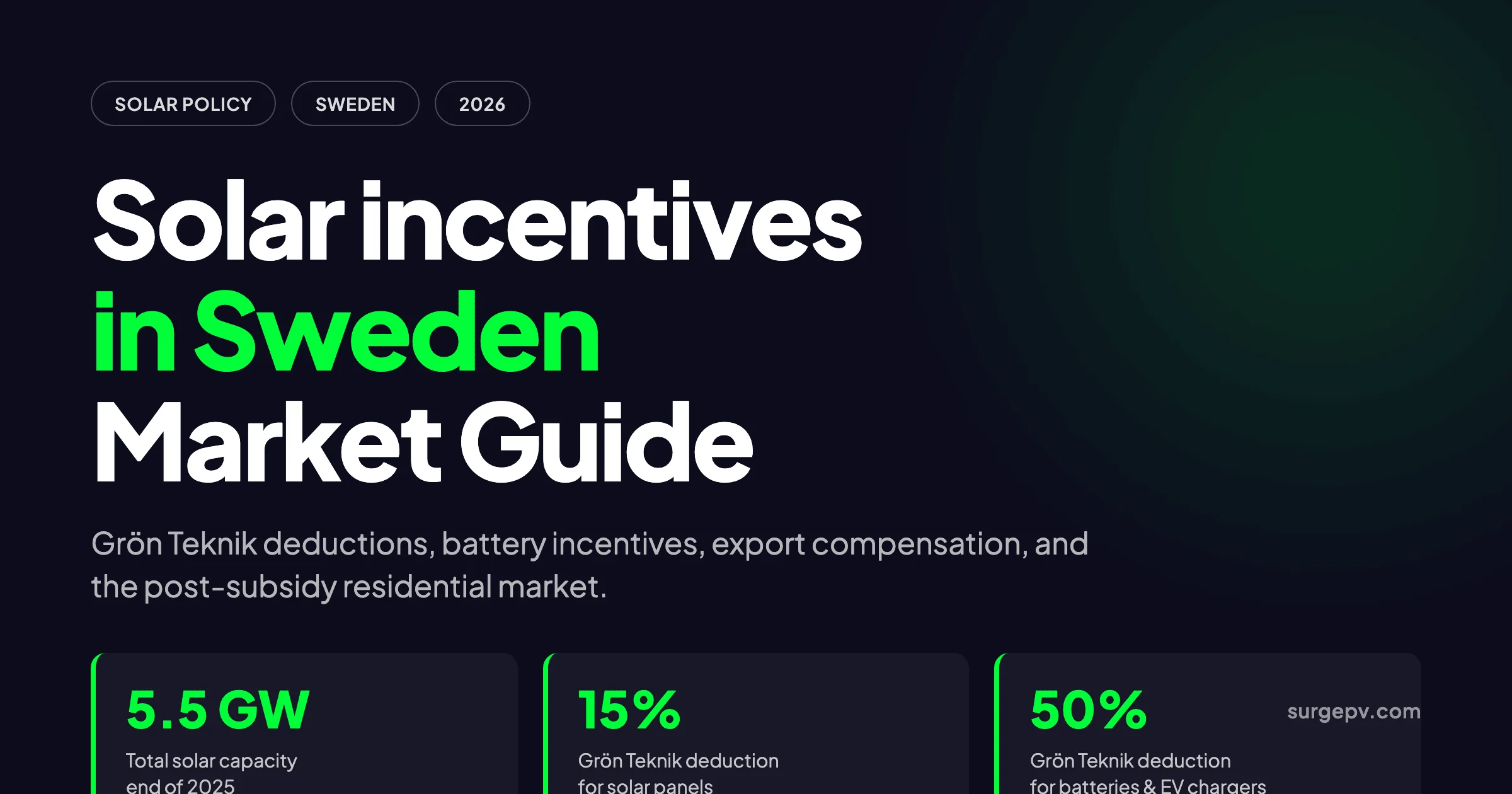
Sweden’s solar incentive framework changed more in six months than in the previous decade. The country ended 2025 with roughly 5.5 GW of installed solar capacity across 314,600 grid-connected plants. Yet the policies that drove much of that growth are now smaller or gone. From 1 July 2025 the Grön Teknik deduction for solar panels fell from 20% to 15%. From 1 January 2026 the 60 öre/kWh microproduction tax credit disappeared entirely. For homeowners, installers and EPCs, the new game is not chasing a grant but stacking the remaining tax deductions and sizing systems for self-consumption.
This guide is an incentive-focused market manual, not a general installation tutorial. It covers the 2026 incentive stack, the legal mechanics, what disappeared, and the practical mistakes that cost Swedish homeowners and businesses money. For broader Swedish market context, including costs, yield and technology choices, see our Solar energy in Sweden 2026 guide. For a country-by-country comparison, see European solar incentives.
If you are designing or proposing Swedish solar projects, a platform that models local tariffs, self-consumption ratios and battery dispatch can cut hours from every quote. Generate solar proposals, run shadow analysis and test payback in SurgePV’s generation and financial tool. Check pricing or book a demo.
Sweden’s 2026 solar incentive stack is now a tax-reduction model, not a grant model. The headline tools are Grön Teknik (15% for solar panels, 50% for batteries and EV chargers), the nätnytta grid benefit and spot-market export income. The biggest change is that surplus export is no longer subsidised.
Quick Answer
Sweden’s active 2026 solar incentives are the Grön Teknik tax deduction — 15% of material and labour for solar panels and 50% for batteries or EV chargers, capped at SEK 50,000 per person per year. The 60 öre/kWh microproduction export credit ended on 1 January 2026. Remaining export income comes from the nätnytta grid benefit and Nord Pool spot-market payments.
In this guide:
- Latest 2026 status of every active Swedish solar incentive
- How Grön Teknik works and who qualifies
- What the microproduction credit abolition means for homeowners
- Commercial and industrial options after the end of business grants
- Local, regional and EU-level support that may still apply
- Three real-world stacking examples with payback impact
- Common mistakes and how to avoid them
Latest Updates: Sweden Solar Incentives 2026
The Swedish solar policy environment shifted decisively in 2025 and early 2026. Two Riksdag decisions restructured residential solar economics and accelerated the move from rooftop subsidies to utility-scale power purchase agreements.
Sweden Solar Incentive Status — June 2026
| Incentive | Type | Status | Key Terms |
|---|---|---|---|
| Grön Teknik — solar panels | Tax deduction | Active | 15% of material + labour; SEK 50,000 cap/person/year |
| Grön Teknik — battery storage | Tax deduction | Active | 50% of material + labour; SEK 50,000 cap/person/year |
| Grön Teknik — EV charger | Tax deduction | Active | 50% of material + labour; SEK 50,000 cap/person/year |
| Microproduction export credit | Tax credit | Abolished 1 Jan 2026 | Was 60 öre/kWh, max SEK 18,000/year |
| Nätnytta (grid benefit) | Export payment | Active | 3.82 öre/kWh paid by network operator |
| Spot-market export income | Market income | Active | Paid by electricity supplier; varies by price zone |
| ROT deduction | Labour-only tax deduction | Active, but not combinable | 30% of labour; SEK 50,000 cap/person/year |
| Company investment grant | Capital grant | Ended 2021 | No national business grant open |
| Green electricity certificates | Certificate market | Closed to new entrants | Only plants approved before 31 Dec 2021 |
Key Changes Since 2025
1 July 2025 — Grön Teknik solar rate cut: The deduction for grid-connected solar panels was reduced from 20% to 15% of material and labour costs. Battery storage and EV chargers stayed at 50%. The annual cap of SEK 50,000 per person was unchanged.
1 January 2026 — Microproduction credit abolished: The skattereduktion för mikroproduktion, which paid 60 öre/kWh for exported renewable electricity up to SEK 18,000 per year, was abolished under Riksdag proposition 2024/25:109 (Riksdagen, 2025).
2025 market rotation: Residential installations fell 39% to 239 MW and commercial installations fell 35% to 215 MW, while utility-scale solar grew 46% to 198 MW, according to Svensk Solenergi (2026).
Key Takeaway
2026 is a post-subsidy year for residential solar. The only remaining national incentive is Grön Teknik, and its value is highest when paired with a battery or EV charger. Export income is now purely market-based.
Why Sweden’s Incentive Stack Matters in 2026
Sweden has some of the lowest solar irradiance in Europe — roughly 950 kWh/kWp/year nationally, ranging from 800 kWh/kWp in the northern interior to 1,100 kWh/kWp in southern Skåne. Despite that, the market grew almost forty-fold between 2016 and 2025. The reason was a combination of high retail electricity prices, simple tax deductions and the microproduction export credit. Now that the export credit is gone, the incentive design sends a clear signal. Consume what you generate, store the rest, and stop treating the grid as a subsidised buyer.
Market Size and Targets
Sweden added 652 MW of solar in 2025 across about 25,000 installations, down 23% from 848 MW in 2024, according to Svensk Solenergi (2026). Cumulative capacity reached roughly 5.5 GW by the end of 2025.
| Segment | 2025 MW Added | Year-on-Year Change |
|---|---|---|
| Residential (< 20 kW) | 239 MW | −39% |
| Commercial (1–1,000 kW) | 215 MW | −35% |
| Utility-scale (> 1,000 kW) | 198 MW | +46% |
| Total | 652 MW | −23% |
Solar generated 4.1 TWh in 2024, or about 2.4% of Sweden’s electricity production. Industry body Svensk Solenergi targets 30 TWh of annual solar generation by 2030.
What the Slowdown Means for Incentives
The 2025 slowdown was not caused by a shortage of sunlight or module supply. It was caused by two predictable policy changes. The July 2025 cut to the Grön Teknik solar rate and the January 2026 abolition of the microproduction credit were both signalled in government budget proposals. Yet many installers continued to quote payback periods based on the old 20% deduction and the 60 öre/kWh export credit.
For solar professionals, the competitive edge is now accurate modelling. A proposal that still assumes the old export credit will overstate annual savings by SEK 1,500–3,000 for a typical 10 kWp system. A proposal that pairs solar with battery storage and an EV charger can recover much of that lost value. The 50% battery deduction is still intact. That is why a solar design platform with Swedish tariff and battery-dispatch logic is now essential.
The Legal Foundation: Grön Teknik-avdraget
Every current residential solar incentive in Sweden sits under one legal umbrella: skattereduktion för grön teknik, commonly called Grön Teknik-avdraget. It replaced the previous direct investment grant (investeringsstöd) for private individuals when it entered force on 1 January 2021.
How the Deduction Works
The deduction is applied directly to the installer’s invoice. The customer pays the net amount, and the installer claims the reduction from Skatteverket. This is the same invoice model used for ROT and RUT deductions.
Key conditions, according to Skatteverket (2026):
- The installation must be carried out by a company with F-tax approval (F-skatt).
- The system must be grid-connected and serve the taxpayer’s own or parent’s dwelling.
- Eligible dwellings include owned houses, owner apartments and tenant-owned apartments.
- Materials must be new and supplied by the installer. If the customer buys materials separately, only labour qualifies.
- Solar panels, inverters, mounting, cabling and monitoring hardware tied to the system are eligible.
- The deduction does not cover roof reconstruction, new switchboards, grid connection fees, travel or restoration work.
2026 Grön Teknik Rates
| Technology | Deduction Rate | Annual Cap (per person) |
|---|---|---|
| Grid-connected solar panels | 15% of material + labour | SEK 50,000 |
| Battery storage for self-produced electricity | 50% of material + labour | SEK 50,000 |
| EV charging point | 50% of material + labour | SEK 50,000 |
The SEK 50,000 cap is per person, not per household. Two property owners can each claim up to SEK 50,000 in the same calendar year, giving a combined ceiling of SEK 100,000. The cap applies to all green-technology deductions combined.
Example: 8 kWp Residential System with Battery
Consider a typical 8 kWp rooftop system costing SEK 120,000, paired with a 10 kWh battery costing SEK 60,000.
- Solar deduction: 15% × SEK 120,000 = SEK 18,000
- Battery deduction: 50% × SEK 60,000 = SEK 30,000
- Total incentive: SEK 48,000
- Effective net project cost: SEK 132,000
Without the battery, the effective discount would be only SEK 18,000 on a SEK 120,000 project, or 15%. With the battery, the effective discount rises to 26.7% of the combined project cost. This asymmetry is intentional. The government wants to shift household solar from midday export peaks to evening self-consumption.
Grön Teknik versus ROT
ROT-avdraget is a separate 30% deduction on labour costs for renovation and repair, capped at SEK 50,000 of labour per person per year. Skatteverket does not allow both ROT and Grön Teknik for the same installation. For most solar projects, Grön Teknik is the better choice because it covers material as well as labour.
What Changed on 1 January 2026: The Microproduction Credit
The most significant Swedish solar policy change in years took effect on 1 January 2026. The skattereduktion för mikroproduktion av förnybar el — usually called the “60-öringen” — was abolished entirely.
What the Credit Was
From 2015 to 2025, micro-producers received a tax credit of 60 öre for every kWh of surplus renewable electricity exported to the grid. One Swedish krona (SEK) equals 100 öre. The credit was capped at 30,000 exported kWh per year, giving a maximum annual benefit of SEK 18,000. The credit could not exceed the value of electricity taken from the grid at the same connection point. Households that were net exporters could not claim credits on the excess. Rules and examples were published by Skatteverket (2026).
The Riksdag voted to abolish it under proposition 2024/25:109 (Riksdagen, 2025). The government’s stated rationale was that the Swedish solar market had matured and that subsidy funds should be redirected toward grid expansion and firm generation capacity.
What Remains for Exported Solar
Sweden never had true net metering, where exported kWh are credited at the full retail rate. What remains after the credit’s abolition is a market-based export framework:
- Nätnytta: 3.82 öre/kWh paid by the local network operator for every exported kWh. It compensates for reduced grid losses.
- Spot-market payment: Your electricity supplier pays the hourly Nord Pool spot price for exported kWh. Typical 2025–2026 values ranged from 50 öre/kWh to over 100 öre/kWh, depending on the price zone and season.
- Mottagningsplikt: Electricity suppliers must accept surplus electricity from small producers on reasonable terms.
The Financial Impact on a Typical Home
Take a 10 kWp system that exports 4,000 kWh per year. Under the old credit, that export was worth SEK 2,400 per year. In 2026 the same export might earn SEK 2,000–4,000 from the spot market plus SEK 153 in nätnytta. The net loss is small for households with low export ratios, but large for systems sized primarily for export.
The lesson is clear: in Sweden, a self-consumed kWh is now worth far more than an exported kWh. A system sized for 80–90% self-consumption, with a battery or EV charger to absorb midday production, loses only SEK 400–600 of credit income per year. An export-heavy system can lose SEK 2,000 or more.
Opinion: The Policy Reset Is Deliberate
The Swedish government is not quietly sunsetting solar support. It is redesigning the market around self-consumption and storage. Installers who treat 2026 as a design-and-storage market will keep margins. Installers who keep selling oversized, export-heavy arrays will face longer payback claims and unhappy customers.
Commercial and Industrial Solar Incentives
There is no national capital grant or tax credit open to new commercial or industrial solar installations in 2026. The company investment subsidy that ran until 2021 ended, and the Grön Teknik deduction is restricted to private individuals.
What C&I and Utility-Scale Projects Use Instead
- Power purchase agreements (PPAs): A corporate buyer signs a long-term contract with a solar park. The park may be on-site, off-site or virtual. This is the dominant model for new Swedish utility-scale capacity.
- Merchant spot-market sales: Large plants sell directly into the Nord Pool spot market. Revenue varies with hourly prices and is highest in price zones SE3 and SE4.
- Direct lines and private wires: Industrial consumers can connect directly to a nearby solar plant without routing through the public distribution network, avoiding some grid charges.
- Corporate tax depreciation: Solar assets can be depreciated under normal corporate tax rules, providing a standard time-value-of-money benefit.
- Grid benefit payments: Network operators may pay nätnytta to larger producers under negotiated terms, though the rate and eligibility differ from the residential micro-producer rule.
Green Electricity Certificates (Elcertifikat)
The Swedish-Norwegian elcertifikat system still operates, but new solar plants are not eligible. Only plants approved before 31 December 2021 can receive certificates. For existing owners the system runs until 2035. Certificate prices have fallen to levels that provide only marginal income for small systems, so new projects should not model certificate revenue.
The Market Split
The 2025 data shows the split plainly. Residential and commercial segments contracted, while utility-scale grew 46%. The projects that are moving forward in 2026 are usually backed by a PPA or a large industrial offtaker, not by a grant stack. For C&I installers, the financial model is built around avoided grid consumption and hedged electricity prices.
Local, Regional and EU Support
Sweden does not offer nationwide municipal property-tax breaks or construction-tax exemptions for solar in the way Spain or some U.S. states do. There is no IBI-style discount for installing panels.
Municipal-Level Support
Some municipalities have run local information campaigns, free energy-advisor consultations or small pilot grants, but these are not uniform. A homeowner should check the local kommun website and the regional energy agency (regional energikontor) for any active programs. A consolidated overview of Swedish energy-renovation support schemes is maintained by Embuild (2026). Because local budgets are small and deadlines change quickly, do not rely on municipal support when quoting a project.
EU Funds
Sweden has received Next Generation EU and REPowerEU funding, but the bulk flows through national programmes such as building renovation grants, industrial electrification and grid modernisation rather than direct rooftop solar subsidies. The Grön Teknik deduction is a national tax-policy tool, not an EU grant.
What This Means for Quoting
For most Swedish projects in 2026, the only reliable incentives are Grön Teknik and, for export, the nätnytta plus spot-market income. Any proposal should model those three items conservatively and treat regional or municipal support as a bonus, not a base-case assumption.
How to Stack Incentives: Three Real-World Scenarios
The following examples are illustrative, based on typical 2026 costs and incentive rates. Actual figures depend on location, installer quote, electricity contract and self-consumption ratio.
Scenario 1 — 8 kWp Rooftop with 10 kWh Battery, Stockholm
| Item | Amount |
|---|---|
| Gross solar cost | SEK 120,000 |
| Gross battery cost | SEK 60,000 |
| Grön Teknik — solar (15%) | −SEK 18,000 |
| Grön Teknik — battery (50%) | −SEK 30,000 |
| Net investment | SEK 132,000 |
| Estimated annual savings | SEK 14,000–16,000 |
| Payback | 8.5–9.5 years |
This household consumes most of its daytime production directly and stores summer surplus for evening use. The battery restores much of the value lost when the microproduction credit ended.
Scenario 2 — 8 kWp Rooftop without Battery, Same Household
| Item | Amount |
|---|---|
| Gross solar cost | SEK 120,000 |
| Grön Teknik — solar (15%) | −SEK 18,000 |
| Net investment | SEK 102,000 |
| Estimated annual savings + export | SEK 8,000–10,000 |
| Payback | 10–13 years |
Without storage, a larger share of summer production is exported at spot-market prices. The payback is longer than the battery case because the 50% battery deduction is no longer available and export income is lower than avoided retail purchases.
Scenario 3 — 100 kWp Commercial Rooftop, Southern Sweden
| Item | Amount |
|---|---|
| Gross installed cost | SEK 1,200,000 |
| Available national incentives | None |
| Corporate tax depreciation benefit (illustrative) | −SEK 240,000 over schedule |
| Net effective cost | SEK 960,000 |
| Annual avoided electricity cost | SEK 180,000 |
| Payback | 5–6 years |
This project relies on avoided consumption during daytime factory operations. The economics come from the spread between retail electricity prices and the all-in cost of solar, not from grants. Accurate load profiling and generation and financial modelling are essential before committing capital.
Common Mistakes and Misconceptions
Even experienced installers lose money on Swedish projects by mishandling the incentive sequence. Here are the most common errors.
Hiring a Non-F-Tax Installer
Grön Teknik only applies when the work is performed by an F-tax-approved company. A homeowner who hires a cash-in-hand installer or does the work DIY loses the entire deduction.
Quoting Based on the Old 60-Öre Export Credit
The microproduction credit is gone. Any proposal that still includes it is misleading. The conservative assumption for export income is the nätnytta plus the supplier’s spot-market tariff, which can be close to zero in northern Sweden during summer oversupply.
Oversizing for Export
Because exported kWh earn only the spot price while self-consumed kWh avoid the full retail rate, every oversized kWp wastes capital. A system sized for 75–85% self-consumption ratio usually outperforms a larger system with high export.
Mixing Grön Teknik and ROT
You cannot claim both deductions for the same installation. Most solar projects are better off with Grön Teknik because it covers material. If an installer splits the invoice to try to claim both, Skatteverket can deny both deductions.
Ignoring Price Zones
Sweden has four electricity price zones: SE1 and SE2 in the north, SE3 around Stockholm and SE4 in the south. Spot prices and export values vary significantly by zone. A system in SE4 can earn two to three times more for exported kWh than a system in SE1 during some hours. Proposals should use location-specific prices.
Assuming Reduced VAT
Sweden has not introduced a zero or reduced VAT rate for residential solar. Standard 25% VAT normally applies. This is a cash-cost difference of thousands of kronor compared with markets that have adopted 0% VAT.
Conclusion
Sweden’s 2026 solar incentive framework is smaller than it was, but it is still usable. The Grön Teknik deduction remains the central tool, and its 50% rate for batteries makes solar-plus-storage the most attractive residential configuration. The abolition of the microproduction credit removes the export subsidy and forces installers to design around self-consumption.
For solar professionals, the competitive edge is no longer just installation price. It is the ability to model the full post-incentive cost, apply the correct tax deductions and size systems for the household’s actual load profile. Tools like Clara AI and SurgePV’s generation and financial tool can automate that workflow for Swedish projects.
Three actions to take now:
- Quote with 2026 rules — use 15% Grön Teknik for solar, 50% for batteries, no microproduction credit and 25% VAT.
- Size for self-consumption — a self-consumed kWh is worth more than an exported kWh in every Swedish price zone.
- Pair solar with storage or EV charging — the 50% battery deduction is the strongest remaining incentive and shortens payback.
For more on Swedish system design and payback, see our Solar energy in Sweden 2026 guide. For installers looking to scale, our guide for solar installers covers proposal automation and compliance workflows.
Frequently Asked Questions
What solar incentives are available in Sweden in 2026?
Sweden’s main 2026 solar incentive is the Grön Teknik tax deduction: 15% of material and labour costs for grid-connected solar panels, and 50% for batteries or EV chargers. The deduction is capped at SEK 50,000 per person per year. The 60 öre/kWh microproduction export credit was abolished on 1 January 2026. Homeowners can still receive the nätnytta grid benefit of 3.82 öre/kWh and sell surplus electricity at the Nord Pool spot-market price through their electricity supplier.
What is the Grön Teknik deduction for solar panels?
Grön Teknik-avdraget is a direct tax reduction applied at the point of purchase for green-technology installations. For solar panels it is 15% of material and labour costs, capped at SEK 50,000 per person per year. The installer deducts it from the invoice and claims the amount back from Skatteverket. The installation must be carried out by an F-tax-approved company and the system must serve the taxpayer’s own or parent’s dwelling.
How much is the battery incentive in Sweden?
Battery storage paired with a solar installation qualifies for a 50% Grön Teknik deduction on material and labour, capped at SEK 50,000 per person per year. The same cap applies to EV chargers. A couple who both own the property can each claim up to SEK 50,000, giving a combined annual ceiling of SEK 100,000.
What happened to Sweden’s 60 öre/kWh microproduction credit?
The skattereduktion för mikroproduktion was abolished on 1 January 2026 under Riksdag proposition 2024/25:109. It previously paid 60 öre for every kWh exported to the grid, up to 30,000 kWh or SEK 18,000 per year. Without it, households rely on the nätnytta grid benefit and market-based export prices, making self-consumption and battery storage more important.
Do businesses get solar incentives in Sweden?
No major national grants for commercial or industrial solar are open in 2026. The company investment subsidy ended in 2021. Businesses typically finance rooftop or ground-mount systems through power purchase agreements, merchant spot-market sales, direct private-wire arrangements or balance-sheet capex with standard corporate tax depreciation. New installations are not eligible for green-certificate income.
Can I combine Grön Teknik and ROT deductions on the same installation?
No. Skatteverket does not allow Grön Teknik and ROT deductions for the same installation. Grön Teknik is usually the better choice for solar because it covers both material and labour. ROT covers only 30% of labour costs and is capped at SEK 50,000 of labour per person per year.
How do I apply for the Grön Teknik deduction?
You do not apply yourself. The F-tax-approved installer deducts the Grön Teknik amount directly from your invoice. The installer then reports the reduction to Skatteverket and is reimbursed. You confirm the deduction in your annual income declaration. The installation must be completed and fully paid before the deduction is granted.
Is solar still worth it in Sweden after the 2026 incentive cuts?
Yes, but the economics favour self-consumption over export. A household that consumes 80–90% of its solar production on site loses only a small amount of export income. Adding a battery or EV charger restores much of the value because the 50% battery deduction is still generous. Systems sized for export now have payback periods of roughly 12–15 years, while high-self-consumption designs can still pay back in 8–10 years.
What is nätnytta in Sweden?
Nätnytta is a grid-benefit payment of 3.82 öre/kWh that the local network operator pays for every kWh a micro-producer feeds into the grid. It compensates for reduced grid losses from local generation. It is separate from the spot-market price your electricity supplier pays for surplus exports and is not a net-metering credit.
Does Sweden apply reduced VAT to solar installations?
No. Sweden has not adopted the EU-authorised zero or reduced VAT rate for residential solar. Standard 25% VAT normally applies to solar installations, which is one reason the upfront net cost remains high despite the Grön Teknik deduction. Some neighbouring markets, such as Germany and the Netherlands, apply 0% VAT, but Sweden does not.
Where this fits
This article is part of SurgePV's Solar Incentives & Policy hub, which works through the topic from first principles to the decisions a project team actually has to make.

