

Quick Answer
Solar energy in Sweden costs SEK 12,000–18,000/kWp installed. The government offers a 20% investment grant (max SEK 350,000) and reduced VAT at 12%. Despite low irradiance (950–1,100 kWh/m²/year), payback is 8–12 years due to high electricity prices.
Sweden reached 5.5 GW of installed solar capacity at the end of 2025 — a 39x increase from 0.14 GW in 2016 — while simultaneously dismantling the main incentive that drove residential adoption. The January 1, 2026 abolition of the skattereduktion för mikroproduktion (the 60 öre/kWh microproduction tax credit) marks the most significant policy shift in Swedish solar history. This guide covers what the 2026 policy reset means for homeowners and installers, how the remaining incentives stack up, and what the Arctic latitude actually demands from PV system design. See our guide on Battery Solar System Design UK for more.
Solar energy in Sweden costs SEK 12,000–18,000/kWp installed. The government offers a 20% investment grant (max SEK 350,000) and reduced VAT at 12%. Despite low irradiance (950–1,100 kWh/m²/year), payback is 8–12 years due to high electricity prices.
TL;DR — Solar Energy in Sweden 2026
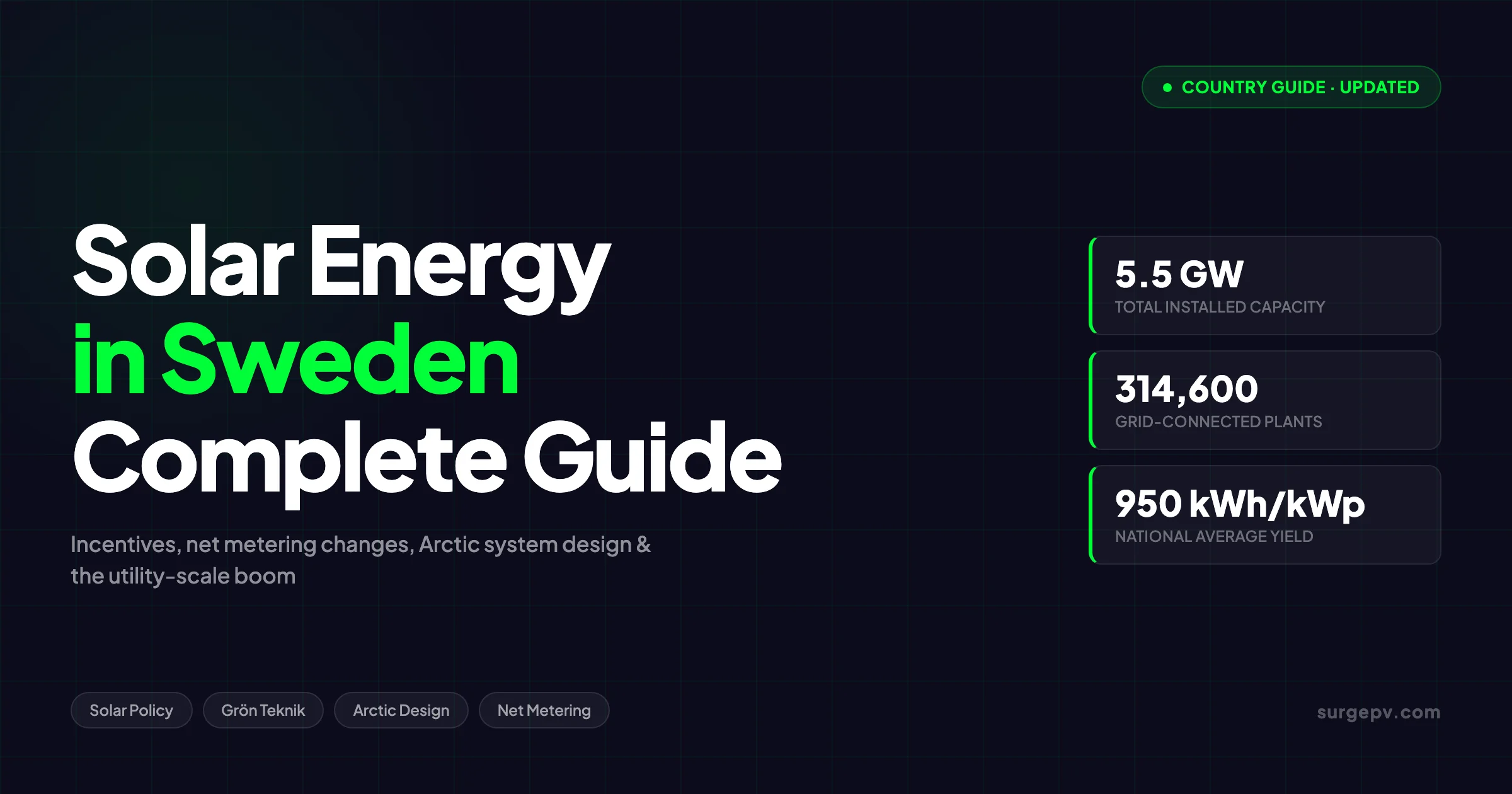
Sweden has 5.5 GW installed solar across 314,600 grid-connected plants. The 60 öre/kWh microproduction export credit is gone as of January 1, 2026. The Grön Teknik deduction dropped from 20% to 15% for solar panels (July 2025), though batteries still attract 50%. Payback periods for residential systems now run 12–15 years without storage. Utility-scale grew 46% in 2025 and is the market’s growth engine. Bifacial vertical arrays are the preferred technology for latitudes above 60°N.
Read Bifacial Solar Panel Design Guide for a complete walkthrough.
Sweden’s Solar Market: The State of Play in 2026
Sweden’s solar market is two markets operating in opposite directions.
Residential and commercial installations both declined sharply in 2025 — residential fell 39% to 239 MW, commercial fell 35% to 215 MW. Utility-scale, by contrast, grew 46% to a record 198 MW and jumped from 7% to 30% of new annual capacity. The total: 652 MW added in 2025, down 23% from 848 MW in 2024, which itself trailed the 1.1–1.4 GW record set in 2023.
| Segment | 2025 MW Added | YoY Change | Notes |
|---|---|---|---|
| Residential (under 20 kW) | 239 MW | -39% | 287,000+ plants; ~3 GW cumulative |
| Commercial (20 kW–1 MW) | 215 MW | -35% | — |
| Utility-scale (above 1 MW) | 198 MW | +46% | Record; 30% of new capacity |
| Total | 652 MW | -23% | 5.5 GW cumulative |
The Swedish Energy Agency recorded 314,600 grid-connected solar plants as of April 2026, with 21,600 new connections in 2025 alone. Solar generated 4.1 TWh in 2024 — 2.4% of Sweden’s total electricity production. Industry body Svensk Solenergi targets 30 TWh/year by 2030 and 45 TWh by 2045.
The slowdown in residential installations is directly attributable to two incentive cuts that took effect within six months of each other: the July 2025 reduction of the Grön Teknik deduction for solar from 20% to 15%, and the January 2026 abolition of the microproduction export credit. Neither move was unexpected — both had been signaled in government budget proposals — but their combined effect has fundamentally changed the residential investment case.
Key Takeaway
Sweden’s solar growth has not stopped — it has rotated. Utility-scale developers with PPAs and merchant revenue strategies are accelerating while the residential market recalibrates to a post-subsidy economics model centered on self-consumption and battery storage.
For more on this topic, see Adding Battery Storage Services.
How Much Sun Does Sweden Actually Get?
The question gets asked more than it deserves. Southern Sweden, from Skåne up to Stockholm, receives roughly the same solar irradiance as Denmark, the Netherlands, and the less productive parts of Germany. The national average yield is 950 kWh/kWp/year — more than enough to justify solar economically when electricity prices are high. Also see: Germany solar subsidies. For the latest details on Germany, see Community Solar Projects Germany.
| Region | Annual Irradiance | Key Cities |
|---|---|---|
| Southern coast (Skåne) | ~1,100 kWh/m² | Malmö, Helsingborg |
| Stockholm metro | ~1,000 kWh/m² | Stockholm, Uppsala |
| Central Sweden | ~900–950 kWh/m² | Örebro, Linköping |
| Northern inland | ~800–850 kWh/m² | Östersund, Jämtland |
| Far north (Kiruna area) | ~800 kWh/m² | Kiruna, Gällivare |
The irradiance range from south to north is a modest 25% reduction — not the dramatic cliff most installers assume. Jämtland County has the third-highest per-capita solar capacity in Sweden despite sitting at 62°N.
The real challenge is not total irradiance but seasonal distribution. Stockholm’s daily average runs 0.51 kWh/kWp in January versus 6.18 kWh/kWp in July. Stockholm gets 283 sunshine hours in July and just 32 in December. December and January together contribute less than 2% of annual solar output. Any system in Sweden is sized, implicitly or explicitly, for summer production — winter is almost irrelevant to annual yield calculations but critical to self-consumption economics.
Pro Tip
For Swedish installations, shadow analysis should account for the sun’s maximum elevation angle of only 6° in December at 60°N — far lower than angles used in standard European shading models. Row spacing that avoids inter-row shading in Spain will produce severe winter shading in Sweden. SurgePV’s solar shadow analysis software handles latitude-specific sun path calculations automatically.
For a direct comparison, see Arka 360 vs SurgePV.
Optimal system parameters for Sweden: tilt of 30–50° from horizontal, azimuth within 10° of due south. At higher latitudes (above 63°N), increasing tilt toward 50–55° captures more low-angle winter sun. The tradeoff is higher snow accumulation at steeper tilts on non-bifacial modules.
Southern Sweden (Skåne, Västra Götaland, Stockholm region) delivered 59.3% of all new installations in 2025. This reflects population density as much as irradiance, but also installer concentration and grid capacity — factors that matter more to project economics than the difference between 950 and 1,100 kWh/m².
What Changed on January 1, 2026: The Policy Reset
Two changes took effect within six months of each other. Together, they ended the era of straightforward residential solar economics in Sweden.
July 1, 2025: Grön Teknik deduction reduced from 20% to 15% for solar panels. The reduction applied only to solar PV panels. Batteries and EV chargers remained at 50%. The cap of SEK 50,000 per person per year was unchanged.
January 1, 2026: Skattereduktion för mikroproduktion abolished. This was the bigger change. The tax credit of 60 öre/kWh for surplus electricity fed to the grid — capped at 30,000 kWh or SEK 18,000 per year — was eliminated entirely via Riksdag proposition 2024/25:109. The government’s stated rationale: the Swedish solar market has matured, and subsidy funding should redirect to grid expansion and nuclear power capacity.
What remains after January 2026:
| Compensation Type | Rate | Who Pays |
|---|---|---|
| Nätnytta (grid benefit) | 3.82 öre/kWh | Network operator |
| Spot market price for exports | ~50–100 öre/kWh (varies) | Electricity supplier |
| Grön Teknik deduction (solar panels) | 15% of material + labor | Swedish Tax Agency |
| Grön Teknik deduction (battery/EV charger) | 50% of material + labor | Swedish Tax Agency |
| ROT avdrag (labor only) | 30% of labor costs | Swedish Tax Agency |
The practical effect on a typical 10 kWp residential system that exports 40% of production (4,000 kWh/year at 60 öre/kWh): the household lost SEK 2,400/year in export income. On a SEK 150,000 system with 15% Grön Teknik (SEK 22,500 credit), payback extends from approximately 8 years to 12–15 years.
The exception is high self-consumption households — those with EV charging, heat pumps, or large daytime loads. If you consume 80–90% of production on-site, the loss of the export credit costs you 600–800 kWh/year in credit income rather than 4,000 kWh. This is why the industry response to the policy change has been almost uniform: add a battery.
The Grön Teknik-Avdraget: Sweden’s Primary Solar Incentive
The Grön Teknik-avdraget (Green Technology Deduction) is a direct tax reduction applied at the point of purchase for qualifying green technology installations. It replaced the old Investeringsstöd (direct investment grant) program that ran from 2009 to 2021.
How it works: The installer submits the invoice to Skatteverket (the Swedish Tax Agency) on behalf of the customer. The customer pays the net amount — the deduction is applied before the bill, not as a later tax refund. Installation must be carried out by an F-tax (F-skatt) approved company.
Current rates (as of July 1, 2025):
| Technology | Deduction Rate | Annual Cap (per person) |
|---|---|---|
| Solar PV panels | 15% of material + labor | SEK 50,000 |
| Battery storage | 50% of material + labor | SEK 50,000 |
| Home EV chargers | 50% of material + labor | SEK 50,000 |
The SEK 50,000 cap is per person, not per household. A couple installing solar and a battery can each claim up to SEK 50,000 — effectively doubling the maximum deduction.
What qualifies:
- New solar panels installed on or directly connected to the residence
- New materials only (no second-hand equipment)
- Primary or secondary residence of the taxpayer
- Work performed by an F-tax approved company
For a typical 8 kWp residential system costing SEK 120,000, the 15% Grön Teknik deduction provides SEK 18,000 in immediate tax reduction. A 10 kWh battery costing SEK 60,000 attracts an additional SEK 30,000 deduction. Total incentive on a solar-plus-storage system: SEK 48,000 on a SEK 180,000 project — a 26.7% effective discount.
Key Takeaway
The asymmetry between the 15% solar deduction and 50% battery deduction is intentional. Sweden wants to maximize self-consumption and minimize grid stress, not incentivize surplus electricity export. For system designers, this means: size for self-consumption, add storage, and model around the household’s actual load profile.
Net Metering in Sweden: What the Skattereduktion Abolition Means
Sweden never had net metering in the American sense — where surplus solar electricity is credited directly against your bill at retail rates. What it had from 2015 to 2025 was the skattereduktion för mikroproduktion: a 60 öre/kWh tax credit for each kWh fed to the grid, up to 30,000 kWh or SEK 18,000 per year.
This is now gone. The term “net metering” is frequently misapplied to Sweden in both English and Swedish-language sources. Here is what actually remains:
Nätnytta (grid benefit): 3.82 öre/kWh, paid by the local network operator for every kWh a micro-producer feeds to the grid. This compensates for reduced grid losses from local generation. It is not negotiable and not set by your electricity supplier.
Spot market compensation: Your electricity supplier separately compensates you for exported electricity at the spot market price (Nord Pool SE1–SE4 depending on location). This varies by agreement and market conditions — typical range is 50–100 öre/kWh. This is where most residual export income now comes from.
What to tell homeowners: export income from a 10 kWp system exporting 4,000 kWh/year might be SEK 2,000–4,000/year in market prices plus SEK 153 in nätnytta. That compares to the roughly SEK 2,400 previously earned via the now-abolished tax credit. The loss is real but not catastrophic for low-export systems. For high-export systems without batteries or EVs, the economics have deteriorated significantly.
For a country-by-country comparison of export limits and compensation mechanisms, see grid export limitation rules by country. For France-specific information, see Agricultural Solar Case Study.
Pro Tip
Swedish electricity is divided into four price zones (SE1–SE4, north to south). SE4 (Malmö area) and SE3 (Stockholm) typically have higher spot prices and therefore better export compensation. SE1 and SE2 in the north can see near-zero or negative spot prices during peak summer production — making oversizing arrays relative to self-consumption especially uneconomical in northern Sweden.
Stacking Deductions: Grön Teknik + ROT Avdrag
Sweden normally prohibits claiming both the ROT avdrag (renovation deduction) and Grön Teknik on the same project. Solar installations are the exception.
ROT avdrag for solar:
- Covers 30% of labor costs only (not materials)
- Capped at SEK 50,000 per person per year (shared cap with other ROT work that year)
- Labor typically represents 25–35% of total solar system cost
- For a SEK 120,000 system where labor is SEK 36,000: ROT deduction = SEK 10,800
Combining both deductions on the same project:
- Grön Teknik at 15% of total cost (materials + labor) = SEK 18,000 on SEK 120,000
- ROT at 30% of labor = SEK 10,800 on SEK 36,000
- Total deductions: SEK 28,800 — a 24% effective discount before counting battery storage incentives
The SEK 50,000 annual caps are separate for each program. A homeowner who has already used SEK 40,000 of their ROT cap on kitchen renovations can still claim the full SEK 50,000 Grön Teknik deduction on solar. This makes solar one of the few investment categories in Sweden where effective double-stacking is legal.
Green Electricity Certificates (Elcertifikat): Who Still Qualifies
The elcertifikat system is a tradeable certificate market running jointly between Sweden and Norway. For every MWh of certified renewable electricity produced, generators receive one certificate. Electricity suppliers and large consumers must buy certificates proportional to their consumption.
The key restriction for new installations: facilities must have been approved for the certificate system before December 31, 2021. Any solar plant installed after that date is ineligible for elcertifikat income.
For existing owners, the system runs until 2035. Certificate prices have fallen as the market matured — typically 1–3 öre/kWh equivalent for small residential systems. A 10 kWp system producing ~10 MWh/year earns roughly 10 certificates worth SEK 10–30 each at current market prices. It was never a substantial income stream for residential installations.
The practical message: elcertifikat are a legacy income stream for pre-2022 installations. New projects should not include certificate income in any financial model.
Key Takeaway
The only financial mechanisms available for a solar installation permitted in 2025 or 2026 are: Grön Teknik deduction (15% solar, 50% battery), ROT avdrag (30% of labor), and spot market export income. No elcertifikat. No microproduction tax credit. Model accordingly.
For broader context on European incentive structures, see European solar incentives and European solar tax credits.
Designing Solar Projects for Swedish Conditions?
SurgePV handles latitude-specific shadow analysis, bifacial rear-gain modeling, and snow load calculations — built for installers who work above 55°N.
Book a DemoNo commitment required · 20 minutes · Live project walkthrough
Designing Solar for Nordic Conditions
Standard PV design models built for central European conditions fail in Sweden — not catastrophically, but consistently in ways that erode project economics. Below are the five engineering challenges that define solar design above 55°N.
Challenge 1: The Seasonal Production Imbalance
A system sized to cover 100% of annual consumption in Sweden will massively overproduce in summer and barely cover demand in winter. Stockholm’s average daily yield runs from 0.51 kWh/kWp in January to 6.18 kWh/kWp in July — a 12:1 ratio. No reasonable battery can bridge that gap seasonally.
The design implication: self-consumption optimization in Sweden is a monthly calculation, not an annual one. Summer surplus cannot simply be stored for winter. Systems should be sized for the spring/autumn shoulder seasons, with summer surplus treated as grid export income and winter demand covered by the grid.
Challenge 2: Snow Load and Module Coverage
Snow accumulation on flat or low-tilt modules can result in zero production for 14 or more days in December. This is not merely a yield issue — in extreme cases, it creates structural load well beyond standard module ratings for certain mounting configurations.
The fix: tilt of 35° or above sheds snow more readily. Heated mounting rails are used in some northern installations. The most effective solution is vertical mounting (discussed in the next section). Any yield calculation for a Swedish installation that excludes a snow coverage factor is optimistic by 3–8% annually.
Challenge 3: Frost Heave and Foundation Integrity
Ground-mounted systems at northern latitudes face a soil mechanics problem that has damaged multiple installations. Permafrost-adjacent soils and seasonally frozen ground cause frost heave — the upward movement of soil as water freezes and expands. Standard perforated ground piles, designed to grip soil, will move with the freezing substrate.
A documented case from Luleå (a 699 kW ground-mount system) recorded perforated piles deforming during the first winter, requiring replacement with deeper non-perforated piles. Standard geotechnical surveys designed for road construction are insufficient for PV racking in frost-prone soils. Site investigations for northern Swedish ground-mounts must include frost depth analysis, soil thermal conductivity measurements, and seasonal bearing capacity calculations.
Challenge 4: Irradiance Data Accuracy at High Latitude
Satellite-derived irradiance data — the foundation of yield assessments — degrades in accuracy above 65°N. Geostationary satellites sit over the equator and view polar regions at oblique angles. Polar-orbiting satellites struggle to distinguish cloud cover from snow, producing systematic errors in GHI estimates.
Ground measurement networks are sparse in northern Sweden, and instruments at those latitudes frequently suffer from rime ice accumulation and limited winter access for calibration. Any bankable yield assessment for a project above 65°N should include irradiance data uncertainty adders of 5–8% — larger than the typical 2–3% applied in central Europe.
For irradiance measurement terms, see global horizontal irradiance and plane of array irradiance in the SurgePV glossary. For Global-specific compliance details, see Global net-metering-by-country.
Challenge 5: Low Sun Angle and Row Spacing
At 60°N, the sun’s maximum elevation in June is approximately 53°. In December it reaches only 6°. The consequence for array layout: inter-row shading becomes severe if standard European row spacing is applied to Swedish latitudes.
A 30° tilt array in Barcelona might require 2.0m of row spacing per meter of module height. The same array in Stockholm at the same tilt needs 3.5–4.0m. Using southern European defaults for a Swedish ground-mount project will produce inter-row shading losses of 8–15% — easily enough to destroy a project’s bankability.
Temperature Performance: The Upside
One underappreciated benefit of Nordic operation: cold temperatures improve silicon cell efficiency. Silicon solar cells operate more efficiently below 25°C (the standard test condition). Studies at 65°N found median module operating temperatures of 15°C versus the 25°C STC baseline — contributing 2–4% higher energy yield compared to STC predictions. Degradation rates in Nordic climates also run slower: approximately -0.37%/year versus -0.75%/year in continental US climates.
Bifacial and Vertical Arrays: The Nordic Advantage
The most significant technical development for Swedish solar economics in the past three years is the quantified performance of vertical bifacial arrays in high-latitude, snow-covered environments.
How Bifacial Gain Works at High Latitude
Bifacial solar panels generate electricity from both front and rear faces. Rear-side production requires reflected light (albedo) from surrounding surfaces. In most climates, ground albedo runs 15–25% (typical grass or soil). In Sweden from November through April, snow cover pushes albedo to 60–90% — dramatically increasing rear-side contribution.
The bifacial gain at Swedish latitudes during winter can exceed 20–30% of front-side production. Competitors in warmer climates see bifacial gains of 5–12%. Snow cover is not just a problem in Sweden — it is an asset for bifacial systems.
Vertical East-West Bifacial Arrays
The most effective configuration for northern Sweden combines bifacial technology with near-vertical mounting (80–90°) in an east-west orientation. This is called vertical bifacial PV (VBPV) and has several specific advantages at high latitude:
Snow shedding: At 80–90° tilt, snow does not accumulate. Field data shows near-zero snow coverage even during heavy snowfall periods that completely cover conventional tilted arrays.
Winter production: Field measurements comparing a vertical bifacial system against a conventional south-facing fixed-tilt system at similar latitudes show:
- December VBPV: 6.1 kWh/kW/month
- December conventional fixed-tilt: 1.32 kWh/kW/month
- Vertical outperformed the tilted system on 28 of 31 December days
Annual yield: A roof-ridge VBPV installation achieves approximately 1,000 kWh/kWp/year — versus 780 kWh/kWp for a conventional parallel-to-roof monofacial installation on the same building. That is a 28% yield improvement.
Seasonal peak shift: Vertical arrays produce most strongly in spring and autumn rather than summer midday. This matches residential demand profiles more closely — reducing summer surplus export while improving self-consumption in shoulder seasons.
| Configuration | Annual Yield | December Yield | Snow Accumulation |
|---|---|---|---|
| Conventional monofacial (parallel to roof) | 780 kWh/kWp | Very low | High — manual clearing needed |
| South-facing fixed-tilt bifacial (30–40°) | 950 kWh/kWp | 1.32 kWh/kW/month | Partial shedding |
| Vertical east-west bifacial (VBPV) | 1,000 kWh/kWp | 6.1 kWh/kW/month | Near zero |
Key Takeaway
The exception to VBPV’s advantage: on ideal south-facing roofs with ample area, a larger conventional south-facing array can still out-yield VBPV on an annual basis. A 24-panel south-facing monofacial system generates approximately 11,000 kWh/year; 12 vertical bifacial panels in the same footprint generate around 4,100 kWh. VBPV is the right choice where south-facing roof area is limited, east-west roofs dominate, or winter self-consumption is a priority.
The IEA Photovoltaic Power Systems Programme (PVPS) identifies fixed-tilt bifacial as the best-positioned technology for Arctic and subarctic deployment in its national survey reports. This recommendation now informs installer training and utility-scale project specifications across Scandinavia.
Using solar design tools that accurately models bifacial rear-gain with location-specific albedo data is not optional for Swedish projects — it directly determines whether an installation is correctly sized and financially viable.
Sweden’s Utility-Scale Solar Boom
While residential installations declined 39% in 2025, utility-scale PV grew 46% to a record 198 MW. This divergence will widen in 2026 and beyond.
What Is Driving Utility-Scale Growth
Power purchase agreements (PPAs): Large Swedish electricity consumers — manufacturing companies, data centers, H&M Group, IKEA — are contracting directly with solar developers for 10–15 year fixed-price electricity agreements. These PPAs provide revenue certainty that replaces government subsidies for large-scale projects. Sweden’s corporate PPA market is one of the most active in Europe.
Land availability: Sweden has extensive areas of low-productivity agricultural and forestry land suitable for ground-mount solar. Sveaskog, the state-owned forestry company, signed a major land-lease agreement with Alight and Svea Solar covering a potential 2 GW development pipeline.
Permitting reform: The Swedish government reformed the building permit process in late 2024, setting a maximum 12-month approval window for utility-scale solar projects. Previously, permitting timelines of 3–5 years were common and a major barrier to large project development.
Price cannibalization risk: As utility-scale solar builds out, peak summer midday production increasingly exceeds grid demand in SE3 and SE4, pushing spot prices to zero or negative during sunny afternoons. Developers who modeled 2021–2022 electricity prices are now stress-testing their IRRs against lower merchant revenues. The response: hybrid solar-wind projects (which shift production seasonally) and battery augmentation for frequency response markets.
Notable Projects and Developers
| Project | Capacity | Status | Developer |
|---|---|---|---|
| Hultsfred Solar Farm (Småland) | 100 MWp | Commissioned Sept 2025 | Alight + Neoen |
| Sveaskog land-lease portfolio | 2 GW pipeline | Under permitting | Alight + Svea Solar |
| Ax-el Solar Park | 64 MW | Commissioned 2025 | — |
| Skåramåla hybrid (solar + wind) | 39 MW solar + 50 MW wind | Commissioned 2025 | — |
Hultsfred, at 100 MWp, is Sweden’s largest operating solar facility. It supplies H&M Group under a long-term PPA, with construction managed by Equans Solar & Storage. It demonstrates that utility-scale PV is commercially viable in central Sweden without any direct subsidy.
Neoen has 304 MW of operational solar in Sweden — the largest portfolio of any non-Swedish developer in the country. Alight is targeting 5 GW across Europe by 2030.
Pro Tip
Utility-scale developers in Sweden are increasingly using dynamic financial models that include battery revenue stacking from the frequency containment reserve (FCR) market, which can add SEK 50,000–200,000/MW/year in ancillary service income — partially offsetting the risk of solar price cannibalization in peak summer hours.
Is Solar Still Worth It in Sweden After the 2026 Changes?
The straightforward answer: yes, for most homeowners — but the calculation is no longer simple, and the break-even requires honest modeling.
Residential Economics in 2026
A typical 8 kWp system in Stockholm with 40% self-consumption:
| Metric | Figure |
|---|---|
| System cost (before incentives) | SEK 120,000 |
| Grön Teknik deduction (15%) | -SEK 18,000 |
| ROT avdrag (~30% of SEK 30,000 labor) | -SEK 9,000 |
| Net cost | SEK 93,000 |
| Annual production | ~7,600 kWh/year |
| Self-consumed (40%): 3,040 kWh × SEK 2.48 | SEK 7,539/year |
| Exported (60%): 4,560 kWh × SEK 0.60 (spot avg.) | SEK 2,736/year |
| Nätnytta: 4,560 kWh × SEK 0.038 | SEK 173/year |
| Total annual benefit | ~SEK 10,448/year |
| Simple payback | ~8.9 years |
Add a 10 kWh battery (SEK 60,000 before 50% Grön Teknik = SEK 30,000 net cost):
- Raises self-consumption from 40% to 70%
- Converts 3,040 kWh from export income (SEK 0.60/kWh) to self-consumption savings (SEK 2.48/kWh)
- Adds approximately SEK 3,000–4,500/year in additional savings
- Combined solar-plus-battery system at ~SEK 123,000 net cost with 70% self-consumption: payback of 8–11 years
The key variable: Swedish electricity prices are volatile. In 2021–2022, retail prices exceeded SEK 3–4/kWh in SE3 and SE4 during winter peaks. If prices rise again as electrification of transport and heating accelerates, solar payback periods compress rapidly.
Who Benefits Most
High-consumption households with EVs and heat pumps: If you charge a car at home and run a heat pump, your daytime load is substantial. A solar-plus-battery system can cover 80–90% of daytime consumption. Payback of 6–9 years is achievable.
Commercial properties: The Grön Teknik deduction does not apply to commercial buildings, but commercial installations are fully deductible as a business expense. Electricity cost savings go directly to operating profit. Commercial solar in Sweden often has stronger economics than residential.
Utility-scale developers with PPAs: For projects above 1 MW with corporate offtakers, Swedish solar is commercially viable without any incentive. Hultsfred proves this.
Who should think carefully: A homeowner with low electricity consumption, no EV, no heat pump, and a roof that exports 60–70% of production faces payback periods of 15+ years. The math works eventually, but other investments may generate better returns in the near term.
Key Takeaway
The single most important design decision for Swedish residential solar in 2026 is the self-consumption ratio. Every percentage point of self-consumption added is worth SEK 2.48/kWh at current retail prices, versus roughly SEK 0.60/kWh for exported electricity. Self-consumption optimization — through battery sizing, load shifting, and EV scheduling — now drives the investment case more than panel count.
For financial modeling that handles Swedish electricity tariffs, time-of-use rates, and storage dispatch optimization, the generation and financial tool is built for this type of analysis. For ROI comparisons with other European markets, see solar panel ROI in Italy. Also see: solar panel ROI in Italy.
Step-by-Step: How to Install Solar Panels in Sweden
Step 1: Site Assessment and System Design
Conduct a roof or ground-site assessment covering:
- Roof orientation, tilt, and available area
- Shading obstructions (adjacent buildings, chimneys, trees) — particularly important given Sweden’s low winter sun angle
- Structural load capacity (roof must handle 15–25 kg/m² for standard mounting plus Swedish snow loads)
- Ground conditions for ground-mounts — frost depth analysis mandatory in northern municipalities
Use solar software with accurate Swedish irradiance data and latitude-specific sun path modeling.
Step 2: Check Local Building Permit Requirements
Most residential solar installations do not require a building permit (bygglov) if they follow the roof’s angle and do not protrude more than 0.2m from the roof surface. Exceptions apply for:
- Buildings in protected historic zones (kulturmiljöområden)
- Listed buildings (byggnadsminnen)
- Installations that significantly alter the building’s appearance
- Ground-mounted systems above certain area thresholds (varies by municipality)
Check with the local municipality (kommunen) before contracting. The December 2025 building permit reforms eased some restrictions around income-generating solar installations on private property.
Step 3: Grid Connection Notification
For systems up to 43.5 kW (residential scale), notify your network operator (elnätsbolag) rather than applying for a formal connection permit. The network operator has 30 days to respond. They may require a technical assessment if local grid capacity is constrained.
For systems above 43.5 kW, a full grid connection application (nätkoncession) is required, with timelines varying from 3 months to over a year.
Step 4: Select an F-Tax Approved Installer
Select an installer with F-skattsedel (F-tax certificate) — required for Grön Teknik and ROT deductions to apply. The installer can verify their F-tax status on Skatteverket’s website. Request quotes from at least three installers. Bills should clearly separate material costs from labor costs for ROT deduction purposes.
Step 5: Installation and Connection
Most residential installations complete in 1–2 days. After installation, the installer submits Grön Teknik and ROT deduction requests to Skatteverket on the customer’s behalf. The customer pays only the net amount. The network operator installs a bidirectional meter (tvåvägsmätare).
Step 6: Register as a Micro-Producer
Register with your electricity supplier as a mikroproducent. This is separate from the network operator notification. Your supplier will then pay spot market prices for your exported electricity. The microproduction tax credit no longer exists as of January 2026, but the registration process remains unchanged.
Step 7: Monitor and Optimize
Connect your system to a monitoring platform. Track self-consumption ratio monthly — if you are exporting more than 50% of production, a battery or load-shifting strategy (scheduling dishwasher and washing machine to run at peak production hours) will improve economics significantly.
Good solar proposal software that includes performance monitoring integration helps homeowners track these metrics and compare actual against modeled production.
Sweden in the European Solar Context
Sweden’s 5.5 GW installed base puts it in the mid-tier of European solar markets — well behind Germany (90+ GW), Spain (30+ GW), and the Netherlands (25+ GW), but ahead of its Nordic neighbors. Finland has approximately 1.8 GW; Norway remains below 400 MW due to its hydro dominance. Also see: Spain net metering.
SolarPower Europe’s Global Market Outlook 2025–2029 projects Sweden as one of the faster-growing European markets in the medium term, driven by utility-scale PPAs, electrification demand, and the government’s 100% renewable electricity target by 2040. For Global-specific compliance details, see Global solar-permitting-speed-by-country.
The EU’s Solar Rooftop Initiative under the revised Energy Performance of Buildings Directive requires new public and commercial buildings above 250 m² to install solar by 2026, and new residential buildings from 2029. Sweden is implementing these requirements, creating a category of mandated solar installations that sits outside the Grön Teknik economics debate entirely. For full details on the EU mandate, see EU solar rooftop mandate (EPBD).
IRENA’s Renewable Capacity Statistics 2026 records 511 GW of solar PV added globally in 2025. Sweden’s 652 MW represents 0.13% of global additions — significant for a country of 10.5 million people and comparable in per-capita terms to major European markets.
Conclusion
Sweden’s solar market has passed a genuine inflection point with the 2026 policy changes. Three actions worth taking now:
-
If you are a residential installer: Build every proposal around the self-consumption ratio, not the system size. Add battery storage as the default, not an upsell — the 50% Grön Teknik deduction makes batteries the most incentivized component in a Swedish solar system. Show customers the post-2026 economics transparently, including the honest payback range without storage versus with storage.
-
If you are a utility-scale developer: The permitting reform and PPA market are your framework. Model merchant risk in SE3 and SE4 with price cannibalization assumptions. Consider hybrid solar-wind configurations or battery augmentation for frequency reserve income to diversify revenue streams beyond pure electricity sales.
-
If you are selecting design software for Swedish work: Latitude-specific capabilities matter — bifacial rear-gain modeling with albedo variation, snow load calculations, accurate low-sun-angle shading analysis, and battery dispatch optimization are the core of a bankable Swedish yield assessment, not optional features.
Frequently Asked Questions
Is solar energy worth it in Sweden after the 2026 incentive changes?
Yes, but the economics have shifted. The abolition of the 60 öre/kWh microproduction tax credit on January 1, 2026, extends payback periods from 8 years to 12–15 years for systems that export heavily. Pairing solar with battery storage and an EV charger restores the economics — and the 50% Grön Teknik deduction on batteries makes storage significantly cheaper.
What replaced net metering in Sweden in 2026?
Sweden never had true net metering. It had a skattereduktion för mikroproduktion — a tax credit of 60 öre/kWh for surplus electricity sold to the grid, abolished January 1, 2026. What remains is a nätnytta (grid benefit) of 3.82 öre/kWh paid by the network operator, plus the spot market price from the electricity supplier, which typically runs 50–100 öre/kWh.
What is the Grön Teknik-avdraget for solar panels in Sweden?
The Grön Teknik-avdraget (Green Technology Deduction) is a tax credit on solar installations. As of July 1, 2025, the rate for solar panels was reduced from 20% to 15% of material and labor costs, capped at SEK 50,000 per person per year. Batteries and EV chargers remain at the higher 50% deduction rate.
How do solar panels perform in Swedish winter?
Poorly in absolute terms. Stockholm gets just 32 sunshine hours in December versus 283 in July. December and January together contribute less than 2% of annual solar output. Vertical bifacial arrays outperform standard fixed-tilt by producing 6.1 kWh/kW/month versus 1.32 kWh/kW/month in winter — a 4x advantage driven by reflected light from snow and natural snow-shedding.
What is the average solar yield in Sweden?
The national average is approximately 950 kWh/kWp/year, ranging from 800 kWh/kWp in the northern interior around Kiruna to 1,100 kWh/kWp along the southern coast in Skåne. This is comparable to Denmark, the Netherlands, and parts of Germany.
What is Sweden’s largest solar farm?
Hultsfred Solar Farm in Småland, at 100 MWp, commissioned in September 2025 by Alight and Neoen. It supplies H&M Group under a long-term power purchase agreement. A 2 GW pipeline of utility-scale projects by Alight and Svea Solar on Sveaskog forestry land is currently under permitting.
Can I combine ROT avdrag with Grön Teknik for solar in Sweden?
Yes. Sweden allows stacking both deductions for solar rooftop installations — an exception to the normal rule that limits you to one deduction type. ROT covers 30% of labor costs; Grön Teknik covers 15% of total material and labor costs. Combined, this reduces the effective out-of-pocket cost by roughly 20–25% for a typical residential system.
What solar panel design works best in northern Sweden?
Vertical east-west bifacial arrays (VBPV) perform best in northern Sweden. They shed snow naturally, capture reflected light from snow-covered ground on the rear cell, and produce more evenly across seasons. In December, a vertical bifacial system produces approximately 4.6x more than a conventional south-facing fixed-tilt system at the same latitude.
Where this fits
This article is part of SurgePV's Solar Incentives & Policy hub, which works through the topic from first principles to the decisions a project team actually has to make.

