

Answer
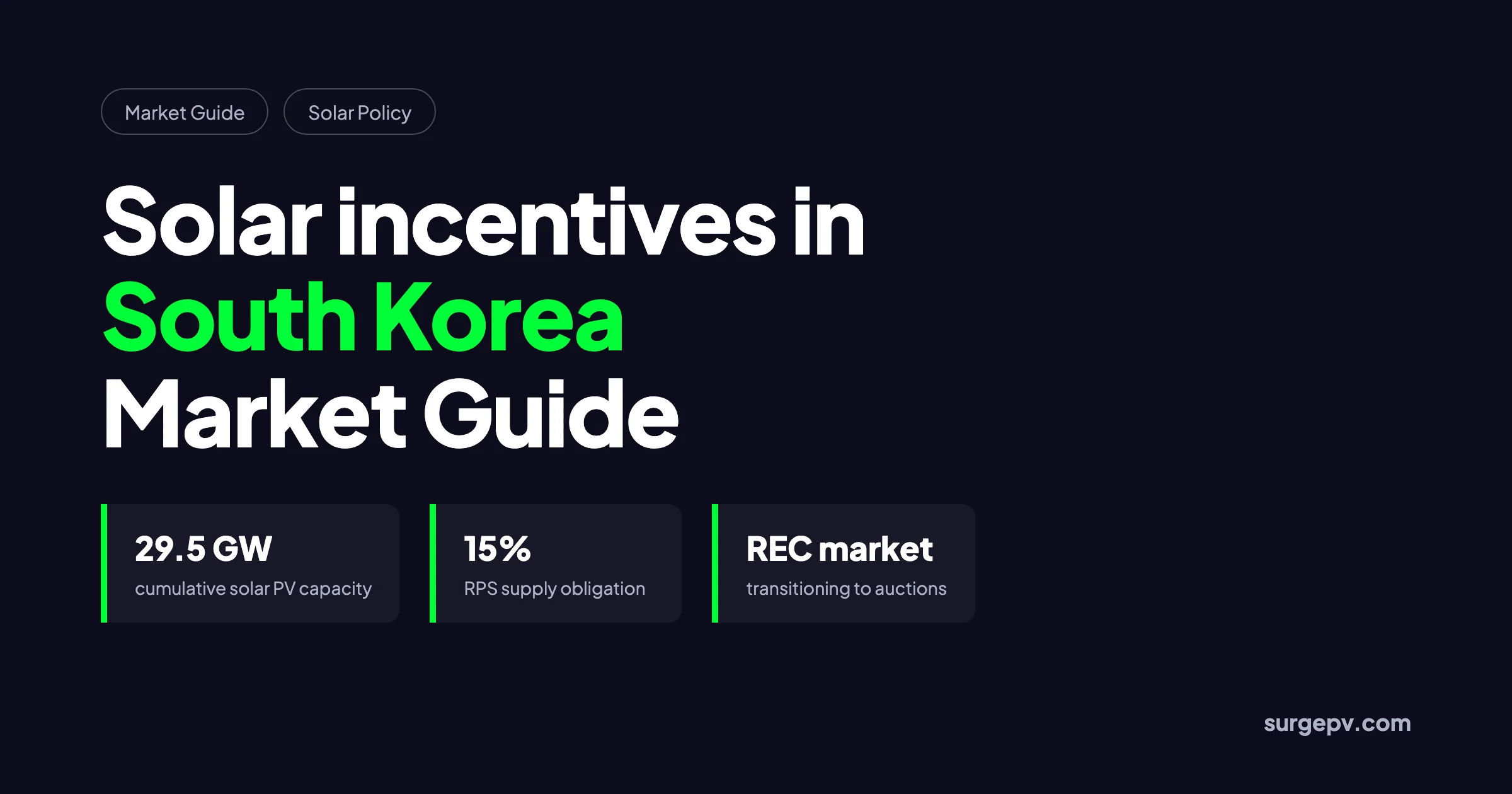
South Korea's 2026 solar incentives are built around the RPS/REC system, KEA fixed-price contract tenders, net metering for systems up to 1 MW, K-RE100 and corporate REC procurement, new I-RECs for behind-the-meter solar, and residential storage subsidies. The RPS is being phased out and replaced by government-run auctions from 2027.
South Korea added about 2.5 GW of solar capacity in 2024. Cumulative PV capacity reached roughly 29.5 GW by year-end, according to PV Magazine data from the Korea Energy Agency (2025). The government now targets 100 GW of renewable capacity by 2030, according to PV Magazine reporting on the Ministry of Climate, Energy and Environment (2026). For installers, EPCs, and investors, 2026 is a transition year. The certificate-based Renewable Portfolio Standard (RPS) is heading for retirement. Government-run auctions are taking shape, and new value streams such as I-RECs and corporate PPAs are opening.
This guide explains how South Korean solar incentives actually work in 2026. It covers the RPS/REC mechanism, the Korea Energy Agency’s fixed-price tenders, net metering, K-RE100, I-RECs, storage subsidies, and the mistakes that waste money. For a broader view, see our global solar market forecast for 2026. For payback comparisons across markets, see solar payback period by country.
If you are designing systems or writing proposals for Korean clients, use a solar design platform that models net metering value, REC revenue, and export tariffs. The right tool can cut hours from every project. Model scenarios automatically, then generate solar proposals in minutes. Check pricing or book a demo to see how SurgePV handles Korean projects.
Quick Answer
South Korea’s 2026 solar incentives are built around the RPS/REC system, KEA fixed-price contract tenders, net metering for systems up to 1 MW, K-RE100 and corporate REC procurement, new I-RECs for behind-the-meter solar, and residential storage subsidies. The RPS is being phased out. From 2027 it will be replaced by government-run auctions.
In this guide:
- Latest 2026 status of every active South Korean solar incentive
- How the RPS, RECs, and KEA fixed-price tenders work
- Net metering rules for residential and small commercial systems
- Corporate routes: K-RE100, direct PPAs, and I-RECs
- Residential storage subsidies and local rebates
- Commercial and industrial options beyond rooftop net metering
- How the 2027 auction transition changes project finance
- Common mistakes and how to avoid them
Latest Updates: South Korea Solar Incentives 2026
South Korea’s renewable policy framework is shifting from a certificate obligation to a contract-based auction model. The 2026 H1 solar tender may be the last under the current RPS/REC framework, while legislation to replace the RPS advances through the National Assembly.
South Korea Solar Incentive Status — June 2026
| Incentive | Type | Status | Key Terms |
|---|---|---|---|
| RPS supply obligation | Regulatory obligation | Active, being phased out | 15% in 2026 for generators over 500 MW |
| REC spot and contract market | Tradable certificates | Active, closing to new entrants from 2027 | 1 REC per MWh; solar multipliers 1.0–1.5 |
| KEA fixed-price solar tender | Competitive procurement | Active, likely final 2026 round | Ceiling was KRW 155,742/MWh in 2025 |
| Net metering | Bill credit | Active | For systems up to 1,000 kW |
| K-RE100 / Green Premium | Voluntary corporate program | Active | Register with KEA, procure RECs or pay premium |
| Direct corporate PPAs | Contract route | Active | Enabled by Electric Utility Act amendments |
| I-RECs | International certificates | Active from April 2025 | For behind-the-meter solar not in K-REC |
| Residential storage subsidy | Capital subsidy | Active | KRW 300,000–500,000/kWh, capped at 50% of cost |
| Carbon criteria in tenders | Scoring criterion | New in 2026 | Up to 20 points for module carbon footprint |
| Storage mandate for new plants | Grid code | Active | 20%–30% of capacity for new solar/wind above 1 MW |
Key Changes Since 2025
RPS phase-out: In May 2024, the Ministry of Trade, Industry and Energy announced the RPS would be phased out and replaced by a competitive auction mechanism modelled on the UK’s Contract for Difference system, according to Korea Wind Intelligence (2026). A substitute bill cleared the National Assembly’s Climate, Energy, Environment and Labor Committee in May 2026. It still needs further votes, according to PV Magazine (2026).
2027 transition: Under the proposed Renewable Energy Act overhaul, new projects would enter exclusively through government-run auctions from 2027. The REC spot market would close to new entrants from 2027 and be abolished by 2029. Existing operators would have access to a transition market through 2029.
Carbon scoring: The 2026 solar tender introduces a 20-point quantitative score for module carbon emissions. Modules at 630 kg CO₂/kW or below receive the top tier. Modules above 710 kg CO₂/kW receive the bottom tier, according to TaiyangNews (2026).
I-REC approval: The I-TRACK Foundation approved South Korea for I-REC issuance in April 2025. This creates a parallel certificate market for self-consumed solar that cannot register under the national K-REC system.
Key Takeaway
2026 is the final year to secure revenue under the existing RPS/REC framework. New projects should assume government auctions from 2027. Model revenue through PPAs or merchant power rather than REC spot prices.
Why South Korea’s Solar Market Matters in 2026
South Korea is a large, electricity-intensive economy with limited land and strong manufacturing demand. Solar is the country’s dominant renewable technology, but deployment has slowed from the peak years around 2020.
Market Size and Targets
South Korea added about 2.5 GW of solar capacity in 2024. Cumulative PV capacity reached roughly 29.5 GW, according to PV Magazine reporting on Korea Energy Agency data (2025). The 11th Basic Plan targets about 55.7 GW of solar capacity by 2030 and 77.2 GW by 2038, according to Renewables Information (2026). The Ministry of Climate, Energy and Environment has set a headline target of 100 GW of renewable capacity by 2030.
Solar supplied roughly 5% of national electricity generation in 2023, while coal, gas, and nuclear together supplied about 90%, according to Aurora Energy Research (2024). This gap between current solar share and government targets is the long-term demand driver for the market.
Land Constraints and Technology Choices
Scarce flat land and strong public opposition to large ground-mount projects have pushed development toward rooftops, factory carports, agricultural solar, and floating PV. The 47.2 MW Imha Dam floating PV plant began operating in late 2025. The government is planning 3 GW of reservoir floating solar by 2030, according to PV Magazine (2026). These siting choices affect interconnection cost, REC multipliers, and whether a project can use net metering or must bid into tenders.
For solar professionals, the design challenge is maximizing generation per square meter while meeting KEPCO interconnection standards. Accurate shading analysis and hourly production modelling are essential, especially for rooftop and floating projects. Modern solar design software handles both.
The Legal Foundation: RPS, RECs, and the Renewable Energy Act
South Korea’s renewable sector is governed by the Renewable Energy Act and the Electric Utility Act. The Renewable Portfolio Standard and the REC market are the two mechanisms that have shaped most solar investment over the past decade.
Renewable Portfolio Standard (RPS)
The RPS applies to power generators with installed capacity above 500 MW. These supply obligors must meet a rising share of renewable electricity in their generation mix. The obligation was 13.5% in 2024 and is 15% in 2026. It is scheduled to rise to 25% by 2030, according to Norton Rose Fulbright (2025).
Obligors can comply in two ways:
- Build their own renewable capacity and receive RECs for generation.
- Purchase RECs from renewable generators in the spot market or under long-term contracts.
Failure to meet the target can result in penalties. These can reach 150% of the average REC price for the shortfall, according to CMS Expert Guides (2024).
Renewable Energy Certificates (RECs)
One REC represents 1 MWh of certified renewable generation. RECs are issued by the New and Renewable Energy Center under the Korea Energy Agency. Solar projects receive REC multipliers between 1.0 and 1.5 based on technology, capacity, and location. Higher multipliers are designed to reward more challenging project types such as floating solar.
RECs trade on the Korea Power Exchange spot market or through bilateral contracts. The spot price has fluctuated widely. It fell to lows near KRW 50,000/MWh in 2022 and has recently ranged around KRW 75,000–80,000/MWh, according to Aurora Energy Research (2024). Because prices are volatile, project finance usually relies on fixed-price REC contracts rather than spot exposure.
The 2027 Auction Transition
Under the proposed reform, the RPS obligation would be replaced by a government-run contract market. Winning bidders would receive long-term fixed-price contracts similar to UK Contracts for Difference. The REC spot market would close to new entrants in 2027 and be abolished by 2029. Existing projects would continue under a transition market through 2029, according to PV Magazine (2026).
KEA Fixed-Price Contract Tenders
The Korea Energy Agency has run competitive solar tenders since 2017. These tenders award long-term REC contracts at fixed prices, giving developers revenue certainty. They are the main route for utility-scale solar in South Korea.
How the Tenders Work
Tenders are usually held twice a year. Developers bid a price for bundled SMP-plus-REC revenue. Winning projects sign a long-term contract with KEPCO and receive a guaranteed price floor for the REC component. From 2017 to 2025, the cumulative offered solar capacity across successive rounds was 14,810 MW. Of this, 10,638 MW were selected, according to PV Magazine citing KEA briefing materials (2026).
The ceiling price has declined as solar costs fell. It was KRW 157,307/MWh in 2024 and KRW 155,742/MWh in 2025, according to TaiyangNews (2026). The 2026 ceiling was expected to be raised to restore developer interest after several rounds were undersubscribed, according to InfoLink (2026).
New Scoring Rules for 2026
The 2026 tender changes the bid evaluation formula:
- Bid price weighting drops from 90 points to 70 points.
- Module carbon emissions receive up to 20 points, with four tiers from 630 kg CO₂/kW or below to above 710 kg CO₂/kW.
- Floating solar projects receive an extra 12 months to commission for capacities above 1 MW.
These changes mean low-carbon modules and realistic construction schedules are now as important as price. A PV generation and financial modeling that lets you test different REC prices, tender ceilings, and carbon-score assumptions is useful for bid preparation.
Net Metering and Small-Scale Solar
For households and small businesses, net metering is the most direct incentive. It has been in place since 2005. It applies to solar systems up to 1,000 kW, according to the Korea Energy Economics Institute (2023).
How Net Metering Works
KEPCO measures the electricity the customer imports from the grid and the surplus the solar system exports. The exported amount is credited against the imported amount before the monthly bill is calculated. If exports exceed imports in a given month, the surplus rolls forward as a credit.
The value of the credit depends on the customer’s retail tariff. South Korea uses an inclining block rate for households, so high-consumption customers pay more per kWh. Solar offsets consumption at the marginal tariff, which makes rooftop PV most attractive for households that use enough electricity to reach the higher tiers.
Declining Compensation and the Shift to Self-Consumption
The effective net metering compensation rate has fallen. It reportedly declined from around KRW 120/kWh to roughly KRW 70/kWh by 2026, according to IndexBox market analysis (2026). Lower export value makes self-consumption more valuable than export. This is the main reason residential battery storage is growing: storing midday solar for evening use avoids buying high-tier grid electricity.
Residential Storage Subsidies
The national government operates a residential solar-storage subsidy program. Industry reports cite subsidies of KRW 300,000 to 500,000 per kWh of battery capacity. The subsidy is capped at 50% of total system cost, according to IndexBox (2026). Local governments in cities such as Seoul, Busan, and Jeju add per-system rebates. Because municipal programs change frequently, always check the current notice before quoting a customer.
Corporate Routes: K-RE100, RECs, Direct PPAs, and I-RECs
Large companies in South Korea face pressure from global supply chains to procure renewable electricity. The main options are K-RE100 registration, direct PPAs, REC purchases, and, since 2025, I-RECs.
K-RE100 and Green Premium
K-RE100 is the national implementation of the global RE100 initiative. Companies register with the Korea Energy Agency. They can meet their targets by procuring RECs, signing renewable PPAs, or paying KEPCO’s Green Premium, according to CMS Expert Guides (2024). The Green Premium is an extra payment to KEPCO that allows the buyer to be recognized as a user of renewable electricity.
Direct Corporate PPAs
Amendments to the Electric Utility Act created a framework for direct and indirect corporate PPAs. A notable early deal was Hyundai’s 610 GWh, 20-year agreement, according to Mordor Intelligence (2026). Direct PPAs give corporations price certainty and give developers a long-term offtake, but they require careful structuring because PPA electricity may not automatically carry REC eligibility.
I-RECs for Behind-the-Meter Solar
The I-TRACK Foundation approved South Korea for I-REC issuance in April 2025. I-RECs apply to renewable electricity that is not registered under the national K-REC system, mainly self-consumed rooftop solar. Industry estimates suggest about 3.2 GW of Korean rooftop solar could be eligible, according to CnerG (2025).
Key rules:
- Only generation not used for K-RECs can earn I-RECs.
- Self-consumed and exported portions must be metered separately.
- Projects that received government subsidies may need extra documentation to prove they own the environmental attributes.
For multinational manufacturers with rooftop solar, I-RECs can support Scope 2 reporting and RE100 claims without exporting power to the grid.
Commercial and Industrial Solar Incentives
C&I solar in South Korea is usually driven by avoided retail or wholesale electricity costs rather than rooftop net metering. The right route depends on system size, load profile, and whether the project can secure a long-term contract.
Wholesale Market Sales
Systems from roughly 20 kW to 5 MW can sell surplus electricity into the Korea Power Exchange wholesale market at the System Marginal Price. Average wholesale prices have ranged from about USD 0.08/kWh to USD 0.12/kWh, according to IndexBox (2026). Because SMP is lower than retail tariffs, self-consumption is usually more valuable than export.
KEA Tenders and Corporate PPAs
Larger C&I and utility-scale projects typically compete in KEA fixed-price tenders or sign direct PPAs with corporates. These routes provide price certainty but require permits, land rights, interconnection studies, and often a battery storage share. New solar and wind plants above 1 MW must generally pair with energy storage equal to 20% to 30% of capacity, according to IndexBox (2026).
Demand-Charge Management
Industrial customers in South Korea face significant demand charges. Solar reduces energy charges, but batteries are often needed to cut peak demand. Semiconductor fabs, petrochemical plants, and data centers are increasingly adding solar-plus-storage to manage both energy costs and carbon reporting.
For C&I installers, the design priorities are load profiling, demand-charge analysis, and shadow analysis rather than simple bill offset. A tool that combines these inputs with Korean tariffs and tender assumptions makes the business case clearer.
How to Stack Incentives: Two Real-World Scenarios
The following examples are illustrative, based on typical 2026 costs and incentive rates. Actual figures depend on location, customer class, tariff, and whether the project wins a tender or PPA.
Scenario 1 — 5 kW Residential Rooftop, Seoul Metropolitan Area
| Item | Amount |
|---|---|
| Gross installed cost | KRW 12,000,000 |
| Local government rebate | −KRW 1,000,000 |
| Battery storage subsidy (8 kWh at KRW 400,000/kWh) | −KRW 3,200,000 |
| Net cost | KRW 7,800,000 |
| Annual bill savings (high-tier offset + storage arbitrage) | KRW 1,400,000 |
| Payback | 5.6 years |
Without storage and with a lower net metering export rate, payback would stretch to roughly 8 to 10 years.
Scenario 2 — 5 MW Commercial Rooftop, Industrial Zone
| Item | Amount |
|---|---|
| Gross installed cost | KRW 7,500,000,000 |
| Battery storage (20% of capacity, 1 MW/2 MWh) | +KRW 800,000,000 |
| Total CAPEX | KRW 8,300,000,000 |
| Annual energy savings and demand-charge reduction | KRW 900,000,000 |
| Estimated REC/tender revenue | KRW 300,000,000 |
| Simple payback | 6.9 years |
The project economics depend heavily on whether the REC revenue comes from a fixed-price tender or a volatile spot market.
Common Mistakes and Misconceptions
Even experienced developers lose money in South Korea by misunderstanding how the incentives interact. Here are the most costly errors.
Assuming the Feed-In Tariff Still Exists
South Korea ended its national feed-in tariff in 2018. Projects that expect a guaranteed feed-in rate are using the wrong financial model. New projects must value RPS/REC revenue, net metering, tenders, or PPAs.
Ignoring the 2027 Transition
Developers still bidding based on long-term REC spot price assumptions may be surprised when the spot market closes to new entrants in 2027. Any project not yet in the 2026 tender pipeline should model government auction revenue instead.
Overestimating Net Metering Export Value
The net metering compensation rate has fallen. Designing a residential system that exports a large share of generation is less attractive than sizing it to match daytime and battery-backed consumption.
Neglecting the Carbon Score
The 2026 tender awards up to 20 points for module carbon intensity. Using high-carbon modules can push a bid out of the money even if the price is low. Check the manufacturer’s carbon certification before specifying modules.
Confusing K-REC and I-REC Eligibility
A project cannot earn both K-RECs and I-RECs for the same MWh. Behind-the-meter systems must choose the certificate pathway that matches their offtake strategy before registering.
Underestimating Interconnection and Storage Requirements
KEPCO interconnection queues and studies can take 6 to 12 months for systems above 500 kW. This is a major bottleneck for larger projects, according to IndexBox (2026). New utility-scale projects also need storage, which adds cost and design complexity.
Conclusion
South Korea’s solar incentive framework in 2026 is a stack in transition. The RPS/REC system and KEA fixed-price tenders still provide the main revenue streams, but they will be replaced by government-run auctions from 2027. Net metering remains valuable for small systems, while corporates can choose K-RE100, direct PPAs, or I-RECs. Storage subsidies and mandates are pushing solar-plus-storage as the default design.
For solar professionals, the edge is no longer just installation cost. It is the ability to model RPS transition risk, REC value, net metering declines, and tender scoring rules in one workflow. SurgePV’s solar design software, generation and financial tool, and Clara AI can help you build bankable Korean proposals faster.
Three actions to take now:
- Confirm the revenue route before sizing — RPS/REC tender, net metering, PPA, or merchant power each changes the optimal design.
- Model the 2027 transition — do not assume long-term REC spot revenue for projects that have not secured a contract.
- Size for self-consumption and storage — falling net metering export value makes batteries and load shifting more valuable than export.
For regional comparisons, see our solar payback period by country guide. For installers scaling in Asia, our guide for solar installers covers proposal automation and compliance workflows.
Frequently Asked Questions
What solar incentives are available in South Korea in 2026?
South Korea’s 2026 solar incentives include the Renewable Portfolio Standard (RPS) and Renewable Energy Certificate (REC) market, KEA fixed-price contract tenders, net metering for systems up to 1 MW, K-RE100 and corporate REC procurement, I-RECs for behind-the-meter solar, and residential storage subsidies. The framework is transitioning from certificate-based support to government-run auctions. The auction model is expected to begin in 2027.
Does South Korea have a feed-in tariff for solar?
No. The national feed-in tariff was phased out in 2018. New projects rely on the RPS/REC system, KEA fixed-price tenders, net metering, or corporate power purchase agreements rather than a guaranteed feed-in tariff.
How does net metering work in South Korea?
Net metering applies to solar systems up to 1,000 kW. Exported electricity is credited against the customer’s monthly import from KEPCO, and any surplus is carried forward to the next month. The value of the credit depends on the customer’s retail tariff tier.
What is the Renewable Portfolio Standard (RPS)?
The RPS requires power generators with more than 500 MW of installed capacity to supply a rising share of their electricity from renewable sources. In 2026 the obligation is 15%, rising to 25% by 2030. Compliance is demonstrated through RECs.
What are Renewable Energy Certificates (RECs)?
One REC represents 1 MWh of renewable electricity generation. RECs are issued by the Korea Energy Agency and traded on the Korea Power Exchange spot market or through long-term contracts. Solar projects receive REC multipliers of 1.0 to 1.5 depending on project type and location.
What are I-RECs and how do they differ from K-RECs?
I-RECs are international renewable energy certificates approved for South Korea in April 2025. They cover behind-the-meter generation that cannot register under the national K-REC system. A project cannot earn both K-RECs and I-RECs for the same MWh.
What incentives exist for residential solar and battery storage?
Residential projects benefit from net metering and national or local subsidies. The national residential solar-storage subsidy program reportedly provides KRW 300,000 to 500,000 per kWh of battery capacity, capped at 50% of system cost. Some municipalities add per-system rebates.
How do commercial and industrial projects sell solar power?
C&I systems from roughly 20 kW to 5 MW can sell surplus into the wholesale market at the System Marginal Price. Larger projects typically bid into KEA fixed-price tenders or sign direct corporate power purchase agreements. New solar and wind plants above 1 MW must usually pair with 20% to 30% energy storage.
What is K-RE100?
K-RE100 is South Korea’s version of the global RE100 initiative. Registered companies can meet 100% renewable electricity targets by procuring RECs, paying the Green Premium through KEPCO, or signing renewable energy power purchase agreements.
What is changing in 2027 for South Korean solar incentives?
Legislation advancing in 2026 would abolish the RPS and shift new renewable projects to government-run auctions from 2027. The REC spot market would close to new entrants in 2027 and be abolished by 2029, while existing projects would use a transition market through 2029.
Where this fits
This article is part of SurgePV's Solar Incentives & Policy hub, which works through the topic from first principles to the decisions a project team actually has to make.

