

Answer
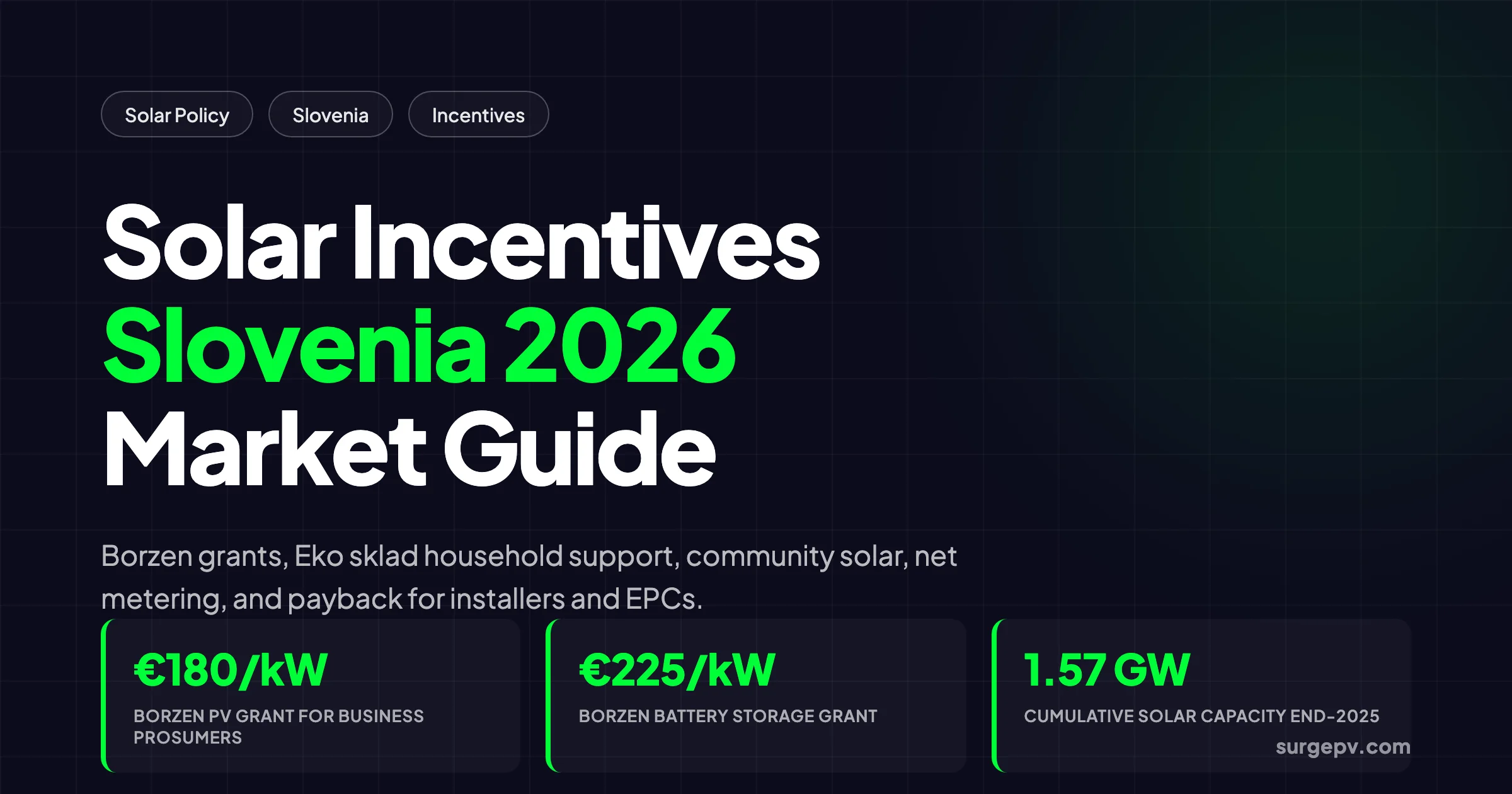
Slovenia's 2026 solar incentives include Borzen-administered business prosumer grants of €180/kW for PV and €225/kW for BESS, Eko sklad residential subsidies, community solar support up to 45% of PV costs, and annual net metering for self-supply.
Slovenia’s solar market is shifting faster than many installers realize. Cumulative installed PV capacity reached roughly 1.57 GW at the end of 2025. That is up from about 1.42 GW in 2024, according to IRENA data reported by TaiyangNews (2026). The country is preparing to introduce electricity sharing on July 1, 2026. It is finalizing a new Comprehensive National Energy and Climate Plan for 2030-2040. And, most importantly for installers, the administration of business solar subsidies has moved from Eko sklad to Borzen.
This guide is a practical market and incentive manual for installers, EPCs, cooperatives, and property owners. It covers the 2026 Slovenian solar incentive stack, the move from Eko sklad to Borzen, net metering and self-supply rules, energy communities, and realistic payback examples. For the broader European picture, see our European solar incentives guide. For a software-focused view of the Slovenian workflow, see our best solar software in Slovenia guide.
If you design systems or write proposals for Slovenian clients, SurgePV is a cloud solar design platform with local tariffs and incentive templates that saves hours on every project. Use the generation and financial tool to model payback, self-consumption, and stacked incentives automatically, then generate solar proposals in minutes.
Slovenia’s 2026 solar incentive stack can cut net project cost by 15-45% when layered correctly. Active tools include Borzen business prosumer grants, Eko sklad household subsidies, community solar support, favorable Eko sklad loans, and annual net metering for self-supply. The key is matching the program to the project type and applying with the correct administrator.
TL;DR — Solar Incentives in Slovenia 2026
Business solar subsidies now run through Borzen: €180/kW for PV and €225/kW for batteries under a €30 million call that opened in May 2026. Eko sklad still handles household subsidies and soft loans. Community solar offers up to 45% of PV costs. Annual net metering remains active, and electricity sharing starts July 1, 2026. Residential payback is typically 7-10 years.
In this guide:
- Latest 2026 status of every active Slovenian solar incentive
- Market context: why Slovenia reached 1.57 GW of solar in 2025
- The shift from Eko sklad to Borzen for business subsidies
- Eko sklad household subsidies and soft loans
- Community solar grants for cooperatives and energy communities
- Net metering and the new electricity-sharing framework
- Tax, VAT, and grid-charge considerations
- C&I and utility-scale support
- A real-world residential payback example
- Common mistakes and how to avoid them
Latest Updates: Slovenia Solar Incentives 2026
The Slovenian solar policy environment in 2026 is defined by institutional change. The biggest single update is that new business and prosumer subsidies for PV and battery storage are no longer managed by Eko sklad. They are now administered by Borzen, the national electricity market operator.
Slovenia Solar Incentive Status — June 2026
| Incentive | Type | Administrator | Status | Key Terms |
|---|---|---|---|---|
| Business prosumer PV grant | Capital grant | Borzen | Active from May 2026 | €180/kW, up to 1 MW |
| Business prosumer BESS grant | Capital grant | Borzen | Active from May 2026 | €225/kW, co-located with PV |
| Household PV + battery subsidy | Capital grant | Eko sklad | Active, rounds subject to budget | Rates vary by call |
| Community solar grant | Capital grant | Cohesion Policy / Ministry | Active through 2027 | Up to 45% PV costs, min 100 kW |
| Eko sklad soft loan | Loan | Eko sklad | Active | Favorable terms for clean-energy investments |
| Self-supply net metering | Grid settlement | DSO / supplier | Active | Annual netting at connection point |
| Electricity sharing | Administrative transfer | Supplier | From July 1, 2026 | Share surplus with other users |
| Feed-in tariff / operating premium | Price support | Borzen / Energy Agency | Closed to most new small entrants | Legacy and large projects only |
Key Changes Since 2024
May 2026 — Borzen takes over business subsidies. Borzen launched a €30 million public call for legal entities (Balkan Green Energy News, 2026). Applications opened on May 12, 2026. Eligible projects include solar power plants for self-consumption up to 1 MW and co-located battery storage. The maximum subsidy is €180 per kW of PV and €225 per kW of battery capacity. Projects need a connection permit and must start works after January 1, 2025. Facilities must become operational within 18 months of the award decision.
July 2026 — Electricity sharing begins. Slovenia will allow solar producers to share surplus electricity with other users administratively from July 1, 2026. The transferred electricity is not physically routed to the recipient. It is reflected as a credit on supplier bills. Users under annual net metering can transmit surplus but cannot receive shared electricity. Large companies are excluded because sharing would qualify as an economic activity, according to TaiyangNews (2026).
2025-2027 — Community solar funding doubled. Due to strong interest, Slovenia increased community renewable energy funding from €16.1 million to €31.2 million for the 2025-2027 period, according to CE Energy News (2025). The program supports community PV systems of at least 100 kW where at least 80% of participants are household consumers.
Key Takeaway
2026 is a transition year for Slovenian solar incentives. Business subsidies have moved to Borzen, household subsidies remain at Eko sklad, and electricity sharing creates new options for prosumers. Installers should verify the correct administrator and application timeline before quoting a post-subsidy price.
Why Slovenia’s Solar Market Matters in 2026
Slovenia is not the largest solar market in Europe, but it is one of the most policy-active in the Western Balkans and Central European region. The country has a high share of hydropower and nuclear in its electricity mix. This makes midday solar integration relatively manageable compared with markets dominated by fossil-flexible generation.
Market Size and Targets
Slovenia installed enough solar in 2025 to raise cumulative capacity to roughly 1.57 GW. That figure comes from IRENA data reported by TaiyangNews (2026). That follows approximately 1.42 GW at the end of 2024. The market is growing across residential, commercial, and community segments.
Slovenia’s updated National Energy and Climate Plan (Balkan Green Energy News, 2024) targets a 55.4% share of renewables in electricity by 2030. The plan also calls for 400 MW of batteries, 100 MW of electrolyzers, and additional pumped-storage hydropower. The Ministry of Infrastructure has separately aimed to add roughly 1 GW of new solar PV capacity by 2030. That target is noted by PV Know How (2026).
| Metric | Value | Source |
|---|---|---|
| Cumulative solar capacity end-2025 | ~1.57 GW | IRENA / TaiyangNews (2026) |
| Cumulative solar capacity end-2024 | ~1.42 GW | IRENA / TaiyangNews (2026) |
| 2030 renewable electricity target | 55.4% | Updated NECP (2024) |
| 2030 battery target | 400 MW | Updated NECP (2024) |
| Solar irradiance, Ljubljana | ~1,150-1,250 kWh/kWp/year | Global Solar Atlas |
| Solar irradiance, Primorska coast | ~1,300-1,400 kWh/kWp/year | Global Solar Atlas |
| Household electricity price (2025) | ~€0.18-€0.22/kWh | Eurostat / PV Know How (2026) |
Slovenia’s average annual PV output ranges from roughly 1,100 kWh per installed kWp in less favorable Alpine or northern locations to 1,400 kWh/kWp on the Primorska coast. Ljubljana sits in the middle of that range at roughly 1,200 kWh/kWp/year under optimal tilt and orientation.
Why the Policy Reset Matters
Slovenia is moving from a grant model centered on Eko sklad to a split model. Eko sklad retains household renovation and residential solar subsidies. Borzen now manages business prosumer grants and large-scale support schemes. This split mirrors the country’s broader energy-market reforms, which include electricity sharing, energy communities, and a push for battery storage.
For solar professionals, the lesson is that Slovenian demand is policy-sensitive and administratively complex. Grant windows, administrator changes, and grid-connection rules drive installation timing more than seasonal weather patterns.
Borzen Business Prosumer Grants: The Big 2026 Change
Borzen, the Slovenian electricity market operator, launched the most important new solar subsidy of 2026. The public call targets legal entities, cooperatives, entrepreneurs, and local authorities that want to install solar for self-consumption and battery storage.
2026 Borzen PV + BESS Rates
| Element | Detail |
|---|---|
| Total budget | €30 million |
| PV subsidy rate | €180/kW of installed capacity |
| BESS subsidy rate | €225/kW of installed storage capacity |
| Maximum project size | 1 MW for PV |
| Eligible applicants | Legal entities, cooperatives, entrepreneurs, local authorities |
| Application opened | May 12, 2026 |
| Works start date | After January 1, 2025 |
| Completion deadline | 18 months from award decision |
| Payment | After facility begins operation |
The call applies to solar power plants for self-consumption and batteries co-located with those plants. Eligible projects must already have a connection permit issued and must have started works after January 1, 2025. The subsidy is paid after the facility becomes operational, not upfront.
Eligibility and Application Process
Typical requirements include:
- The applicant is a legal entity, cooperative, entrepreneur, or local authority.
- The PV system is for self-consumption, up to 1 MW.
- A connection permit has been issued.
- Works began after January 1, 2025.
- The facility becomes operational within 18 months of the award decision.
- The applicant submits a payment request after commissioning.
Grants are paid to investors upon confirmation of the payment request. This means businesses must finance construction and then claim reimbursement. Cash-flow planning is therefore important.
Pro Tip — Avoiding Application Rejection
The most common reason for rejection is missing documentation, especially the connection permit and proof that works began after the eligible date. Businesses should obtain the connection permit and keep dated contracts and invoices before applying.
Eko Sklad: Household Solar Subsidies and Soft Loans
Eko sklad, the Slovenian Environmental Public Fund, remains the main entry point for residential solar subsidies, energy renovation grants, and favorable loans. While business PV + battery subsidies moved to Borzen in 2026, Eko sklad still runs programs for households.
Eko Sklad Household Solar Support
Eko sklad has historically offered higher subsidies for PV systems with batteries than for PV-only systems. Under earlier calls, households could receive up to €500 per kWh of battery capacity. PV without storage received only €50 per kW, according to Balkan Green Energy News (2023). Battery subsidies were set at ten times the PV-only rate to encourage self-consumption and reduce grid pressure.
Battery eligibility comes with conditions. The storage capacity must be at least 0.7 hours of the installed PV capacity. A 10 kW PV system must therefore have at least a 7 kWh battery. Subsidies cannot exceed 25% of the total investment.
Eko Sklad Soft Loans
Beyond grants, Eko sklad provides low-interest loans for clean-energy investments. Loan terms typically track the three-month EURIBOR plus a small margin. Loan amounts range from roughly €1,500 to €40,000 for households and can reach much higher amounts for businesses and multi-apartment buildings.
| Use | Typical Loan Terms |
|---|---|
| Household clean-energy investments | €1,500-€40,000, EURIBOR + margin |
| Solar power plants | Up to 20% of investment value through grants |
| Comprehensive building renovation | Up to 50% of eligible costs |
| Multi-apartment building renovation | Higher amounts, project-dependent |
Energy Poverty Programs
Eko sklad also runs targeted programs for socially vulnerable households. The ZERO500 program, for example, can cover 100% of eligible energy renovation costs up to roughly €9,620 for eligible low-income households. In cases where roof insulation is needed, the cap can rise to roughly €15,000. These programs are not solar-specific but can be combined with PV where the renovation includes rooftop work.
Community Solar and Energy Communities
Slovenia has one of the more advanced frameworks for energy communities in Central Europe. The Energy Act and the Act on the Promotion of the Use of Renewable Energy Sources provide the legal basis. These laws enable renewable energy communities and citizens’ energy communities.
Community Solar Grant Program
Due to strong interest, Slovenia increased community renewable energy funding to €31.2 million for 2025-2027. That increase is reported by CE Energy News (2025). The program supports community PV systems with a minimum capacity of 100 kW, where at least 80% of participants are household consumers.
| Element | Detail |
|---|---|
| Total funding | €31.2 million for 2025-2027 |
| PV cost coverage | Up to 45%, capped at €350/kW |
| BESS cost coverage | Up to 30%, capped at €225/kWh |
| Minimum capacity | 100 kW |
| Household participation | At least 80% of participants |
| Application rounds | May, September, December |
Two investment categories exist: systems between 100-300 kW and systems above 300 kW. The funding split is roughly €12.2 million for solar panels and €19 million for storage systems. This structure reflects the government’s priority: community solar should be paired with batteries to absorb midday surplus and reduce distribution-grid stress.
Why Energy Communities Matter
Energy communities allow households, SMEs, and local organizations to produce, consume, share, or sell energy under defined rules. For installers, this opens larger project sizes than typical residential rooftops. A 150 kW community system on a school, factory, or municipal building can serve dozens of households through administrative allocation.
The governance and metering arrangements are more complex than a standard prosumer installation. Projects need clear internal rules, allocation keys, and supplier contracts. A solar design platform that can model community consumption profiles and shared generation is valuable for these projects.
Net Metering, Self-Supply, and Electricity Sharing
Understanding the grid settlement framework is essential for correct sizing and honest payback projections. Slovenia uses annual net metering for self-supply, called samooskrba, and is introducing electricity sharing from July 2026.
Annual Net Metering (Samooskrba)
Under Slovenia’s self-supply framework, a prosumer only pays the difference between grid consumption and solar exports. This accounting typically covers one calendar year. Network charges, taxes, and other levies are calculated on the net difference at the connection point.
This is a valuable framework for residential and small-business systems. A household that exports surplus solar in summer can offset winter grid imports. The grid effectively acts as a seasonal battery, though only at the energy-component level.
Key practical points:
- Net metering applies at the connection point level.
- The settlement period is typically one calendar year.
- The prosumer must obtain the distribution system operator’s consent before connecting the self-supply device.
- Oversizing far beyond annual consumption reduces value, because exported surplus is settled at lower rates than avoided grid purchases.
Electricity Sharing from July 1, 2026
The new electricity-sharing framework is different from net metering. It allows a solar producer to allocate surplus to another user through the supplier. The electricity does not physically flow to the recipient. Instead, the supplier credits the recipient’s bill and debits the producer’s surplus balance.
Important limits:
- Users under annual net metering can act as transmitters but not recipients.
- Large companies cannot participate because electricity sharing would qualify as an economic activity.
- Only the electricity component of bills is affected. Network charges are not shared.
For example, a self-sufficient producer that sends 9,000 kWh to the grid and consumes 7,000 kWh could share 1,000 kWh with another user. The producer would still retain a 1,000 kWh surplus in the final net-metering calculation, according to TaiyangNews (2026).
Key Takeaway — Metering in Slovenia 2026
Annual net metering remains the core value driver for residential and small-business solar. Electricity sharing adds flexibility for certain prosumer configurations but does not replace net metering. Design every system around self-consumption first, and use storage to capture value that would otherwise be lost to low export prices.
Tax, VAT, and Grid Considerations
Slovenia’s tax treatment of solar is generally straightforward but has nuances that affect project economics.
VAT
Residential solar installations are typically subject to the standard VAT rate of 22%. There is no broad reduced VAT rate for residential PV comparable to some EU neighbors. Businesses can recover VAT on installation costs as part of their normal VAT accounting.
Income Tax and Depreciation
For households, self-consumed solar electricity reduces the electricity bill directly and is not treated as taxable income. Export income is settled through the supplier at market-linked rates and falls under normal electricity supply rules.
For businesses, solar systems are treated as fixed assets. Companies can depreciate the investment against taxable income and recover VAT on installation costs. The exact depreciation schedule follows Slovenian corporate tax rules.
Grid Charges and Regulated Prices
Slovenia implemented temporary electricity price caps during the energy crisis. The maximum permitted tariff items for household electricity without VAT were set from November 2024 to February 2025. The higher tariff was €0.084/kWh, the lower tariff €0.070/kWh, and the uniform tariff €0.077/kWh, according to Eurostat (2026). These caps were removed from March 2025, and market prices now apply.
The RES+CHP contribution, an environmental levy on electricity bills, was also temporarily suspended for household consumers until June 2025. Installers should confirm current levy rates when modeling savings.
Solar Installation Costs and Payback in Slovenia
The financial case for solar in Slovenia rests on high retail electricity prices, decent irradiance, and available subsidies. Battery storage is increasingly important as the market shifts from pure net metering toward self-consumption optimization.
Typical System Costs
A residential solar system in Slovenia typically costs €1,000-€1,500 per kWp all-in, including panels, inverter, mounting, cabling, labor, permits, and grid connection. A 5 kWp system therefore costs roughly €5,000-€7,500 before any battery or subsidy.
| System Component | Typical Cost Range |
|---|---|
| 5 kWp PV system | €5,000-€7,500 |
| 10 kWh battery | €4,000-€6,000 |
| 5 kWp PV + 10 kWh battery | €9,000-€13,500 |
| Commercial rooftop >50 kWp | €900-€1,300/kWp |
Adding a battery raises upfront cost but also raises self-consumption. Borzen offers €225/kW for business battery storage. Eko sklad has historically offered up to €500/kWh for household batteries. The net cost of storage can therefore be attractive.
Worked Residential Payback Example
Consider a household in Ljubljana with the following assumptions:
- 5 kWp rooftop PV system
- Annual generation: ~6,000 kWh
- Self-consumption ratio: 40% without battery, 65% with battery
- Retail electricity price: €0.20/kWh
- Export settlement: €0.05/kWh
- System cost before subsidy: €6,500
- Eko sklad grant: €1,000
- Battery cost: €5,000
- Battery subsidy: €3,500
Without battery:
- Self-consumed value: 6,000 kWh × 40% × €0.20 = €480/year
- Export value: 6,000 kWh × 60% × €0.05 = €180/year
- Total annual value: €660/year
- Net cost after grant: €5,500
- Simple payback: €5,500 / €660 = 8.3 years
With battery:
- Self-consumed value: 6,000 kWh × 65% × €0.20 = €780/year
- Export value: 6,000 kWh × 35% × €0.05 = €105/year
- Total annual value: €885/year
- Net cost after subsidies: €6,500 + €5,000 - €1,000 - €3,500 = €7,000
- Simple payback: €7,000 / €885 = 7.9 years
This example shows that batteries can shorten payback even though they add upfront cost, provided the subsidy is captured and self-consumption rises enough. Exact payback depends on consumption profile, tariff structure, and actual subsidy uptake.
C&I Payback
Commercial and industrial projects often see faster payback due to economies of scale and higher daytime consumption. A 200 kW rooftop system at €1,100/kWp costs roughly €220,000 before subsidies. With a Borzen grant of €180/kW, the net cost falls by €36,000. If the business consumes most generation on-site at €0.18/kWh, annual savings can exceed €35,000, giving a payback of roughly 5-7 years.
Common Mistakes and Tradeoffs
Every solar market has failure modes. Slovenia is no exception, and the 2026 administrator change makes careful documentation especially important.
Mistake 1: Starting Installation Before Approval
The most expensive error is beginning works before the grant is approved or before the eligible start date. The Borzen business call requires works to begin after January 1, 2025. Eko sklad calls typically require the system to be operational at the time of application and works to begin after the call is published. Starting early usually voids the grant.
Mistake 2: Oversizing for Export
Under annual net metering, a system sized close to annual consumption delivers the best return. Oversizing far beyond consumption means most surplus is exported at low settlement rates. The value of a self-consumed kilowatt-hour is roughly 3-4 times the value of an exported kilowatt-hour.
Mistake 3: Ignoring Battery Sizing Rules
Eko sklad battery subsidies require storage capacity of at least 0.7 hours of PV capacity. A 10 kW system needs at least 7 kWh of batteries. Installing a smaller battery makes the project ineligible for the higher subsidy rate.
Tradeoff: Battery Cost vs. Subsidy Value
Batteries add upfront cost but unlock higher subsidies and raise self-consumption. The decision depends on the household’s consumption profile. A household with high evening consumption, an electric vehicle, or a heat pump will benefit more from storage. Daytime-heavy households gain less from batteries.
Tradeoff: Community Solar vs. Individual Self-Supply
Community solar allows larger systems and shared costs but requires governance, allocation rules, and supplier coordination. Individual self-supply is simpler but limited by rooftop space and single consumption profile. Community solar suits multi-apartment buildings, housing cooperatives, and municipal projects.
Conclusion: Three Actions for Slovenian Solar Projects in 2026
Slovenia’s solar incentive framework in 2026 rewards preparation. The move of business subsidies to Borzen, the continuation of Eko sklad household support, and the launch of electricity sharing create new opportunities. They also create new administrative traps.
If you are an installer, EPC, or property owner, take three actions now:
- Confirm the correct administrator before quoting. Business prosumer grants now run through Borzen. Household subsidies and soft loans remain at Eko sklad. Use the wrong portal and the application fails.
- Size for self-consumption, not maximum output. Annual net metering is valuable, but exported surplus is not. A smaller system that covers daytime load usually beats a larger system that exports most of its generation.
- Model incentives before the site visit. Use a solar design platform with Slovenian tariffs, net-metering logic, and Borzen/Eko sklad subsidy templates. Then generate proposals that show realistic payback. If you want to see how SurgePV handles Slovenia, book a demo or check pricing.
FAQ
What solar incentives are available in Slovenia in 2026?
Slovenia’s 2026 solar incentives include Borzen-administered grants for legal entities of €180/kW for PV and €225/kW for batteries, Eko sklad residential subsidies for households, community solar grants covering up to 45% of PV costs, and favorable Eko sklad loans. Annual net metering for self-supply remains active, and electricity sharing begins on July 1, 2026.
Who administers solar subsidies in Slovenia in 2026?
Business and prosumer subsidies shifted from Eko sklad to Borzen, the Slovenian electricity market operator, in 2026. Eko sklad still manages household subsidies, energy renovation grants, and soft loans. Community solar is funded through the European Cohesion Policy Programme.
What is the maximum business solar subsidy in Slovenia in 2026?
The May 2026 Borzen public call offers up to €180 per kW of installed PV and €225 per kW of battery energy storage capacity. Eligible projects must be up to 1 MW, have a connection permit, and start works after January 1, 2025. The total budget is €30 million.
Does Slovenia have net metering for solar?
Yes. Slovenia operates annual net metering for self-supply, called samooskrba. Prosumers can offset electricity taken from the grid over a calendar year with surplus solar exported to the grid. This applies at the connection point level and is separate from the new electricity-sharing framework launching July 1, 2026.
What is Slovenia’s 2026 community solar program?
Slovenia doubled community renewable energy funding to €31.2 million for 2025-2027. Companies and cooperatives can receive up to 45% of PV costs, capped at €350/kW, and up to 30% of battery costs, capped at €225/kWh. Projects must be at least 100 kW and at least 80% household consumers.
How much does a residential solar system cost in Slovenia in 2026?
A residential solar system in Slovenia typically costs €1,000-€1,500 per kWp all-in, depending on roof type, components, and installer. A 5 kWp system therefore costs roughly €5,000-€7,500 before subsidies. Adding a 10 kWh battery adds approximately €4,000-€6,000.
What is the solar payback period in Slovenia?
A well-sized residential solar system in Slovenia typically pays back in 7-10 years without subsidies and 6-8 years with Eko sklad support. Payback depends on self-consumption ratio, retail electricity price, system cost, and whether battery storage is added. Ljubljana and Primorska often see faster payback due to higher irradiance.
What is electricity sharing in Slovenia from July 2026?
From July 1, 2026, Slovenia allows solar producers to share surplus electricity with other users through an administrative transfer reflected on supplier bills. It affects only the electricity component, not network charges. Users under annual net metering can act as transmitters but not recipients. Large companies cannot participate because sharing would qualify as an economic activity.
What is Slovenia’s 2030 solar target?
Slovenia’s updated National Energy and Climate Plan targets a 55.4% share of renewables in electricity by 2030. The Ministry of Infrastructure has also aimed to add roughly 1 GW of new solar PV capacity by 2030. Cumulative solar capacity reached approximately 1.57 GW at the end of 2025.
What is the biggest mistake when applying for Slovenian solar grants?
The most expensive mistake is starting installation before securing written approval or a connection permit. Both the Borzen business call and Eko sklad household programs require eligible works to begin after specific dates and after approval. The second common error is oversizing for export under net metering, when self-consumption delivers the best return.
Where this fits
This article is part of SurgePV's Solar Incentives & Policy hub, which works through the topic from first principles to the decisions a project team actually has to make.

