

Answer
Solar support in Nepal depends on the technology, applicant and programme window. AEPC publishes routes for commercial rooftop systems, irrigation and mini-grids, but a published subsidy rule does not prove that applications or funds remain available. Check the dated call, approval conditions, NEA connection and export agreement, and current customs classification before including a benefit in a quote.
An installer preparing a Nepal proposal needs two separate answers: which support route fits the project, and whether that route is accepting this applicant now. An old programme page can help with the first question while leaving the second unanswered.
Source review: September 30, 2026. This guide identifies official routes and documented historical terms. It does not certify a current award, connection approval or customs exemption for a particular customer. Retain the Nepali fiscal year and the original notice date alongside any Gregorian date used in the proposal.
Choose the Route by Project Type
| Project | Start with | Evidence needed before treating support as available |
|---|---|---|
| Commercial or industrial rooftop | AEPC’s DKTI description and current notices | Eligible applicant, current intake, approved loan and support calculation |
| Captive institutional or commercial energy project | AEPC/CREF challenge-fund route | Relevant window, concept-note deadline and award process |
| Irrigation pumping | Current AEPC irrigation notice and application | Applicant ownership, location, pump category and eligible costs |
| Government or community hospital | Current institutional notice | Exact institution eligibility and complete demand documents |
| Off-grid mini-grid | Applicable AEPC policy and programme | Grid-access criteria, ownership, service area and contribution |
| Grid-connected rooftop or power producer | NEA’s applicable connection and purchase route | Approved design, metering, tariff agreement and permission to export |
Use AEPC’s current document index to locate the actual notice and forms. At this review, the index displayed hospital solar demand and community irrigation entries dated 24 Bhadra 2083. Their listing is evidence of a published process, not proof of an unexpired deadline, budget allocation or eligibility for every hospital or farmer.
A household should identify its actual technology and location before comparing support. A rural solar home system, an irrigation pump and an urban grid-connected rooftop are different applications. A grant for one is not transferable to the others.
DKTI: Documented Financing Support, Not an Automatic Discount
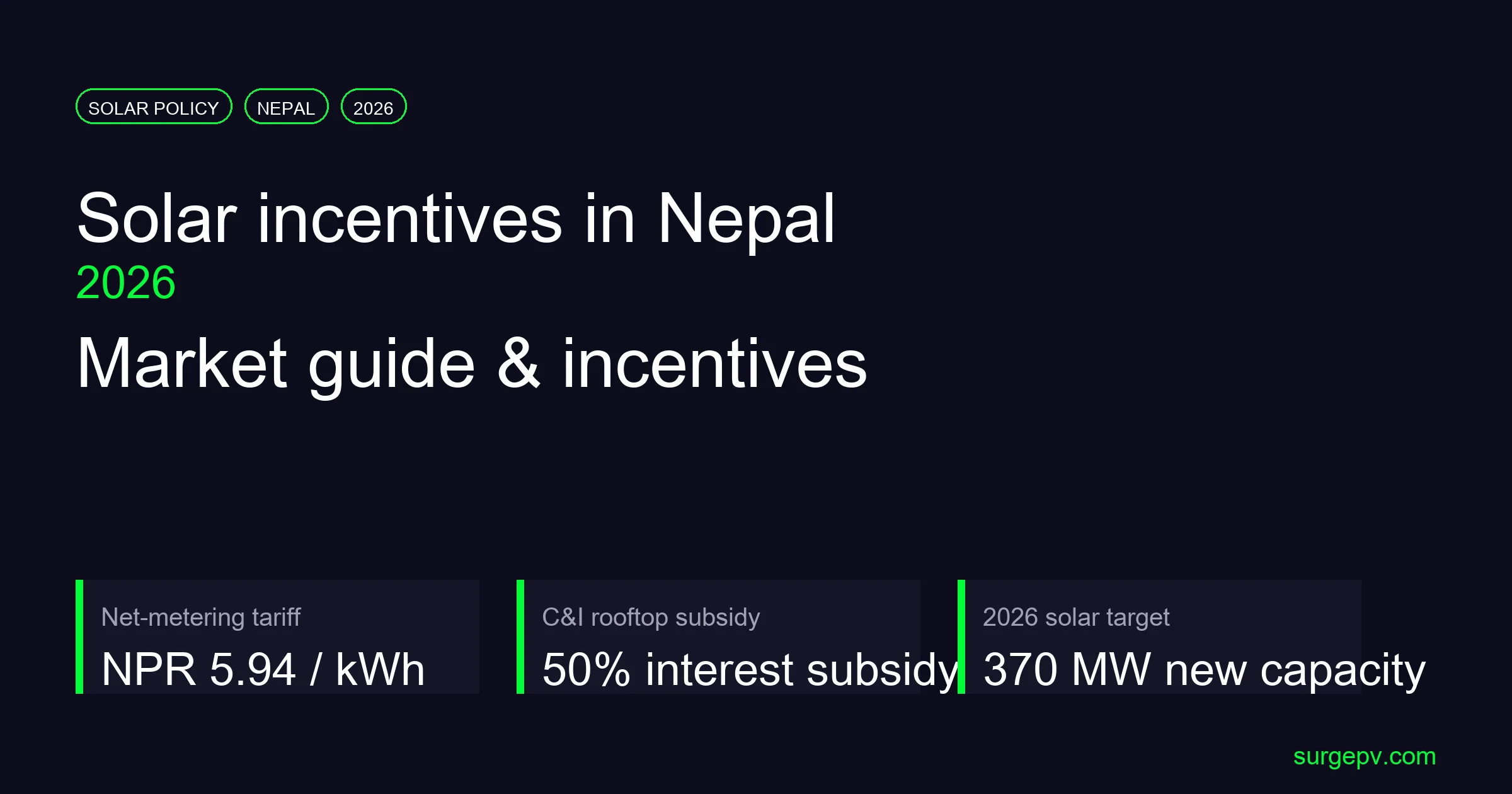
AEPC’s DKTI programme page describes a commercial and industrial rooftop component, including eligible ESCO applications. It cites 50% interest support for five years under the Renewable Energy Subsidy Policy 2022. The same page describes separate off-grid irrigation and mini-grid components.
The page gives a project start date of April 1, 2022 and a duration of 3.5 years. Those dates make it particularly important to verify a later extension or current application notice before calling the route open in September 2026. The description alone is insufficient.
Request written confirmation of the approved loan principal, eligible interest, term, payment schedule and recipient. Half of eligible interest is not half the installation price. A loan approval also does not substitute for a subsidy approval, and a subsidy approval does not authorise grid export.
Sustainable Energy Challenge Fund: Check the Call, Then the Award
AEPC/CREF’s September 2024 SECF call described a concept-note stage followed by shortlisted full applications, due diligence and evaluation. Its stated October 2024 deadlines should not be reused as a current intake invitation.
For a new application, locate the later notice for the specific support window and confirm which institution receives it. The official application-process description explains that technical feasibility, financial viability and applicant capacity are evaluated. Submission is therefore not an award.
Before a proposal includes a generation-based incentive or interest buy-down, retain:
- The current call and the application window it covers.
- The applicant’s legal identity and eligibility evidence.
- The cost and financing items accepted for support.
- The measurement, verification and payment conditions.
- The final award, including any cap, expiry and repayment obligation.
- Rules on other public funding and whether benefits can be combined.
Do not assume that different programmes stack simply because their descriptions appear online. Keep speculative support outside the committed project price.
NEA Export Terms: Historical Evidence Is Not Today’s Agreement
An AEPC-hosted GIZ report from 2024 discusses the historical rooftop framework, including a 500 kWp limit and NPR 5.94/kWh compensation following the 2023 reinstatement it describes. That is dated policy analysis, not proof that every term remains unchanged for an application today.
NEA’s 2024 grid-connected solar procurement document also identifies NPR 5.94/kWh as a benchmark tariff. A procurement benchmark and a customer’s rooftop export settlement answer different questions. Confirm the actual route through NEA and the responsible office before relying on a rate or capacity limit.
Ask for the current agreement’s capacity definition, connection limit, metering arrangement, export eligibility, settlement period and payment conditions. Record whether capacity means DC module peak power, inverter AC rating or permitted export. A system above a historical threshold is not automatically approved under a different route.
Model self-consumption with matching time intervals. Annual solar energy equal to annual consumption does not mean all solar production is used on site: daytime surplus and night-time imports can coexist. Grid-tied PV also does not provide backup during an outage without an appropriate, approved backup arrangement.
Customs and VAT: Classify Before Claiming Relief
Check the Department of Customs tariff publications for the relevant fiscal year. A tax summary from the preceding budget year is not sufficient evidence for a current shipment.
For each imported line item, retain the HS classification, description, quantity, customs value, origin, applicable duty and VAT treatment, and any recommendation or authorisation required. Ask the authority or qualified customs adviser to confirm the project-specific route before shipment.
Modules, inverters, batteries, mounting steel and installation services should not all receive an assumed single concession. Where an AEPC or Department of Electricity Development recommendation is required, a quotation’s reference to solar use is not the recommendation itself. This review does not establish a blanket 1% duty or universal VAT exemption.
Build a Cash-Flow Case Without Double Counting
Use the installed quote as the starting point. If it already reflects approved import relief, do not subtract that relief again. Model interest support against the financing schedule rather than deducting five years of possible future support as if it were cash received on installation day.
Keep these lines separate:
- Installed price and the taxes actually included.
- Loan principal, interest and repayment dates.
- Approved support receipts and their timing.
- Avoided import charges from solar used on site.
- Eligible export value under the signed arrangement.
- Operating costs, replacements and any additional fees.
Illustrative Energy-Value Calculation
This is arithmetic, not a Nepal tariff quotation or a measured customer case. Assume annual PV output of 100,000 kWh, of which 70,000 kWh is used on site and 30,000 kWh is eligible export. Use assumed avoided import value of NPR 10/kWh and export value of NPR 4/kWh.
- Avoided energy purchases: 70,000 × 10 = NPR 700,000.
- Export value: 30,000 × 4 = NPR 120,000.
- Combined gross energy value: NPR 820,000.
At an assumed NPR 50,000 annual operating cost, the simplified net amount is NPR 770,000 before financing, taxes, replacements and any settlement restrictions. A purely illustrative NPR 6,000,000 cash cost divided by that amount gives approximately 7.8 years of simple payback. It is not a project forecast: the example ignores degradation, discounting and changing tariffs, and assumes the export value is fully realisable.
If export has no approved value, remove that line rather than crediting every surplus unit automatically. Use the net-metering calculation assumptions guide to distinguish self-use from export and settlement limits, and retain a production assumption register with the proposal.
Pre-Quote Evidence Checklist
Before promising a benefit, record the administrator, exact programme, policy edition, notice date, closing date, applicant eligibility, support basis and payment conditions. For NEA, retain the connection and purchase documents separately. For imports, retain the item-level tax determination.
Present three statuses clearly: documented historical rule, current application route confirmed, and project award or agreement confirmed. Budget targets, programme achievements and supplier assurances should not be placed in the third category. Where confirmation is missing, provide an unincentivised case and name the decision that remains outstanding.
Frequently Asked Questions
What solar incentives can a Nepal project investigate?
Start with the relevant AEPC programme and current application notice. Commercial rooftop financing, irrigation, mini-grid and institutional support have different conditions. Treat support as unconfirmed until the administrator establishes eligibility, application availability and the award terms.
Is AEPC’s 50% support half the solar installation cost?
The DKTI commercial rooftop description specifies 50% interest support for five years under the cited policy. Interest support is different from a capital grant. The eligible loan, calculation basis, payment conditions and current application route still require confirmation.
Is NPR 5.94/kWh a guaranteed current rooftop export tariff?
No current universal rooftop rate is established by this review. An AEPC-hosted 2024 GIZ report describes historical rooftop terms, while NEA’s separate 2024 solar procurement document identifies a benchmark tariff. Obtain the applicable current NEA agreement rather than transferring a tender benchmark to a rooftop bill.
Can a household receive solar support in Nepal?
Do not assume either universal household support or no household support at all. Identify the household technology, grid access, location and applicable current scheme. Historical rural and household provisions do not establish an open grant for a grid-connected urban rooftop today.
Are all imported solar goods taxed at 1% or exempt from VAT?
Do not apply one tax treatment to a complete installation. Check the current fiscal-year schedule, HS classification, equipment purpose, recommendation requirements and importer documentation with the competent authority before pricing any concession.
What payback should a Nepal solar proposal show?
Calculate it from the actual installed quote, consumption profile, tariff, approved export arrangement, operating costs and confirmed support timing. Show a case without unapproved incentives. A national five-to-seven-year promise is not justified by those project-specific inputs.
Where this fits
This article is part of SurgePV's Solar Incentives & Policy hub, which works through the topic from first principles to the decisions a project team actually has to make.

