

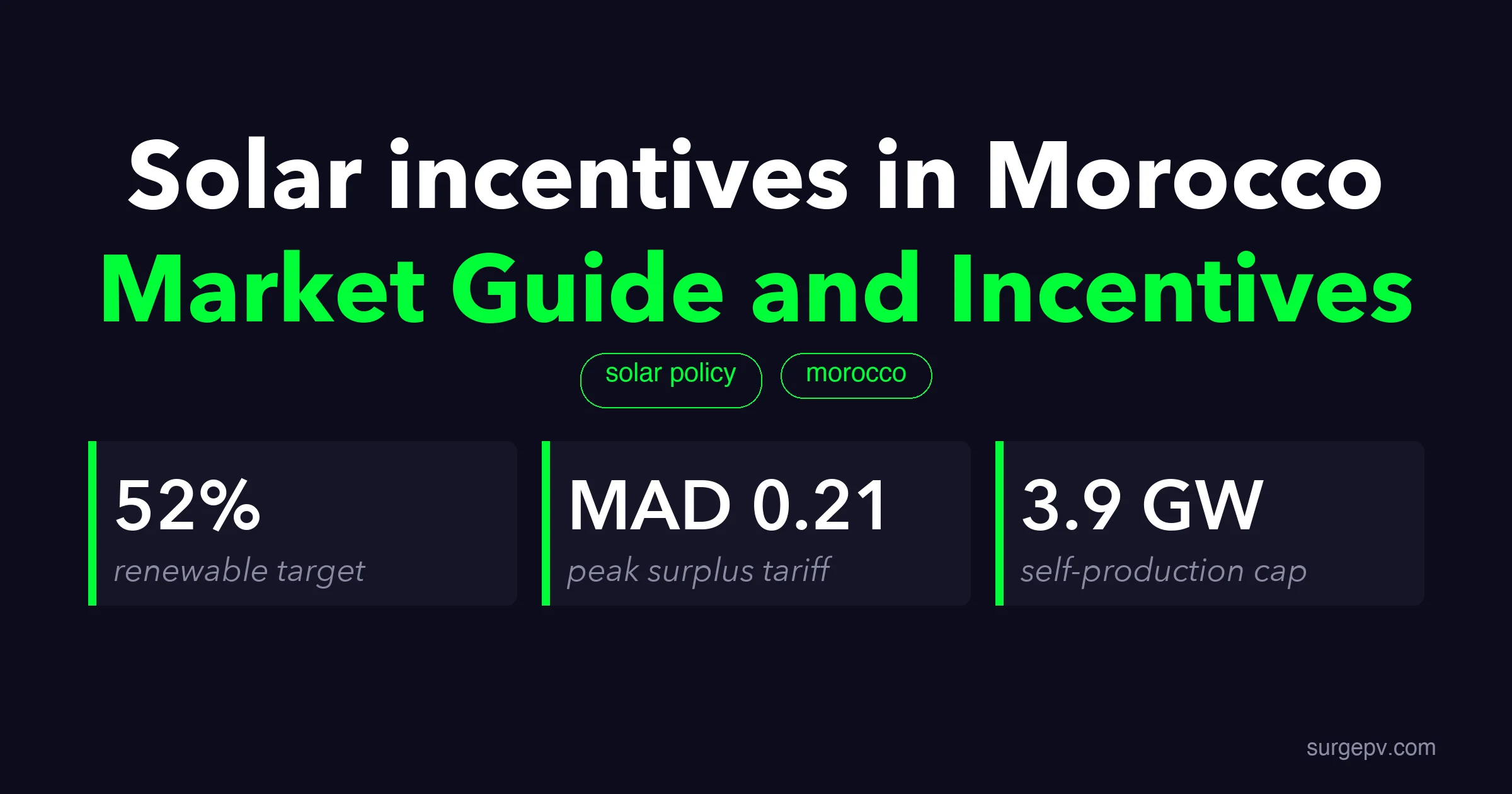
Morocco reached roughly 45.5% renewable installed capacity by mid-2025 and is on track to hit its 52% target well before 2030, according to IEA-PVPS country reporting (2026). For solar professionals, that milestone matters less than what changed in early 2026: the long-awaited implementing decree for Law 82-21 finally turned self-consumption and limited surplus export into a real commercial option, while ANRE set the first transparent net metering tariffs for medium- and high-voltage systems.
This guide is not a generic market overview. It explains the 2026 incentive stack for installers, EPCs, and investors: who qualifies, what the export limits are, how VAT and customs treatment actually work, and where the money is. For the broader North African context, see our global solar market forecast. For utility-scale background, see our Morocco Noor solar program guide.
If you are designing systems or writing proposals for Moroccan clients, a solar design platform that models ONEE tariffs, self-consumption ratios, and export caps can save hours per project. Model payback and export value automatically, then generate solar proposals in minutes. Check pricing or book a demo to see how SurgePV handles Morocco.
Morocco’s 2026 solar incentive stack is real, but it is not a single subsidy. The value comes from layering Law 82-21 self-consumption, ANRE net metering and surplus tariffs, reduced VAT on panels, Investment Charter customs relief, and MASEN-led programs for large and distributed solar.
Quick Answer
Morocco’s 2026 solar incentives center on self-consumption under Law 82-21, net metering for commercial and industrial systems, reduced VAT on panels, customs relief for manufacturing inputs, and MASEN-led utility programs. Residential low-voltage net metering is still pending, so the strongest near-term returns are in C&I rooftop solar.
TL;DR — Solar Incentives in Morocco 2026
Active mechanisms: Law 82-21 self-production with 20% surplus export, ANRE net metering tariffs for medium/high-voltage systems, a 10% VAT rate on PV panels and solar water heaters, VAT exemption with deduction for manufacturing inputs, Investment Charter customs and VAT relief, and MASEN programs including Noor Atlas and Solar Rooftop 500. Residential low-voltage net metering has not yet been implemented.
In this guide:
- Latest 2026 status of every active Moroccan solar incentive
- The legal foundation: Law 13-09, Law 82-21, MASEN, and ANRE
- How net metering, surplus export, and self-consumption actually work
- Tax and customs incentives: VAT, duty relief, and the Investment Charter
- MASEN programs: Noor Atlas, Solar Rooftop 500, and the shift to PV-plus-storage
- Commercial and industrial routes beyond rooftop net metering
- Regional differences and where the resource is strongest
- Three real-world stacking scenarios with payback impact
- Common mistakes and how to avoid them
Latest Updates: Morocco Solar Incentives 2026
The Moroccan policy environment shifted in early 2026. After years of waiting, the implementing decree for Law 82-21 was published in March 2026, with effect from June 2026. At the same time, ANRE published net metering tariffs for non-residential systems and confirmed a host capacity for self-generation.
Morocco Solar Incentive Status — Mid-2026
| Incentive | Type | Status | Key Terms |
|---|---|---|---|
| Law 82-21 self-production | Self-consumption + surplus | Active from June 2026 | Up to 20% of annual production can be exported |
| ANRE net metering | Surplus credit | Active for MV/HV/VHV | MAD 0.21/kWh peak, MAD 0.18/kWh off-peak |
| Low-voltage net metering | Surplus credit | Pending | Residential tariff not yet set |
| Reduced VAT on PV panels | Sales tax relief | Active | 10% VAT on PV panels and solar water heaters |
| VAT exemption for manufacturing inputs | Input tax relief | Active | Exemption with right of deduction for panel materials |
| Investment Charter | Direct grants + tax relief | Active | Up to 30% grants, VAT/customs exemptions on capital goods |
| Customs duty on assembled panels | Import tariff | Rising | Reports indicate 25% duty on assembled modules to support local assembly |
| MASEN Noor Atlas | Utility-scale program | Under construction | ~305 MW across six sites |
| Solar Rooftop 500 | Distributed program | Launched | Up to 500 MW on commercial, industrial, and public rooftops |
| Self-production capacity cap | Regulatory cap | 3,886 MW | 72% solar, 28% wind after 2025 authorized projects |
Key Changes Since 2025
March 2026 — Law 82-21 implementing decree: The decree, published in the Official Bulletin, allows self-producers to consume their own renewable electricity and sell up to 20% of surplus back to the grid. It took effect on June 9, 2026, three months after publication, according to PV Magazine International (2026).
February 2026 — ANRE net metering tariffs: ANRE set tariffs for high, medium, and very-high-voltage systems for the period March 1, 2026, to February 28, 2027. Low-voltage tariffs for residential PV will be set later, according to PV Magazine France (2026).
Self-production capacity cap: After accounting for projects already authorized in 2025, the remaining available capacity for self-production is 3,886 MW, split 72% solar and 28% wind, according to PV Magazine International (2026).
Key Takeaway
2026 is a transition year. The most reliable incentives are C&I self-consumption, the new surplus tariffs, and VAT relief, because the residential low-voltage framework and local manufacturing tariff policy are still evolving. Size systems for self-consumption first, export second.
Why Morocco’s Solar Market Matters in 2026
Morocco has some of the best solar resources in North Africa. Annual sunshine exceeds 3,000 hours in many regions, and solar irradiance in the south is among the highest in the world. That resource quality makes solar economically attractive even before incentives are stacked.
Market Size and Targets
Morocco’s target is 52% of installed electricity capacity from renewable sources by 2030, broken down as 20% solar, 20% wind, and 12% hydropower, according to IEA policy data (2019). The country reached 45.5% renewable installed capacity by mid-2025, putting it on track to meet the goal by 2028, according to IEA-PVPS (2026).
By the end of 2025, Morocco’s total renewable capacity reached roughly 4,851 MW, including conventional hydropower, wind, solar PV, and concentrated solar power, according to IEA-PVPS (2026). Within that total, solar PV was 546 MW and concentrated solar power was 540 MW.
Large-scale solar alone reached nearly 1.3 GW of cumulative capacity by early 2026, according to ONEE data reported by PV Magazine France (2026). Import data suggests another roughly 3 GW of operational solar may be spread across commercial and industrial systems, solar pumping, and the residential market.
The Resource Driver
Solar economics in Morocco are driven by two forces: excellent irradiance and high retail electricity prices by North African standards. A well-designed commercial rooftop in Casablanca or Tangier can avoid grid purchases at retail rates that often exceed MAD 1.0 per kWh, while surplus exports earn only MAD 0.21 per kWh at peak. That gap makes self-consumption the dominant value.
For solar professionals, the opportunity is to show both generation and bill avoidance at the customer’s actual tariff tier. That requires hourly load modeling and accurate shading analysis, both of which are built into modern solar design software.
The Legal Foundation: Law 13-09, Law 82-21, and MASEN
Morocco’s electricity sector is governed by a layered legal framework. Law 13-09 opened renewable energy production to private actors. Law 82-21 created a dedicated self-production regime. MASEN runs the national renewable energy program and utility-scale tenders.
Key Laws and Institutions
| Framework | Role | Relevance |
|---|---|---|
| Law 13-09 | Opened renewable generation to private producers | Basis for IPPs, corporate PPAs, and direct sales |
| Law 82-21 | Dedicated self-production law | Simplified procedures for self-consumption and limited export |
| Law 57-09 | Created MASEN | Implements national solar program and public-private partnerships |
| ANRE | National Electricity Regulatory Authority | Sets tariffs, grid access rules, and hosting capacity |
| ONEE | National electricity and water utility | Manages transmission grid and is the off-taker for many projects |
Self-Production Regimes Under Law 82-21
The implementing decree, Decree No. 2.25.100, defines three administrative routes based on project size and grid connection level, according to ITMO Solar (2026) and IEA-PVPS (2026):
| Regime | Capacity | Process | Typical Use |
|---|---|---|---|
| Prior declaration | Up to 2 MW | Simple declaration to ANRE, ~30 days | SMEs and rooftop installations |
| Approval | 2 MW to 50 MW | Technical file review by ANRE | Large industrial companies |
| Authorization | Above 50 MW | Authorization by the supervising ministry | Very large industrial or utility projects |
For installers, the practical implication is that most commercial and industrial rooftop projects fall under the prior declaration route. They avoid the concession regime as long as they stay within size and grid-connection limits.
Self-Consumption and Net Metering in 2026
Morocco does not have a European-style feed-in tariff. Instead, it offers self-consumption with limited surplus export and net metering for larger non-residential systems. Understanding the difference is essential.
Net Metering Under Law 13-09
Net metering in Morocco has existed since 2015 for systems connected to high and medium voltage. Under this mechanism, exported solar generation is credited against future consumption within a defined period. The February 2026 ANRE decision set new compensation tariffs for the year ahead.
- Peak-hour surplus: MAD 0.21 per kWh
- Off-peak surplus: MAD 0.18 per kWh
- Applies to high, medium, and very-high-voltage systems
- Low-voltage residential tariff still to be determined
Self-Production Under Law 82-21
Law 82-21 introduces a clearer self-consumption framework. Self-producers can consume their own generation and inject up to 20% of annual production into the public grid. The system uses a bidirectional meter provided by ONEE or the authorized distributor.
Key rules:
- Surplus export is capped at 20% of annual production.
- Network use tariffs are MAD 0.0607 per kWh for medium-voltage distribution and MAD 0.0638 per kWh for national transmission.
- The decree took effect on June 9, 2026.
- Total available self-production capacity is capped at 3,886 MW.
Why the 20% Cap Matters
The 20% export limit means solar systems should be sized for on-site consumption, not maximum generation. A kilowatt consumed on site avoids a retail purchase that may cost MAD 1.0 or more. A kilowatt exported earns only MAD 0.21 at peak. The difference is roughly 5:1, so oversizing for export destroys returns.
A well-modeled solar yield and financial analysis can test each compensation scheme against the customer’s actual hourly consumption profile.
Tax and Customs Incentives
Morocco does not offer a direct federal tax credit for homeowners who buy solar panels. The real tax value lies in reduced VAT, input VAT recovery for manufacturers, customs relief for large investors, and the Investment Charter.
Value-Added Tax Relief
The 2022 Finance Act restored VAT neutrality for sales of photovoltaic panels and solar water heaters. The current regime, confirmed in Moroccan tax guidance, includes:
- A reduced 10% VAT rate on domestic and imported PV panels and solar water heaters.
- VAT exemption with right of deduction for products and materials used to manufacture PV panels, including cells, solar glass, frames, support structures, and junction boxes.
This is summarized by PwC Africa Energy and Utilities Tax Guide (2022).
Customs Duties
For investors importing solar manufacturing equipment or capital goods, the standard import duty on many capital goods is around 2.5%, with VAT at 20%, according to PV Knowhow (2025). Industry reports also indicate that Finance Law 2026 raised the duty on assembled photovoltaic panels to 25% to encourage local assembly plants in industrial zones. Verify the exact HS code and current rate with a Moroccan customs broker before procurement.
Investment Charter
Framework Law 03-22, the 2022 Investment Charter, provides negotiated incentives for significant projects:
- Direct subsidies of up to 30% of eligible investment for qualifying projects.
- Territorial and sectoral premiums that can raise total support higher.
- VAT and customs duty exemptions on capital goods, machinery, and tools for up to 36 months.
- Professional tax exemption for the first five years.
- Reduced corporate tax rates in Industrial Acceleration Zones.
Eligibility typically requires an investment of at least MAD 50 million and the creation of at least 50 permanent jobs, managed through AMDIE and the Regional Investment Centers, according to Upsilon Consulting (2026).
MASEN, Noor, and Large-Scale Solar
The Moroccan Agency for Sustainable Energy, MASEN, remains the central institution for utility-scale solar. Its portfolio has shifted from concentrated solar power to PV-plus-storage.
Noor Ouarzazate
The 580 MW Noor Ouarzazate complex is Morocco’s flagship solar project. It combines parabolic trough, solar tower, and PV technologies. Noor III, the 150 MW solar tower, shut down for 14 months after a molten salt storage tank leak and restarted in April 2025.
Noor Atlas
Noor Atlas is a roughly 305 MW distributed PV program spanning six sites: Jerada, Errachidia, Figuig, Boulemane, Tata, and Tan-Tan. ONEE and MASEN signed the power purchase agreement and launched construction in March 2026, with phased grid connection from July 2027.
Solar Rooftop 500
Solar Rooftop 500, or SR500, aims to install up to 500 MW of rooftop solar on commercial, industrial, and public buildings. It is expected to be a major lever for distributed solar deployment in 2026, according to PV Magazine France (2026).
The Shift to PV-Plus-Storage
Morocco’s 2025-2030 Electric Equipment Plan adds roughly 12,445 MW of new capacity, about 80% renewable. Solar PV accounts for 35.8% of planned additions, wind for 31.8%, and battery storage adds 1,500 MW, according to our Morocco Noor solar program guide. No new concentrated solar power is included. For developers, this means bankable projects now need storage integration, and design tools must model battery dispatch as well as PV production.
Commercial and Industrial Solar Routes
C&I solar in Morocco operates under different rules than residential rooftop. The economics are usually driven by avoided retail purchases, carbon compliance for exporters, and corporate power purchase agreements.
Self-Consumption Rooftops
The most common C&I route is a rooftop system sized to match daytime load. The customer consumes generation directly and exports any surplus up to the 20% cap. Real examples include a 386 kW rooftop at the FIT Voltaira Morocco automotive plant in Tanger Med and a 1.7 MW system at Safran Nacelles in Casablanca that covers about 20% of the plant’s consumption, as reported by PV Magazine France (2024).
Corporate Power Purchase Agreements
Under Law 13-09, private renewable producers can sell electricity directly to large consumers or consortia through the national grid. Corporate PPAs are increasingly attractive to export-oriented manufacturers that need to reduce Scope 2 emissions before the EU carbon border adjustment mechanism tightens.
Solar Carbon Program
Some MASEN programs, such as the Solar Carbon Program, require full self-consumption and do not allow surplus export. Always confirm the specific program rules before sizing and interconnecting.
Industrial Acceleration Zones
Companies in Industrial Acceleration Zones can benefit from full corporate tax exemption for the first five years and a capped 20% rate thereafter, plus VAT exemptions and reduced customs duties. These zones are a natural fit for large manufacturing loads with rooftop or ground-mount solar.
For C&I installers, the design priorities are different from residential work. Load profiling, demand-charge analysis, and shadow analysis matter more than simple bill offset.
Regional Differences and Solar Resource
Morocco’s solar market is highly concentrated geographically. The best resources are in the south and east, while the largest loads are in the north.
Ouarzazate and the South
The Ouarzazate region hosts the Noor Ouarzazate complex and offers some of the highest irradiance in the country. It is the natural location for utility-scale solar and green hydrogen projects.
Tangier and the North
Tangier and Tanger Med host export-oriented automotive and aerospace factories with large rooftops and strong incentive to reduce carbon intensity. Solar rooftop potential here is high, but grid reinforcement is needed in some areas.
Casablanca and Industrial Corridors
Casablanca, Mohammedia, and the surrounding industrial belt have the highest electricity demand. Rooftop space is limited, so C&I projects must optimize every square meter with accurate layout and shading analysis.
Practical Tip
Always model the local ONEE tariff and grid constraints, not a national average. The same 500 kW system can have a very different payback in a high-tariff industrial zone with good self-consumption than in a subsidized rural area with weak grid hosting capacity.
How to Stack Incentives: Three Real-World Scenarios
The following examples are illustrative, based on typical 2026 costs and incentive rates. Actual figures depend on location, tariff, installer quote, and whether the customer is a business or individual.
Scenario 1 — 5 kW Residential Rooftop, Marrakech
| Item | Amount |
|---|---|
| Gross installed cost | MAD 75,000 |
| Reduced VAT benefit (10% vs 20%) | −MAD 6,800 |
| Net cost | MAD 68,200 |
| Annual bill savings (self-consumption only) | MAD 12,000 |
| Payback | 5.7 years |
This scenario assumes the household consumes most generation on site. Without a low-voltage net metering framework, surplus export has no value, so battery storage or load shifting becomes important.
Scenario 2 — 500 kW Commercial Rooftop, Casablanca
| Item | Amount |
|---|---|
| Gross installed cost | MAD 5,000,000 |
| Reduced VAT and input recovery | −MAD 450,000 |
| Annual avoided electricity (retail) | MAD 850,000 |
| Annual surplus export revenue (capped at 20%) | MAD 90,000 |
| Payback | 5.0 years |
The combination of high retail tariffs, the 10% VAT rate, and limited surplus export makes this the sweet spot for Moroccan solar in 2026.
Scenario 3 — 10 MW Ground-Mount Project, South Morocco
| Item | Amount |
|---|---|
| Gross CAPEX | USD 7,000,000 |
| Investment Charter grant (estimate) | −USD 1,500,000 |
| LCOE with incentives | ~USD 0.030/kWh |
| PPA price | USD 0.045/kWh |
| Project IRR | 12–15% |
Utility-scale economics depend heavily on PPA terms, grid connection cost, land access, and storage requirements.
Common Mistakes and Misconceptions
Even experienced installers lose money in Morocco by misunderstanding how incentives interact. Here are the most common errors.
Oversizing for Export
The single most expensive mistake is designing a system that exports more than 20% of annual production. Because surplus export rates are a fraction of retail import rates, every kilowatt of excess generation is less valuable than a kilowatt consumed on site. Size for self-consumption, not maximum generation.
Assuming Residential Net Metering Is Live
Many international installers market rooftop solar to Moroccan households as if net metering were already available. As of mid-2026, the low-voltage residential framework is still pending. Customers should be told clearly whether their system will be off-grid, self-consumption-only, or able to export.
Ignoring the 20% Export Cap
A system that exports 30% of annual production will only be paid for the first 20%. The remaining 10% is effectively donated to the grid. Model export carefully and size accordingly.
Misapplying VAT Exemption
Not every solar purchase qualifies for the reduced 10% VAT rate or input VAT recovery. The invoice structure, HS code, and buyer status matter. A tax advisor or customs broker should review the transaction before procurement.
Underestimating Interconnection Time
ONEE interconnection and meter change-out can take several months, especially in high-growth industrial zones. Build realistic timelines into contracts and customer expectations.
Treating MASEN Programs Like Standard C&I
MASEN programs often have specific self-consumption, local content, or technology requirements. The Solar Carbon Program, for example, does not allow surplus export. Always read the program rules before bidding.
Conclusion
Morocco’s solar incentive framework in 2026 is a stack built from Law 82-21 self-consumption, ANRE net metering and surplus tariffs, reduced VAT on panels, Investment Charter customs and tax relief, and MASEN programs for large and distributed solar. None of these mechanisms is as simple as a single upfront rebate, but combined they make solar one of the most attractive generation options in the country.
For solar professionals, the competitive edge is no longer just installation price. It is the ability to model the right compensation scheme, size for self-consumption, and stack tax benefits correctly. Tools like Clara AI and SurgePV’s generation and financial tool can automate that workflow for Moroccan projects.
Three actions to take now:
- Verify the compensation scheme before sizing — self-consumption, net metering, or surplus export changes the optimal system size.
- Stack tax benefits correctly — confirm the 10% VAT rate applies, recover input VAT where eligible, and use the Investment Charter for large projects.
- Size for self-consumption — exported energy in Morocco is worth far less than avoided retail purchases.
For regional comparisons, see our solar payback period by country guide. For installers scaling in Morocco, our guide for solar installers covers proposal automation and compliance workflows.
Frequently Asked Questions
What solar incentives are available in Morocco in 2026?
Morocco’s active 2026 solar incentives include net metering and surplus export for commercial and industrial systems, a reduced 10% VAT rate on photovoltaic panels and solar water heaters, VAT exemption with right of deduction for solar manufacturing inputs, customs relief under the Investment Charter, and MASEN programs such as Noor Atlas and Solar Rooftop 500.
Does Morocco have net metering for residential solar in 2026?
Not yet. ANRE has set net metering tariffs for high, medium, and very-high-voltage systems, but the low-voltage framework for residential rooftops is still being finalized. Households can still install off-grid or self-consumption systems, but grid-connected residential net metering is not operational in mid-2026.
What are the surplus export tariffs for self-producers in Morocco?
Under the implementing decree for Law 82-21, self-producers can sell up to 20% of annual production back to the grid. ANRE set surplus tariffs at MAD 0.21 per kWh during peak hours and MAD 0.18 per kWh during off-peak hours for the period from March 2026 to February 2027.
What is Law 82-21 on electricity self-production?
Law 82-21 is the 2022 framework that allows Moroccan businesses and individuals to generate renewable electricity for self-consumption and inject a limited surplus into the grid. Its implementing decree, published in March 2026 and effective from June 2026, sets capacity thresholds, administrative procedures, and export limits.
How do VAT and customs incentives work for solar equipment in Morocco?
Photovoltaic panels and solar water heaters are subject to a reduced 10% VAT rate, while products and materials used to manufacture panels are exempt from VAT with the right of deduction. Large investment projects can also qualify for customs duty and VAT exemptions on capital goods through the Investment Charter.
What is the Solar Rooftop 500 program?
Solar Rooftop 500, or SR500, is a Moroccan initiative launched to install up to 500 MW of rooftop solar mainly on commercial, industrial, and public buildings. It is expected to be a major driver of distributed solar deployment in 2026 and beyond.
What is the Noor Atlas solar project?
Noor Atlas is a roughly 305 MW distributed solar PV program developed by ONEE and MASEN across six sites in eastern, southeastern, and southern Morocco. Construction began in early 2026, with phased grid connection targeted from July 2027.
What is the typical solar payback period in Morocco?
Well-designed commercial and industrial solar systems in Morocco often pay back in 5 to 8 years, driven by high irradiance, avoided grid purchases, and the new surplus export tariffs. Utility-scale projects can be even faster when they secure long-term power purchase agreements.
Can foreign investors access Moroccan solar incentives?
Yes. Law 13-09 opened renewable electricity production to private Moroccan and foreign investors. Foreign developers can participate through self-production, independent power producer structures, and MASEN tenders, subject to local registration and grid access rules.
What is the most common mistake when sizing a C&I solar system in Morocco?
The most common mistake is oversizing for export. Because surplus sales are capped at 20% of annual production and paid at rates well below retail import tariffs, every kilowatt of excess generation is worth less than a kilowatt consumed on site. Systems should be sized to maximize self-consumption.
Where this fits
This article is part of SurgePV's Solar Incentives & Policy hub, which works through the topic from first principles to the decisions a project team actually has to make.

