

Answer
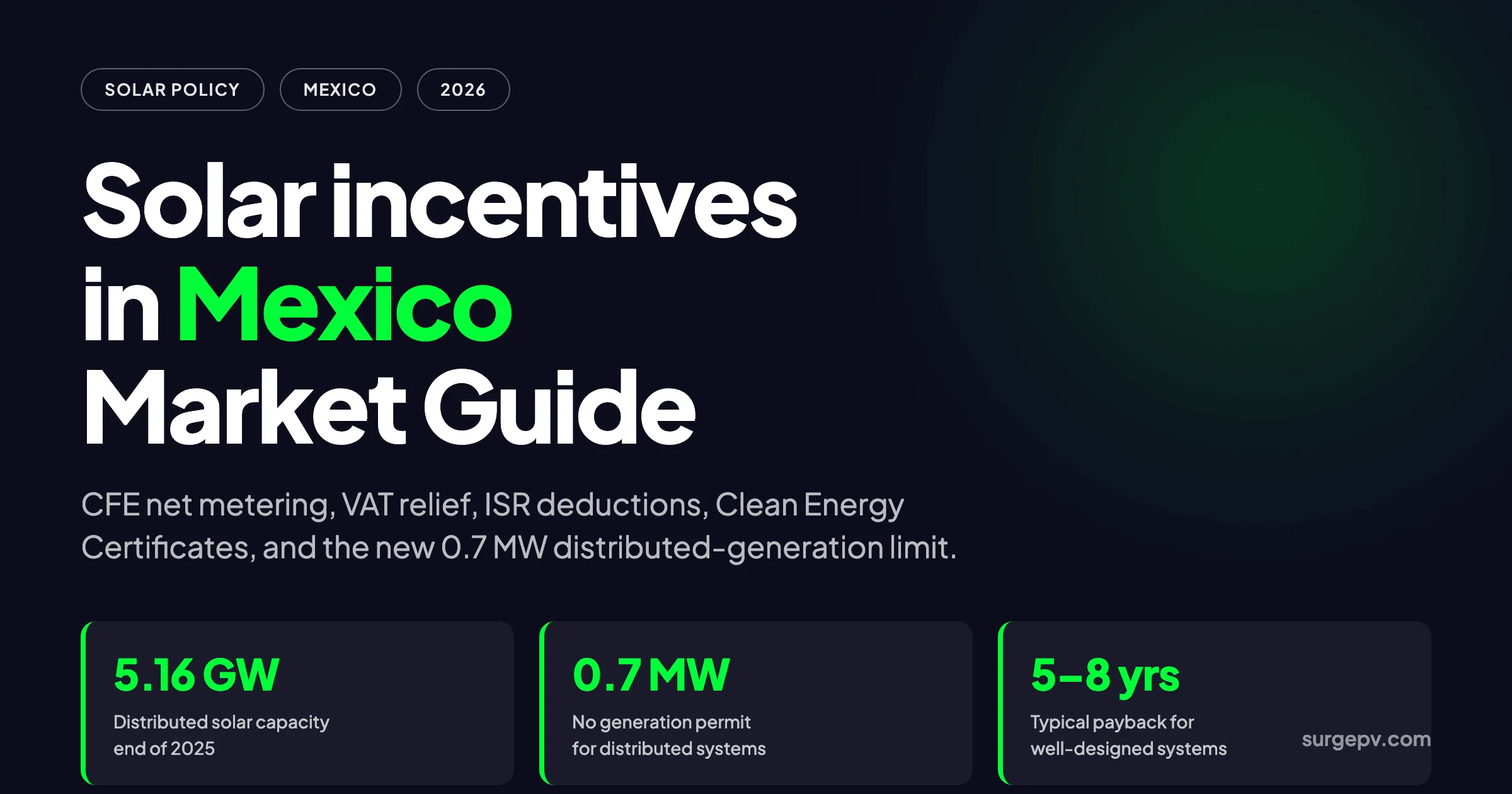
Mexico's 2026 solar incentives are a stack rather than a single subsidy: zero VAT on qualifying solar panels, 100% immediate income-tax deduction for renewable-energy machinery, CFE net metering or net billing with a 12-month rollover, Clean Energy Certificates for projects over 0.5 MW, and distributed generation permits up to 0.7 MW.
Mexico’s distributed solar market crossed a milestone at the end of 2025. The country reached 5.16 GW of small-scale solar capacity across more than 600,000 installations, with net metering accounting for 5.11 GW of that total, according to CleanTechnica data attributed to the National Energy Commission (2026). For installers, EPCs, and property owners, the message is clear: Mexico is no longer an emerging solar market. It is a maturing one where incentives matter, but only if you understand how they actually stack.
This guide is a market-focused incentive manual, not a generic cost breakdown. It covers the 2026 legal framework, the real incentives that reduce project cost, how CFE compensates surplus generation, and the mistakes that waste money. For the broader Latin American picture, see our global solar market forecast. For payback benchmarks by country, see solar payback period by country.
If you are designing systems or writing proposals for Mexican clients, a solar design platform that models CFE tariffs, self-consumption ratios, and net metering settlement rules can save hours per project. Model payback and export value automatically, then generate solar proposals in minutes. Check pricing or book a demo to see how SurgePV handles Mexico.
Mexico’s 2026 solar incentive stack is real, but it is not a handout. The value comes from combining VAT relief on panels, immediate ISR deductibility for businesses, CFE net metering or net billing, Clean Energy Certificate revenue for larger generators, and a distributed-generation threshold now raised to 0.7 MW.
TL;DR — Solar Incentives in Mexico 2026
Active mechanisms: VAT exemption on qualifying solar panels, 100% first-year ISR deduction for renewable-energy machinery, CFE net metering with 12-month rollover or net billing at market rates, Clean Energy Certificates for qualifying generators, and distributed generation up to 0.7 MW without a generation permit. The new Electricity Sector Law reserves 54% of national generation for CFE while leaving 46% for private participation.
In this guide:
- Latest 2026 status of every active Mexican solar incentive
- The legal foundation: LIE, the new LSE, and distributed generation
- How CFE net metering, net billing, and total sale actually work
- Tax incentives: VAT, ISR deduction, import benefits, and PROSEC
- Clean Energy Certificates and who can earn them
- Commercial and industrial routes beyond rooftop net metering
- Regional differences and where the market is hottest
- Three real-world stacking scenarios with payback impact
- Common mistakes and how to avoid them
Latest Updates: Mexico Solar Incentives 2026
The Mexican solar policy environment shifted in 2025. A new Electricity Sector Law reorganized generation modalities, raised the distributed-generation cap, centralized regulation under the Comisión Nacional de Energía, and reaffirmed CFE’s leading role. At the same time, distributed solar kept growing at record pace.
Mexico Solar Incentive Status — June 2026
| Incentive | Type | Status | Key Terms |
|---|---|---|---|
| VAT exemption on solar panels | Sales tax relief | Active | Applies to qualifying panels and materials under PROSEC |
| ISR immediate deduction for renewable machinery | Income tax deduction | Active | 100% of investment deductible in first year |
| CFE net metering | Surplus credit | Active | 12-month rollover for systems up to 0.7 MW |
| CFE net billing | Surplus sale | Active | Export paid at market-based rate |
| Total sale | Energy sale | Active | Full project output sold to CFE or supplier |
| Clean Energy Certificates (CELs) | Tradable certificates | Active, rules evolving | One CEL per MWh; must be used within 30 months |
| Distributed generation threshold | Regulatory | Raised to 0.7 MW | No generation permit required |
| Energy storage mandate | Grid code | Active for new plants | Minimum 30% storage for new solar/wind |
| 54% CFE generation share | Market structure | Active | Private cap of 46% under six participation schemes |
Key Changes Since 2025
March 2025 — Electricity Sector Reform: The constitutional and secondary reforms replaced the Electricity Industry Law framework with the Law of the Electricity Sector. CFE must hold at least 54% of national generation. Private developers can participate through distributed generation, isolated self-consumption, interconnected self-consumption, long-term production contracts, mixed investment schemes, and independent power producers.
Distributed generation cap raised to 0.7 MW: Systems up to 0.7 MW connected to distribution circuits no longer require a generation permit. This benefits commercial rooftops, small factories, and large residential estates.
CEL rule changes: New rules extend CEL eligibility to a broader set of clean power plants regardless of ownership or commissioning date, and require CELs to be used within 30 months of issuance. This may increase supply and put downward pressure on certificate prices.
Storage mandate: New solar and wind projects must integrate battery storage equal to at least 30% of installed capacity, making hybrid solar-plus-storage the default design for utility-scale developments.
Key Takeaway
2026 is a transition year. The most reliable incentives are VAT relief, ISR deductibility, and net metering value, because CEL prices are uncertain and permitting timelines remain long. Size systems for self-consumption first, export second.
Why Mexico’s Solar Market Matters in 2026
Mexico has some of the best solar resources in the world. Roughly 85% of national territory receives strong irradiation, and northern states such as Sonora, Baja California, and Chihuahua can deliver capacity factors above 25% for fixed-tilt PV.
Market Size and Targets
Mexico’s total solar capacity reached an estimated 15.92 GW in 2026, growing from 13.94 GW in 2025, according to Mordor Intelligence (2026). Utility-scale solar remains the largest segment, but distributed generation is the fastest-growing part of the market.
Distributed solar alone reached 5.16 GW across 600,368 installations by the end of 2025, according to CleanTechnica data from the National Energy Commission (2026). Of that, 593,607 applications totaling 5.11 MW were linked to net metering. Systems up to 50 kW represented 98.23% of applications and 63.59% of net-metered capacity.
The government’s target under President Claudia Sheinbaum is 45% renewable electricity by 2030, supported by roughly USD 23.4 billion in energy infrastructure investment and plans to add over 13 GW of capacity by 2030, according to Intersolar market data (2025).
The DAC Tariff Driver
One of the strongest economic drivers for residential solar is CFE’s High Consumption Domestic Tariff, known as DAC. Once a household’s bimonthly consumption crosses a threshold, the rate jumps sharply. Solar offsets consumption at the marginal rate, which makes rooftop PV particularly attractive for middle- and upper-income homes in Mexico City, Monterrey, and Guadalajara.
For solar professionals, the opportunity is to show both generation and bill avoidance at the customer’s actual tariff tier. That requires hourly load modeling and accurate shading analysis, both of which are built into modern solar design software.
The Legal Foundation: LIE, LSE, and Distributed Generation
Mexico’s electricity sector is governed by two overlapping frameworks. The 2014 Electricity Industry Law (Ley de la Industria Eléctrica, LIE) created the modern distributed-generation market. The 2025 Electricity Sector Law (Ley del Sector Eléctrico, LSE) reorganized generation modalities and strengthened CFE’s role.
Generation Modalities Under the 2025 Framework
| Modality | Size | Permit Required | Typical Use |
|---|---|---|---|
| Distributed generation | Up to 0.7 MW | No | Residential, commercial, small industrial rooftops |
| Isolated self-consumption | 0.7 MW to 20 MW | Yes | Industrial parks, mines, large factories |
| Interconnected self-consumption | Up to 0.7 MW grid-tied | Yes above 0.7 MW | C&I behind-the-meter systems |
| Wholesale market generation | Any size | Yes | Utility-scale solar parks, IPPs |
| Long-term production contracts | Any size | Yes | Projects selling to CFE |
| Mixed investment schemes | Any size | Yes | Public-private partnerships with CFE |
Distributed Generation in Practice
Distributed generation is the route used by almost all rooftop solar in Mexico. Key rules:
- Systems must be connected to the CFE distribution network.
- Energy and associated products must be used for self-consumption or sold to CFE.
- The owner chooses net metering, net billing, or total sale.
- Interconnection requires a bidirectional meter and compliance with CFE technical standards.
For installers, the practical implication is that most residential and small commercial projects fall under a clear, permit-free route as long as they stay below 0.7 MW and meet CFE interconnection requirements.
CFE Net Metering, Net Billing, and Total Sale
The Comisión Federal de Electricidad (CFE) offers three compensation schemes for distributed generators. Choosing the wrong one can cut project returns by 20% or more.
Net Metering (Medición Neta)
Under net metering, exported kWh are credited against imported kWh. The customer pays only the net energy balance.
- Credits roll forward month to month within a 12-month window.
- At the annual settlement, unused credits usually expire.
- Available for systems up to 0.7 MW under current rules.
- Best for customers whose daytime generation matches daytime consumption.
Net Billing (Facturación Neta)
Under net billing, imported energy is billed at the full retail rate, while exported energy is paid at a separate, market-linked rate.
- Export value is typically lower than the retail import rate.
- Better for larger systems that consistently export a high share of generation.
- Requires more sophisticated metering and settlement.
Total Sale (Venta Total)
In a total sale arrangement, the generator sells all output to CFE or a qualified supplier and does not consume any electricity on site. This is effectively a small power producer model.
- Requires a power purchase agreement.
- No supply contract for on-site consumption.
- Common for ground-mounted systems on land without adjacent load.
Why the Annual Rollover Matters
The 12-month rollover is generous in theory but dangerous in practice. A system that overproduces in summer and underproduces in winter can bank credits, but credits left at the annual true-up are lost. That is why the standard design rule in Mexico is the same as in other net-metering markets: size for 75–90% annual self-consumption, not 100% offset or maximum export.
A well-modeled solar financial analysis tool can test each compensation scheme against the customer’s actual hourly consumption profile.
Tax and Fiscal Incentives
Mexico does not offer a direct federal tax credit for homeowners who buy solar panels. The real tax value lies in VAT relief, immediate business deductibility, and import benefits.
Value-Added Tax (IVA) Exemption
Under the Sectoral Promotion Program (Programa de Promoción Sectorial, PROSEC) and related customs provisions, solar panels and certain materials used in photovoltaic manufacturing qualify for VAT exemption on importation and domestic acquisition. The exemption applies to:
- Photovoltaic cells and modules.
- Solar glass, encapsulant films, and junction boxes.
- Supporting structures and frames used in panel manufacturing.
For end users, the practical benefit depends on whether the installer passes the VAT savings through. Residential customers should ask whether the quoted price includes or excludes IVA and whether the equipment qualifies under PROSEC.
Income Tax (ISR) Immediate Deduction
Article 34 of Mexico’s Income Tax Law allows a 100% immediate deduction for investments in machinery and equipment used for renewable energy generation or cogeneration systems. This is one of the strongest incentives available.
- The deduction is taken in the year the asset is put into service.
- It applies to companies, not residential individuals.
- Qualifying assets include modules, inverters, mounting, and electrical equipment.
For a company in the 30% corporate tax bracket, a MXN 1,000,000 solar investment can generate MXN 300,000 of tax relief in year one. That is equivalent to a 30% upfront subsidy spread through the tax system.
Import Duty and Customs Benefits
Renewable energy projects can register under PROSEC and other sectoral programs that reduce or eliminate import duties on equipment not produced competitively in Mexico. Combined with the VAT exemption, this materially lowers the landed cost of imported modules and inverters.
Property and Local Incentives
A few municipalities and states offer additional property-tax relief or streamlined permitting for renewable energy systems. These are not uniform. Always check the local ayuntamiento or state energy agency before quoting.
Clean Energy Certificates (CELs)
Clean Energy Certificates are the main market-based incentive for larger renewable projects in Mexico. They were created under the 2013 energy reform and remain relevant under the 2025 framework.
How CELs Work
- One CEL is issued for each megawatt-hour of clean electricity generated.
- CELs are issued by the energy regulator and traded in the market.
- Large consumers and suppliers must meet clean energy obligations, which creates demand.
- CELs can provide a meaningful secondary revenue stream for utility-scale and some commercial projects.
2026 Rule Changes
Recent reforms changed three important rules, according to Trio Advisory (2025):
- CEL eligibility no longer depends on ownership or commissioning date.
- CELs must be used within 30 months of issuance.
- Suppliers and qualified end users must comply with CEL obligations.
The broader eligibility may increase CEL supply and pressure prices. Developers should not bank on historical CEL revenue levels in new project finance models.
Who Can Earn CELs
CELs are generally relevant for:
- Utility-scale solar parks in the wholesale market.
- Self-supply and isolated generation projects above certain thresholds.
- Some corporate PPA structures.
Residential rooftop systems do not earn CELs. Commercial systems above roughly 0.5 MW may qualify if they register correctly.
Commercial and Industrial Solar Incentives
C&I solar in Mexico operates under different rules than residential rooftop. The economics are usually driven by avoided demand charges, self-supply structures, and corporate PPAs rather than net metering.
Isolated Self-Consumption
Isolated self-consumption allows a generator to produce and consume electricity without using the public transmission or distribution grid. It covers plants from 0.7 MW to 20 MW.
- Common for industrial parks, mines, and large factories.
- Requires a generation permit.
- Can serve multiple affiliated loads through private wires.
- Avoids CFE network charges but requires dedicated infrastructure.
Self-Supply Legacy and Modern Structures
The old self-supply model under the LIE allowed companies to generate electricity for their own use. The 2025 reform created new interconnected self-consumption and mixed-investment schemes that replace or modernize this route. Companies evaluating self-supply should review whether legacy permits remain valid or must migrate to the new framework.
Corporate Power Purchase Agreements
Corporate PPAs are long-term contracts between a renewable generator and a large buyer. They are increasingly popular with nearshoring manufacturers in northern Mexico.
- Buyer receives a fixed or indexed price per kWh.
- Project is typically off the buyer’s balance sheet.
- Does not rely on net metering or CFE tariffs.
- Can be structured with or without physical delivery.
Accelerated Depreciation
In addition to the 100% immediate ISR deduction, companies can benefit from standard accelerated depreciation schedules for energy assets. The combined tax benefit often makes C&I solar the lowest-cost electricity source for factories with suitable rooftops or land.
For C&I installers, the design priorities are different from residential work. Load profiling, demand-charge analysis, and shadow analysis matter more than simple bill offset.
State and Local Variations
Mexico’s solar market is highly concentrated geographically. Jalisco, Sonora, Baja California, Nuevo León, and Mexico City account for the majority of distributed installations.
Jalisco
Jalisco leads the country in distributed solar installations, with 99,949 systems totaling 747.67 MW by the end of 2025, according to CNE data reported by CleanTechnica (2026). The state has a strong installer base, relatively high CFE rates, and a supportive state government.
Sonora and Baja California
Northern states have the best solar resource in the country. Sonora hosts the 457 MW Puerto Peñasco solar complex and CFE’s planned 1 GW solar-plus-storage project. Baja California has excellent irradiance but also grid constraints in some areas.
Nuevo León
Monterrey and the surrounding industrial corridor drive strong C&I demand. Nearshoring manufacturing growth has increased corporate PPA activity.
Mexico City
The capital has a large residential market driven by high CFE tariffs and the DAC rate threshold. Space constraints and shading make accurate design especially important.
Practical Tip
Always model the local CFE tariff, not a national average. The same 10 kW system can have a three-year payback difference between a high-tariff city and a subsidized rural rate zone.
How to Stack Incentives: Three Real-World Scenarios
The following examples are illustrative, based on typical 2026 costs and incentive rates. Actual figures depend on location, tariff, installer quote, and whether the customer is a business or individual.
Scenario 1 — 6 kW Residential Rooftop, Guadalajara
| Item | Amount |
|---|---|
| Gross installed cost | MXN 180,000 |
| VAT exemption benefit (assuming passed through) | −MXN 24,000 |
| Net cost | MXN 156,000 |
| Annual bill savings (DAC escape + net metering) | MXN 32,000 |
| Payback | 4.9 years |
Without net metering, the same system would pay back in roughly 7–8 years.
Scenario 2 — 250 kW Commercial Rooftop, Monterrey
| Item | Amount |
|---|---|
| Gross installed cost | MXN 4,500,000 |
| VAT exemption on imported equipment | −MXN 600,000 |
| ISR immediate deduction benefit (30% rate) | −MXN 1,170,000 |
| Net effective cost | MXN 2,730,000 |
| Annual avoided electricity + demand charges | MXN 650,000 |
| Payback | 4.2 years |
The ISR deduction is the largest single benefit for corporate projects.
Scenario 3 — 10 MW Utility-Scale Solar Park, Sonora
| Item | Amount |
|---|---|
| Gross CAPEX | USD 7,500,000 |
| Import duty and VAT relief | −USD 900,000 |
| LCOE with incentives | ~USD 0.035/kWh |
| PPA price | USD 0.045/kWh |
| CEL revenue (conservative) | +USD 2–4/MWh |
| Project IRR | 12–15% |
Utility-scale economics depend heavily on PPA terms, grid connection cost, and CEL prices.
Common Mistakes and Misconceptions
Even experienced installers lose money in Mexico by misunderstanding how incentives interact. Here are the most common errors.
Oversizing for Export
The single most expensive mistake is designing a system that exports more than the customer consumes. Net metering credits expire at the annual settlement, and net billing export rates are well below retail import rates. Size for self-consumption, not maximum generation.
Assuming a U.S.-Style Tax Credit
Many international installers pitch solar by referencing the former U.S. Investment Tax Credit. Mexico does not have a comparable residential credit. The value is in VAT relief, business deductibility, and bill savings.
Ignoring the 12-Month Rollover
A system that overproduces for six months and then underproduces for six months can use net metering credits effectively. A system that overproduces all year wastes the surplus. Model monthly as well as annual production and consumption.
Underestimating Interconnection Time
CFE interconnection queues can take several months, especially in high-growth areas. Permitting, meter change-out, and inspection delays are common. Build realistic timelines into contracts and customer expectations.
Forgetting Storage for New Utility Projects
The 2025 grid code requires new solar and wind projects to include battery storage equal to at least 30% of capacity. Developers who price solar-only projects may find themselves unable to permit or interconnect.
Misapplying VAT Exemption
Not every solar panel purchase automatically qualifies for VAT exemption. The equipment must meet PROSEC rules, and the transaction must be documented correctly. A tax advisor should review the invoice structure before procurement.
Conclusion
Mexico’s solar incentive framework in 2026 is a stack built from VAT relief, ISR deductibility, CFE net metering or net billing, Clean Energy Certificates, and a favorable distributed-generation threshold. None of these mechanisms is as simple as a single upfront rebate, but combined they make solar one of the most attractive generation options in the country.
For solar professionals, the competitive edge is no longer just installation price. It is the ability to model the right compensation scheme, size for self-consumption, and stack tax benefits correctly. Tools like Clara AI and SurgePV’s solar yield and financial analysis can automate that workflow for Mexican projects.
Three actions to take now:
- Verify the compensation scheme before sizing — net metering, net billing, or total sale changes the optimal system size.
- Stack tax benefits correctly — businesses should claim the 100% ISR deduction; all buyers should confirm VAT treatment.
- Size for self-consumption — exported energy in Mexico is worth less than avoided retail purchases.
For regional comparisons, see our solar payback period by country guide. For installers scaling in Mexico, our guide for solar installers covers proposal automation and compliance workflows.
Frequently Asked Questions
What solar incentives are available in Mexico in 2026?
Mexico’s 2026 solar incentives include a value-added tax exemption on qualifying solar panels, a 100% immediate income-tax deduction for machinery and equipment used in renewable-energy generation, CFE net metering or net billing with a 12-month rollover, Clean Energy Certificates for qualifying generators, and distributed generation without a generation permit for systems up to 0.7 MW.
Does Mexico have a federal tax credit for residential solar?
No. Mexico does not offer a direct federal tax credit similar to the former U.S. Investment Tax Credit. Instead, businesses can deduct 100% of qualifying renewable-energy equipment in the year of investment, and residential buyers benefit mainly from VAT relief on solar panels and long-term bill savings through net metering.
How does CFE net metering work in Mexico?
Under CFE net metering, excess solar generation is credited against future consumption within a 12-month period. The customer pays only the net difference between energy consumed and energy exported. Credits that are not used within the annual settlement window typically expire, so systems are usually sized to match on-site consumption.
What is the difference between net metering and net billing in Mexico?
Net metering offsets exported kWh against imported kWh on a rolling 12-month basis. Net billing pays the generator for exported energy at a separate market-based rate while the customer continues to pay the full retail rate for imports. Net metering is generally better for self-consumption projects, while net billing suits larger exporters.
What are Clean Energy Certificates (CELs) in Mexico?
CELs are tradable certificates issued by the energy regulator for each megawatt-hour of clean electricity generated. They create an additional revenue stream for utility-scale and some commercial projects. Recent reforms require CELs to be used within 30 months of issuance and have opened eligibility to a broader set of clean power plants.
What is the maximum size for distributed generation in Mexico?
The 2025 Electricity Sector Law raised the distributed generation limit from 0.5 MW to 0.7 MW. Systems at or below 0.7 MW connected to the distribution network do not need a generation permit and can choose net metering, net billing, or total sale arrangements with CFE.
Is solar panel equipment exempt from VAT in Mexico?
Yes, under the Sectoral Promotion Program (PROSEC) and related customs provisions, solar panels and certain materials used in photovoltaic manufacturing are exempt from value-added tax on importation and domestic acquisition. The exemption is most clearly available for equipment incorporated into qualifying solar projects; always confirm with a customs or tax advisor.
What is the typical solar payback period in Mexico?
Payback periods for well-designed residential and commercial solar systems in Mexico typically range from 5 to 8 years, driven by high irradiance, CFE net metering, and the ability to escape high-demand tariffs. Systems in sunny northern states can pay back faster, while projects with low self-consumption ratios may take longer.
Can commercial and industrial projects access solar incentives in Mexico?
Yes. C&I projects benefit from the 100% immediate ISR deduction for renewable-energy equipment, VAT relief on imported solar panels, net billing or self-supply structures, and Clean Energy Certificate revenue for larger generators. Isolated self-consumption and long-term corporate PPAs are also common C&I routes.
What is the most common mistake when sizing a solar system in Mexico?
The most common mistake is oversizing for export. Because net metering credits expire after the annual settlement and net billing export rates are lower than retail tariffs, every kilowatt of surplus export is less valuable than a kilowatt consumed on site. Systems should be sized to maximize self-consumption rather than total generation.
Where this fits
This article is part of SurgePV's Solar Incentives & Policy hub, which works through the topic from first principles to the decisions a project team actually has to make.

