

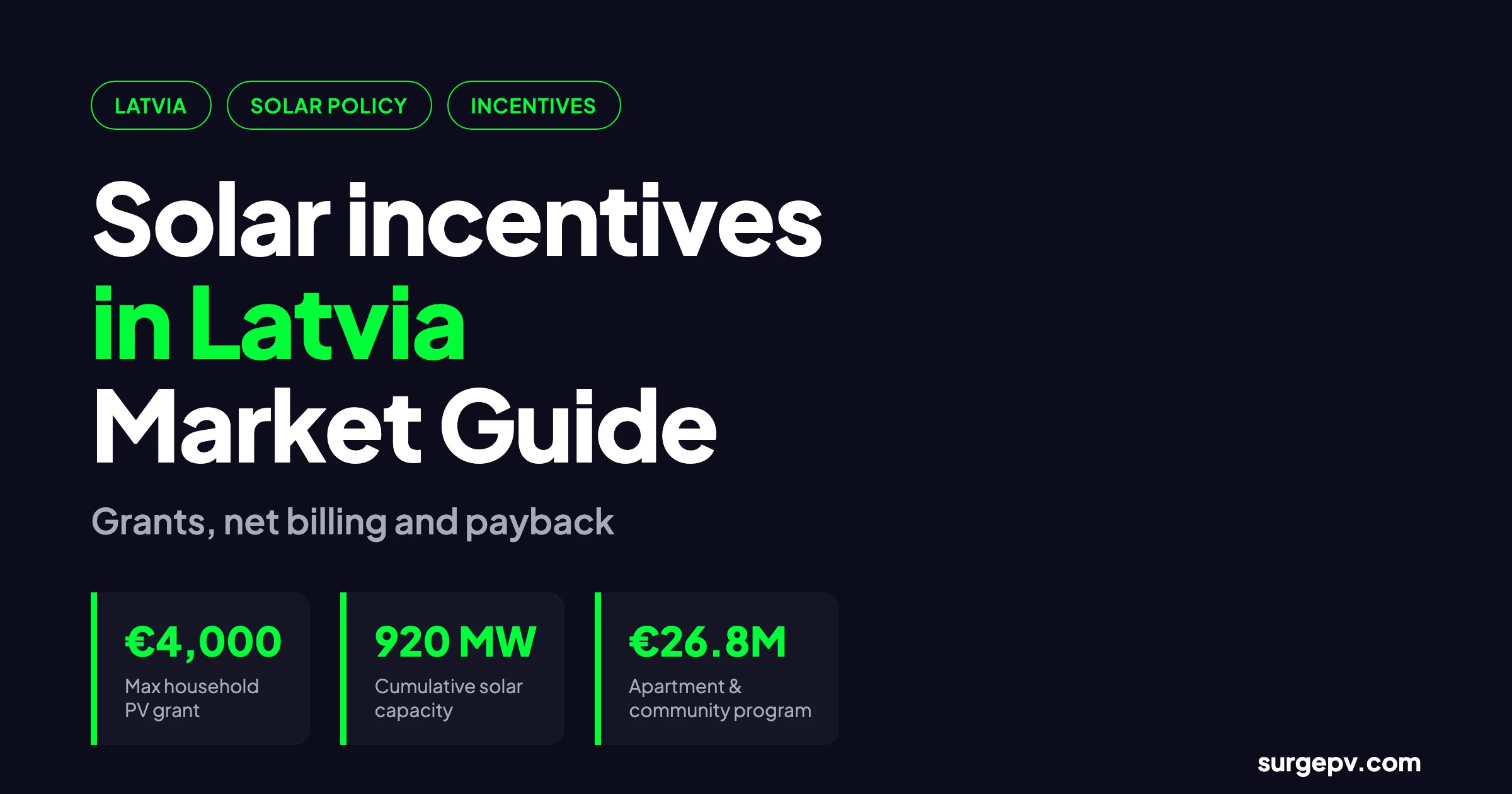
Latvia added 258 MW of solar in 2025. Cumulative capacity reached 920 MW by year-end. The data comes from Sadales tīkls, the distribution system operator, and was reported by pv magazine (2026). That is a remarkable jump for a market that had only a few megawatts at the start of the decade.
The growth has been driven first by household microgenerators responding to high electricity prices. A wave of ground-mount and rooftop plants followed as Latvia disconnected from the BRELL grid and accelerated its renewable build-out.
For 2026, the policy picture is clearer but more demanding. Net metering is closed to newcomers. New systems must earn their return under net billing. Households can still access grants through ALTUM and the Environmental Investment Fund (EKII). A fresh €26.8 million Modernisation Fund program has opened apartment buildings, municipalities and energy communities to co-financing. Large-scale solar has no feed-in tariff, so developers depend on market prices, PPAs and EU-backed finance.
This guide covers every active Latvia solar incentive in 2026. It explains how net billing changes project economics, what the new apartment-building program means, and how installers can model accurate paybacks. For solar professionals working across the Baltics, a solar design platform with Latvian tariffs and net-billing logic can turn complex subsidy stacks into clear proposals.
Quick Answer
Latvia’s 2026 solar incentives include ALTUM/EKII household grants covering up to 70% of PV and battery costs (capped at €4,000 for solar, €2,500 for storage), a new €26.8M Modernisation Fund program for apartments, municipalities and energy communities, grandfathered net metering until 2029, and net billing for new systems that values exports at roughly Nord Pool minus €20/MWh.
In this guide:
- Latest 2026 status of every active Latvia solar incentive
- Market context: how Latvia reached 920 MW and where it is heading
- Net metering vs net billing: what changed and who keeps the old rules
- Household grants through ALTUM and EKII
- The €26.8M apartment, municipal and energy community program
- Commercial and utility-scale support: no FiT, but market and EU finance
- Real-world payback examples under net billing
- Energy communities and apartment-block shared solar
- Common mistakes and tradeoffs
- FAQ
Latvia solar incentives at a glance 2026
Latvia’s incentive framework is deliberately split. Households receive upfront capital grants. Apartment blocks, municipalities and energy communities now have their own Modernisation Fund window. Large generators get no production subsidy and must sell into the market.
| Incentive | Type | Status 2026 | Key Detail |
|---|---|---|---|
| ALTUM/EKII household grant | Capital grant | Active through 2029 | Up to 70% of eligible costs; €4,000 cap for PV/wind; €2,500 cap for batteries over 5 kWh |
| Modernisation Fund program | Capital grant | Active from February 2026 | €26.8M for apartments (€10M), public institutions (€7.6M) and energy communities (€9.2M) |
| Net metering | Virtual credit | Closed to new systems | Grandfathered until 28 February 2029 for existing active customers |
| Net billing | Virtual euro credit | Default for new systems | Export value tied to Nord Pool Latvia price minus up to €20/MWh |
| Feed-in tariff / CfD | Revenue support | Not available | Latvia does not offer FiTs or CfDs for solar, per the IEA Latvia 2024 Energy Policy Review |
| EU Cohesion/Recovery funds | Capital grants and loans | Active | Enterprise energy-efficiency loans with capital discounts, apartment-building renovation rebates |
| EIB/EIF green finance | Debt / guarantees | Active | Utility-scale and hybrid solar-plus-storage project finance |
Key changes since 2024
May 2024 — net metering closed to newcomers. New household systems must use net billing. Existing net-metering customers keep their arrangement until 2029.
Late 2024 — battery storage added to household grants. The number of micro-solar systems paired with batteries jumped from 1,500 to 2,400 in 2025, according to Sadales tīkls data.
February 2026 — €26.8M Modernisation Fund program launched. For the first time, multi-apartment buildings, municipalities and energy communities can access dedicated co-financing for solar, batteries and heat pumps.
February 2025 — Baltic grid synchronisation completed. Latvia, Estonia and Lithuania disconnected from the BRELL network and now operate in the continental European synchronous area, reinforcing the case for domestic renewable capacity and storage.
Key Takeaway
Latvia’s solar incentives reward self-consumption, not export. The best projects combine grants with batteries or flexible loads so that at least 80% of generation is used on site.
Latvia solar market in 2026
Latvia’s solar story is a case study in how fast a small market can scale when electricity prices spike and policy opens the door. Cumulative solar capacity was under 50 MW in 2020. It reached about 466 MW by the end of 2024 and hit 920 MW by the end of 2025. The figure comes from the European Commission’s 2025 Country Report for Latvia and Sadales tīkls figures reported by pv magazine.
Market size and targets
| Metric | Value | Source |
|---|---|---|
| Cumulative solar end-2025 | 920 MW | Sadales tīkls / pv magazine (2026) |
| Solar added in 2025 | 258 MW | Sadales tīkls / pv magazine (2026) |
| Of which solar power plants | 710 MW | Sadales tīkls (2025) |
| Of which microgenerators | 210 MW | Sadales tīkls (2025) |
| Number of microgenerators | ~24,800 | Sadales tīkls (2025) |
| End-of-decade solar target | ~1.3 GW | Latvian Renewable Energy Alliance (2026) |
| 2030 renewable electricity target | 100% | Updated Latvian NECP (2024) |
| 2030 renewable energy share target | 60% | Updated Latvian NECP (2024), reported by Baltic News (2024) |
Latvia’s updated National Energy and Climate Plan was submitted in 2024. It raised the 2030 renewable-energy target from 50% to 60% of gross final consumption. The plan also aims for 100% renewable electricity by 2030. The solar target is not binding in the same way, but industry observers treat the end-of-decade figure of around 1.3 GW as the practical benchmark.
What the market structure means for installers
The Latvian market now has three distinct segments:
- Microgeneration (up to 11.1 kW): dominated by households. Growth has slowed since net metering ended, but grants keep the segment alive at 10-15 MW per year.
- Commercial and industrial rooftop: driven by high retail electricity prices and the need for energy independence. These projects usually size for self-consumption and use net billing or electricity trading.
- Utility-scale solar and hybrid plants: financed by developers such as Ignitis Renewables, Green Genius and European Energy, often with battery storage. These plants sell into Nord Pool and rely on merchant exposure or corporate PPAs.
For solar professionals, the key skill is no longer just installation. It is load profiling, net-billing modelling and grant stacking. A solar proposal tool that can model Latvian self-consumption ratios and export values gives a clear edge.
Net metering vs net billing in Latvia
Understanding the difference between net metering and net billing is the most important step for any Latvian solar project in 2026. The switch that took effect on 1 May 2024 rewrote the economics of distributed solar.
How Latvian net metering worked
Under the old net metering system, households with renewable capacity up to 11.1 kW could export surplus electricity to the grid. They received virtual kilowatt-hour credits in return. Those credits could offset future grid imports within the same household. The grid acted like a virtual battery.
Net metering was the main driver of Latvia’s early household solar boom. It allowed households to size systems generously, export summer surplus and use the credits in winter. Batteries were optional.
How Latvian net billing works
Net billing values electricity in euros, not kilowatt-hours. An active customer consumes solar power directly, buys grid power at the full retail rate, and receives euro credits for exports. The credits can offset consumption at the generation site. They can also offset electricity bills at other properties owned by the same active customer, according to the PERSIST D2.1 evaluation report (2024).
Key parameters for systems up to 49.999 kW:
- Settlement basis: hourly financial settlement
- Export credit: next-day hourly Nord Pool Latvia price minus a reduction of up to €20/MWh
- Retail purchase price: includes energy, distribution, mandatory procurement component and 21% VAT
- Eligible systems: new active customers from 1 May 2024
- Existing systems: grandfathered under net metering until 28 February 2029
For systems between 50 kW and 999.99 kW, the universal net-billing formula does not apply. The export value is negotiated directly between the active customer and the electricity trader.
Why the shift matters for payback
Under net metering, an exported kilowatt-hour avoided roughly the full retail price of an imported kilowatt-hour. Under net billing, the same exported kilowatt-hour may be worth only €0.05-€0.10, while the household still pays €0.13-€0.22 for grid purchases depending on the contract. The value of self-consumption has therefore increased by a factor of roughly two to four.
This changes design priorities:
- Size to consumption, not roof area. Oversizing reduces returns because exports are worth less.
- Add storage. A battery shifts midday solar generation to evening consumption, raising the self-consumption ratio.
- Shift loads. Running heat pumps, EV chargers and appliances during solar production hours improves economics.
A household that self-consumes 80% of its solar output will usually outperform a household that exports 50%, even if the second system is larger.
Household solar grants: ALTUM and EKII
The main support channel for Latvian households is a capital-grant program. It is administered through ALTUM and the Environmental Investment Fund (EKII). The program has been extended through 2029 and was updated in late 2024 to include battery storage.
2026 household grant terms
| Element | Detail |
|---|---|
| Total program budget | €85 million for the EKII household grant window |
| Maximum total grant per home | €15,000 |
| Grant share of costs | Up to 70% of eligible costs |
| PV/wind generation cap | €4,000 per project |
| Battery storage cap | €2,500 for batteries of at least 5 kWh |
| Minimum self-consumption | 80% of annual generation |
| Maximum capacity | 999.99 kW |
| Eligible buildings | Single-family homes, multi-apartment buildings, owner-occupied |
| Monitoring | Five-year reporting on generation and consumption |
The figures are drawn from the EKII program comparison page (2026) and the Frontiers in Energy Research (2026) comparative study of active-customer support schemes.
What the 80% self-consumption rule means
The 80% self-consumption requirement is the make-or-break rule. A household that generates 5,000 kWh per year must consume at least 4,000 kWh on site. If actual self-consumption falls short, the grant can be clawed back or future applications refused.
This is why battery storage became eligible in late 2024. Without a battery, many Latvian households self-consume only 30-40% of their solar generation because demand peaks in the morning and evening. A 5-10 kWh battery can lift that ratio to 70-80% or higher, especially when paired with a heat pump or electric vehicle.
Application process
- Confirm technical feasibility and expected self-consumption with a certified installer.
- Prepare property ownership, identity and electricity consumption documents.
- Submit the application through the EKII or ALTUM portal before installation begins.
- Install the system according to the approved technical design.
- Submit commissioning documents, invoices and proof of payment.
- Receive the grant payment after verification.
Grants are generally paid after installation, so households must finance the upfront cost. Installers should not treat the grant as a deposit.
A real-world household example
Consider a family near Riga with a 5 kWp rooftop system and a 7 kWh battery. The system costs €6,500 all-in. The household consumes 6,000 kWh per year and self-consumes 80% of the solar generation.
- Grant: 70% of €6,500 = €4,550, capped at €4,000
- Net cost: €2,500
- Annual self-consumed value: 4,200 kWh × €0.17/kWh = €714
- Annual export credit: 1,050 kWh × €0.07/kWh = €74
- Simple payback: €2,500 ÷ €788 = 3.2 years
Without the grant, the same system would pay back in roughly 10-12 years. This example is illustrative; actual figures depend on the installer quote, electricity contract and household load profile.
The €26.8 million apartment, municipal and energy community program
In February 2026, Latvia’s Ministry of Climate and Energy approved a €26.8 million grant program funded through the EU Modernisation Fund. It targets groups that the household grant did not reach: apartment dwellers, municipalities and energy communities.
Program allocation 2026
| Segment | Budget | Aid intensity |
|---|---|---|
| Multi-apartment buildings | €10 million | Up to 70% of eligible costs |
| State and local government institutions | €7.6 million | Up to 80% of eligible costs |
| Energy communities | €9.2 million | Up to 70% of eligible costs |
The program supports solar PV, battery storage, heat pumps and solar thermal systems. For apartment buildings, at least 80% of the electricity generated by shared equipment must be used for self-consumption. Public buildings must meet at least energy efficiency class D, unless they are part of an energy community.
Why this matters for apartments
More than 60% of Latvian households live in multi-apartment buildings, according to the MDPI study on PV energy communities in Latvian apartments (2025). These households previously had limited access to rooftop solar because of split ownership and shared roofs. The new program allows apartment owners to apply through a building manager or owners’ association, turning shared roofs into shared assets.
Energy communities
The program also provides the first dedicated funding stream for Latvian energy communities. An energy community can aggregate generation and consumption across multiple meters, helping members reach the 80% self-consumption threshold that individual households might miss. Communities are capped at 15 MW total renewable capacity.
Commercial, industrial and utility-scale solar
Large-scale solar in Latvia operates under a different framework than household systems. There is no feed-in tariff, no premium and no national CfD for solar. The economics are driven by market prices, corporate PPAs, EU funds and development finance.
No feed-in tariff
The IEA’s 2024 Latvia energy policy review states this clearly. It says Latvia no longer offers feed-in tariffs or contracts for difference for electricity produced from renewable resources. Generators sell electricity at the market price. This applies to utility-scale and commercial solar alike.
Merchant market and Nord Pool
Latvia is part of the Nord Pool day-ahead market. Prices in the Latvia bidding zone have averaged roughly €0.05-€0.10/kWh in 2025-2026. They can spike during winter evenings or turn negative during sunny, windy summer afternoons, as shown by euenergy.live (2026). Merchant projects therefore face significant price risk and are increasingly built with battery storage or hedged through PPAs.
EU and development finance
Despite the absence of production subsidies, capital support exists for larger projects:
- EIB green loans: a €35.2 million EIB facility for Sunly will add 329 MW of solar parks, according to EIB (2026).
- EIF green financing: a €30 million EIF deal with BluOr Bank supports green upgrades by Latvian companies, reported by EIF (2025).
- Recovery and Resilience Facility: enterprise energy-efficiency loans with capital discounts of up to 30%, capped at €1.5 million per group.
Corporate PPAs
The Latvian PPA market is still developing. Currently, most direct contracts are arranged through electricity suppliers rather than as standalone agreements. Industry observers expect legislation to clarify this in the coming years. For now, the strongest large-scale business case is behind-the-meter C&I solar that displaces retail purchases.
Solar costs and payback in Latvia 2026
Latvia combines moderate solar irradiance, falling equipment prices and some of the highest retail electricity prices in the Baltic region. The result is a positive but grant-dependent business case for residential systems and a strong case for commercial rooftops with high daytime load.
Residential installation costs
| System size | Total installed cost | Cost per kWp | Typical use |
|---|---|---|---|
| 3 kWp | €3,000-€3,900 | €1,000-€1,300 | Small apartment or holiday home |
| 5 kWp | €5,000-€6,500 | €1,000-€1,300 | Average family home |
| 8 kWp | €8,000-€10,400 | €1,000-€1,300 | Larger home or small business |
| 10 kWp | €10,000-€13,000 | €1,000-€1,300 | Large home or farm |
All-in costs include modules, inverter, mounting, DC/AC cabling, labour, grid connection application, bidirectional meter and commissioning. Battery storage adds roughly €4,000-€7,000 for a 5-10 kWh lithium-ion system.
Retail electricity prices
Household electricity prices in Latvia in 2026 range from about €0.13/kWh on dynamic tariffs to €0.18-€0.22/kWh on fixed contracts. These prices include VAT, distribution and the mandatory procurement component, according to the elektroenergija.lv tariff calculator (2026).
Payback scenarios
| Scenario | Gross cost | Grant | Net cost | Annual benefit | Simple payback |
|---|---|---|---|---|---|
| 5 kWp PV + battery, high self-consumption | €11,000 | €5,500 | €5,500 | €1,100 | 5.0 years |
| 5 kWp PV only, grant only | €6,500 | €4,000 | €2,500 | €800 | 3.1 years |
| 5 kWp PV only, no grant | €6,500 | €0 | €6,500 | €600 | 10.8 years |
| 100 kWp C&I rooftop, 75% self-consumption | €80,000 | €15,000 (RRF/ALTUM) | €65,000 | €11,000 | 5.9 years |
The battery-plus-PV scenario assumes the household shifts enough load to reach 80% self-consumption and qualifies for both the PV and battery grant components. The exact split depends on the current ALTUM and EKII rules at the time of application.
Energy communities and apartment blocks
Energy communities are Latvia’s next frontier for solar. They solve the split-incentive problem in apartment buildings and allow small prosumers with shaded or small roofs to share a single installation.
Legal status
Latvia has recognised energy communities in national legislation through amendments to the Energy Law and Electricity Market Law. A dedicated regulation sets a 15 MW cap per community and requires 80% collective self-consumption for state support. Communities must operate on a not-for-profit or limited-profit basis and prioritise local benefit.
Virtual net metering
The net-billing system already allows an active customer to offset electricity consumption at multiple properties owned by the same entity. Energy communities extend this logic to multiple owners, allowing production at one site to be credited against consumption at other meters within the community. This is especially useful for apartment blocks, agricultural cooperatives and small commercial clusters.
Why energy communities matter for Latvia
With nearly two thirds of Latvian households living in apartments, rooftop solar cannot scale through single-family homes alone. Energy communities let residents co-own a shared system, split maintenance costs and meet the 80% self-consumption requirement through aggregated demand. The €9.2 million allocation in the 2026 Modernisation Fund program is a clear signal that policymakers want this segment to grow.
Common mistakes and tradeoffs
Latvian solar in 2026 rewards careful planning. These are the most common errors and the tradeoffs every prosumer should understand.
Mistake 1: Designing for net metering
Many installers and homeowners still size systems as if retail-rate net metering were available. Under net billing, oversizing reduces returns. Design the system to match daytime consumption, with storage to capture evening use.
Mistake 2: Ignoring the 80% self-consumption rule
Households that receive ALTUM/EKII support must self-consume 80% of annual generation. A proposal that ignores this rule can lead to grant clawback. Model the load profile, add a battery, or shift flexible loads before applying.
Mistake 3: Missing the grant window
Although the household program is open through 2029, budgets are finite. The EKII dashboard shows monthly application volumes and disbursements. Submit early in the year to avoid end-of-budget uncertainty.
Mistake 4: Treating export income as a primary revenue stream
Under net billing, exports are credited at roughly the Nord Pool price minus up to €20/MWh. On many summer afternoons, that value is close to zero. Self-consumed solar is the profit driver.
Tradeoff: Battery cost vs self-consumption gain
Batteries add €4,000-€7,000 but can raise self-consumption from 35-45% to 75-85%. In Latvia’s net-billing environment, the battery payback is typically 4-7 years when combined with the EKII grant.
Tradeoff: Apartment community vs individual system
Households with small or shaded roofs may get better economics by joining an apartment energy community than by installing a small standalone system. Communities require more coordination but offer scale advantages and shared maintenance.
Conclusion
Latvia’s solar incentive framework in 2026 is a clear pivot away from export-based support and toward self-consumption. Net metering is closed to newcomers, but ALTUM and EKII household grants, the new €26.8 million Modernisation Fund program and EU-backed finance keep the market moving. The country is on track to beat its end-of-decade solar target if large projects in the pipeline connect on schedule.
For solar professionals, the competitive advantage is no longer just installation price. It is the ability to model net billing accurately, stack grants correctly, and design systems that hit the 80% self-consumption threshold. Tools like Clara AI and SurgePV’s generation and financial tool can automate that workflow for Latvian projects.
Three actions to take now:
- Model self-consumption first — under net billing, every exported kilowatt-hour is worth far less than a self-consumed one.
- Check the grant stack before quoting — combine ALTUM/EKII household support, the Modernisation Fund program and any municipal top-ups where relevant.
- Prepare documentation early — grant approvals, grid connection agreements and smart metering all have lead times that can delay commissioning.
For the broader European context, see our European solar incentives guide. For a regional payback comparison, see our solar payback period by country guide.
Frequently Asked Questions
What solar incentives are available in Latvia in 2026?
Active Latvia solar incentives in 2026 include ALTUM/EKII household grants. They cover up to 70% of eligible PV and battery costs, capped at €4,000 for solar and €2,500 for storage. A €26.8M Modernisation Fund program supports apartment buildings, municipalities, state agencies and energy communities. Existing systems keep grandfathered net metering until 2029. New systems use net billing, where exports are credited at roughly the Nord Pool Latvia price minus up to €20/MWh.
Is net metering still available in Latvia in 2026?
Net metering is only available for existing active customers who registered before 1 May 2024. Those households keep retail-rate virtual credits until 28 February 2029. New residential, commercial and public-sector systems must use net billing, which values exported electricity in euros rather than kilowatt-hours.
How much is the Latvia household solar grant in 2026?
The ALTUM/EKII household grant covers up to 70% of eligible costs for PV, wind or battery systems, with a maximum of €4,000 for electricity generation equipment and up to €2,500 for batteries of at least 5 kWh. The total project cap is €15,000 per home, and at least 80% of annual generation must be self-consumed.
What is the €26.8 million Latvia solar grant program?
Approved in February 2026, the Modernisation Fund program provides co-financing for solar, battery storage and heat pumps in multi-apartment buildings (€10M), state and local government institutions (€7.6M) and energy communities (€9.2M). Aid intensity is up to 70% for apartments and communities and up to 80% for public institutions.
Does Latvia have feed-in tariffs for solar in 2026?
No. Latvia does not offer feed-in tariffs or contracts for difference for new solar generators. Large solar plants sell electricity at market prices through Nord Pool. Commercial and utility-scale projects rely on merchant revenue, corporate power purchase agreements, EU-funded investment grants and development finance from institutions such as the EIB.
What is the difference between net metering and net billing in Latvia?
Net metering credits exported kilowatt-hours against future imports at retail value. Net billing converts exports into euro credits based on the electricity trader’s pricing scheme, which for small systems tracks the Nord Pool Latvia day-ahead price minus up to €20/MWh. Self-consumed solar is therefore far more valuable than exported solar under net billing.
How much does a residential solar system cost in Latvia in 2026?
Residential solar in Latvia costs roughly €1,000-€1,300 per kWp installed, including panels, inverter, mounting, cabling, labour, permits and grid connection. A typical 5 kWp system costs €5,000-€6,500 before subsidies. With the ALTUM/EKII grant covering up to 70% capped at €4,000, net cost can fall to €1,500-€2,500.
What is the solar payback period in Latvia?
A well-designed residential system with a battery can pay back in 4-7 years after grants in Latvia, while an unsubsidised PV-only system sized for export can take 9-12 years. Commercial rooftops with high daytime self-consumption can pay back in 5-8 years. Adding storage to lift self-consumption above 80% is usually the deciding factor.
What are the self-consumption rules for Latvia solar grants?
Households receiving ALTUM/EKII support must self-consume at least 80% of the electricity they generate annually. The same 80% self-consumption rate and a 999.99 kW capacity cap apply to state aid for active customers. Energy communities must also reach 80% collective self-consumption and are limited to 15 MW total renewable capacity.
Can apartment buildings install shared solar in Latvia?
Yes. The €26.8M Modernisation Fund program explicitly supports residents of multi-apartment buildings, plus energy communities and public institutions. Apartment owners can apply through an authorised representative such as a building manager or owners’ association, with co-financing of up to 70% of eligible costs.
Where this fits
This article is part of SurgePV's Solar Incentives & Policy hub, which works through the topic from first principles to the decisions a project team actually has to make.

