

Answer
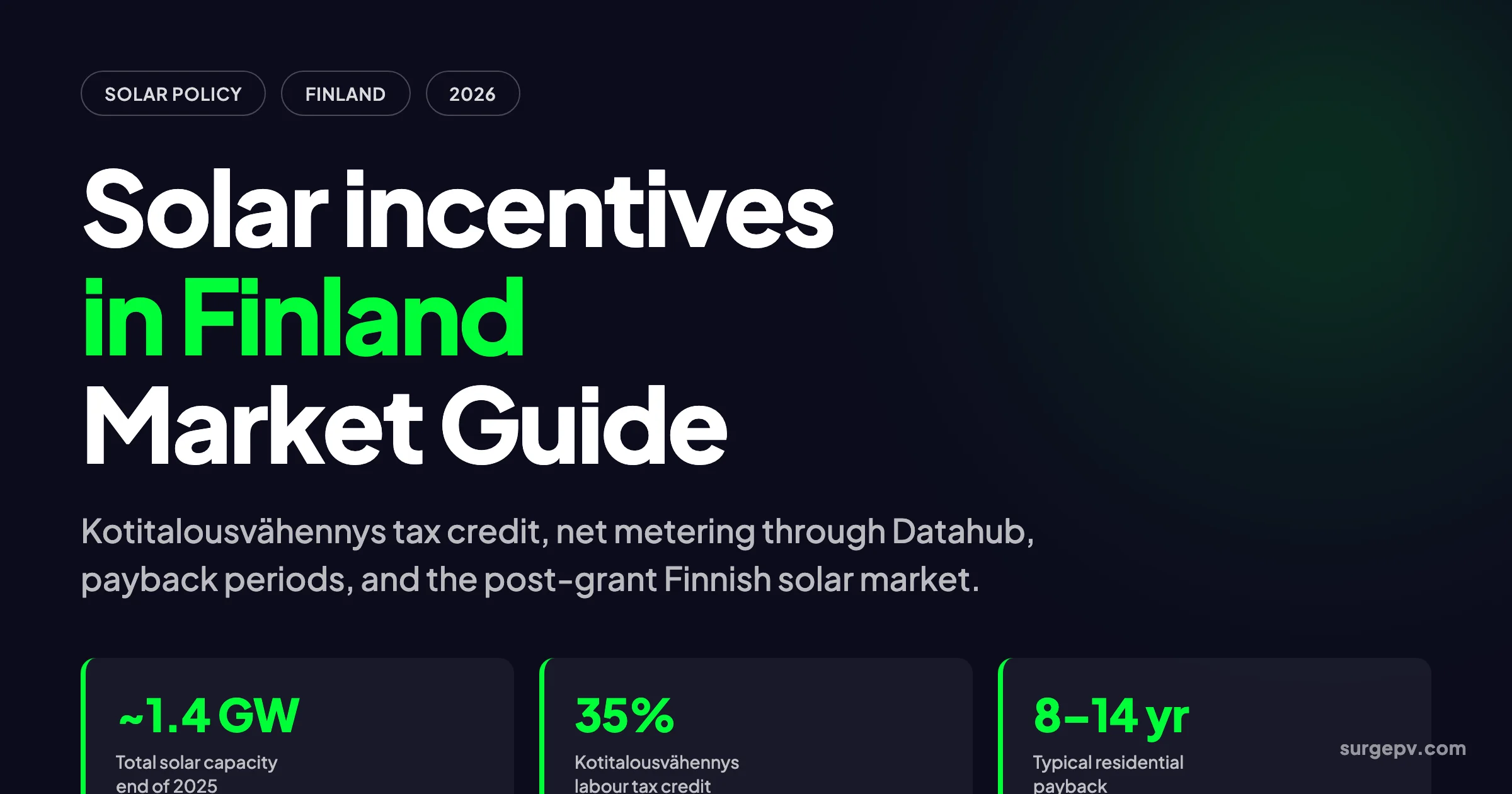
Finland's 2026 solar incentives are dominated by the Kotitalousvähennys household tax credit — 35% of installation labour costs, capped at €1,600 per person per year with a €150 threshold. The real economic driver is Finland's net metering scheme (netotus), which credits exported solar against annual consumption at the full retail electricity price through the national Datahub settlement system. There is no national capital grant, no feed-in tariff for new systems, and no reduced VAT for residential solar.
Finland’s solar market has quietly become one of Europe’s most interesting post-grant cases. The country ended 2024 with roughly 1,200 MW of installed solar capacity, or about 1.4% of national electricity production. In 2025 it added a record 227 MW and total solar capacity more than doubled, according to Baltic Wind (2026). By early 2026, combined Finnish wind and solar capacity crossed 10 GW.
The policy story is not about generous subsidies. It is about a single tax credit and a very favourable net metering design. Finland’s Kotitalousvähennys household tax credit cuts 35% of installation labour costs. Its net metering scheme, run through the national Datahub platform, credits exported solar at the full retail electricity price over a one-year settlement period. There is no national capital grant, no feed-in tariff for new systems, and no reduced VAT. For homeowners, installers, and EPCs, the lesson is simple: size the system for the annual electricity bill, not for a grant cap.
This guide focuses on incentives and the market mechanics that make them work. For a broader European comparison, see our European solar incentives guide. For VAT treatment across the continent, see solar VAT rates in Europe. If you are designing Finnish projects, a platform that models net metering, seasonal yield, and self-consumption can cut hours from every quote. Generate solar proposals, run shadow analysis, and test payback in SurgePV’s generation and financial tool. Check pricing or book a demo.
Finland’s 2026 solar incentive stack is small, but the net metering design is unusually strong. The headline tool is Kotitalousvähennys. The hidden engine is netotus.
Quick Answer
Finland’s 2026 solar incentives are dominated by the Kotitalousvähennys household tax credit — 35% of installation labour costs, capped at €1,600 per person per year with a €150 threshold. The real economic driver is Finland’s net metering scheme (netotus), which credits exported solar against annual consumption at the full retail electricity price through the national Datahub settlement system. There is no national capital grant, no feed-in tariff for new systems, and no reduced VAT for residential solar.
In this guide:
- Latest 2026 status of every active Finnish solar incentive
- How Kotitalousvähennys works and who qualifies
- How net metering through Datahub changes the economics
- What disappeared: capital grants, feed-in tariffs, and reduced VAT
- Commercial and utility-scale options without subsidies
- Regional yield differences and design constraints at 60–70°N
- Three real-world stacking examples with payback impact
- Common mistakes and how to avoid them
Finland Solar Incentives at a Glance 2026
Finland’s incentive framework is lean. The country deliberately moved away from capital grants and toward a model where low retail electricity prices, a labour tax credit, and full retail net metering do the heavy lifting.
Incentive Status Table — June 2026
| Incentive | Type | Status | Key Terms |
|---|---|---|---|
| Kotitalousvähennys — solar installation labour | Tax credit | Active | 35% of labour cost; €1,600 cap/person/year; €150 threshold |
| Net metering (netotus) | Export credit | Active | Annual settlement; full retail price through Datahub |
| Smart meter | Metering | Active | Bidirectional meter installed by DSO; usually free or low cost |
| Corporate tax depreciation | Tax benefit | Active | Standard depreciation for business assets |
| Capital grant / rebate | Capital subsidy | Ended | No national grant open to new residential or C&I systems |
| Feed-in tariff | Export remuneration | Ended | No FIT for new systems |
| Reduced or zero VAT | Purchase tax break | Not available | Standard 25.5% VAT applies |
| Agricultural renewable energy subsidy | Capital subsidy | Ended | 40% investment subsidy no longer open |
Key Changes Since 2025
2023 — Nationwide net metering: Datahub, Finland’s centralised information exchange system for the retail electricity market, extended net metering to all PV systems. Before 2023, only a few distribution system operators offered it.
2025 — Kotitalousvähennys reduction: The household tax credit was reduced from 40% to 35% of labour costs, the annual cap fell from €2,250 to €1,600 per person, and the threshold rose from €100 to €150. The change took effect for invoices paid from 1 January 2025.
April 2026 — Planned temporary increase: The Finnish government announced a framework decision to raise Kotitalousvähennys to 40% and the cap to €2,100 per person for 2026–2027. As of mid-2026, the Tax Administration’s official guidance still applies the 35% / €1,600 rules while implementing legislation is prepared.
Key Takeaway
Finland has one of Europe’s smallest direct incentive stacks, but net metering at full retail price does much of the work that grants do elsewhere. The design favours households with steady annual consumption and a south-facing roof.
Why Finland’s Incentive Stack Matters in 2026
Finland is not a high-irradiance market. National average solar yield is roughly 700–900 kWh/kWp per year, about half of southern Europe. In southern Finland — Helsinki, Turku, Tampere — a well-oriented system can reach 800–1,000 kWh/kWp. In the north, Rovaniemi sees closer to 700 kWh/kWp, according to the Finland Solar Calculator (2026).
Yet the market is growing. The reason is not abundant sunshine. It is a combination of three factors:
- High electricity self-sufficiency ambition: Finland wants to reduce import dependence and balance its large wind fleet.
- Favourable net metering: Full retail credit makes every exported kWh as valuable as a self-consumed kWh over the year.
- Low non-household electricity prices: Industrial users pay among the lowest rates in the EU, but household rates and fixed charges still make self-consumption attractive.
Market Size and Targets
| Metric | Value | Source |
|---|---|---|
| Total solar capacity, end 2024 | ~1,200 MW | Sweco / Finnish Renewables (2025) |
| Solar capacity added in 2025 | ~227 MW | Baltic Wind (2026) |
| Wind + solar capacity, early 2026 | over 10 GW | Baltic Wind (2026) |
| Share of electricity production, 2024 | ~1.4% | Sweco (2025) |
| Potential capacity by 2035 | up to 16 GW | Fingrid / Sweco (2025) |
Small-scale solar dominates. Of the roughly 1,200 MW installed at the end of 2024, approximately 1,080 MW was small-scale production and only about 120 MW was industrial-scale plants above 1 MW.
What the Growth Means for Incentives
The absence of a capital grant does not mean the market is stalled. It means the economics must be modelled honestly. A Finnish installer who assumes too much self-consumption will overstate savings. One who ignores net metering will understate them. Accurate modelling of annual consumption patterns, seasonal production, and the Datahub settlement is now the competitive advantage.
For solar professionals, this is where solar design software pays for itself. A proposal that models Finland’s net metering correctly will show a different payback than one that treats exports as lost revenue.
Kotitalousvähennys: Finland’s Household Tax Credit
Every current residential solar incentive in Finland sits under one mechanism: Kotitalousvähennys, the tax credit for household expenses. It is not a rebate on the system. It is a direct reduction of income tax based on the labour portion of the installation invoice.
How the Credit Works
The credit applies only to work done by a company registered in Finland’s prepayment register (ennakkoperintärekisteri). The invoice must separately itemise the labour cost, including VAT. Materials, travel, and equipment do not qualify.
For solar installations in 2026, the rules are:
- Credit rate: 35% of the VAT-inclusive labour cost.
- Annual cap: €1,600 per person.
- Annual threshold: €150 per person, subtracted once per year.
- Couple maximum: €3,200 if both spouses claim.
- Eligible work: Installation labour, including solar panels, inverters, mounting, cabling, and commissioning.
Example: a €10,000 system with €3,500 of labour. For one person, the credit is €3,500 × 35% − €150 = €1,075. For a couple splitting the labour cost evenly, each claims €1,750 × 35% − €150 = €462.50, for a combined €925.
2026 Rates and the Planned Increase
| Scenario | Rate | Cap per person | Threshold | Couple cap |
|---|---|---|---|---|
| Current 2026 rules | 35% | €1,600 | €150 | €3,200 |
| Planned 2026–2027 increase | 40% | €2,100 | €150 | €4,200 |
The April 2026 framework decision, reported by sources including Rakentaja (2026) and Alavus Ikkunat (2026), would raise the credit temporarily. However, the Finnish Tax Administration (2026) notes that its guidance page is still being updated and the current rules apply until implementing legislation enters force.
Who Qualifies
You can claim Kotitalousvähennys if:
- You are a Finnish tax resident.
- The work is done in your own home, a holiday home, or certain relatives’ homes.
- You ordered and paid for the work yourself.
- The service provider is in the prepayment register.
- You paid by bank transfer or card, not cash.
- The invoice clearly separates labour from materials.
How to Claim
Most installers report the labour amount directly to the Tax Administration. You then confirm the deduction in your pre-filled tax return through OmaVero. Alternatively, you can apply the credit to your tax card during the year, which reduces monthly withholding.
Pro Tip for Installers
Put labour and materials on separate invoice lines. If the labour portion is buried in a single total, the customer may not be able to claim the full credit or may face a delayed tax assessment.
Net Metering Through Datahub
Finland’s net metering scheme is the most financially significant part of the residential solar stack. It is not a cash payment. It is an accounting mechanism that makes exported solar as valuable as imported grid electricity over a calendar year.
How Netotus Works
Netotus — “netting” of electricity — credits surplus solar generation against grid consumption within the same calendar year. Exported kWh are credited at the retail electricity price charged by your supplier. Settlement is annual, so a household that produces a surplus in June can use that credit to cover consumption in December.
Before 2023, only a handful of distribution system operators offered net metering because each ran its own IT systems. The national Datahub platform, launched in 2023, replaced those fragmented systems. As reported by pv magazine (2022), net metering became available to all PV systems through Datahub.
Why It Matters Financially
Finnish household electricity prices in 2026 range from roughly €0.10/kWh on spot-price contracts to €0.14–0.18/kWh on fixed contracts, with distribution and taxes on top. A blended all-in rate of roughly €0.18/kWh is commonly used for payback calculations. Because net metering credits exports at that retail rate, every kWh produced reduces the bill by the same amount whether it is self-consumed or exported.
Compare this with Sweden or Germany, where exported kWh may be paid only at the spot market price of €0.05–0.10/kWh. Finland’s design is more generous to prosumers, which is why even a 700–900 kWh/kWp resource can deliver acceptable paybacks.
Practical Requirements
To use net metering, you need:
- A grid-connected PV system registered with your local DSO.
- A bidirectional smart meter, usually installed free or at low cost by the DSO.
- An electricity contract with a supplier that participates in Datahub settlement.
- Annual reconciliation: any surplus at year-end may be paid out at a lower rate or carried forward, depending on the supplier.
The Seasonal Pattern
Finnish solar production is concentrated between April and September. In December, a Helsinki system may produce only 1–5% of its July output. Net metering smooths this mismatch by banking summer surplus for winter use. It does not eliminate the winter deficit — households still draw from the grid from November to February — but it removes the penalty for overproducing in summer.
Opinion: Net Metering Is the Real Finnish Incentive
Finnish policymakers did not abolish subsidies and leave homeowners empty-handed. They replaced a grant with a market rule — full retail netting — that is arguably more durable. The risk is that high rooftop penetration or EU market rules could eventually force a move toward hourly netting or lower export compensation. For now, net metering is the strongest reason to install solar in Finland.
What Finland Does Not Offer in 2026
Finland’s incentive stack is small partly because several earlier instruments have ended. Do not rely on these when quoting a project.
Ended Capital Grants
Finland previously offered a 25% rebate for homeowners, businesses, and communities that covered part of the purchase and installation cost of PV systems. A 40% investment subsidy was also available for agricultural renewable energy production. Both programmes are closed to new applicants.
No Feed-in Tariff for New Systems
Unlike Germany, Austria, or France, Finland does not guarantee a fixed price for exported solar from new systems. Existing contracts may remain in place, but new residential and commercial systems must rely on net metering or market-based sales.
No Reduced VAT
Finland applies the standard 25.5% VAT rate to solar installations. This is higher than the 0% or reduced rates seen in some neighbouring markets. For a typical €10,000 system, VAT adds roughly €2,050 to the gross price.
No Municipal Property Tax Break
Finland does not offer a nationwide property tax exemption or construction tax break for solar in the way some Spanish municipalities or U.S. states do. Local building rules apply, but they are not a financial incentive.
The Impact on Quoting
Because the stack is thin, Finnish proposals must be precise. The three levers are:
- Kotitalousvähennys on labour.
- Net metering on annual production.
- Self-consumption optimisation through load timing, EV charging, or storage.
Any assumption beyond those three should be treated as a bonus, not a base case.
Commercial and Utility-Scale Solar
There is no national capital grant or tax credit open specifically to new commercial, industrial, or utility-scale solar installations in 2026. The economics for these segments are built around power markets and corporate offtake.
What C&I and Utility Projects Use
- Power purchase agreements (PPAs): A corporate buyer agrees to purchase electricity from a solar park for a fixed term. The park may be on-site, off-site, or virtual.
- Merchant spot-market sales: Large plants sell into the Nord Pool spot market. This can be profitable but exposes the project to price volatility, including negative prices.
- Direct private-wire arrangements: An industrial consumer connects directly to a nearby solar plant, avoiding some grid charges.
- Corporate tax depreciation: Solar assets are depreciated under normal Finnish corporate tax rules, providing a standard time-value-of-money benefit.
- Industrial electricity prices: Finland’s non-household electricity prices were the lowest in the EU in the second half of 2025, at €0.0748/kWh including non-recoverable taxes and levies, according to Eurostat (2026). Low input costs help industrial self-consumption projects but also compress the premium that solar can capture.
The Negative Price Challenge
Finland recorded more than 700 hours of negative electricity prices in 2024, according to Intelligent Employment (2026). Negative prices are increasingly forcing developers to pair solar with storage or flexible consumption. A standalone solar plant that exports during midday summer peaks may receive little or even negative revenue in those hours.
The Market Split
Utility-scale solar is the fastest-growing segment. While small-scale solar still dominates installed capacity, large projects are driving annual additions. These projects are usually financed through long-term PPAs or balance-sheet capex, not grants.
For C&I installers, the financial model is built around avoided grid consumption, not export income. A factory or data centre that consumes electricity during daylight hours can justify a rooftop system even without subsidies.
Regional and Practical Design Factors
Finland’s high latitude and dark winters shape every design decision. Incentives matter, but orientation, tilt, and consumption timing matter just as much.
Solar Yield by Region
| Location | Approximate yield | Notes |
|---|---|---|
| Helsinki | ~790 kWh/kWp/yr | Best urban market; south-facing critical |
| Turku | ~820 kWh/kWp/yr | Slightly sunnier than Helsinki |
| Tampere | ~750–800 kWh/kWp/yr | Good central-south option |
| Oulu | ~650–700 kWh/kWp/yr | Shorter season, viable for high self-consumption |
| Rovaniemi | ~700 kWh/kWp/yr | Lowest useful sun hours; north-facing unusable |
Figures are illustrative and based on the Finland Solar Calculator (2026). Actual yields depend on roof orientation, tilt, shading, and local weather.
Orientation and Tilt
At 60–70°N, roof orientation is more important than in southern Europe:
- South-facing at 35–40° tilt: optimal.
- East- or west-facing: roughly 20% lower annual yield.
- North-facing: generally not recommended.
- Flat roofs: use tilt frames set to 35–40°.
Snow and Seasonality
Snow cover is real but often overstated. South-facing panels at 35–45° tilt usually shed snow naturally within 1–3 days because the dark surface warms quickly when sunlight hits it. Flat roofs may need occasional clearing. Snow losses are typically 3–5% of annual production, concentrated in December–February when output is already near zero.
The bigger constraint is the four-month winter deficit. From November to February, Finnish solar production is negligible. A battery can shift afternoon production to evening, but it cannot cover winter heating demand. Homes should plan for full grid dependency during those months.
Consumption Timing
Because net metering is annual, timing matters less than in markets with hourly settlement. However, self-consumed kWh still avoid distribution and supplier margins that exported kWh may not fully recover. Timing heavy loads — EV charging, water heating, dishwashers — to midday solar hours improves returns.
How to Stack Incentives: Three Real-World Scenarios
The following examples are illustrative, based on typical 2026 costs and incentive rates. Actual figures depend on location, installer quote, electricity contract, and self-consumption ratio.
Scenario 1 — 6 kWp Rooftop, Helsinki Family Home
| Item | Amount |
|---|---|
| Gross system cost | €8,000 |
| Labour share | €2,800 |
| Kotitalousvähennys (one person) | €2,800 × 35% − €150 = €830 |
| Net effective cost | €7,170 |
| Annual production | ~4,700 kWh |
| Annual savings at €0.18/kWh | ~€846 |
| Simple payback | ~8.5 years |
This household consumes enough to absorb most of its production through net metering over the year. The credit is claimed by one person.
Scenario 2 — 8 kWp Rooftop with Battery, Turku
| Item | Amount |
|---|---|
| Gross system cost | €13,000 |
| Labour share | €4,000 |
| Kotitalousvähennys (couple) | €4,000 × 35% − €300 = €1,100 |
| Net effective cost | €11,900 |
| Annual production | ~6,500 kWh |
| Self-consumption without battery | 35% |
| Self-consumption with battery | 55% |
| Annual savings with battery | ~€1,170 |
| Simple payback | ~10.2 years |
The battery adds upfront cost but raises the self-consumption ratio from roughly 35% to 55%. In Finland’s net metering environment, the benefit is moderate but real for households that want to reduce grid dependency in the evenings.
Scenario 3 — 250 kWp C&I Rooftop, Tampere
| Item | Amount |
|---|---|
| Gross system cost | €225,000 |
| Incentive | None (no grant, no FIT) |
| Annual production | ~190,000 kWh |
| Self-consumption rate | 85% |
| Avoided grid cost at €0.10/kWh | €16,150/year |
| Simple payback | ~14 years |
Without subsidies, the business case rests entirely on avoided grid purchases. This is why C&I projects in Finland are usually oversized only to the extent that daytime consumption can absorb production.
Common Mistakes and How to Avoid Them
1. Assuming a Capital Grant Still Exists
Some older marketing materials still reference the 25% rebate or the agricultural 40% subsidy. Both are closed. The only direct residential incentive is Kotitalousvähennys.
2. Misstating the Kotitalousvähennys Cap
The credit is 35% of labour, capped at €1,600 per person, with a €150 threshold. It is not 35% of the total system cost. A €10,000 system with €3,500 labour does not yield a €3,500 credit.
3. Ignoring the Planned Rate Increase
The April 2026 framework decision may raise the credit to 40% and the cap to €2,100. Until the Tax Administration updates its guidance and implementing rules pass, quote conservatively at 35% / €1,600 and note the potential uplift as pending.
4. Quoting Payback Without Seasonality
A Finnish system produces almost nothing from November to February. Payback calculations that assume uniform monthly production will mislead customers. Model production by month and show the annual net metering settlement.
5. Overlooking Consumption Patterns
Net metering helps, but a household with low annual consumption will export most of its production. At year-end, surplus credits may be paid out at a lower rate. Size the system to match annual consumption, not roof area.
6. Forgetting the VAT Impact
Standard 25.5% VAT applies. A €10,000 quote excluding VAT becomes €12,550 including VAT. Make sure customers understand whether prices are shown with or without VAT.
Frequently Asked Questions
What solar incentives are available in Finland in 2026?
Finland’s main 2026 solar incentive is the Kotitalousvähennys household tax credit: 35% of the labour portion of installation costs, capped at €1,600 per person per year, minus a €150 annual threshold. A couple can claim up to €3,200. The country’s net metering scheme (netotus) is equally important — it credits surplus solar exports against annual electricity consumption at the full retail price. There is no national capital grant, no feed-in tariff for new systems, and no reduced VAT.
How does Kotitalousvähennys work for solar panels?
Kotitalousvähennys is a direct tax credit for household renovation and installation work, including solar panel installation. Only the labour share qualifies, not modules, inverters, or materials. The credit equals 35% of the VAT-inclusive labour cost, up to €1,600 per person per year. A €150 annual threshold is subtracted once per person. The installer must be registered in Finland’s prepayment register and the invoice must itemise labour separately. The credit is claimed through the OmaVero tax portal.
What is net metering (netotus) in Finland?
Netotus is Finland’s net metering mechanism. It allows small producers to offset electricity exported to the grid against electricity imported from the grid within the same calendar year. Settlement runs through Datahub, the national centralised information exchange system for the retail electricity market. Because exports are credited at the retail electricity price, self-consumed and exported kWh are treated equally over the year, which is unusually favourable compared with markets that pay only spot price for exports.
Is there a feed-in tariff or capital grant for solar in Finland in 2026?
No. Finland does not offer a national feed-in tariff or capital grant for new residential, commercial, or industrial solar installations in 2026. Earlier instruments, including a 25% rebate for homeowners and a 40% investment subsidy for agricultural producers, have ended. New projects rely on the household tax credit, net metering, corporate tax depreciation, power purchase agreements, or merchant market sales.
Does Finland apply reduced VAT to solar installations?
No. Finland applies the standard 25.5% VAT rate to solar installations. Unlike Germany, Austria before April 2025, or the Netherlands before 2026, Finland has not adopted a zero or reduced VAT rate for residential solar. This is one reason the upfront cost remains relatively high despite the labour tax credit.
What is the typical payback period for residential solar in Finland?
Typical residential payback in Finland is 8–14 years, depending on system size, location, roof orientation, self-consumption rate, and electricity price. South-facing systems in Helsinki, Turku, or Tampere perform best. Northern locations such as Oulu or Rovaniemi have lower annual yields and longer paybacks. Combining solar with an EV charger, heat pump, or battery can shorten payback by improving self-consumption.
Do businesses get solar incentives in Finland?
Businesses do not receive a dedicated solar capital grant in 2026. Commercial and industrial projects typically use standard corporate tax depreciation, power purchase agreements, direct private-wire arrangements, or merchant sales on the Nord Pool wholesale market. Utility-scale projects have grown rapidly, but they depend on offtake contracts and grid connection rather than subsidies.
How important is roof orientation for solar in Finland?
Orientation is critical at Finland’s latitude of 60–70°N. A south-facing roof at 35–40° tilt gives the best output. East- or west-facing roofs lose roughly 20% of annual production. North-facing roofs are generally not viable. Flat roofs should use tilt frames set to 35–40°. Snow usually sheds naturally from sloped south-facing panels within 1–3 days.
Will Kotitalousvähennys increase in 2026?
Finland’s April 2026 framework decision announced a temporary increase for 2026–2027, raising the credit rate to 40% and the cap to €2,100 per person. However, as of mid-2026 the Finnish Tax Administration’s official guidance still applies the 35% rate and €1,600 cap. The increase requires implementing legislation. Check Vero.fi before quoting, because the effective rate depends on when the invoice is paid and when the new rules enter force.
How do I apply for net metering in Finland?
You do not apply separately. Your electricity supplier and distribution system operator handle net metering through Datahub. You need a bidirectional smart meter, which most Finnish DSOs install free or at low cost when you register your solar system. The installer notifies the local DSO after commissioning. Net metering is settled annually, so summer surplus offsets winter consumption automatically.
Conclusion: Three Actions for Finnish Solar Projects
Finland’s 2026 solar market is a case study in doing more with less. The direct incentives are small, but the net metering design is strong and the market is growing fast.
- Size for the annual bill, not the roof. Use net metering to match production to yearly consumption, not to maximise summer exports.
- Model the real stack. Include Kotitalousvähennys on labour only, standard VAT, and retail-rate net metering. Do not assume grants or feed-in tariffs.
- Design for the latitude. South-facing orientation, 35–40° tilt, and honest winter production assumptions are non-negotiable for credible Finnish quotes.
If you are quoting Finnish solar projects, a platform that captures local incentives, seasonal yield, and self-consumption can make the difference between a credible proposal and a costly mistake. Try SurgePV’s solar design software, build solar proposals with Finnish tariff logic, or book a demo to see the full workflow.
Where this fits
This article is part of SurgePV's Solar Incentives & Policy hub, which works through the topic from first principles to the decisions a project team actually has to make.

