

Quick Answer
Solar VAT rates in Europe 2026: Germany 0% (permanent), UK 0% (through 2027), France 10%, Italy 10%, Spain 10%, Netherlands 0% (temporary), Poland 8% (under 50 kW). Most countries reduced VAT on solar to accelerate deployment. Commercial projects often pay standard VAT rates but can reclaim through input tax.
A solar system in Germany costs the customer 0% VAT on every component — panels, inverter, battery, and labor. The same system across the border in Austria now attracts 20%. In Spain, a homeowner wanting to apply the 10% reduced rate faces conditions so narrow that most installers default to 21% rather than risk an audit. Europe’s solar VAT landscape is not a harmonized policy — it is a patchwork of national decisions sitting on top of a single EU directive, with rates ranging from 0% to 27% depending on where the customer lives. Also see: Germany solar subsidies. Also see: Spain net metering.
Solar VAT rates in Europe 2026: Germany 0% (permanent), UK 0% (through 2027), France 10%, Italy 10%, Spain 10%, Netherlands 0% (temporary), Poland 8% (under 50 kW). Most countries reduced VAT on solar to accelerate deployment. Commercial projects often pay standard VAT rates but can reclaim through input tax. Also see: solar panel ROI in Italy. Also see: France solar feed-in tariffs.
Solar VAT rates in Europe 2026: Germany 0% (permanent), UK 0% (through 2027), France 10%, Italy 10%, Spain 10%, Netherlands 0% (temporary), Poland 8% (under 50 kW). Most countries reduced VAT on solar to accelerate deployment. Commercial projects often pay standard VAT rates but can reclaim through input tax. For the latest details on France, see Agricultural Solar Case Study. Read more about Battery Solar System Design UK.
TL;DR — Solar VAT in Europe
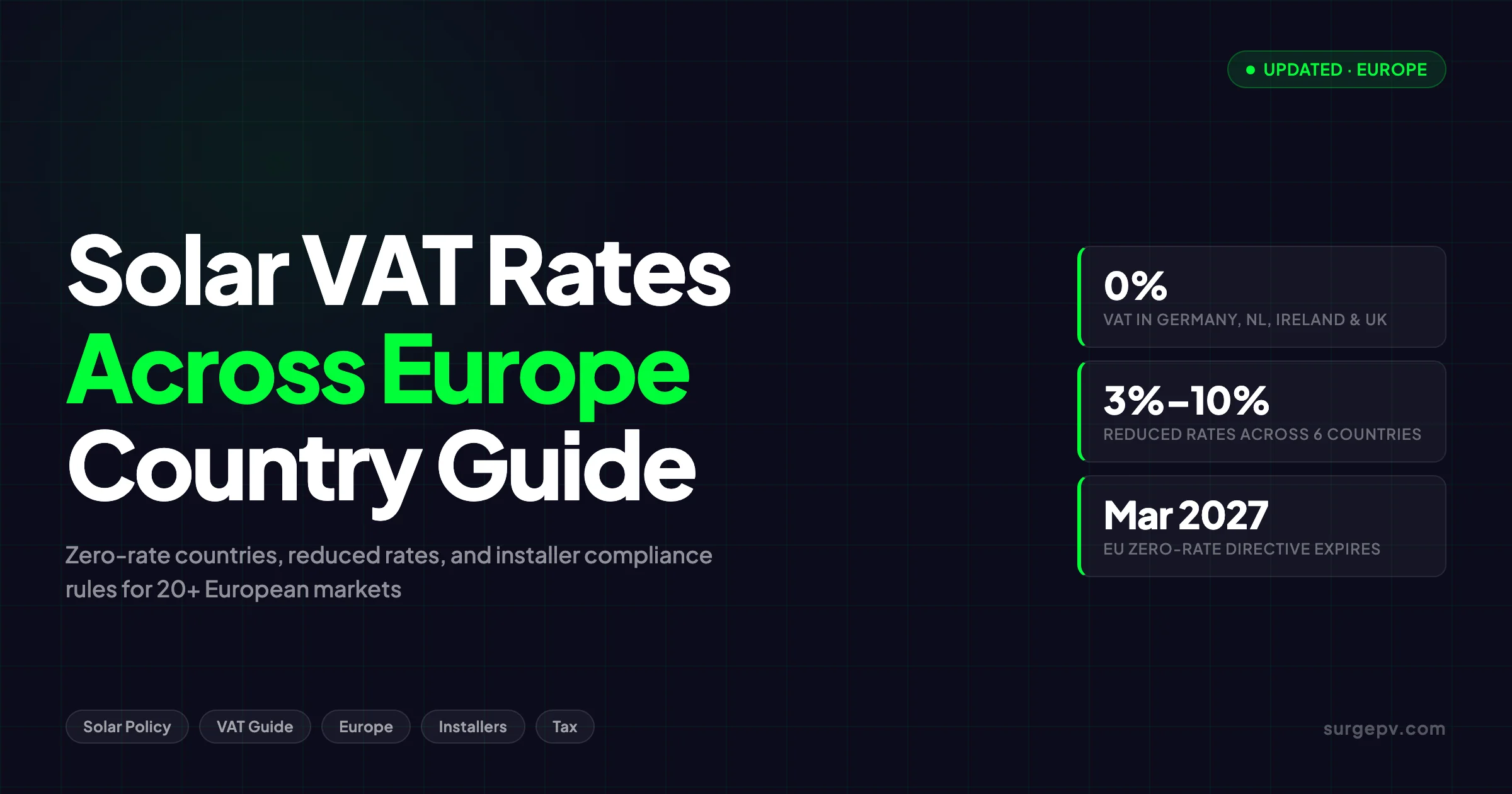
Germany, the Netherlands, Ireland, Croatia, and the UK apply 0% VAT to residential solar. France (5.5%), Belgium (6%), Poland (8%), and Italy (10%) offer reduced rates. Spain, Austria, Portugal, and the Nordic countries apply full standard rates — in Austria and Portugal’s cases after temporary zero/reduced rates expired in 2025. The EU directive allowing zero rates expires March 31, 2027.
For Italy-specific information, see Commercial Rooftop Solar Case Study Italy.
For cloud solar design software users working across multiple European markets, this divergence directly affects project economics, proposal accuracy, and invoicing compliance. A proposal tool that auto-populates VAT at the local rate is not a luxury — it is a compliance requirement.
The EU Legal Framework: Council Directive 2022/542
The legal foundation for Europe’s solar VAT reductions is Council Directive (EU) 2022/542, adopted April 5, 2022. It amended Annex III of the VAT Directive to explicitly include:
“Supply and installation of solar panels on and adjacent to private dwellings, housing, and public and other buildings used for activities in the public interest.”
Before this directive, solar panels fell into a gray zone — some member states applied reduced rates by treating solar as “energy-saving materials,” but this was legally contested. The directive eliminated that ambiguity.
The directive allows member states to apply:
- A zero rate (0%)
- A super-reduced rate (below 5%)
- A reduced rate (5% or above)
Two critical points every installer and specifier should know:
It is permissive, not mandatory. The directive enables reductions — it does not require them. Each member state passes its own legislation. The result is the patchwork of rates described in this guide.
The zero-rate window closes March 31, 2027. After that date, EU law reverts to a minimum rate of 5% for solar, unless the Commission extends the directive. Countries that applied 0% via standalone national law (Germany, Netherlands, Ireland) may be legally exposed after this date unless they re-legislate or the directive is extended.
For Installers Operating Across Borders
VAT on installation services is always charged in the country where the property is located — not where your business is registered. If you work in multiple EU markets, check whether you need local VAT registration in each country. The EU SME exemption introduced in January 2025 can reduce this burden for smaller installers.
Zero-Rate Countries: Where Solar Carries 0% VAT
Germany — 0% Since January 1, 2023
Germany’s zero rate is the most significant in Europe by volume — it covers the EU’s largest solar market. Effective January 1, 2023, panels, inverters, batteries (including retrofit storage), mounting hardware, and installation labor all attract 0% VAT when installed on: See Solar Racking Design Guide for detailed guidance.
- Single-family homes
- Apartment buildings
- Public-benefit buildings (schools, hospitals, local government buildings)
- Any building adjacent to the above
The system capacity cap is 30 kWp. Commercial installations above this threshold remain at 19% standard VAT. Electricity deliveries — feed-in payments — are also excluded and taxed at 19%.
The zero rate is enshrined in German national law (§ 12 Abs. 3 UStG), not just the EU directive. This means it does not automatically expire in March 2027 the way directive-dependent zero rates do — though it may need to be re-examined if the EU framework shifts.
For installers, this is a clean arrangement: issue an invoice showing 0% VAT on the full installation value. You retain the right to reclaim input VAT on all your purchases — panels, inverters, materials — through your regular VAT returns. This is the zero-rate vs. exemption distinction that matters operationally.
Zero Rate vs. VAT Exempt: A Critical Difference
A zero-rated supply carries 0% VAT, but the supplier retains full input VAT recovery rights on purchases made to deliver that supply. A VAT-exempt supply also charges 0% to the customer, but the supplier cannot reclaim input VAT — effectively embedding the VAT cost in their price. Germany, the Netherlands, Ireland, and the UK all use true zero rates. Always confirm this distinction when advising clients or processing your own returns.
Netherlands — 0% Since January 1, 2023
The Netherlands implemented its zero rate for solar at the same time as Germany. The rate applies to the supply and installation of solar panels on private dwellings only — residential in use, not commercial or mixed commercial premises.
Installers should retain a screenshot of the BAG (Basisregistratie Adressen en Gebouwen) land register entry confirming the residential classification of the installation address. This is the Dutch tax authority’s standard audit requirement.
Commercial installations at business premises attract 21% standard VAT. Mixed-use properties — a home with an office or a farm with an adjacent dwelling — can qualify for 0% on the residential portion.
One nuance applies to self-employed individuals who install solar on their own home: the 0% rate applies to the purchase and installation, but if they subsequently feed electricity to the grid as part of their business activity, they must account for VAT on the feed-in compensation through their VAT return.
Ireland — 0% Since May 1, 2023
Ireland introduced its 0% rate slightly later than Germany and the Netherlands, effective May 1, 2023. The rate applies to the supply and installation of solar panels under a single combined supply-and-install contract for private dwellings. Schools and mixed-use buildings with a residential component also qualify.
The single-contract requirement is the practical pinch point. If a homeowner signs a separate contract for equipment and a separate contract for labor, the 0% rate does not apply — both revert to 23% standard VAT. Installers should structure their customer agreements as a unified supply-and-install contract.
Battery storage qualifies for 0% when purchased under the same contract as the panels. A retrofit battery installed under a separate contract at a later date attracts 23%. See Adding Battery Storage Services for detailed guidance.
Croatia — 0%
Croatia applies 0% VAT to solar installations. Against its 25% standard rate, this is a significant reduction. The specific conditions — capacity limits, residential-only restriction, combined contract requirements — could not be confirmed with a primary source at the time of publication. Installers working in Croatia should verify current conditions with the Porezna uprava (Croatian Tax Administration) before invoicing at zero rate.
United Kingdom — 0% Since April 2022
The UK’s zero rate predates the EU directive and is entirely separate from it — a product of domestic law under the Energy Saving Materials (ESM) relief, not EU membership. Effective April 1, 2022, the supply and installation of solar panels for domestic properties and charities carries 0% VAT in Great Britain. Northern Ireland follows the same rate from May 2023.
The UK rate covers panels, mounting hardware, inverters, and battery storage when installed as part of the same project. Unlike some EU zero rates, the UK does not impose a system capacity cap.
The Solar Energy UK association has confirmed the current interpretation: residential solar and storage qualify for 0% as a combined supply under a single project, even when battery installation follows panel installation within a reasonable timeframe.
Reduced-Rate Countries: Solar VAT Between 3% and 10%
Luxembourg — 3% (Super-Reduced Rate)
Luxembourg applies its super-reduced rate of 3% to solar installations — the lowest solar VAT in Europe for countries that are not fully zero-rated. Against Luxembourg’s standard rate of 17% (the lowest standard VAT in the EU), this is still a meaningful reduction. Specific eligibility conditions are limited in publicly available sources; installers should verify with the Administration de l’Enregistrement, des Domaines et de la TVA.
Romania — 5%
Romania applies a 5% reduced VAT rate to solar installations, against its 19% standard rate. This places Romania alongside the minimum threshold the EU directive will allow after March 2027 — meaning Romania’s rate requires no adjustment when the zero-rate window closes.
France — 5.5% (From October 1, 2025, With Conditions)
France’s solar VAT situation is the most nuanced in Europe. As of October 1, 2025, residential solar systems can qualify for a 5.5% reduced rate, but only when all three conditions are met:
- The building is residential in use
- System capacity does not exceed 9 kWc (kilowatts-peak DC)
- The installation includes an energy management system (EMS) that synchronizes household consumption with solar generation
- The panels meet France’s low carbon footprint standard — a maximum of 530 kg CO₂ equivalent per kWp, per the PPE2 v2 decree
Systems that do not satisfy all four criteria — including all commercial installations and any residential system above 9 kWc — attract the standard 20% VAT.
Battery storage is explicitly excluded from the 5.5% rate regardless of system size. Batteries installed alongside solar are taxed at 20%.
A transitional 10% rate was available through December 31, 2025 for projects with a signed, dated quote and deposit pre-dating January 1, 2026. That window is now closed.
France: Check Your Panel Carbon Score
France’s 5.5% rate requires panels with a carbon footprint below 530 kg CO₂eq per kWp — a standard that effectively favors European-manufactured modules over some lower-cost Asian alternatives. Before quoting 5.5%, confirm the specific module’s carbon footprint certification from the manufacturer.
For solar proposal software users generating French customer quotes, the VAT field must dynamically reflect these conditions. A 10 kWc residential system with no EMS should show 20%, not 5.5%.
Belgium — 6% (For Dwellings Older Than 10 Years)
Belgium applies a permanent 6% reduced rate to solar installations on private dwellings that are more than 10 years old. This applies to panels, inverters, mounting systems, and labor when a single contractor both supplies and installs. DIY material purchases — a homeowner buying panels separately and hiring labor separately — do not qualify.
A temporary 6% rate for newer dwellings (less than 10 years old) expired December 31, 2024. As of January 1, 2025, solar on dwellings less than 10 years old reverts to 21% standard VAT.
The combined supply-and-install requirement mirrors Ireland’s — structure contracts accordingly.
Poland — 8% (For Systems Up to 50 kW)
Poland reduced its solar VAT from 23% to 8% in 2019, and the rate has remained stable since. The 8% applies to both residential and commercial solar installations, provided the system capacity does not exceed 50 kW. Above that threshold, the standard 23% rate applies.
This capacity-based cutoff is distinct from most European frameworks, which tie reduced rates to residential use rather than system size. A 45 kW commercial rooftop in Poland qualifies for 8%; a 51 kW system on the same building does not.
For installers designing systems near the 50 kW threshold, system sizing decisions carry a direct VAT implication. A solar design tools tool that models VAT treatment as part of the financial simulation makes this threshold visible at the design stage, not the invoicing stage.
Italy — 10%
Italy applies a 10% reduced VAT rate (IVA) to the supply and installation of photovoltaic systems for residential use. The rate covers panels, inverters, and goods supplied for system construction — excluding raw materials and semi-finished products purchased separately.
The installer applies 10% directly on the invoice. The customer provides a self-declaration confirming residential use and attaches relevant building permits. Italy does not impose a capacity cap for the 10% rate.
Commercial installations and non-residential properties attract Italy’s standard 22% IVA. When the energy producer sells electricity — either to the grid or under a power purchase agreement — ordinary 22% VAT applies to the energy supply transaction regardless of which VAT rate applied to the installation.
Standard-Rate Countries: No Effective Solar VAT Relief
Spain — 21% in Most Cases
Spain’s solar VAT situation is a source of significant confusion — and audit risk — for installers. The country applies its standard 21% VAT to solar installations in the overwhelming majority of cases.
A 10% reduced rate technically exists for “rehabilitation or renovation” work on residential buildings, but the conditions are so restrictive that standalone solar installations rarely qualify:
- The building must be primarily residential (at least 50% of the floor area)
- The work must be classified as rehabilitation — not a standalone system addition
- The contractor’s material contribution must not exceed 40% of the total project value
A binding ruling from Spain’s Directorate General of Taxes (DGT ruling V0303-25, confirmed in BDO Spain’s analysis) clarified in 2025 that standalone solar panel installation on an existing home does not automatically qualify as rehabilitation. Installers who have been applying 10% to standard residential installs face audit exposure — as do the homeowners who received those quotes. For Global-specific compliance details, see Global net-metering-by-country. For Global-specific compliance details, see Global solar-permitting-speed-by-country.
The practical advice for Spanish installers: default to 21% unless you have explicit documentation that all three rehabilitation conditions are met.
Austria — Reverted to 20% (April 1, 2025)
Austria had a 0% VAT rate for solar systems up to 35 kWp from January 1, 2024. The rate covered panels, inverters, batteries, mounting hardware, and installation labor. It was originally planned to run through December 2025.
Budget pressures forced early termination. The 0% rate ended April 1, 2025. Orders placed before March 6, 2025 retained the zero rate through end of 2025 under transitional provisions.
As of April 1, 2025, Austria’s solar installations attract the standard 20% VAT. This is a direct policy reversal — the same market that benefited from a cost reduction now faces one of the higher solar VAT rates in Europe.
For the solar energy in Austria market, this change meaningfully affects residential system economics. A €12,000 system now carries €2,400 in VAT rather than zero.
Portugal — Reverted to 23% (July 1, 2025)
Portugal’s trajectory mirrors Austria’s. A 6% reduced rate covering panels, inverters, batteries, cables, mounting, and labor was in effect from 2022 through June 30, 2025. No extension was announced.
From July 1, 2025, Portuguese solar VAT reverted to the standard 23% — the highest standard rate in Western Europe. The financial impact is immediate: a €7,000 residential system went from €420 in VAT to approximately €1,610. For installers who had priced projects based on the 6% rate, any delayed installations past the June 30 cutoff required contract renegotiation.
Temporary Rate Risk
Austria and Portugal both demonstrate the risk of building business models around temporary VAT reductions. When structuring long-term proposals or multi-year framework agreements, clarify whether the applicable VAT rate has a legislated expiry. If it does, your contract should specify which party bears the risk of a rate change.
Nordic Countries and Other Markets
The Nordic countries — Sweden, Denmark, Finland, and Norway — apply their standard rates to solar installations with no sector-specific reduction:
| Country | Solar VAT Rate | Standard Rate |
|---|---|---|
| Sweden | 25% | 25% |
| Denmark | 25% | 25% |
| Finland | 25.5% | 25.5% |
| Norway (non-EU) | 25% | 25% |
Norway falls outside EU VAT Directive entirely. Its solar VAT policy is domestic and not subject to the same framework.
The Czech Republic applies its standard 21% rate to solar with no confirmed reduction. Greece applies 24%. Hungary has a 27% standard rate — the highest in the EU — with unconfirmed reports of a reduced solar rate; installers should verify directly with the Nemzeti Adó- és Vámhivatal (NAV) before applying any reduced rate.
Complete Europe Solar VAT Comparison Table
| Country | Solar VAT Rate | Standard Rate | Condition | Permanent? |
|---|---|---|---|---|
| Germany | 0% | 19% | ≤30 kWp on dwellings/public buildings | Yes (national law) |
| Netherlands | 0% | 21% | Residential property only | Yes (permanent) |
| Ireland | 0% | 23% | Private dwellings; single supply-install contract | Yes (permanent) |
| Croatia | 0% | 25% | Conditions unconfirmed | Unknown |
| UK | 0% | 20% | Domestic properties and charities | Until March 2027 |
| Luxembourg | 3% | 17% | Conditions unconfirmed | Unknown |
| Romania | 5% | 19% | Not confirmed | Appears ongoing |
| France | 5.5% | 20% | ≤9 kWc, EMS required, low-carbon panels, residential | Appears permanent |
| Belgium | 6% | 21% | Dwellings >10 years old; single contractor | Permanent (older homes) |
| Poland | 8% | 23% | Systems ≤50 kW; residential and commercial | Appears permanent |
| Italy | 10% | 22% | Residential use; self-declaration required | Appears permanent |
| Spain | 21% (10% in theory) | 21% | 10% requires rehabilitation conditions — rarely met | n/a |
| Austria | 20% | 20% | Zero rate expired April 1, 2025 | No (reverted) |
| Portugal | 23% | 23% | 6% rate expired July 1, 2025 | No (reverted) |
| Sweden | 25% | 25% | No reduction | n/a |
| Denmark | 25% | 25% | No reduction | n/a |
| Finland | 25.5% | 25.5% | No reduction | n/a |
| Norway | 25% | 25% | Non-EU; no reduction | n/a |
| Greece | 24% | 24% | No confirmed reduction | n/a |
| Czech Republic | 21% | 21% | No confirmed reduction | n/a |
| Hungary | 27% | 27% | Reduced rate unconfirmed | Unknown |
The 2027 Cliff Edge: What Happens to Zero Rates After March 31, 2027
Council Directive 2022/542 explicitly permits zero VAT rates on solar until March 31, 2027. After that date, EU law reverts to requiring a minimum of 5% VAT on solar unless the directive is amended.
What this means in practice depends on how each country implemented its zero rate:
Countries that zero-rated via directive reference — these rates technically expire with the directive permission. If the directive is not extended, their domestic legislation becomes non-compliant with EU law and must be amended.
Germany and the Netherlands legislated 0% as standalone national law. This creates a legal gray area: the national law would remain on the books after March 2027, but the EU framework would not support it. The European Commission would need to act — or Germany and the Netherlands would need to legislate a minimum 5% — to resolve the conflict.
The UK is unaffected. Its zero rate sits in domestic UK law with no EU dependency. Its current statutory basis runs until March 31, 2027 in Great Britain by coincidence of the same date, but for unrelated domestic reasons.
The most likely outcome is a Commission extension before March 2027, given the EU’s stated 2030 renewable energy targets. But “most likely” is not “certain,” and installers designing or financing systems with 15-25 year economic horizons should be aware that the zero-rate assumption may not hold for the full project life.
For deeper analysis of solar subsidies across Europe, including feed-in tariffs, grants, and net metering rules by country, see the full tracker.
Design Solar Proposals Across Multiple European Markets
SurgePV’s proposal engine lets you generate locally accurate proposals — including correct VAT rates — for projects across 50+ countries. No manual rate lookup required.
Book a DemoNo commitment required · 20 minutes · Live project walkthrough
For a direct comparison, see Arka 360 vs SurgePV.
Installer Implications: How VAT Rates Affect Your Business
Invoicing in Zero-Rate Countries
In Germany, the Netherlands, Ireland, and Croatia, the invoicing process is straightforward but requires one important distinction: you issue a zero-rated invoice, not an exempt invoice.
A zero-rated invoice shows:
- The full net value of the supply
- A VAT rate of 0%
- The resulting VAT amount: €0
An exempt invoice would look similar to the customer, but carries a different meaning for your business: VAT-exempt suppliers cannot recover input VAT on purchases made to deliver the exempt supply. Zero-rated suppliers can. This distinction has direct cash flow implications when you’re buying panels and equipment at 19-21% from your suppliers.
Germany: Standard invoice format. Enter 0% in the VAT line. No special declaration form required from the customer. For systems above 30 kWp, revert to 19%.
Netherlands: Retain a BAG register screenshot confirming the installation address is residential. The Dutch tax authority (Belastingdienst) uses this in VAT audits.
Ireland: Ensure the supply-and-install contract is a single document covering both equipment and labor. Separate contracts disqualify the 0% rate.
Cross-Border Installation Rules
This is the point most installers get wrong. VAT on physical installation services is charged based on the location of the property — not the location of your business.
If you are a German solar installer doing a project in France, French VAT rules apply. Your German zero rate is irrelevant. You need to charge French VAT (20%, or 5.5% if the system qualifies) and you may need a French VAT registration to do so legally.
The EU’s standard B2B reverse charge mechanism applies to cross-border service transactions, but only when your customer is a VAT-registered business. In residential installations, the customer is typically a private individual — not VAT-registered — which means reverse charge does not apply and local VAT registration becomes necessary.
The EU’s new SME VAT exemption scheme, effective January 1, 2025, lets small businesses registered in one EU member state access the VAT exemption threshold of another member state where they operate. This reduces the registration burden for smaller cross-border operators, but does not eliminate it for businesses above those thresholds.
B2B vs. B2C: Different Rules Apply
The reduced and zero rates available across Europe are almost universally targeted at B2C residential supply. The standard rate applies to commercial, B2B solar installations in virtually every European jurisdiction.
| Scenario | VAT Treatment |
|---|---|
| Installer buys panels from supplier (for residential job) | Standard rate from supplier; installer reclaims via input VAT |
| Homeowner in DE, NL, IE, HR receives installation | 0% on full invoice |
| Business premises solar (all countries) | Standard rate — no reduced rate for commercial B2B |
| Cross-border supply of panels only (goods, no installation) | EU reverse charge — buyer accounts for VAT |
| Cross-border installation service for private homeowner | VAT of the country where property is located |
Cash Flow and Pricing Implications
For installers operating in zero-rate markets (Germany, Netherlands, Ireland), the VAT situation is operationally favorable:
- You charge customers 0% VAT
- You reclaim 19-23% input VAT on all purchases — panels, inverters, cables, sub-contracted labor
- This produces a regular VAT refund position, requiring timely submission of VAT returns
In markets with a reduced rate that is still below your input VAT rate — for example, Belgium at 6% while your supply chain VAT runs at 21% — you are in a partial refund position. The difference between input and output VAT is recovered through returns.
In standard-rate markets (Spain, Greece, Sweden), VAT is cost-neutral for VAT-registered businesses but significantly impacts the final price for private homeowners who cannot reclaim it.
When modeling project economics, use the generation and financial tool to ensure VAT assumptions are reflected accurately in payback and ROI projections. A German homeowner’s 25-year NPV looks different from a Swedish homeowner’s when you correctly account for the VAT delta at purchase.
Common VAT Mistakes Solar Installers Make
Applying the 10% Rate in Spain Without Documentation
Spanish installers frequently quote 10% VAT on residential solar under the assumption that all home installations qualify for the renovation reduced rate. They do not. The three conditions — residential building, rehabilitation classification, materials cost under 40% of total — must all be met and documented. Applying 10% without this documentation creates audit liability for both installer and customer.
Separating Equipment and Labor Contracts in Ireland
The 0% rate in Ireland requires a single supply-and-install contract. Installers who structure their business model with a separate equipment sale and a separate installation service contract lose the 0% qualification on both. Restructure customer agreements into a single combined contract before the first invoice.
Missing the Netherlands BAG Requirement
Dutch installers know the 0% rate applies to residential properties, but some omit the BAG register documentation during busy periods. The Belastingdienst will request this evidence in an audit. Build BAG record retrieval into your job intake process.
Invoicing Commercial Clients at Residential Rates
In every European jurisdiction offering a reduced solar rate, the reduction applies to residential installations only (with the exception of Poland’s capacity-based threshold, which covers both). Charging a commercial client 0% or a reduced rate because they are on a trade account is incorrect — standard rate applies, and the customer cannot reclaim a reduced rate that was incorrectly applied if later challenged.
Not Monitoring Temporary Rate Expiry Dates
Austria and Portugal both had temporary zero or reduced rates that expired in 2025. Installers with multi-month project pipelines that extended past those expiry dates needed to renegotiate contracts or absorb the VAT increase. Monitor published sunset dates and build contractual rate-change clauses into long-running agreements.
How Solar VAT Affects Installation Pricing Across Markets
The VAT rate affects both the sticker price visible to a homeowner and the competitive dynamics of the market. Where VAT is zero, the installed system cost is lower by exactly the amount that would have been collected — 19-25% of the project value in most markets.
Consider a standard 8 kWp residential system with a net installed cost of €10,000:
| Country | VAT Rate | Total Customer Cost | VAT Amount |
|---|---|---|---|
| Germany | 0% | €10,000 | €0 |
| Netherlands | 0% | €10,000 | €0 |
| Ireland | 0% | €10,000 | €0 |
| Poland | 8% | €10,800 | €800 |
| Italy | 10% | €11,000 | €1,000 |
| Austria | 20% | €12,000 | €2,000 |
| Spain | 21% | €12,100 | €2,100 |
| Portugal | 23% | €12,300 | €2,300 |
| Sweden | 25% | €12,500 | €2,500 |
The €2,500 gap between a German homeowner and a Swedish homeowner is not a product quality difference — it is a policy difference. For an installer working across both markets, proposals should reflect local VAT accurately rather than using a blanket rate.
This is also relevant when comparing cross-border competition. In markets bordering Germany — Austria, Poland, Czech Republic — German installers competing for jobs across the border cannot apply German VAT rules. The installation location determines the applicable rate.
For current solar installation cost breakdowns across European markets, including VAT treatment in the cost components, see the dedicated analysis.
Pro Tip: Build VAT Into Your Proposal Template
Solar proposals in multi-country operations should clearly separate net price, VAT rate applied, VAT amount, and gross price. This prevents disputes when rates change mid-project and supports customers in understanding the true cost components. A customer-ready solar proposals that auto-populates VAT by project country eliminates manual errors in this field.
Country-Specific Compliance Checklist for Installers
Germany
- System at or below 30 kWp
- Installation on an eligible building (dwelling, apartment, public-benefit building)
- Invoice shows 0% VAT rate (not exempt notation)
- Input VAT on purchases claimed through regular VAT return
Netherlands
- Installation address confirmed as residential via BAG register
- BAG screenshot retained in project file
- Invoice shows 0% VAT rate with residential address
- Commercial addresses defaulted to 21%
Ireland
- Single supply-and-install contract in place
- Property is a private dwelling or qualifying school/mixed-use building
- Batteries included in the same contract (if applicable)
- Invoice shows 0% on full contract value
France
- System ≤9 kWc
- EMS (energy management system) specified in scope
- Module carbon footprint certification obtained (≤530 kg CO₂eq/kWp)
- Customer building confirmed as residential
- Battery storage invoiced separately at 20%
Belgium
- Customer dwelling confirmed as more than 10 years old
- Single contractor for supply and installation
- Invoice shows 6% rate
Poland
- System capacity at or below 50 kW
- Invoice shows 8% rate
Italy
- Customer self-declaration of residential use obtained
- Building permits attached to project file
- Invoice shows 10% IVA
Spain
- Default to 21% unless all three rehabilitation conditions documented
- Legal opinion obtained if applying 10%
Conclusion
Europe’s solar VAT map in 2026 divides into three clear tiers. Germany, the Netherlands, Ireland, Croatia, and the UK have eliminated VAT on residential solar — making cost parity with grid electricity achievable years earlier than in markets where 20-25% VAT sits on top of every system. A second tier — France, Belgium, Poland, Italy, Romania, Luxembourg — applies reduced rates that provide meaningful relief without reaching zero. The third tier — Spain, Sweden, Denmark, Finland, Greece, and the Czech Republic — applies standard rates with no effective reduction.
Three things every solar installer and project developer should do now:
- Audit your invoicing templates across each market you operate in. Verify the VAT rate, the invoice notation (zero-rated, not exempt), and the documentation requirements for each country.
- Monitor the March 2027 deadline. EU-wide zero rates expire then. Germany and the Netherlands may be protected by national law, but others are not. Build rate-change clauses into contracts covering project timelines that extend past that date.
- Model VAT explicitly in proposal economics. A 25% VAT adds €2,500 to a €10,000 system — this affects payback period and ROI calculations materially. Proposals that present pre-VAT costs without flagging the applicable rate are misleading customers.
For installers working across multiple European markets, solar software suite that handles country-specific VAT logic at the proposal stage removes a significant source of invoicing errors and compliance risk.
Frequently Asked Questions
Which European countries have 0% VAT on solar panels?
Germany, the Netherlands, Ireland, and Croatia all apply 0% VAT to residential solar installations. The UK — outside the EU — also applies 0% under its domestic Energy Saving Materials relief. Each country has specific conditions: Germany caps the zero rate at 30 kWp, the Netherlands limits it to residential properties, and Ireland requires a combined supply-and-install contract.
Does Germany charge VAT on solar panels?
No. Germany applies 0% VAT to the supply and installation of solar panels on homes, apartment buildings, and public-benefit buildings, provided the system does not exceed 30 kWp. The zero rate covers panels, inverters, batteries, mounting hardware, and installation labor. It has been in force since January 1, 2023 and is permanent under German national law.
Is there VAT on solar panels in the UK?
The UK applies 0% VAT on the supply and installation of solar panels for domestic properties and charities. This zero rate sits under the Energy Saving Materials relief in UK domestic law — separate from the EU VAT Directive — and has been in force since April 2022. It covers both panels and battery storage when installed as part of the same project.
What is the EU VAT Directive for solar panels?
Council Directive 2022/542, adopted in April 2022, amended the EU VAT Directive’s Annex III to explicitly include the supply and installation of solar panels on private dwellings, housing, and public buildings. This allows — but does not require — EU member states to apply a 0% or reduced VAT rate on solar. The permission to apply a zero rate expires March 31, 2027 unless the directive is extended.
What happened to Portugal’s reduced solar VAT rate?
Portugal applied a 6% reduced VAT rate on solar panels, inverters, batteries, cables, mounting, and installation labor from 2022 through June 30, 2025. The temporary rate expired on July 1, 2025 with no extension announced. Solar VAT in Portugal reverted to the standard 23% rate — increasing the VAT cost on a €7,000 system from around €420 to over €1,600.
Can I install solar panels in another EU country and apply the zero VAT rate?
VAT on physical installation services is charged in the country where the property is located — not where the installer is registered. If you’re an installer from Germany working on a project in France, French VAT rules apply. This may require local VAT registration in the country where you’re working. The EU SME exemption (active from January 2025) can reduce compliance burden for smaller cross-border operators.
What is the 2027 solar VAT deadline?
Council Directive 2022/542 allows EU member states to apply a 0% VAT rate on solar until March 31, 2027. After that date, the minimum VAT rate on solar under EU law reverts to 5% — unless the European Commission extends or amends the directive before then. Countries that legislated 0% via standalone national law (Germany, Netherlands) face a legal gray area after March 2027 if they do not adjust their domestic legislation.
How should solar installers invoice customers in zero-rate VAT countries?
In zero-rate countries like Germany, the Netherlands, and Ireland, installers issue a standard invoice showing 0% VAT — not a VAT-exempt invoice. The distinction matters: zero-rated suppliers retain the right to reclaim input VAT on their purchases (panels, equipment, materials), whereas VAT-exempt businesses cannot. In the Netherlands, retain a BAG land register screenshot as proof the installation address is residential. In Ireland, the supply and installation must be covered under a single contract.
Where this fits
This article is part of SurgePV's Solar Incentives & Policy hub, which works through the topic from first principles to the decisions a project team actually has to make.

