

Answer
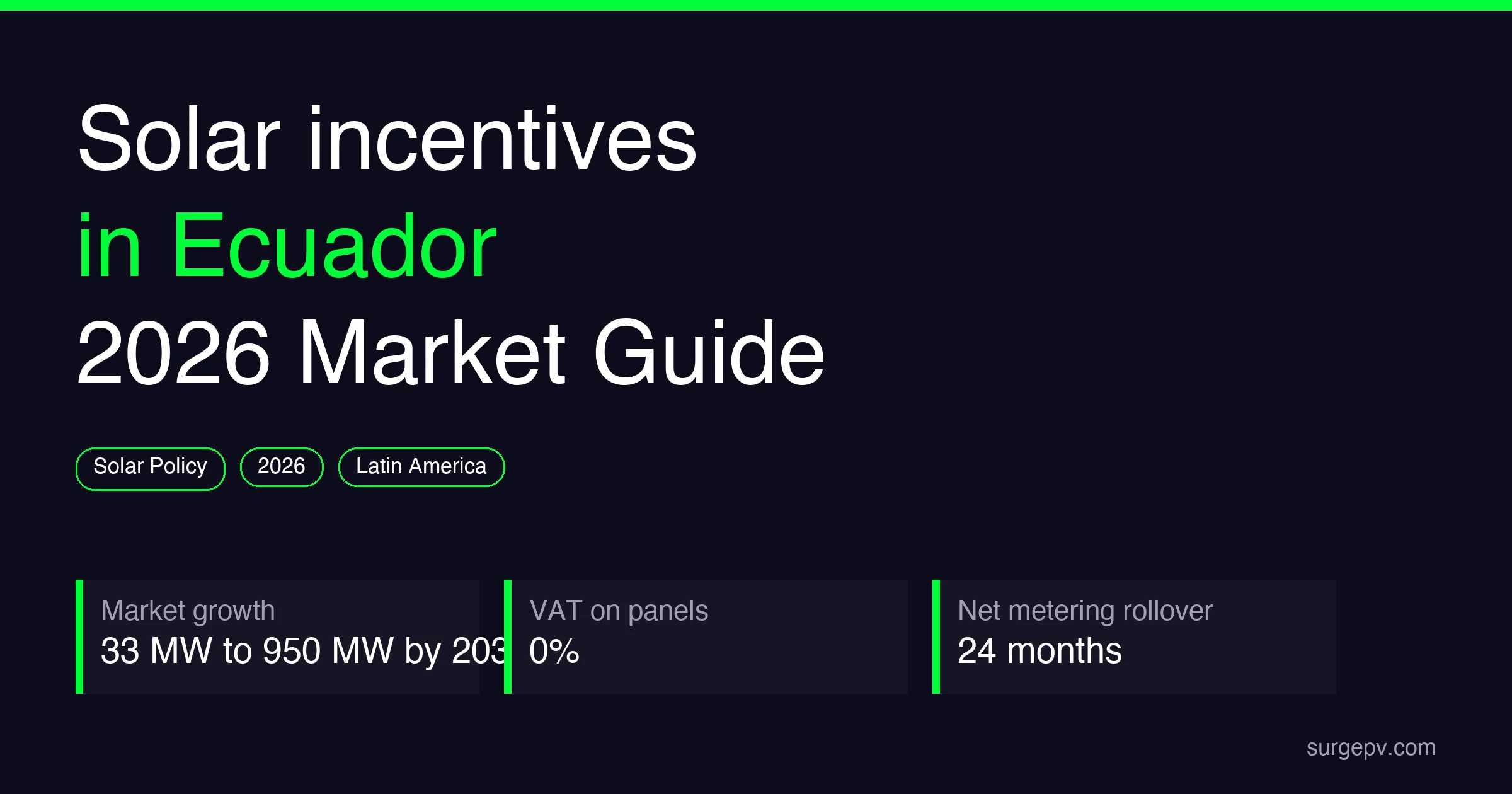
Ecuador's 2026 solar incentives include 0% VAT on solar panels, zero import duty on modules, a 100% additional depreciation deduction for corporate solar assets, net metering with a 24-month rollover for regulated consumers under ARCERNNR-008/23, and a private-project threshold raised to 100 MW. There is no direct residential tax credit; value comes from tax relief and bill savings.
Ecuador’s solar market is at a turning point. The 2024 drought-driven blackouts showed the risks of relying on hydropower for more than 70% of electricity. The government responded by rewriting the rules for private generation. The October 2024 Organic Law to Promote Private Initiative in Energy Generation raised the private project threshold to 100 MW. June 2025’s Executive Decree 32 then ordered large consumers to install their own generation by late 2026. At the same time, installed solar capacity is expected to grow from 33 MW in 2025 to 950 MW by 2030, a 95.81% CAGR, according to Mordor Intelligence (2025).
For installers, EPCs, and property owners, the opportunity is real but the incentive stack is different from North America or Europe. Ecuador does not hand out upfront rebates. The value is in tax exemptions, accelerated depreciation, net metering credits, and a regulatory window that now lets private developers build faster.
This guide explains the 2026 incentive framework, how net metering works, who qualifies for tax benefits, and the mistakes that waste money. For regional context, see our global solar market forecast and solar payback period by country. If you are designing systems or writing proposals for Ecuadorian clients, SurgePV’s solar design software models local tariffs, self-consumption ratios, and net metering rules. You can then generate solar proposals in minutes, or check pricing and book a demo.
Quick Answer
Ecuador’s 2026 solar incentives include 0% VAT on solar panels, zero import duty on modules, a 100% additional depreciation deduction for corporate solar assets, net metering with a 24-month rollover for regulated consumers under ARCERNNR-008/23, and a private-project threshold raised to 100 MW.
TL;DR — Solar Incentives in Ecuador 2026
Active mechanisms: 0% VAT on solar panels, zero import duty on PV modules, 100% additional depreciation for companies, five-year income tax exemption for new renewable investments outside Quito and Guayaquil, net metering with a 24-month rollover under ARCERNNR-008/23, and private projects up to 100 MW without competitive bidding. The biggest risk is oversizing for export, because credits reset and surplus is not paid in cash.
In this guide:
- Latest 2026 status of every active Ecuadorian solar incentive
- Why the 2024 blackouts rewrote the market rules
- The legal foundation: LOSPEE, ARCERNNR-008/23, and the 100 MW reform
- How net metering and self-supply work for regulated consumers
- Tax incentives: VAT, import duty, depreciation, and income tax relief
- Commercial, industrial, and utility-scale routes
- Regional differences and where the market is hottest
- Three real-world stacking scenarios with payback impact
- Common mistakes and how to avoid them
Latest Updates: Ecuador Solar Incentives 2026
The Ecuadorian policy environment changed quickly after the 2024 energy crisis. The government passed a new private-generation law, tightened the rules for large consumers, and expanded the distributed generation cap. Solar is now treated as a strategic option rather than a niche technology.
Ecuador Solar Incentive Status — June 2026
| Incentive | Type | Status | Key Terms |
|---|---|---|---|
| 0% VAT on solar panels | Sales tax relief | Active | Applies to panels and certain solar accessories under the Internal Tax Regime Law |
| Zero import duty on PV modules | Customs relief | Active | Modules generally enter at 0% under Andean tariff treatment for capital goods |
| 100% additional depreciation | Income tax deduction | Active | Additional deduction for machinery and equipment used in renewable energy generation |
| Five-year income tax exemption | Income tax holiday | Active | For new renewable energy investments outside Quito and Guayaquil |
| Net metering for regulated consumers | Surplus credit | Active | 24-month rollover under ARCERNNR-008/23 |
| Distributed generation cap | Regulatory | Raised to 2 MW | Up to 2 MW for grid injection; over 2 MW for non-injected self-supply |
| Private project threshold | Regulatory | Raised to 100 MW | No competitive bidding required below 100 MW |
| Large-consumer self-generation mandate | Regulatory | Active | High-voltage consumers must install generation by December 18, 2026 under Decree 32 |
Key Changes Since 2024
October 2024 — Organic Law to Promote Private Initiative in Energy Generation: The reform raised the private renewable project threshold from 50 MW to 100 MW and removed the requirement for competitive bidding below that cap. The goal was to speed up investment after the drought revealed a generation deficit. Projects under 100 MW can now proceed with direct permitting, cutting licensing timelines by several months.
November 2023 — ARCERNNR-008/23: The regulator replaced the 2021 distributed generation regulation and raised the cap from 1 MW to 2 MW for systems that inject surplus into the grid. For systems that do not export, capacity can exceed 2 MW. The rule introduced clearer metering, billing, and 24-month rollover provisions.
June 2025 — Executive Decree 32: High-voltage consumers must install generation systems to cover their own demand until December 18, 2026. Surplus can be sold to the grid under ARCONEL rules. This created an immediate C&I solar mandate for factories, mines, and large commercial users.
April 2025 — solar LCOE falls below hydro peaking: Average global module prices fell to roughly USD 0.10 per W in 2024, pushing Ecuador’s solar levelized cost of energy toward USD 40 per MWh, according to Mordor Intelligence (2025). That undercuts new hydro peaking plants priced at USD 60-80 per MWh.
Key Takeaway
2026 is the year Ecuador moved from auction-only solar to a multi-track market. The most reliable incentives are VAT relief, import duty exemption, and depreciation, because regulatory timelines for larger projects remain uncertain.
Why Ecuador’s Solar Market Matters in 2026
Ecuador has some of the most consistent solar resources in the world. Its equatorial location gives roughly 12 hours of daylight year-round, and fixed-tilt PV plants achieve capacity factors of 16-17%, with tracking systems reaching up to 21%, according to Mordor Intelligence (2025). Southern highlands and coastal Manabí see irradiation above 5.0 kWh/m²/day.
Market Size and Targets
The Ecuador solar market is forecast to grow from 33 MW in 2025 to 950 MW by 2030, a 95.81% CAGR, according to Mordor Intelligence (2025). PV technology is expected to capture 100% of that growth, with utility-scale assets leading after 2026.
In 2024, Ecuador’s total generation capacity was 9,255 MW, of which 5,686 MW was renewable and only 29 MW was photovoltaic, according to Trade.gov (2025). Hydro dominated at 5,419 MW. The 2024 drought proved that dependence is dangerous: blackouts reached 14 hours per day and caused roughly USD 2 billion in economic losses.
The Hydro Dependency Driver
Hydro generated 71.68% of electricity in 2023, but output drops 30-40% in dry periods, according to Mordor Intelligence (2025). During deficits, the system relies on diesel and gas peaking plants at USD 120-150 per MWh, plus imported power from Colombia. Solar, with an LCOE near USD 40 per MWh, is now the cheaper marginal source.
For solar professionals, the pitch is no longer just environmental. It is about energy security and lower marginal cost. A well-modeled solar financial modeling can show clients exactly how solar reduces exposure to volatile spot prices and dry-season rationing.
The Legal Foundation: LOSPEE, ARCERNNR-008/23, and Private Generation Reform
Ecuador’s electricity sector is governed by the Organic Law of the Public Electric Power Service (LOSPEE). The 2024 reform and subsequent decrees created three main participation routes for solar.
Generation Routes in 2026
| Route | Size | Grid Connection | Typical Use |
|---|---|---|---|
| Distributed self-supply (regulated consumers) | Up to 2 MW injected | Distribution network | Residential, commercial, and small industrial rooftops |
| Self-supply without injection | Over 2 MW | Behind-the-meter or private network | Large factories, mines, industrial parks |
| Private generation project | Up to 100 MW without bidding | Transmission or distribution | Utility-scale solar parks |
| Wholesale / auctioned project | Any size | National Interconnected System | Large solar parks under CELEC EP PPAs |
Distributed Generation in Practice
Regulation ARCERNNR-008/23 covers Sistemas de Generación Distribuida para Autoabastecimiento (SGDA) for regulated consumers. Key requirements include:
- The system must use a non-conventional renewable source, such as solar.
- Nominal power is capped at the consumer’s maximum recorded demand.
- The owner must obtain a feasibility certificate from the distribution company and an authorization certificate from ARCONEL.
- The SGDA can be owned by the consumer or a third party.
- Commercialization of the electricity generated is prohibited; surplus can only be credited through net metering.
For installers, the practical implication is that most residential and commercial projects fall under a clear permitting route as long as they stay below 2 MW and match the consumer’s recorded demand.
Net Metering and Self-Supply for Regulated Consumers
ARCONEL, the electricity regulator, manages net metering through the distribution companies. The compensation rules are set out in ARCERNNR-008/23.
How Net Metering Works
Under the regulation:
- Exported kilowatt-hours are credited against imported kilowatt-hours.
- Credits roll forward month to month for 24 months.
- At the end of the 24-month period, any unused credits reset to zero. The distributor does not pay cash for them.
- The customer continues to pay fixed charges, demand charges, and commercialization fees.
- A bidirectional meter records imports and exports separately.
This 24-month rollover is more generous than an annual true-up, but it is still not a cash payment. A system that produces a large surplus in year one and then underproduces in year two can use the banked credits, but a system that chronically overproduces simply donates the excess to the grid.
Sizing Rule
The standard design rule in Ecuador is the same as in other net-metering markets: size for self-consumption, not maximum generation. A self-consumption ratio of 75-90% is usually optimal. For solar professionals, this means modeling hourly load profiles carefully. SurgePV’s shadow analysis and generation tools can match production to consumption and avoid the export trap.
Tax and Fiscal Incentives
Ecuador does not offer a direct federal tax credit for homeowners who buy solar panels. The real value lies in VAT relief, import duty exemption, accelerated depreciation, and targeted income tax holidays.
Value-Added Tax (IVA) Exemption
Ecuador’s Internal Tax Regime Law applies a 0% VAT rate to solar panels and plants for wastewater treatment, according to WIPO Lex (2019). This applies to both local transfers and imports. The benefit is immediate at the point of purchase, but buyers should confirm that the invoice correctly classifies the equipment. Residential customers should ask whether the quoted price already reflects the 0% rate.
Import Duty Relief
Photovoltaic modules generally enter Ecuador at zero import duty under the Andean Community tariff treatment for capital goods and renewable energy equipment, according to Auxadi (2021). Inverters, batteries, and balance-of-system components may still attract duties or the standard 15% VAT, so the total landed cost depends on the bill of materials.
Additional 100% Depreciation
Companies can deduct an additional 100% of the depreciation and amortization corresponding to machinery, equipment, and technologies used to generate energy from renewable sources, according to Lexology (2023). This is not accelerated depreciation in the accounting sense; it is an additional deduction for income tax purposes. The deduction is capped at 5% of total income and requires authorization from the tax authority.
For a company in the 25% corporate tax bracket, a USD 100,000 solar investment can generate roughly USD 25,000 of tax relief through this deduction alone, spread over the depreciation life of the asset.
Five-Year Income Tax Exemption
New productive investments in renewable energy located outside the urban areas of Quito and Guayaquil can qualify for a five-year income tax exemption, according to Lexology (2023). Investments inside those two cities may qualify for a shorter period. This exemption requires the investment to be genuinely new and productive, and to receive approval from the competent authority.
Financing and Other Incentives
Public and private banks can offer preferential financial products for renewable energy self-consumption systems, and the Inter-American Development Bank’s DREX platform helps SMEs finance 50-500 kW systems. These financing channels are not subsidies, but they reduce the weighted average cost of capital and improve project economics.
Commercial, Industrial, and Utility-Scale Routes
C&I and utility-scale solar operate under different rules than residential rooftop. The economics are driven by avoided cost, corporate PPAs, and regulatory dispatch rather than net metering.
Self-Supply for Large Consumers
Non-regulated consumers, such as large industrial users, can install SGDA systems for self-supply. A separate regulation, ARCERNNR-006/23, governs these projects. Key features include:
- Systems can exceed 2 MW if they do not inject surplus into the grid.
- The SGDA must be connected to the consumer’s internal network.
- Electricity generated cannot be sold commercially, but affiliated loads under the same entity can be served.
- A feasibility certificate and ARCONEL authorization are required.
Decree 32 makes this route urgent. High-voltage consumers must install generation to cover their demand by December 18, 2026. For many factories and mines, the fastest compliance path is a behind-the-meter solar array.
Utility-Scale Projects and Auctions
The Ministry of Energy and Mines has promoted utility-scale solar through tenders and direct permitting. The 200 MW El Aromo project was awarded under a 310 MW tender, and the ministry identified seven sites totaling 1.58 GW by January 2024, according to Mordor Intelligence (2025). State utility CELEC EP anchors most PPAs.
The October 2024 reform allows private developers to build projects up to 100 MW without competitive bidding. This has attracted independent producers to provinces with adequate transmission, particularly Manabí, Loja, and Guayas.
Corporate Power Purchase Agreements
Corporate PPAs are becoming more common with nearshoring manufacturers and agro-exporters. These contracts fix or index a price per kWh, keep the project off the buyer’s balance sheet, and do not depend on net metering. They are especially attractive for exporters in the banana, cacao, and shrimp sectors that need stable power costs.
For C&I installers, the design priorities are load profiling, demand-charge analysis, and grid-code compliance. SurgePV’s Clara AI and solar design software can automate these workflows for Ecuadorian projects.
Regional Differences and Where the Market Is Hottest
Solar development in Ecuador is concentrated in provinces with strong irradiation and available transmission.
Loja
Loja posts the highest irradiation in the country, averaging 5.7 kWh/m²/day, according to Mordor Intelligence (2025). CELEC GENSUR launched the 200 MW La Ceiba project here in January 2025. The province is expected to lead installed capacity through 2030.
Manabí
Manabí hosts the 200 MW El Aromo plant near Portoviejo. Flat coastal terrain simplifies construction, and the province has better grid access than the southern highlands.
Guayas
Guayas is home to Guayaquil and roughly 35% of national demand. It added 150 MW of distributed projects under earlier regulations and offers ample commercial rooftop space. C&I systems here can achieve paybacks of 5-7 years against retail tariffs near USD 0.156 per kWh, according to Mordor Intelligence (2025).
Imbabura and Carchi
These northern highland provinces have irradiation above 4.8 kWh/m²/day but weak 230 kV transmission. TRANSELECTRIC plans USD 150 million in upgrades by 2027, but several corridors will not be energized before 2028.
Amazon and Galápagos
Off-grid PV-diesel microgrids power schools, clinics, and remote communities. The rural electrification program deployed 60 MW of self-consumption capacity by mid-2025 and cut diesel use by up to 70%, according to Mordor Intelligence (2025). The Galápagos Islands target 100% renewable electricity by 2030.
Practical Tip
Always model the local tariff, not a national average. Residential tariffs are heavily subsidized, averaging roughly USD 0.097 per kWh, while business tariffs average USD 0.095 per kWh, according to Global Petrol Prices (2025). The same 10 kW system can have very different paybacks in Guayaquil, Quito, and a rural zone.
How to Stack Incentives: Three Real-World Scenarios
The following examples are illustrative, based on typical 2026 costs and incentive rates. Actual figures depend on location, tariff, installer quote, and whether the customer is an individual or a business.
Scenario 1 — 5 kW Residential Rooftop, Quito
| Item | Amount |
|---|---|
| Gross installed cost | USD 7,500 |
| 0% VAT benefit on panels | −USD 450 |
| Net cost | USD 7,050 |
| Annual bill savings (subsidized tariff) | USD 650 |
| Payback | 10.8 years |
Subsidized residential tariffs make rooftop solar slower to pay back than in many Latin American markets. The value is mainly bill savings and protection against future tariff reform.
Scenario 2 — 250 kW Commercial Rooftop, Guayaquil
| Item | Amount |
|---|---|
| Gross installed cost | USD 187,500 |
| 0% VAT and zero duty on modules | −USD 18,750 |
| 100% additional depreciation benefit (25% rate) | −USD 42,188 |
| Net effective cost | USD 126,562 |
| Annual avoided electricity | USD 24,700 |
| Payback | 5.1 years |
The depreciation benefit and higher commercial tariff make C&I solar the sweet spot in Ecuador today.
Scenario 3 — 50 MW Utility-Scale Solar Park, Manabí
| Item | Amount |
|---|---|
| Gross CAPEX | USD 42.5 million |
| Module duty and VAT relief | −USD 4.3 million |
| LCOE with incentives | ~USD 0.040/kWh |
| PPA price | USD 0.055/kWh |
| Five-year income tax exemption benefit | +USD 3-5 million NPV |
| Project IRR | 13-16% |
Utility-scale economics depend heavily on PPA terms, grid connection cost, and permitting timelines. The 100 MW threshold removes the auction bottleneck but environmental and indigenous consultation can still add 18 months or more.
Common Mistakes and Misconceptions
Even experienced installers lose money in Ecuador by misunderstanding how incentives interact. Here are the most common errors.
Oversizing for Export
The single most expensive mistake is designing a system that exports more than the customer consumes. Net metering credits reset after 24 months, and surplus energy is not paid in cash. Every exported kWh is worth less than a kWh consumed on site. Size for self-consumption first.
Assuming a U.S.-Style Tax Credit
Many international installers pitch solar by referencing the U.S. Investment Tax Credit. Ecuador does not have a comparable residential credit. The value is in VAT relief, business deductibility, and bill savings.
Ignoring the 24-Month Rollover
A two-year rollover is generous, but it is not indefinite. Credits that are not used within 24 months are lost. Model monthly production and consumption, not just annual totals.
Mixing Up Regulated and Non-Regulated Rules
Residential and small commercial customers fall under ARCERNNR-008/23. Large industrial and mining clients fall under ARCERNNR-006/23. The metering, permitting, and compensation rules are different. Applying the wrong regulation can delay interconnection for months.
Underestimating Permitting Time
Environmental impact assessments and, where applicable, prior consultation under ILO 169 can extend utility-scale timelines beyond 18 months, according to Mordor Intelligence (2025). Build realistic contingencies into contracts.
Forgetting Balance-of-System Taxes
Panels may enter at 0% VAT and zero duty, but inverters, batteries, cables, and mounting can attract the standard 15% VAT and applicable duties. A proposal that assumes the entire system is tax-free will understate real cost.
Conclusion
Ecuador’s solar incentive framework in 2026 is a stack built from VAT relief, import duty exemption, corporate depreciation, income tax holidays, net metering, and a new private-generation threshold. None of these mechanisms is as simple as a single upfront rebate, but combined they make solar the lowest-cost marginal generation option in much of the country.
For solar professionals, the competitive edge is no longer just installation price. It is the ability to model the right compensation scheme, size for self-consumption, and stack tax benefits correctly. SurgePV’s design and financial tools can automate that workflow for Ecuadorian projects.
Three actions to take now:
- Verify the customer category before sizing — regulated and non-regulated consumers use different regulations and compensation rules.
- Stack tax benefits correctly — businesses should claim the 100% additional depreciation; all buyers should confirm 0% VAT treatment on panels.
- Size for self-consumption — exported energy in Ecuador is credited, not paid, and credits expire after 24 months.
For installers scaling in Latin America, our guide for solar installers covers proposal automation and compliance workflows.
Frequently Asked Questions
What solar incentives are available in Ecuador in 2026?
Ecuador’s 2026 solar incentives include a 0% VAT rate on solar panels, zero import duty on photovoltaic modules, a 100% additional depreciation deduction for corporate solar equipment, net metering with a 24-month energy rollover under ARCERNNR-008/23, and a private renewable project threshold raised to 100 MW.
Does Ecuador have a federal tax credit for residential solar?
No. Ecuador does not offer a direct residential tax credit similar to the U.S. Investment Tax Credit. Homeowners benefit mainly from 0% VAT on panels, bill savings through net metering, and protection from future tariff increases.
How does net metering work in Ecuador?
Under ARCERNNR-008/23, regulated consumers with distributed self-supply systems can offset imported kilowatt-hours with exported kilowatt-hours. Unused credits roll forward for 24 months and then reset to zero, so systems are usually sized to match on-site consumption.
What is the maximum size for distributed generation in Ecuador?
Regulation ARCERNNR-008/23 allows distributed self-supply systems up to 2 MW when injecting surplus into the grid, and over 2 MW for self-consumption that is not injected. Systems must be approved by the distribution company and ARCONEL.
Are solar panels exempt from VAT and import duty in Ecuador?
Yes. Ecuador’s Internal Tax Regime Law applies a 0% VAT rate to solar panels, and customs duties on photovoltaic modules are generally zero under the Andean tariff framework for capital goods. Inverters, batteries, and balance-of-system equipment may still attract VAT or duty.
Can commercial and industrial projects access solar incentives in Ecuador?
Yes. C&I and utility-scale projects benefit from 0% VAT and zero duty on modules, 100% additional depreciation, a five-year income tax exemption for new renewable investments outside Quito and Guayaquil, and the ability to sell surplus under regulated PPAs or self-supply contracts.
What is the typical solar payback period in Ecuador?
Well-designed commercial and industrial systems can pay back in 5 to 7 years, while residential payback is often longer because subsidized household tariffs reduce the value of avoided grid purchases. Payback improves sharply if subsidies are removed or self-consumption is high.
What is the most common mistake when sizing a solar system in Ecuador?
The most common mistake is oversizing for export. Because net metering credits reset after 24 months and surplus is not compensated in cash, every exported kilowatt-hour is worth less than a kilowatt-hour consumed on site. Systems should be sized for self-consumption first.
Did Ecuador’s 2024 energy reform change private solar rules?
Yes. The October 2024 Organic Law to Promote Private Initiative in Energy Generation raised the private project threshold to 100 MW, removed the competitive bidding requirement for projects below that size, and allowed faster licensing for independent producers.
What is Decree 32 and how does it affect large consumers?
Executive Decree 32, issued in June 2025, requires high-voltage consumers to install generation systems to cover their own demand until December 18, 2026. Surplus power can be sold to the grid under ARCONEL regulations, creating a near-term C&I solar mandate.
Where this fits
This article is part of SurgePV's Solar Incentives & Policy hub, which works through the topic from first principles to the decisions a project team actually has to make.

