

Croatia added 417 MW of solar in 2025 and passed the 1 GW milestone in May, according to the Association of Renewable Energy Sources of Croatia (OIEH, 2026) and pv magazine. That is more solar than the country installed in any previous year, and the market is now dominated by rooftop systems connected to the distribution grid. Roughly three quarters of installed capacity serves commercial and industrial customers, while households account for the remaining quarter.
The policy backdrop changed at the start of 2026. Net metering, which had made rooftop PV attractive even without a battery, was replaced by net billing. Households now receive a lower price for exported electricity than they pay for grid purchases. At the same time, the government expanded direct capital grants through the Environmental Protection and Energy Efficiency Fund (FZOEU), added battery subsidies for the first time, and maintained zero VAT on solar panels.
This guide explains every active Croatia solar incentive in 2026: who qualifies for FZOEU grants, how net billing changes project economics, what HROTE auctions and feed-in tariffs mean for larger systems, how to stack incentives, and the mistakes that lengthen payback. For installers and EPCs, it also shows how accurate self-consumption modeling has become the difference between a credible proposal and an underperforming system. A cloud solar design platform with Croatian tariffs and net-billing logic can automate that workflow.
Quick Answer
Croatia’s 2026 solar incentives include FZOEU grants covering 50-70% of residential solar, battery and heat-pump investments, zero VAT on solar panels, and HROTE auctions and feed-in tariffs for larger projects. New residential systems now operate under net billing, so self-consumption and battery storage determine payback more than export income.
TL;DR — Solar incentives in Croatia 2026
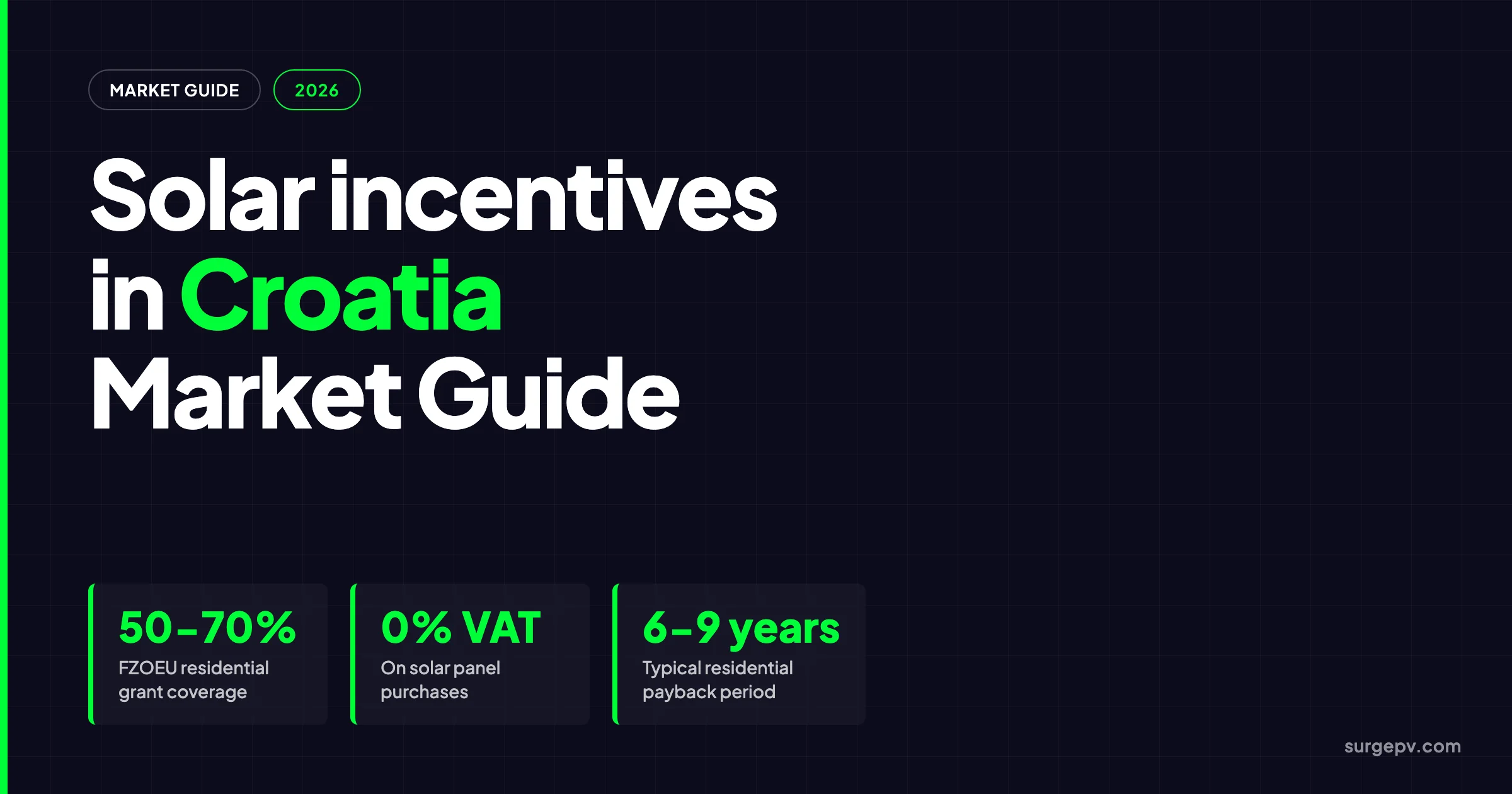
FZOEU grants cover 50-70% of household solar, battery and heat-pump costs. Solar panels are exempt from VAT. Net billing replaced net metering from January 2026. HROTE auctions support projects above 500 kW, and feed-in tariffs apply to 50-200 kW projects. Typical residential payback is 6-9 years; commercial rooftops with high self-consumption can pay back in 4-7 years.
In this guide:
- Latest 2026 status of every active Croatia solar incentive
- Why Croatia’s solar market crossed 1 GW and where it is heading
- Net metering vs net billing: what changed and who is affected
- FZOEU residential grants — rates, eligible systems and application rules
- Tax incentives: zero VAT on panels and how it stacks with grants
- Commercial, industrial and utility-scale support through HROTE
- Real-world payback examples under net billing
- Common mistakes and tradeoffs
- FAQ
Solar incentives in Croatia 2026: Quick Answer
Croatia’s 2026 incentive framework has two distinct layers. Households and small prosumers rely on direct capital grants from FZOEU, zero VAT on solar panels, and favorable grid connection rules for systems up to several hundred kilowatts. Larger commercial, industrial and utility projects rely on HROTE competitive auctions and feed-in tariffs.
| Incentive | Status 2026 | Key Detail |
|---|---|---|
| FZOEU residential solar grant | Active | 50-70% of eligible costs; €6,000-€8,400 for solar |
| FZOEU battery grant | Active | €5,600-€7,840 when installed with solar |
| FZOEU heat pump grant | Active | €6,250-€8,750 for bundled thermal projects |
| VAT on solar panels | Abolished | 0% VAT on solar panel purchases |
| Net metering | Closed to new systems | Ended January 1, 2026 for new residential systems |
| Net billing | Active for new systems | Surplus sold at market or regulated export rates |
| HROTE feed-in tariff | Active | 50-200 kW projects capped at €84.66/MWh |
| HROTE market premium auction | Active | Projects above 500 kW; 12-year contracts |
| Business decarbonization grants | Active | €80 million program for heating, cooling and thermal modernization |
The practical implication: a household that designs for self-consumption and adds a battery can capture the FZOEU grant, avoid the poor economics of exporting under net billing, and pay back the system in roughly 6-9 years. A household that oversizes for export will see longer paybacks because exported kilowatt-hours are worth far less than self-consumed ones.
Latest updates: Croatia solar policy status 2026
Croatia’s solar policy in 2026 is defined by a single tension. The government wants more rooftop solar to meet the NECP target of 2,382 MW by 2030, but it also needs to protect the distribution grid and keep household electricity bills affordable. The result is a grant-heavy residential program combined with a stricter grid settlement regime.
Croatia solar incentive status — June 2026
| Program / Mechanism | Status | Key Detail |
|---|---|---|
| FZOEU residential PV grant | Active | April 2026 tenth package: €20 million for solar |
| FZOEU battery grant | Active | €8 million; batteries must be installed with solar |
| FZOEU heat pump grant | Active | €10 million for heat-pump replacements |
| VAT on solar panels | Abolished | 0% on panel purchases |
| Net metering | Closed to new residential systems | Existing contracts preserved |
| Net billing | Default for new systems | Monthly financial settlement at export rates |
| HROTE feed-in tariff | Active | 50-200 kW; max €84.66/MWh; 10 MW quota |
| HROTE market premium auction | Active | >500 kW; 12-year premium contracts |
| Energy poverty renovation grants | Active | €25 million for energy-poor households |
| NECP solar target | Active | 2,382 MW by 2030 |
Key changes since 2024
January 2026 — Net metering ends. Croatia replaced retail-rate net metering with net billing for new residential systems. Under the old rules, a kilowatt-hour exported in July could offset a kilowatt-hour imported in December. Under net billing, exports are settled in cash at export rates that exclude distribution, transmission and most taxes. RES Croatia warned that this could extend payback periods by up to 30% and weaken residential demand.
April 2026 — Tenth support package. The government announced a €38 million call managed by FZOEU for residential solar, batteries and heat pumps. The package also capped household electricity prices until September 30, 2026, which indirectly affects the value of solar self-consumption. The call is part of a broader €450 million energy package.
2025 — Earlier FZOEU solar call paused. A June 2025 call offering up to 50% of eligible costs or €600/kW received more than 4,100 applications in two months and was temporarily closed in August 2025 because the budget was oversubscribed. This showed that demand for residential solar in Croatia is strong when grants are available.
2024-2025 — HROTE auctions expand. HROTE, the Croatian Energy Market Operator (2026), awarded premiums for 420 MW of solar and hydropower under a 2024 call and launched a 2024-2 feed-in tariff procedure for smaller projects. The auction framework now covers projects from 50 kW to well above 1 MW.
Key Takeaway — 2026 Incentive Priority
The most important action for Croatian solar in 2026 is to size systems for self-consumption, not generation. Net billing makes exported kilowatt-hours worth much less than avoided grid purchases. Combine FZOEU grants with zero-VAT panels, and add a battery if the household can shift evening load.
Why Croatia’s solar market matters in 2026
Croatia is one of the sunniest countries in the European Union. Annual sunshine ranges from roughly 2,000 to 2,700 hours, and solar irradiance is strong along the Adriatic coast. Despite this resource, solar deployment lagged for years because of slow permitting, grid connection uncertainty and low regulated electricity prices.
That changed quickly. Cumulative solar capacity rose from about 200 MW in 2020 to 1,255 MW by December 2025, according to OIEH and pv magazine data. The 2025 additions alone, at 417 MW, were more than double the 2023 total. If growth continues at the current pace, solar will overtake wind in installed capacity during 2026.
Market size and targets
| Metric | Value | Source |
|---|---|---|
| Cumulative solar end-2025 | ~1,255 MW | RES Croatia / pv magazine (2026) |
| Solar added in 2025 | 417 MW | RES Croatia / pv magazine (2026) |
| Solar generation 2025 | 1,127 GWh | OIEH (2026) |
| Share of electricity consumption | 5.8% | OIEH (2026) |
| NECP 2030 solar target | 2,382 MW | Croatian NECP (2025) |
| NECP 2030 renewable share target | 42.5% | Croatian NECP (2025) |
Croatia’s updated NECP, submitted in March 2025, raised the renewable-energy target from 36.4% to 42.5% of gross final consumption by 2030. It also targets a 62% reduction in emissions covered by the EU Emissions Trading System relative to 2005.
The solar target of 2,382 MW is ambitious because Croatia must add roughly the same amount of solar in the next five years as it installed in the previous two decades. Grid connection bottlenecks are the main risk. Industry sources estimate that about 3.5 GW of renewable and battery storage projects are ready to proceed but are waiting for clarity on connection fees and procedures.
What the market structure means for installers
Most Croatian solar connects to the distribution grid through HEP-ODS, the distribution system operator. Smaller commercial and industrial projects of 10-50 kW dominate the rooftop segment because they face lower grid-connection uncertainty than large ground-mount plants. Behind-the-meter systems on factories, warehouses and shopping malls are growing fastest because businesses want to reduce exposure to retail electricity prices.
For solar professionals, the shift from net metering to net billing makes hourly consumption data essential. A proposal that assumes 1:1 offset will overstate savings. Tools that model Croatian irradiance, retail tariffs, net billing export rates and battery dispatch produce more credible payback forecasts.
Net metering vs net billing in Croatia
Understanding the difference between net metering and net billing is the most important step for any Croatian solar project in 2026. The change that took effect on January 1, 2026 rewrote the economics of residential solar.
How Croatian net metering worked
Under net metering, exported solar electricity earned a credit that could offset future grid consumption. The grid functioned like a virtual battery. A kilowatt-hour exported during the day was worth roughly the same as a kilowatt-hour imported at night. This made oversizing attractive because excess production retained retail value.
Net metering was the main driver of Croatia’s early residential solar growth. Households could install a system, export summer surplus, and use the credits in winter. Batteries were optional because the grid provided the storage service for free.
How Croatian net billing works
Net billing separates production and consumption financially. Surplus electricity is sold to the grid at an export price. The household still buys grid electricity at the full retail rate. The two flows are settled in euros, not in kilowatt-hours.
Key parameters of Croatian net billing in 2026:
- Settlement basis: Monthly financial settlement
- Export price: Market-based or regulated rate, well below retail
- Retail purchase price: Includes energy, distribution, transmission, renewables fee and VAT
- Eligible systems: New residential prosumers from January 1, 2026
- Existing systems: Grandfathered under original net-metering terms
The exact export rate depends on the supplier and market conditions, but it is materially lower than the regulated household retail price. Industry observers estimate export values at roughly €0.04-€0.08/kWh, while retail purchases remain in the €0.14-€0.16/kWh range.
Why the shift matters for payback
Under net metering, an exported kilowatt-hour avoided roughly €0.15 of retail cost. Under net billing, that same kilowatt-hour might earn €0.05-€0.07. The value of self-consumption has therefore increased by a factor of roughly 2-3.
This changes system design priorities:
- Size to consumption, not roof area. Oversizing no longer pays because exports are worth less.
- Add storage. A battery shifts midday solar generation to evening consumption, increasing self-consumption.
- Shift loads. Running appliances, heat pumps and EV chargers during solar production hours improves economics.
A 5 kWp system in Split that self-consumes 65% of its output will usually deliver better returns than an 8 kWp system that exports 60% of its output, even though the smaller system costs less upfront.
Who still qualifies for net metering
Only solar systems that were connected and registered under net-metering contracts before January 1, 2026 retain that status. New systems must use net billing. Upgrading or expanding a grandfathered system may trigger reclassification, so homeowners should confirm the rules with HEP-ODS before adding panels or replacing inverters.
FZOEU residential subsidies explained
The Environmental Protection and Energy Efficiency Fund, or FZOEU (Fond za zaštitu okoliša i energetsku učinkovitost), is the main channel for Croatian household solar grants. In April 2026, the government announced its tenth support package, worth €38 million for residential solar, batteries and heat pumps.
April 2026 support package
| Element | Detail |
|---|---|
| Total package | €38 million |
| Solar allocation | €20 million |
| Heat pump allocation | €10 million |
| Battery allocation | €8 million |
| Target beneficiaries | Homeowners with registered residence |
| Higher support rate | 70% for income up to €1,341.42/month in 2025 |
| Standard support rate | 50% for households above the income threshold |
| Expected applications | ~15,000 |
The income threshold of €1,341.42 per month refers to average monthly income in 2025. Households below this level receive the 70% support rate, which can cover a large share of a typical residential system.
Typical grant amounts
| Component | Support Range | Notes |
|---|---|---|
| Solar power plant | €6,000-€8,400 | Varies by system size and income tier |
| Battery storage | €5,600-€7,840 | Only when installed with solar panels |
| Heat pump | €6,250-€8,750 | Must meet efficiency criteria |
The battery subsidy is significant because it is the first time Croatia has directly supported residential storage. The requirement that batteries must be installed with solar reflects the government’s goal of increasing self-consumption and reducing grid stress under net billing.
Eligibility rules
Typical requirements for FZOEU residential grants include:
- The applicant is the owner or co-owner of a family house.
- The property is legal and meets technical requirements.
- The applicant has registered residence at the address.
- The system is installed and commissioned by a certified installer.
- The installation meets FZOEU technical specifications.
Each call publishes its own documentation requirements, eligible equipment lists and application deadlines. The safe practice is to download the current terms from the FZOEU portal (2026) before signing a contract.
Application process
- Confirm technical feasibility with a certified installer.
- Prepare property ownership, residency and income documentation.
- Submit the online application through the FZOEU portal.
- Install the system according to the approved technical design.
- Submit commissioning documents, invoices and payment proofs.
- Receive the grant payment by bank transfer after verification.
Grants are generally paid after installation, so households must finance the upfront cost. Installers should not treat the grant as a deposit.
Earlier 2025 solar call
Before the April 2026 package, FZOEU ran a 2025 call that offered up to 50% of eligible costs or €600 per kW of installed capacity. It received more than 4,100 applications in two months and was temporarily closed in August 2025 due to oversubscription. Over the previous two years, FZOEU had co-financed roughly 5,600 rooftop systems. This history shows that Croatian grant windows can close quickly when demand is high.
Tax incentives and VAT treatment
Croatia’s tax treatment of solar is more favorable than in many EU countries. The most important change is the abolition of VAT on solar panels.
Zero VAT on solar panels
Solar panels are exempt from VAT in Croatia. This reduces the hardware cost directly. For a 5 kWp system with panel costs of roughly €2,000-€2,500, the savings compared with the standard 25% VAT rate are approximately €400-€500.
The exemption applies to solar panels themselves. Installation services, inverters, mounting systems, cabling and batteries may still be taxed at the standard VAT rate unless a specific exemption applies. The installer must structure the invoice correctly to capture the benefit.
Income tax treatment
Self-consumed solar electricity is not treated as taxable income for residential prosumers. Export income under net billing is generally small for households and does not create significant income tax liability.
For businesses, solar is depreciated as a fixed asset, and export income is part of taxable revenue. Commercial investors should work with a Croatian accountant to optimize depreciation schedules and VAT recovery.
Property tax and permits
Rooftop solar installations generally do not increase property tax assessments. Building permit requirements vary by municipality, but small rooftop systems often qualify for a simplified notification procedure rather than a full building permit. The e-Permits system, piloted in Zagreb, is being mainstreamed to reduce administrative delays.
Solar costs and payback in Croatia
Croatia combines strong solar irradiance, competitive installation costs and moderate retail electricity prices. The result is a positive but policy-sensitive business case for residential and commercial solar.
Solar installation costs Croatia 2026
| System Size | Total Installed Cost | Cost Per kWp | Notes |
|---|---|---|---|
| 3 kWp | €3,000-€4,200 | €1,000-€1,400 | Suitable for small households |
| 5 kWp | €5,000-€7,000 | €1,000-€1,400 | Most common residential size |
| 8 kWp | €8,000-€11,200 | €1,000-€1,400 | Larger homes or small businesses |
| 10 kWp | €10,000-€14,000 | €1,000-€1,400 | Near typical residential upper limit |
All-in costs include monocrystalline PV modules, inverter, mounting, DC/AC cabling, labor, HEP-ODS connection application, bidirectional meter and commissioning. Battery storage adds €4,000-€7,000 for a 5-10 kWh lithium-ion system.
Croatian residential costs are competitive by European standards. The solar installation cost per kWp Europe guide places Croatia in the €1,000-€1,400/kWp band, close to Poland and below Germany, France or Italy.
Regional payback comparison
| Region | Irradiance | Residential Payback (Net Billing) | Notes |
|---|---|---|---|
| Split-Dalmatia | 1,700-1,900 kWh/m²/year | 6-8 years | Strong coastal irradiance |
| Dubrovnik-Neretva | 1,700-1,850 kWh/m²/year | 6-8 years | High summer demand from tourism |
| Zagreb / Continental | 1,250-1,450 kWh/m²/year | 7-9 years | Lower irradiance, lower install costs |
| Istria | 1,550-1,700 kWh/m²/year | 6-8 years | Good solar resource, tourism load |
| Slavonia | 1,300-1,500 kWh/m²/year | 7-9 years | Lower irradiance, agricultural demand |
Coastal regions pay back faster because of higher irradiance and strong summer air-conditioning load. Continental regions still work financially, especially for households with heat pumps or electric heating.
Worked example: 5 kWp system in Split
Consider a household in Split with a 5 kWp rooftop system costing €6,000 all-in before subsidies. The system produces approximately 7,500 kWh per year. The household consumes 3,500 kWh on-site and exports 4,000 kWh.
- Self-consumed value: 3,500 kWh × €0.15/kWh = €525/year
- Export value: 4,000 kWh × €0.06/kWh = €240/year
- Total annual benefit: €765/year
- Simple payback: €6,000 / €765 = 7.8 years
If the household adds a 7 kWh battery for €5,500 and raises self-consumption from 47% to 72%, the math changes:
- New self-consumed value: 5,400 kWh × €0.15/kWh = €810/year
- New export value: 2,100 kWh × €0.06/kWh = €126/year
- Total annual benefit: €936/year
- Total system cost: €11,500 before subsidies
- Zero-VAT panel saving: ~€450
- After 50% FZOEU grant: €5,525
- Simple payback: €5,525 / €936 = 5.9 years
This example shows why combining the grant, zero-VAT panels and a battery can shorten payback by roughly two years compared with an unsubsidized PV-only system.
Commercial and industrial economics
Commercial systems in Croatia typically cost €750-€950/kWp at 50-500 kWp scale. With net billing, C&I projects must model:
- Self-consumption rate during daylight hours
- Retail electricity rate vs export rate
- Fixed and demand charges
- Grid connection cost allocations
A 100 kWp commercial system with 75% self-consumption can achieve 4-7 year payback in coastal regions. The business case depends heavily on load profile matching, which is why PV shade analysis and hourly consumption modeling are standard for C&I proposals.
Commercial, industrial and utility-scale incentives
Large-scale solar in Croatia operates under a different framework than residential systems. The economics are driven by HROTE auctions, corporate power purchase agreements and merchant market exposure rather than household grants.
HROTE auctions and market premiums
HROTE runs competitive auctions for renewable energy projects. Winning projects receive market-premium contracts that top up revenue when market prices fall below a strike price and require payback when prices exceed it. This contract-for-difference mechanism reduces merchant price risk.
Key parameters:
- Eligible projects: Generally above 500 kW
- Contract duration: 12 years
- Support mechanism: Double-sided sliding premium
- Recent awards: 420 MW of solar and hydropower under a 2024 call
A 2024 auction by HROTE earmarked €257.2 million to incentivize 450 MW of solar, 150 MW of wind and 7.25 MW of hydropower, according to RatedPower (2024). SMEs and renewable energy communities receive priority access for smaller projects.
Feed-in tariffs for small projects
For projects between 50 kW and 200 kW, HROTE offers guaranteed purchase prices through feed-in tariffs. A 2024 call set a maximum price of €84.66/MWh for solar projects in this range, with a total quota of 10 MW.
This bracket is relevant for small businesses, agricultural operations and energy communities that are too large for residential net billing but too small for utility-scale auctions.
Corporate PPAs and merchant projects
Large C&I consumers are increasingly signing direct power purchase agreements with solar developers. The PPA fixes a long-term electricity price and hedges against retail volatility. Off-site solar does not qualify for FZOEU grants or prosumer net billing, but it avoids rooftop complexity and can serve tenants or multi-site businesses.
Grid constraints
The biggest risk to Croatian solar growth is grid saturation. About 3.5 GW of renewable and battery storage projects are ready to proceed but are waiting for clarity on unit connection fees and grid reinforcement cost allocations. For distributed solar, this means connection approvals may take longer in congested areas and new projects may face grid reinforcement cost allocations.
Energy communities and collective self-consumption
Croatia has introduced frameworks for renewable energy communities and collective self-consumption, though uptake has been slower than in Greece or Italy. Energy communities allow households, businesses, municipalities and farmers to share production from a single installation without each participant needing their own roof.
Legal framework
Energy communities in Croatia are aligned with the EU Clean Energy Package. They must operate on a not-for-profit or limited-profit basis and prioritize local benefit. The cooperative governance model gives members one vote regardless of capital contribution.
Virtual net metering
Virtual net metering allows production at one location to be credited against consumption at other meters, typically within the same distribution network area. This makes apartment buildings, agricultural cooperatives and small commercial clusters attractive candidates for community solar.
Why energy communities matter for Croatia
More than half of Croatian households live in multi-apartment buildings. Many of these buildings have suitable rooftops but fragmented ownership. Energy communities solve the split-incentive problem by allowing residents to co-own a shared system and share benefits through virtual net metering.
For installers, a single apartment building project can serve 10-30 households with a system size of 30-150 kWp. The sales cycle is longer because it requires cooperative formation and member agreements, but the per-project value is higher.
Common mistakes and tradeoffs
Croatian solar in 2026 rewards careful planning. These are the most common errors and the tradeoffs every prosumer should understand.
Mistake 1: Designing for net metering
Many installers and homeowners still use net-metering assumptions. Under net billing, oversizing reduces returns. Design the system to match daytime consumption, with storage to capture evening use.
Mistake 2: Ignoring the income threshold
The FZOEU grant rate depends on household income. A proposal that assumes the 70% rate for a household above the €1,341.42/month threshold will understate the client’s net cost. Always verify the income tier before quoting.
Mistake 3: Missing the grant window
FZOEU calls have finite budgets and can close within weeks when demand is high. The 2025 solar call closed in August after two months because of oversubscription. Households should prepare application documents before the call opens.
Tradeoff: Battery cost vs self-consumption gain
Batteries add €4,000-€7,000 to project cost but can raise self-consumption from 45-55% to 70-80%. In Croatia’s net billing environment, the battery payback is typically 4-7 years when combined with the FZOEU grant.
Tradeoff: Rooftop vs energy community
Households with small or shaded roofs may get better economics by joining an energy community than by installing a small standalone system. Energy communities require more coordination but offer scale advantages and shared maintenance.
Tradeoff: Zero-VAT panels vs full system VAT
Zero VAT applies to solar panels, not necessarily to inverters, batteries or installation services. A quote that lumps everything into a single line item may miss the opportunity to optimize VAT treatment. Ask for an itemized invoice.
Conclusion
Croatia’s solar incentive framework in 2026 is a policy pivot. Net metering is gone for new residential systems, but direct grants, battery subsidies and zero VAT on panels have softened the transition. The FZOEU tenth support package is the most important tool for households. HROTE auctions and feed-in tariffs serve commercial, industrial and utility developers. The NECP target of 2,382 MW by 2030 means the market must roughly double in five years.
For solar professionals, the competitive advantage is no longer just installation price. It is the ability to model net billing accurately, stack incentives correctly, and size systems for self-consumption. Tools like Clara AI and SurgePV’s PV generation and financial modeling can automate that workflow for Croatian projects.
Three actions to take now:
- Model self-consumption first — under net billing, every exported kilowatt-hour is worth less than a self-consumed one.
- Check the income tier before quoting — the FZOEU grant rate is 50% or 70% depending on household income.
- Prepare FZOEU applications early — budgets are finite and high-demand calls close fast.
For the broader European context, see our European solar incentives guide. For installers looking to scale across Europe, our solar payback period by country guide benchmarks Croatia against neighboring markets.
Frequently Asked Questions
What solar incentives are available in Croatia in 2026?
Active Croatia solar incentives in 2026 include FZOEU capital grants covering 50-70% of residential solar, battery and heat-pump costs; zero VAT on solar panels; and HROTE auctions and feed-in tariffs for commercial, industrial and utility-scale projects. The April 2026 tenth support package allocated €20 million for solar, €10 million for heat pumps and €8 million for batteries.
Is net metering still available in Croatia in 2026?
No. Croatia ended net metering for new residential solar systems on January 1, 2026. New prosumers now use net billing, where surplus electricity is sold to the grid at market-based rates that are lower than the retail purchase price. Existing net-metering contracts remain valid under their original terms.
How much is the FZOEU solar grant in 2026?
The Environmental Protection and Energy Efficiency Fund (FZOEU) covers up to 70% of eligible costs for households at risk of energy poverty with average monthly income up to €1,341.42 in 2025, and up to 50% for higher-income households. Solar power plant support ranges from €6,000 to €8,400, battery systems from €5,600 to €7,840 when installed with solar, and heat pumps from €6,250 to €8,750.
Can I get a VAT reduction on solar panels in Croatia?
Yes. Croatia abolished VAT on solar panels, meaning the standard VAT rate does not apply to panel purchases. This reduces upfront hardware costs. Installation services and other system components may still be subject to standard VAT, so the invoice structure matters.
What is the difference between net metering and net billing in Croatia?
Net metering allowed exported solar kilowatt-hours to be credited against later grid consumption, effectively using the grid as storage at retail value. Net billing, which applies to new systems from 2026, sells surplus electricity to the grid at lower wholesale or regulated export rates while grid purchases remain at full retail price. Self-consumed solar is now far more valuable than exported solar.
Are businesses eligible for solar incentives in Croatia?
Yes. Businesses can access HROTE competitive auctions for projects above 500 kW, which award 12-year market-premium contracts, and feed-in tariffs for smaller projects in the 50-200 kW range capped at €84.66/MWh. A separate €80 million business decarbonization program supports heating, cooling and thermal-energy modernization.
How much does a residential solar system cost in Croatia in 2026?
Residential solar in Croatia costs approximately €1,000-€1,400 per kWp installed, including panels, inverter, mounting, cabling, labor, permits and grid connection. A typical 5 kWp system costs €5,000-€7,000 before subsidies. With the FZOEU grant covering 50-70% and zero VAT on panels, the net cost can fall to €2,000-€4,000.
What is the solar payback period in Croatia?
The solar payback period in Croatia is roughly 6-9 years for residential systems after the 2026 net billing change, and 4-7 years for well-matched commercial rooftops with high daytime self-consumption. Adding a battery and shifting loads to solar hours can shorten payback by 1-3 years compared with a PV-only system sized for export.
What is the maximum solar system size for households in Croatia?
Residential prosumer systems in Croatia are typically sized up to the household’s contracted power and annual consumption. While specific caps vary by connection agreement with HEP-ODS, practical residential installations usually fall in the 3-10 kWp range. Larger systems require different grid connection procedures and may be treated as commercial producers.
What is Croatia’s solar target for 2030?
Croatia’s updated National Energy and Climate Plan targets a 42.5% share of renewable energy in gross final consumption by 2030 and a solar capacity target of 2,382 MW. Cumulative solar capacity reached about 1,255 MW by December 2025, so Croatia must add roughly the same amount again in the next five years.
Where this fits
This article is part of SurgePV's Solar Incentives & Policy hub, which works through the topic from first principles to the decisions a project team actually has to make.

