

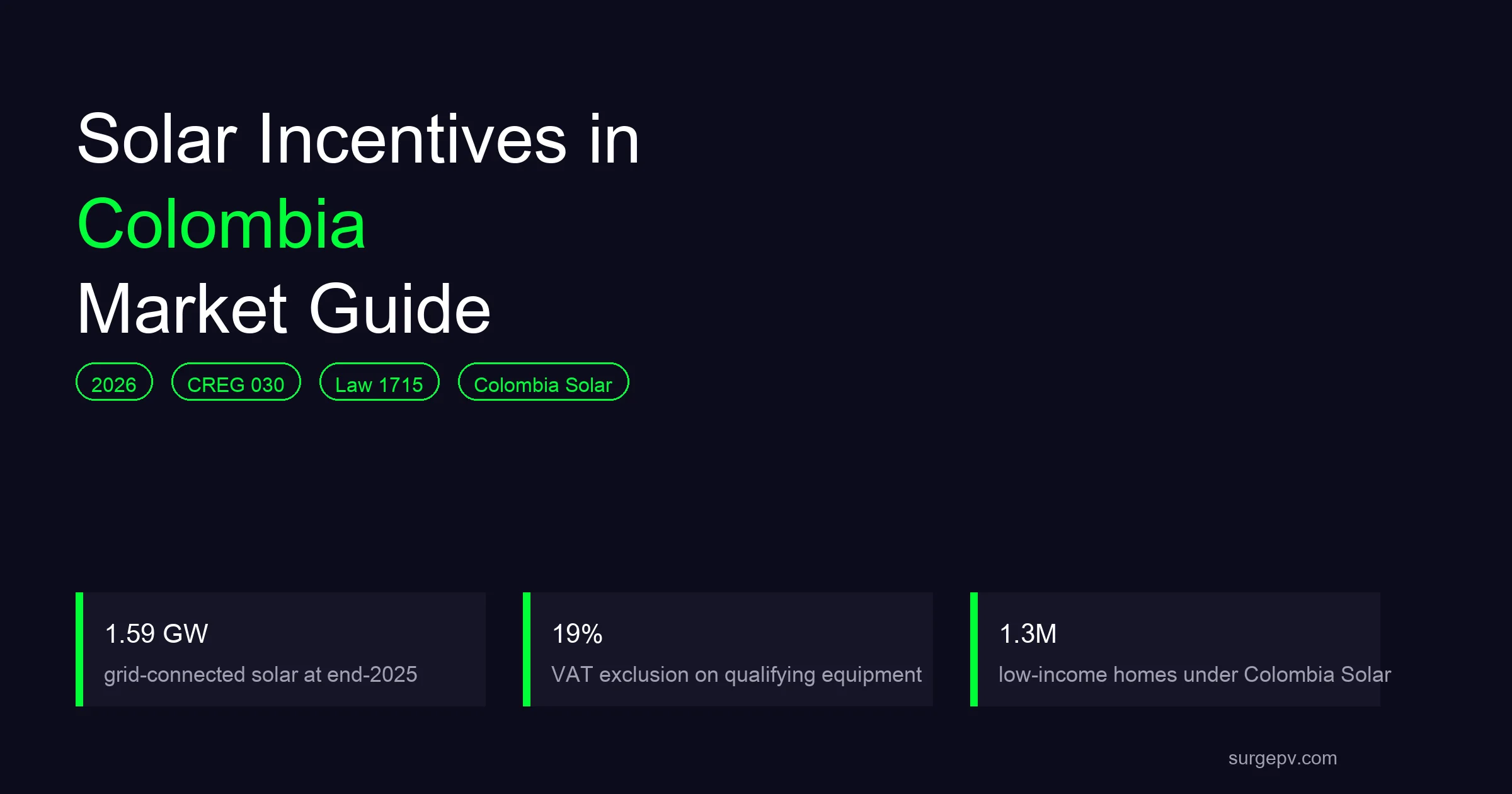
Colombia’s solar market has shifted from a promising concept into a measurable build-out. At the end of 2025, grid-connected solar capacity reached 1.59 GW, according to XM figures reported by PV Magazine (2026). Solar now supplies 7.6% of the country’s installed capacity, up from a rounding error just five years ago. Behind that growth sits a stack of incentives that most installers and investors understand only in fragments.
This guide assembles the full 2026 incentive picture for Colombia. It covers the tax benefits in Law 1715 and Law 2099, the net metering rules under CREG Resolution 030 of 2018, the new Colombia Solar social program, utility-scale auctions, and the practical steps to claim each benefit. It also explains why the headline 50% income-tax deduction is often less valuable than the VAT exclusion, and why Caribbean projects pay back twice as fast as Andean ones.
Quick Answer
Colombia’s 2026 solar incentives include a 50% income-tax deduction, VAT exclusion, import-duty exemption, and accelerated depreciation under Law 1715/2014 and Law 2099/2021. Net metering for systems up to 1 MW is governed by CREG Resolution 030/2018, and the Colombia Solar program funds rooftop PV for 1.3 million low-income households.
TL;DR — Solar Incentives in Colombia 2026
Active incentives: 50% income-tax deduction, 19% VAT exclusion, import-duty exemption, and 33.33% accelerated depreciation under Law 1715. Distributed solar up to 1 MW qualifies for net billing under CREG 030/2018 and Resolution 174/2021. The Colombia Solar program has approved USD 2.1 billion for 1.3 million low-income households. Installed PV reached 1.59 GW at end-2025, with another 1.37 GW in testing. Caribbean C&I projects can pay back in 4–5 years; residential rooftop payback is typically 11–14 years.
In this guide:
- Colombia solar market snapshot: capacity, mix, and 2026 outlook
- The regulators and laws that shape every project
- Law 1715 and Law 2099 tax incentives explained
- Net metering and distributed generation rules
- Colombia Solar low-income program details
- Utility-scale auctions, PPAs, and open access
- Regional economics and real payback ranges
- The biggest misconception installers repeat
- Step-by-step guide to claiming incentives
- FAQ
Colombia Solar Market at a Glance: 2026 Snapshot
Colombia’s electricity system is still dominated by hydropower, but solar is now the fastest-growing source. At the end of December 2025, the National Interconnected System (SIN) had 21,028 MW of installed capacity, according to XM data reported by PV Magazine (2026). Solar PV accounted for 1,594 MW, or 7.6% of the total. Hydroelectricity supplied 62.8%, and thermal plants supplied 29.6%.
The country added 333.87 MW of solar in 2025 alone, representing 87.8% of all new generation capacity connected that year. Another 1,365.6 MW of solar projects were in initial testing at year-end, suggesting the operational fleet could double quickly as those projects finish commissioning.
| Technology | Installed Capacity (Dec 2025) | Share of SIN |
|---|---|---|
| Hydroelectricity | 13,209.97 MW | 62.8% |
| Thermal | 6,224.52 MW | 29.6% |
| Solar PV | 1,594.08 MW | 7.6% |
| Total SIN | 21,028.56 MW | 100% |
Source: XM Colombia, reported by PV Magazine (2026).
The pipeline is far larger than current installations. UPME had approved roughly 18.7 GW of capacity as of late 2024, of which 13.5 GW was solar and 2.8 GW was wind, according to SEI (2025). Another 5,022 MW of solar was under construction. The gap between approved capacity and operational capacity is the central story of Colombian solar in 2026: the projects exist on paper, but grid connection and environmental licensing are the bottlenecks.
The Regulatory Stack: Who Governs Colombia Solar in 2026
Solar projects in Colombia touch at least four national agencies. Misunderstanding which agency handles which step is the most common reason proposals stall.
| Agency | Role | What It Controls |
|---|---|---|
| Ministry of Mines and Energy (MME) | Policy and planning | National energy plans, renewable targets, Colombia Solar program design |
| UPME | Planning and certification | Project registration, FNCER certification, auction design, grid expansion planning |
| CREG | Economic and technical regulation | Tariffs, net metering rules, distributed generation standards |
| XM | Market and grid operation | Wholesale market administration, dispatch, grid connection testing |
| ANLA / CARs | Environmental licensing | Environmental permits for projects above thresholds |
| DIAN | Tax administration | VAT refund processing and income-tax deduction verification |
The legal foundation is Law 143 of 1994, the Electricity Law, plus Law 142 of 1994, the Public Services Law. Law 1715 of 2014 added the first renewable-specific incentives. Law 2099 of 2021, the Energy Transition Law, updated and strengthened those incentives, particularly by requiring UPME certification for VAT benefits.
CREG Resolution 030 of 2018 created the distributed generation framework. Resolution 174 of 2021 raised the small-scale self-generator limit from 0.1 MW to 1 MW and improved surplus compensation terms, according to the World Bank (2022). For installers, the practical point is simple: projects under 100 kW get a simplified interconnection path, while larger systems need a full connection contract and a bi-directional meter.
Law 1715 and Law 2099: The Core Tax Incentives
Colombia’s incentive framework is not a single subsidy. It is a set of four tax tools that stack together. Each tool has its own eligibility rules and paperwork.
1. Income-Tax Deduction
Article 11 of Law 1715, as amended by Law 2099, allows taxpayers to deduct 50% of the total investment value from taxable income. The deduction is taken over up to 15 years, starting in the taxable year after the project enters operation. It cannot exceed 50% of the taxpayer’s net liquid income in any year.
For a USD 1 million solar investment, this means up to USD 500,000 can be deducted over 15 years. At Colombia’s 35% corporate income-tax rate, that is a nominal tax saving of up to USD 175,000. The catch is that the company must have enough taxable profit each year to absorb the deduction. Start-ups or loss-making entities cannot use it immediately.
2. VAT Exclusion
Article 12 of Law 1715 excludes qualifying goods and services from the 19% VAT. The benefit applies to equipment, machinery, materials, and services used for pre-investment and investment in FNCER projects. To claim it, the project must be certified by UPME and the goods must appear on the PROURE list maintained by UPME Resolution 319 of 2022.
Decree 829 of 2020 also allows investors to request a VAT refund from DIAN for VAT paid before certification is completed. This is often the most valuable incentive for small and medium installers because it is immediate and does not depend on future profits.
3. Import-Duty Exemption
Article 13 of Law 1715 exempts imported machinery, equipment, and materials from customs duties if those items are not produced in Colombia and are essential to the FNCER project. The exemption requires UPME certification and a showing that domestic equivalents are unavailable.
4. Accelerated Depreciation
The same Article 11 allows accelerated depreciation of up to 33.33% per year for renewable-energy assets. A standard commercial asset in Colombia might depreciate over 10–20 years. The accelerated schedule lets a company write off the asset in roughly three years, improving early-year cash flow.
| Incentive | Mechanism | Typical Value | Key Condition |
|---|---|---|---|
| Income-tax deduction | 50% of investment deducted over 15 years | Up to 35% of deduction value in tax savings | Sufficient taxable income |
| VAT exclusion | 19% VAT removed or refunded | 19% of eligible capex | UPME certification + PROURE list |
| Import-duty exemption | Customs duties waived | Varies by tariff line | No local production equivalent |
| Accelerated depreciation | 33.33% per year | Faster tax shield | FNCER-certified asset |
Source: Invest in Colombia (2024) and SEI (2025).
Net Metering and Distributed Generation in Colombia
Colombia does not use pure retail net metering. It uses a hybrid net-metering and net-billing model. Understanding the difference is essential for sizing systems correctly.
How the Mechanism Works
Under CREG Resolution 030 of 2018, a small-scale self-generator (AGPE) or distributed generator (GD) can install up to 1 MW. The system generates electricity for self-consumption and injects surplus into the distribution grid. Within the same billing period, injected energy offsets consumed energy. The customer pays only the commercialization charge for the netted volume.
If monthly generation exceeds consumption, the surplus is credited at the wholesale market price, not the full retail tariff. That wholesale price is typically 0.6–0.7 times the retail rate, according to SurgePV’s Colombia design guide (2026). Credits are generally non-cumulative, meaning they do not roll over indefinitely.
Simplified vs. Full Interconnection
Systems of 100 kW or less benefit from a simplified interconnection procedure. The distribution utility must respond within set timeframes and cannot demand connection studies beyond the scope of the regulation. Systems above 100 kW require a connection contract and may need grid-impact studies.
The customer must install a bi-directional smart meter. The meter measures energy consumed from the grid and energy injected into the grid. Most Colombian distribution utilities now have standardized net-metering application forms, but timelines vary by company.
What This Means for Sizing
Because surplus exports are paid at wholesale rather than retail, the best economics come from systems sized to match on-site consumption. Oversizing a system to export heavily reduces the effective value of each kilowatt-hour. For a factory with a steady daytime load, a 500 kW rooftop array can avoid retail purchases at COP 700–900 per kWh. The same kilowatt-hour exported earns only the wholesale price.
Installers who model these projects need solar design software that handles Colombian tariff structures. SurgePV’s solar financial analysis tool can model net billing under CREG Resolution 030/2018 and export the results into a Spanish-language proposal.
Colombia Solar Program and Low-Income Subsidies
The most visible new program in 2026 is Colombia Solar. It is a social policy wrapped in an energy transition goal: replace traditional electricity subsidies with rooftop self-generation for low-income households.
Funding and Target
CONPES 4158 approved COP 8.35 trillion, approximately USD 2.1 billion, for 2026–2030, according to PV Magazine (2025). The program aims to install rooftop PV on roughly 1.3 million households in strata 1, 2, and 3. Participating households are expected to save 20–40% on their electricity bills. The program also targets more than 25,000 direct and indirect jobs and technical training in priority regions.
Implementation
The Ministry of Mines and Energy leads the program, with support from the National Planning Department and the Ministry of Finance. Implementation involves distribution utilities, local governments, and public utilities. The systems are sized by household consumption and local solar resource. Gecelca, a national utility, launched a solar-focused entity called Gecelca Solar in late 2025 with an initial target of 650 MW.
Why It Matters for Installers
Colombia Solar is not a simple rebate program. It is a large-scale procurement and deployment scheme that will create demand for local installers, financiers, and maintenance providers. Companies that can deliver Spanish-language proposals, handle UPME paperwork, and meet quality standards are best positioned to win work.
For social housing projects, solar proposal software with templated Colombian documentation can cut proposal time from hours to minutes. That matters when municipalities are reviewing bids under tight deadlines.
Utility-Scale Auctions and Corporate PPAs
While distributed solar attracts most installer attention, utility-scale solar drives the headline capacity numbers.
UPME Auctions and Reliability Procurement
Colombia has held several renewable energy auctions under UPME. The February 2024 reliability auction awarded about 4.4 GW of solar projects, representing 99% of the capacity allocated, according to The Energy Pioneer (2024). These projects are long-term power purchase agreements that supply the wholesale market and large regulated consumers.
In 2026, UPME is also working to unblock grid capacity. Resolution 000358 of 2026 established new protocols for transmission capacity allocation, responding to queue congestion that had delayed projects with advanced permits, according to IndexBox (2026).
Corporate PPAs and Open Access
Large commercial and industrial buyers can sign direct PPAs with solar generators under Colombia’s open-access framework. This is attractive for mining companies, data centers, and manufacturers that want price stability after the 2024 electricity price spike linked to El Niño. Mordor Intelligence (2026) notes that corporate PPAs are one of the main growth drivers for C&I solar.
Utility-scale solar in Colombia now posts levelized costs below USD 0.10 per kWh, according to Mordor Intelligence (2026). That is below the cost of diesel generation in non-interconnected zones and increasingly competitive with grid supply for large consumers.
Grid Constraints
The main risk for utility-scale developers is not incentives but transmission. UPME reported roughly 20 GW of approved capacity as of mid-2025, about 95% of it solar and wind, according to Empsii (2025). That is nearly double the current installed system capacity. Without faster transmission expansion, many approved projects will wait years for a connection.
Regional Solar Economics and Payback in Colombia
Colombia’s geography creates sharp differences in solar economics. The Caribbean coast has desert-like solar resource, while the Andean highlands have moderate resource but high retail tariffs.
Solar Resource by Region
IDEAM data show annual global horizontal irradiance ranging from roughly 1,450 kWh per square meter on the Pacific coast to more than 2,000 kWh per square meter in La Guajira. The Caribbean coast, including Barranquilla and Cartagena, sits at 1,730–2,000 kWh per square meter per year. The Andean region, including Bogotá, is lower at 1,550–1,750 kWh per square meter per year.
| Region | Annual GHI (kWh/m²/year) | Typical Peak Sun Hours |
|---|---|---|
| La Guajira | 2,000–2,100 | 5.5–6.0 |
| Caribbean Coast | 1,730–2,000 | 5.0–5.5 |
| Orinoquia / Amazon | 1,550–1,900 | 4.5–5.0 |
| Andean | 1,550–1,750 | 4.0–4.5 |
| Pacific Coast | 1,450–1,550 | 3.5–4.0 |
Source: IDEAM solar atlas, summarized in Redalyc (2019) and UPME planning documents.
Retail Tariffs
Colombian residential electricity prices averaged about USD 0.205 per kWh in 2026 benchmarks, according to Global Petrol Prices (2026). Business rates are close to residential rates because Colombia’s tariff structure redistributes costs through strata-based subsidies. The effective bill impact of solar therefore depends heavily on the customer’s subsidy level and consumption pattern.
Payback Ranges
Market studies quote residential rooftop payback of 11.3–13.8 years, according to Mordor Intelligence (2026). Commercial and industrial systems in major cities typically pay back in 8–12 years, while high-irradiance Caribbean cities can see payback as low as 4.1–4.6 years for well-optimized projects, according to a 2024 MDPI study. For a global comparison, see our solar payback period by country guide.
The lesson is regional. A 100 kW warehouse roof in Barranquilla with high self-consumption can be a strong investment. The same system in a cloudy Andean valley with low daytime load may never pay back without the Colombia Solar subsidy.
Myth: Colombia Has No Solar Incentives
A common installer refrain is that Colombia killed solar incentives when the Council of State annulled Decree 570 of 2018 in 2023. That annulment did end one auction mechanism, but it did not touch Law 1715 or Law 2099.
The core incentives remain fully available in 2026:
- The 50% income-tax deduction under Article 11.
- The VAT exclusion under Article 12.
- The import-duty exemption under Article 13.
- Accelerated depreciation under Article 11.
- Net metering under CREG Resolution 030 of 2018, updated by Resolution 174 of 2021.
- The Colombia Solar low-income program.
The real bottlenecks are administrative. UPME certification can take months. Distribution utilities have different net-metering timelines. Grid connection queues for large projects stretch for years. The incentives exist; the friction is in execution.
Practical Guide: How to Claim Solar Incentives in Colombia
Here is the sequence most projects follow to capture the full incentive stack.
Step 1: Confirm Project Eligibility
Verify that the project qualifies as a non-conventional renewable energy source under Law 1715. Solar PV qualifies. Hybrid projects with storage may need additional review. Decide early whether the project is distributed generation, self-generation, or utility-scale, because each path has different rules.
Step 2: Register with UPME
Submit the project to UPME for registration and certification. This is the gateway to the VAT exclusion, import-duty exemption, and income-tax deduction. UPME will check that the technology and equipment align with the PROURE list. Keep copies of every invoice and import declaration.
Step 3: Apply for Interconnection
For distributed systems up to 1 MW, file the interconnection request with the local distribution utility under CREG Resolution 030 of 2018. Systems of 100 kW or less use the simplified path. Larger systems need a connection contract and may require a grid-impact study. Order the bi-directional meter early; meter availability is a common delay.
Step 4: Claim Tax Benefits
Work with a Colombian accountant to claim the income-tax deduction, VAT exclusion or refund, and accelerated depreciation. DIAN processes VAT refunds and verifies deductions. The deduction must be spread over up to 15 years and capped at 50% of net taxable income each year.
Step 5: For Colombia Solar Applicants
Households in strata 1–3 should monitor Ministry of Mines and Energy announcements for enrollment windows. Local governments and utilities will manage installation. Installers seeking to participate should register as approved providers and prepare Spanish-language technical and financial proposals.
Step 6: Model Accurately
Use software that handles Colombian rules. A proposal that assumes full retail net metering will overstate returns. A proposal that ignores the VAT exclusion will understate them. SurgePV’s solar design platform includes CREG Resolution 030/2018 net billing logic and Colombian tariff data. For a software comparison, see our guide to the best solar design software in Colombia.
Future Outlook and Risks
Colombia’s solar trajectory is strong but not guaranteed. The government targets 6 GW of non-conventional renewable capacity by 2026, though analysts expect closer to 3 GW, according to Argus Media (2025). The long-term Just Energy Transition scenario projects 15.2 GW of solar by 2030 and 25 GW by 2050, according to SEI (2025).
Three risks will shape the next five years:
- Transmission constraints. Approved projects far exceed available grid capacity. UPME’s Mission Transmission and Resolution 000358 of 2026 are attempts to fix this, but construction takes years.
- Policy continuity. Incentives have survived one administration already, but future governments could modify tax benefits or the Colombia Solar budget.
- Tariff pressure. The government has intervened to limit retail tariff increases. If tariffs are kept below cost, the value of self-consumption falls and payback periods lengthen.
For installers and developers, the practical response is to build a pipeline of distributed projects with high self-consumption and documented UPME certification. Those projects are less exposed to transmission queues and tariff politics than large utility-scale sites.
FAQ
What are the main solar incentives in Colombia in 2026?
The main solar incentives in Colombia are anchored in Law 1715 of 2014 and the Energy Transition Law 2099 of 2021. They include a 50% income-tax deduction on the investment value, a full exclusion from the 19% VAT for qualifying equipment and services, an exemption from import duties for machinery not produced locally, and accelerated depreciation of up to 33.33% per year. Distributed generators also benefit from CREG Resolution 030 of 2018, which allows systems up to 1 MW to connect to the grid and receive credits for surplus exports.
How does net metering work in Colombia?
Colombian net metering is regulated by CREG Resolution 030 of 2018 and updated by Resolution 174 of 2021. Systems up to 1 MW can connect to the distribution grid as small-scale self-generators (AGPE) or distributed generators (GD). Installations of 100 kW or less use a simplified interconnection process. Energy injected into the grid can offset energy consumed within the same billing period. Any monthly surplus is typically compensated at the wholesale market price, which is usually 0.6–0.7 times the retail tariff, rather than at full retail value.
Who qualifies for the Colombia Solar low-income program?
The Colombia Solar program targets residential customers in strata 1, 2, and 3 who already receive electricity subsidies. CONPES 4158 approved COP 8.35 trillion, roughly USD 2.1 billion, for 2026–2030 to install rooftop PV systems for about 1.3 million low-income households. The program is managed by the Ministry of Mines and Energy and aims to cut household bills by 20–40% while reducing pressure on the national subsidy fund.
What is the payback period for solar in Colombia?
Payback varies sharply by region and customer type. Residential rooftop systems typically pay back in 11–14 years, according to Mordor Intelligence (2026). Commercial and industrial rooftop systems in major cities such as Bogotá, Medellín, and Cali commonly pay back in 8–12 years, while high-irradiance Caribbean locations can see C&I payback as low as 4–5 years, according to a 2024 MDPI study. The best returns come from high self-consumption and sites with strong solar resource.
Does Colombia offer a federal tax credit for solar like the US ITC?
No. Colombia does not use a US-style investment tax credit. Instead, it offers a 50% income-tax deduction spread over up to 15 years, a VAT exclusion, an import-duty exemption, and accelerated depreciation. These benefits require UPME certification that the project qualifies as a non-conventional renewable energy source. The tax deduction is also capped at 50% of the taxpayer’s net taxable income in any given year, so it is most valuable for profitable companies with sufficient tax liability.
What is UPME’s role in Colombian solar incentives?
UPME, the Mining and Energy Planning Unit, certifies projects as non-conventional renewable energy sources (FNCER) so they can access Law 1715 tax benefits. UPME also maintains the PROURE list of eligible equipment and services for VAT and import-duty exemptions, runs capacity auctions for utility-scale solar, and publishes the indicative generation and transmission expansion plans that guide grid access.
Are there utility-scale solar incentives in Colombia?
Yes. Utility-scale developers compete in UPME auctions and long-term energy procurement processes that award power purchase agreements. The February 2024 reliability auction allocated about 4.4 GW of solar projects, according to The Energy Pioneer (2024). Law 1715 tax benefits also apply to large projects, and open-access regulations allow large consumers to sign corporate PPAs directly with generators. However, grid-connection queues and transmission constraints are the main practical bottlenecks.
What is the biggest misconception about solar incentives in Colombia?
The biggest misconception is that Colombia has no solar incentives because a 2018 renewable auction decree was annulled in 2023. That annulment affected one auction mechanism, not the underlying Law 1715 incentive framework. The 50% tax deduction, VAT exclusion, import-duty exemption, net metering, and the Colombia Solar social program all remain active. The real barrier is usually paperwork, UPME certification, and grid access, not the absence of incentives.
Where this fits
This article is part of SurgePV's Solar Incentives & Policy hub, which works through the topic from first principles to the decisions a project team actually has to make.

