

Answer
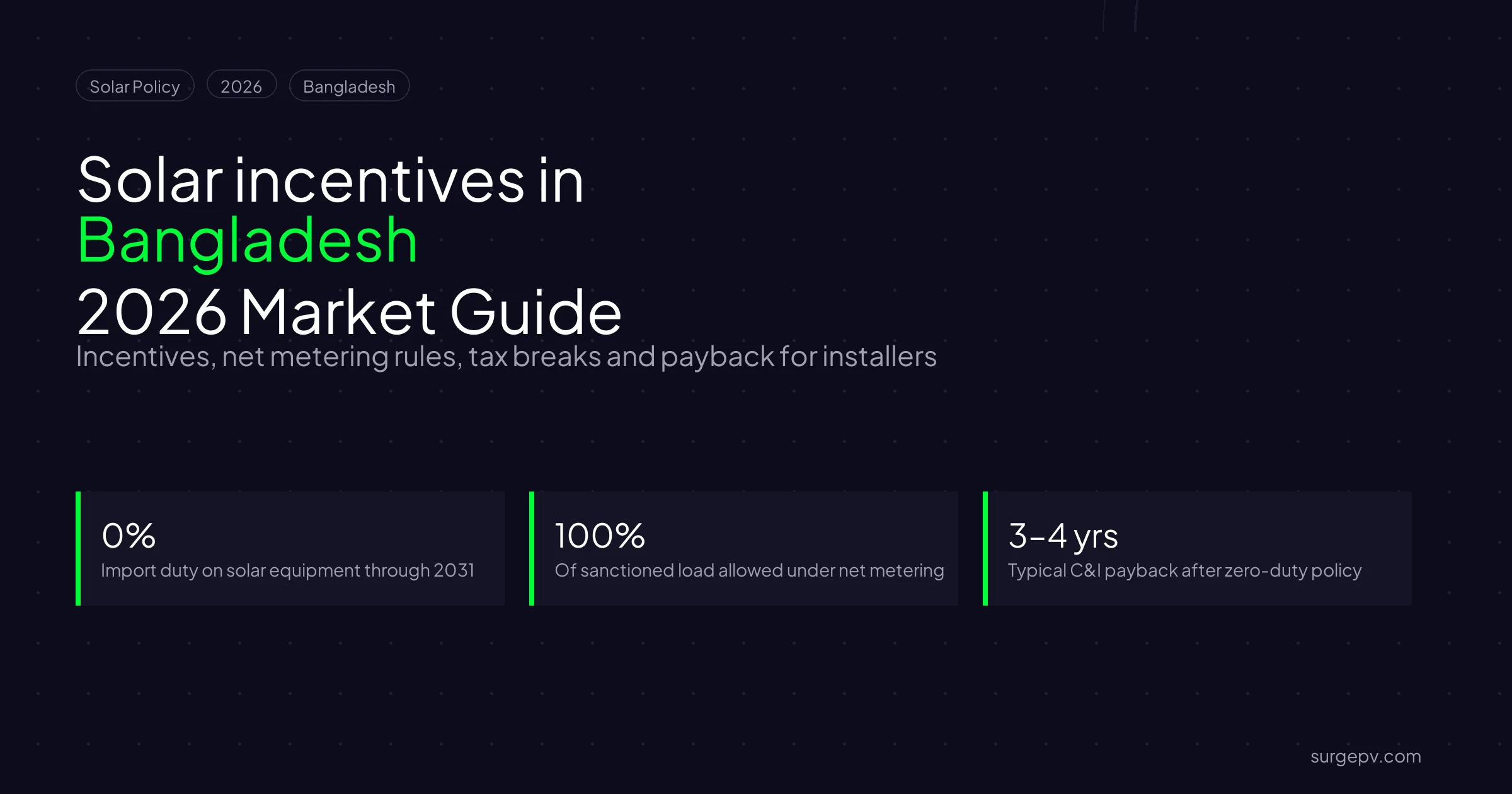
Bangladesh's 2026 solar incentives combine zero import duty on panels, inverters, batteries and balance-of-system equipment through 2031, a 10-year tax holiday for renewable projects, 0% tax on solar generation until 2035, net metering up to 100% of sanctioned load, and mandatory rooftop solar for large new buildings and load increases.
Bangladesh’s solar market crossed a clear threshold in 2025. The government approved the Net Metering Guidelines 2025, the National Rooftop Solar Programme, and a new Renewable Energy Policy. Then the FY2026-27 budget removed import duties on solar equipment entirely. For installers, EPCs and factory owners, the message is simple: Bangladesh is moving from pilot projects to a scaled solar market.
This guide is a practical incentive manual for 2026. It covers the active policy stack, how net metering works, who qualifies, mandatory rooftop solar rules, and how the new tax breaks change project economics. For regional comparisons, see our solar payback period by country guide. For the global picture, see our global solar market forecast 2026.
If you design systems or write proposals for Bangladeshi clients, use a solar design platform that models local tariffs and sanctioned-load limits. This can cut proposal time significantly. Model payback automatically, then generate solar proposals in minutes. Check pricing or book a demo to see how SurgePV handles Bangladesh.
Bangladesh’s 2026 solar incentive stack is built from tax breaks, net metering expansion and mandatory installation rules rather than direct cash subsidies. The value comes from combining zero import duty, tax holidays, net metering at 100% of sanctioned load, and mandatory rooftop solar for large buildings.
TL;DR — Solar Incentives in Bangladesh 2026
Active mechanisms: zero import duty on solar equipment through 2031; 10-year tax holiday for renewable projects; 0% income tax on solar generation until 2035; 5% tax rebate on electricity-related expenses; net metering up to 100% of sanctioned load; mandatory rooftop solar for large buildings; and the National Rooftop Solar Programme targeting 2,000–3,000 MW.
In this guide:
- Latest 2026 status of every active Bangladesh solar incentive
- Market size, targets and why solar now makes sense
- Net Metering Guidelines 2025: who qualifies, capacity limits and payment rules
- Mandatory rooftop solar rules for buildings and load increases
- Tax and fiscal incentives: import duty, tax holiday, income tax exemption and rebate
- National Rooftop Solar Programme and public-sector models
- Industrial and commercial routes beyond rooftop net metering
- Real-world payback scenarios with numbers
- Common mistakes and how to avoid them
Latest Updates: Bangladesh Solar Incentives 2026
Bangladesh’s solar policy environment changed fast between mid-2025 and mid-2026. Three reforms reshaped the market: the Net Metering Guidelines 2025, the Renewable Energy Policy 2025, and the FY2026-27 budget’s zero-duty package.
Bangladesh Solar Incentive Status — June 2026
| Incentive | Type | Status | Key Terms |
|---|---|---|---|
| Zero import duty on solar equipment | Customs relief | Active | Modules, inverters, batteries, BESS, mounting, DC cables until 30 June 2031 |
| 10-year tax holiday | Corporate tax exemption | Active | For renewable power generation projects |
| 0% tax on solar generation | Income tax exemption | Active | Until 30 June 2035, including private plants |
| 5% tax rebate on electricity expenses | Income tax credit | Active | For eligible consumers and businesses using solar power |
| Net metering up to 100% of sanctioned load | Surplus credit | Active | Single-phase and three-phase consumers eligible |
| Direct payment for surplus | Cash settlement | Active | To bank or mobile banking accounts |
| Mandatory rooftop solar | Regulatory mandate | Active | New buildings over 92.2 m² and load increases ≥10 kW |
| National Rooftop Solar Programme | Capacity programme | Active | 2,000–3,000 MW target across public institutions |
| Online net metering portal | Administrative | Active | nem.powerdivision.gov.bd |
Key Changes Since 2025
Net Metering Guidelines 2025 raised the rooftop solar cap from 70% to 100% of sanctioned load. They also opened net metering to single-phase consumers and allowed prepaid and smart meters. Consumers can now receive direct payment via bank or mobile banking. Applications are submitted online at nem.powerdivision.gov.bd.
Mandatory rooftop solar rules now require new buildings with more than 92.2 square meters of usable rooftop to install net-metered solar as a condition for grid connection. The December 2025 Power Division circular applies to industrial and commercial consumers with 10 kW or more of allocated load. These consumers must install a system equal to at least 20% of approved load.
Zero import duty package in the FY2026-27 budget removed all major import taxes on solar and storage equipment through 30 June 2031. Covered items include PV modules, inverters, lithium batteries, BESS, battery management systems, mounting structures and UV-protected DC cables.
Key Takeaway
2026 is Bangladesh’s strongest solar policy year to date. The most reliable incentives are the zero-duty equipment regime and net metering value, because direct subsidies are limited and project execution timelines remain uneven.
Why Bangladesh’s Solar Market Matters in 2026
Bangladesh has strong solar fundamentals. Average solar irradiance is roughly 5 kWh/m²/day, and the country receives abundant sunshine for most of the year. The bigger driver, however, is energy security.
Market Size and Targets
Bangladesh’s total installed power generation capacity stood at approximately 28,919 MW as of May 2026. Renewable energy contributed roughly 5% of that total, according to Daily Sun reporting BPDB data (2026). Solar power capacity is approximately 1,450–1,500 MW across grid-connected and off-grid systems, including more than 6 million solar home systems.
The Renewable Energy Policy 2025 targets 20% of total power from renewables by 2030 and 30% by 2040, according to BSS reporting SREDA officials (2025). The government also announced a 10,000 MW solar target over the next five years, according to The Financial Express (2026).
The Load-Shedding and Tariff Driver
Bangladesh experienced significant load shedding in 2024, and grid reliability remains a concern. Industrial and commercial consumers face high electricity costs and gas shortages. Rooftop solar reduces grid dependence, hedges against tariff increases, and can provide backup when paired with batteries.
For solar professionals, the opportunity is to show both bill savings and energy security. That requires hourly load modeling and accurate shading analysis, both of which are built into modern solar design software.
The Regulatory Foundation: SREDA, BERC and the Utilities
Bangladesh’s renewable energy sector is governed by a layered framework. The Sustainable and Renewable Energy Development Authority (SREDA) sets policy and maintains approved product lists. The Bangladesh Energy Regulatory Commission (BERC) regulates tariffs and grid codes. The Bangladesh Power Development Board (BPDB) and distribution utilities handle interconnection.
Key Institutions
| Institution | Role |
|---|---|
| SREDA | Renewable energy policy, net metering guidelines, approved equipment lists |
| BERC | Tariff orders, grid code, regulatory approvals |
| BPDB | Bulk generation, tendering for utility-scale solar, distribution in some areas |
| DESCO | Dhaka Electric Supply Company — distribution utility |
| DPDC | Dhaka Power Distribution Company — distribution utility |
| NESCO | Northern Electricity Supply Company |
| WZPDCL | West Zone Power Distribution Company |
| BREB | Bangladesh Rural Electrification Board — rural distribution |
| IDCOL | Infrastructure Development Company Limited — off-grid solar and irrigation finance |
Approved Equipment
SREDA maintains lists of approved solar panels and inverters at solar.sreda.gov.bd. Using non-approved equipment is one of the most common reasons net metering applications are rejected.
Net Metering in Bangladesh 2026
Net metering is the core incentive for rooftop solar in Bangladesh. The 2025 guidelines expanded eligibility and removed several practical barriers.
Who Qualifies
- Active consumers of DESCO, DPDC, NESCO, WZPDCL, BREB or BPDB.
- Single-phase and three-phase consumers.
- Consumers with postpaid, prepaid or smart meters.
- No outstanding electricity bills at the time of application.
Capacity Limits
The system AC capacity cannot exceed 100% of the sanctioned load. Residential single-phase consumers typically need a minimum 1 kW system, while three-phase consumers need at least 3 kW. For load increases, the December 2025 circular requires three-phase consumers with allocated load of 10 kW or more to install at least 5 kW.
How Credits Work
Exported kWh are credited against imported kWh. The settlement period and credit rollover rules are set by the distribution utility. Consumers can also opt for direct payment of surplus credits to bank or mobile banking accounts.
Application Process
- Prepare an engineering design package: layout, single-line diagram, string diagram, earthing and cable sizing.
- Submit online through the SREDA net metering portal.
- Utility reviews technical documents.
- Site inspection and bidirectional meter installation.
- Commissioning and agreement signing.
A well-modeled energy and financial modeling tool can test system size, self-consumption ratio and payback against the customer’s actual tariff slab.
Mandatory Rooftop Solar Rules
Bangladesh is one of the few markets where rooftop solar is both incentivized and required for certain buildings.
New Buildings
New residential, commercial, industrial, educational and healthcare buildings with more than 92.2 square meters (1,000 square feet) of usable rooftop must install a net-metered solar system to receive a grid connection.
Load Increases
Existing buildings that want to increase their sanctioned load must install additional rooftop solar. The December 2025 Power Division circular made the requirement stricter for industrial and commercial consumers.
C&I Minimum Capacity Requirements
| Allocated Load | Minimum Rooftop Solar Requirement |
|---|---|
| Below 10 kW | Optional, but encouraged |
| 10 kW or more (industrial/commercial) | Minimum 20% of approved load |
| Three-phase ≥10 kW | Minimum 5 kW net-metered system |
These rules create a steady pipeline of commercial and industrial projects. For installers, the priority is accurate structural assessment and fast utility coordination.
Tax and Fiscal Incentives
Bangladesh does not offer direct cash rebates for most rooftop solar buyers. The real value lies in import duty relief, tax holidays and income tax exemptions.
Zero Import Duty on Solar Equipment
The FY2026-27 budget eliminated all major import taxes on solar and storage equipment through 30 June 2031. Covered items include:
- Solar PV modules and panels
- Grid-tied, hybrid and off-grid inverters
- Lithium cells and lithium-ion batteries
- Battery energy storage systems (BESS)
- Battery management systems (BMS)
- Battery thermal management systems
- Mounting structures and installation systems
- UV-protected solar DC cables
Previously, combined import taxes on PV equipment ranged from roughly 26.2% to 58.6%, according to ESG Institute Bangladesh (2026). The zero-duty policy is the single largest cost reduction for Bangladesh solar in 2026.
10-Year Tax Holiday
Renewable power generation projects qualify for a 10-year corporate tax holiday. This applies to utility-scale, commercial and industrial projects that meet SREDA and registration requirements.
0% Income Tax on Solar Generation
The FY2026-27 budget granted a 0% tax rate on solar power generation projects until 30 June 2035. This includes privately developed power plants.
5% Tax Rebate on Electricity Expenses
Eligible consumers and businesses using solar-generated power receive a 5% tax rebate on electricity-related expenses. They can credit this against payable income tax.
Green Finance
The Bangladesh Bank and commercial banks offer green finance lines at preferential rates for renewable energy projects. IDCOL also provides concessional financing for off-grid solar, solar irrigation and mini-grids.
Financing Models for Rooftop Solar
Bangladeshi consumers and businesses can choose from three main ownership models. Each has different cash-flow and balance-sheet implications.
| Model | Upfront Cost | Who Owns the Asset | Best For |
|---|---|---|---|
| CAPEX | Full system cost paid by consumer | Consumer | Homeowners, factories with cash |
| OPEX | Near-zero upfront; monthly fee to developer | Developer | Schools, hospitals, SMEs with limited capital |
| Lease/loan | Partial or full financing via bank | Consumer or bank | Commercial buildings with steady cash flow |
Under the OPEX model, the developer installs, operates and maintains the system. The consumer pays a fixed tariff per kWh that is typically lower than the grid rate. This model is popular under the National Rooftop Solar Programme for public institutions.
Interest rates for green loans from commercial banks typically range from 7% to 12%. IDCOL refinancing can bring effective rates lower for eligible off-grid and irrigation projects. For C&I buyers, the combination of zero import duty, a 10-year tax holiday and low-cost green finance can push project IRR above 15%.
National Rooftop Solar Programme
The National Rooftop Solar Programme, approved in June 2025, aims to install 2,000–3,000 MW of rooftop solar across government and public institutions. The programme supports multiple implementation models.
Implementation Models
| Model | Who Bears Cost | Typical Use |
|---|---|---|
| CAPEX | Government institution | Government offices with budget |
| OPEX | Private investor | Schools, hospitals, religious institutions |
| Utility-investor partnership | Distribution utility + investor | Public institutions with limited budget |
Under the OPEX and partnership models, electricity generated is first supplied to the institution. Surplus is exported to the distribution utility at a bulk tariff not exceeding roughly Tk. 8.89 per unit, according to the National Rooftop Solar Programme Implementation Guideline (2025).
Practical Challenges
The programme faces tight timelines and capacity hurdles. Bangladesh installed roughly 245 MW of rooftop solar between June 2008 and June 2025, according to IEEFA (2025). Adding 3,000 MW in a short period requires more than 12 times that pace. IEEFA notes that the combined sanctioned load of government offices, hospitals and educational institutions is likely below 3,000 MW. This makes the target physically constrained under current net metering rules.
Commercial and Industrial Solar Routes
C&I solar in Bangladesh is driven by a different economics than residential rooftop. The main value drivers are avoided grid tariffs, diesel substitution, gas shortage hedging and export compliance.
Captive and Self-Consumption
Factories with high daytime loads can install rooftop solar under net metering and offset consumption at the retail tariff. Because export credits are settled at lower bulk rates, self-consumption is more valuable than export.
Corporate PPAs
Corporate power purchase agreements allow large buyers to contract directly with renewable generators. These are increasingly attractive to export-oriented garment and textile factories facing EU supply-chain decarbonization requirements.
Solar Irrigation and Agriculture
IDCOL’s solar irrigation programme is one of the largest off-grid solar deployments in the country. Solar pumps replace diesel pumps for agriculture, often with 30–60% capital subsidy support.
Utility-Scale Solar Parks
BPDB has tendered large-scale solar parks across the country. Utility-scale developers benefit from the 10-year tax holiday, 0% generation tax until 2035, zero-duty equipment imports and long-term power purchase agreements.
For C&I installers, the design priorities are load profiling, demand analysis and irradiance and shading analysis. SurgePV models each route in its generation and financial tool.
Real-World Payback Scenarios
The following examples are illustrative, based on typical 2026 costs after the zero-duty policy. Actual figures depend on location, tariff slab, installer quote and self-consumption ratio.
Scenario 1 — 5 kW Residential Rooftop, Dhaka
| Item | Amount |
|---|---|
| Gross installed cost | Tk. 350,000 |
| Annual bill savings (LT-A 301–400 slab) | Tk. 80,800 |
| Simple payback | 4.3 years |
This example is based on the eBill Bangladesh solar savings calculator (2026). Higher self-consumption improves payback further.
Scenario 2 — 100 kW Commercial Rooftop, Chattogram
| Item | Amount |
|---|---|
| Gross installed cost | Tk. 5,500,000 |
| Annual avoided electricity cost | Tk. 1,400,000 |
| Simple payback | 3.9 years |
Commercial projects benefit from high daytime load, high retail tariffs and the ability to claim the 5% tax rebate on electricity expenses.
Scenario 3 — 1 MW Industrial Captive Solar, Gazipur
| Item | Amount |
|---|---|
| Gross installed cost | Tk. 45,000,000 |
| Annual savings (grid + diesel substitution) | Tk. 12,000,000 |
| Simple payback | 3.8 years |
Industrial projects that displace diesel generator runtime during load shedding can achieve the fastest payback.
Common Mistakes and Misconceptions
Even experienced installers lose money in Bangladesh by misunderstanding how incentives interact.
Oversizing for Export
The single most expensive mistake is designing a system that exports more than the customer consumes. Net metering export credits are typically settled at bulk rates, which are lower than retail import rates. Size for self-consumption, not maximum generation.
Assuming a Direct Subsidy
Bangladesh does not offer a direct upfront cash subsidy for most rooftop solar buyers. The value is in import duty relief, tax holidays, net metering savings and mandatory market expansion.
Ignoring SREDA Approval Lists
Using non-approved panels or inverters is a leading cause of net metering rejection. Always cross-check models on the SREDA approved-products portal before procurement.
Underestimating Interconnection Time
Utility review, site inspection, meter change-out and commissioning can take 30–60 days or longer. Build realistic timelines into contracts and customer expectations.
Forgetting Structural Assessment
Many Bangladeshi rooftops were not designed for solar loads. A structural assessment is essential, especially for older commercial buildings and government institutions.
Misapplying Tax Benefits
Tax holidays and rebates require correct registration and documentation. Work with a local tax advisor to ensure the project structure qualifies.
Conclusion
Bangladesh’s solar incentive framework in 2026 is a stack built from zero import duty, tax holidays, generation tax exemption, net metering expansion and mandatory rooftop solar rules. None of these mechanisms is as simple as a cash rebate, but combined they make solar one of the fastest-payback investments in the country’s power sector.
For solar professionals, the competitive edge is the ability to model the right system size, maximize self-consumption, navigate SREDA approvals and stack tax benefits correctly. Tools like Clara AI and SurgePV’s generation and financial tool can automate that workflow for Bangladesh projects.
Three actions to take now:
- Verify the sanctioned load before sizing — net metering caps system capacity at 100% of sanctioned load.
- Maximize self-consumption — exported energy in Bangladesh is worth less than avoided retail purchases.
- Use SREDA-approved equipment and document tax benefits — rejection and lost tax value are expensive.
For installers scaling in South Asia, our guide for solar installers covers proposal automation and compliance workflows.
Frequently Asked Questions
What solar incentives are available in Bangladesh in 2026?
Bangladesh offers zero import duty on solar PV modules, inverters, lithium batteries, BESS, mounting structures and DC cables through 2031. Renewable power projects receive a 10-year tax holiday, and solar generation is taxed at 0% until 2035. Consumers also get a 5% tax rebate on electricity-related expenses and net metering up to 100% of sanctioned load.
How does net metering work in Bangladesh?
Under the Net Metering Guidelines 2025, consumers can install rooftop solar up to 100% of their sanctioned load. Excess generation is exported to the grid through a bidirectional meter, and credits are settled against future electricity bills. Consumers can also receive direct payment to bank or mobile banking accounts.
Is rooftop solar mandatory in Bangladesh?
Yes. New buildings with more than 92.2 square meters (1,000 square feet) of usable rooftop must install net-metered solar to receive a grid connection. Industrial and commercial consumers with allocated loads of 10 kW or more must install at least 20% of their approved load. Existing buildings seeking load increases must also add rooftop solar.
What is the payback period for solar in Bangladesh?
Well-designed residential rooftop systems in Bangladesh typically pay back in 4–6 years. Commercial and industrial systems can pay back in 3–4 years after the zero-duty policy. Payback depends on self-consumption ratio, tariff slab, system cost and whether the installer passes through import-duty savings.
Who can apply for net metering in Bangladesh?
Active consumers of DESCO, DPDC, NESCO, WZPDCL, BREB or BPDB can apply. Both single-phase and three-phase consumers are eligible. Applicants must have no outstanding bills and must use SREDA-approved panels and inverters. Applications are submitted online through nem.powerdivision.gov.bd.
What are Bangladesh’s renewable energy targets?
Bangladesh’s Renewable Energy Policy 2025 targets 20% of total power from renewables by 2030 and 30% by 2040. The government also announced a 10,000 MW solar target over the next five years. Current solar capacity is roughly 1,450–1,500 MW across grid-connected and off-grid systems.
Are solar inverters duty-free in Bangladesh?
Yes. The FY2025-26 budget cut inverter import duty from 10% to 1%. The FY2026-27 budget then extended zero import duty to inverters, batteries, BESS, mounting structures and other balance-of-system equipment through June 2031.
What is the National Rooftop Solar Programme?
The National Rooftop Solar Programme, approved in June 2025, aims to install 2,000–3,000 MW of rooftop solar across government offices, schools, hospitals and other institutions. It supports CAPEX, OPEX and utility-investor partnership models with bulk-tariff export arrangements.
Can industries sell surplus solar power in Bangladesh?
Yes. Net-metered consumers can export surplus generation to the distribution utility and receive bill credits or direct payment. Large generators can also sell power through corporate PPAs, captive power arrangements or wholesale market structures.
What is the most common mistake when sizing a solar system in Bangladesh?
The most common mistake is oversizing for export. Net metering value is highest when solar generation is consumed on site because export credits are typically settled at bulk or avoided-cost rates. Systems should be sized to maximize self-consumption rather than total generation.
Where this fits
This article is part of SurgePV's Solar Incentives & Policy hub, which works through the topic from first principles to the decisions a project team actually has to make.

