

Illinois homeowners paid an average residential electricity rate of about 16-17 cents per kWh in early 2026, well above the national average, according to LTD Solar Consulting rate analysis (2026). That price gap is why solar remains attractive even after the federal Residential Clean Energy Credit expired for homeowner-owned systems at the end of 2025. The state has built one of the strongest incentive stacks in the Midwest. The challenge is that the rules changed materially on January 1, 2025, and the value of a project now depends heavily on utility territory, system sizing, and whether the customer qualifies for income-based programs.
This guide covers every active Illinois solar incentive in 2026. It explains Illinois Shines SREC payments, ComEd and Ameren DG rebates, the shift to supply-only net metering, property tax treatment, Illinois Solar for All, and how financing choices affect ROI. For the national context, see our solar incentives in USA 2026 guide and state solar incentives in the US overview. For installers, accurate territory-specific modeling is now the difference between a proposal that closes and one that gets rejected. SurgePV’s solar design software and generation and financial tool let you model each incentive stream, utility rate, and financing scenario in one place. You can then generate professional solar proposals and check pricing or book a demo.
Quick Answer
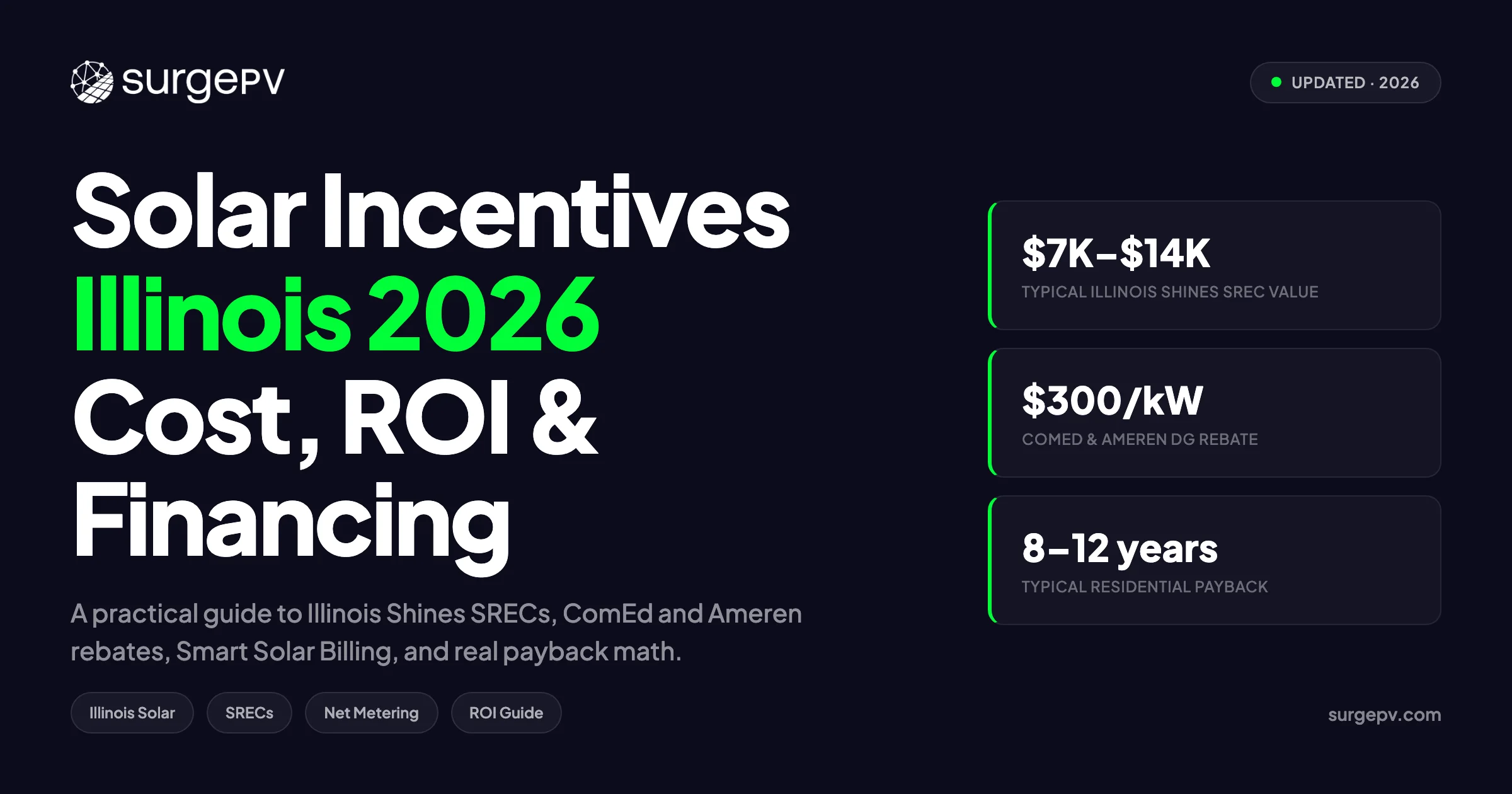
Illinois solar incentives in 2026 include Illinois Shines SREC payments worth roughly $7,000-$14,000 for a typical residential system, ComEd and Ameren DG rebates at $300/kW for solar and $300/kWh for batteries, a property tax exemption, and supply-only net metering for new systems. The federal residential tax credit expired for homeowner-owned systems after December 31, 2025.
TL;DR — Illinois Solar Incentives 2026
Active programs: Illinois Shines upfront SREC payments, ComEd/Ameren DG rebates, battery rebates, property tax exemption, and Illinois Solar for All for income-qualified households. New systems use supply-only net metering. No state sales tax exemption and no state income tax credit. The federal Section 25D residential credit is gone for homeowner-owned systems placed in service after December 31, 2025.
In this guide:
- Illinois solar incentive snapshot and what changed in 2026
- Federal tax credit status for residential and commercial projects
- Illinois Shines SREC payments, blocks, and 2026-27 pricing
- ComEd and Ameren DG rebates and Smart Solar Billing rules
- Property tax, sales tax, and other state rules
- Illinois Solar for All and community solar
- Cost, ROI, and payback scenarios by utility territory
- Financing options and common mistakes
Illinois Solar Incentives at a Glance — 2026
Illinois remains one of the better state-level solar markets even without the federal residential tax credit. The value comes from stacking several programs rather than relying on one large rebate. Utility territory matters more in Illinois than in most states.
| Incentive | Type | 2026 Status | Typical Value |
|---|---|---|---|
| Federal residential ITC (Section 25D) | Tax credit | Expired | $0 for cash or loan residential purchases |
| Federal Section 48E | Commercial tax credit | Active, deadlines apply | 30% for eligible commercial, lease, or PPA systems |
| Illinois Shines SRECs | Upfront performance payment | Active | $73.71-$83.87 per REC for 2025-26; 2026-27 rates proposed higher |
| ComEd/Ameren DG rebate — solar | Utility rebate | Active | $300/kW DC for smart inverter systems |
| ComEd/Ameren DG rebate — battery | Utility rebate | Active | $300/kWh of battery storage |
| Property tax exemption | Tax exemption | Active | Solar assessed same as HVAC; no added tax |
| Sales tax exemption | Tax exemption | Not available | Standard state and local sales tax applies |
| Illinois Solar for All | Low-income program | Active, waitlists likely | No upfront cost; guaranteed savings |
| Community solar | Subscription credit | Active | 5-15% bill credit discount |
| Net metering | Bill credit | Changed Jan 1, 2025 | Supply-only credits for new systems |
The biggest misconception is that Illinois offers a state tax credit or a sales tax exemption. It does not. The real money is in the SREC payment, the DG rebate, and the property tax exemption. The biggest risk is designing a system for full retail net metering that no longer exists.
How the Federal Tax Credit Changed in 2026
The federal Residential Clean Energy Credit under Internal Revenue Code Section 25D allowed homeowners to claim 30% of qualified solar and battery costs. It expired on December 31, 2025. Homeowner-owned systems placed in service on or after January 1, 2026 no longer qualify. This is not a phase-down. It is a hard stop.
For Illinois homeowners, this changes the sales conversation. In 2024 and 2025, installers could lead with “30% federal tax credit plus Illinois Shines.” In 2026, the proposal has to stand on state and utility incentives plus avoided utility costs. The math still works in most of Illinois because electricity rates are high and state incentives are strong, but the payback period is longer than it was.
Commercial and third-party-owned residential systems still have a path. Section 48E, the Clean Electricity Investment Credit, offers a 30% base credit for projects that begin construction by July 4, 2026, or are placed in service by December 31, 2027. This is why solar leases and power purchase agreements can still advertise lower monthly payments in 2026. The system owner, not the homeowner, claims the credit.
The One Big Beautiful Bill Act, signed July 4, 2025, created these deadlines. Commercial solar buyers should treat mid-2026 as the decision point. Development, permitting, and interconnection for a commercial project can easily take 12-18 months. Waiting until late 2026 risks missing the construction begin date.
Illinois Shines: SREC Payments Explained
Illinois Shines, officially the Adjustable Block Program, is the state’s main solar incentive. It was created under the Future Energy Jobs Act of 2016 and expanded under the Climate and Equitable Jobs Act of 2021. The program is administered by the Illinois Power Agency (2026).
The program works differently from traditional SREC markets. Instead of selling credits annually on an open market, homeowners sign a 15-year contract with an Approved Vendor. The vendor receives an upfront lump-sum payment based on the projected SRECs the system will generate over 15 years. The vendor then passes that value to the homeowner, usually as a reduction in the system price.
One SREC, or Renewable Energy Credit, equals one megawatt-hour of electricity generation. A typical 8 kW residential system in Illinois produces about 9-10 MWh in year one and roughly 130 MWh over 15 years. That translates to about 130 SRECs.
2025-26 SREC Pricing
SREC prices vary by utility territory and system size. For the 2025-26 program year, which began June 2, 2025, the Illinois Power Agency set the following prices, according to SolarReviews (2026):
| Group | Territory | Size | Price per REC |
|---|---|---|---|
| Group A | Ameren, MidAmerican, rural co-ops in MISO | 0-10 kW | $73.71 |
| Group A | Ameren, MidAmerican, rural co-ops in MISO | 10-25 kW | $63.53 |
| Group B | ComEd, rural co-ops and munis in PJM | 0-10 kW | $83.87 |
| Group B | ComEd, rural co-ops and munis in PJM | 10-25 kW | $77.53 |
A typical 8 kW system in ComEd territory earning 130 RECs at $83.87 would generate roughly $10,900 in SREC payments. The same system in Ameren territory at $73.71 would generate roughly $9,600. These payments typically arrive about one year after installation, after the system is interconnected and metered.
2026-27 Pricing Outlook
The Illinois Power Agency has proposed significant increases for the 2026-27 program year. According to StraightUp Solar (2026), the proposed increases range from 34% to 43% depending on system size and utility territory:
| System Size | Ameren / Rural Co-ops | ComEd |
|---|---|---|
| Under 10 kW | 36% increase | 34% increase |
| 10-25 kW | 41% increase | 43% increase |
These rates are subject to Illinois Commerce Commission approval. Homeowners should verify current block availability and pricing at illinoisshines.com before signing a contract. Blocks fill over time, and waiting too long can mean lower prices.
How the Payment Reaches You
The payment flows through your Approved Vendor, which is usually your installer or a partner. The vendor receives the SREC payment from the program and applies it to your system cost. Your contract should specify the exact amount, whether it is guaranteed, and when it will be applied. Do not assume the full published REC price goes to you. The vendor may retain a portion for administration and risk.
The Illinois Shines payment is taxable income. Homeowners must report it in the year received. Consult a tax professional to understand the impact on your specific situation.
ComEd and Ameren DG Rebates and Smart Solar Billing
ComEd and Ameren Illinois offer a Distributed Generation rebate for systems with qualifying smart inverters. The rebate is separate from Illinois Shines and can be stacked on top of it.
The current rebate is $300 per kW of installed solar capacity. An 8 kW system earns $2,400. The battery rebate is $300 per kWh of storage capacity. A 10 kWh battery earns $3,000. These numbers are confirmed by EnergySage (2026) and utility tariff filings.
Taking the DG rebate has a critical side effect. It enrolls the system in supply-only net metering, also called Smart Solar Billing. This is the new standard for all residential systems interconnected on or after January 1, 2025, regardless of whether the rebate is taken.
Smart Solar Billing Explained
Under supply-only net metering, exported solar generation is credited only against the supply portion of the electric bill. It does not offset delivery charges, transmission charges, or fixed monthly customer fees.
In ComEd territory, the supply credit rate is roughly 6.8 cents per kWh, according to ExSpenditure (2026). In Ameren territory, it is roughly 8 cents per kWh. The all-in retail rate in ComEd is closer to 17 cents per kWh, while Ameren averages about 15.5 cents per kWh. That means exported solar is worth roughly 40-50% of what it would have been under full retail net metering.
This changes design strategy. Oversizing a system for export is no longer optimal. The better approach is to size the system close to actual consumption and, where budget allows, add battery storage to shift midday solar production to evening use. Every kWh consumed on-site avoids the full retail rate. Every kWh exported earns only the supply credit.
Legacy Full Retail Net Metering
Systems interconnected before January 1, 2025 keep full retail-rate net metering for the life of the system. This is a valuable grandfathered benefit. However, it can be lost if the system is modified in certain ways.
For ComEd customers, any modification requiring a new interconnection application ends grandfathered status. For Ameren customers, increasing the system nameplate capacity by more than 100% ends grandfathered status. Homeowners with legacy net metering should consult their utility before adding panels or batteries.
Property Tax, Sales Tax, and Other State Rules
Illinois treats solar equipment favorably for property taxes but not for sales taxes. This surprises many homeowners who read outdated summaries online.
Property Tax Exemption
Illinois law requires solar energy systems to be assessed the same as conventional HVAC equipment. The added value of a residential solar system does not increase the property tax assessment. This is a permanent exemption under 35 ILCS 200/10-10.
Homeowners should file Form PTAX-330 with their county assessor. The form documents that the solar system should not increase assessed value. Typical annual savings range from $200 to $500 depending on the county tax rate and system value. The exemption applies even though solar can increase market value by $15,000 to $25,000, according to Windfree Solar (2026).
Sales Tax
Illinois does not have a statewide sales tax exemption for residential solar equipment or installation labor. Solar purchases are subject to the state sales tax rate plus any local taxes. Some online sources incorrectly state that an exemption exists. Homeowners should verify current tax treatment with their installer or the Illinois Department of Revenue.
This matters for proposal accuracy. A $25,000 system in an area with a 7.25% combined sales tax rate incurs about $1,800 in sales tax. Installers should not bury this in a line item. It should be explicit in the quote.
Clean and Reliable Grid Affordability Act
Governor Pritzker signed the Clean and Reliable Grid Affordability Act in January 2026. The law expands energy efficiency programs and creates new battery storage incentives. It takes effect June 1, 2026, according to Windfree Solar (2026).
The law establishes a Virtual Power Plant framework that allows residential battery owners to receive additional compensation for utility-scheduled grid dispatch events. Early guidance suggests a $250 per kWh battery storage rebate may be available for enrolled systems. Details are still emerging, and homeowners should verify program launch status with ComEd or Ameren before relying on it.
Illinois Solar for All and Income-Qualified Programs
Illinois Solar for All is a subset of Illinois Shines for income-qualified households. It is one of the strongest low-income solar programs in the country. Households at or below 80% of area median income can receive solar at no upfront cost with guaranteed savings.
How Illinois Solar for All Works
Participants pay no money down. They pay a small monthly fee for 15 years, typically around $25 per month or less. After 15 years, ownership of the system transfers to the household. The program guarantees that the participant’s total costs will not exceed 50% of the value of the energy produced by the system.
For a Cook County single-person household, the income limit is approximately $65,000, according to Windfree Solar (2026). Limits vary by county and household size. Applicants must use an ILSFA-approved vendor.
Single-family capacity for the program reached its limit in 2025, so new applicants may be placed on a waitlist for the 2026 cycle. The waitlist is still worth joining because the program terms are significantly better than standard Illinois Shines for those who qualify.
Community Solar
Illinois renters and homeowners without suitable roofs can subscribe to community solar. Subscribers receive bill credits for production from an off-site array, typically at a 5-15% discount compared to retail rates. No panels are installed on the subscriber’s property.
Community solar is available through Illinois Shines and has a separate low-income pathway through Illinois Solar for All. It is a good option for apartments, shaded homes, and households that cannot install rooftop solar.
Cost, ROI, and Payback Scenarios by Utility Territory
The financial case for solar in Illinois depends on where you live. ComEd territory generally has higher electricity rates and higher SREC prices than Ameren territory. That creates shorter payback periods in northern Illinois.
Typical System Costs
As of mid-2026, Illinois residential solar costs average roughly $3.00 to $3.75 per watt before incentives, according to EnergySage (2026). A typical 8 kW system costs $24,000 to $30,000 before incentives.
Scenario 1: ComEd Territory, 8 kW System
| Line Item | Value |
|---|---|
| Gross system cost | $28,000 |
| Illinois Shines SRECs | -$10,900 |
| ComEd DG rebate | -$2,400 |
| Net upfront cost | $14,700 |
| Annual savings at $0.17/kWh | $1,800-$2,200 |
| Simple payback | 7-8 years |
This assumes the system offsets most annual consumption and exports a modest surplus under Smart Solar Billing. Payback is faster if the household has high daytime usage or adds battery storage to capture peak rates.
Scenario 2: Ameren Territory, 8 kW System
| Line Item | Value |
|---|---|
| Gross system cost | $28,000 |
| Illinois Shines SRECs | -$9,600 |
| Ameren DG rebate | -$2,400 |
| Net upfront cost | $15,900 |
| Annual savings at $0.155/kWh | $1,600-$2,000 |
| Simple payback | 8-10 years |
Ameren has lower SREC prices and lower electricity rates than ComEd, so payback is slightly longer. The system still makes financial sense for most households with good roofs and stable usage.
Scenario 3: Solar-Plus-Battery in ComEd Territory
| Line Item | Value |
|---|---|
| Gross system cost | $42,000 |
| Illinois Shines SRECs | -$10,900 |
| Solar DG rebate | -$2,400 |
| Battery DG rebate | -$3,000 |
| Net upfront cost | $25,700 |
| Annual savings with self-consumption | $2,400-$2,900 |
| Simple payback | 9-11 years |
Batteries improve economics under Smart Solar Billing because they shift solar production to evening hours when retail rates are highest. They also provide backup power value that is not captured in simple payback math.
These scenarios are illustrative. Actual results depend on roof orientation, shading, equipment, financing, and future utility rate changes. SurgePV’s generation and financial tool can model specific projects with current Illinois rates and incentives.
Model Illinois incentives with SurgePV
Build territory-specific proposals that stack Illinois Shines, DG rebates, and Smart Solar Billing accurately.
Book a DemoNo commitment required · 20 minutes · Live project walkthrough
Financing Options for Illinois Solar in 2026
Without the federal residential tax credit, financing choice matters more. The best option depends on the customer’s tax situation, credit score, and preference for ownership.
Cash Purchase
Cash delivers the highest lifetime savings because there is no interest. The customer captures the full Illinois Shines SREC payment and DG rebate. Payback is typically 7-10 years in Illinois, and the system produces free electricity for 15-25 years after that.
Solar Loan
Solar loans allow ownership without a large upfront payment. The customer still captures SRECs and rebates. However, loan interest reduces net savings. A 20-year loan at 7-9% interest can add 30-50% to the total cost of the system compared to cash.
In 2026, the federal tax credit cannot be used to reduce loan principal for new homeowner-owned systems. That removes one of the main arguments for financing through a loan. Customers should compare loan payments to expected utility savings carefully.
Lease and Power Purchase Agreement
Leases and PPAs require no upfront payment and provide immediate monthly savings. The system owner, usually a financing company or installer, claims any available federal Section 48E credit. The homeowner receives a lower electricity rate, typically 10-20% below utility rates.
The downside is that the homeowner does not own the system or capture the SRECs directly. SREC value is built into the lease rate. Leases and PPAs can also complicate home sales.
Illinois Solar for All
For income-qualified households, Illinois Solar for All is usually the best option. It provides no upfront cost and guaranteed savings. The program handles the financing and incentive capture.
Common Mistakes and Misconceptions
Illinois solar proposals fail or get disputed when installers oversimplify the incentive stack. Here are the most common errors.
Assuming Full Retail Net Metering Still Exists
Many homeowners and some installers still size systems based on full retail net metering. That changed on January 1, 2025. New systems get supply-only credits. Oversizing for export wastes money. The right approach is to size for actual consumption and maximize self-consumption.
Confusing Illinois Shines with a State Tax Credit
Illinois Shines is an upfront SREC payment, not a tax credit. It is taxable income. It does not reduce state income tax liability. Customers who expect a tax credit may be disappointed at filing time.
Ignoring the Sales Tax
Proposals that do not include sales tax understate the true upfront cost. Illinois does not exempt solar equipment from sales tax. The customer pays it, either as part of the system price or separately.
Waiting Too Long on Illinois Shines Blocks
Illinois Shines operates in blocks that fill over time. Delaying a project can mean moving from a higher-priced block to a lower-priced one. In 2026, the proposed 2026-27 rate increase creates a window, but blocks can still fill.
Misrepresenting Battery Economics
Batteries improve self-consumption under Smart Solar Billing, but they do not pay for themselves through export credits. Their value comes from avoiding peak retail rates and providing backup power. Proposals should show realistic battery dispatch and savings, not inflated export value.
Conclusion
Illinois solar incentives in 2026 are still strong, but they require careful stacking. The federal residential tax credit is gone for homeowner-owned systems. The value now comes from Illinois Shines SREC payments, ComEd and Ameren DG rebates, the property tax exemption, and Smart Solar Billing optimization.
- Verify your utility territory and current Illinois Shines block pricing before signing a contract.
- Size the system for self-consumption, not export, because new systems use supply-only net metering.
- Compare cash, loan, lease, and Illinois Solar for All options using a territory-specific financial model.
For installers, accurate Illinois proposals require precise modeling of SREC value, DG rebates, supply-only net metering, and utility rates. SurgePV’s PV design software helps you design systems that match the new rules, while the energy and financial modeling tool lets you build proposals that show real payback and ROI for both residential and commercial projects.
Frequently Asked Questions
What solar incentives are available in Illinois in 2026?
Illinois solar incentives in 2026 include Illinois Shines upfront SREC payments, ComEd and Ameren Distributed Generation rebates at $300/kW for solar and $300/kWh for battery storage, a property tax exemption that prevents added home value from increasing assessments, and income-qualified Illinois Solar for All. New residential systems are on supply-only net metering. The federal residential tax credit expired for homeowner-owned systems after December 31, 2025.
Does Illinois have a state solar tax credit in 2026?
No. Illinois does not offer a state income tax credit for residential solar installations. The main financial incentive is the Illinois Shines SREC program, which provides an upfront payment rather than a tax credit. Do not confuse this with a state tax credit.
Is the federal solar tax credit still available in Illinois in 2026?
The 30% federal Residential Clean Energy Credit under Internal Revenue Code Section 25D expired for homeowner-owned systems placed in service after December 31, 2025. Commercial, lease, and PPA systems may still qualify under Section 48E if construction begins by July 4, 2026, or the system is placed in service by December 31, 2027.
How much are Illinois Shines SRECs worth in 2026?
For the 2025-26 program year, Illinois Shines REC prices range from roughly $73.71 to $83.87 per REC depending on utility territory and system size. The Illinois Power Agency has proposed higher 2026-27 rates with increases of 34-43%. A typical 8 kW residential system can receive $7,000-$14,000 in total SREC payments over the 15-year contract.
What is the ComEd DG rebate for solar in 2026?
ComEd and Ameren Illinois offer a Distributed Generation rebate of $300 per kW of installed solar capacity for residential systems with qualifying smart inverters. They also offer $300 per kWh of battery storage capacity. An 8 kW solar system earns $2,400. Taking the rebate enrolls the system in supply-only net metering.
How does net metering work in Illinois in 2026?
New residential systems interconnected on or after January 1, 2025 receive supply-only net metering. Exported solar is credited only against the supply portion of the bill, not delivery charges or fixed fees. Legacy systems interconnected before January 1, 2025 keep full retail-rate net metering for the life of the system unless modified in ways that trigger reclassification.
Does Illinois have a sales tax exemption for solar panels?
No. Illinois does not have a statewide sales tax exemption for residential solar equipment or installation labor. Solar purchases are generally subject to the state sales tax rate plus any local taxes. Some online sources incorrectly claim an exemption exists.
Does Illinois have a property tax exemption for solar panels?
Yes. Illinois law requires solar energy systems to be assessed the same as conventional HVAC equipment. The added value of a residential solar system does not increase the property tax assessment. Homeowners should file Form PTAX-330 with their county assessor to document the system.
What is Illinois Solar for All?
Illinois Solar for All is an income-qualified program for households at or below 80% of area median income. It provides no-upfront-cost solar with guaranteed savings of at least 50% on the value of energy produced. Participants pay a small monthly fee for 15 years, after which ownership transfers to the household.
What is the typical solar payback period in Illinois in 2026?
A well-designed residential solar system in Illinois typically pays back in 8 to 12 years in 2026 without the federal residential tax credit. Payback is shorter in ComEd territory due to higher electricity rates and shorter in systems that pair solar with battery storage under Smart Solar Billing. Exact payback depends on utility territory, system size, financing, and incentive timing.
Where this fits
This article is part of SurgePV's Solar Incentives & Policy hub, which works through the topic from first principles to the decisions a project team actually has to make.
