

Hawaii has the highest residential electricity rates in the United States. The average Oahu homeowner pays roughly $0.42 per kWh, while some neighbor island rates exceed $0.45 per kWh, according to the U.S. Energy Information Administration. That single fact explains why solar has spread across the islands faster than almost anywhere else in the country. It also explains why Hawaii became the first state to close traditional net metering, replacing it with a set of programs that reward self-consumption and grid services rather than exports.
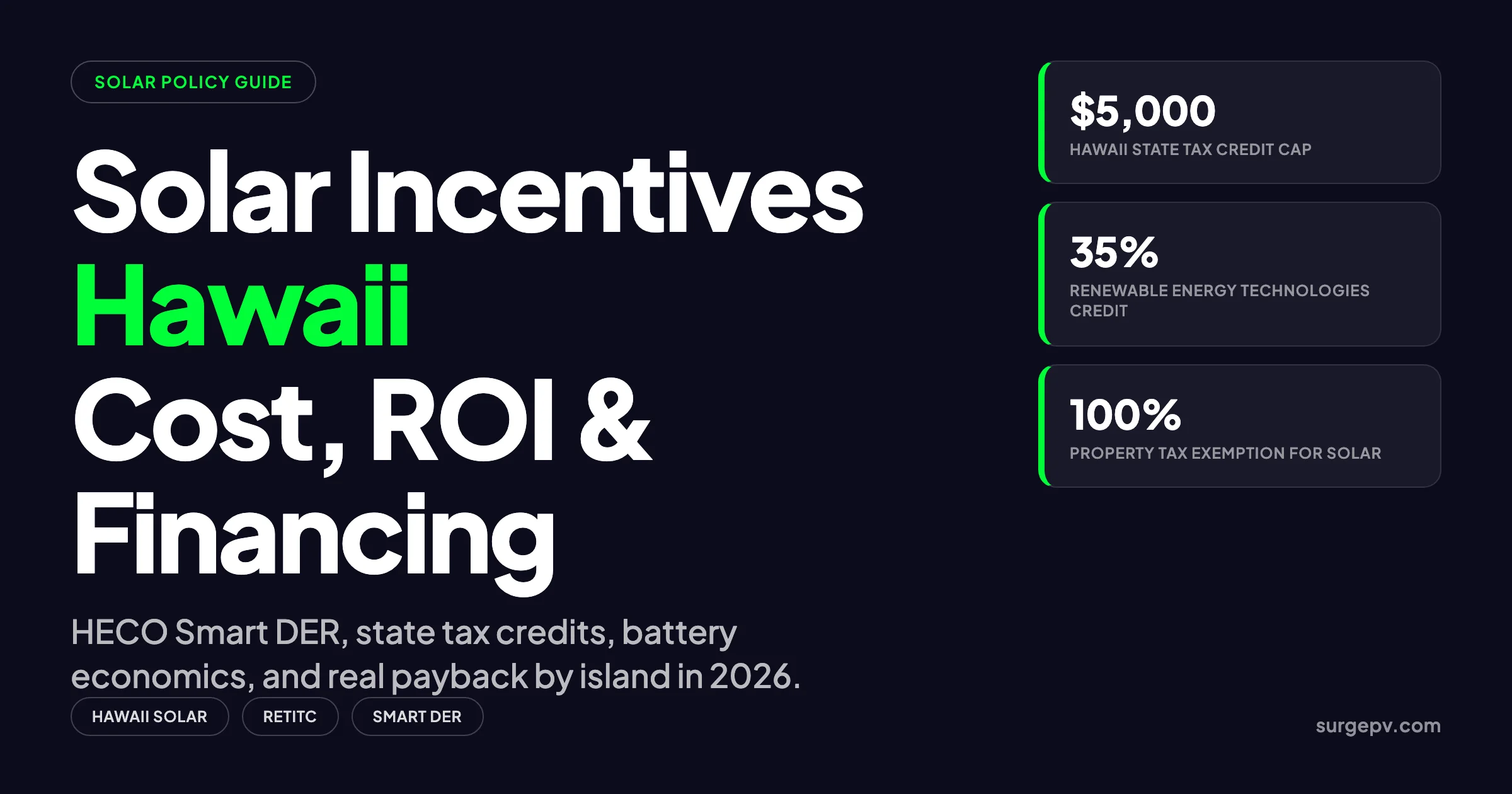
In 2026, the federal Residential Clean Energy Credit is gone for homeowner-owned systems. That removes a 30% headline benefit that installers used to lean on. But Hawaii’s state-level incentives remain unusually strong. The 35% Renewable Energy Technologies Income Tax Credit, capped at $5,000 per system, still covers a meaningful share of a residential installation. The 100% property tax exemption protects homeowners from higher annual taxes. And Hawaiian Electric’s Smart DER programs, combined with battery storage, can still deliver payback periods of under a decade.
This guide breaks down every incentive that matters for Hawaii solar in 2026. It covers the state tax credit, HECO’s Smart DER Export and Non-Export pathways, BYOD Plus battery incentives, KIUC’s separate rules, financing options, and real ROI numbers for Oahu, Maui, and Hawaii Island. For the federal policy context, see our post on solar incentives in the USA. Program details change, so verify current rules through the DSIRE database or the Hawaii State Energy Office. For system design help, SurgePV’s solar design software lets installers model self-consumption and export under Hawaii’s time-of-use rates.
Quick Answer
Hawaii homeowners in 2026 can claim the 35% Renewable Energy Technologies Income Tax Credit up to $5,000, a 100% property tax exemption, and HECO Smart DER export credits. Battery storage is effectively required for strong ROI because traditional net metering closed in 2015.
TL;DR — Hawaii Solar Incentives 2026
Active programs: Hawaii RETITC 35% up to $5,000 per system, 100% property tax exemption, GET exemption for qualifying solar work, HECO Smart DER Export and Non-Export, BYOD Plus battery incentives, Hawaii Energy solar water heating rebates, and income-qualified Honolulu solar loans. Traditional net metering is closed. Federal Section 25D expired for homeowner-owned systems; Section 48E may still apply to commercial and third-party-owned systems.
In this guide:
- Why Hawaii’s solar market looks nothing like the mainland.
- Federal solar tax credit: what changed in 2026.
- Hawaii RETITC: how to claim the 35% state credit.
- Property tax and GET exemptions every homeowner gets.
- HECO Smart DER Export, Non-Export, and BYOD Plus explained.
- KIUC and the neighbor island differences.
- Solar water heating, heat pumps, and efficiency rebates.
- Financing options with no money down.
- Real 2026 payback examples for Oahu, Maui, and Hawaii Island.
- Common mistakes Hawaii installers make.
Hawaii Solar Market Snapshot: Why the Incentive Stack Is Different
Hawaii ended traditional net metering in October 2015. That was years before California’s NEM 3.0 and most other state transitions. The reason was grid stability. Rooftop solar penetration on some circuits reached levels that threatened voltage regulation and required expensive infrastructure upgrades. Rather than limit installations, regulators changed the compensation structure.
The result is a market built around self-consumption. In most mainland states, solar economics depend on exporting excess midday production to the grid at retail or near-retail rates. In Hawaii, exported energy is worth far less than energy used on site. The difference between a $0.42 retail kWh and a $0.10 to $0.18 export credit is the entire economic story. That gap makes batteries valuable. A battery turns midday solar into evening electricity, displacing imports at the full retail rate.
Hawaii’s market is also fragmented by utility. Hawaiian Electric Company serves Oahu. Maui Electric Company serves Maui, Molokai, and Lanai. Hawaii Electric Light Company serves Hawaii Island. Kauai is served by the member-owned Kauai Island Utility Cooperative, which sets its own rates and programs. Each utility operates under Hawaii Public Utilities Commission oversight, but tariffs differ by island. SurgePV supports residential solar design across all of these territories with island-specific rate structures.
Finally, Hawaii has no statewide sales tax. The General Excise Tax applies to most goods and services, but qualifying solar energy systems and installation are exempt. That removes roughly 4% to 4.5% from the installed cost compared with a taxed transaction. Combined with the state tax credit and high electricity rates, Hawaii remains one of the best solar markets in the country even without the federal credit.
Federal Solar Tax Credit: What Changed in 2026
The federal Residential Clean Energy Credit under Internal Revenue Code Section 25D allowed homeowners to claim 30% of qualified solar, battery, and solar water heating costs. It expired on December 31, 2025, after federal legislation terminated the credit rather than extending it. Homeowner-owned systems placed in service on or after January 1, 2026, no longer qualify.
This is a major shift for Hawaii because the federal credit historically covered the largest share of system cost. A $40,000 solar-plus-battery installation that qualified for the full 30% credit received $12,000 back on the federal return. That benefit is no longer available for purchases in 2026.
Commercial projects and third-party-owned residential systems still have a path. Section 48E, the Clean Electricity Investment Tax Credit, offers a 30% credit for projects that begin construction by July 4, 2026, or are placed in service by December 31, 2027. That is why leases and power purchase agreements can still advertise lower monthly payments in 2026: the financing company owns the system and claims the credit.
Installers should verify the exact status of federal credits with the latest IRS Residential Clean Energy Credit guidance. Promising a 30% federal credit for a 2026 homeowner-owned installation without verification is a consumer protection risk. The safer sales approach is to model the project both with and without the federal credit, present the scenarios clearly in a solar proposal, and lead with Hawaii’s state incentives.
Hawaii State Tax Credit: The Biggest Remaining Incentive
The Hawaii Renewable Energy Technologies Income Tax Credit is the cornerstone of the 2026 incentive stack. It is a state credit, separate from federal law, and it survived the federal changes. For residential single-family solar photovoltaic systems, the credit is 35% of qualified costs, capped at $5,000 per system.
Qualified costs include the solar panels, inverter, wiring, mounting hardware, battery storage when paired with solar, labor, and sales tax if actually paid. The credit is claimed on Hawaii Form N-342, filed with the state income tax return. It is non-refundable, meaning it can reduce state tax liability to zero, and unused amounts carry forward to future tax years.
Battery storage can qualify for its own credit if it meets statutory requirements. A battery added to an existing solar system may also qualify, subject to the same cap. Because the credit is capped rather than scaled, smaller systems capture a higher percentage of their cost. A $14,300 system captures the full 35%. A $30,000 system captures only about 16.7% because the $5,000 cap limits the benefit.
The credit has no income limit, but the taxpayer must have enough Hawaii state tax liability to use it. Homeowners with low state tax bills may need several years to absorb the full credit. Installers should not promise immediate full value to every customer.
| System Cost | RETITC Rate | RETITC Cap | Effective Credit Share |
|---|---|---|---|
| $10,000 | 35% | $5,000 | $3,500 (35%) |
| $14,300 | 35% | $5,000 | $5,000 (35%) |
| $25,000 | 35% | $5,000 | $5,000 (20%) |
| $40,000 | 35% | $5,000 | $5,000 (12.5%) |
Property Tax and GET Exemptions
Hawaii offers two tax benefits that reduce the lifetime cost of ownership. The first is a 100% property tax exemption for active solar energy systems. The added value of a solar installation is excluded from the real property assessment. On a $700,000 home where solar adds roughly $25,000 in value, the exemption prevents that $25,000 from being taxed at county property tax rates of roughly 0.3% to 1.3%. Over 25 years, that saves thousands of dollars.
The second benefit is the General Excise Tax exemption for qualifying solar energy systems. Hawaii does not have a traditional sales tax. Instead, businesses pay a GET that is often passed through to customers. Qualifying solar equipment and installation services are exempt from GET, which effectively removes 4% to 4.5% from the installed cost. On a $30,000 system, that is roughly $1,200 to $1,350 in avoided tax.
Homeowners should confirm with their installer whether the quoted price already reflects the GET exemption. Some contractors itemize it; others build it into a turnkey price. Either way, the exemption is one reason Hawaii’s all-in installed costs, while high in absolute dollars, are competitive on an after-incentive basis.
HECO Smart DER Programs: Export, Non-Export, and BYOD Plus
In 2024, Hawaiian Electric replaced its legacy Customer Grid-Supply Plus and Smart Export programs with the Smart DER tariff. Smart DER is now the standard interconnection framework for new residential solar customers on Oahu, Maui, Molokai, Lanai, and Hawaii Island.
All Smart DER participants must have an advanced meter and must enroll in a Shift and Save time-of-use rate. Shift and Save rates reward customers who move electricity use away from the evening peak, when the grid is most constrained. Solar production peaks at midday, when rates are lower. A battery shifts that production into the evening peak, where the value is highest.
Smart DER Export
The Export pathway allows the system to send energy to the grid. Customers receive bill credits based on time-varying export rates. Daytime exports are worth less than evening exports. On Oahu, daytime export credits have been in the range of $0.10 to $0.18 per kWh, while evening peak credits can reach $0.30 or more per kWh. Exact rates change by island and rate period.
Export is best for homes with larger batteries that can store midday solar and discharge during evening peak hours. Tools like battery storage design software help size storage correctly so the system captures the highest export credits rather than exporting during low-value daytime windows.
Smart DER Non-Export
The Non-Export pathway blocks any energy from flowing back to the grid. Customers receive no export credits, but they also avoid many of the grid impact studies that slow approvals. Non-Export often receives faster technical review, especially in grid-saturated areas.
This pathway makes sense for customers who want backup power and self-consumption above all else. It also works well for homes that can shift most of their daytime load to match solar production. Pairing Non-Export with a battery is almost always necessary to use solar after sunset.
BYOD Plus Battery Incentive
Bring Your Own Device Plus is Hawaiian Electric’s battery grid services program. Customers receive an upfront incentive and monthly bill credits for allowing the utility to dispatch their battery during peak events. The program is designed to reduce evening demand and improve grid stability.
BYOD Plus requires a qualifying battery and inverter system. It sits on top of a Smart DER agreement. The upfront payment and monthly credits can meaningfully improve battery economics, but participation also means the utility can control when your battery discharges. Homeowners should understand the dispatch rules before enrolling.
| Program | Exports Allowed | Battery Role | Best For |
|---|---|---|---|
| Smart DER Export | Yes, time-varying credits | Store midday solar for evening discharge | Homes seeking maximum bill savings |
| Smart DER Non-Export | No | Required for night use | Grid-saturated areas, fast approval |
| BYOD Plus | On top of Smart DER | Grid services dispatch | Evening peak reduction, extra battery credits |
KIUC and the Neighbor Island Picture
Kauai is not served by Hawaiian Electric. It is served by the Kauai Island Utility Cooperative, a member-owned utility. KIUC has its own interconnection rules, rates, and programs. The cooperative has been a national leader in renewable energy, reaching periods of 100% renewable generation during midday hours with utility-scale solar-plus-storage projects.
For residential customers, KIUC offers its own solar interconnection process and battery programs. Rates and export credits differ from HECO’s Smart DER. KIUC also offers rebates for heat pump water heaters, solar water heaters, and other efficiency measures. Homeowners on Kauai should work with an installer who understands KIUC’s specific requirements rather than assuming Oahu rules apply.
The neighbor islands served by Hawaiian Electric also differ from Oahu. Maui, Molokai, Lanai, and Hawaii Island have smaller grids and higher penetration rates per circuit. That can lead to longer interconnection timelines and more frequent requirements for export-limiting or non-export systems. Maui and Hawaii Island also have different retail rates and export credit values than Oahu.
Solar Water Heating, Heat Pumps, and Efficiency Rebates
Solar water heating is one of the best deals in Hawaii. Water heating can account for 30% or more of a household’s electricity use in the state. Hawaii Energy, the ratepayer-funded efficiency program, offers a $1,000 rebate for qualifying solar water heaters that replace electric water heaters. Some installations also qualify for low-income adders.
Heat pump water heaters are another strong option. They use roughly one-third the electricity of a standard electric resistance water heater. Hawaii Energy and KIUC offer rebates for qualifying heat pump water heaters, typically $500 to $700. When paired with high Hawaii electricity rates, the payback period for a heat pump water heater can be under three years.
The federal HEAR and HOMES rebate programs, created under the Inflation Reduction Act, may also provide support for whole-home efficiency upgrades in Hawaii. HEAR offers up to $14,000 for income-qualified households for heat pumps, electrical panels, wiring, insulation, and heat pump water heaters. HOMES offers up to $8,000 for whole-home energy savings. These programs are administered by the Hawaii State Energy Office, and availability depends on funding and implementation timelines.
Efficiency matters because it reduces the size of the solar and battery system needed. A home that uses 8,000 kWh per year needs a smaller solar array than a home that uses 14,000 kWh per year. Solar water heating and heat pump water heaters are often the cheapest ways to cut load before sizing solar.
Financing Options: GEM$, Loans, Leases, and PPAs
Hawaii homeowners have several ways to pay for solar with little or no money down. The right option depends on who wants to claim the tax credit, how long the homeowner plans to stay in the house, and whether they have state tax liability.
Green Energy Money $aver On-Bill Program
The Green Energy Money $aver program, administered by the Hawaii Green Infrastructure Authority, provides financing for energy efficiency and solar systems. Repayment is made through the utility bill. The program is available to homeowners, renters, small businesses, nonprofits, and state agencies. Because repayment is on-bill, it can be accessible to customers who might not qualify for traditional loans.
City and County of Honolulu Solar Loan Program
Honolulu offers interest-free loans to income-eligible homeowners for solar PV and solar water heating through its Rehabilitation Loan Program. The loans are available only to residents of the City and County of Honolulu and are aimed at low- and moderate-income households. This is one of the most attractive financing options on Oahu for qualifying applicants.
Solar Loans, Leases, and PPAs
Traditional solar loans from credit unions, banks, and national lenders are widely available. With a loan, the homeowner owns the system and claims the RETITC. Leases and power purchase agreements let a third party own the system and claim any available commercial tax credits. The homeowner pays a fixed monthly amount or a per-kWh rate, usually with no upfront cost.
Each structure changes the incentive math. A cash purchase captures the full RETITC and long-term savings but requires capital. A loan captures the credit and spreads payments over time. A lease or PPA avoids upfront cost but gives up the credit and some lifetime savings.
Real 2026 ROI Examples by Island
Numbers make the policy concrete. The examples below assume a 6 kW solar array paired with a 13.5 kWh battery, a common residential configuration in Hawaii. Costs and rates are approximate and vary by installer, equipment, and roof complexity. SurgePV’s energy and financial modeling tool lets installers build these island-specific ROI models for every customer.
Oahu Example
A 6 kW solar-plus-battery system on Oahu might cost $45,000 before incentives. After the $5,000 Hawaii RETITC and the GET exemption, the effective upfront cost falls to roughly $38,500. With an electricity rate of $0.42 per kWh and a Smart DER Export strategy that maximizes self-consumption, annual savings might reach $4,500 to $5,500. Simple payback is roughly 7 to 9 years.
Maui Example
Maui rates are often higher than Oahu, sometimes exceeding $0.45 per kWh. A similar system might cost $47,000 before incentives. The same $5,000 state credit applies. Higher rates improve savings, but interconnection timelines can be longer due to grid constraints. Payback is often 6 to 8 years for systems that are approved under Smart DER Export.
Hawaii Island Example
Hawaii Island has strong solar resource and high rates, but grid saturation is a real issue in some neighborhoods. A 6 kW system with battery might cost $44,000. If Smart DER Export is denied due to grid capacity, a Non-Export system with battery backup still pays back in 8 to 11 years through self-consumption and outage avoidance. Payback stretches if the home cannot shift load to match solar production.
| Island | Estimated System Cost | Effective Cost After RETITC | Approximate Annual Savings | Simple Payback |
|---|---|---|---|---|
| Oahu | $45,000 | $38,500 | $4,500–$5,500 | 7–9 years |
| Maui | $47,000 | $40,500 | $5,000–$6,000 | 6–8 years |
| Hawaii Island | $44,000 | $37,500 | $4,000–$5,000 | 8–11 years |
Common Mistakes Hawaii Installers Make
Hawaii’s solar market rewards local expertise. The most common mistakes come from treating Hawaii like the mainland.
The first mistake is promising traditional net metering. New customers cannot get it. Every proposal should clearly explain Smart DER Export, Non-Export, or KIUC rules. Customers who expect full retail credits will be disappointed if the proposal is not explicit.
The second mistake is undersizing the battery. Solar-only systems in Hawaii face low export credits. A battery is usually required to make the economics work. Installers who design solar-only systems to hit a low price point often deliver poor savings.
The third mistake is ignoring island-specific interconnection timelines. Oahu, Maui, and Hawaii Island have different grid constraints. A design that works in one neighborhood may require a non-export configuration in another. Good installers check circuit saturation before finalizing system size.
The fourth mistake is overpromising the federal tax credit. With Section 25D expired for homeowner-owned systems in 2026, installers must lead with the Hawaii RETITC and be clear about federal eligibility. For leases and PPAs, the financing party may still claim Section 48E, but that is not a homeowner benefit.
The fifth mistake is neglecting efficiency. Water heating, air conditioning, and pool pumps dominate Hawaii loads. Reducing those loads before sizing solar lowers system cost and improves payback. Solar water heating rebates and heat pump water heaters should be part of the conversation.
FAQ
What solar incentives are available in Hawaii in 2026?
Hawaii offers the 35% Renewable Energy Technologies Income Tax Credit capped at $5,000 per system, a 100% property tax exemption for the added value of solar, and a General Excise Tax exemption for qualifying solar equipment and installation. Hawaiian Electric customers can enroll in Smart DER Export or Non-Export programs and the BYOD Plus battery incentive. Solar water heating rebates up to $1,000 are available through Hawaii Energy, and income-eligible Honolulu homeowners can access interest-free solar loans.
Does Hawaii still have net metering?
No. Hawaii closed traditional full-retail net metering to new applicants in October 2015. New Hawaiian Electric customers choose between Smart DER Export, which pays time-varying export credits, or Smart DER Non-Export, which allows no grid exports and prioritizes self-consumption. Kauai Island Utility Cooperative operates its own programs for its members.
How much is the Hawaii state solar tax credit in 2026?
The Hawaii Renewable Energy Technologies Income Tax Credit is 35% of qualified solar system costs, capped at $5,000 per system for residential single-family homes. You claim it on Hawaii Form N-342. Battery storage paired with solar can qualify separately under its own cap if it meets the statutory requirements.
Is the federal solar tax credit still available in Hawaii in 2026?
The federal Residential Clean Energy Credit under Internal Revenue Code Section 25D expired for homeowner-owned systems placed in service after December 31, 2025. Commercial projects and third-party-owned residential systems such as leases and power purchase agreements may still qualify under Section 48E through 2027. Homeowners should verify current IRS guidance before signing a contract based on the credit.
Do solar panels increase property taxes in Hawaii?
No. Hawaii exempts 100% of the value added by an active solar energy system from real property taxation. The exemption applies to residential systems and prevents the assessed value of your home from rising because of the solar installation.
Is a battery required for solar in Hawaii?
A battery is not legally required, but it is financially essential for most new systems. Export credits under Smart DER are lower than retail rates, so self-consumed solar saves more than exported solar. A battery stores midday production for evening use, which is when Hawaiian Electric’s Shift and Save rates are highest.
What is the HECO Smart DER program?
Smart DER is Hawaiian Electric’s umbrella distributed energy resource tariff that replaced Customer Grid-Supply Plus and Smart Export for new customers in 2024. It has two pathways: Export, which pays bill credits for energy sent to the grid, and Non-Export, which blocks exports and often gets faster approval in grid-saturated areas. Both require an advanced meter and enrollment in a Shift and Save time-of-use rate.
What is BYOD Plus in Hawaii?
Bring Your Own Device Plus is a Hawaiian Electric program that pays battery owners an upfront incentive and monthly bill credits in exchange for dispatching stored energy during grid events. It sits on top of a Smart DER agreement and is designed to reduce evening peak demand.
How long does solar take to pay back in Hawaii?
A typical residential solar-plus-battery system in Hawaii pays back in 5 to 9 years, depending on the island, utility program, system size, and financing method. Payback is faster than on the mainland because Hawaii’s retail electricity rates are among the highest in the United States.
Can I finance solar in Hawaii with no money down?
Yes. Options include the Green Energy Money $aver on-bill program, the City and County of Honolulu Rehabilitation Loan Program for income-eligible homeowners, solar loans from credit unions and national lenders, leases, and power purchase agreements. Each option affects who owns the system and which tax credits can be claimed.
Where this fits
This article is part of SurgePV's Solar Incentives & Policy hub, which works through the topic from first principles to the decisions a project team actually has to make.
