

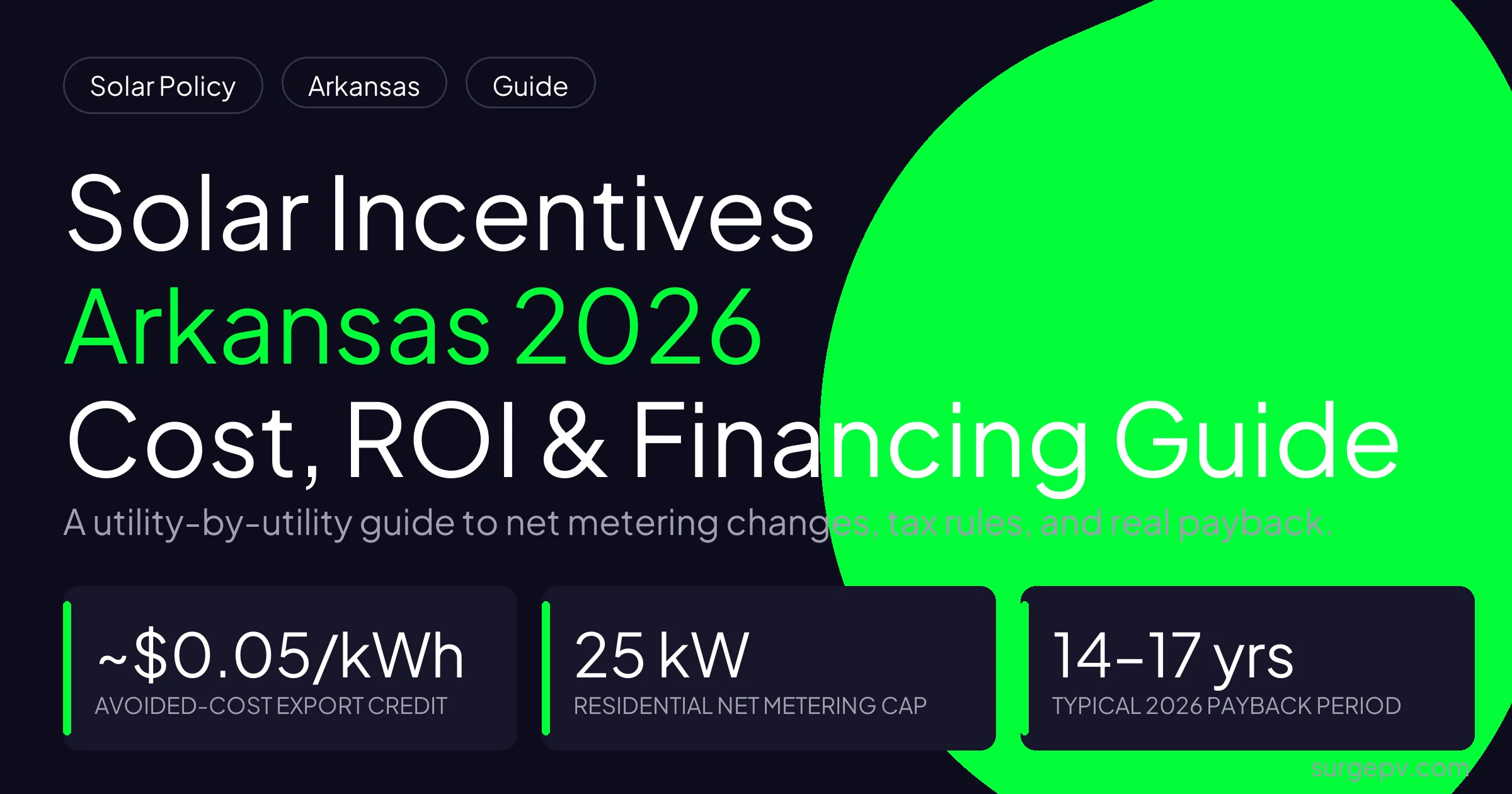
Arkansas homeowners paid an average residential electricity rate of about 13 cents per kWh in mid-2026, according to the U.S. Energy Information Administration (2026). That is below the national average, which is one reason solar payback in Arkansas is longer than in high-rate states like California or Massachusetts. The bigger change in 2026 is not the rate. It is the law. Act 278 ended 1:1 retail net metering for new systems and replaced it with net billing at avoided cost.
This guide explains what solar incentives Arkansas actually offers in 2026. It covers the grandfathering deadline, how net billing works, what Entergy Arkansas and the other utilities pay for exported solar, and why financing choices now matter more than ever. For the national picture, see our solar incentives in USA 2026 guide and state solar incentives in the US overview. For installers, modeling the correct utility rate and export credit is now the difference between a proposal that closes and one that gets rejected. SurgePV’s solar design software lets you model each incentive stream, utility rate, and financing scenario in one place.
Quick Answer
Arkansas solar incentives in 2026 are limited. The federal residential ITC expired at the end of 2025. Active benefits include legacy 1:1 net metering for systems grandfathered by September 30, 2024, and non-legacy net billing with avoided-cost export credits for new systems. Arkansas has no state solar tax credit, no property tax exemption, and no sales tax exemption.
In this guide:
- Arkansas solar incentive snapshot and what changed in 2026
- Federal tax credit status for residential and commercial projects
- How Act 278 changed net metering and who is grandfathered
- Utility-specific rules for Entergy Arkansas, SWEPCO, OG&E, and cooperatives
- Property tax, sales tax, and other state rules
- Cost, ROI, and payback scenarios by system type
- Financing options and common mistakes
Arkansas Solar Incentives at a Glance — 2026
Arkansas is a low-incentive, sunshine-rich state. The economics work because of decent sun and rising electricity rates, not because of big rebates. The same system can have very different payback depending on whether it was grandfathered under the old net metering rules. The table below summarizes the main programs active in 2026.
| Incentive | Type | 2026 Status | Typical Value |
|---|---|---|---|
| Federal residential ITC (Section 25D) | Tax credit | Expired | $0 for cash or loan residential purchases placed in service after 2025 |
| Federal Section 48E | Commercial tax credit | Active, deadlines apply | 30% for eligible commercial, lease, or PPA systems |
| Arkansas state solar tax credit | Tax credit | Not available | $0 |
| Arkansas property tax exemption | Tax exemption | Not available | Standard property tax applies |
| Arkansas sales tax exemption | Tax exemption | Not available | Standard state and local sales tax applies |
| Legacy net metering | Bill credit | Grandfathered until June 1, 2040 | 1:1 retail credit for systems that met the Sept. 30, 2024 deadline |
| Non-legacy net billing | Export buyback | Active for new systems | Avoided cost rate, roughly 5 cents/kWh |
| Residential net metering cap | System size limit | Active | 25 kW or 100% of prior 12-month peak usage, whichever is less |
| Commercial net metering cap | System size limit | Active | 5 MW or 100% of prior 12-month peak usage, whichever is less |
| Third-party ownership | Financing structure | Active | Leases and PPAs allowed under Act 464 of 2019 |
| HOA solar access | Legal protection | Limited | No comprehensive statewide law; check local covenants |
The biggest misconception is that Arkansas still offers 1:1 net metering to new customers. It does not, unless the system was grandfathered. The real money for new systems is self-consumption, avoided utility rate increases, and the federal commercial credit captured by lease or PPA providers. The biggest risk is designing a system for export credits that no longer exist at retail rate.
What Changed in 2026: Act 278 and the End of Retail Net Metering
Three changes shape Arkansas solar proposals in 2026. Two of them are state policy shifts. The third is the federal expiration of the residential tax credit.
Act 278 Ended 1:1 Net Metering for New Systems
Act 278, formerly Senate Bill 295, was signed into law by Governor Sanders on March 13, 2023, according to New Farm Solar’s Arkansas net metering analysis (2024). The law amended the Arkansas Renewable Energy Development Act of 2001 and Act 464 of 2019. It requires utilities to move new solar customers to a net billing structure instead of 1:1 retail net metering.
Under the old rules, a kilowatt-hour sent to the grid offset a kilowatt-hour pulled from the grid at the full retail rate. Under the new rules, a kilowatt-hour sent to the grid is credited at the utility’s avoided cost rate. That rate is based on the prior year’s 12-month average locational marginal price in the relevant regional transmission organization, according to DSIRE’s Arkansas net billing summary (2026). In practice, the avoided cost rate is roughly 5 cents per kWh, or a little less than half the typical retail rate.
The practical result is simple. A kilowatt-hour you use directly from your panels offsets a full retail-rate kWh. A kilowatt-hour you export earns only a wholesale-style credit. The difference can cut your effective savings by 50% or more on exported power.
The Grandfathering Deadline Was September 30, 2024
Systems that submitted a standard interconnection agreement, facilities agreement, or a Public Service Commission complaint about a facilities agreement by September 30, 2024, are grandfathered. They keep the 1:1 retail credit rate until June 1, 2040, according to DSIRE (2026). Customers who submitted between March 12, 2023, and September 30, 2024, are called legacy transitional customers. Customers who submitted before March 12, 2023, are legacy customers. Both groups get the same 20-year grandfathering.
If you are reading this in 2026 and do not already have a grandfathered system, you cannot get 1:1 net metering. Your proposal must be built around net billing and self-consumption.
Capacity Limits Changed
Act 278 also changed system size limits. Non-residential systems can now be sized up to 5,000 kW, or 5 MW, or 100% of the customer’s highest usage in the prior 12 months, whichever is less, according to DSIRE (2026). That is an increase from the previous 1 MW cap. Residential systems remain capped at 25 kW or 100% of the customer’s highest monthly usage in the prior 12 months, whichever is less.
Municipal utilities are allowed to set lower capacity limits. They can cap residential systems below 25 kW and non-residential systems below 300 kW. Always confirm the specific rules with your utility before sizing a system.
Federal Solar Tax Credit: What Changed in 2026
The biggest single change in Arkansas solar math is federal. The 30% Residential Clean Energy Credit under Internal Revenue Code Section 25D expired for homeowner-owned systems placed in service after December 31, 2025, under the One Big Beautiful Bill Act. Homeowners who buy solar with cash or a loan in 2026 cannot claim it.
This removes the largest single incentive that existed in prior years. Installers once led with “30% federal tax credit plus net metering.” In 2026, Arkansas proposals must stand on self-consumption, avoided utility costs, and the grandfathering status of the system.
Commercial, leased, and power-purchase-agreement systems may still access the Investment Tax Credit under Section 48E. The usual safe-harbor rules apply: construction must generally begin before July 4, 2026, or the system must be placed in service by December 31, 2027, according to IRS guidance on the One Big Beautiful Bill Act (2025). Lease and PPA providers can pass part of that credit through as lower monthly payments.
For cash and loan buyers, the federal credit is gone. The rest of the stack must carry the project. That means every Arkansas installer proposal should lead with the customer’s actual utility rate, self-consumption pattern, and whether the system can be grandfathered. Do not lead with a federal tax credit that no longer exists for residential customers.
Systems placed in service in 2025 can still be claimed on the 2025 tax return using IRS Form 5695. Homeowners should verify current eligibility with a tax professional before signing a contract based on the credit.
How Arkansas Net Billing Works Now
Net billing is not net metering. The difference is not semantic. It changes the value of every exported kilowatt-hour.
Instantaneous Netting
Under non-legacy net billing, your meter tracks imports and exports in real time. Solar generation is used on-site first. Any excess is sent to the grid immediately and credited at the avoided cost rate. You cannot bank excess kilowatt-hours within a billing cycle to offset future consumption, according to the University of Arkansas Cooperative Extension Service (2024).
This means a cloud passing over your roof at noon can drop production just as your air conditioner cycles on. You import power at the retail rate. Five minutes later, the sun returns, production exceeds demand, and you export at the avoided cost rate. That asymmetry is why self-consumption and battery storage matter in net billing markets.
The Avoided Cost Rate
The avoided cost rate is based on the prior year’s 12-month average locational marginal price in the relevant regional transmission organization. Entergy Arkansas is in the Midcontinent Independent System Operator, or MISO. SWEPCO and OG&E are in the Southwest Power Pool, or SPP. The exact rate varies by utility load zone and year.
In practice, the avoided cost rate has been around 5 cents per kWh, according to EnergySage’s Arkansas solar incentives guide (2026). That is well below the typical Arkansas retail rate of 12 to 13 cents per kWh. The gap is the reason oversizing for export is a losing strategy in 2026.
Legacy Net Metering Still Exists for Some
If your system is grandfathered, the rules are different. You get 1:1 retail credits. Excess generation is carried forward to future billing periods. You can request payment for credits older than 24 months, or the utility will pay you for remaining credits if you sell the home, stop service, or transfer the system, according to Entergy Arkansas net metering service rules (2026).
The grandfathered customer is in a much stronger financial position. If you are quoting a homeowner with a grandfathered system, make sure the proposal reflects the legacy tariff. If you are quoting a new system, size it for self-consumption.
Utility-Specific Rules for Arkansas Solar Customers
Arkansas solar economics depend heavily on which utility serves the property. The major providers have different rate structures, caps, and interconnection processes.
Entergy Arkansas
Entergy Arkansas is the largest investor-owned utility in the state. It serves the Little Rock metro area, most of central and southeast Arkansas, and parts of the Delta. Entergy offers both a Legacy Net-Metering Service Schedule and a Non-Legacy Net Metering rate schedule, according to Entergy Arkansas (2026).
For legacy customers, excess kWh are accumulated and credited to the next billing period. For non-legacy customers, excess generation is credited at the avoided cost rate. Entergy provides a bidirectional meter at no charge. Non-standard meters are paid for by the customer.
Entergy’s residential net metering cap is 25 kW or the customer’s highest residential usage in the prior 12 months, whichever is less. Non-residential systems can be sized up to 5 MW or the customer’s highest usage in the prior 12 months, whichever is less.
Southwestern Electric Power Company (SWEPCO)
SWEPCO, an American Electric Power subsidiary, serves parts of northwest Arkansas including Fort Smith and the surrounding area. SWEPCO also operates under the Arkansas Public Service Commission net metering and net billing rules. New residential customers after September 30, 2024, are on the non-legacy tariff with avoided-cost export credits.
SWEPCO customers should confirm the current avoided cost rate and any residential time-of-use rate options before sizing a system. Time-of-use rates can change the value of self-consumption if the home uses more power during peak-price evening hours.
Oklahoma Gas & Electric (OG&E)
OG&E serves parts of western Arkansas, including Fort Smith and the Arkansas River Valley. Like Entergy and SWEPCO, OG&E Arkansas customers fall under the PSC rules. New systems are on non-legacy net billing. OG&E offers time-of-use rate plans in some areas, which can affect solar value. Check the current tariff before modeling.
Electric Cooperatives
First Electric Cooperative, Arkansas Electric Cooperative Corporation, and other rural electric cooperatives serve large parts of the state. Co-ops are member-owned and set their own rates and interconnection rules within state law. Some co-ops may offer more favorable buyback terms than the investor-owned utilities. Others may have stricter interconnection requirements or lower capacity limits.
Co-op customers should contact their specific cooperative for the current net metering or net billing tariff, interconnection application, and any fees.
Municipal Utilities
Municipal utilities in Arkansas can set their own net metering capacity limits below the state maximum. They can cap residential systems below 25 kW and non-residential systems below 300 kW. Some municipal utilities may not offer net metering at all. Always verify the program with the municipal utility before quoting.
State Tax Exemptions and What Arkansas Does Not Offer
Arkansas is not a high-incentive state. The absence of several common incentives is as important as the presence of net billing.
No State Solar Tax Credit
Arkansas does not offer a state income tax credit for solar installations. This is straightforward. Homeowners cannot reduce their Arkansas state income tax with a solar credit.
No Property Tax Exemption
Arkansas does not exclude the added value of a solar system from property tax assessments, according to EnergySage (2026). Homeowners should expect the added value of the system to be included in their assessed value. Some county assessors may not actively reassess after a solar installation, but there is no statutory protection.
No Sales Tax Exemption
Arkansas does not exempt residential solar equipment from state and local sales tax. The state sales tax rate is 6.5%, and local taxes can add to that, according to Sovos’ Arkansas sales tax guide (2026). Installers should include sales tax in the quoted system price. A $25,000 system can carry more than $1,600 in sales tax depending on the local rate.
Limited HOA Protections
Arkansas does not have a comprehensive statewide solar access law that prohibits homeowners associations from banning solar panels. Some local ordinances may offer limited protections, but many subdivision covenants can restrict panel placement, visibility, or installation. Homeowners should review their HOA documents before signing a contract.
Cost, ROI, and Payback Scenarios
Arkansas solar payback is longer than the national average because electricity rates are lower and the federal residential credit is gone. But the state has good sun, which helps production.
Typical System Cost
The average cost of solar in Arkansas is about $2.38 per watt including installation, according to EnergySage’s Arkansas solar cost data (2026). A typical 8 kW system costs about $19,000 before incentives. With no state incentives and no federal residential credit, that is the effective cash price for most homeowners in 2026.
SolarReviews reports an average cost of $2.70 per watt in Arkansas as of 2026, according to SolarReviews (2026). Actual prices vary by installer, roof complexity, equipment choice, and local permitting costs.
Production Expectations
Arkansas receives about 217 sunny days per year, above the national average of 205, according to EcoWatch’s Arkansas solar analysis (2025). A well-sited 8 kW system in Arkansas can produce roughly 11,000 to 12,000 kWh per year depending on roof orientation, shading, and equipment.
Payback Without the Federal Credit
A cash-purchased 8 kW system in Arkansas at $2.50 per watt costs about $20,000 before tax. With no federal residential credit and no state incentives, annual savings depend on self-consumption and the export credit rate.
- Legacy net metering scenario: If the system is grandfathered and offsets a retail rate of 13 cents/kWh on most production, annual savings might be $1,400 to $1,600. Simple payback is 13 to 15 years.
- Net billing scenario: If half the production is exported at 5 cents/kWh and half is self-consumed at 13 cents/kWh, effective savings per kWh drop. Annual savings might be $1,000 to $1,300. Simple payback is 15 to 18 years.
- Battery plus solar scenario: Adding a $12,000 battery increases self-consumption but also increases upfront cost. Payback can stretch to 18 to 22 years unless backup power value is included.
These are planning estimates, not guarantees. Actual payback depends on equipment degradation, utility rate increases, financing costs, and maintenance.
25-Year Value
Even with a 15-year payback, a solar system can deliver meaningful long-term value. A system that saves $1,300 per year on average, with utility rates rising 2.5% annually, can save $35,000 to $45,000 over 25 years. The homeowner just needs a long ownership horizon to capture it.
Financing Options in Arkansas
Because the federal residential credit is gone and state incentives are thin, financing choices have a larger impact on total cost than in high-incentive states.
Cash Purchase
Cash delivers the lowest total cost and the simplest payback math. The homeowner owns the system, keeps all savings, and can claim any available depreciation if the system is commercial. The downside is the upfront outlay.
Solar Loan
A solar loan lets the homeowner own the system with little or no money down. In 2026, interest rates on unsecured solar loans often range from 7% to 12%. That interest can add $5,000 to $10,000 to the total cost of a $20,000 system over the loan term. The monthly payment must be compared with the average monthly utility savings. If the loan payment exceeds the bill savings, the homeowner is cash-flow negative until the loan is paid off.
Solar Lease and Power Purchase Agreement
Leases and PPAs remain available in Arkansas. The homeowner does not own the system. The lease or PPA provider owns it, claims the Section 48E commercial credit if eligible, and sells the homeowner power at a fixed or escalating rate. The homeowner gets lower upfront cost and predictable payments but gives up the long-term savings and any home equity boost from ownership.
Third-party ownership was expanded by Act 464 of 2019, which allowed leasing and power purchase agreements for tax-exempt entities and raised the commercial system cap to 1 MW, according to the University of Arkansas Division of Agriculture (2024).
Home Equity Line of Credit
A HELOC or home equity loan can be a lower-cost way to finance solar than an unsecured solar loan. Rates are typically lower because the loan is secured by the home. The homeowner owns the system and keeps all incentives. The risk is that the loan is tied to the home.
Common Mistakes to Avoid
Arkansas solar proposals fail when installers use outdated assumptions. Here are the most common errors.
Quoting the 30% Federal Tax Credit to New Residential Customers
The Residential Clean Energy Credit expired for homeowner-owned systems placed in service after December 31, 2025. If a homeowner is buying with cash or a loan in 2026, they cannot claim it. Some national installers still mention it in marketing. Do not rely on it in an Arkansas residential proposal unless the customer has a specific tax situation that qualifies under a different provision.
Oversizing for Export
Under net billing, exported power earns only the avoided cost rate. A system that produces 50% more than the home uses will export most of that excess at 5 cents/kWh. The homeowner paid for that capacity at the full installed cost. The safer design rule is to size the system for roughly 90% to 100% of annual usage, with a bias toward daytime self-consumption.
Ignoring Utility-Specific Rates
Entergy, SWEPCO, OG&E, co-ops, and municipal utilities have different rates and tariffs. A proposal built for Entergy Arkansas will be wrong for a First Electric Cooperative customer. Always confirm the customer’s utility and current tariff before modeling.
Forgetting the Grandfathering Question
If the customer installed solar before September 30, 2024, or submitted an interconnection agreement by that date, the system may be on legacy net metering. That changes the value of every exported kilowatt-hour. Ask the question. Check the utility bill or interconnection agreement.
Skipping the HOA Check
Arkansas does not have strong statewide HOA protections for solar. A system design that works technically may be blocked by covenants. Review HOA documents early in the sales process.
Frequently Asked Questions
What solar incentives are available in Arkansas in 2026?
Arkansas solar incentives in 2026 are limited. The federal residential tax credit expired for homeowner-owned systems placed in service after December 31, 2025. Active programs include legacy 1:1 net metering for systems grandfathered by September 30, 2024, and non-legacy net billing with avoided-cost export credits for new systems. Arkansas has no state solar tax credit, no property tax exemption, and no statewide sales tax exemption.
Does Arkansas have net metering for solar in 2026?
Arkansas has a legacy net metering program for systems that submitted a standard interconnection agreement by September 30, 2024. Those systems keep 1:1 retail-rate credits until June 1, 2040. New systems installed after that date take service under non-legacy net billing. Excess generation is credited at the utility’s avoided cost rate, which is roughly half the retail rate.
What is Act 278 in Arkansas solar?
Act 278, formerly Senate Bill 295, was signed into law in March 2023. It ended 1:1 retail net metering for new Arkansas solar customers and replaced it with a net billing structure. Systems that were online or had submitted a standard interconnection agreement by September 30, 2024, are grandfathered into the old 1:1 rate structure until June 1, 2040.
Is the federal solar tax credit still available in Arkansas in 2026?
The 30% federal Residential Clean Energy Credit under Internal Revenue Code Section 25D expired for homeowner-owned systems placed in service after December 31, 2025. Commercial, leased, and power-purchase-agreement systems may still qualify under Section 48E, but construction must generally begin before July 4, 2026, or the system must be placed in service by December 31, 2027.
Does Arkansas have a state solar tax credit?
No. Arkansas does not offer a state income tax credit for residential or commercial solar installations. The only tax-related benefit for some projects is the federal commercial credit available to lease or PPA providers.
Does Arkansas have a property tax exemption for solar panels?
No. Arkansas does not provide a statewide property tax exemption for residential solar energy systems. Homeowners should expect the added value of a solar installation to be included in their property tax assessment, though local assessor practice can vary.
Does Arkansas have a sales tax exemption for solar equipment?
No. Arkansas does not exempt residential solar equipment from state and local sales tax. The standard state sales tax rate is 6.5%, and local taxes can add to that. Installers should include sales tax in the quoted system price.
What is the typical solar payback period in Arkansas in 2026?
A cash-purchased residential solar system in Arkansas typically pays back in 14 to 17 years in 2026, assuming no federal residential tax credit. The exact range depends on system cost, electricity rate, self-consumption, and whether the system is grandfathered under legacy net metering. Legacy systems with 1:1 retail credits generally pay back faster than new systems under net billing.
What is the avoided cost rate for solar exports in Arkansas?
Under Arkansas non-legacy net billing, excess solar generation is credited at the utility’s avoided cost rate. That rate is based on the prior year’s 12-month average locational marginal price in the relevant regional transmission organization. In practice, it is often around 5 cents per kWh, or a little less than half the typical retail rate.
Can an HOA ban solar panels in Arkansas?
Arkansas law does not have a comprehensive statewide solar access law that prohibits HOAs from banning solar panels. Homeowners should review their subdivision covenants and association rules before signing a contract. Some local ordinances may offer limited protections.
Conclusion
Arkansas solar in 2026 is a different proposition than it was in 2024. The federal residential tax credit is gone. Retail net metering is gone for new systems. What remains is a sunshine-rich state with below-average electricity rates, a net billing structure that rewards self-consumption, and a grandfathering window that has already closed.
Three actions will separate a good Arkansas proposal from a bad one:
- Confirm the utility and tariff. Entergy Arkansas, SWEPCO, OG&E, cooperatives, and municipal utilities all have different rates and rules. Model the actual tariff, not a generic assumption.
- Size for self-consumption, not export. Under net billing, exported power earns avoided-cost credits. Keep production on-site through right-sizing, load shifting, or battery storage.
- Use accurate financial modeling. With no federal residential credit and thin state incentives, every cent of savings matters. SurgePV’s generation and financial tool and customer-ready solar proposals let you model each scenario and show customers real payback numbers. Check pricing or book a demo to see how it works.
Where this fits
This article is part of SurgePV's Solar Incentives & Policy hub, which works through the topic from first principles to the decisions a project team actually has to make.
