

Arizona was one of the first states to move away from retail-rate net metering. The Arizona Corporation Commission (ACC) approved net billing for Arizona Public Service (APS) in 2017. Salt River Project (SRP) is a public utility district not regulated by the ACC. It followed with its own solar rate redesign and retired all legacy net metering plans for new customers in November 2025. Then, on January 1, 2026, the federal Residential Clean Energy Credit under Internal Revenue Code Section 25D expired for homeowner-owned systems.
Those three changes mean the Arizona solar incentive stack in 2026 is smaller but more targeted. The statewide tax credit, sales tax exemption, and property tax exemption remain. The real money is now in utility-specific battery programs and designing systems for self-consumption rather than export. A homeowner in Phoenix served by APS faces a different calculation from a homeowner in Mesa served by SRP. The roof, panels, and price could be identical.
This guide covers every Arizona solar incentive that matters in 2026. It explains the state tax breaks, how APS and SRP solar programs work, battery incentives, and how to model payback by utility territory. For the federal policy context, see our post on tax credits for solar products. For proposal modeling, SurgePV’s PV design software and generation and financial tool let installers apply the right rates for each Arizona project.
Quick Answer
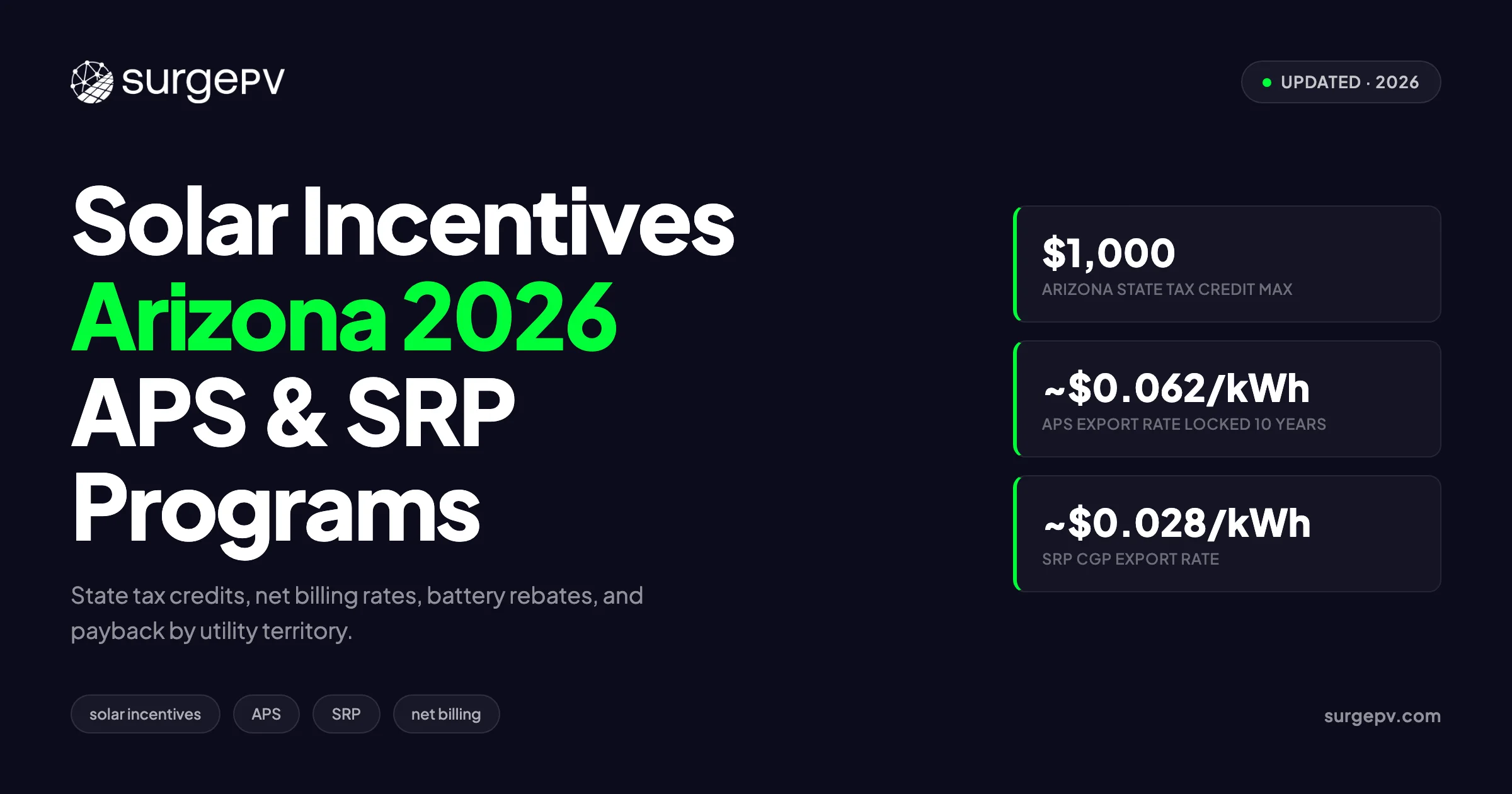
Arizona solar incentives in 2026 include a 25% state tax credit up to $1,000, a 5.6% sales tax exemption, and a property tax exemption. APS customers get a ~$0.062/kWh export rate locked for 10 years plus Storage Rewards. SRP retired net metering in November 2025; new customers move to the Customer Generation Plan with demand charges and Battery Partner payments.
In this guide:
- How the Arizona solar incentive stack changed after the federal Section 25D expiration.
- State incentives: tax credit, sales tax exemption, and property tax exemption rules.
- How Arizona net billing works and why the 10-year rate lock matters.
- APS solar programs, rate plans, and the Storage Rewards Pilot.
- SRP Customer Generation Plan, demand charges, and the Battery Partner Program.
- Other Arizona utilities: TEP, Mohave Electric, and co-ops still offering net metering.
- Battery incentives and why storage is now central to Arizona solar economics.
- Worked payback examples for APS and SRP customers.
- The biggest mistakes Arizona installers make when modeling savings.
Latest Updates: Arizona Solar Incentives 2026
Arizona’s solar market is stable but no longer driven by large federal tax credits. The state incentives are permanent. The utility rules are the moving parts. Here is the status of every major program as of June 2026.
| Incentive | 2025 Status | 2026 Status | Who Qualifies |
|---|---|---|---|
| Federal Section 25D residential credit | 30% for homeowner-owned systems | 0% for new homeowner-owned systems | No one for 2026 installs |
| Federal Section 48E commercial/TPO credit | 30% + bonuses | 30% through 2027 with deadlines | Commercial, lease, and PPA owners |
| Federal battery storage ITC | 30% through 2032 | 30% through 2032 | Batteries 3 kWh or larger |
| Arizona state solar tax credit | Active | Active, 25% up to $1,000 lifetime | Homeowners who own their system |
| Arizona solar sales tax exemption | Active | Active, 5.6% state tax | All AZ solar equipment purchases |
| Arizona solar property tax exemption | Active | Active, permanent | All AZ solar owners |
| APS net billing (RCP rate) | Active | Active, ~$0.062/kWh locked 10 years | APS customers |
| APS Storage Rewards Pilot | Active | Active, performance-based | APS customers with qualifying battery |
| SRP legacy net metering | Closed to new applicants Nov 2025 | Grandfathered systems only | Systems interconnected before Nov 2025 |
| SRP Customer Generation Plan | Active | Active for new solar customers | SRP customers |
| SRP Battery Partner | Active | Active, VPP payments | SRP customers with qualifying battery |
| TEP net billing | Active | Active, ~$0.057/kWh | TEP customers |
| TEP Energy Storage Rewards | Active | Active, ~$720/year typical | TEP customers with battery |
| Mohave Electric SunWatts solar rebate | Active | Active, $0.05/W up to $2,500 | Mohave Electric Cooperative customers |
| Mohave Electric battery rebate | Active | Active, $500 one-time | Mohave Electric customers with battery |
Sources: Arizona Revised Statutes §43-1083; Arizona Revised Statutes §42-5061; Arizona Revised Statutes §42-11054; Solar Topps APS buyback analysis; SRP solar price plans; SRP Battery Partner.
Arizona State Solar Incentives
Arizona offers three statewide incentives that reduce the upfront and ongoing cost of solar. Unlike federal credits, these are permanent under state law.
Arizona Residential Solar Energy Tax Credit
Arizona Revised Statutes §43-1083 allows a credit equal to 25% of the cost of a solar energy device. The device must be installed at the taxpayer’s residence. The maximum credit is $1,000 per residence, and the cap is a lifetime aggregate. A homeowner who claimed $600 on a previous system can claim only $400 on a new one.
The credit is claimed on Arizona Form 310. If the credit exceeds state income tax liability in the installation year, the unused portion carries forward for up to five consecutive taxable years. The system must be installed at the taxpayer’s primary residence. Lease and power purchase agreement customers do not qualify because they do not own the equipment.
In practical terms, the state credit acts as a flat $1,000 discount for almost every residential solar purchase. A 7 kW system costing $21,000 generates a 25% credit of $5,250, but the homeowner receives only $1,000.
Solar and Wind Equipment Sales Tax Exemption
Arizona Revised Statutes §42-5061 and §42-5159 exempt the retail sale and installation of solar energy devices from the state’s 5.6% transaction privilege tax. The exemption applies to photovoltaic panels, inverters, racking, wiring, and installation labor. Batteries are generally included when part of a solar energy system.
The exemption is automatic at the point of sale. The retailer or contractor must be registered with the Arizona Department of Revenue as a solar energy retailer or solar energy contractor. The customer does not file paperwork. On a $20,000 system, the exemption saves $1,120 in state sales tax.
City and local sales taxes may still apply. Some Arizona municipalities add 0.5% to 2% in local transaction privilege taxes. Installers should itemize which taxes are waived and which remain.
Energy Equipment Property Tax Exemption
Arizona Revised Statutes §42-11054 states that solar energy devices, grid-tied photovoltaic systems, and other on-site solar energy systems add no value to the property. This applies to tax assessment purposes. The exemption is permanent and has no cap on system size or value.
To claim the exemption, the property owner must provide the county assessor with documentation of purchase and installation costs. The deadline is no later than six months before the notice of full cash value is issued for the initial valuation year. If the system is added late in the year, the deadline is March 31. In Maricopa County, typical annual savings range from $100 to $300 depending on system value and local millage rates.
| Arizona State Incentive | Value | Eligibility | How to Claim |
|---|---|---|---|
| Residential solar tax credit | 25% of cost, max $1,000 | Homeowners who own the system | Arizona Form 310 with state tax return |
| Sales tax exemption | 5.6% of equipment and labor | All solar energy device purchases | Automatic at point of sale via registered installer |
| Property tax exemption | 100% of added value excluded | All residential solar installations | Submit documentation to county assessor |
Arizona Solar Installation Costs in 2026
Incentive value is meaningful only when compared to system cost. Arizona has competitive installed prices because of high installer competition in Phoenix, Tucson, and the Sun Corridor. Strong solar irradiance also reduces the cost per kilowatt-hour produced.
Residential System Costs
A typical Arizona residential system in 2026 costs $2.80–$3.20 per watt before incentives, according to EnergySage marketplace data. A 7 kW system runs $19,600–$22,400. A 10 kW system runs $28,000–$32,000. These prices include panels, inverter, racking, labor, permits, and interconnection.
| System Size | Cost Per Watt | Total Cost Before Incentives | Net Cost After AZ State Credit and Sales Tax Exemption |
|---|---|---|---|
| 5 kW | $2.90–$3.30 | $14,500–$16,500 | $12,700–$14,500 |
| 7 kW | $2.80–$3.20 | $19,600–$22,400 | $17,300–$19,800 |
| 10 kW | $2.70–$3.10 | $27,000–$31,000 | $23,900–$27,500 |
| 13 kW | $2.60–$3.00 | $33,800–$39,000 | $29,900–$34,600 |
Net cost assumes the $1,000 Arizona state tax credit and a 5.6% sales tax exemption on equipment and labor. It does not include the federal Section 25D credit, which expired for homeowner-owned systems on December 31, 2025.
Battery Storage Costs
A typical residential battery installation adds $10,000–$16,000 to the project. A 10 kWh lithium iron phosphate battery with installation, gateway, and permitting generally costs $11,000–$14,000. A 13.5 kWh battery such as the Tesla Powerwall 3 typically runs $14,000–$16,000 installed.
The federal battery storage tax credit of 30% through 2032 reduces the net battery cost by $3,000–$4,800. Utility battery program payments can recover an additional $500–$1,320 per year.
What Drives Arizona Pricing
Three factors keep Arizona costs moderate relative to national averages:
- High irradiance: Phoenix receives roughly 6.5 peak sun hours per day. Systems produce more energy per watt, improving the cost per kilowatt-hour.
- Competitive market: Maricopa County has dozens of installers competing on price and service.
- Permitting efficiency: Many Arizona jurisdictions offer online permitting and fast turnaround, reducing soft costs.
However, summer heat, roof age, and monsoon season can add costs. Installers may recommend enhanced flashing, conduit sealing, or panel-level optimization for roofs exposed to intense heat and wind-driven rain.
How Arizona Net Billing Works in 2026
Arizona moved to net billing in 2017. Under net billing, exported solar energy is credited at a rate below the retail price of electricity. The customer still pays full retail for grid imports. The gap between retail rates and export credits makes self-consumption the most valuable strategy.
The Resource Comparison Proxy Rate
APS and Tucson Electric Power (TEP) use the Resource Comparison Proxy method to set export rates. The ACC approves these rates in annual tranches. The 2025–2026 APS rate is approximately $0.062/kWh. TEP’s rate is roughly $0.057/kWh.
A key protection for APS and TEP customers is the 10-year rate lock. The export rate in effect at interconnection is guaranteed for 10 years. Future tranches may decline by up to 10% per year for new customers, so the sooner a system interconnects, the higher the locked rate.
Instantaneous Netting
Arizona utilities generally use instantaneous or hourly netting, not monthly netting. A kilowatt-hour exported at noon is credited separately from a kilowatt-hour imported at 7 PM. The customer cannot offset a summer evening peak kWh with a spring midday export kWh on a one-for-one basis.
This design rewards customers who consume solar generation on site during the day or shift it to evening hours with a battery. Oversized arrays that export large midday surpluses lose value under net billing.
Grid Access and Fixed Charges
APS charges a Grid Access Fee of approximately $0.93 per kW of solar capacity per month. A 7 kW system pays about $6.50 per month. SRP charges new solar customers on the Customer Generation Plan a fixed service charge of approximately $32 per month. These charges reduce the headline savings from solar and must be included in any proposal.
| Billing Feature | APS | SRP | TEP |
|---|---|---|---|
| Export compensation | RCP rate, ~$0.062/kWh | CGP rate, ~$0.028/kWh | RCP rate, ~$0.057/kWh |
| Rate lock | 10 years | None advertised | 10 years |
| Demand charges | Avoidable on Saver Choice | Required on CGP | Varies by plan |
| Solar fixed charge | ~$0.93/kW per month | ~$32/month | Varies |
| Peak window | 4–7 PM weekdays | 2–8 PM weekdays | Varies |
APS Solar Programs 2026
Arizona Public Service is the state’s largest investor-owned utility, serving Phoenix and much of northern Arizona. APS solar rules are set by the ACC and apply uniformly within the APS territory.
APS Net Billing and Rate Plans
New APS solar customers are placed on a time-of-use rate plan with net billing. The most common choice is Saver Choice, which has no demand charges and peak hours from 4 PM to 7 PM weekdays. Saver Choice Plus and Premier Choice plans exist for customers who want larger peak/off-peak differentials or who can manage demand.
For most residential solar customers, Saver Choice is the safest starting point. It avoids demand charges, which simplifies savings projections. Peak rates on Saver Choice typically range from $0.18/kWh to $0.24/kWh, while off-peak rates fall to $0.08/kWh to $0.10/kWh.
APS Storage Rewards Pilot
APS replaced its upfront Residential Battery Pilot, which paid up to $3,750, with the Storage Rewards Pilot. The new program is performance-based. Enrolled battery owners earn approximately $110 per average kilowatt of battery output per season. The season runs from May 1 through October 31. APS may call up to 60 discharge events per season, each lasting one to four hours.
A typical 13.5 kWh battery with 6 kW of output capacity can earn approximately $660 per season, or $1,320 per year. The pilot is approved for five years and capped at 5,000 participants. Enrollment is open while capacity remains.
The program makes battery storage a central part of APS solar economics. A battery stores midday solar and discharges during peak hours, replacing grid imports at $0.18/kWh to $0.24/kWh instead of exporting at $0.062/kWh.
APS Solar Export Rate Timeline
Since 2017, APS has reduced the RCP rate by roughly 10% each year, except during the 2020 pandemic pause. The rate fell from 12.9 cents/kWh in 2017–2018 to approximately 6.2 cents/kWh in 2025–2026. A homeowner who installed in 2017 and locked in 12.9 cents/kWh still receives that rate through 2027. A homeowner installing in 2026 locks in roughly 6.2 cents/kWh for the next 10 years.
This declining trajectory means timing matters. Every year of delay costs future customers export income, even though the 10-year lock protects them from further declines once interconnected.
SRP Solar Programs 2026
Salt River Project is a public power utility serving Mesa, Scottsdale, Tempe, Chandler, Gilbert, and parts of Phoenix. SRP is not regulated by the ACC, so it sets its own solar rates. In November 2025, SRP retired all traditional net metering plans for new customers.
SRP Customer Generation Plan
New SRP solar customers are placed on the Customer Generation Plan. This is a time-of-use net billing plan with export credits around $0.028/kWh to $0.035/kWh and demand-based charges. The plan also carries a fixed service charge of approximately $32 per month for solar customers.
The demand charge is based on the highest 60-minute interval of grid use during on-peak hours, which run from 2 PM to 8 PM weekdays. The charge is not based on total monthly consumption. A single high-use hour can drive a large demand charge even if total monthly usage is modest.
This makes SRP solar economics more sensitive to system design and customer behavior than APS. Solar panels reduce energy charges but do not automatically eliminate demand charges. A battery that discharges during the 2 PM to 8 PM window can reduce the peak demand interval and capture the largest cost savings.
SRP Battery Partner Program
SRP Battery Partner is a virtual power plant program. It pays residential battery owners for allowing SRP to discharge their batteries during grid events. Enrolled customers receive $55 per kilowatt of average battery output twice per year, or $110 per kW per year. The program is approved for five years, ending April 30, 2030, and is capped at 5,000 customers.
Participating batteries must be compatible with SRP’s program. As of 2026, FranklinWH and Tesla batteries are listed as participating partners. The enrollment process runs through the battery manufacturer’s platform or EnergyHub.
For SRP customers, the Battery Partner payment stacks with demand-charge savings and the federal battery tax credit. A 6 kW battery could earn $660 per year from Battery Partner alone, plus several hundred dollars more in avoided demand charges.
SRP Grandfathered Net Metering
SRP customers who interconnected under legacy net metering plans before November 2025 remain on those plans for a grandfather period. The length of the grandfather period depends on the original interconnection year. Customers should check their interconnection agreement for the plan sunset date. Adding a battery to a grandfathered system does not necessarily change the solar plan, but battery incentives and rates may differ.
Other Arizona Utilities
Not every Arizona customer is served by APS or SRP. Tucson Electric Power, UniSource Energy Services, and several electric cooperatives have their own rules.
Tucson Electric Power
TEP serves Tucson and southern Arizona. TEP uses ACC-approved net billing with an export rate around $0.057/kWh and a 10-year rate lock. TEP also offers the Energy Storage Rewards Program, which pays residential battery owners approximately $120 per average kW of battery output per year. A typical residential battery system earns roughly $720 per year.
TEP may call up to 100 control events per year, with each event lasting up to four hours. The program compensates enrolled batteries for discharging during peak demand events.
UniSource Energy Services
UniSource Energy Services (UES) serves parts of northwestern and southeastern Arizona, including Kingman and Mohave County outside the Mohave Electric Cooperative territory. UES also operates under ACC net billing rules with export rates similar to APS and TEP. Customers should verify the current UES export rate and rate plan options directly with the utility.
Electric Cooperatives
Some rural electric cooperatives still offer traditional net metering or more favorable solar terms than the major utilities.
- Mohave Electric Cooperative offers the SunWatts Renewable Energy Program. It pays $0.05 per watt of installed solar up to $2,500 for systems 50 kW or smaller. The cooperative also offers a $500 battery rebate for qualifying batteries.
- Navopache Electric Cooperative and Sulphur Springs Valley Electric Cooperative (SSVEC) have historically offered full net metering, though customers should confirm current rules before quoting.
- Trico Electric Cooperative and other co-ops may have their own solar programs. Rates and rules vary by cooperative board policy.
Battery Incentives and Why Storage Changes the Math
Arizona’s move to net billing makes battery storage more valuable than it was under net metering. The reason is simple. A kilowatt-hour exported to the grid at $0.028/kWh to $0.062/kWh is worth far less than a kilowatt-hour used on site. On-site use avoids a $0.18/kWh to $0.40/kWh retail import.
Federal Battery Storage Investment Tax Credit
Standalone batteries and batteries paired with solar qualify for a 30% federal tax credit. The credit is authorized under Internal Revenue Code §25D(e) and related guidance, extended through 2032. The battery must have a capacity of at least 3 kWh. The credit applies to the total installed cost of the battery, including labor.
On a $12,000 battery installation, the federal credit is $3,600. On a $16,000 Tesla Powerwall 3 installation, the credit is $4,800. Unused credits can be carried forward if the homeowner’s tax liability is insufficient in the installation year.
Utility Battery Programs Compared
| Utility | Program | Payment | Typical Annual Value (6 kW battery) |
|---|---|---|---|
| APS | Storage Rewards Pilot | ~$110/avg kW per season | ~$1,320 |
| SRP | Battery Partner | $55/kW twice per year | ~$660 |
| TEP | Energy Storage Rewards | ~$120/avg kW per year | ~$720 |
| Mohave Electric | Battery rebate | $500 one-time | $500 |
Sources: SRP Battery Partner; Palmetto Arizona solar guide; EnergySage Arizona incentives.
When a Battery Pays Off
A battery pays off when the value of shifted energy exceeds its net cost. In Arizona, the value stack includes:
- Avoided peak-rate grid imports at $0.18/kWh to $0.40/kWh.
- Avoided SRP demand charges, which can exceed $10/kW on some plans.
- Utility battery program payments of $500 to $1,320 per year.
- Federal tax credit of 30% through 2032.
For an SRP customer on the Customer Generation Plan, a battery is often necessary for attractive payback. For an APS customer on Saver Choice, a battery improves economics but a solar-only system can still work. For any customer with time-of-use rates, the battery should be sized to cover the peak window, not the entire daily load.
Who Benefits Most? Three Arizona Customer Profiles
The value of Arizona solar incentives depends heavily on the utility, the rate plan, and whether a battery is included. Here are three realistic 2026 scenarios.
Profile 1: APS Customer in Phoenix, Solar-Only
A Phoenix homeowner on APS Saver Choice installs a 7 kW system for $21,000. The household uses 11,000 kWh per year and self-consumes 55% of solar production. The system generates roughly 11,500 kWh per year.
- Gross cost: $21,000
- Arizona state tax credit: −$1,000
- Sales tax exemption value: −$1,120
- Net cost: $18,880
- Self-consumed solar: 6,325 kWh at $0.15/kWh blended retail = $949/year
- Exported solar: 5,175 kWh at $0.062/kWh = $321/year
- APS Grid Access Fee: 7 kW × $0.93/kW × 12 = $78/year
- Annual net benefit: $1,192
- Simple payback: 15.8 years
The payback is long because the federal credit is gone and net billing export rates are low. The system still breaks even over its 25-year life, but the homeowner should expect a 12- to 16-year payback unless utility rates rise faster than modeled.
Profile 2: SRP Customer in Mesa, Solar-Plus-Battery
A Mesa homeowner on SRP Customer Generation Plan installs a 7 kW system with a 13.5 kWh battery for $35,000. The household self-consumes 80% of solar production with the battery and reduces peak demand by 4 kW on average.
- Gross cost: $35,000
- Federal battery credit (30% of $16,000 battery): −$4,800
- Arizona state tax credit: −$1,000
- Sales tax exemption value: −$1,960
- Net cost: $27,240
- Avoided energy and demand charges: $1,600/year
- SRP Battery Partner payment: 6 kW × $110 = $660/year
- SRP fixed service charge: −$384/year
- Annual net benefit: $1,876
- Simple payback: 14.5 years
The battery is essential for this customer. Without it, the SRP fixed charge and low export rate would push payback past 18 years. With the battery, demand-charge reduction and Battery Partner payments make the project viable.
Profile 3: Mohave Electric Cooperative Customer in Bullhead City
A Bullhead City homeowner on Mohave Electric Cooperative installs a 7 kW system for $19,500. The cooperative still offers favorable net metering terms and the SunWatts rebate.
- Gross cost: $19,500
- SunWatts solar rebate: 7,000 W × $0.05 = −$350
- Arizona state tax credit: −$1,000
- Sales tax exemption value: −$1,092
- Net cost: $17,058
- Self-consumed and net-metered solar value: $1,350/year
- Annual net benefit: $1,350
- Simple payback: 12.6 years
Cooperative customers often see the best economics in 2026. The combination of a rebate and more favorable export terms offsets the absence of the federal credit.
Common Mistakes Arizona Installers Make
The shift from net metering to net billing has exposed several bad habits in solar sales and design. Avoiding these mistakes is more important than finding additional incentives.
Designing for Annual Offset Instead of Self-Consumption
Under net metering, a larger system always produced more savings because every exported kWh earned a retail credit. Under net billing, oversized arrays export at $0.028/kWh to $0.062/kWh. A system that produces 40% more than the home consumes during the day wastes capital.
The right design matches daytime production to daytime load. West-facing panels can push production into the late afternoon, which helps on both APS and SRP time-of-use plans. A battery covers the evening peak.
Ignoring Demand Charges on SRP
An SRP proposal that models only energy charges will overstate savings. The Customer Generation Plan includes demand charges based on the highest 60-minute peak. A customer who runs the dryer, oven, and air conditioner at 6 PM on a July weekday can see a demand charge of $10/kW or more.
Installers should model the customer’s actual load profile, not average monthly usage. SurgePV’s generation and financial tool can import SRP rate schedules and simulate battery dispatch to reduce demand peaks.
Quoting a Flat Export Rate
Generic assumptions like “APS pays 6 cents for exports” miss the time-of-use structure and the 10-year lock. The locked rate applies to the tranche in effect at interconnection. A proposal written in July 2026 should use the current tranche rate, not an old rate from a competitor’s website.
Forgetting the Grid Access Fee
APS charges roughly $0.93 per kW of solar capacity per month. On a 10 kW system, that is $112 per year. SRP charges a $32 per month fixed service charge, or $384 per year. These fees are not optional. They must appear in every savings projection.
Assuming the Federal Credit Still Applies
Some homeowners still expect a 30% federal tax credit on purchased solar. The Residential Clean Energy Credit under Section 25D expired for homeowner-owned systems on December 31, 2025. Installers should clarify this early in the sales process. Lease and PPA customers may still benefit indirectly through Section 48E, but the installer or financier claims the credit.
Model APS and SRP Rates Correctly in Every Proposal
Arizona solar savings depend on the utility, the rate plan, and the battery dispatch strategy. SurgePV’s financial modeling applies the right export rates, demand charges, and incentive stack for APS, SRP, TEP, and cooperative territories.
Explore Financial ModelingNo commitment required · 20 minutes · Live project walkthrough
How to Stack and Apply for Arizona Solar Incentives
Stacking incentives correctly is more valuable than finding hidden rebates. The standard Arizona residential stack in 2026 is the state tax credit, sales tax exemption, property tax exemption, and a utility battery program.
Step 1: Confirm the Utility and Rate Plan
Check the customer’s electric bill. Determine whether the home is served by APS, SRP, TEP, UniSource, or a cooperative. The utility determines the export rate, demand charges, and available battery programs. Do not design an SRP system with APS assumptions.
Step 2: Size for Self-Consumption
Model the customer’s hourly load against solar production. In Arizona, self-consumed solar is worth 2x to 6x exported solar. Avoid oversized arrays that produce large midday surpluses. Use solar design software with hourly simulation and solar shading analysis for production accuracy.
Step 3: Choose Ownership Structure
If the customer purchases the system, the Arizona state tax credit, sales tax exemption, and property tax exemption apply. The federal residential credit does not. If the customer leases or signs a PPA, the financier may claim Section 48E and pass part of the savings through as lower monthly payments. For a deeper breakdown, see our solar financing options guide.
Step 4: Add a Battery If Appropriate
For SRP customers, a battery is usually necessary for strong economics. For APS customers, a battery improves payback and unlocks Storage Rewards. For TEP customers, a battery unlocks Energy Storage Rewards. For Mohave Electric customers, a battery qualifies for the $500 rebate.
Step 5: Apply for Utility Battery Programs
APS Storage Rewards, SRP Battery Partner, and TEP Energy Storage Rewards require enrollment after installation. The installer or battery manufacturer typically handles enrollment. Verify battery compatibility before quoting.
Step 6: File the Property Tax Exemption
Submit purchase and installation documentation to the county assessor within the deadline. Missing the deadline can delay the exemption by a full tax year.
Step 7: Claim the State Tax Credit
The homeowner files Arizona Form 310 with the state income tax return for the year the system is placed in service. Keep itemized invoices and proof of placed-in-service date. If the credit exceeds liability, carry the unused portion forward for up to five years.
Conclusion
Arizona solar incentives in 2026 are smaller than in previous years but still meaningful. The federal residential tax credit is gone, and net metering has been replaced by net billing. The remaining value is in state tax breaks, utility battery programs, and smart system design.
- Confirm the utility and rate plan before quoting any savings. APS and SRP have fundamentally different economics.
- Size systems for self-consumption, not annual offset. Export credits are too low to justify oversized arrays.
- Include a battery for SRP customers and most customers who want strong payback under time-of-use rates.
For installers working across Arizona utility territories, SurgePV combines solar design, shade analysis, and incentive-aware financial modeling in one platform.
Frequently Asked Questions
What solar incentives are available in Arizona in 2026?
Arizona solar incentives in 2026 include the 25% state income tax credit up to $1,000, a 5.6% state sales tax exemption, and a 100% property tax exemption on added system value. Utility programs include APS net billing with a 10-year rate lock, APS Storage Rewards, SRP Customer Generation Plan, SRP Battery Partner, TEP Energy Storage Rewards, and Mohave Electric SunWatts rebates.
Does Arizona have net metering in 2026?
Arizona no longer offers traditional retail-rate net metering for new customers of the major utilities. APS, SRP, and TEP operate under net billing, which credits exports at a rate below the retail price. APS export rates are approximately $0.062/kWh and locked for 10 years. SRP export rates are roughly $0.028/kWh on the Customer Generation Plan. Some rural electric cooperatives still offer full net metering.
How much is the Arizona state solar tax credit in 2026?
The Arizona Residential Solar Energy Tax Credit equals 25% of the cost of a solar energy device, capped at $1,000 per residence under Arizona Revised Statutes §43-1083. The credit is claimed on Arizona Form 310 and can be carried forward for up to five years if it exceeds the taxpayer’s liability. Lease and PPA customers do not qualify.
What is the APS solar buyback rate in 2026?
APS compensates exported solar energy through the Resource Comparison Proxy rate, which was approximately $0.062/kWh for the 2025–2026 tranche. The rate is locked for 10 years from interconnection under Arizona Corporation Commission rules, though new customers may see lower rates in future tranches. APS also charges a Grid Access Fee of about $0.93 per kW of solar capacity per month.
What happened to SRP net metering?
SRP retired all traditional net metering plans for new solar customers in November 2025. New customers are placed on the Customer Generation Plan, a time-of-use net billing plan with export credits around $0.028/kWh and demand-based charges. Existing SRP solar customers remain grandfathered on their original plans until their plan’s sunset date.
Are there battery incentives in Arizona in 2026?
Arizona does not offer a statewide battery rebate, but several utility programs exist. APS Storage Rewards pays about $110 per average kW of battery output per season. SRP Battery Partner pays $55 per kW twice per year. TEP Energy Storage Rewards pays roughly $720 per year for a typical residential battery. Mohave Electric offers a $500 battery rebate. Batteries also qualify for the 30% federal energy storage credit through 2032.
Is the federal solar tax credit still available in Arizona in 2026?
The federal residential solar tax credit under Internal Revenue Code Section 25D expired for homeowner-owned systems installed after December 31, 2025. Commercial projects and third-party-owned residential systems may still qualify for a 30% credit under Section 48E. Construction must begin by July 4, 2026, or systems must be placed in service by December 31, 2027.
How does solar payback differ between APS and SRP in 2026?
APS generally delivers shorter payback for solar-only systems because export rates are roughly double SRP’s and APS avoids demand charges on its Saver Choice plans. SRP makes solar-plus-battery systems more attractive because the Battery Partner program and demand-charge savings can offset the lower export credit. A typical Phoenix APS home sees solar-only payback of 8–11 years, while an SRP home often needs a battery to reach comparable economics.
Where this fits
This article is part of SurgePV's Solar Incentives & Policy hub, which works through the topic from first principles to the decisions a project team actually has to make.
