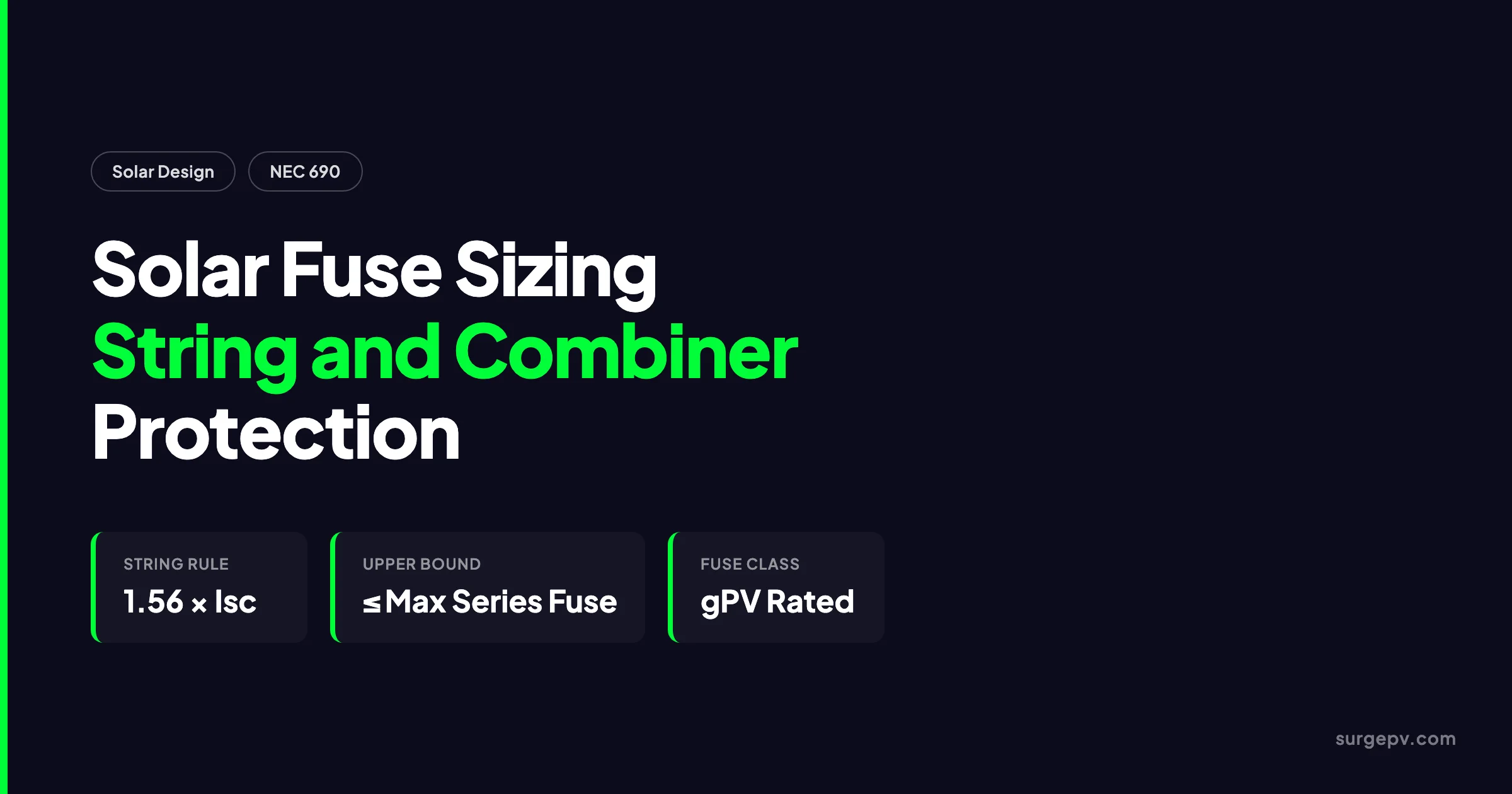
A solar fuse sizing mistake held up commissioning for two weeks on a 500 kW rooftop project I reviewed last year. The module nameplate said 15 A maximum series fuse. The design package showed Isc at 11.2 A, which calculates to 11.2 × 1.56 = 17.5 A, rounded up to 20 A. The installer had confused minimum with maximum. The 15 A fuses were under the module limit, but they were also below the NEC minimum. The combiner boxes had to be re-fused before energization.
Solar fuse sizing is not hard, but it has two hard boundaries. The fuse must be large enough to carry continuous current and small enough to protect the module. This guide covers both. It walks through the NEC 690.9 string calculation and the combiner main OCPD. It also covers IEC 62548 differences, voltage and breaking capacity selection, temperature derating, and the mistakes that repeat on every job.
Quick Answer — Solar Fuse Sizing
Size a PV string fuse at 1.56 × the module Isc, rounded up to the next standard rating, and never above the module’s maximum series fuse rating. For a 14 A Isc module the math is 14 × 1.56 = 21.8 A, so a 25 A gPV fuse is typical. Combiner main fuses use the same 1.56 factor applied to the sum of all string Isc values.
In this guide:
- Why fuse sizing is the most common electrical design callback
- The NEC 690.9 string fuse formula, worked with real module data
- Combiner output and main OCPD sizing for 6-, 12-, and 24-string boxes
- IEC 62548 vs NEC 690: when the same string needs a different fuse
- Voltage rating, breaking capacity, and temperature derating
- gPV fuse classes and how to choose a manufacturer
- Seven mistakes that fail plan review or cause nuisance trips
- When you can legally omit string fuses
- How solar design software automates the math
Why Solar Fuse Sizing Matters
Fuses are the simplest overcurrent devices on a solar plant, but they sit at the most vulnerable point. A string fuse protects each series string from reverse current fed by the parallel strings around it. A combiner main fuse protects the home-run conductor to the inverter. If either is wrong, the result is more than a code violation. It is a failed inspection, a lost day of production, or in the worst case, a fire in the DC circuitry.
The physics are straightforward. PV modules are current-limited sources. Even into a bolted fault, a string can deliver only about 1.25 to 1.56 times its short-circuit current. That is why standard utility fuse classes do not work. gPV fuses are designed to open at low overcurrents on high-voltage DC circuits where there is no natural zero-crossing to extinguish the arc. Using the wrong class or rating defeats that purpose.
Solar fuse sizing also affects coordination. The string fuse must clear before the combiner main, and the combiner main must clear before the inverter breaker. If ratings are too close, a single string fault drops the whole combiner. For a deeper look at coordination, see the guide on overcurrent protection coordination in solar PV.
The NEC 690.9 String Fuse Formula
NEC 690.9(B) requires the overcurrent protection device on a PV source circuit to carry not less than 125 percent of the maximum circuit current. NEC 690.8(A)(1) already multiplies Isc by 1.25 for irradiance enhancement. The Mersen sizing fuses for photovoltaic systems per NEC technical topic combines both factors:
Minimum fuse rating = 1.25 × 1.25 × Isc = 1.56 × Isc
The result is rounded up to the next standard fuse size. Standard gPV ratings are 10, 12, 15, 20, 25, 30, 32, 40, 50, 63, 80, 100, and 125 A. For residential and small commercial strings the common range is 10–30 A.
Worked Example — 9.6 A Residential Module
Take a 410 W module with these nameplate values:
- Isc: 9.6 A
- Maximum series fuse rating: 20 A
- System voltage: 1000 V DC
Calculation: 9.6 × 1.56 = 14.98 A. The next standard size is 15 A. The 15 A rating is below the 20 A module maximum, so it is acceptable.
Worked Example — 14.2 A Commercial Bifacial Module
Take a 550 W bifacial module with these values:
- Isc: 14.2 A
- Maximum series fuse rating: 25 A
- System voltage: 1500 V DC
Calculation: 14.2 × 1.56 = 22.15 A. The next standard size is 25 A. The module limit is also 25 A, so the fuse is at the boundary but still compliant.
Worked Example — 18.5 A High-Power Module
Take a 600 W TOPCon module with these values:
- Isc: 18.5 A
- Maximum series fuse rating: 30 A
- System voltage: 1500 V DC
Calculation: 18.5 × 1.56 = 28.86 A. The next standard size is 30 A. This is another boundary case. If the module limit were 25 A, the design would fail and you would need to reduce strings per combiner or choose a different module.
String Fuse Selection Table
| Module Isc (A) | 1.56 × Isc (A) | Standard Fuse | Typical Module Max Series Fuse |
|---|---|---|---|
| 8.0 | 12.48 | 15 A | 15–20 A |
| 9.6 | 14.98 | 15 A | 20 A |
| 11.2 | 17.47 | 20 A | 20–25 A |
| 13.0 | 20.28 | 25 A | 25 A |
| 14.2 | 22.15 | 25 A | 25 A |
| 18.5 | 28.86 | 30 A | 30 A |
The upper bound is non-negotiable. The fuse rating must be equal to or less than the module maximum series fuse rating. If the calculated minimum exceeds the maximum, the module cannot be used in that configuration. Do not round down the minimum to fit.
Combiner Output Fuse and Main OCPD Sizing
The combiner output fuse protects the conductor from the combiner bus to the inverter DC input. NEC 690.8(A)(2) defines the maximum output circuit current as the sum of the maximum currents of all parallel source circuits. Each source circuit maximum current is already 1.25 × Isc. Then 690.9(B) applies another 1.25 multiplier for the OCPD. The practical formula is:
Combiner main rating = 1.56 × (N × Isc)
where N is the number of parallel strings in the combiner.
Worked Example — 12-String Combiner
A 12-string combiner uses modules with Isc = 14.2 A.
- Combined maximum current: 12 × 14.2 = 170.4 A
- Main OCPD: 170.4 × 1.56 = 265.8 A
- Next standard size: 300 A
The main fuse or breaker must be rated for the system DC voltage. It also needs a sufficient interrupting rating. For a 1500 V system, this typically means a 300 A, 1500 V DC fuse in a Class J or RK1 holder. A listed DC molded-case breaker is also acceptable.
Worked Example — 24-String Combiner
A 24-string combiner uses modules with Isc = 13.0 A.
- Combined maximum current: 24 × 13.0 = 312 A
- Main OCPD: 312 × 1.56 = 486.7 A
- Next standard size: 500 A or 600 A depending on the manufacturer’s standard ratings
On large commercial projects the combiner main is often fused on the positive output only. It pairs with a matched DC disconnect switch. Some designs use fuses on both positive and negative conductors for ungrounded arrays. The choice depends on the system grounding plan and the AHJ interpretation.
For more on combiner layout, enclosure selection, and string grouping, see the combiner box design for commercial solar guide.
IEC 62548 vs NEC 690: Key Differences
The same PV string can produce two different fuse ratings depending on which code governs the project. This matters for international contractors, equipment procurement, and dual-certified modules.
NEC 690.9 uses a single multiplier: 1.56 × Isc. IEC 62548-1 Clause 9.4 uses a range: the fuse rating must be at least 1.25 × Isc and no more than the module’s maximum overcurrent protection rating. The IEC approach allows more optimization but requires careful checking against the module datasheet. The PV Magazine source and output circuit fuse sizing webinar walks through both calculation paths with worked examples.
Side-by-Side Comparison — 10 A Isc String
| Parameter | IEC 62548 | NEC 690 |
|---|---|---|
| Minimum fuse current | 1.25 × 10 = 12.5 A | 1.56 × 10 = 15.6 A |
| Standard size selected | 15 A | 20 A |
| Upper limit | Module max reverse current | Module max series fuse rating |
| Governing clause | IEC 62548-1 Cl. 9.4 | NEC 690.9(B) |
The 5 A difference has real procurement consequences. A project team sourcing fuses to IEC ratings for a U.S.-bound installation may find the AHJ requires larger NEC-rated fuses at plan review. Conversely, using NEC-rated fuses on an IEC project can push the fuse closer to the module limit and reduce protection margin.
Both standards require gPV-rated fuses. Both require the fuse to be rated for the maximum system voltage. And both require the selected rating to stay below the module manufacturer’s maximum overcurrent protection value. The divergence is in how much margin the code demands between normal operating current and the fuse rating.
Voltage Rating, Breaking Capacity, and Temperature Derating
Fuse selection is not only about amps. The wrong voltage class or interrupting rating can make a fuse unsafe even if the current rating is correct.
Voltage Rating
The fuse must be rated for at least the maximum PV system voltage at the coldest expected ambient. NEC 690.7 provides temperature correction factors. The Eaton Bussmann series photovoltaic application guide gives a practical rule:
Fuse voltage rating ≥ 1.20 × Voc × Ns
Voc is the module open-circuit voltage. Ns is the number of modules in series. For a string of 20 modules with Voc = 50 V, the corrected string voltage is 1000 V. The fuse should be rated at 1000 V DC minimum. For systems below −40 °C, Eaton recommends using 1.25 instead of 1.20.
Common ratings are 600 V, 1000 V, and 1500 V DC. Residential systems are usually 600 V or 1000 V. Commercial and utility systems are usually 1000 V or 1500 V.
Breaking Capacity
Breaking capacity, or interrupting rating, is the maximum fault current the fuse can safely interrupt. On the DC side, available fault current is the sum of contributions from parallel strings. For a combiner with N strings:
Available fault current ≈ (N − 1) × 1.25 × Isc
A 12-string combiner with 14 A Isc modules sees approximately 11 × 1.25 × 14 = 192.5 A of available fault current. Most gPV fuses are rated at 10–50 kA interrupting, which is far above typical PV fault levels. Still, the rating must be documented in the submittal.
Temperature Derating
Fuses are thermal devices. A 20 A fuse tested at 25 °C does not carry 20 A indefinitely at 70 °C. Manufacturer curves typically show:
| Ambient Temperature | Derated Current (typical) |
|---|---|
| 25 °C | 100% |
| 40 °C | 95% |
| 50 °C | 90% |
| 60 °C | 85% |
| 70 °C | 80% |
A combiner box in direct Arizona sun can reach 75 °C internally. A 20 A fuse at 75 °C effectively becomes a 16 A fuse. If the calculated minimum is 15.6 A, the derated fuse barely passes. If the minimum is 17 A, you must upsize to 25 A and recheck the module maximum.
For more on temperature effects in electrical design, see the solar wire sizing under NEC 690.8 guide.
gPV Fuse Classes and Manufacturer Selection
Only gPV-class fuses are listed for PV string protection. The gPV marking means the fuse meets IEC 60269-6 and is recognized under UL 2579. It is designed to interrupt low overcurrents at high DC voltage and to survive thermal cycling from sunrise to sunset.
Do not use standard AC fuses, Class H fuses, or Class RK5 fuses in PV strings. They lack the DC interrupting rating and the low-overcurrent clearing ability. An AC fuse in a DC fault can arc inside the holder and turn a simple fault into a fire.
Common gPV Product Lines
| Manufacturer | Series | Voltage | Size | Common Ratings |
|---|---|---|---|---|
| Mersen | HelioProtection / FR10GG69V | 1000 V DC | 10 × 38 mm | 1–32 A |
| Mersen | FR22GG69V | 1500 V DC | 22 × 58 mm | 10–160 A |
| Eaton Bussmann | PV-(amp)A10F | 1000 V DC | 10 × 38 mm | 1–20 A |
| Eaton Bussmann | PV-(amp)A14L | 1500 V DC | 14 × 65 mm | 15–32 A |
| Littelfuse | SPF / KLKD-PV | 1000 V DC | 10 × 38 mm | 1–30 A |
| Siba | 10×38 gPV | 1000 V DC | 10 × 38 mm | 1–32 A |
Most string fuses use 10 × 38 mm cartridge holders. Larger ratings for recombiners and battery circuits use 14 × 51 mm, 22 × 58 mm, or NH-style fuses. Always match the holder to the fuse body size and voltage class.
Manufacturer selection usually comes down to availability, price, and local distributor relationships. For critical projects, request time-current curves and temperature derating data with the submittal. The curves prove the fuse will clear at the available fault current without nuisance blowing at normal operating current.
Common Solar Fuse Sizing Mistakes
The same errors appear on plan review desks year after year. Most are simple to avoid once you know the boundary conditions.
Mistake 1 — Using the Module Maximum Series Fuse as the Minimum
The module nameplate gives a maximum, not a target. A 25 A maximum series fuse rating does not mean you must use a 25 A fuse. It means you cannot exceed 25 A. The minimum is still 1.56 × Isc.
Mistake 2 — Ignoring Temperature Derating
A 20 A fuse in a 70 °C combiner box is effectively a 16 A fuse. If the string runs at 14 A continuous, the margin is too thin. Always apply the manufacturer’s derating curve and upsize if needed.
Mistake 3 — Wrong Fuse Class
Class RK5, Class H, and standard AC fuses are not listed for PV strings. Use only gPV fuses to IEC 60269-6 or UL 2579. The wrong class may not interrupt a DC fault.
Mistake 4 — Sizing the Combiner Main Equal to the String Fuse
A 30 A string fuse and a 30 A combiner main provide no selectivity. A single string fault will blow both. The main must be sized at 1.56 × the combined string current, which is usually 200–600 A on commercial systems.
Mistake 5 — Omitting the Voltage Check
A 600 V fuse in a 1000 V string is a code violation and a safety hazard. The fuse must be rated for the maximum system voltage corrected for the lowest expected temperature.
Mistake 6 — Applying 1.56 to Each String and Then Summing
This double-counts the multiplier. The correct sequence is: sum the string Isc values first, then multiply by 1.56 for the combiner main. For a 6-string combiner with 10 A Isc modules, the main is 6 × 10 × 1.56 = 93.6 A, rounded to 100 A. Not 6 × 10 × 1.56 added separately.
Mistake 7 — Assuming All Identical Modules Use the Same Fuse
Module families within the same wattage class can have different Isc and different maximum series fuse ratings. A 550 W module from one supplier may need 25 A while a 550 W module from another needs 20 A. Size per datasheet, not per wattage class.
When You Can Skip String Fuses
NEC 690.9(A) allows string fuses to be omitted in two situations:
- The PV source circuit conductors have ampacity at least equal to the maximum current calculated under 690.8. The available fault current will not damage them.
- The array has two or fewer strings in parallel. Backfeed current from a healthy string cannot exceed the fault-current tolerance of the faulted string or conductor.
In practice, this means most single-string residential systems and many two-string systems do not need separate string fuses. The strings land directly on the inverter’s integrated DC inputs. The inverter’s internal protection covers the circuit.
With three or more strings in parallel, the math changes. A faulted string can receive backfeed from the other strings. The combined reverse current can overheat the conductor and damage module cells before the inverter reacts. String fuses become required. Use the solar string sizing calculator to confirm voltage, current, and fuse boundaries before finalizing the design.
Battery-backed systems are an exception. Even a single string connected to a battery bank needs fuse protection. A battery can deliver thousands of amps into a fault, far more than a PV string can source. The fuse must be rated to interrupt that battery fault current.
Fuse Sizing in Solar Design Software
Manual fuse sizing is fine for one-off residential jobs. On commercial projects with hundreds of strings, software removes the copy-paste errors. Modern solar design software pulls the module Isc from the product database. It applies NEC 690.9 or IEC 62548 automatically. It checks the module maximum series fuse rating and flags mismatches before the single-line diagram is exported.
The workflow I use on large projects includes these checks:
- Import the module datasheet and confirm Isc and maximum series fuse rating
- Set the design code to NEC 690 or IEC 62548
- Let the software assign strings to combiners by home-run distance
- Review the generated fuse schedule for boundary cases
- Apply temperature derating based on the site climate zone
- Export the fuse schedule as part of the permit package
For EPCs who also need detailed engineering deliverables or PE-stamped permit drawings, a solar design and engineering consultancy can layer on structural, electrical, and civil checks. This is especially useful on multi-megawatt projects where fuse sizing is one line item in a much larger protection study.
If you are comparing tools, start with the solar software pricing page. You can also book a SurgePV demo to see how the fuse schedule integrates with string sizing and voltage-drop calculations.
Frequently Asked Questions
How do you size a solar string fuse?
Size a solar string fuse at 1.56 times the module short-circuit current (Isc) under NEC 690.9. Round up to the next standard rating — 10, 12, 15, 20, 25, or 30 A. Then confirm the selected fuse does not exceed the module’s maximum series fuse rating printed on the nameplate. For example, a 14 A Isc module needs 14 × 1.56 = 21.84 A, rounded up to a 25 A fuse.
What is the 1.56 multiplier in solar fuse sizing?
The 1.56 multiplier comes from two consecutive 1.25 factors in NEC Article 690. The first 1.25 converts Isc to maximum circuit current, accounting for irradiance above standard test conditions. The second 1.25 sizes the overcurrent device for continuous duty, since PV circuits run at peak output for three or more hours. Combined: 1.25 × 1.25 = 1.5625, rounded to 1.56.
Can a solar fuse be larger than the module maximum series fuse rating?
No. The module’s maximum series fuse rating is the hard upper limit. The NEC calculation gives a minimum fuse size; the module datasheet gives a maximum. The selected fuse must satisfy both: it must be at least 1.56 × Isc and no larger than the maximum series fuse rating. Exceeding the module rating voids the listing and can allow a fault to damage cells before the fuse clears.
Do all solar strings need fuses?
No. NEC 690.9(A) allows string fuses to be omitted when there are two or fewer strings in parallel and the conductors are sized for the available fault current. With three or more parallel strings, a faulted string can receive backfeed current from the healthy strings that exceeds safe limits, so string fuses are required. Battery-backed systems should always use fuses regardless of string count.
How do you size a combiner box main fuse?
Size the combiner main fuse at 1.56 times the sum of all string short-circuit currents. For a 12-string combiner with 14 A Isc per string, the combined current is 12 × 14 = 168 A. The main OCPD is 168 × 1.56 = 262 A, rounded up to the next standard size, typically 300 A. The device must also be rated for the maximum system voltage and have a DC interrupting capacity at least equal to the available fault current.
What is the difference between NEC 690.9 and IEC 62548 fuse sizing?
NEC 690.9 uses a single 1.56 × Isc multiplier. IEC 62548 uses a range: the fuse rating must be at least 1.25 × Isc and no more than 2.4 × Isc. It must also stay below the module maximum reverse-current rating. For a 10 A Isc string, NEC typically yields a 20 A fuse; IEC typically yields a 15 A or 20 A fuse. Both standards require gPV-rated fuses.
What does gPV mean on a solar fuse?
gPV stands for general-purpose photovoltaic. It is a fuse class defined by IEC 60269-6 and UL 2579 for DC solar circuits. gPV fuses are designed to interrupt low overcurrents at high DC voltage, withstand daily thermal cycling, and clear reverse-current faults from parallel strings. Standard AC fuses or non-gPV DC fuses must not be used in PV string circuits.
Should you derate solar fuses for temperature?
Yes. gPV fuses are typically tested at 25 °C ambient, but combiner boxes on rooftops can reach 65 °C to 75 °C. At 60 °C a 20 A fuse may carry only 90 percent of its nameplate current, giving an effective rating of 18 A. If the calculated minimum fuse current is 17.5 A, the derated 20 A fuse still passes, but a 15 A fuse would not. Always check the manufacturer’s temperature derating curve.
Where this fits
This article is part of SurgePV's Solar Design hub, which works through the topic from first principles to the decisions a project team actually has to make.