

Gas stations are becoming a surprising solar target. They combine large, flat, unshaded canopies with 24-hour operations and a daytime-heavy load that aligns with PV output. In the United States, roughly 145,000 fueling stations operate convenience stores, and electricity is one of the largest fixed costs after labor and fuel supply. The EIA Commercial Buildings Energy Consumption Survey (2018) covers food sales buildings. That category includes convenience stores with gas stations, and it reports an average of 53.3 kWh per square foot per year. That is over four times the average for all commercial buildings. The result is a compact, energy-intensive site where a modest canopy array can cut operating costs by a meaningful margin.
The design challenge is not the solar physics. It is the fuel-retail environment: flammable liquids, classified electrical zones, high-traffic canopies, and an owner who cannot afford a long shutdown. Solar design for gas stations must therefore start with the actual load curve, respect NEC Article 514 and NFPA 30A, and leave room for EV charging. This guide covers the 2026 workflow from load profiling and code compliance to canopy sizing, financial modeling, and the mistakes that derail projects.
If you are designing gas station solar, use a cloud solar design platform that imports interval data, runs shadow analysis, and exports permit-ready plans. SurgePV is an all-in-one solar software platform built for this workflow.
Quick Answer
Solar design for a gas station sizes a canopy, store roof, or carport array around the site’s actual 24-hour load curve and strict hazardous-location codes. A typical US station with a convenience store uses 80,000–150,000 kWh per year and can offset 25–70% of that load with a 25–75 kWdc solar system. The design must comply with NEC Article 514 and NFPA 30A, maximize self-consumption, and leave headroom for EV charging.
TL;DR — Solar Design for Gas Station 2026
Gas stations have flat canopies, 24-hour loads, and high electricity intensity, so solar design must start with interval data and code boundaries. A 120,000 kWh/year station targeting 50% offset at a 20% capacity factor needs roughly 34 kWdc. Canopy retrofits cost $2.00–$3.50/Wdc before incentives. NEC Article 514 and NFPA 30A set the electrical safety rules; EV charging should be planned from day one.
In this guide:
- Why gas station solar design is a distinct discipline
- How to profile energy use at a fueling facility
- Sizing methodology from kWh target to DC kilowatts
- Canopy, store-roof, carport, and ground-mount tradeoffs
- NEC Article 514 and NFPA 30A compliance basics
- EV charging integration and load impact
- Worked financial example for a 60 kW canopy system
- Common design mistakes and how to avoid them
- FAQ with 10 gas station solar questions
Why Gas Station Solar Design Is Different
A gas station is not a small retail store with a big roof. It is a fuel-handling facility where electrical work is regulated as a potential ignition source. The canopy sits directly above dispensers that emit gasoline vapors. The convenience store runs refrigeration, HVAC, and lighting around the clock. The site must stay open during construction, and the owner measures payback in single-digit years.
The first difference is the load shape. Fuel traffic peaks during commute hours, which overlap with midday solar output. Canopy lighting runs all night. Refrigeration and HVAC run almost continuously. A car wash, if present, adds large but intermittent motor loads. The aggregate profile is flat and daytime-weighted, which is ideal for high self-consumption.
The second difference is the codes. NEC Article 514 and NFPA 30A (2024) define classified zones around dispensers, tanks, and vents. Equipment installed inside those zones must be rated for hazardous locations. Equipment outside those zones can use standard PV hardware, but the wiring path between the canopy and the inverter must be planned carefully.
The third difference is the structure. A gas station canopy is typically a thin, pre-engineered steel roof designed to carry its own weight, lighting, and snow or wind loads. Adding several thousand pounds of PV modules, racking, and conduit requires a structural review. Many existing canopies need reinforcement, while newer canopies are sometimes built with solar loading in mind.
| Factor | Typical Retail Store | Gas Station with Convenience Store |
|---|---|---|
| Annual electricity use | 10–30 kWh/ft² | ~53 kWh/ft² in store alone |
| Daily load shape | Business-hour peak | 24-hour base with daytime peaks |
| Hazardous zones | None | Around dispensers, tanks, vents |
| Best mounting surface | Roof | Canopy, store roof, carport |
| Self-consumption potential | 50–70% | 60–85% |
| Future electrification | Low | High from EV charging |
The table explains why a generic commercial solar proposal underperforms on gas stations. The design must treat codes, canopy structure, and future EV load as inputs from the first iteration.
Profiling Energy Use at a Gas Station
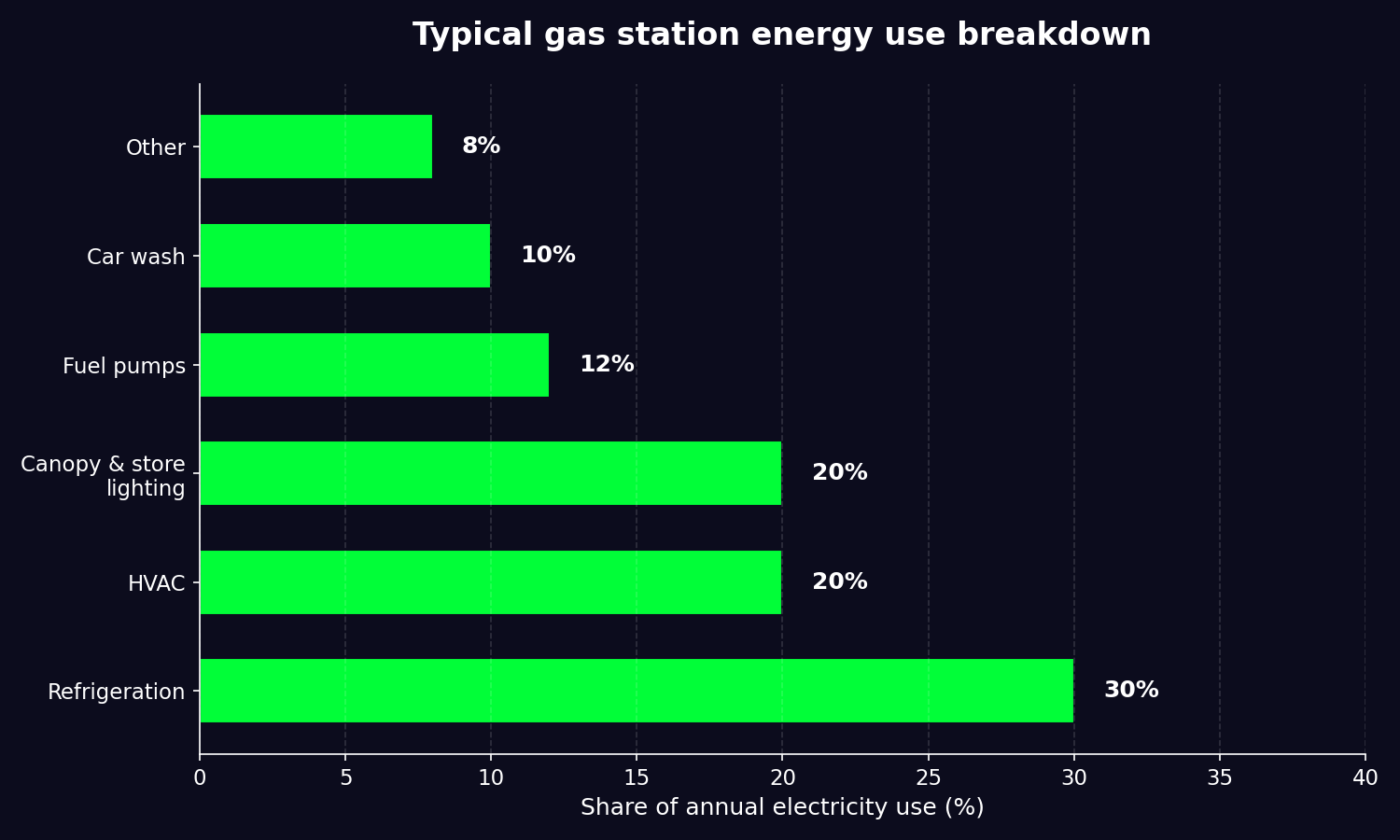
The load profile sets the array size, the inverter rating, the interconnection path, and the financial case. Start by separating the site into its major end uses.
Convenience store
The convenience store is usually the largest continuous load. The EIA 2018 CBECS data gives food sales buildings an electricity intensity of 53.3 kWh per square foot per year. A 2,400 square foot store therefore consumes roughly 128,000 kWh per year. Refrigeration, HVAC, and lighting dominate that total. The load is relatively flat across the day because the store operates 18–24 hours.
Fuel dispensers and canopy lighting
Modern fuel dispensers draw 0.5–1.5 kW each while active, but they sit idle most of the time. Canopy lighting is the bigger base load. A typical canopy uses LED fixtures, yet a large forecourt can still draw 5–15 kW continuously after dark. If the site still uses older high-intensity discharge fixtures, lighting can account for 20–30% of the total bill.
Car wash
An automatic car wash adds large motor loads that run for short bursts. A single wash cycle can pull 20–50 kW. Vacuums, air compressors, and dryers add smaller steady loads. Because car wash use is intermittent, it is often cheaper to offset with solar than to store energy for it.
EV chargers
EV charging is the fastest-growing load category at fuel-retail sites. Level 2 chargers add 7–22 kW per port. DC fast chargers add 50–150 kW per port. Even one or two fast chargers can double the site’s peak demand. The design must model charger utilization separately from the rest of the load.
A typical US gas station with a convenience store falls in the 80,000–150,000 kWh/year range. A busier highway location with a car wash and quick-service restaurant can exceed 200,000 kWh/year. The generation and financial tool models each load category hour by hour. You can see which hours solar covers and which still pull from the grid.
Sizing the Solar Array for a Gas Station
The correct sizing sequence for gas station solar is: measure load, define code boundaries, choose mounting, maximize self-consumption, then pick the kWp number. Sizing by canopy area alone is the most common mistake.
Step 1: Collect interval data and site information
Request 12–24 months of 15-minute or 30-minute interval data from the utility. Monthly bills hide the daily peaks caused by car washes and EV chargers. You also need:
- Canopy dimensions, column spacing, and structural drawings
- Store roof area, age, and condition
- Fuel-dispenser layout and hazardous-zone boundaries
- Existing electrical service size and transformer rating
- Car wash equipment inventory and schedule
- Plans for EV charger count, type, and utilization
Step 2: Separate loads by category
Build a load curve by hour and by month. Separate the store base load, canopy lighting, fuel pumps, car wash, and EV charging. Each category has a different solar value. Store and canopy loads are the easiest to offset because they run during the day. Lighting at night cannot be offset without storage.
Step 3: Choose a target offset based on self-consumption
Gas stations typically achieve self-consumption ratios of 60–85% without storage. Because exported solar is usually worth far less than on-site consumption, the economic optimum is often an array that covers 30–60% of annual load, not 100%.
Run three sizing scenarios:
| Scenario | Sizing target | Best for |
|---|---|---|
| High self-consumption | Production = 30–45% of annual load | Low export value or net billing |
| Maximum canopy use | Production = 50–70% of annual load | Strong net metering or high electricity rates |
| EV-ready | Production = future load with chargers | Sites adding chargers within 2–3 years |
Step 4: Convert target kWh to DC capacity
Divide the target annual kilowatt-hours by the local capacity factor. A fixed-tilt canopy in the southern United States might achieve 20–25%. A canopy in the northern United States might achieve 15–20%.
For example, a station targeting 60,000 kWh/year of solar generation at a 20% capacity factor needs:
- Required DC energy = 60,000 kWh/year ÷ 0.20 = 300,000 kWh/year of DC nameplate
- Required DC capacity = 300,000 kWh/year ÷ 8,760 hours = 34 kWp
Round to a practical module layout. A 35 kWdc system would produce roughly 61,320 kWh/year at that capacity factor.
Use the solar design software with interval-data import to test these scenarios automatically. Manual spreadsheets struggle to capture the hourly value of self-consumption, export, and EV charging load at the same time.
Canopy, Roof, Carport, and Ground-Mount Options
Most gas stations have four real-estate options. Each has a different cost, risk profile, and code impact.
Canopy solar
The canopy is usually the most visible and productive surface. It is flat, unshaded, and oriented horizontally. A 20 m × 15 m canopy can host 40–80 modules and roughly 20–40 kWdc, depending on module wattage and exclusion zones. Because the canopy is directly above fuel dispensers, the wiring must drop through columns and run outside classified zones.
Pros:
- Uses existing structure with no new land
- High visibility for branding and sustainability claims
- Production aligns with daytime fuel traffic
Cons:
- Structural review almost always required
- Hazardous-location wiring adds cost
- Construction access is limited during operating hours
Store roof solar
The convenience store roof is a standard commercial rooftop. It is usually the lowest-cost option, but the area is small relative to the load. A 2,400 square foot store roof might host 15–30 kWdc.
Pros:
- Lowest installed cost per watt
- Standard commercial electrical practice
- No interaction with fuel-dispenser zones
Cons:
- Limited area
- Roof condition and warranty must be reviewed
- HVAC units and signage may create shading
Solar carports
If the canopy is too small or too weak, a solar carport in the parking area can carry the project. It also creates shaded parking and a natural home for EV charging. Carports cost more per watt than rooftop but avoid the hazardous-zone wiring of the canopy.
Pros:
- Adds parking shade and EV charging infrastructure
- No roof structural limits
- Easier maintenance access than canopy
Cons:
- Higher cost per watt due to steel structure
- Foundation and civil work required
- May consume parking spaces
A 50-space parking lot can host 100–200 kWdc in a standard carport layout. See the solar carport design guide for detailed structural and electrical guidance.
Ground-mount solar
Ground-mount works for stations with spare land behind the store or along highway frontage. It offers the lowest cost per watt and the simplest maintenance access, but it competes with land use and requires fencing.
| Mounting option | Typical size | Cost trend | Best for |
|---|---|---|---|
| Canopy | 20–80 kW | Higher | High visibility, existing strong canopy |
| Store roof | 15–40 kW | Lowest | Simple, low-cost offset |
| Carport | 50–200 kW | Higher | Old canopy, EV charging, extra parking |
| Ground-mount | 100 kW+ | Low per watt | Sites with spare land |
Use the platform’s shade engine to check shading from canopy fascia, light poles, signage, and neighboring buildings before finalizing the layout.
Electrical Safety and Hazardous-Location Codes
Gas station solar design lives at the intersection of the National Electrical Code and fire safety codes. Getting this wrong can stop a project at plan check or create a long-term liability.
NEC Article 514
NEC Article 514 defines the classified locations around motor fuel dispensing facilities. The areas immediately around dispensers are classified. So are the underside of the canopy in some configurations and spaces near tank vents. These are Class I, Division 1 or 2 locations. Standard PV modules, inverters, and conduit systems are not allowed inside these zones unless they are specifically listed for hazardous locations.
The good news is that the canopy roof surface is generally outside the classified zone. PV modules can be mounted on top of the canopy with standard equipment. The conductors must then be routed down columns and away from classified areas in approved raceways. Sealing fittings are required where raceways pass between classified and unclassified areas.
NFPA 30A
NFPA 30A, the Code for Motor Fuel Dispensing Facilities and Repair Garages (2024), governs the overall fire safety of the facility. It addresses dispenser spacing, emergency shutdown systems, and the installation of EV charging equipment. Solar designs must coordinate with the facility’s emergency shutdown system so that a fuel-system shutdown does not create an unsafe condition for PV conductors or inverters.
Common code pitfalls
Three items cause the most first-cycle plan-check corrections:
- Placing DC combiners or optimizers inside classified zones. Keep all active electronics outside the NEC 514 boundaries.
- Using improper conduit seals. Raceways passing between classified and unclassified areas need approved seals to prevent vapor migration.
- Ignoring the emergency shutdown interface. The PV system must have a clearly labeled disconnect that emergency responders can operate.
For complex canopy retrofits or PE-stamped permit packages, engineering consultancies such as Heaven Designs can help. They provide solar design services, detailed engineering, and permit design support for EPCs on code-sensitive commercial jobs.
EV Charging Integration
Gas stations are natural EV charging hosts. The site already has high electrical capacity, 24-hour staffing, retail amenities, and customers who expect a quick stop. Solar plus EV charging turns a fuel-retail site into an energy hub.
Charger types and loads
Level 2 chargers add 7–22 kW per port. They suit drivers who will spend 30–90 minutes in the store. A bank of four Level 2 chargers can add 28–88 kW of connected load.
DC fast chargers add 50–150 kW per port, with some units exceeding 350 kW. They suit highway locations where drivers stop for 15–30 minutes. Two 150 kW DC fast chargers can add 300 kW of peak demand.
Code and siting
NFPA 30A now includes specific provisions for EV charging at motor fuel dispensing facilities. EV charging spaces must be located so that fuel spills cannot pool underneath the vehicle, and chargers must be protected from vehicle impact. The equipment must also be coordinated with the emergency shutdown system. The Monta EV charging site design guide (2026) covers layout, traffic flow, and operational integration in detail.
Solar value
Solar generation can cover Level 2 charging during daylight hours and reduce the grid draw for DC fast chargers. Fast chargers rarely achieve 100% solar self-consumption because their peak power far exceeds a typical canopy array. The financial value comes from reducing the energy component of the charging bill, not from eliminating grid imports.
Size the electrical service, transformer, and solar inverter with headroom for future chargers. Retrofitting a larger service after the solar install is expensive and may require utility upgrades.
Financial Model and ROI Worked Example
Gas station solar economics are driven by three factors: high electricity rates, high self-consumption, and strong federal incentives. Here is a realistic worked example for a 60 kWdc canopy system on a mid-size station in the United States.
Inputs:
- Annual electricity use: 130,000 kWh
- Peak demand: 85 kW
- Local commercial electricity rate: $0.13/kWh
- Capacity factor for fixed canopy: 20%
- Installed canopy cost: $2.50/Wdc
Sizing:
The design targets 50% annual offset to keep self-consumption high.
- Target solar generation = 130,000 × 0.50 = 65,000 kWh/year
- Required DC capacity = 65,000 ÷ (8,760 × 0.20) = 37 kWp
Round to a practical layout: 60 kWdc is larger than the 50% target but fits the available canopy and leaves room for EV charging growth. At 20% capacity factor, a 60 kWdc system produces about 105,120 kWh/year.
Cost before incentives:
- 60 kW × $2.50/W = $150,000
- 30% federal ITC = $45,000
- Net cost = $105,000
Savings:
- First-year solar generation: 60 kW × 8,760 × 0.20 = 105,120 kWh
- Avoided energy cost: 105,120 × $0.13 = $13,666
- Simple payback: $105,000 ÷ $13,666 = 7.7 years
This is a conservative case. Stations in markets with $0.16–$0.20/kWh commercial rates, such as California or the Northeast, can see paybacks of 5–6 years. Commercial rooftop solar in 2026 typically costs $1.40–$1.80 per watt DC before incentives. Benchmark pricing sits near $1.55/Wdc according to NREL (2024) and $1.71/Wdc according to SEIA and Wood Mackenzie (2025). Store-roof systems land at the lower end of that range; canopy and carport systems trend higher.
| Line item | Value |
|---|---|
| System size | 60 kW DC |
| Gross installed cost | $150,000 ($2.50/W) |
| Section 48E ITC (30%) | −$45,000 |
| Net project cost | $105,000 |
| Annual energy production | 105,120 kWh |
| Annual electricity savings | $13,666 |
| Simple payback | 7.7 years |
State and utility incentives can improve these numbers. Check the DSIRE database for programs in your project location.
Common Gas Station Solar Design Mistakes
Gas station projects fail or underperform for predictable reasons. Here are the most common design mistakes and how to avoid them.
1. Sizing by canopy area instead of verified load
A canopy can fit a big array, but a big array that exports most of its production at avoided-cost rates loses money. Start with interval data and target high self-consumption.
2. Ignoring NEC 514 classified zones
Placing standard PV electronics inside hazardous zones is a plan-check rejection and a safety risk. Map the classified boundaries before locating combiners, optimizers, or disconnects.
3. Skipping the structural review
Older canopies were not designed for PV loads. Adding modules and racking without a structural letter can overload columns and foundations. Reinforcement is often required.
4. Treating the canopy as a generic roof
Canopy wiring must drop through columns, avoid fuel vapor zones, and coordinate with emergency shutdown systems. Standard rooftop details do not apply.
5. Forgetting future EV charging
A site that adds two DC fast chargers can double its peak demand. Size the service, transformer, and solar inverter with headroom.
6. Poor interconnection assumptions
Gas stations in older areas may have limited service capacity or long utility study timelines. Submit a pre-application early and model export value realistically.
How SurgePV Automates Gas Station Solar Design
Manual gas station solar design often involves five or six disconnected tools: one for the load profile, one for the canopy layout, one for shading and yield, one for string sizing, one for the financial model, and one for the proposal. Every time the load assumption or charger count changes, the chain of spreadsheets must be updated by hand. That is where design automation pays off.
Design software like SurgePV keeps the entire workflow in one environment. You import the station’s interval meter data, model the proposed canopy or carport array against real consumption, and run hourly PV generation simulations. The platform sizes the inverter and DC collection, calculates self-consumption, export, and EV charging offset automatically, and generates a bankable customer-facing proposal.
For gas station projects, three capabilities matter most:
- Load-aware sizing. Clara AI sizes the array against the actual load curve rather than a generic annual average, so the offset claim is accurate from the first iteration.
- Code-aware layout. SurgePV models canopy dimensions, obstruction setbacks, and shade from signage and light poles, so the panel count reflects real buildable area.
- Bankable proposals. The design outputs feed directly into a proposal with hourly production, cash flows, and sensitivity tables. This cuts the time from site visit to signed contract for EPCs and developers.
For the design-to-proposal workflow, proposal software keeps the financial and technical data consistent as the project evolves.
Design Gas Station Solar in SurgePV
Model interval load, canopy layouts, EV charging headroom, and bankable proposals in one cloud platform.
Book a DemoNo commitment required · 20 minutes · Live project walkthrough
Next Steps for Your Gas Station Solar Project
Gas station solar in 2026 is a mature play with clear design rules and strong incentives. The projects that succeed treat the station as a fuel-handling facility first and a solar host second. They size the array for self-consumption, respect NEC Article 514 and NFPA 30A, and plan for EV charging before the service upgrade is needed.
Three actions will move you forward today:
-
Pull 12–24 months of interval data and benchmark the station against typical convenience-store energy use. Identify whether the canopy, store roof, carport, or ground-mount path has the most buildable area.
-
Run a code-aware design in SurgePV. Map NEC 514 classified zones, model hourly generation against the operating schedule, and test three sizing scenarios before finalizing the kWp number.
-
Compare ownership, PPA, and lease structures using a solar proposal tool that handles Section 48E credits, bonus credits, depreciation, and gas-station cash flow. If you want a hands-on walkthrough, book a SurgePV demo.
Frequently Asked Questions
What is solar design for a gas station?
Solar design for a gas station is the process of sizing, laying out, and integrating a photovoltaic system to offset a fueling facility’s electricity use. It starts with the site’s 24-hour load curve. It accounts for hazardous-location codes such as NEC Article 514 and NFPA 30A. It then selects canopy, store-roof, carport, or ground-mount options that maximize self-consumption and bill savings.
How much electricity does a gas station use per year?
A typical US gas station with a convenience store uses 80,000–150,000 kWh per year. The convenience store alone often runs at about 53.3 kWh per square foot per year, according to the EIA (2018). Fuel pumps, canopy lighting, car washes, and EV chargers add to that base load.
Can solar panels be installed on a gas station canopy?
Yes. Modern gas station canopies are often large, flat, and unshaded, making them ideal solar platforms. A 20 m × 15 m canopy can host 40–80 panels and roughly 20–40 kWdc. The design must include a structural review, proper electrical isolation, and compliance with hazardous-location wiring rules.
What codes govern solar on gas stations?
In the United States, NEC Article 514 defines hazardous-location boundaries around fuel dispensers and tanks. NFPA 30A sets the fire-safety rules for motor fuel dispensing facilities. Solar equipment mounted outside the classified zones can use standard PV hardware. Conductors passing through or near classified areas must be in approved raceways and properly sealed.
How do you size a solar array for a gas station?
Collect 12–24 months of interval meter data. Separate the store, pumps, lighting, car wash, and EV charging loads. Then choose a target offset that keeps most generation on-site. Divide the target annual kilowatt-hours by the local capacity factor. A 120,000 kWh/year station targeting 50% offset at a 20% capacity factor needs about 34 kWdc of solar.
Is EV charging a good fit for gas station solar?
Yes, when the site has spare electrical capacity and the chargers are located outside the fuel-dispenser hazardous zones. Level 2 chargers add 7–22 kW per port, while DC fast chargers add 50–150 kW each. Solar can offset daytime charging load, but the utility service and interconnection must be sized for the full EV load during low-solar periods.
How much does gas station solar cost in 2026?
Commercial rooftop solar in 2026 typically costs $1.40–$1.80 per watt DC before incentives. Benchmark pricing sits near $1.55/Wdc according to NREL (2024) and $1.71/Wdc according to SEIA and Wood Mackenzie (2025). Canopy and carport retrofits usually fall in the $2.00–$3.50/Wdc range because of structural review, hazardous-location wiring, and foundation work.
What incentives are available for gas station solar in 2026?
In the United States, federal incentives include the 30% Investment Tax Credit under Section 48E. They also include domestic content and energy community bonus credits, plus MACRS depreciation for taxable owners. State, utility, and local rebates vary, so check the DSIRE database for current programs.
What are the most common gas station solar design mistakes?
The most common mistakes are sizing by canopy area instead of verified load, ignoring NEC Article 514 boundaries, and placing electrical equipment inside classified zones. Teams also skip the structural review and fail to model EV charging growth.
How does SurgePV help with gas station solar design?
SurgePV imports interval meter data and models canopy or carport layouts. It checks shade from signage and light poles, simulates hourly generation against the station load curve, and sizes inverters and EV charging headroom. It then generates a bankable proposal with cash flows and incentives. The design-to-proposal workflow keeps load, layout, and financial data in one place.
Next Steps
- Pull 12–24 months of interval data and separate store, pump, lighting, car wash, and EV charging loads before sizing any array.
- Map NEC 514 classified zones and keep active PV electronics outside them.
- Book a SurgePV demo to run the full design-to-proposal workflow on one of your gas station projects.
Where this fits
This article is part of SurgePV's Solar Design hub, which works through the topic from first principles to the decisions a project team actually has to make.



