

Answer
Solar design for an airport sizes PV systems on terminals, hangars, carports, or open land while satisfying FAA airspace and glare reviews. A typical commercial airport terminal uses 150–350 kWh per square meter per year, and a 2 MW rooftop can offset 10–15% of that load at $1.50–$2.00/Wdc before incentives.
Airports are among the most energy-intensive properties in any city. A single large terminal can consume as much electricity as a small town. At the same time, airports control thousands of acres of flat roofs, parking fields, and buffer land that sit in full sun. That combination makes solar design for airport properties a high-value engineering specialty. It also makes it one of the most regulated.
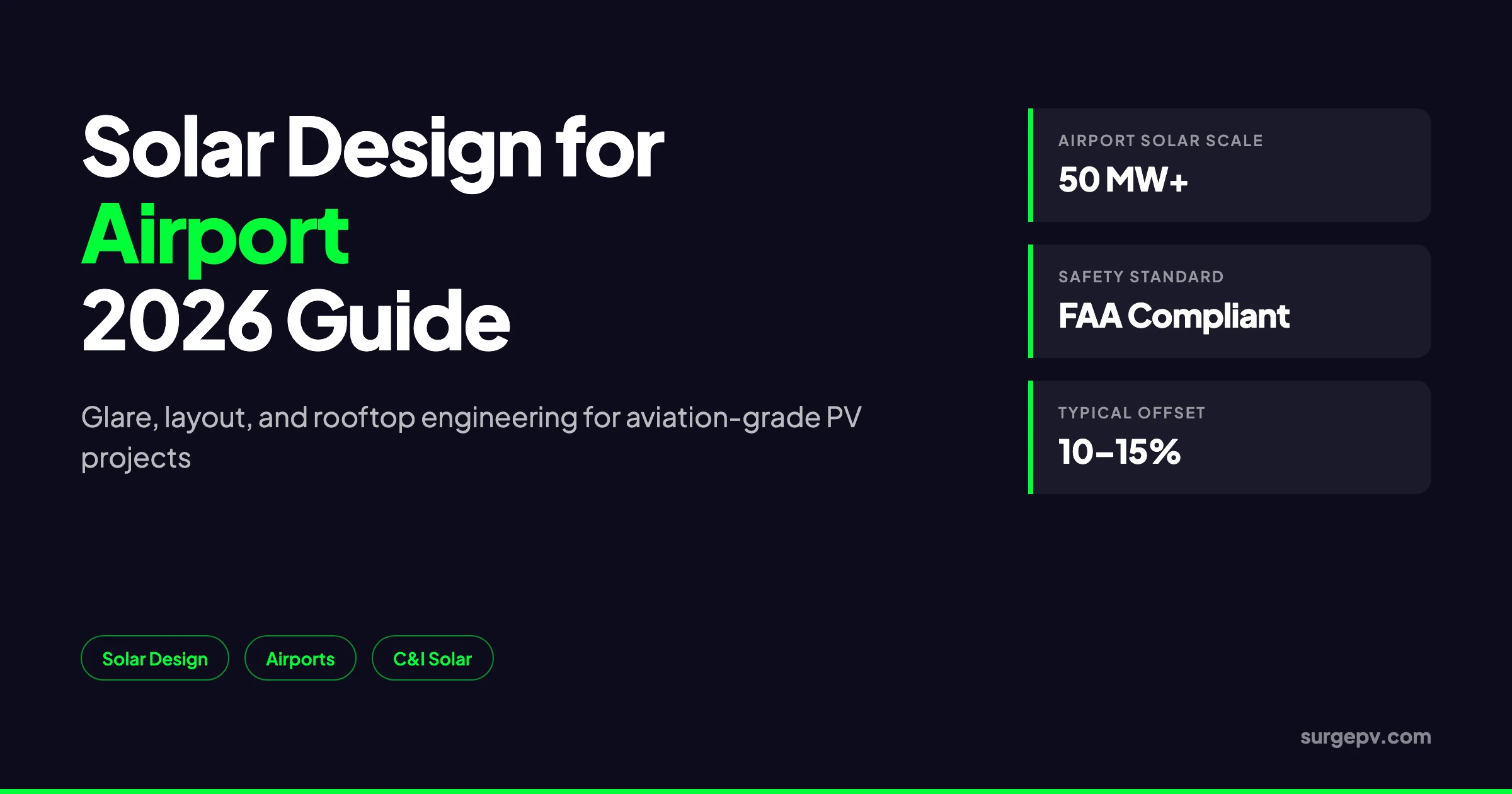
Denver International Airport now operates 11 solar arrays with a combined capacity of about 50 MW, according to a December 2025 airport press release. Cochin International Airport in India became the first fully solar-powered airport in 2015 and has since expanded to 50 MWp, according to CIAL. A 2025 review in Scientific Reports notes that Indianapolis International Airport offsets approximately 39,000 metric tons of CO₂ per year. Denver prevents more than 11,000 metric tons annually.
These projects prove that airports can host solar at scale. They also show that success depends on navigating FAA airspace rules, glare studies, security requirements, and airport-specific load profiles. No module should be lifted onto a roof until these steps are complete.
This guide covers the 2026 workflow for airport solar design. It focuses on the engineering decisions that determine whether a project is safe, permitted, and profitable. If you are quoting airport solar, use a cloud solar design platform that imports site plans, runs shadow analysis, and exports permit-ready drawings. SurgePV is built for solar installers, and Clara AI can accelerate layout and glare-aware design for complex sites.
Quick Answer
Solar design for an airport sizes PV systems on terminals, hangars, carports, or open land while satisfying FAA airspace and glare reviews. A typical commercial airport terminal uses 150–350 kWh per square meter per year. A 2 MW rooftop can offset 10–15% of that load at $1.50–$2.00/Wdc before incentives.
TL;DR — Solar Design for Airport 2026
Airport solar is a high-load, high-regulation design problem. Terminal roofs and carports are the easiest locations; ground-mount arrays on airport land need glare and airspace approval. The FAA reviews every project under 14 CFR Part 77 and requires a glare study with no hazardous reflection at control towers or on runway approaches. Commercial rooftop solar costs $1.47–$1.72/Wdc in 2025, while carports run near $3.14/W. Start with interval load data and the FAA review, then size the array and financial model.
In this guide:
- Why airport solar design is a distinct discipline
- Where solar fits on an airport property
- FAA airspace and glare review requirements
- Sizing methodology from load to kilowatts
- Structural, electrical, and security considerations
- Worked financial example for a 2 MW terminal rooftop
- Common airport solar design mistakes
- FAQ with 10 airport solar questions
Why Airport Solar Design Is Different
An airport is not a normal commercial rooftop job. It is a 24-hour transportation facility with strict safety, security, and regulatory layers. The same features that make airports attractive for solar—large flat roofs, open land, and high daytime loads—also create the constraints.
The first constraint is aviation safety. Any structure or reflecting surface that could distract pilots, air traffic controllers, or ground operators is reviewed by the FAA. Solar panels are less reflective than metal roofs or snow, but the FAA requires a formal glare assessment for any project on or near an airport. The FAA Technical Guidance for Evaluating Selected Solar Technologies on Airports (2018) is the primary reference for this review.
The second constraint is the load profile. Terminal HVAC, lighting, baggage systems, and passenger processing run continuously. The result is a flat, high baseline with daytime peaks that align well with solar output. A 2025 review in Energy and Buildings found that airport terminals average about 234 kWh per square meter per year. Per-passenger consumption ranges from 1.7 to 2.75 kWh per passenger. That intensity means even a multi-megawatt array produces a meaningful but partial offset.
The third constraint is operational continuity. Airports cannot shut down terminals or parking structures for long installation windows. Construction access is limited, security screening is mandatory for workers and equipment, and staging areas are tightly controlled. Design decisions that would be routine elsewhere—such as crane placement or inverter location—become critical at an airport.
| Factor | Typical Commercial Rooftop | Airport Solar |
|---|---|---|
| Primary regulator | Local AHJ and utility | FAA, TSA, airport sponsor, local AHJ |
| Glare review | Usually none | Mandatory glare study |
| Airspace review | None below height limits | Form 7460-1 under Part 77 |
| Load shape | Business hours | 24-hour baseline with daytime peaks |
| Security | Standard site access | Badged access, secure staging |
| Installation windows | Flexible | Tight, night, or off-peak only |
The design must therefore start with the FAA process and the airport’s actual energy data. Everything else follows from those two inputs.
Where Solar Fits on an Airport Property
Not every sunny spot on an airport is buildable. Solar projects must avoid runway safety areas, blast zones, navigational aid clearances, and future airport layout plan changes. Within those limits, four categories dominate.
Terminal and Hangar Rooftops
Terminal roofs are the most straightforward location. They are large, flat, and close to the electrical load. Hangar roofs are similarly attractive, especially at cargo or maintenance hubs. A 1 MW DC rooftop system typically needs 3,000–4,000 square meters of usable area after setbacks, walkways, and equipment zones.
The design must account for roof age, structural capacity, and future HVAC or baggage equipment upgrades. Airports often plan terminal expansions decades ahead, so the array should not block future roof penetrations or crane access. This is where a commercial solar system design process adds value.
Parking Lots and Carports
Employee parking, rental-car lots, and public garages are prime candidates for solar carports. A standard US parking stall supports about 800 W DC of solar. A 100-space lot in a double-row layout can host 200–250 kW DC, depending on geometry. Carports also provide shade, reduce heat-island effects, and create a natural platform for EV charging.
The structural design is different from a rooftop. Carports are open buildings under ASCE 7-22. Wind pressure acts on both sides of the panel plane, and clear heights must meet fire-lane requirements. For a deep dive, see our solar carport design guide.
Ground-Mount Arrays on Non-Aviation Land
Many airports own large tracts of land that are not suitable for runways or buildings. Denver International Airport, for example, has placed ground-mount arrays on more than 200 acres of such land. These projects can reach tens of megawatts and may feed the airport directly or export power under a PPA or land lease.
Ground-mount projects face the longest FAA review because they are visible from aircraft and may be near approach paths. They also require fencing, security lighting, and wildlife management plans. The upside is scale and simpler maintenance access.
Emerging Locations
Some airports are testing floating PV on retention ponds, vertical PV along runway buffers, and building-integrated photovoltaics on terminal facades. These are still niche applications. They should be treated as pilots until local FAA and airport sponsor precedents are established.
The FAA Airspace and Glare Review Process
The FAA review is the single most important gate for airport solar in the United States. It applies to projects on airport property and to off-airport projects that could affect aviation safety. The process has two main parts: airspace review and glare assessment.
Airspace Review Under 14 CFR Part 77
Any construction or alteration on a public-use airport must be evaluated for penetration of imaginary surfaces around runways and taxiways. The sponsor submits FAA Form 7460-1, Notice of Proposed Construction or Alteration. The FAA typically issues a determination within 30–45 days. Rooftop arrays that are lower than existing structures may still require review if they alter radar signatures or glare risk.
The FAA has broad authority to review solar projects regardless of height or location. That means even a small carport near a runway may need a case-by-case study. Early coordination with the FAA Airports District Office is the best way to avoid redesign later.
Glare Assessment
The FAA requires a glare study for any solar project that could reflect sunlight toward an air traffic control tower or a runway approach path. The glare analysis can be qualitative, geometric, or a field demonstration. Many developers use the Solar Glare Hazard Analysis Tool (SGHAT), originally developed by Sandia National Laboratories for the FAA.
The FAA color-codes glare into three categories. Green glare has low potential for after-image and is acceptable on approach paths. Yellow and red glare are not permitted on approach paths. No glare is permitted at the Air Traffic Control Tower cab. The standard final approach path is defined as two miles back from 50 feet above the landing threshold along a 3-degree glide path.
Panels are less reflective than many airport surfaces, but low sun angles can still produce reflections. The most common mitigation is to adjust tilt or orientation. Anti-reflective coatings and vegetative screening are also options.
Radar and Communication Interference
Solar equipment can reflect or absorb radio signals. The FAA Technical Operations team evaluates potential impacts on radar, instrument landing systems, and other navigational aids. Large ground-mount arrays near radar lines of sight are the most likely to trigger this review.
Sizing the Array from Load and Available Area
Airport solar sizing starts with two questions: how much energy does the airport use, and how much sunny area is available? The smaller of those two answers sets the practical system size.
Load Profiling
Collect 12–24 months of interval meter data for the terminal, hangars, car parks, and any separately metered tenants. Separate base loads from passenger-driven loads. Base loads include lighting, security, and refrigeration. Passenger-driven loads include baggage handling, people movers, and gate equipment.
A 2025 review in Energy and Buildings reports average terminal energy use intensity of 234 kWh per square meter per year. A 100,000-square-meter terminal therefore uses about 23.4 GWh per year. A 2 MW DC rooftop in Denver with a 22% capacity factor produces about 3.85 GWh per year. That would offset roughly 16% of the terminal load.
Area-to-Capacity Conversion
A useful rule of thumb is 1 MW DC per 3,000–4,000 square meters of flat roof. For carports, plan on roughly 800 W DC per standard parking space. For ground-mount, a 1 MW fixed-tilt array needs about 1.5–2 hectares after access roads and setbacks.
These rules change with module wattage and layout efficiency. A layout using 600 W modules produces more capacity per square meter than one using 400 W modules. A generation and financial tool should replace rules of thumb before finalizing a proposal.
Target Offset
Airports usually target partial offset rather than 100% self-supply. A 10–25% offset from rooftop and carport solar is realistic for many large hubs. Higher offsets require ground-mount arrays, storage, or a combination of on-site and off-site generation.
Worked Sizing Example
Consider a 50,000-square-meter terminal with an average EUI of 234 kWh per square meter per year. Annual consumption is 11.7 GWh. The available roof area after setbacks is 20,000 square meters. At 1 MW per 3,500 square meters, the roof can support about 5.7 MW DC. At a 22% capacity factor, annual production is about 11 GWh, enough to offset roughly 94% of terminal load.
In practice, structural load limits, glare constraints, and interconnection capacity would reduce that number. The final design might land at 2–3 MW DC, producing 3.2–4.8 GWh per year and offsetting 27–41% of terminal load.
Airport Solar Design Workflow
A successful airport solar project moves through five clear phases. Skipping a phase usually creates expensive rework later.
Phase 1: Load and Master Plan Review
Collect 12–24 months of interval meter data and the airport’s latest master plan. Identify which meters serve terminals, hangars, car parks, and tenants. Mark any planned expansions, roof replacements, or electrical upgrades that could conflict with solar.
Phase 2: Site Screening
Map every potential location against FAA surfaces, runway safety areas, navigational aid clearances, and security zones. Eliminate sites that violate these constraints before investing in detailed design. Terminal roofs and remote car parks usually survive this screen.
Phase 3: Glare and Airspace Study
Submit FAA Form 7460-1 early. Run a geometric glare analysis using SGHAT or an equivalent tool. Confirm no glare at the control tower and no yellow or red glare on approach paths. Share results with the airport sponsor and FAA Airports District Office.
Phase 4: Array and Electrical Design
Size the system from verified load and available area. Design the structural attachment, electrical one-line, and interconnection. Model hourly production against airport loads with the same generation and financial tool used for the proposal.
Phase 5: Permitting, Financing, and Construction
Prepare the permit package, select the ownership model, and schedule construction around airport operations. Commission the system and hand over monitoring access to airport facilities staff.
Structural, Electrical, and Security Considerations
Once the size and location are set, the design must satisfy structural, electrical, and security requirements that go beyond a typical commercial project.
Structural Review
Terminal and hangar roofs must be evaluated for dead load, live load, wind uplift, and snow drift. Many airport roofs were not designed with solar loading in mind. Ballasted systems may exceed load limits, and penetrating systems must be coordinated with roof warranties and drainage. A structural PE stamp is normally required.
Solar carports are classified as open buildings under ASCE 7-22. They require higher wind pressure coefficients than ground-mount arrays at similar heights. Foundation design must account for geotechnical conditions, especially in areas with poor soils or high water tables.
Electrical Design
Airport electrical systems are often served at medium voltage with multiple substations. Large arrays may connect at 480 V behind the meter or at 12–34.5 kV through a dedicated interconnection. The design must coordinate with airport operations to avoid outages during commissioning.
Inverter selection depends on array size and voltage. Commercial projects typically use string inverters or central inverters. DC:AC ratios of 1.2–1.35 are common. Surge protection, grounding, and arc-fault protection must meet NEC Article 690 requirements.
Security and Access
Airports restrict access to airside and secure areas. Solar contractors must obtain badges, follow escort requirements, and use approved staging areas. Maintenance plans should minimize the need for workers to enter secure zones. Monitoring systems help reduce site visits by identifying faults remotely.
Wildlife and Vegetation
Ground-mount arrays must manage vegetation to avoid attracting birds or wildlife that could create foreign object debris hazards. Low-growing ground cover is usually preferred over tall grasses or crops that attract birds. Fencing design must also consider wildlife movement and airport safety.
Financial Model: 2 MW Terminal Rooftop Example
Here is a realistic 2026 financial model for a 2 MW DC terminal rooftop system at a US airport. The numbers are illustrative and should be replaced with site-specific inputs before presenting to a client.
| Input | Value |
|---|---|
| System size | 2,000 kW DC |
| Usable roof area | 7,500 m² |
| Capacity factor | 22% |
| Annual production | 3,850 MWh |
| Airport electricity rate | $0.10/kWh |
| Installed cost | $1.65/Wdc |
| Gross cost | $3,300,000 |
| Section 48E ITC (30%) | -$990,000 |
| Net cost after ITC | $2,310,000 |
| MACRS depreciation benefit (est.) | -$660,000 |
| Effective net cost | ~$1,650,000 |
| Annual electricity savings | $385,000 |
| Simple payback | ~4.3 years |
The payback improves if the airport faces demand charges, time-of-use rates, or rising retail prices. Many airport PPAs are structured so the airport pays no upfront capital and buys power at a fixed rate below the utility tariff. The developer captures the tax credits and depreciation.
Commercial PV system pricing in the United States averaged $1.47/Wdc in Q1 2025 and $1.57/Wdc in Q2 2025, according to SEIA and Wood Mackenzie. NREL’s 2024 benchmark placed commercial rooftop solar at $1.55/Wdc, according to the NREL cost benchmark report. Airport-specific projects may run slightly above these benchmarks due to security, access, and FAA coordination costs. Use solar proposal platform to present these numbers in a client-ready format.
Common Airport Solar Design Mistakes
Airport projects fail more often in permitting than in engineering. These are the mistakes that cause the most delays.
Treating Glare as an Afterthought
Teams sometimes complete the full electrical design before submitting the glare study. If the study shows unacceptable reflection at the control tower or on a runway approach, the layout must change. Start the glare analysis during concept design.
Sizing by Roof Area Instead of Load
A large roof can host more solar than the airport can use or export. Oversizing wastes capital and may complicate interconnection. Always start with interval load data.
Using Ground-Mount Tables for Carports
Carports are open buildings, not ground-mount arrays. Using the wrong wind pressure tables underestimates structural loads and can lead to permit rejection or worse, failure under high wind.
Ignoring Future Expansion
Airports plan in decades. A rooftop array that blocks future HVAC upgrades, crane paths, or terminal expansions will be rejected by airport planning staff. Review the Airport Layout Plan and master plan early.
Weak Maintenance Access Planning
Inverters placed in secure areas require escorted maintenance visits. That adds cost and delay. Place equipment in accessible, non-secure locations where possible.
Ownership and Financing Models for Airport Solar
Airports can structure solar projects in several ways. The right model depends on capital availability, tax appetite, risk tolerance, and the airport sponsor’s goals.
Airport-Owned System
In this model, the airport pays for the system and keeps the tax credits, depreciation, and energy savings. Ownership gives the airport full control and the highest long-term return. It also requires upfront capital and carries construction and performance risk. NREL’s 2024 benchmark shows commercial solar at $1.55/Wdc, so even a 2 MW system needs roughly $3.1 million before incentives.
Power Purchase Agreement
Under a PPA, a developer owns, operates, and maintains the system. The airport buys the power at a fixed rate for 15–25 years. This model transfers construction risk and requires no capital from the airport. It is the most common structure for public-sector airports. The developer captures the federal Investment Tax Credit and depreciation. Denver International Airport has used this model for several of its larger arrays.
Land Lease
The airport leases non-aviation land to a solar developer. The developer sells power to the grid or to the airport under a separate PPA. The airport receives lease revenue and may also receive renewable energy credits. This model works best for airports with large tracts of underused land and access to transmission or distribution infrastructure.
Grants and Incentive Stacking
In the United States, airport solar can qualify for the 30% Section 48E Investment Tax Credit and MACRS depreciation. Some projects also qualify for domestic content and energy community bonus credits. Some projects may also access FAA Airport Improvement Program discretionary funds or state clean-energy grants. The exact stack varies by location, ownership structure, and project size.
Each model changes the pro forma. Airport-owned systems show the fastest payback but require capital. PPAs show immediate savings against utility rates but lower lifetime value. Land leases produce rental income but may involve longer development timelines.
Frequently Asked Questions
What is solar design for an airport?
Solar design for an airport is the process of sizing, siting, and engineering photovoltaic systems on airport property. It accounts for terminal and hangar loads, FAA airspace and glare review, aircraft operations, security zones, and financial ownership models.
Can solar panels be installed on airport terminals?
Yes. Terminal roofs, hangars, carports, and non-aviation land are the most common locations. Every airport project must file FAA Form 7460-1 under 14 CFR Part 77. It must also complete a glare study to show no hazardous reflection toward control towers or runway approach paths.
What is the FAA glare rule for airport solar?
The FAA requires no potential for glare at the Air Traffic Control Tower cab and no yellow or red glare along any final approach path. Only low-intensity green glare, with low potential for after-image, is acceptable on approach paths.
How much electricity does an airport use?
A large commercial airport can use 30–200 GWh per year. Terminal buildings average about 234 kWh per square meter per year, according to a 2025 review in Energy and Buildings. Per-passenger consumption typically ranges from 1.7 to 2.75 kWh per passenger.
How much solar can fit on an airport?
A 1 MW rooftop system needs roughly 3,000–4,000 square meters of usable roof. A 100-space solar carport supports 200–250 kW DC. Denver International Airport has 11 arrays totaling about 50 MW across rooftops, carports, and ground-mount sites.
How much does airport solar cost in 2026?
Commercial rooftop solar in the United States costs roughly $1.47–$1.72/Wdc, according to SEIA and Wood Mackenzie 2025 data. Airport-specific rooftop or ground-mount projects usually fall in the $1.50–$2.00/Wdc range. Solar carports run higher, near $3.14/W according to EnergySage H2 2025 data.
What are the best locations for solar at an airport?
The best locations are large flat roofs on terminals and hangars, employee or rental-car parking lots for carports, and non-aviation buffer land for ground-mount arrays. Projects must stay outside runway safety areas, blast zones, and approach surfaces.
Does airport solar need a power purchase agreement?
No. Airports can own systems directly, sign a power purchase agreement (PPA) with a developer, or lease land to a third party. PPAs are popular because they transfer construction risk and require no upfront capital.
What are common airport solar design mistakes?
Common mistakes include ignoring the FAA glare study until late in design and sizing by roof area instead of verified load. Teams also use standard ground-mount wind tables for carports and place equipment where it blocks emergency or maintenance access.
How does SurgePV help with airport solar design?
SurgePV imports site plans and interval meter data, models rooftop and carport layouts, and runs hourly shading and glare screening. It also sizes inverters and interconnection and generates bankable proposals with cash flows and incentive stacking.
Model Airport Solar in SurgePV
Import site plans, run FAA-style glare screening, and build bankable proposals for terminal, carport, and ground-mount airport projects.
Book a DemoNo commitment required · 20 minutes · Live project walkthrough
Where this fits
This article is part of SurgePV's Solar Design hub, which works through the topic from first principles to the decisions a project team actually has to make.



