

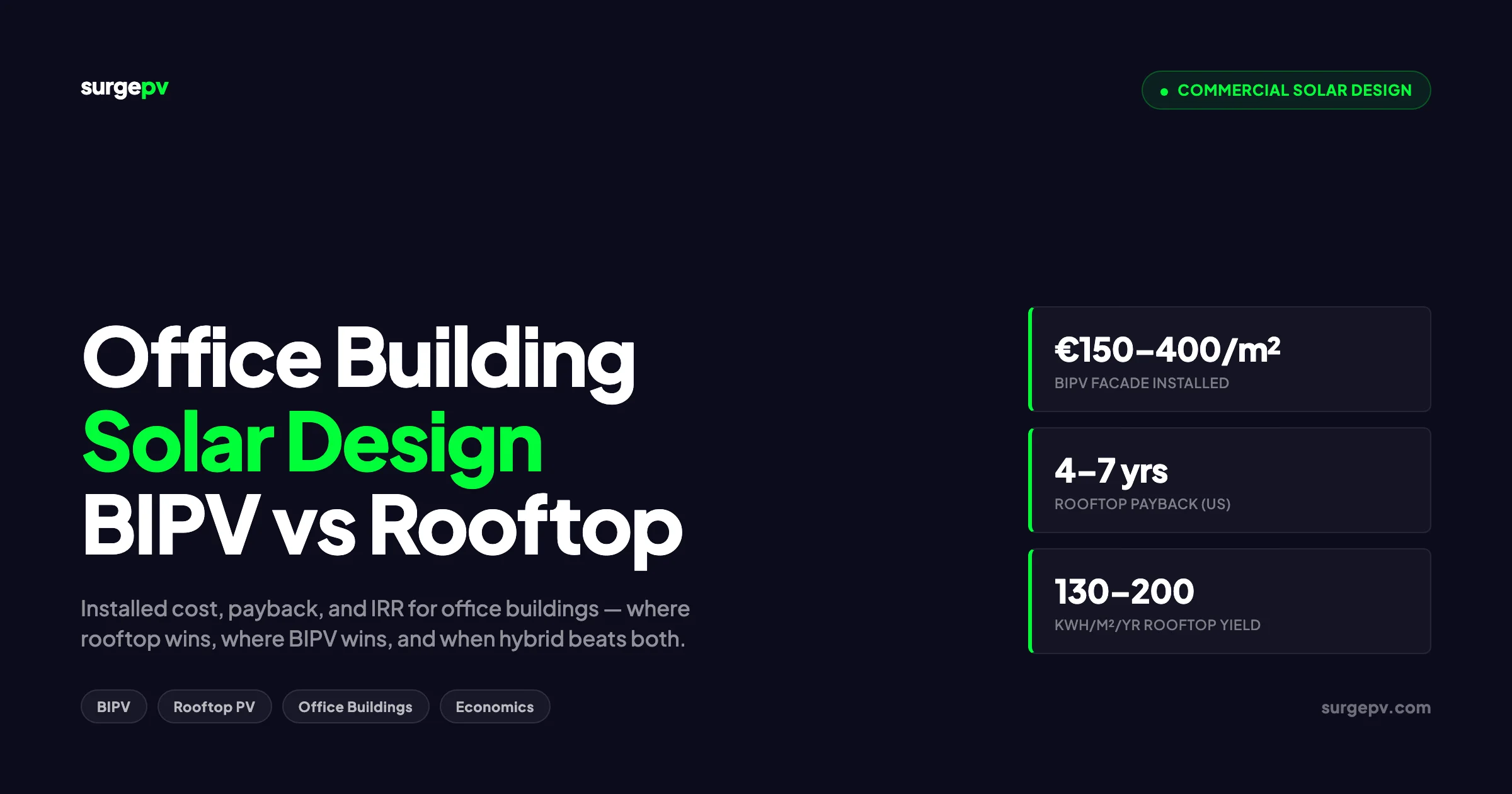
Office buildings consume roughly 20 percent of all commercial electricity in the United States and a similar share across the European Union, which makes them one of the highest-impact targets for on-site solar generation. The two practical paths are familiar: bolt rack-mounted PV onto the roof, or integrate solar directly into the building envelope as cladding, glazing, or a facade. The economics behind those paths are not the same, and the right answer depends on roof area, building height, electricity tariff, and what the architect was already going to spend on the facade. Also see: European Solar Incentives. For Europe-specific compliance details, see Europe solar compliance.
System size on a single-story 50,000 sq ft office runs 300 to 500 kW DC. On a 10-story tower with a 5,000 sq ft mechanical roof, the same array shrinks to 30 to 60 kW. A horizontal rooftop array in mid-latitude offices produces 130 to 200 kWh per square meter of array per year.
TL;DR — Office Solar Economics in One Paragraph
Rooftop PV wins on cost-per-watt and payback for almost every office under five floors. BIPV wins when the roof is too small for the load, when the architect is already specifying a premium facade, or when net-zero certification depends on facade-level generation. Combined systems beat either approach alone on tall office buildings with limited roof footprint.
In this guide:
- The two solar pathways for office buildings, with installed cost and yield
- Rooftop economics: $/W, payback, IRR, and where the model breaks
- BIPV economics: gross cost, net premium, and the cladding subtraction
- A side-by-side financial comparison for a 10,000 m² office case study
- Hybrid rooftop plus facade scenarios and when they pay off
- Design considerations: shading, thermal load, wind, glare
- Software, code compliance, and the path from concept to permit
This is a working economics guide for developers, EPCs, architects, and building owners deciding how to power the next office project. Every number here comes from manufacturer pricing, published BIPV market data, and the financial modeling we run inside solar design tools every day.
The Two Solar Pathways for Office Buildings
Before the financial comparison, the products themselves need clear definitions. Rooftop PV and BIPV are not interchangeable, and the design process for each starts at different points in the project timeline. For France-specific information, see Agricultural Solar Case Study. Read more about Floating Solar Farms France.
Rooftop PV (BAPV)
Rooftop solar on office buildings is technically called Building-Applied Photovoltaics, or BAPV. Modules sit on racking that is either ballasted on flat membrane roofs or attached through standoffs to standing-seam metal. The roof is treated as a host surface, not a generation surface. Modules are commodity 540 to 615 W bifacial mono PERC or TOPCon panels, the same products specified on warehouses and ground-mount fields. See Bifacial Solar Panel Design Guide for detailed guidance.
Typical office rooftop installations cover 50 to 80 percent of available roof area after setbacks, fire access lanes, and HVAC equipment exclusion zones. System size on a single-story 50,000 sq ft office runs 300 to 500 kW DC. On a 10-story tower with a 5,000 sq ft mechanical roof, the same array shrinks to 30 to 60 kW.
BIPV
Building-Integrated Photovoltaics replaces a building product with a solar-generating equivalent. Five product families dominate the office market:
- Facade cladding — opaque PV panels behind a curtain wall or as rainscreen cladding, replacing aluminum composite or terracotta panels
- Spandrel glass — PV-laminated spandrel panels in non-vision zones of curtain walls
- Vision glass — semi-transparent PV glazing in window openings, with 10 to 40 percent visible light transmission
- Solar canopies and louvres — PV-integrated horizontal shading on south-facing windows
- Roof-integrated tiles or laminates — solar-active roofing replacing membrane or metal
BIPV must be specified during schematic design. Retro-fitting BIPV onto a finished facade is significantly more expensive than integrating it from the start, and it usually requires re-permitting the envelope.
Pro Tip
If you are evaluating an office project still in concept design, run the BIPV scenario in parallel with the rooftop-only scenario from day one. Once the curtain wall package is bid out, the cladding-substitution math no longer applies and BIPV economics get much worse.
Rooftop Solar Economics for Office Buildings
Rooftop PV on commercial real estate is mature, fully bankable, and priced like a commodity. The 2026 numbers are tight enough to publish without big error bars.
Installed Cost
| System Size | Installed Cost (US, after tariffs) | Installed Cost (EU) |
|---|---|---|
| 50–100 kW | $1.40–1.70/W | €1.05–1.30/W |
| 100–500 kW | $1.10–1.40/W | €0.85–1.10/W |
| 500 kW–1 MW | $0.95–1.20/W | €0.75–0.95/W |
| 1 MW+ rooftop | $0.85–1.05/W | €0.65–0.85/W |
Module pricing dropped to $0.12 per watt for monocrystalline PERC by mid-2025, according to the US Department of Energy. The remainder of the installed price covers racking, inverters, balance-of-system, electrical, labor, permitting, and overheads.
Annual Yield
A horizontal rooftop array in mid-latitude offices produces 130 to 200 kWh per square meter of array per year. Specific yield by region:
| Region | Specific Yield | kWh/m²/year (array) |
|---|---|---|
| Southern Spain, Italy, Greece | 1,500–1,700 kWh/kWp | 200–230 |
| Central Europe (Germany, France, Belgium) | 950–1,100 kWh/kWp | 130–155 |
| UK and Ireland | 850–1,000 kWh/kWp | 115–140 |
| US Southwest (AZ, NV, CA) | 1,700–2,000 kWh/kWp | 230–270 |
| US Northeast and Midwest | 1,150–1,400 kWh/kWp | 155–190 |
These figures come straight from the generation and financial tool when you drop a horizontal array on a typical office geometry.
Payback and IRR
US commercial rooftop projects in 2026 deliver:
- Simple payback: 4 to 7 years with the 30 percent ITC and MACRS bonus depreciation
- Internal Rate of Return: 15 to 25 percent over 25 years
- Net cost reduction from incentives: 50 to 60 percent of gross capex
EU rooftop projects without the same depreciation framework run 6 to 10 year payback and 10 to 18 percent IRR, with country-specific adjustments documented in our solar payback period by country post.
Where Rooftop Economics Break
The model is reliable until you hit one of three constraints:
- Roof footprint is too small for the load. Once a building exceeds three or four stories, the roof can no longer host enough capacity to offset more than 10 to 20 percent of consumption.
- Roof is occupied. Mechanical equipment, helipads, green roofs, terraces, and shading from adjacent towers can take 30 to 60 percent of nominal roof area off the table.
- Roof structure cannot carry the load. Older steel-frame office buildings often need structural reinforcement to add 4 to 5 psf of ballasted PV, which can add 10 to 15 percent to project cost.
When any of those apply, the conversation moves to the facade.
BIPV Economics for Office Buildings
BIPV pricing is harder to publish in clean tables because the cost depends on the substrate, the integration product, and the conventional building material being displaced. The industry now has enough installed projects to publish reliable ranges.
Installed Cost by Product Type
| BIPV Product | Installed Cost | Net Premium vs Conventional |
|---|---|---|
| Roof-integrated tiles or laminates | €180–€350/m² | €50–€150/m² (vs metal or membrane) |
| Facade cladding (opaque) | €150–€400/m² | €50–€250/m² (vs aluminum composite) |
| Spandrel PV glass | €350–€700/m² | €100–€300/m² (vs spandrel glass) |
| Vision PV glass | €450–€900/m² | €150–€500/m² (vs IGU window) |
| PV canopies and louvres | €500–€1,200/m² | €200–€600/m² (vs metal sunshades) |
Source data drawn from European BIPV project databases and manufacturer published pricing (Onyx Solar, BIPV market reference).
The spread is wide because facade and curtain wall pricing itself is wide. A €150/m² aluminum rainscreen is at the cheap end of office cladding; a €700/m² unitized curtain wall is at the high end. BIPV substitutes against whatever the project was already specifying, and the net premium is what matters for the financial model.
Annual Yield by Surface
| BIPV Surface | Specific Yield | kWh/m²/year |
|---|---|---|
| Roof-integrated (10–30° tilt) | 130–200 kWh/m² | 130–200 |
| South-facing facade (vertical) | 80–150 kWh/m² | 80–150 |
| East/west facade (vertical) | 50–95 kWh/m² | 50–95 |
| North facade | 25–45 kWh/m² | 25–45 |
| Vision PV glass (south, 30% VLT) | 25–60 kWh/m² | 25–60 |
Vertical surfaces lose 25 to 40 percent of yield versus tilted rooftop installations because the tilt angle is wrong for most latitudes. They gain back some of that loss in winter at high latitudes, where the sun sits low and a vertical south facade picks up more direct beam than a horizontal roof.
Payback and the Net Premium Argument
A €200,000 BIPV facade with 1,000 m² of opaque cladding generating 100 kWh/m²/year produces 100,000 kWh/year. At a €0.30/kWh commercial electricity tariff, that is €30,000/year in avoided cost.
- Gross payback at €200,000: 6.7 years (looks excellent)
- Net premium payback if conventional cladding would have cost €120,000: €80,000 net premium / €30,000 per year = 2.7 years
That second calculation is the only one that matters when the building was always going to have cladding. The cladding spend is a sunk cost in the architectural budget, and the BIPV premium is the only portion that needs to earn a return from generation.
The catch: if the project was going to use a €60/m² rainscreen, the net premium on a €250/m² BIPV facade is €190/m² — and the math swings back toward 12 to 18 year payback. The cladding subtraction works only when the alternative cladding spec was already premium.
Model Both Scenarios in 30 Minutes
Drop the building geometry into SurgePV, run rooftop and BIPV layouts side by side, and see payback, IRR, and NPV for each option in a single dashboard.
Book a DemoNo commitment required · 20 minutes · Live project walkthrough
For a direct comparison, see Arka 360 vs SurgePV.
Side-by-Side Case Study: 10,000 m² Office in Frankfurt
To make the comparison concrete, here is a single building modeled three ways. The case study uses a real project archetype: a six-story office tower in Frankfurt with 10,000 m² of gross floor area, 1,800 m² of rooftop, and 4,000 m² of south, east, and west facade.
Building Assumptions
| Parameter | Value |
|---|---|
| Gross floor area | 10,000 m² |
| Roof area (usable for PV) | 1,400 m² (after setbacks and HVAC) |
| Facade area (south) | 1,500 m² |
| Facade area (east + west) | 2,500 m² |
| Annual electricity consumption | 850,000 kWh |
| Commercial tariff | €0.30/kWh |
| Cladding base spec | Aluminum composite, €180/m² |
| Discount rate | 6% |
| System life | 25 years |
Scenario A: Rooftop Only
| Metric | Value |
|---|---|
| Installed capacity | 280 kW DC (200 W/m² × 1,400 m²) |
| Annual yield | 268,000 kWh (specific yield 955 kWh/kWp) |
| Coverage of demand | 31% |
| Installed cost | €224,000 (€0.80/W) |
| Year-1 savings | €80,400 |
| Simple payback | 2.8 years |
| 25-year NPV (6%) | €796,000 |
| IRR | 36% |
Scenario B: BIPV Facade Only (South Only)
| Metric | Value |
|---|---|
| BIPV facade area | 1,500 m² (south only) |
| Annual yield | 165,000 kWh (110 kWh/m²) |
| Coverage of demand | 19% |
| Installed cost | €375,000 (€250/m²) |
| Conventional cladding spend avoided | €270,000 (€180/m²) |
| Net BIPV premium | €105,000 |
| Year-1 savings | €49,500 |
| Net-premium payback | 2.1 years |
| 25-year NPV on net premium | €516,000 |
| IRR on net premium | 47% |
Scenario C: Hybrid Rooftop + South Facade BIPV
| Metric | Value |
|---|---|
| Rooftop capacity | 280 kW DC |
| BIPV facade area | 1,500 m² south |
| Total annual yield | 433,000 kWh |
| Coverage of demand | 51% |
| Total installed cost | €599,000 |
| Net premium (after cladding offset) | €329,000 |
| Year-1 savings | €129,900 |
| Blended payback (net premium) | 2.5 years |
| 25-year NPV | €1,295,000 |
| IRR | 42% |
The hybrid scenario is the strongest answer for this archetype. Rooftop captures the cheapest electrons, BIPV closes the gap to 51 percent self-consumption, and the cladding subtraction makes the marginal facade investment look better than the rooftop on IRR.
The numbers shift when assumptions change. Drop the cladding base spec to €60/m² and Scenario B’s IRR collapses from 47 percent to 11 percent. Push the tariff to €0.45/kWh (current Italian commercial rate) and every scenario gains 4 to 8 IRR points. The point of the model is not to publish one universal answer; it is to show that the right system depends on inputs that vary widely between projects. For Italy-specific information, see Commercial Rooftop Solar Case Study Italy.
Where Each Approach Wins
After running this model on roughly 200 commercial office projects across Europe and the US, a clear pattern emerges.
Rooftop Wins When
- The building is one to four stories with a generous roof footprint
- The roof is in good structural and waterproofing condition (or about to be replaced)
- The owner’s primary goal is lowest cost per kWh
- The cladding is already specified at a budget price point
- The project is operating in a US market with full ITC and MACRS access
BIPV Wins When
- The building is six stories or more with a small roof footprint
- The architect is specifying a premium facade (curtain wall, unitized panels, terracotta)
- Net-zero certification or local energy codes require envelope-level generation
- The project has marketing or branding value tied to visible sustainability
- A historic or preservation review blocks rooftop equipment
Hybrid Wins When
- The owner wants 40 to 70 percent on-site generation
- The roof can host an array but cannot cover load on its own
- Grid export is capped or self-consumption is the financial driver
- The project is targeting BREEAM Outstanding, LEED Platinum, or DGNB Platinum
Design Considerations Beyond Pure Economics
The IRR table is the start of the conversation, not the end. Three design factors push real projects in directions that the financial model alone does not capture.
Shading and Inter-Row Geometry
On rooftop arrays, the binding constraint is inter-row shading from adjacent modules and from rooftop equipment. Office buildings in dense urban cores also lose 5 to 25 percent of yield to shading from neighboring towers. Run a full solar shadow analysis software before sizing. We have seen confident assumptions of “the rooftop has clear southern exposure” turn into 15 percent yield losses once neighboring buildings were modeled.
BIPV facades on tall buildings face the opposite problem: the upper floors generate well, but the lower floors are shaded by adjacent buildings for most of the day. A facade that looks like 1,500 m² of south exposure on a site plan can deliver yield from only 800 m² of unshaded surface. Detailed hour-by-hour shading analysis matters more for BIPV than for rooftop.
Thermal Load and Cooling
BIPV facades absorb solar radiation and re-emit it as heat. Without a ventilated cavity behind the panel, that heat conducts into the building and increases cooling load. Properly designed BIPV with a 50 mm or larger ventilated cavity can match or beat the thermal performance of conventional cladding. Poorly designed BIPV can add 5 to 10 percent to peak cooling demand and undermine net energy savings.
Wind, Glare, and Maintenance
Rooftop ballasted arrays are designed to ASCE 7 wind loads and have a 25-year track record on commercial roofs. BIPV facade modules face higher wind pressures at upper floors and require structural calculations for both pull-out and shear. Glare from BIPV vision glass is a separate review item near airports and traffic corridors. Maintenance access on a 12-story facade requires rope access or a building maintenance unit, which adds €0.005 to €0.015/kWh to operating cost over the asset life.
Software and Workflow for Office Building Solar Design
Office building solar design crosses three disciplines that traditionally do not share files: the architect on Revit, the structural engineer on STAAD or RAM, and the solar EPC on dedicated PV design software. The tools that work for residential rooftop or utility-scale ground-mount do not translate cleanly to mixed roof and facade buildings. See Advanced Solar PV Design Software for detailed guidance.
The minimum capability set for office solar design:
- 3D building geometry import from Revit, IFC, or SketchUp
- Mixed roof and facade module placement in a single project file
- Hour-by-hour shading including site context (neighboring buildings, trees)
- Inverter and string design that handles vertical strings on facades alongside horizontal strings on roofs
- Financial modeling for both gross and net-premium cost cases
- Proposal output for the building owner
SurgePV handles all six in one workflow. Clara AI generates the rooftop layout and a first-pass facade configuration in minutes; the energy and financial modeling tool outputs payback, IRR, NPV, and 25-year cash flow for each scenario; and the solar proposal software packages the comparison for the owner. For a deeper look at the design step, see our commercial solar system design guide.
Code Compliance for Office BIPV and Rooftop
Both approaches must pass building code review. The hooks are different.
US Code Requirements
| Code | Rooftop PV (BAPV) | BIPV |
|---|---|---|
| NEC 690 (PV systems) | Required | Required |
| NEC 705 (interconnection) | Required | Required |
| IBC structural | Roof load ASCE 7 | Facade load ASCE 7 + curtain wall standard |
| Fire (UL 1703 / UL 61730) | Module rating | Module + assembly rating |
| Local AHJ permit | Standard | Standard, plus envelope sub-permit |
| Title 24 (CA) | Energy compliance credit | Energy + envelope credit |
EU Code Requirements
| Code | Rooftop PV | BIPV |
|---|---|---|
| EN 50539 (PV system) | Required | Required |
| IEC 61215 / 61730 | Module standard | Module + glazing standard |
| EN 13830 (curtain walls) | N/A | Required for facade BIPV |
| EPBD (energy performance) | Counts toward NZEB | Counts toward NZEB |
| EU Solar Rooftop Mandate | Required on new commercial buildings 2026+ | Counts as compliance |
For owners pursuing certifications, both BIPV and rooftop count toward LEED, BREEAM, and DGNB scoring. Net-zero energy targets in Title 24 (California), Massachusetts Stretch Code, and the EU EPBD recast all credit on-site generation regardless of whether the panels sit on the roof or in the wall.
Picking the Right Path for Your Office Project
Three questions decide the answer almost every time:
- How many usable square meters of roof do you have per kW of demand? If you have more than 3 m² of usable roof per peak kW of building demand, rooftop alone is probably enough.
- What is the project already spending on cladding? If the cladding spec is below €120/m², BIPV facade does not have a strong net-premium case. If the spec is above €250/m², BIPV is competitive on its own merits.
- Does the certification target need facade-level generation? If LEED Zero Energy or DGNB Platinum require envelope generation, the BIPV question is no longer optional. For United States-specific compliance details, see United States arizona/phoenix.
Run those three filters and the right system architecture usually picks itself. The financial model then refines sizing, product selection, and inverter strategy.
Conclusion: Three Action Items
- Run rooftop, BIPV, and hybrid scenarios in parallel during schematic design — never sequentially after the cladding bid is locked.
- Use the net-premium calculation, not the gross BIPV cost, when comparing facade integration to rooftop. The cladding subtraction changes the answer.
- Model shading, thermal, and wind effects with hour-by-hour analysis before committing to a facade BIPV strategy. Yield assumptions made from a site plan are unreliable on tall buildings.
For project teams sizing a new office building solar system right now, book a demo with our team and we will walk through the rooftop, BIPV, and hybrid scenarios on your specific geometry inside SurgePV.
Frequently Asked Questions
Is BIPV cheaper than rooftop solar for an office building?
On a cost-per-watt basis, BIPV is more expensive: facade BIPV runs €150 to €400 per square meter installed, while rooftop PV averages $0.85 to $1.40 per watt (around €70 to €110 per square meter of array). Once you subtract the conventional cladding or curtain-wall material that BIPV replaces, the net premium drops to €50 to €250 per square meter. So rooftop wins on raw economics, but BIPV closes the gap when the building was already going to spend money on a high-end envelope.
What is the payback period for solar on an office building?
A well-designed commercial rooftop system pays back in 4 to 7 years in markets with the 30 percent federal tax credit and MACRS depreciation, or 6 to 10 years in most of Europe. BIPV facades on the same building typically pay back in 12 to 20 years on the gross investment, or 10 to 15 years on the net premium when you account for displaced cladding cost.
How much energy does an office BIPV facade generate compared to a rooftop array?
South-facing facade BIPV generates 80 to 150 kWh per square meter per year. Rooftop PV on the same building generates 130 to 200 kWh per square meter per year. Facades produce roughly 60 to 75 percent of rooftop yield because the tilt is vertical, but they have far more available area on a tall office building.
Should I combine BIPV and rooftop solar on the same office?
Yes, on most mid-rise and high-rise office projects the strongest economics come from a hybrid system. Rooftop captures the cheapest kilowatt-hours, and facade BIPV adds capacity for buildings where the roof footprint is small relative to the floor area. Combined systems also hedge load shape: facade output peaks earlier and later in the day than horizontal rooftop output.
Does BIPV qualify for the same incentives as rooftop solar?
In the United States, BIPV qualifies for the 30 percent Investment Tax Credit and MACRS bonus depreciation as long as the system is electrically functional and meets the IRS definition of energy property. In the EU, BIPV is eligible for most national rooftop programs, and several countries offer additional grants for facade integration under net-zero building schemes. Eligibility varies by jurisdiction, so confirm with the local tax authority before financial modeling.
What is the best solar design software for office buildings?
Office building solar design needs a tool that handles 3D geometry, complex shading from neighboring structures, mixed roof and facade modeling, and detailed financial output. SurgePV covers all four in one workflow, with Clara AI generating layouts in minutes and the generation and financial tool delivering payback, IRR, and NPV alongside the energy model.
How much roof area does a typical office building need for solar?
A 50,000 square foot single-story office can usually fit a 300 to 500 kW rooftop system, which covers 30 to 60 percent of annual consumption depending on operating hours. Multi-story office buildings have far less roof area per occupant, which is where BIPV facades or carports start to make economic sense.
Does BIPV affect the building’s energy rating or LEED score?
BIPV contributes to LEED Energy and Atmosphere credits, BREEAM Energy credits, and DGNB certification scoring. It also helps satisfy net-zero energy targets in EU EPBD compliance and local energy codes such as California Title 24. Because BIPV displaces a building product, its embodied carbon savings often count separately under materials and resources credits.
Where this fits
This article is part of SurgePV's Solar Design hub, which works through the topic from first principles to the decisions a project team actually has to make.