

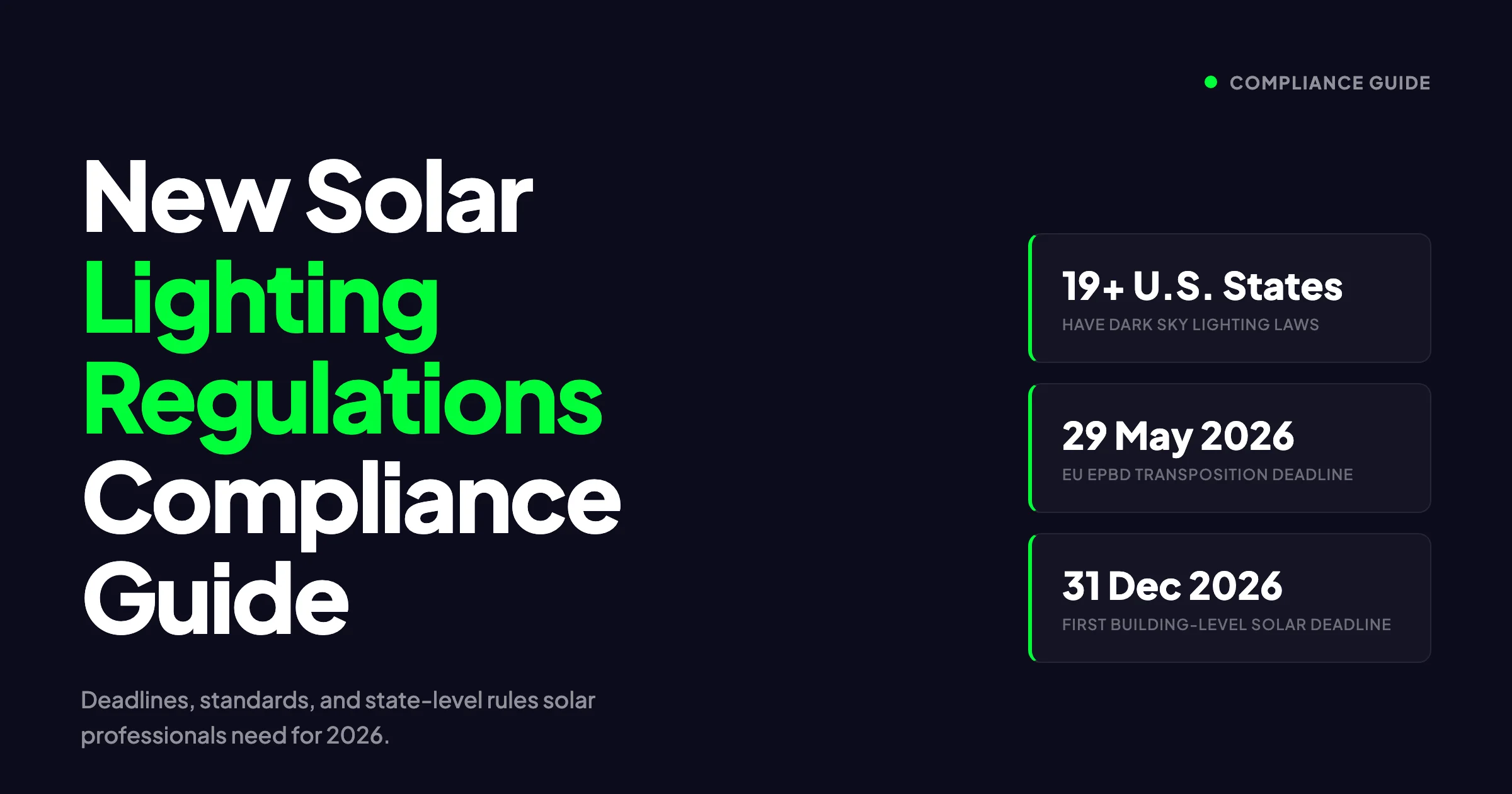
Solar lighting projects are no longer a simple pole-and-panel install. In 2026, new regulations are targeting product safety, electrical codes, and local ordinances at the same time. A solar street light in Denver now has to clear NEC rules, dark-sky ordinances, and the city’s prescriptive energy deadlines. A project in Germany has to meet the EU Energy Performance of Buildings Directive transposition timeline. Even a small off-grid pathway light may need FCC certification if it has a wireless sensor.
For teams already using solar design suite to model arrays, adding solar lighting compliance to the workflow is the next logical step. The same data used for solar shadow analysis helps prove that a pole-mounted panel will get enough sun to meet the lighting schedule.
For solar professionals, the challenge is not the complexity of any single rule. It is that the rules come from three different layers: national product standards, state or national electrical codes, and municipal zoning or dark-sky laws. Missing any one layer can delay a project for weeks.
In this guide, you will learn:
- What counts as solar lighting in 2026 and why the category matters
- The three regulatory layers every project must pass
- U.S. standards and NEC 2026 updates that apply to solar lighting
- State and municipal rules, including dark-sky and zoning requirements
- EU and global compliance deadlines for solar on buildings
- Product certifications that determine whether equipment can be installed
- A compliance checklist you can use on the next project
Quick Answer
New solar lighting regulations in 2026 focus on three areas: electrical safety under NEC Article 690 and Article 411, product standards such as ANSI C136.40 and UL 8750, and local dark-sky or zoning ordinances. The EU EPBD requires member states to transpose solar-on-buildings rules by 29 May 2026, with the first building-level deadline on 31 December 2026.
What Counts as Solar Lighting in 2026?
Solar lighting is any fixture that uses a photovoltaic module to charge a battery and power a light source. The category covers everything from small residential garden lights to municipal solar street lights and airport perimeter lighting. In 2026, the distinction between consumer products and commercial systems matters because the regulations are very different.
Small consumer products, such as solar path lights sold at retail, are usually self-contained units. They fall under general product safety rules and FCC Part 15 if they include wireless controls. They rarely need a permit or inspection.
Commercial solar lighting includes street lights, parking lot lights, area lights, and off-grid security lights. These systems use larger PV modules, deep-cycle batteries, charge controllers, and LED arrays. They are subject to electrical codes, structural standards for poles, and local lighting ordinances.
Industrial solar lighting covers airport perimeters, data centers, military bases, and large campuses. These projects often require compliance with FAA rules, IES roadway lighting standards, and site-specific security requirements.
The common thread is that every system has four parts: the PV module, the battery, the controller, and the luminaire. Each part carries its own compliance burden.
The Three Regulatory Layers Every Project Must Pass
Solar lighting projects must pass three separate regulatory layers. Most delays happen because a team checks one or two layers and misses the third.
Layer 1: Product Standards
Product standards define how the equipment itself must be built and tested. In the U.S., key standards include UL 1703 or UL 61730 for PV modules, UL 8750 for LED lighting, and ANSI C136.40 for solar-powered roadway and area lighting systems. Batteries may need to meet UL 1973 or UL 9540, especially for lithium-ion chemistries.
In the EU, products need CE marking under the Low Voltage Directive, EMC Directive, and RoHS. Road lighting must meet EN IEC 60598-2-3. The General Product Safety Regulation also applies to consumer products.
Layer 2: Electrical and Fire Codes
Electrical codes govern how the system is installed and connected. In the U.S., NFPA 70, the National Electrical Code, is the baseline. Article 690 covers solar PV circuits. Article 411 covers low-voltage lighting systems. Article 706 covers energy storage systems. NFPA 855 covers battery enclosure fire safety.
The NEC edition that applies depends on the state or local authority having jurisdiction. As of mid-2026, some jurisdictions are still on NEC 2020, others have adopted NEC 2023, and NEC 2026 is being phased in. Always verify the adopted edition before designing.
Layer 3: Local Ordinances
Local ordinances are where most projects get stuck. Municipalities regulate outdoor lighting through zoning codes, dark-sky ordinances, and design guidelines. Common requirements include full cutoff fixtures, maximum correlated color temperature, curfew timers, and limits on light trespass.
A project can pass the electrical inspection and still fail local approval if the fixture is too bright, too blue, or aimed the wrong way. This is why the site review should always include the local zoning or planning department, not just the electrical inspector.
U.S. Solar Lighting Standards and 2026 NEC Updates
The 2026 National Electrical Code makes several changes that affect solar lighting systems, especially those with battery storage or grid connections. We covered the full set of changes in our NEC 2026 solar changes guide. For solar lighting, the most relevant updates involve Article 690, Article 411, and battery safety.
Article 690 Changes
Article 690 governs solar PV systems. For solar lighting, the relevant updates include:
- 690.4(G): Fractions under 0.5 are dropped after correction factors, not rounded up. This changes conductor and overcurrent sizing calculations.
- 690.8(A)(1)(a): Bifacial modules must use the highest short-circuit current rating from the manufacturer datasheet.
- 690.13: Disconnecting means now references 705.20, creating a unified standard for distributed energy resources.
- 690.31: PV and non-PV circuits may share raceways if separated by barriers. PV wire is allowed where RHW-2 is permitted.
These changes matter for solar lighting because many systems now use bifacial modules and shared conduit runs for sensors or controls.
Article 411 for Low-Voltage Lighting
Article 411 covers low-voltage lighting systems, including many 12V or 24V DC solar lights. It limits system voltage, defines wiring methods, and requires listed equipment. For solar lighting, the key is to make sure the entire system, including the battery and controller, is rated for the voltage and current it will see in the field.
Article 706 and NFPA 855 for Batteries
Energy storage systems are covered by Article 706. NFPA 855 sets fire safety requirements for battery installations. For solar street lights with lithium batteries, this means proper thermal isolation, impact protection, and ventilation. Some jurisdictions now require battery enclosures to be listed to UL 9540A for thermal runaway fire propagation.
ANSI C136 Series
The ANSI C136 series from NEMA covers roadway and area lighting equipment. For solar lighting, the most important standard is ANSI C136.40, which defines electrical and mechanical requirements for DC-only solar-powered systems. It covers PV modules, batteries, power controls, enclosures, and labeling. The standard recommends an operating temperature range of -40°F to +140°F, which is critical for outdoor durability.
ANSI C136.41 covers dimming controls and the 7-pin NEMA receptacle used for photocontrols. This is relevant for smart solar street lights with adaptive lighting profiles.
State and Municipal Rules: Dark Sky, Zoning, and Permits
Federal and national standards set the floor. State and municipal rules often add the constraints that determine whether a project can proceed.
Dark Sky Laws
At least 19 U.S. states, plus Washington, D.C. and Puerto Rico, have laws or policies aimed at reducing light pollution. These rules vary widely.
- Arizona requires outdoor fixtures to be fully or partially shielded. Non-compliant fixtures must be extinguished from midnight to sunrise.
- Colorado requires full-cutoff fixtures above certain lumen thresholds and mandates consideration of glare reduction and night environment preservation.
- New Hampshire encourages municipalities to adopt local ordinances to conserve energy and reduce light pollution.
- Florida has a statewide model lighting ordinance to protect sea turtles, which many coastal counties follow.
- Texas allows counties near military installations to regulate outdoor lighting.
Most dark-sky compliance, however, happens at the municipal level. Cities such as Flagstaff, Arizona; Borrego Springs, California; and Petoskey, Michigan have strict ordinances that can affect solar lighting projects.
Common Dark Sky Requirements
Dark sky ordinances typically require:
- Fully shielded fixtures with no light above 90 degrees from nadir
- Correlated color temperature of 3000K or lower, often 2700K or 2200K
- Targeted distribution that avoids uplight and spill light
- Dimming or curfew controls to reduce output during low-traffic hours
- Photometric plans showing compliance before permit approval
Solar lighting can be an advantage here. Because solar lights are not tied to grid power, they can be programmed to dim or shut off at specific times without affecting other circuits. Teams using a solar proposal platform platform can document these control schedules directly in the customer deliverable, which reduces change orders later.
Zoning and Permits
Local zoning codes regulate where solar lighting can be installed and how it must look. Common requirements include:
- Maximum pole height, often 15 to 30 feet depending on the zone
- Setbacks from property lines and rights-of-way
- Design compatibility in historic districts
- Limits on the number or spacing of fixtures
- Requirements for underground wiring or concealed conduits
Some municipalities classify solar lighting poles as accessory structures, which triggers additional setback and height rules. Others treat them as signage or utility infrastructure. The classification affects the permit path and the fees.
Utility and Interconnection Rules
Grid-tied solar lighting, such as solar-powered parking lot lights with grid backup, may need utility approval. This is more common in commercial and industrial projects. The interconnection process can add weeks or months, so it should be started early.
EU EPBD and Global Solar Lighting Compliance Deadlines
Outside the U.S., the most significant 2026 regulation is the revised EU Energy Performance of Buildings Directive, or EPBD. We break down the full mandate in our EU solar rooftop mandate EPBD guide. While the EPBD is primarily about solar PV and thermal on buildings, it also affects building-integrated and exterior solar lighting.
EU EPBD Transposition Deadline
EU member states must transpose Directive 2024/1275 into national law by 29 May 2026. Failure can trigger infringement proceedings. Germany, France, Italy, Spain, and other member states are updating national building codes to comply.
Building-Level Solar Deadlines
The EPBD introduces a phased solar mandate under Article 10. The deadlines are:
| Building Type | Deadline |
|---|---|
| New public and non-residential buildings over 250 m² | 31 December 2026 |
| Existing public buildings over 2,000 m² | 31 December 2027 |
| Existing non-residential buildings over 500 m² during major renovation | 31 December 2027 |
| Existing public buildings over 750 m² | 31 December 2028 |
| New residential buildings and covered parking | 31 December 2029 |
| Existing public buildings over 250 m² | 31 December 2030 |
These requirements apply where solar is technically, economically, and functionally feasible. Member states can define exemptions for heritage buildings, shaded sites, and other constraints.
Lighting and Building Automation
The EPBD also requires building automation controls in non-residential buildings with HVAC systems over 290 kW by 31 December 2024. This includes lighting control integration. For solar professionals, this means exterior solar lighting should be designed to communicate with the building management system where required.
Global Standards
In Australia, solar lighting must comply with AS/NZS 1158 for lighting performance and AS/NZS 4509 for stand-alone power systems. PV modules must meet IEC 61215 and IEC 61730. Understanding solar irradiance is essential here, because the same metric that sizes a rooftop array also determines whether a solar light will survive the winter without grid backup. In India, the Ministry of New and Renewable Energy sets standards for solar street lights under the off-grid and decentralized solar program.
Product Certifications That Matter
Certifications are the proof that equipment meets the required standards. Specifying uncertified equipment is one of the fastest ways to fail an inspection or lose a bid.
U.S. Product Certifications
| Component | Common Certification | What It Covers |
|---|---|---|
| PV module | UL 61730 or UL 1703 | Safety and performance of photovoltaic modules |
| LED luminaire | UL 8750 | Safety of LED lighting equipment |
| Battery | UL 1973, UL 9540, UL 9540A | Safety, fire, and thermal runaway testing |
| Charge controller | UL 1741-SA | Grid support and inverter functions |
| Wireless control | FCC Part 15 | Radio frequency emissions |
| Pole | ASTM A123, AASHTO LRFD | Corrosion protection and wind-load structural design |
EU Product Certifications
| Component | Common Certification | What It Covers |
|---|---|---|
| PV module | IEC 61215, IEC 61730 | Design qualification and safety |
| LED luminaire | EN IEC 60598-2-3 | Road and street lighting safety |
| Battery | IEC 61427, UN 38.3 | Cycle life and transport safety |
| Electronics | CE marking, EMC Directive | Electromagnetic compatibility |
| General product safety | GPSR | Consumer product safety obligations |
Dark Sky Certification
DarkSky International runs an approved luminaires program. Fixtures that meet the criteria can carry the DarkSky Approved label. The 2026 guidelines note that fully off-grid solar lighting products operating at 48V DC or lower are exempt from the usual third-party electrical safety certification requirement, making approval more accessible for solar products.
Common Compliance Mistakes and How to Avoid Them
Most compliance failures are avoidable. They happen when teams treat solar lighting like a standard electrical job or a standard lighting job, rather than a hybrid of both.
Mistake 1: Ignoring Local Dark Sky Rules
A project can pass NEC and product standards and still fail local approval if the fixture is not dark-sky compliant. The fix is to review the local ordinance before specifying equipment and to require a photometric plan from the manufacturer or lighting designer.
Mistake 2: Using the Wrong NEC Edition
Different jurisdictions adopt different NEC editions. Designing to NEC 2023 when the local authority is still on NEC 2020 can cause rework. Always confirm the adopted edition and any local amendments before starting the design.
Mistake 3: Undersizing the Battery Enclosure
Battery fire safety is becoming a bigger issue. NFPA 855 and local fire codes may require thermal isolation, impact protection, and ventilation. Using a battery enclosure that is not listed for the application can stop a project at inspection.
Mistake 4: Forgetting Wind Load on Poles
Solar lighting poles carry PV modules and batteries at height. They must be engineered for local wind loads. AASHTO LRFD is the common standard, but local jurisdictions may have higher requirements for hurricane or seismic zones.
Mistake 5: Assuming Solar Lighting Is Exempt from Permits
Small consumer solar lights are usually exempt. Commercial and industrial systems almost always need permits. The permit path may involve electrical, zoning, planning, and environmental reviews. Starting the permit conversation late is expensive.
Compliance Checklist for Solar Lighting Projects
Use this checklist at the start of every solar lighting project. It will not cover every jurisdiction, but it will catch the most common failure points.
Design Phase
- Confirm the authority having jurisdiction and the adopted NEC edition
- Review local zoning, dark-sky, and lighting ordinances
- Verify utility interconnection requirements for grid-tied systems
- Specify PV modules listed to UL 61730 or IEC 61215/IEC 61730
- Specify LED luminaires listed to UL 8750 or EN IEC 60598-2-3
- Specify batteries with appropriate UL or IEC safety certification
- Confirm battery enclosure meets NFPA 855 and local fire code
- Engineer poles for AASHTO LRFD wind loads plus local amendments
- Request photometric plan showing dark-sky compliance
- Confirm wireless controls meet FCC Part 15 or EU EMC requirements
Installation Phase
- Install per manufacturer instructions and listed wiring methods
- Use PV wire, USE-2, or conduit as required by Article 690
- Install disconnecting means per Article 690.13 or 705.20
- Label all circuits, disconnects, and enclosures per NEC
- Ground and bond all metal parts per Article 250
- Test adaptive controls and curfew schedules before final inspection
Inspection and Closeout
- Schedule electrical inspection with the AHJ
- Provide product data sheets and certifications
- Submit photometric plan and dark-sky compliance documentation
- Obtain zoning or planning approval if required
- Document as-built conditions and warranty information
Design Solar Lighting Projects Faster
SurgePV helps solar professionals lay out PV arrays, run shade analysis, and generate compliant proposals in one platform.
Book a DemoNo commitment required · 20 minutes · Live project walkthrough
Frequently Asked Questions
What are the new solar lighting regulations for 2026?
The main 2026 changes are the NEC 2026 updates to Article 690 for PV wiring and disconnects, ANSI C136.40 for solar lighting systems, tighter dark-sky ordinances in states like Arizona and Colorado, and the EU EPBD transposition deadline of 29 May 2026 for member states.
Do solar lights have to comply with the National Electrical Code?
Yes. Grid-tied and large off-grid solar lighting systems in the U.S. must comply with NFPA 70, including Article 690 for PV circuits and Article 411 for low-voltage DC wiring. The specific NEC edition depends on what your state or local authority having jurisdiction has adopted.
What is ANSI C136.40 and why does it matter?
ANSI C136.40 is the U.S. standard for solar-powered roadway and area lighting systems. It defines electrical, mechanical, and labeling requirements for DC-only solar luminaires, including battery enclosures, PV modules, and operating temperature ranges.
Which states have dark sky lighting laws?
At least 19 U.S. states plus D.C. and Puerto Rico have laws or policies to reduce light pollution. Arizona, Colorado, New Hampshire, Florida, and Texas have notable statewide rules, but most dark-sky compliance happens at the municipal level.
What is the EU EPBD deadline for solar on buildings?
EU member states must transpose the revised Energy Performance of Buildings Directive into national law by 29 May 2026. The first building-level deadline is 31 December 2026, when new public and non-residential buildings over 250 m² must install solar where feasible.
What certifications do solar lighting products need?
In the U.S., products typically need UL 1703 or UL 61730 for PV modules, UL 8750 for LED lighting, and FCC Part 15 for wireless controls. In the EU, CE marking, RoHS, EMC Directive, and EN IEC 60598-2-3 for road lighting are common requirements.
Can a solar lighting project pass electrical inspection but fail local approval?
Yes. A project can meet NEC and product standards but still be rejected by the local authority having jurisdiction if it violates dark-sky ordinances, zoning setbacks, or fixture height limits. Always check local rules before specifying equipment.
What is the most common compliance mistake on solar lighting projects?
The most common mistake is assuming the project only needs to pass electrical inspection. Installers often overlook local dark-sky ordinances, wind-load pole calculations, and battery enclosure fire safety, which can cause costly redesigns.
Where this fits
This article is part of SurgePV's Solar Incentives & Policy hub, which works through the topic from first principles to the decisions a project team actually has to make.

