

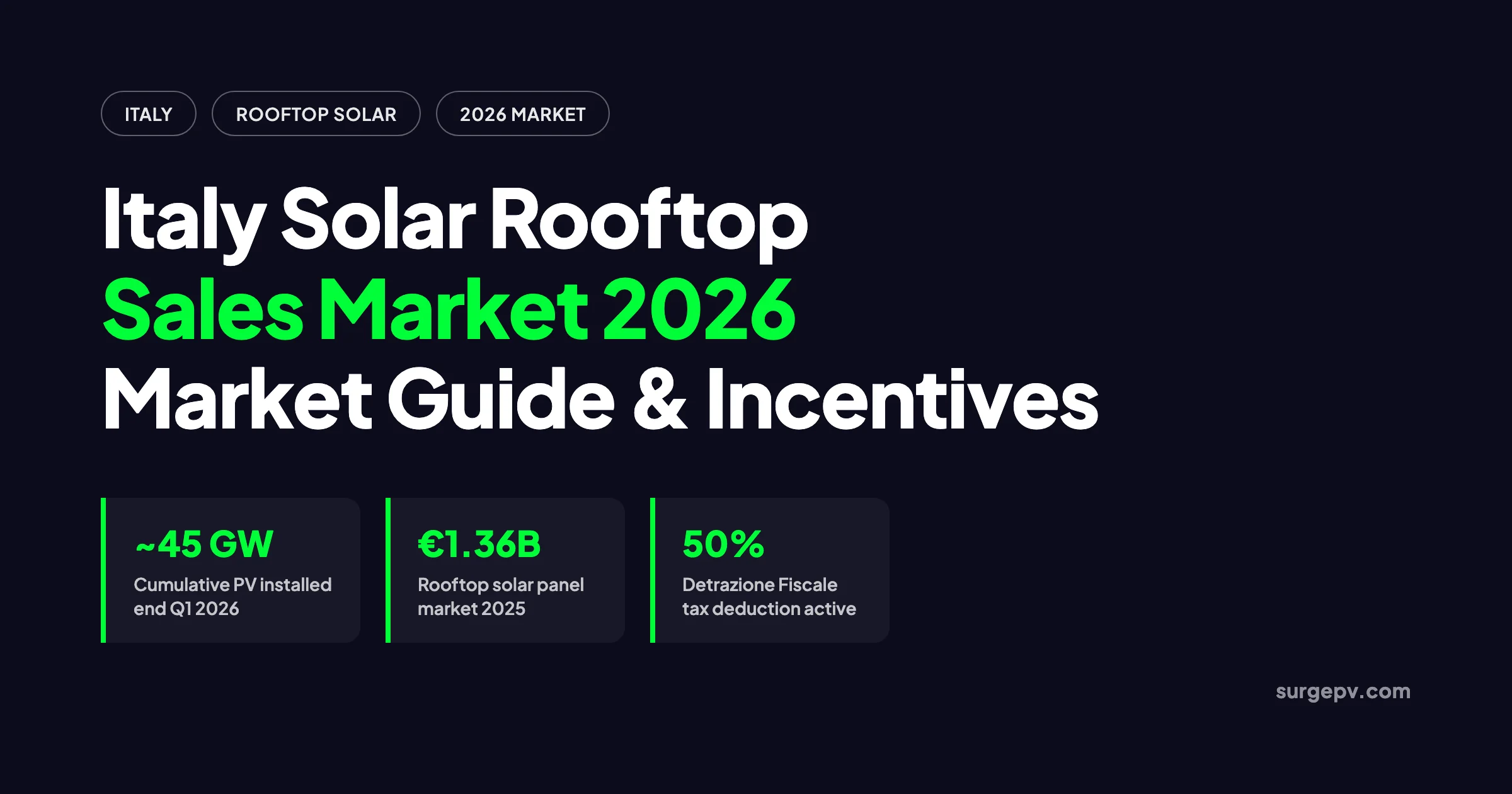
Italy reached roughly 45 GW of cumulative photovoltaic (PV) capacity by the end of Q1 2026. More than 2.2 million systems were connected to the grid, according to Terna data cited by RTB.Solar (2026). The rooftop segment — residential, commercial, and energy-community systems on buildings — has become the most competitive battlefield for installers, distributors, and solar sales teams. After the Superbonus 110% era ended, the market reset around economics, tax deductions, and shared energy models.
This guide is written for solar sellers, EPC contractors, project developers, and sales managers. It helps them price, pitch, and close rooftop solar projects in Italy during 2026. We cover market size, buyer segments, active incentives, regional economics, sales channels, and the operational details that separate winning proposals from rejected ones.
Consider a sales rep in Bari pitching a 6 kWp system to a family of four. In 2022, the pitch centred on the Superbonus 110%. In 2026, it centres on the monthly electricity bill. With self-consumption and Ritiro Dedicato, payback is roughly six years. That is a sale made on arithmetic, not on a subsidy.
In this guide:
- Market snapshot and 2026 installation trajectory
- How the rooftop solar market is structured by buyer segment
- Active incentives: Ecobonus 50%, Ritiro Dedicato, and CER energy communities
- Economics, costs, and payback by region
- Regional breakdown: North, Centre, and South
- Key market players and sales channels
- Common misconceptions buyers still hold
- Practical sales checklist for Italian rooftop proposals
- Outlook, risks, and FAQs
Quick Answer
Italy’s solar rooftop sales market in 2026 is a €1.36 billion distributed PV market built on ~45 GW of cumulative capacity. Residential, commercial, and energy-community segments now sell on economics rather than the expired Superbonus 110%.
Italy Solar Rooftop Market Snapshot 2026
Italy installed a record 6.8 GW of solar in 2024. It added an estimated 6.4 GW in 2025, according to RTB.Solar (2026). Q1 2026 alone added 1.44 GW. The cumulative fleet crossed 45 GW. This puts Italy on a path toward its PNIEC (Piano Nazionale Integrato Energia e Clima) target of 52 GW by 2030. It also supports the revised EU REPowerEU target of 85 GW by 2030.
Utility-scale projects now capture 55–60% of annual additions, but rooftop solar remains strategically important. Distributed systems avoid land-use conflicts, connect faster to saturated grids, and serve the high-tariff regions where self-consumption saves the most money.
| Indicator | Value | Source |
|---|---|---|
| Cumulative PV installed | ~45 GW | End Q1 2026, Terna via RTB.Solar (2026) |
| 2024 annual additions | 6.8 GW | Terna via SurgePV market analysis (2026) |
| 2025 annual additions | ~6.4 GW | RTB.Solar (2026) |
| Rooftop panel market size | $1.36B (2025) | OMR Global (2026) |
| 2035 rooftop panel forecast | $2.42B | OMR Global (2026) |
| Residential electricity price | €0.27–€0.35/kWh | ARERA via SurgePV Italy ROI guide |
| PNIEC 2030 solar target | 52 GW | Italian National Energy and Climate Plan |
The rooftop solar panel market alone was valued at $1.36 billion in 2025. It is projected to grow at a 6.0% compound annual growth rate to $2.42 billion by 2035, according to OMR Global (2026). That growth is slower than the utility-scale boom because rooftop sales depend on household decisions, small-business cash flow, and community governance. It is also more resilient to incentive volatility once the payback math is clear.
The market structure has changed dramatically since 2020. Italy’s first solar boom, driven by Conto Energia feed-in tariffs between 2008 and 2013, added over 9 GW in a single year at its peak. When those tariffs closed, annual installations collapsed to just 300–400 MW for much of the 2010s. The Superbonus 110% created a second residential boom in 2021–2022, with residential deployments growing 127% in 2022, according to SurgePV’s European market analysis. That boom also distorted the market: it encouraged oversized systems, low-quality installs, and tax-credit arbitrage rather than long-term energy savings.
For solar sales teams, the headline is simple. Italy is no longer a subsidy-driven market. It is a retail-electricity-arbitrage market where every kilowatt-hour self-consumed replaces a €0.30/kWh bill.
How the Italian Rooftop Solar Market Is Structured
The Italian rooftop market is usually divided by system size and buyer type. Each segment has different decision-makers, sales cycles, price sensitivity, and financing preferences.
Residential segment (systems under 20 kW). Residential rooftop solar dominated the Superbonus era. Homeowners installed systems sized 3–10 kWp, often bundled with batteries and heat pumps. The 110% tax deduction made upgrades essentially free for households with sufficient IRPEF (personal income tax) liability. When the Superbonus closed for new standalone PV in 2026, the segment contracted sharply.
In 2026, residential sales depend on three arguments:
- Self-consumption savings at €0.27–€0.35/kWh retail.
- Detrazione Fiscale 50%, which cuts net cost by half over 10 years.
- Simplicity — small systems need only CILA (Comunicazione Inizio Lavori Asseverata) municipal notification in most cases.
A typical 6 kWp residential system costs €6,600–€9,000 before incentives. After the 50% tax deduction, the effective net cost drops to roughly €3,300–€4,500. Payback ranges from 5 years in the south to 8 years in the north, depending on irradiance and consumption profile.
The residential buyer in 2026 is more cautious than the Superbonus buyer. They compare solar to other uses of capital. They ask about maintenance, roof leaks, inverter replacement, and what happens if they sell the house. They also compare quotes from three to five installers. Trust signals matter: certified installer qualifications, regional references, clear warranties, and a professional proposal.
Sales tip: lead with the monthly electricity bill, not the system size. Most homeowners do not care about kilowatts. They care about whether the system eliminates their bill. Show them a before-and-after bill for a household like theirs in the same province.
Commercial and industrial segment (20 kW to 1 MW). Commercial and industrial (C&I) rooftop solar is the most stable sales segment in 2026. Italian industrial electricity prices are among the highest in Europe. Businesses with daytime loads — warehouses, factories, logistics hubs, cold storage — can achieve 80–95% self-consumption. That makes solar a direct hedge against volatile energy costs.
A 200 kWp commercial rooftop system in Northern Italy typically costs €200,000–€250,000 all-in. It generates 250,000–270,000 kWh per year and pays back in 5–7 years, as shown in our commercial rooftop solar case study Italy warehouse.
C&I buyers are more sophisticated than homeowners. They ask for detailed yield and shade analysis, self-consumption modelling by hour, tax treatment comparisons, O&M contracts, and PPA options if they prefer zero capex.
The decision process is also longer. A residential sale may close in two to four weeks. A C&I sale often takes three to nine months, involving facility managers, energy consultants, CFOs, and sometimes board approval. Proposals must be bankable and defensible. The best C&I sales teams include an engineer in early meetings and can answer structural, electrical, and regulatory questions on the spot.
Financing preferences vary by company size. Large manufacturers may self-fund. Mid-sized companies often use leasing or green loans. Some prefer a power purchase agreement (PPA) with a third-party owner. Each structure changes who claims the tax deduction, who owns the asset, and who carries O&M risk.
Sales tip: bring an energy manager or facility manager into the conversation early. The CFO will ask about tax and cash flow, but the energy manager decides whether the load profile fits solar generation.
Utility-scale rooftop and energy communities. Large rooftops on shopping centres, factories, and public buildings can host systems above 200 kWp. These projects often fall under Ritiro Dedicato rather than Scambio sul Posto. They require more permits, structural assessments, and grid-connection studies.
The fastest-growing large-rooftop structure in 2026 is the Comunità Energetiche Rinnovabili (CER). A CER is a legal entity that lets multiple consumers share electricity from a shared renewable plant. Apartment buildings, municipalities, small businesses, and agricultural cooperatives can form a CER. The plant is typically capped at 1 MW. Members receive an incentive up to €110/MWh on shared virtual self-consumption for 20 years.
CERs solve a problem that single-family rooftop systems cannot: they let apartment buildings and small communities access solar economics even when individual roof ownership is fragmented. Sales teams that learn the CER governance model — roles, metering, allocation rules, and GSE registration — will have a structural advantage in urban Italy.
The sales process for a CER is different from a standard rooftop sale. You are not selling to one homeowner. You are selling to a condominium assembly, a municipality, or a group of small businesses. The pitch must address governance, cost allocation, and long-term administration. Legal templates and pre-approved statutes can shorten the sales cycle. Some installers partner with local lawyers or energy consultants to handle the setup.
CERs also change the optimal system design. Shared plants are often larger than individual rooftop systems and may combine multiple roofs or a single large roof with virtual sharing across meters. Accurate allocation modelling is critical, because members want to see exactly how much they save and how the €110/MWh incentive is distributed.
For installers comparing community models across Europe, our European solar market growth country analysis explains how Italy’s CER framework compares with Germany’s energy communities.
2026 Incentives and Support Mechanisms
Italian rooftop solar incentives changed more between 2022 and 2026 than in the previous decade. Sales professionals must be precise. A proposal that references the Superbonus 110% in 2026 will lose credibility.
Detrazione Fiscale 50% (Ecobonus)
The Ecobonus allows property owners to deduct 50% of eligible solar installation costs from personal or corporate income tax over 10 years. The deduction applies to solar systems installed on existing buildings, typically at 10% reduced VAT (IVA al 10%).
| Feature | Detail |
|---|---|
| Rate | 50% of eligible cost |
| Period | 10 equal annual instalments |
| Cap | €96,000 per property unit for renovation work |
| Eligible | Homeowners, tenants with owner consent, condominiums |
| VAT | 10% for existing buildings (22% for new builds) |
| Application | Annual tax return (730/UNICO) + ENEA upload |
The deduction is not a rebate. It reduces tax liability. If a household pays no IRPEF, the deduction has no value unless transferred to a bank or third party through the “cessione del credito” mechanism. Sales teams should verify the buyer’s tax capacity before promising savings.
A common mistake is to present the Ecobonus as a 50% discount today. It is not. It is a tax credit spread over 10 years. The net present value of those future deductions is lower than the nominal 50%. At a 5% discount rate, the present value is roughly 38–40% of the system cost. Proposals should either show the nominal deduction or a discounted net cost, but never mix the two without explanation.
Commercial buyers have an alternative. Instead of the 50% deduction, companies can use accelerated depreciation schemes such as ACE or hyper-depreciation for energy-efficient assets. Hyper-depreciation can reach 130–250% of the asset cost in the first years, producing stronger near-term cash flow for profitable companies. The best choice depends on tax position, debt levels, and investment horizon.
Scambio sul Posto vs Ritiro Dedicato
Scambio sul Posto (SSP) was Italy’s net-metering scheme. It credited exported solar electricity against annual grid imports. New SSP registrations closed in 2025. Existing contracts remain valid until expiration, but no new systems can enroll.
New rooftop systems sell surplus through Ritiro Dedicato (RID). Under RID, the GSE (Gestore dei Servizi Energetici) purchases exported electricity at hourly zonal market prices. Average RID prices have ranged €0.08–€0.13/kWh in recent quarters, well below the €0.27–€0.35/kWh retail rate.
This price gap changes the sales pitch. Under SSP, exporting was valuable. Under RID, self-consuming is valuable. A kWh consumed on-site avoids the full retail rate. A kWh exported earns only the market price. Batteries and load-shifting become easier to sell because they increase self-consumption.
The transition from SSP to RID also affects system sizing. Under SSP, installers sometimes oversized systems because exports were credited at retail value. Under RID, oversized systems produce low-value exports. The optimal size is now the one that maximises self-consumption, not total generation. For many households, that means a smaller PV system plus a battery rather than a larger PV system alone.
For a deeper technical explanation, see our guide to Italy feed-in tariffs and rooftop solar.
CER renewable energy communities
The CER framework, introduced under the January 2024 CER Decree, is the most significant new mechanism for rooftop solar sales in 2026. Key terms include:
- Plant size up to 1 MW.
- Members connected to the same primary substation.
- Incentive up to €110/MWh on shared virtual self-consumption.
- 20-year guarantee from contract signing.
- Priority for municipalities under 5,000 residents.
As of early 2025, Italy had developed 221 renewable energy communities, according to GSE statistics cited by Zhu et al. (2025). Most are small to medium size, in the 10–100 kW range. The model is still maturing, but it is the clearest path to scale rooftop solar in apartment-dense cities.
National Energy Income and regional grants
The Reddito Energetico Nazionale (National Energy Income) covers the full cost of a 2–6 kW rooftop system for low-income families. Eligibility depends on ISEE (Indicator of the Economic Condition of the Family), with thresholds around €15,000 or €30,000 for large families. The GSE manages the fund.
Several regions run parallel grant schemes:
- Puglia: POR solar grants of €500–€2,000 for residential rooftops in towns under 10,000 residents.
- Lombardy: AxEL program for PV-plus-battery combinations.
- Sicily: FESR grants for residential and small commercial systems.
These programs open and close based on annual budgets. Sales teams should check regional portals before quoting, because a grant can change payback by one to two years.
Economics of Rooftop Solar in Italy
Italian rooftop solar economics in 2026 rest on a simple equation. Retail electricity is expensive. Solar levelised cost of electricity (LCOE) is cheap. The spread between the two pays for the system.
Installed costs. Rooftop system costs vary by segment.
| Segment | Cost per kWp | Typical system size | Total cost range |
|---|---|---|---|
| Residential | €1,100–€1,500 | 3–10 kWp | €3,300–€15,000 |
| Commercial rooftop | €1,000–€1,250 | 50–500 kWp | €50,000–€625,000 |
| Industrial rooftop | €900–€1,100 | 200 kWp – 1 MW | €180,000–€1.1M |
| CER shared plant | €1,000–€1,300 | 50–1,000 kWp | €50,000–€1.3M |
Module prices have fallen to roughly €0.10–€0.14/Wp for Tier-1 bifacial TOPCon modules CIF Italy, according to RTB.Solar (2026). Labour, permits, mounting, and grid connection make up the rest. Southern Italy tends to have slightly lower labour costs. Alpine and remote areas carry access premiums.
Soft costs are a larger share of the total in rooftop projects than in utility-scale projects. Permitting, design, customer acquisition, and grid paperwork can represent 15–25% of residential system costs. This is why sales efficiency matters so much. A proposal tool that automates yield, financials, and documentation can cut soft costs and improve close rates.
Payback and returns. A well-designed residential system in Southern Italy achieves payback in 5–6 years. Central Italy needs 6–7 years. Northern Italy needs 7–9 years. Commercial systems with high self-consumption often pay back in 5–7 years.
Internal rates of return (IRR) over 25 years range from 17% in the north to above 30% in the south. This is according to our solar panel ROI Italy analysis. The figures assume 80–95% self-consumption for C&I and 30–50% for residential systems without a battery. They also assume 50% Detrazione Fiscale, annual degradation of 0.5–0.7%, and O&M at 0.6–1.0% of capex per year.
The financing method changes the apparent payback. A cash buyer sees full savings immediately. A buyer using a green loan sees positive cash flow only after the loan is repaid. A PPA buyer sees savings from month one but gives up ownership and long-term upside. Sales proposals should model all three structures when relevant.
The self-consumption imperative. Under Ritiro Dedicato, export value is roughly one-third of retail value. Every percentage point of additional self-consumption directly improves project economics. This is why batteries, heat pumps, EV chargers, and load-shifting are now standard upsells in Italian rooftop proposals.
A typical Italian household without a battery self-consumes 30–40% of its solar production. Adding a 5–10 kWh battery can raise self-consumption to 60–75%. Adding an EV charger or heat pump can push it above 80%. Each upsell must be modelled separately. A battery that makes sense in Sicily may not make sense in Trentino, where irradiance is lower and winter heating demand is higher.
For installers who want accurate modelling, SurgePV’s solar design software and solar financial analysis tool can help. They let you build hour-by-hour self-consumption scenarios with Italian tariff structures.
Regional Breakdown: North, Centre, and South
Italy’s geography creates three distinct rooftop solar markets. Solar resource, grid capacity, labour costs, and buyer profiles all vary.
Northern Italy. Northern Italy hosts the country’s industrial base. Lombardy, Veneto, and Emilia-Romagna have large C&I rooftops, strong daytime loads, and high electricity demand. The economics are good, but grid saturation is a growing problem. Terna has reported queues of projects waiting for grid connection in northern regions.
- Solar resource: 1,100–1,300 kWh/kWp/year.
- Payback: 7–9 years residential, 5–7 years C&I.
- Key buyers: Factories, logistics warehouses, retail chains.
- Challenge: Grid congestion and longer connection timelines.
Central Italy. Central Italy, including Lazio, Tuscany, and Umbria, offers a balance of residential demand, tourism-related commercial load, and proximity to Rome. Solar resource is moderate to good. The region is less saturated than the north but has stricter visual and heritage rules in historic centres.
- Solar resource: 1,300–1,450 kWh/kWp/year.
- Payback: 6–8 years residential, 5–7 years C&I.
- Key buyers: Hotels, farms, public buildings, suburban households.
- Challenge: Permitting complexity near UNESCO and historic zones.
Southern Italy and islands. Southern Italy has the best solar economics. Puglia leads with 3.8 GW of installed capacity, according to Mordor Intelligence (2026). Sicily and Sardinia have high irradiance and growing CER activity. The south also receives a disproportionate share of PNRR funds — 60% of Italy’s €6.9 billion renewable-energy allocation is directed to southern build-out.
- Solar resource: 1,450–1,650 kWh/kWp/year.
- Payback: 5–6 years residential, 4–6 years C&I.
- Key buyers: Agriculture, small municipalities, energy communities.
- Challenge: Lower population density and weaker distribution-grid capacity in rural areas.
Regional strategy matters. A single sales playbook will not work across Italy. Northern prospects care about grid reliability and industrial hedging. Southern prospects care about upfront cost and grant access. Urban prospects in all regions need CER solutions.
The same 6 kWp system produces 25–40% more electricity in Puglia than in Lombardy. That changes everything: system size, payback, battery economics, and the optimal sales argument. Sales teams should build region-specific proposal templates rather than using a single national model.
Key Market Players and Sales Channels
The Italian rooftop solar market has no single dominant national installer. Instead, it is fragmented into regional EPCs, electrical contractors, solar specialists, and large utility-affiliated developers.
Utility-scale developers with C&I arms. Enel Green Power, EF Solare Italia, and Sonnedix collectively controlled approximately 34.6% of the Italian solar market share in 2025, according to Mordor Intelligence (2026). These players focus on utility-scale projects but increasingly offer C&I and PPA solutions for large rooftops.
Regional EPCs and installers. Most rooftop volume flows through small and medium-sized installers. These companies dominate residential sales and small commercial projects. Their competitive advantages are local relationships, fast permitting, and direct customer service.
Distributors and wholesalers. Module and inverter distributors play a gatekeeping role. They influence installer product choices and can drive volume through financing packages, training, and co-marketing. Italian distributors carry brands such as LONGi, JinkoSolar, Trina Solar, Huawei, SMA, Fronius, and Fimer.
Sales channels. Successful Italian solar sellers use a multi-channel approach:
| Channel | Best for | Notes |
|---|---|---|
| Direct door-to-door | Residential | High cost per lead; requires compliance with anti-spam rules |
| Digital lead generation | Residential, C&I | Google Ads, Facebook, and local portals dominate |
| Referrals | All segments | Strong in tight communities; essential for CER formation |
| Energy consultants | C&I | Buyers trust third-party energy managers |
| PPA providers | Large C&I | Zero-capex model; long sales cycle |
| Municipal partnerships | CER | Requires education and governance support |
Residential sales still convert through door-to-door and digital leads in many regions. C&I sales require consultative selling and technical credibility. CER sales require community organising and legal support.
Digital marketing in Italy has become more competitive. Cost per lead ranges from €30–€80 for residential solar in major metropolitan areas. The best campaigns target high-intent keywords such as “impianto fotovoltaico costo”, “detrazione fiscale fotovoltaico”, and “comunità energetica condominio”. Landing pages should include a savings calculator, local references, and a clear call to action.
For solar sales teams looking to automate proposal generation, SurgePV’s solar proposals tool produces professional Italian-language proposals with yield, financials, and GSE-compliant documentation.
What Most Buyers Get Wrong
The Italian rooftop solar market suffers from outdated beliefs. Sales professionals who correct these misconceptions build trust faster.
-
“The Superbonus 110% is still available.” The 110% deduction drove the 2021–2022 boom. It is closed for new standalone PV applications in 2026. The correct message: the 50% Detrazione Fiscale remains active, and solar economics are strong without any subsidy because retail electricity prices are high.
-
“I will sell electricity to the grid at the retail rate.” Many homeowners assume surplus solar earns the same €0.30/kWh they pay for grid power. It does not. Ritiro Dedicato pays market-indexed rates, typically €0.08–€0.13/kWh. The sales pitch should focus on self-consumption, not export revenue.
-
“A battery is always worth it.” Batteries improve self-consumption and provide backup, but they extend payback by 0.5–2 years in many cases. The value depends on consumption profile, tariff structure, and whether the buyer values resilience. Do not default to bundling a battery. Model it explicitly.
-
“Energy communities are too complex for ordinary households.” CERs involve shared governance, but the concept is no more complex than a condominium administrator. In fact, many CERs are formed within existing condominiums. The legal templates and GSE registration process are becoming standardised.
The common thread across all four misconceptions is outdated information. Buyers read news from 2022 or hear stories from neighbours who installed under the Superbonus. The sales team’s job is to reset expectations with current numbers and a transparent calculation.
Sales Checklist for Italian Rooftop Proposals
A winning Italian rooftop solar proposal in 2026 must be technically accurate, financially transparent, and legally complete. Here is a practical checklist.
Pre-qualify and build the proposal
Pre-qualify the buyer. Start with five questions:
- Property ownership or consent: renters need owner approval; condominiums need assembly votes.
- Tax capacity: can the buyer use the 50% Detrazione Fiscale, or should they transfer the credit?
- Roof condition: age, structural load, shading, orientation, and available area.
- Consumption profile: annual kWh, peak demand, time-of-use patterns.
- Grid connection: available capacity, meter type, DSO zone.
Pre-qualification saves time. A household with no tax liability and a shaded north-facing roof is not a good candidate for a standard sale. A warehouse with a flat roof, high daytime load, and a grid connection already sized for peak demand is a strong candidate.
Build the technical proposal. A complete proposal should include a satellite or drone-based roof survey. It should also include a shading analysis, solar access report, system sizing, annual yield estimate (P50/P90), single-line diagram, bill of materials, and mounting and structural assessment.
Italian buyers and banks are sceptical of generic estimates. A proposal that shows a single annual kWh number without a monthly profile will be questioned. A proposal that shows P50 and P90 yield ranges, with uncertainty inputs, builds credibility. The same applies to shade analysis: a drone or LiDAR-based report is now expected for commercial projects.
SurgePV’s solar design software automates much of this workflow, including CEI 0-21 compliant electrical design and GSE-ready documentation.
Build the financial proposal. Show the gross system cost and the net cost after Detrazione Fiscale 50%. Add any regional grant impact, annual savings from self-consumption, and export revenue under Ritiro Dedicato. Finish with payback period, NPV, IRR, and O&M cost estimate.
The financial proposal must be honest about assumptions. If you assume 90% self-consumption for a household with no battery and no daytime occupancy, the buyer will be disappointed. If you assume retail electricity prices stay flat for 25 years, the savings look smaller than they likely will be. The best proposals include a sensitivity table showing payback under high, base, and low self-consumption scenarios.
Permits, registration, and closing
Handle permits and registration. The standard sequence is:
- CILA or SCIA municipal notification.
- Grid connection request to the local DSO.
- GSE registration before first injection.
- ENEA upload within 90 days for Ecobonus claims.
- APE energy performance certificate if required.
Permitting timelines vary widely by municipality. Some towns process CILA in days. Others take weeks, especially if the building is in a historic centre or a protected visual zone. Sales teams should set realistic expectations and, where possible, handle the paperwork as part of the turnkey service.
For a full regulatory walkthrough, see our solar business regulations Italy guide.
Close the sale. Italian buyers respond to concrete numbers and local references. Use case studies from similar buildings in the same province. Show monthly bill reduction, not just annual savings. Provide a clear timeline. And explain who manages GSE registration, because that is the part most buyers fear.
The close should also address post-installation service. Who monitors the system? Who cleans the panels? Who replaces the inverter after 10–12 years? Buyers who trust the installer to handle O&M are more likely to sign. Maintenance packages can also become a recurring revenue stream for the installer.
Outlook and Risks to 2030
Italy’s rooftop solar market will likely bottom out from the Superbonus withdrawal in 2026–2027. It should then recover through CER growth, falling module prices, and persistent high electricity prices. This is according to our European solar market growth country analysis.
Base case and key risks
| Year | Annual additions | Cumulative capacity |
|---|---|---|
| 2024 | 6.8 GW | ~37 GW |
| 2025 | 6.4 GW | ~43–45 GW |
| 2026 | 6–8 GW | ~50 GW |
| 2028–2030 | 6–8 GW/year | 52–58 GW |
The official PNIEC target of 52 GW by 2030 appears achievable. The more ambitious REPowerEU target of 85 GW by 2030 would require a sustained acceleration to 10–14 GW per year after 2030.
Rooftop solar will play a disproportionate role in reaching the higher target. Utility-scale ground-mount projects face land-use opposition, permitting delays, and grid connection queues. Rooftops are already built, already permitted as structures, and closer to load centres. The EU Solar Strategy and REPowerEU plan both emphasise rooftop deployment as a fast-track decarbonisation tool.
Key risks:
- Grid saturation: Northern regions already face long connection queues. Without distribution-grid investment, rooftop projects will stall even where economics are excellent.
- Policy uncertainty: Tax deductions can change with each Legge di Bilancio. CER rules are still evolving.
- Labour shortages: The installer base expanded during the Superbonus boom. A demand dip could cause workforce attrition, then bottlenecks when the market recovers.
- Module trade disruption: Global tariff disputes and supply-chain shifts affect module prices and availability.
- Cannibalisation: As solar penetration rises, midday wholesale prices fall. This affects Ritiro Dedicato revenue and makes storage more important.
The most controllable risk is sales-team readiness. Installers that retrain quickly, adopt accurate design and financial tools, and build CER expertise will capture market share from competitors that still pitch the Superbonus.
FAQ
How big is the Italy solar rooftop sales market in 2026?
Italy’s rooftop solar panel market was valued at approximately €1.36 billion in 2025. It is projected to reach around €2.42 billion by 2035, according to OMR Global (2026). The broader Italian PV market reached roughly 45 GW of cumulative installed capacity by the end of Q1 2026.
What incentives are available for rooftop solar in Italy in 2026?
Active incentives include the 50% Detrazione Fiscale (Ecobonus) tax deduction spread over 10 years. GSE Ritiro Dedicato handles surplus export. Comunità Energetiche Rinnovabili (CER) energy communities offer incentives up to €110/MWh for 20 years. The Superbonus 110% is closed for new standalone PV applications.
Is Scambio sul Posto still available for new Italian rooftop solar systems?
No. Scambio sul Posto (SSP) closed to new registrations in 2025. New systems sell surplus electricity through Ritiro Dedicato at hourly zonal market prices. Existing SSP contracts remain valid until their natural expiration.
What is the typical payback period for residential rooftop solar in Italy?
A well-sited residential system in Italy typically pays back in 5–8 years. Southern regions such as Puglia and Sicily achieve 5–6 years, while northern regions such as Lombardy need 7–9 years. Payback depends on self-consumption, electricity prices, and incentive stacking.
Who are the main buyers in the Italian rooftop solar market?
The market splits into three buyer groups. Homeowners install systems under 20 kW. Commercial and industrial operators install 20 kW to 1 MW systems. Energy communities (CER) are formed by apartment buildings, municipalities, and small businesses.
What is a CER energy community in Italy?
CER stands for Comunità Energetiche Rinnovabili. It is a legal framework that lets groups of consumers share electricity from a shared renewable plant, typically up to 1 MW. Members receive an incentive up to €110/MWh on shared virtual self-consumption for 20 years.
How much does rooftop solar cost in Italy in 2026?
Residential systems cost €1,100–€1,500 per kWp all-in. Commercial and industrial rooftop systems cost €1,000–€1,250 per kWp. Prices include modules, inverter, mounting, labour, permits, and GSE registration.
What is the biggest sales challenge in the Italian rooftop solar market?
The biggest challenge is explaining the post-Superbonus value proposition. Many prospects still expect 110% deductions. Sales teams must reframe the conversation around high retail electricity prices, self-consumption, and the 50% Ecobonus.
Which Italian regions offer the best rooftop solar economics?
Southern Italy offers the best economics due to higher irradiance. Puglia leads with 3.8 GW installed, and Sicily and Sardinia have strong resources. Northern Italy has higher grid congestion but also larger industrial demand.
What documents does an Italian solar sales proposal need?
A complete proposal should include a site-specific yield estimate and shade analysis. It should also include a single-line diagram, bill of materials, and GSE registration plan. Finish with incentive calculation, payback and IRR figures, and the installer’s certification.
Conclusion
Italy’s solar rooftop sales market in 2026 is a post-subsidy market that rewards precision. The Superbonus boom is over, and the next growth phase belongs to installers and sales teams who can explain self-consumption economics. They must also navigate Ritiro Dedicato and CER rules, and tailor proposals by region and buyer type.
Three actions will matter most in the next 18 months:
- Retrain sales teams on the post-Superbonus narrative. Lead with retail electricity savings, not tax deductions.
- Build CER capability. Energy communities are the clearest path to scale rooftop solar in apartment-dense Italian cities.
- Invest in accurate design and financial modelling. Italian buyers are becoming more sophisticated. Proposals that get the GSE numbers wrong will lose to competitors that get them right.
For solar professionals building Italian proposals, SurgePV provides solar design, shade analysis, and financial modelling tools. The platform is built for the Italian market and includes GSE-compliant documentation and incentive calculations.
Where this fits
This article is part of SurgePV's Solar Incentives & Policy hub, which works through the topic from first principles to the decisions a project team actually has to make.

