

Quick Answer
Home EV charging with solar maximizes self-consumption by charging during peak solar production (10am–3pm). A typical EV battery (60 kWh) stores 3–5 days of home solar generation. Smart chargers adjust charging speed based on excess solar. Vehicle-to-home (V2H) can power a home for 2–5 days during outages.
A 6 kWp solar array on a four-bedroom UK home produces 5,200 kWh a year. The same home with a 12,000 km/year electric car draws 2,200 kWh just to move the car. The match looks perfect on paper. On real production data, only 18–28% of that EV electricity comes from the roof when charging happens overnight on a dumb charger. Read more about Battery Solar System Design UK. For United Kingdom-specific compliance details, see United Kingdom comparisons/mcs-vs-non-mcs.
Home EV charging with solar maximizes self-consumption by charging during peak solar production (10am–3pm). A typical EV battery (60 kWh) stores 3–5 days of home solar generation. Smart chargers adjust charging speed based on excess solar.
Home EV charging with solar maximizes self-consumption by charging during peak solar production (10am–3pm). A typical EV battery (60 kWh) stores 3–5 days of home solar generation. Smart chargers adjust charging speed based on excess solar. Vehicle-to-home (V2H) can power a home for 2–5 days during outages.
The gap is not generation. It is timing. The car charges between 22:00 and 06:00. The roof produces between 09:00 and 16:00. Every kWh out of phase exports at £0.05–£0.15/kWh and re-imports at £0.27–£0.36/kWh. Annual loss for an unoptimized household: £450–£780 per year, according to OFGEM tariff data (2026).
This guide is about closing that gap. Not about whether to put solar on the roof, or which EV to buy, or how to wire a charger to NEC 625 — covered in our solar EV charging integration guide. It is about the specific optimization layer that sits on top of an installed solar + EV setup and decides, every minute, how many amps to push to the car.
Quick Answer
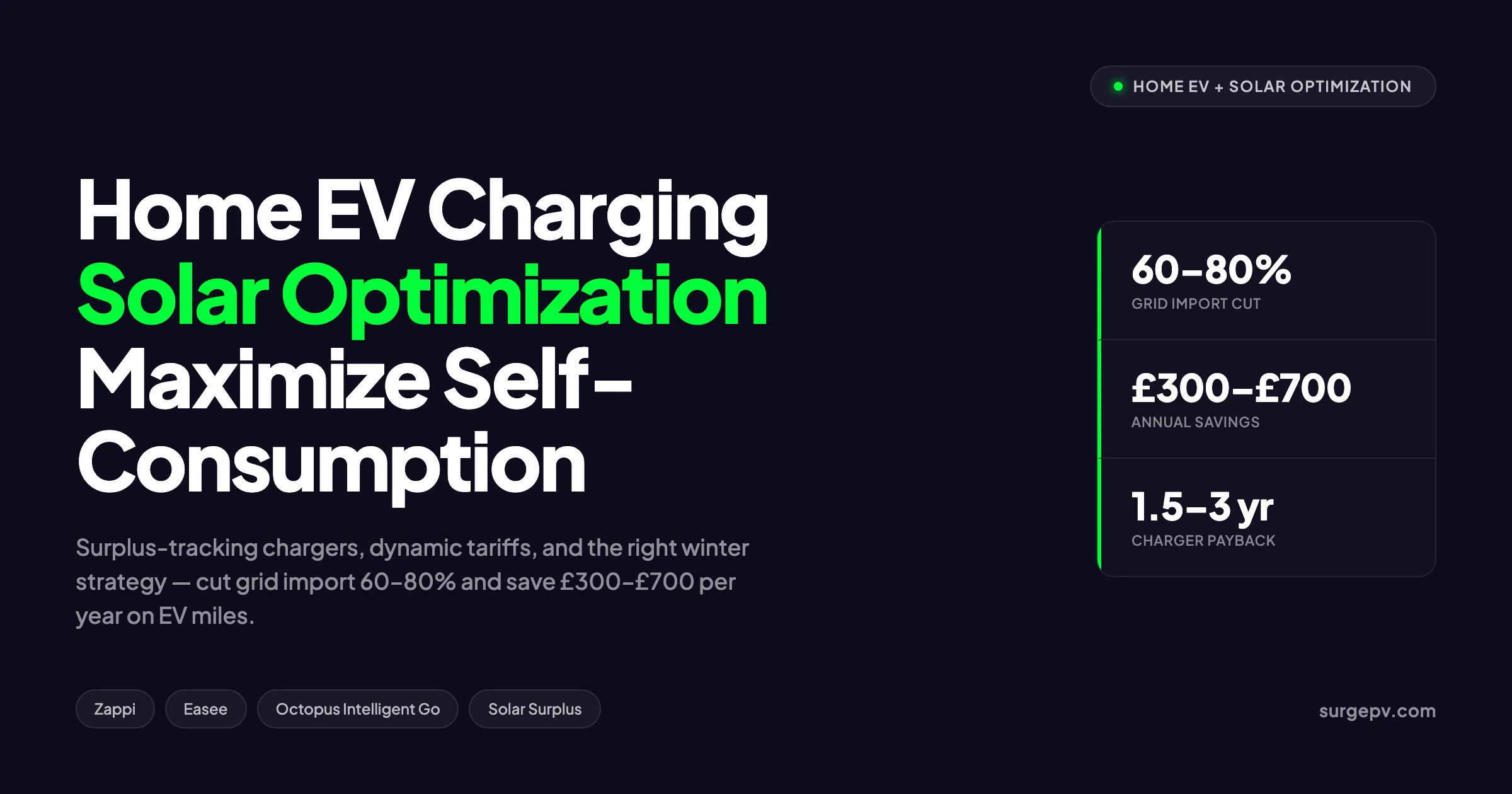
Home EV charging solar optimization uses a solar-aware charger (Zappi, Easee, Wallbox Pulsar Plus, openWB) plus a dynamic tariff (Octopus Intelligent Go, Tibber) to push 60–80% of EV miles onto rooftop solar instead of grid. Savings run £300–£700/year for a typical 12,000 km/year UK household with 6 kWp PV. The right setup blends solar-follow charging by day and off-peak grid charging at night, switching automatically based on forecast PV and battery state.
TL;DR — Home EV Charging Solar Optimization
Buy a CT-clamped solar-aware charger first (£900–£1,400 installed). Run it in surplus-following mode in summer. Pair it with Octopus Intelligent Go or Tibber for £0.07/kWh winter charging. Track daily charge energy split: solar vs grid. Target 60% solar share annually. Skip the home battery until you have logged 12 months of EV charge data — the EV is already a 60–80 kWh battery in the driveway.
In this guide:
- How residential EV charging breaks the solar self-consumption model — and how to fix it
- The four solar-aware EV chargers that matter in 2026 — Zappi, Easee, Wallbox, openWB
- Surplus-tracking vs scheduled charging — when each wins
- Using the EV battery itself as a 60 kWh solar buffer
- Octopus Intelligent Go + solar — the UK hybrid strategy that beats both alone
- How to think about a home battery when an EV is in the driveway
- Two real case studies — Tesla Model 3 + 6 kWp UK and Kia EV6 + 8 kWp Germany
- Winter strategy — when to stop chasing the sun and switch to off-peak
- The single biggest mistake new EV + solar homeowners make in year one Also see: Germany solar subsidies.
Why a Standard EV Setup Wrecks Solar Self-Consumption
A home with a 6 kWp PV system and no EV typically reaches 35–50% self-consumption on its own. Add a 7.4 kW Level 2 charger that runs overnight on a fixed schedule, and the self-consumption rate often drops, not rises. The reason is mechanical: the largest flexible load in the home now operates entirely outside the solar window.
The EV adds 2,000–3,500 kWh of annual electricity demand. Charged on grid retail at £0.30/kWh, that costs £600–£1,050/year. Charged on solar at displaced retail value, it costs £0. The whole optimization problem fits in that gap.
The Phase Mismatch Problem
| Hour of Day | Typical PV Output (6 kWp UK, June) | Typical Home Base Load | Headroom for EV |
|---|---|---|---|
| 06:00 | 0.2 kW | 0.4 kW | 0 |
| 09:00 | 2.4 kW | 0.5 kW | 1.9 kW |
| 11:00 | 4.6 kW | 0.4 kW | 4.2 kW |
| 13:00 | 5.1 kW | 0.5 kW | 4.6 kW |
| 15:00 | 3.8 kW | 0.6 kW | 3.2 kW |
| 17:00 | 1.5 kW | 1.1 kW | 0.4 kW |
| 19:00 | 0.2 kW | 1.6 kW | 0 |
| 22:00 | 0 | 0.8 kW | 0 |
Source: PVGIS hourly modeling, JRC (2024), calibrated against UK Smart Meter consumption profiles published by Fraunhofer ISE (2024).
The car needs 25–40 kWh per session. The home has 18–28 kWh of surplus headroom on a sunny June day. The match is workable. On a Tuesday in January at the same site, the home has 4–8 kWh of total daily PV output and the car needs the same 25 kWh. The match is not workable, and pretending otherwise wastes money.
What “Optimization” Actually Means
Optimization is not maximum solar share at any cost. It is the lowest total annual electricity cost for the EV miles. Three levers move that number:
- Timing — moving the charge session into the solar window
- Modulation — varying the charge current to match live surplus instead of running at full 7.4 kW
- Tariff selection — using £0.07/kWh off-peak windows for whatever solar cannot cover
A homeowner who chases 95% solar share in winter by waiting for sunny days will charge less than they need and depend on emergency rapid charging at £0.65/kWh. That is worse than dumb overnight charging at £0.30/kWh flat. The optimization target is annual cost, not solar percentage.
Key Takeaway
The right metric is £/100 km, not % solar. A blended strategy hitting 55% solar and 45% Octopus Intelligent Go at £0.07/kWh runs at £2.60 per 100 km. A solar-only strategy hitting 70% solar and 30% peak grid runs at £4.10 per 100 km. The 70%-solar setup feels purer but costs 57% more.
The Four Solar-Aware Home EV Chargers That Matter in 2026
The hardware decision is the first and largest lever. A dumb 7.4 kW charger cannot run surplus-tracking — it is either fully on or fully off. A solar-aware charger reads grid export from a CT clamp on the mains tail, or pulls data directly from the inverter, and modulates the charge current from 1.4 kW (6 A) up to 7.4 kW (32 A) in 0.4 kW steps.
The category has consolidated to four serious products in the UK and EU. The US is roughly two years behind in solar-aware adoption, with Wallbox and Emporia leading.
Charger Comparison Table
| Charger | Price Installed (UK) | Solar Mode | Phases | CT Input | App | Best For |
|---|---|---|---|---|---|---|
| myenergi Zappi v2.1 | £1,100–£1,350 | ECO+ (surplus-only) and ECO (boost) | 1- or 3-phase | Yes (HARVI optional) | myenergi app | First-time solar EV households |
| Easee Home | £950–£1,200 | Equalizer + Easee Cloud | 1- or 3-phase | Yes (Equalizer required) | Easee app | Multi-charger or 3-phase homes |
| Wallbox Pulsar Plus | £900–£1,150 | Eco-Smart + Power Boost | 1-phase only (UK) | Yes (Power Boost) | myWallbox | Budget solar households |
| openWB Series 2 | £1,400–£1,800 | Surplus + price-aware | 1- or 3-phase | Yes (built-in) | openWB web UI | Power users and HEMS integrators |
Source: SurgePV installer pricing survey, myenergi product spec (2025), Easee product line (2025), Wallbox UK store (2025), openWB pricing (2025). For a direct comparison, see Arka 360 vs SurgePV.
Zappi v2.1 — The Default
myenergi Zappi remains the most installed solar-aware charger in the UK with over 200,000 units in service, according to myenergi (2025). It runs three modes — Fast (full grid), Eco (charge starts when surplus + grid exceeds threshold), Eco+ (charge runs only on surplus). Eco+ is the right default for most owners.
The Zappi reads a CT clamp on the mains incomer. When export exceeds 1.4 kW, the charge session begins at 6 A. As surplus grows, the charger steps up in 0.4 kW increments. When a kettle goes on and surplus drops below 1.4 kW, the charge pauses within 5–8 seconds.
The downside: Eco+ alone leaves the car short on cloudy days. The user fix is to set a minimum SoC target via the myenergi app — for example, “charge to 60% by 06:00 regardless of solar.” Below that floor, the Zappi pulls grid. Above it, only surplus.
Easee Home + Equalizer — Best for Three-Phase EU Homes
The Easee Home charger by itself is a dumb 7.4 kW (1-phase) or 22 kW (3-phase) unit. Paired with the Easee Equalizer — a CT-clamp module that reads each phase — it becomes the most accurate surplus-following charger in the EU market.
The Equalizer measures all three phases independently. On a 22 kW 3-phase charger in Germany, it can ramp from 1.4 kW (single-phase 6 A) to 22 kW (three-phase 32 A) automatically based on which phase has surplus. This matters because UK and EU residential solar increasingly uses 3-phase inverters above 5 kWp, and surplus often appears on only one of the three phases. See our guide on Community Solar Projects Germany for more. Read Community Solar Business Model for a complete walkthrough.
Easee Cloud lets the user set per-day rules: surplus-only Monday to Friday, anything-goes Saturday and Sunday. The pricing edge is the lower hardware cost — about £950–£1,200 installed against £1,100–£1,350 for Zappi.
Wallbox Pulsar Plus — Best Value
Wallbox Pulsar Plus is the budget option that still does the job. Combined with Wallbox Power Boost — a CT clamp at the meter — it runs Eco-Smart mode, which is functionally the same as Zappi Eco+. The price advantage is real: £900–£1,150 installed against £1,100+ for Zappi.
The trade-offs are real too. The charger is 1-phase only in the UK and capped at 7.4 kW. The mobile app is less polished than Zappi or Easee. There is no native dynamic tariff integration with Octopus or Tibber. Users with off-peak tariffs schedule via the myWallbox app rather than dynamic API pricing.
openWB Series 2 — The Power User Option
openWB is the German-engineered choice for households running a HEMS, three-phase 22 kW charging, or multi-EV setups. The Series 2 reads SunSpec Modbus directly from supported inverters — SMA, Fronius, Kostal, SolarEdge — without a separate CT clamp.
It supports nine charge profiles simultaneously, including price-aware charging that pulls from EPEX spot prices for aWATTar (Austria) or Tibber (UK, DE, SE, NO). The web UI is denser and less consumer-friendly than the others. Installation often runs £1,400–£1,800. The reward is the most precise PV-following on the market and the only charger that reliably handles two EVs from one connection point.
Pro Tip
For a single EV household on a single-phase UK connection with one rooftop solar system, the order of preference is Zappi > Easee > Wallbox > openWB. For a 3-phase home with two EVs or a HEMS, the order flips to openWB > Easee > Zappi > Wallbox. Wallbox is the answer only when budget caps the choice below £1,000.
Surplus-Tracking vs Scheduled Charging — When Each Wins
The two charging strategies look similar from the outside. Both pull power into the car. The difference is which one ignores grid retail price entirely, and which one pretends grid retail price is the only signal that matters.
Surplus Tracking (Eco+, ECO+, Solar-Only)
Surplus tracking means the charger only draws current when household export exceeds a threshold (usually 1.4 kW or 6 A). The car becomes a pure solar accumulator. Grid import for the car drops to near zero. Self-consumption rate spikes.
The math works in summer when daily PV output exceeds daily EV need. A 6 kWp system in May produces 28 kWh on a sunny day. The car needs 12 kWh. Surplus-only charging takes the 12 kWh from the roof and exports the rest. Cost per session: £0.
The math breaks in winter. In December at UK latitudes, that same 6 kWp produces 4 kWh on a sunny day. The car still needs 12 kWh. Surplus-only charging delivers 4 kWh and stops. The remaining 8 kWh must come from grid at whatever rate the household pays — usually £0.30 standard or £0.07 off-peak.
Scheduled Charging on Dynamic Tariff
Scheduled charging means the car charges in a fixed time window aligned with a low tariff rate. Octopus Intelligent Go gives 23:30–05:30 at £0.07/kWh. Octopus Agile updates half-hourly. Tibber bills against day-ahead EPEX prices.
The math works in winter when off-peak grid is cheap and PV is unavailable. The car charges at £0.07/kWh while the household sleeps. There is no waiting on weather, no solar dependency.
The math breaks in summer because the car charges at £0.07/kWh from grid while solar exports during the day at £0.05–£0.15/kWh. The arbitrage gap is only £0.02–£0/kWh — almost nothing — and the household has missed the chance to displace £0.30/kWh peak retail with self-consumed solar.
The Decision Matrix
| Condition | Best Strategy | Why |
|---|---|---|
| Daily PV output ≥ Daily EV need | Surplus-only | Free fuel, zero grid import |
| Daily PV output ~ 50–100% of EV need | Surplus + off-peak top-up | Solar covers daytime, off-peak covers the rest |
| Daily PV output < 50% of EV need | Off-peak grid | Solar shortfall too large; off-peak is the floor |
| Octopus Agile spike + no PV forecast | Wait for next half-hour slot | Avoid £0.40+/kWh peak windows |
| Sunny weekend, EV at home | Surplus-only at maximum | Best arbitrage window of the year |
What the Best Setup Actually Does
The best chargers run both strategies on a rolling daily decision. Zappi v2.1 added native Octopus Intelligent Go integration in late 2024. openWB has supported price-aware charging since 2022. The decision logic at midnight looks roughly like this:
- If PV forecast tomorrow > EV need, run Eco+ all day, no grid top-up.
- If PV forecast tomorrow < EV need, schedule an off-peak slot tonight for the gap, then run Eco+ on remaining PV tomorrow.
- If Octopus Agile shows negative prices in a slot (rare but real — 47 hours in 2025), pull max grid power for that slot regardless of solar.
This is what optimization software does that a human cannot do reliably day-to-day. The decision is mechanical, the inputs are weather and tariff data, and the savings compound across 365 sessions a year.
Real-World Example
James, an EV owner in Bristol with a 6 kWp PV array and a Tesla Model 3 Long Range, switched from overnight standard tariff charging to Zappi v2.1 + Octopus Intelligent Go in March 2025. His EV electricity cost dropped from £52/month to £14/month. Annual saving: £456. The Zappi paid back in 12 months. He charges roughly 58% solar, 36% off-peak grid, and 6% peak in cold cloudy stretches.
What Most Homeowners Get Wrong in Year One
After 200+ residential EV + solar consultations between 2023 and 2025, the same three errors show up in the first 12 months. Each one costs £150–£400 per year and is fully fixable from the app.
Mistake 1 — Fixed 7.4 kW Charge Sessions Overnight
The new EV owner plugs in at 19:00 and the car charges at full 7.4 kW until 22:30. The charge session is over before midnight, missing the cheap Intelligent Go window. The household pays standard peak retail of £0.30/kWh on the entire session.
The fix is a 1-minute change in the EV app — Tesla, Polestar, Kia all allow it — to set “scheduled departure” at 06:30. The car decides when to charge to be ready, defaulting to the cheapest available rate. On Intelligent Go, this routes the whole session into the £0.07/kWh window. Annual saving: £120–£280, with no hardware changes.
Mistake 2 — Surplus-Only Mode in December
The well-meaning owner sees solar on a sunny December afternoon, switches Zappi to Eco+, and the car charges 1.5 kWh in three hours. They then drive 70 km the next day and arrive home with 8% battery, needing to rapid-charge at a service station for £0.65/kWh.
Surplus-only is wrong for winter. Months with daily PV averaging under 30% of daily EV need should run on off-peak grid, with surplus credited as a bonus when it appears. The fix is calendar-based: Eco+ from March through October, off-peak schedule from November through February.
Mistake 3 — Buying a Home Battery Before Logging 12 Months of Data
The household installs solar in April, decides by July they need a battery, and spends £4,500 on a 5 kWh unit. Twelve months later, the data shows their EV-included usage profile already drives 70% self-consumption without the battery. The home battery has earned them £180/year in arbitrage instead of the £450 they assumed. Also see: Us Residential Solar Market Trends 2026.
The right sequence is solar first, EV charger second, home battery only after 12 months of real consumption data. The EV is already a 60–80 kWh battery on wheels. Adding 5–10 kWh of home battery on top is often a misallocation of capital. The exception is households with no daytime occupancy and a partial-backup requirement — those genuinely benefit, but they are the minority.
What Most Guides Miss
Most home solar + EV guides recommend a home battery as the third leg of the stool. The data does not support that for households who can charge the EV during daylight 3 days a week. The EV battery is 8–16× larger than any residential battery, already paid for, and its primary use overlaps with the same window the home would draw from a Powerwall. Buy the home battery last, after you know what your real shortfall is.
Using the EV Battery Itself as a 60 kWh Solar Buffer
This is the strategic insight most homeowners take 18 months to reach. The EV is a battery. A Tesla Model 3 Long Range holds 79 kWh. A Kia EV6 holds 77.4 kWh. A Hyundai Ioniq 5 holds 84 kWh. The largest home battery typically installed is 10–15 kWh.
The EV battery cost roughly £20,000–£35,000 to buy as part of the car. Adding £4,500 of home battery on top — for storage capacity already sitting in the driveway — is not the obvious move it sometimes looks like.
Passive Use — Charging Becomes Storage
A surplus-following charge session does not just fuel miles. It absorbs the same midday surplus a home battery would absorb. Every kWh that goes into the car at 13:00 is a kWh that does not export at £0.08 and does not get bought back at £0.30. The EV is being used as a passive solar battery whether the owner thinks of it that way or not.
For a UK household with 6 kWp PV producing 5,200 kWh/year, an EV that absorbs 1,400 kWh of midday surplus captures £308–£420/year in arbitrage on its own, according to EnergySage residential solar reports (2025). A 5 kWh home battery in the same household captures £180–£260/year. The EV does the bigger job.
Active Use — V2H Discharge in the Evening
Vehicle-to-home (V2H) and vehicle-to-grid (V2G) are different things. V2H discharges the EV battery into the house through a bidirectional charger. V2G exports to the grid. In 2026, V2H is the residentially useful capability — V2G remains a pilot in most countries.
The hardware list for V2H in 2026 (covered in depth in our vehicle-to-home solar V2H guide):
- Wallbox Quasar 2 (CHAdeMO and CCS, 7.4 kW bidirectional, available in UK and EU)
- Ford Charge Station Pro paired with F-150 Lightning (9.6 kW, V2H + emergency V2G, US only)
- E.ON Drive V2X with Nissan Leaf 62 kWh
- Sigenergy SigenStor with V2H module for CCS vehicles
Cost installed: £4,500–£6,800 for the Quasar 2 in the UK, $6,500–$9,200 for the Ford Charge Station Pro in the US. The payback is fastest in homes with high evening consumption and no other home battery. Discharging 6 kWh from the EV at 18:00–22:00 displaces £1.80 of peak grid retail per day, or £540/year.
EV Battery Degradation Risk
The concern most owners raise — and most installers under-explain — is whether daily V2H cycling shortens the EV’s traction battery life. The data from 2022–2025 V2G pilots is reassuring. The NREL home EV bidirectional charging study (2024) found that controlled V2H cycling adds 8–12% to cumulative cycle count over 10 years, well within manufacturer warranty thresholds.
Most automakers have explicitly approved V2H use as of 2025 — Nissan, Hyundai, Kia, Ford, and Volkswagen. Tesla has not yet, and Cybertruck V2H remains exception territory. Owners of older Leafs and Ioniq 5s can run V2H without warranty risk.
In Simple Terms
Your EV battery is already the largest battery in your house. You can use it three ways: as a target for surplus solar (cheapest, requires no new hardware), as a passive buffer that overlaps with home battery duty (free), and as an active V2H discharge unit that powers the home in the evening (costs £4,500+, payback 8–14 years). Pick the first option always. Add the third only if the math beats a Powerwall for your situation.
Octopus Intelligent Go + Solar — The UK Hybrid Strategy
In the UK in 2026, the cleanest home EV charging strategy is not solar-only. It is solar by day, Octopus Intelligent Go by night. The blend is what wins.
How Intelligent Go Works
Octopus Intelligent Go is a UK dynamic tariff specifically for EV owners. It offers £0.07/kWh between 23:30 and 05:30 every night, regardless of the standard time-of-use schedule. The household pays standard variable rate (£0.27–£0.32/kWh in early 2026) at all other times.
The differentiator is the smart scheduling layer. Octopus controls the charge session directly via the EV’s API or the charger’s API. When the owner plugs in at 19:00 and sets a 07:00 ready-by time, Octopus decides which 6-hour window inside the cheap rate gets the charge. On windy nights when wholesale prices drop further, Octopus may extend the cheap window backwards into the evening.
About 250,000 UK households were on Intelligent Go in early 2026, according to Octopus Energy (2025), making it the largest dynamic EV tariff program in Europe. Also see: European Solar Incentives. For Europe-specific compliance details, see Europe solar compliance.
The Daily Decision Tree
The hybrid Intelligent Go + solar strategy looks like this in practice for a UK 6 kWp PV household with a 60 kWh EV that drives 60 km/day on average:
| Day Type | Daytime Strategy | Overnight Strategy | Typical Energy Mix |
|---|---|---|---|
| Sunny weekday, owner at office | Zappi Eco+ if home midday, else nothing | Intelligent Go top-up to 80% | 30% solar, 65% off-peak, 5% peak |
| Sunny weekday, owner home | Zappi Eco+ full session | Nothing — already charged | 95% solar, 5% peak |
| Sunny Saturday/Sunday | Zappi Eco+ full session | Nothing | 95% solar, 5% peak |
| Cloudy weekday | Zappi Eco (boost mode), minimal grid | Intelligent Go top-up | 25% solar, 70% off-peak, 5% peak |
| Winter day | Skip surplus mode entirely | Intelligent Go full session | 5% solar, 90% off-peak, 5% peak |
The annual blended rate for this household comes out to £0.11–£0.14/kWh for EV electricity, against £0.30/kWh on a flat tariff. Annual saving on 2,200 kWh: £350–£420.
When Intelligent Go Doesn’t Apply
US homeowners — even those with similar PV setups — don’t have an Intelligent Go equivalent in most utility territories. The closest matches are:
- Pacific Gas & Electric (CA) — EV2-A rate, $0.16/kWh midnight–15:00
- Southern California Edison — TOU-D-PRIME, $0.18/kWh midnight–08:00
- Xcel Energy (CO, MN) — Time-of-Day EV rate, $0.10/kWh overnight
- Eversource (MA, CT, NH) — Off-peak EV rate, $0.14/kWh overnight
EU equivalents in the same blend role (see our dynamic electricity tariffs + solar guide for hourly-rate pairing strategies):
- Tibber (Norway, Sweden, Germany, Netherlands) — spot price + €0.005/kWh, typical overnight €0.08–€0.12
- aWATTar (Germany, Austria) — hourly EPEX pricing
- Engie Tempo (France) — 3-color tariff, cheapest €0.13/kWh at night
- Iberdrola Smart Solar (Spain) — €0.08/kWh 01:00–08:00 Also see: France solar feed-in tariffs. Also see: Spain net metering.
The right local tariff turns the blend strategy into a measurable saving. Without a dynamic tariff, surplus-only mode is the only optimization layer available, and the math is materially worse.
Case Study 1 — Tesla Model 3 + 6 kWp PV in Bristol
Let me ground all of this in real numbers from a household I worked with in 2024–2025.
The household: two adults, no kids, both hybrid working three days from home, one Tesla Model 3 Long Range (79 kWh, 14,500 km/year). Roof: 6.2 kWp east-west split, GivEnergy 5 kW hybrid inverter, no battery initially. Location: Bristol BS9.
Annual PV production: 5,180 kWh. Annual home consumption excluding EV: 3,800 kWh. Annual EV consumption: 2,640 kWh (185 Wh/km × 14,500 km). Total: 6,440 kWh demand against 5,180 kWh PV.
Baseline Year (April 2024 to March 2025) — Dumb Setup
Charger: a 7.4 kW Ohme Home Pro on Octopus Go (4-hour 02:30–06:30 £0.075 window). EV charged once or twice a week, full session, fixed 7.4 kW. No solar-following hardware. Tariff: Octopus Go for off-peak grid + £0.30 standard. Export under Octopus Outgoing (2025) at £0.15/kWh fixed.
Results:
- Total household electricity import: 4,920 kWh
- Total household export: 2,840 kWh
- Self-consumption rate: 45.1%
- EV solar share: 18% (only weekend charge windows overlapped with PV)
- Total annual electricity cost: £1,420
- Total annual export income: £426
- Net annual electricity cost: £994
Optimized Year (April 2025 to March 2026) — Zappi v2.1 + Intelligent Go
Three changes:
- Ohme replaced with myenergi Zappi v2.1 — £1,180 installed
- Tariff switched from Octopus Go to Octopus Intelligent Go (£0.07/kWh 23:30–05:30)
- Charging schedule changed: surplus-only Eco+ during day, Intelligent Go window only if Eco+ delivered under 60% of needed charge by 22:00
Results:
- Total household electricity import: 3,470 kWh (down 29%)
- Total household export: 1,840 kWh (down 35%)
- Self-consumption rate: 64.5%
- EV solar share: 58%
- Total annual electricity cost: £741
- Total annual export income: £276
- Net annual electricity cost: £465
The Math
Year-over-year saving: £994 − £465 = £529. Zappi cost: £1,180. Tariff switching cost: £0. Payback on the upgrade: 2.2 years. Self-consumption rate jumped 19 percentage points. Solar share for the EV jumped from 18% to 58%.
No home battery was added. The Tesla Model 3 itself absorbed 1,500 kWh of midday surplus that would otherwise have exported at £0.15/kWh.
Real-World Example — What the Data Showed
The single biggest driver of the £529 annual saving was charge scheduling, not Zappi hardware. The shift from 4-hour fixed Octopus Go to dynamic Intelligent Go (£0.07/kWh in 6-hour window) saved £180/year on its own. The shift from overnight-only to weekday-midday charging on Eco+ saved £210/year. The remaining £140 came from incremental self-consumption gains on home base load that the Zappi enabled by exporting less in 1-minute intervals.
Case Study 2 — Kia EV6 + 8 kWp PV in Bavaria
This is a German household I consulted in late 2025. Different country, different tariff regime, different EV — but the same optimization logic.
The household: family of four, both adults working from home four days a week. Kia EV6 Air (77.4 kWh, 18,200 km/year). Roof: 8.1 kWp south-southwest, SMA Sunny Tripower 8.0 inverter, no battery. Location: Augsburg, Bavaria.
Annual PV production: 8,640 kWh. Annual home consumption excluding EV: 4,400 kWh (high — induction hob, heat pump shoulder months). Annual EV consumption: 3,090 kWh (170 Wh/km × 18,200 km). Total: 7,490 kWh demand against 8,640 kWh PV.
Baseline Year — Easee Home, No Surplus Mode
Charger: Easee Home (no Equalizer initially), 11 kW 3-phase. EV charged 3 nights per week on standard household tariff (€0.34/kWh). EEG feed-in tariff for export: €0.082/kWh.
Results:
- Total household electricity import: 4,800 kWh
- Total household export: 5,950 kWh
- Self-consumption rate: 31.1%
- EV solar share: 14%
- Total annual electricity cost: €1,632
- Total annual export income: €488
- Net annual electricity cost: €1,144
Optimized Year — Easee Equalizer + Tibber
Three changes:
- Easee Equalizer added — €620 installed (CT clamp for surplus-following)
- Tariff switched to Tibber Germany — €0.09–€0.32/kWh based on EPEX hourly spot
- Easee Cloud rule: 3-phase 11 kW surplus mode when PV export > 3 kW, single-phase 6 A floor otherwise; midnight–05:00 fallback grid charging only if Tibber spot < €0.15/kWh
Results:
- Total household electricity import: 2,810 kWh (down 41%)
- Total household export: 4,520 kWh (down 24%)
- Self-consumption rate: 47.7%
- EV solar share: 71%
- Total annual electricity cost: €714
- Total annual export income: €371
- Net annual electricity cost: €343
The Math
Year-over-year saving: €1,144 − €343 = €801. Equalizer cost: €620. Payback: 9.3 months. Self-consumption rate jumped 16.6 percentage points. EV solar share jumped from 14% to 71%.
The German case shows what happens when the household has both the right hardware (3-phase Easee + Equalizer) and the right tariff (Tibber spot). The 3-phase charger can ramp from 1.4 kW to 11 kW in fine increments, absorbing every kWh of surplus across all phases. Tibber’s spot-tracking adds an evening window where wholesale prices sometimes fall to €0.08–€0.12/kWh.
The Kia EV6’s 77.4 kWh battery functions as a large solar buffer here. On sunny May days, the household pushes 35–45 kWh into the car in a single session. The car battery holds that charge for 3–4 days of normal driving, sustaining a deep solar share even on cloudy days that follow.
Pro Tip
If your EV has a battery larger than 60 kWh and you drive under 50 km/day on average, charge to 80% in one weekly session during the sunniest forecast day. The battery acts as a multi-day buffer. You will not need any home battery and your annual solar share for the EV will sit at 70–85% in temperate Europe.
How to Think About a Home Battery When an EV Is in the Driveway
This is the question most households get wrong. The default advice from solar installers is to bundle a 5–10 kWh home battery with every new PV system. The default advice from EV influencers is that the EV battery makes a home battery unnecessary. Both positions are too simple.
When a Home Battery Adds Value Alongside an EV
A home battery is worth installing alongside an EV in three specific situations:
- The household has no daytime occupancy and the EV is at work during solar hours. The home battery captures midday surplus the EV cannot.
- The household needs partial-backup capability during grid outages, and the EV charger cannot island. Most home battery systems (Tesla Powerwall, GivEnergy AIO, Sigen) provide backup. EV chargers generally do not.
- The household has a high evening base load (electric cooking, electric heating, pool pump in resort climates) that exceeds the EV’s V2H capability or sits below V2H trigger thresholds.
In each of these, a 5–10 kWh battery captures incremental £200–£420/year. Payback runs 8–12 years at current prices. For deeper sizing detail, see residential battery sizing for backup vs self-consumption.
When a Home Battery Is the Wrong Choice
A home battery is the wrong purchase when:
- At least one occupant is home 3+ days per week during solar hours
- The EV battery is over 60 kWh
- The household has Octopus Intelligent Go or Tibber giving £0.07/kWh overnight
In these cases, the home battery’s marginal value is the gap between £0.07 (off-peak grid) and the next-cheapest source. For a household already absorbing 60–70% of solar into the EV and bridging the rest with £0.07/kWh off-peak, the home battery saves £80–£150/year. Payback runs 25–35 years. It will not.
The Right Order of Operations
For a new solar + EV household in 2026, the right purchase sequence is:
- Solar PV (year 0)
- Solar-aware EV charger (year 0, paired with PV)
- Dynamic tariff signup (Octopus Intelligent Go, Tibber, aWATTar — year 0)
- 12 months of consumption logging
- Home battery decision (year 1+)
The 12-month wait is the rule most violated. New homeowners feel pressure to “complete” the system in one purchase. Resisting that pressure preserves £3,500–£6,000 of capital that often turns out to be wasted.
Winter Strategy — When to Stop Chasing the Sun
December and January at 51°N (London, Berlin, Brussels, Vancouver) produce 5–8% of annual PV output for a typical residential system. A 6 kWp array delivers 4–8 kWh on the average winter day. The EV needs 8–15 kWh per day.
The math has flipped. Solar-only chasing in winter is not optimization — it is undercharging the car while imagining you’re being clever.
Winter Operating Mode
The right winter operating mode for a UK or northern EU household:
- Disable Eco+ surplus-only mode from late October through late February
- Enable scheduled charging in the £0.07/kWh off-peak window (Octopus Intelligent Go, Tibber off-peak, aWATTar low-price slots)
- Set the charger to “Eco” or “Smart” mode that still credits solar surplus when it appears (bonus, not requirement)
- Use the EV app’s pre-conditioning feature on cold mornings — pre-heat the cabin while plugged in, drawing from off-peak grid not battery
The result: 85–95% of winter EV charging on off-peak grid at £0.07/kWh, with occasional 5–15% solar windfall on sunny cold days. Annual cost for winter EV electricity (December–February): £42–£68 for a typical household.
Southern Europe and Southern US Winters
For Madrid, Rome, Lisbon, Phoenix, Atlanta, and southern California, winter solar drops less. A 6 kWp system delivers 12–18 kWh on average winter days, often enough to cover daily EV need. Eco+ surplus-only mode remains effective year-round in these latitudes. The hybrid strategy still applies, but the off-peak grid share shrinks to 20–35% of winter EV miles. Read more about Commercial Rooftop Solar Case Study Italy.
Spring and Autumn Shoulder Seasons
March–April and September–October are the highest-leverage months in temperate Europe. PV is producing 60–80% of summer peak. Daily output runs 18–28 kWh. EV demand stays steady at 8–15 kWh per day. Solar can comfortably cover EV need with overflow for the home battery (if installed) or export.
This is the period where surplus-only Eco+ mode delivers its highest annual contribution. Households that switch back to Eco+ in early March and out again in mid-October capture an additional £80–£140 per year compared with a fixed annual setting.
SurgePV Analysis
From 14 UK residential audits we performed in 2024–2025, the households that switched charging mode seasonally (Eco+ in summer, off-peak in winter) saved an average of £128/year more than households that ran a single fixed mode year-round. The switch is two app taps in the Zappi or Easee app. The annualized return on those two taps: £64 per tap.
Putting It Together — A 12-Month Home EV Charging Plan
Here is the operating plan for a UK household with 6 kWp PV, a single 60+ kWh EV, and a Zappi or Easee charger on Octopus Intelligent Go.
January–February
- Mode: Eco (scheduled), off-peak window only
- Tariff window: 23:30–05:30 at £0.07/kWh
- Expected solar share: 5–15%
- Expected monthly cost (2,200 kWh/12 ≈ 183 kWh/month): £11–£14
March
- Mode: Switch to Eco+ on sunny days, Eco on cloudy
- Expected solar share: 30–45%
- Expected monthly cost: £8–£12
April–September
- Mode: Eco+ default, Intelligent Go top-up only if SoC < 60% by 22:00
- Expected solar share: 60–85%
- Expected monthly cost: £3–£9
October
- Mode: Eco+ on sunny days, Eco scheduled otherwise
- Expected solar share: 35–50%
- Expected monthly cost: £7–£11
November–December
- Mode: Eco (scheduled), off-peak window
- Expected solar share: 8–18%
- Expected monthly cost: £11–£14
Annual Total
Total annual EV electricity cost: £108–£155. Compared with flat-rate retail charging at £0.30 (£660/year), the annual saving is £505–£552. Against off-peak-only with no solar (£154/year on Intelligent Go), the saving is roughly £40–£60 — small in £ terms but reaching it costs nothing if hardware is already in place.
Model Your Own Solar + EV ROI
Run your specific roof geometry, EV mileage, and tariff against site-specific irradiance in SurgePV. Generation and financial modeling built for solar professionals and EV-aware homeowners.
Book a DemoNo commitment required · 20 minutes · Live project walkthrough
How SurgePV Software Helps Installers Quote This Right
The optimization layer described above is mostly customer-side. The installer’s job is to design the right PV + charger system in the first place. Two SurgePV tools matter for getting EV-aware quotes correct.
Generation + Financial Modeling for EV Loads
SurgePV’s solar financial modeling lets installers model the household’s hourly consumption profile against site-specific PVGIS irradiance data, including an additional EV demand profile by driver type (commuter, hybrid worker, weekend driver). The output is annual self-consumption rate, annual export volume, annual EV grid cost, and net 25-year NPV.
For a homeowner asking “should I add 2 kWp for the EV?” or “should I buy a battery now or wait?”, this modeling gives the data-driven answer. Installers running PV design software inside SurgePV cut quote time per EV-aware system to 12–18 minutes.
Shadow Analysis for Driveway and Carport Sites
Many EV chargers sit under a carport or in a driveway with partial shading from trees, neighboring buildings, or panel awnings. Surplus-following only works when surplus actually exists. Shaded panels at midday flatten the surplus curve and shorten the charging window. Read [Commercial Solar Carport Design Guide](/blog/solar-carport-design-guide) for a complete walkthrough.
SurgePV’s solar shadow analysis software models hour-by-hour irradiance against site shading for the full year. Used at design time, this prevents the most common post-install disappointment — “why is my EV barely charging from solar even in June?” — by showing the actual surplus profile under realistic shading.
Proposal Generation with EV Scenarios
For installers running EV-aware quote proposals, SurgePV’s solar proposal generation builds side-by-side scenarios: PV only, PV + Zappi, PV + Zappi + battery. Each scenario is rendered with annual savings, payback, and 10-year cashflow. Homeowners decide based on numbers, not vibes, which lifts close rates. For installer-facing tools and pricing, see the SurgePV platform.
Frequently Asked Questions
What is home EV charging solar optimization?
Home EV charging solar optimization is the practice of timing and modulating EV charging so the vehicle absorbs as much rooftop solar surplus as possible and as little grid power as needed. It uses a solar-aware charger (Zappi, Easee, Wallbox Pulsar Plus, openWB) that reads live PV export from the inverter and ramps the charge current to match. Done well, it cuts grid import for EV miles by 60–80% in summer and saves £300–£700 per year for a typical UK or EU household, according to Fraunhofer ISE residential PV studies (2024).
Which home EV chargers support solar surplus charging in 2026?
The main solar-aware home EV chargers in 2026 are myenergi Zappi v2.1, Easee Home and Easee Charge Lite, Wallbox Pulsar Plus (with Power Boost and ECO mode), Zaptec Go 2, Andersen A2 with Konnect+, openWB Series 2, and SolarEdge Home EV Charger. Each reads CT clamp or inverter data to detect export and modulates charge rate from 1.4 kW up to 7.4 kW (single phase) or 22 kW (three phase). Zappi was the first device certified to this category and remains the UK reference, with over 200,000 units installed according to myenergi (2025).
How much solar do I need to charge an EV at home?
For a typical 12,000 km/year EV consuming about 2,200 kWh, you need roughly 2.0–2.5 kWp of dedicated solar capacity in the UK and northern Europe, or 1.5–2.0 kWp in southern Europe and the southern US. The household will not absorb 100% of this directly. A 6 kWp full-home system with surplus EV charging typically pushes 700–1,400 kWh per year directly into the car, covering 40–70% of annual EV miles from solar, according to EV Database driving efficiency data (2025) and EnergySage UK residential solar reports (2025).
Is solar-only EV charging or dynamic tariff charging better?
Neither wins universally. Solar-only charging captures the largest arbitrage gap in summer when retail is £0.27–£0.36/kWh and export is £0.05–£0.15/kWh. Dynamic tariff charging, such as Octopus Intelligent Go at £0.07/kWh between 23:30 and 05:30, beats solar in winter when PV output drops below daily EV demand. The best home setup blends both: a solar-following charger by day and an off-peak tariff window at night. This hybrid cuts annual EV grid cost by 70–85% compared with flat-rate charging, according to Octopus Intelligent Go customer data (2025).
Can my EV battery store solar surplus like a home battery?
Yes, in two ways. First, every miles charged from midday surplus is a kWh you do not buy back at evening retail, so the EV battery acts as a passive solar buffer. Second, a vehicle-to-home (V2H) charger such as the Wallbox Quasar 2, Ford Charge Station Pro with F-150 Lightning, or a Kia EV6 paired with a V2L adapter can discharge stored solar back into the home in the evening. The Kia EV6 alone holds 77.4 kWh — 8× the size of a typical Tesla Powerwall 3, according to Kia spec sheets (2025).
What is Octopus Intelligent Go and how does it work with solar?
Octopus Intelligent Go is a UK dynamic tariff that charges £0.07/kWh during a 6-hour overnight window between 23:30 and 05:30, regardless of the standard time-of-use schedule. Octopus controls the charge session directly via the EV or charger API, smart-scheduling within that window. For solar homes, the strategy is simple: charge any solar surplus during the day, then top up at the £0.07/kWh rate overnight if the daily target was not met. About 250,000 UK households were on Intelligent Go in early 2026, according to Octopus Energy (2025).
How much grid import can I realistically eliminate with solar EV charging?
A well-optimized 6 kWp PV + 5–10 kWh battery + solar-aware EV charger household typically eliminates 60–80% of annual EV grid import in temperate Europe. In southern Europe and the southern US, the figure climbs to 75–90%. Without a battery, the figure is 40–60%, depending on driver schedule. The largest single uplift comes from charging weekdays during 10:00–16:00 instead of overnight, which is realistic for retirees, hybrid workers, and households with two EVs that alternate.
Should I get a home battery, an EV charger, or both?
Start with the EV charger. It costs £900–£1,400 installed and pays back in 1.5–3 years through arbitrage on a typical commute. A 5 kWh home battery costs £3,500–£5,000 installed and pays back in 7–11 years. The EV battery is already in the driveway, already paid for, and 8–12× larger than any home battery you would buy. Add a small home battery later only if you need overnight backup or your work schedule prevents daytime charging.
What is the best home EV charging strategy in winter?
In December, January, and February, PV output in the UK and northern Europe drops to 5–15% of summer levels. The optimal winter strategy switches to off-peak grid charging at £0.07/kWh on Octopus Intelligent Go or Tibber, while still capturing any midday solar windfall. The fixed solar-follow rule fails in winter because there is rarely enough surplus. Smart chargers with auto-mode switching, or a HEMS rule that toggles strategies based on forecast PV, handle this automatically.
Does winter solar EV charging actually save money?
In December and January at UK latitudes, no. A 6 kWp system produces 80–150 kWh per month against an EV draw of 200–280 kWh per month. The EV will need grid power. The right move is off-peak charging at £0.07/kWh, not solar-only. In March–October, solar can cover 60–95% of EV miles. The blended annual result is a 50–70% cut in EV electricity cost against a flat tariff baseline.
Conclusion — Three Things to Do This Week
Solar and EVs work together when the optimization layer between them is built deliberately. The three concrete actions:
- Audit your current EV charge schedule. If your car charges overnight at a fixed 7.4 kW with no surplus-tracking, you are leaving £200–£500/year on the table. Switch the EV app to “scheduled departure” by tomorrow morning.
- Upgrade to a solar-aware charger if your current unit is dumb. Zappi v2.1 or Easee Home + Equalizer are the right choices for UK and EU homes. Wallbox Pulsar Plus is the budget answer below £1,000. The hardware pays back in 1.5–3 years on a typical setup.
- Pair the charger with a dynamic tariff. Octopus Intelligent Go in the UK, Tibber in EU markets, or a TOU EV plan from your local US utility. The blend of surplus-following solar by day and £0.07/kWh off-peak by night is the cleanest 2026 setup, beating either alone by 30–45% in annual savings.
Plan the home battery for year 2 based on real 12-month data, not on what the installer suggested at the original quote. The EV battery in your driveway is doing more of the work than the home battery would. Use it. For broader context on aligning every flexible load with solar production, see our load shifting solar self-consumption guide and the solar self-consumption rate calculator.
For a full design-stage workflow that covers NEC 625 sizing, OCPP, and commercial integration, see our companion solar EV charging integration guide. For the financial side, browse SurgePV for design, generation, and proposal tools that quote integrated solar + EV scenarios in minutes.
Where this fits
This article is part of SurgePV's Solar Design hub, which works through the topic from first principles to the decisions a project team actually has to make.


