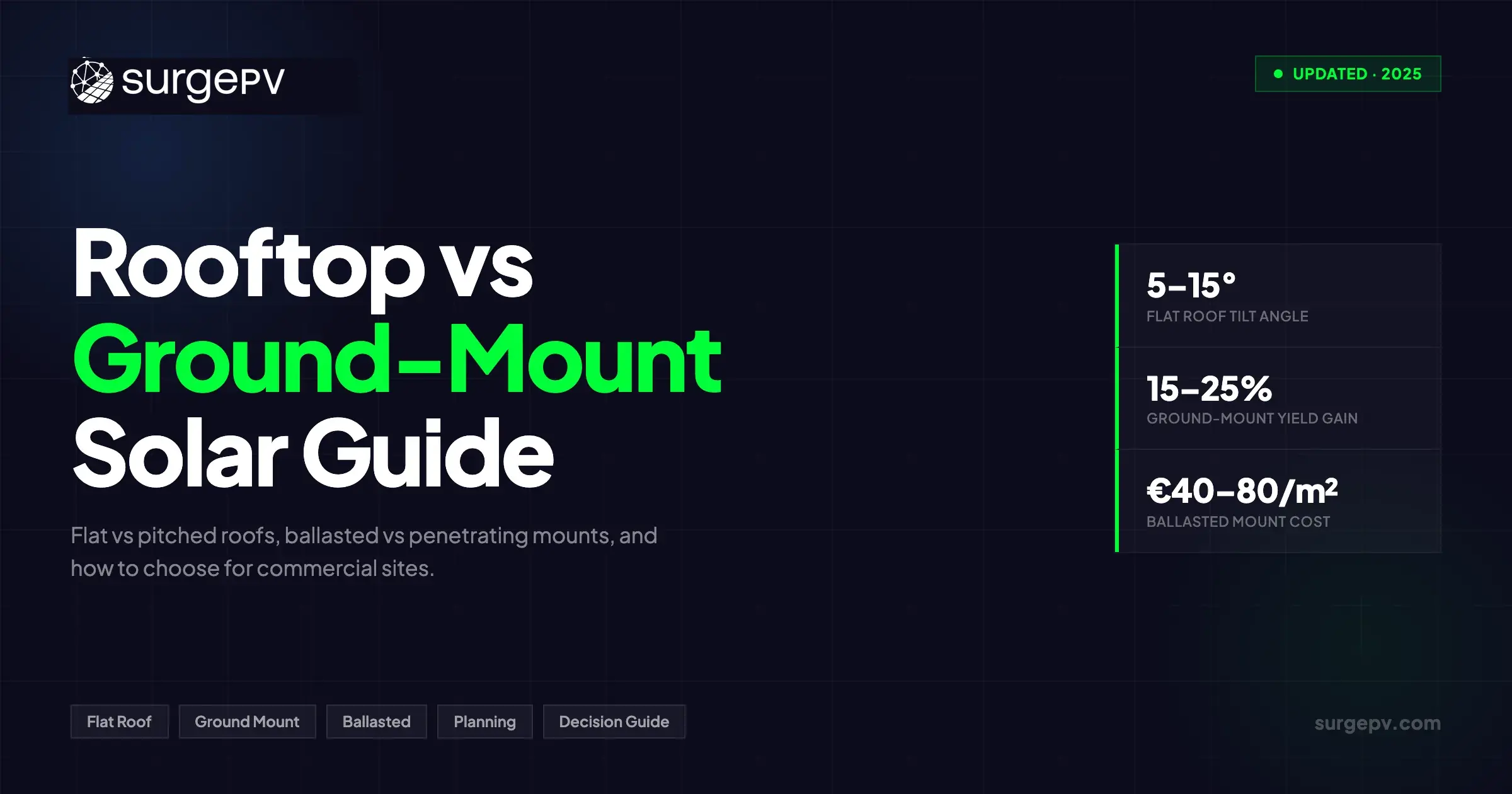
Commercial rooftop solar accounts for 58% of C&I installations for good reason: it uses existing structure, avoids land use change, and typically qualifies for simpler planning procedures. But rooftop isn't always the right answer. Industrial sites with large land plots, farms, and businesses with poor-quality or insufficient roofs often achieve better economics from ground-mount installations - despite the higher upfront cost. This chapter covers both system types in depth, with the cost data, yield differences, structural requirements, and planning implications you need to make the right call for your specific site.
What you'll learn in this chapter
- Why commercial rooftop is the dominant installation type and when it falls short
- Flat roof vs pitched roof commercial systems - mounting differences and constraints
- Ballasted vs penetrating mounting systems for flat roofs
- Ground-mount system types: fixed-tilt vs single-axis tracker
- Full head-to-head cost and yield comparison
- Planning and permitting differences by country
- When a hybrid approach makes sense
- A decision framework for any commercial site
Commercial Rooftop Solar: The Default Choice
Commercial rooftop solar is chosen for 58% of C&I projects - and the economics of that preference are clear. The building structure already exists, the land is already in commercial use, and the roof surface is otherwise generating no revenue. Solar turns a cost centre (roof maintenance, energy bills) into a partial asset.
Flat commercial roofs - the dominant type across warehouses, logistics centres, retail units, and industrial buildings - are highly suited to solar. Flat roofs allow full freedom of panel orientation via tilt-mount systems: panels can be angled south at the optimal tilt for the latitude, regardless of which direction the building faces. This flexibility often produces yields comparable to a pitched roof facing exactly south.
Pitched commercial roofs appear on older industrial buildings, agricultural structures, and some retail units. Roof-integrated solar on pitched roofs is installed using in-roof or on-roof rail systems attached to the roof structure. The orientation of the roof determines the system's orientation - a north-facing slope is unsuitable for solar, so pitched-roof systems typically use only the south-facing sections. East/west split installations are used when a pitched roof has no south-facing slope.
Ballasted vs penetrating mounting is a key decision for flat roof systems. Ballasted systems use concrete blocks to hold the panel array in place without roof penetrations - faster to install, no roof warranty issues, but adds significant additional roof load (35–50 kg/m² with ballast vs 12–18 kg/m² for penetrating systems). Penetrating systems attach directly to the roof structure using waterproofed fixings - lower dead load, but requires a roof warranty check and qualified waterproofer involvement.
| Mounting Type | Additional Roof Load | Roof Penetration | Installation Speed | Best For |
|---|---|---|---|---|
| Ballasted (flat roof) | 35–50 kg/m² | None | Fast | Flat roofs with sufficient structural capacity |
| Penetrating (flat roof) | 12–18 kg/m² | Yes (waterproofed) | Moderate | Roofs with limited load capacity |
| Rail on pitched roof | 15–22 kg/m² | Yes | Moderate | Pitched metal or tile commercial roofs |
Roof age and condition is the single most common reason a commercial rooftop project is delayed or aborted. A flat roof with 5 or fewer years of remaining life cannot support a 25-year solar investment - the roof will need replacing, potentially requiring the solar system to be dismantled and reinstalled. Any commercial rooftop project should include a roof condition survey as part of feasibility. If the roof needs replacing, factor the cost into the project budget and treat it as a dual investment.
Rooftop Installation Costs and Yield
Standard commercial rooftop costs are covered in Chapter 1 (€900–€1,350/kWp across EU markets). Within those figures, flat roof systems with tilt-mount frames carry an additional cost of approximately €0.05–0.10/Wp over flush-mounted pitched roof systems, reflecting the material cost of the tilt frame and the additional roof load management work.
Bifacial panels on flat roof tilt-mount systems deserve specific attention. The concrete or gravel surface of a flat commercial roof has an albedo (reflectance) of 0.10–0.25. A bifacial panel mounted at 15° tilt captures both direct irradiance on the front face and reflected irradiance on the rear face - typically adding 5–12% to annual yield compared to an equivalent monofacial panel in the same position. At a panel cost premium of €10–20/panel for bifacial vs monofacial, the additional energy yield often justifies the upgrade within 2–3 years.
| Panel Type | Front Face Yield | Bifacial Gain (flat roof) | Total Yield Advantage |
|---|---|---|---|
| Monofacial (standard) | 100% baseline | - | Baseline |
| Bifacial (glass-glass) | 100% baseline | +5–12% | 5–12% more energy |
| Bifacial (white reflective roof) | 100% baseline | +10–18% | 10–18% more energy |
Maintenance access is a cost factor that flat roof systems handle better than pitched roofs. Ground-level technicians can access flat roof arrays via roof hatches without specialist working-at-height equipment for routine cleaning and inspection. Pitched roof maintenance typically requires scaffolding or rope access - adding €1,000–3,000 per maintenance visit depending on roof height and pitch.
Ground-Mount Commercial Solar
Ground-mount commercial solar is the right choice when: the roof is insufficient in area or structural condition; a larger system than the roof can accommodate is financially optimal; the site has underutilised land; or the project combines solar with land use (agrivoltaics). Ground-mount costs 15–25% more per kWp than rooftop - but it compensates through higher yield potential and unrestricted system design.
Fixed-tilt ground-mount is the standard approach for systems below 500 kW in Europe. Panels are set at a fixed angle (typically 25–35° for most EU latitudes) facing due south. Foundation types include:
- Driven piles: Steel posts hammered directly into the ground - fastest and cheapest method for most soil types. Requires suitable ground conditions (not rocky or waterlogged).
- Ground screws: Helical screw anchors that minimise disturbance to soil and are reversible - increasingly preferred for agricultural land where land restoration is required.
- Concrete ballast: Precast concrete blocks or cast-in-place foundations - used for harder ground or when planning conditions require minimal soil disturbance.
Single-axis tracking (SAT) systems rotate the panel rows from east to west throughout the day, tracking the sun's position and maintaining optimal irradiance angle. The energy yield advantage over fixed tilt is 15–25% in high-irradiance locations (Spain, Italy, southern US). In lower-irradiance markets (UK, Germany), the yield gain is closer to 12–18% - still significant, but the capital cost premium (typically €0.10–0.20/Wp more) requires careful financial modelling to justify.
SAT is typically cost-effective for systems above 500 kW in Spain, Italy, and southern European markets. At this scale, the per-unit tracker cost falls and the yield advantage compounds over the system lifetime to produce a positive NPV uplift. Smaller systems and northern European locations generally do not justify the tracking premium.
Head-to-Head Comparison
Relative Installation Cost per kWp (Rooftop = 100%)
Approximate relative cost per kWp. Carports include structural canopy cost. SAT = single-axis tracker.
| Factor | Rooftop | Ground-Mount |
|---|---|---|
| Installation cost | Lower (no foundation cost) | Higher (+15–25%) |
| Available area | Limited by roof size and condition | Limited by available land |
| Planning requirements | Often permitted development (rooftop) | Usually full planning permission |
| Yield (same kWp) | Slightly lower (tilt constrained by roof) | Higher (optimal tilt/orientation) |
| Maintenance access | Roof access required; scaffolding for pitched | Ground-level - easier and cheaper |
| Structural requirement | Roof load assessment essential | Ground conditions survey required |
| Tracker option | Not applicable | Single-axis tracking available (+15–25% yield) |
| Dual use | Building already in use | Can combine with agrivoltaics or grazing |
| Best for | Warehouses, offices, retail, manufacturing | Large industrial sites with land, farms |
Pro Tip
When evaluating a site that could support either approach, run a full financial model for both - not just a cost comparison. A ground-mount system that costs 20% more but generates 15% more energy can have a shorter payback in high-irradiance markets. In lower-irradiance markets, the numbers often favour rooftop. The answer depends on your specific site location and electricity tariff.
Planning and Permitting Differences
Planning requirements are one of the most material differences between rooftop and ground-mount commercial solar. The permitting route affects project timeline, cost, and the risk of a project being refused entirely.
United Kingdom: Permitted development rights (PDR) cover commercial rooftop solar up to 1 MW for installations that don't protrude more than 1 metre above the roof plane. This means most commercial rooftop projects can proceed without a planning application - significantly faster than the full planning route. Ground-mount solar, however, almost always requires a full planning application, and systems above 50 kW also require a G99 grid connection application to the DNO. Large ground-mount systems (above 5 MW) are classified as Nationally Significant Infrastructure Projects (NSIPs) and require Development Consent Orders.
Germany: Commercial rooftop systems do not require formal building permission (Baugenehmigung) in most Länder, but all systems above 7 kW must be registered in the Marktstammdatenregister (MaStR) - Germany's grid and market register for energy installations. Ground-mount solar on agricultural land faces significant restrictions: the EEG 2023 restricts ground-mount installations on good agricultural land unless specific criteria are met (e.g., agrivoltaic design, use of marginal land). Industrial land ground-mount is treated more favourably.
Italy: Rooftop installations up to 200 kW on existing commercial buildings can proceed via the simplified Comunicazione di Inizio Lavori (CILA) procedure rather than full permitting. Systems above 200 kW require a Permesso di Costruire. Ground-mount solar above 1 MW is subject to Valutazione di Impatto Ambientale (VIA) - environmental impact assessment - which can add 12–24 months to project timelines.
Spain: Spain has streamlined commercial solar permitting significantly since 2022. Rooftop systems below 100 kW on existing buildings can be self-certified. Ground-mount above 100 kW requires a Declaración de Impacto Ambiental (DIA) environmental assessment. Projects above 50 MW fall under national government jurisdiction.
| Country | Rooftop (under 1 MW) | Ground-Mount | Grid Registration |
|---|---|---|---|
| UK | Permitted development (conditions apply) | Full planning required | G99 above 50 kW |
| Germany | No permit; MaStR registration | Baugenehmigung + land use restrictions | MaStR all systems above 7 kW |
| Italy | CILA below 200 kW; PC above | VIA above 1 MW | GSE registration |
| Spain | Self-cert below 100 kW | DIA above 100 kW | RETA registration |
Design Commercial Solar Projects in SurgePV
System sizing, shading analysis, financial modeling, and professional proposals - built for commercial EPCs.
Book a Free DemoNo commitment required · 20 minutes · Live commercial project walkthrough
Combining Rooftop and Ground-Mount
For large industrial sites - manufacturing facilities, logistics parks, food processing plants - the optimal solar strategy is frequently a hybrid: rooftop on all suitable buildings plus ground-mount on available land within the site boundary. This approach maximises total generation, serves self-consumption from the largest possible array, and uses the existing grid connection point for both systems.
A worked example: a manufacturing site in the East Midlands, UK, with a 3,000 m² warehouse roof and 1.5 hectares of unused hardstanding adjacent to the building.
- Rooftop system: 350 kWp on 2,400 m² of usable flat roof
- Ground-mount system: 500 kWp on 1.2 ha of hardstanding (at 4 m²/kWp for ground-level mounting)
- Total: 850 kWp from a single grid connection point (G99 application)
- Annual generation: approximately 820,000 kWh
- Annual consumption (24-hour manufacturing facility): 1,200,000 kWh
- Self-consumption ratio: approximately 68%
Managing two systems on the same connection point requires careful electrical design - the inverters for both arrays connect to a common AC distribution board before the grid connection meter. Export management controllers limit total site export to the DNO-permitted level, prioritising self-consumption and curtailing export from either array as needed. Solar design software handles the string configuration and export management design for multi-array commercial sites.
Key Takeaway
A hybrid rooftop + ground-mount design uses one grid connection application for both systems, avoiding the duplicated DNO application cost and timeline. If your site has both suitable roof area and available land, specify both in the initial feasibility study rather than treating them as separate projects.
Decision Framework: Which Is Right for You?
The decision tree below applies to most commercial solar site assessments. Work through it in order:
- Roof condition: Is the roof structurally sound with at least 15 years of remaining life? If yes, rooftop is the primary option. If the roof needs replacement within 10 years, factor in re-roofing cost or consider ground-mount.
- Roof area: Is there sufficient usable roof area for the optimal system size (from Chapter 2 sizing analysis)? If yes, proceed with rooftop design. If the roof can only accommodate 50–60% of the target system, consider whether adding ground-mount closes the gap.
- Available land: Does the site have unused land? If yes, ground-mount becomes a viable option - especially for systems above 500 kW where scale economies improve ground-mount economics.
- Planning context: Is there any planning sensitivity (conservation area, listed building setting, visual impact concern)? Rooftop systems are less visible and face lower planning risk in sensitive contexts.
- Budget and payback target: If capital is constrained, rooftop delivers the shorter payback at lower total cost. If maximising lifetime energy generation matters more than near-term payback, ground-mount with tracking (in high-irradiance locations) may be optimal.
Pro Tip
When in doubt, start with a rooftop feasibility study. It takes 1–2 days using solar design software, costs little, and gives you a clear financial baseline. If the rooftop numbers are strong, proceed. If the roof is constraining (area, condition, or orientation), you have the data to justify a ground-mount appraisal without having spent significant time on a site visit.
Frequently Asked Questions
Is ground-mount solar more expensive than rooftop?
Ground-mount commercial solar typically costs 15–25% more per kWp than a comparable rooftop installation, primarily due to foundation costs - driven piles, concrete ballast, or ground screws - and additional cabling. Ground-mount systems often achieve higher annual yields because tilt angle and orientation can be freely optimised, providing a 5–15% yield advantage that can partially offset the higher installation cost over the system's lifetime. In high-irradiance markets like Spain and Italy, the yield advantage makes ground-mount with single-axis tracking financially competitive despite the higher capital cost.
Do I need planning permission for commercial rooftop solar?
In the UK, commercial rooftop solar systems up to 1 MW are often covered by permitted development rights if the installation doesn't exceed 1 metre above the roof plane and other conditions are met. In Germany, most commercial rooftop systems don't require formal planning permission but must be registered in the Marktstammdatenregister. In Spain and Italy, systems below 100 kW on existing commercial buildings often benefit from simplified procedures. Always verify current local regulations with your planning consultant - permitted development limits change.
What structural load does commercial solar add to a roof?
Commercial solar panels with mounting systems add approximately 15–25 kg/m² of dead load to a commercial roof. Ballasted flat-roof systems can add up to 40–50 kg/m² if concrete ballast is used to anchor the array against wind uplift. A structural engineer must assess whether the existing roof structure can support this load before installation proceeds. Some older flat roofs - particularly those built before modern structural standards - require reinforcement. This cost must be factored into the project budget from the outset.
Can I put solar on a metal or corrugated roof?
Yes. Metal and corrugated commercial roofs - common on industrial and agricultural buildings - are well-suited to solar. Specialist clamps attach directly to the roof profile without penetrations, preserving the roof warranty. The primary consideration is confirming that roof purlins and the substructure can support the additional load. Metal roofs typically provide a secure and low-cost mounting solution, and standing-seam metal roofs in particular allow clamp-on installations that require no drilling or sealant.
What is the difference between fixed-tilt and single-axis tracking for ground-mount?
Fixed-tilt ground-mount systems set panels at a fixed optimal angle (typically 25–35° in Europe) with no moving parts - lower cost, zero maintenance of tracking mechanisms, and proven 25-year reliability. Single-axis trackers rotate panel rows from east to west throughout the day, generating 15–25% more annual energy than a comparable fixed-tilt system. The additional energy yield must justify the higher capital cost (typically €0.10–0.20/Wp more) and ongoing tracker maintenance. Single-axis tracking is most cost-effective for systems above 500 kW in high-irradiance markets (Spain, Italy, southern US).
About the Contributors

CEO & Co-Founder · SurgePV
Keyur Rakholiya is identified by SurgePV as its CEO and a company co-founder. His SurgePV author page lists only role information that can be tied to the public profile below; credentials, project totals, testing claims, media appearances, and speaking engagements are not asserted without retained evidence.
